US Officials Give Confusing Comparisons Of US And Russian Nuclear Forces
October 22, 2020 [updated]
In their effort to paint the New START treaty as insufficient and a bad deal for the United States and its allies, Trump administration official have recently made statements suggesting the treaty limits the US nuclear arsenal more than it limits the Russian arsenal.
New START imposes the same restrictions on US and Russian strategic nuclear forces.
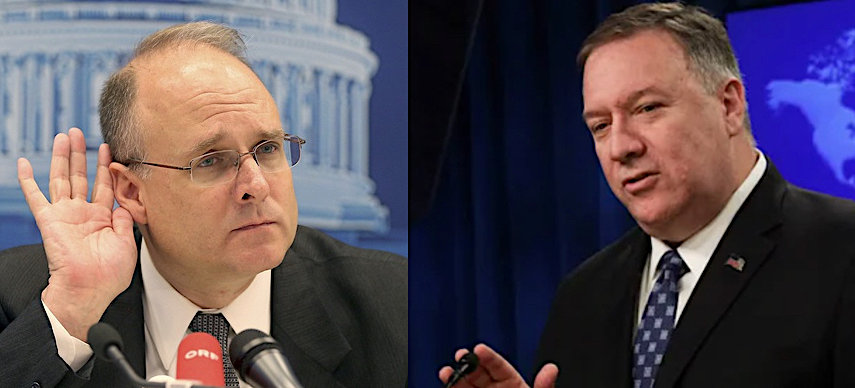
During a virtual conference organized by the Heritage Foundation on October 13, Marshall Billingslea, special presidential envoy for arms control, stated: “What we’ve indicated to the Russians is that we are in fact willing to extend the New START Treaty for some period of time provided that they agree to a limitation, a freeze, in their nuclear arsenal. We’re willing to do the same. I don’t see how it’s in anyone’s interests to allow Russia to build up its inventory of these tactical nuclear weapons systems with which they like to threaten NATO…We cannot agree to a construct that leaves unaddressed 55 percent or more of the Russian arsenal.”
One week later, in an interview on National Public Radio, Billingslea added: “The New START treaty constraints…92 percent of the entire U.S. arsenal, of our deterrent” but “only covers 45 percent or less of the Russian arsenal…”
Finally, on October 21, Secretary of State Michal Pompeo repeated this talking point: “President Trump has made clear that the New START Treaty by itself is not a good deal for the United States or our friends or allies. Only 45 percent of Russia’s nuclear arsenal is subject to numerical limits, posing a threat to the United States and our NATO allies. Meanwhile, that agreement restricts 92 percent of America’s arsenal that is subject to the limits contained in the New START agreement.”
Pompeo and Billingslea didn’t specify what they meant by “arsenal” and the reaction from nuclear weapons analysts – ourselves included – was bewilderment. Most assumed “arsenal” was referring warheads, but the numbers don’t seem to fit with the percentages and descriptions in the statements. Interestingly, the percentages and categories seem to work better for launchers, unless one does a back-of-the-envelope calculation.
Matching Comparison With Warheads
Our first step was to analyze the statements and see if we could make them fit with our understanding of the size and composition of the nuclear arsenals. If we assume the percentages and descriptions refer to warhead numbers, then we see the following potential options:
Option 1: The 45% refers to New START warhead limit for deployed strategic warheads (1,550). If this were the case, then Russia’s entire stockpile would only consist of 3,445 warheads, which we doubt. Our estimate is 4,310. For the United States, 1,550 would only constitute 41% of the US stockpile, not 92% as stated by Billingslea.
Option 2: The 45% refers to the number of strategic warheads that can be loaded onto ICBMs and SLBMs but not bomber weapons. New START counts actual numbers of warheads on deployed ICBMs and SLBMs, but not those on bomber bases. According to our estimate of Russian forces, their ICBMs can load 1,136 warheads and SLBMs can load 720 warheads, a total of 1,856 warheads. That would constitute 43% of the total stockpile of 4,310 warheads (our estimate). It would of course be embarrassing if the US officials have been using our numbers instead of those of the US Intelligence Community. Even so, that methodology does not fit with the 92% comparison used for the United States. US ICBMs and SLBMs can load a maximum of 2,720 warheads, by our estimate, or 72% of the stockpile. And Billingslea explicitly says the US comparison includes the “entire” arsenal.
Option 3: The 45% refers to the total number of strategic warheads in the Russian arsenal (deployed and non-deployed). If that were the case, then the remaining 55% of 3,025 warheads would be non-strategic warheads, far more than the “up to 2,000” stated in the Nuclear Posture Review. And it would imply a total stockpile of 5,500 warheads, far more than the number of warhead spaces on launchers.
Option 4: The percentage numbers come from a simplistic back-of-the-envelope calculation. The Russian 45% is 1,550 (New START limit) / 1,550 (reserve) + 2,000 (tactical). The US 92% is 1,550 (New START limit) / 1,550 (reserve) + 150 (tactical). Those numbers don’t fully match the stockpiles and statements but can explain the comparison. (We are indebted to Pavel Podvig for suggesting this option.)
Billingslea and Pompeo both compared the Russian restrictions to those affecting the US arsenal, but they described it differently.
Billingslea said New START “constraints…92 percent of the entire U.S. arsenal, of our deterrent…” (emphasis added). Since we know the approximate size of the total US stockpile (about 3,800 warheads), 92% would constitute 3,496 warheads, far more than the treaty’s limit of 1,550 deployed strategic warheads. But the count would be close to the number of strategic warheads that can be loaded onto strategic launchers (3,570 by our estimate), leaving about 300 non-strategic warheads.
Pompeo said that New START “restricts 92 percent of America’s arsenal that is subject to the limits” (emphasis added), which is different than what Billingslea said because it doesn’t appear to include non-deployed strategic warheads or tactical warheads, two categories that are not subject to the treaty limits.
Matching Comparison With Launchers
Our next step was to analyze the statements to see how they compare with the number of launchers that can deliver nuclear warheads. New START limits both sides to no more than 800 strategic launchers in total, of which no more than 700 can be deployed at any given time.
In the latest set of aggregate numbers released by the US State Department, the United States is listed with exactly 800 launchers in total, of which 675 are deployed. Russia is listed with a total of 764 launchers, of which 510 are deployed.
While complaining about limits on US and Russian weapons, neither Billingslea nor Pompeo mentions this US strategic advantage of 165 deployed launchers, a number that exceeds the number of Minuteman IIIs in one missile wing and corresponds to more than half of the entire Russian ICBM force.
For the United States, if the 800 total strategic launchers constitute 92% of all US nuclear launchers (“entire” arsenal), then that would imply the existence of another 70 launchers, which potentially could refer to non-strategic fighter-bombers assigned missions with gravity bombs.
For Russia, if the 764 total strategic launchers constitute 45% of all its nuclear launchers, that would potentially imply that Russia has 1,698 total nuclear launchers, of which 934 would be launchers of non-strategic nuclear weapons.
We don’t yet know if this is the case. But the percentages mentioned by Billingslea and Pompeo appear to fit better if they refer to launchers than warheads, unless one applies the Option 4 calculation described above. The Trump administration has been particularly critical about Russia’s development of new types of strategic-range weapons that are not covered by the New START treaty, just like it has criticized that Russia’s non-strategic nuclear weapons are not covered by any arms control agreement.
Context and Recommendations
The comparisons and descriptions of Russian and US nuclear forces presented by Billingslea and Pompeo are confusing. Some might suspect “fuzzy math” but until we see otherwise, we suspect the comparisons use real data. Option 4 above might represent the most likely explanation although it doesn’t fully match the stockpiles and descriptions provided by the officials.
When it comes to nuclear negotiations, it is incredibly important to be precise with official words and statements, in order to avoid misunderstandings or mischaracterizations. Unfortunately, the Trump administration has a habit of cherry-picking or spinning statistics in an apparent attempt to make existing and equitable arms control agreements seem like “bad deals” for the United States. Given this track record, we should view their statements here with skepticism and ask for clarification if they’re referring to warheads or launchers. We have done so but have not yet heard back from the State Department.
A one-year extension of New START is better than no extension, but it’s worse than a five-year extension because it creates uncertainty about the commitment to continue to limit force levels and unnecessarily shortens the time available to negotiate follow-on arrangements. There is no technical need to shorten the extension. If a new deal is made, the old one will fall away.
A freeze on warheads would be a welcoming new step and Russia’s acceptance of the idea is a breakthrough because it opens up possibilities for building on this idea in the future. But a freeze will not have much credibility or effect without verification and despite saying it would like “portal monitoring” the Trump administration has not presented a plan for how this would work or secured Moscow’s agreement. Verification of a total warhead freeze would be much more complex than verifying the New START treaty itself and one year may not be sufficient to do the work. Has the US military and intelligence community signed off on Russian inspectors monitoring every US warhead moving in and out of facilities? Have US allies in Europe agreed to allow Russian officials to monitor the bases where the US Air Force stores nuclear bombs?
Russia’s acceptance of a one-year New START extension and a declaration to freeze warhead levels is a significant compromise from its previous offer to unconditionally extend the treaty by five years with no warhead freeze.
The Trump administration’s “offer” of a one-year extension of New START and a one-year warhead freeze with no verification at the outset represents an astounding walk-back from its previous statements. Trump has repeatedly called New START a “bad deal” and the whole point of the talks was to “fix” what the administration claimed was inadequate verification, incorporate Russia’s new strategic weapons into the agreement, and get China onboard. And how many times have we heard that you can’t trust Russia because they violate every arms control agreement they have signed? Yet here we are. None of those “fixes” are attached to the one-year treaty extension and the administration now says it is willing to sign on to a warhead freeze without agreed verification measures with the Great Cheater.
There is nothing wrong with trying to broaden arms control to other weapons categories and countries. We strongly support that. But the last-minute flurry and attempts to shorten extension strongly suggest that the Trump administration has been more focused on creating chaos and to appear tough on Moscow and Beijing than to create nuclear arms control progress. The one-year timeline unnecessarily constrains both countries and could well mean that they would be in pretty much the same situation one year from now.
The inconvenient fact is that New START is working as designed and keeps the vast majority of Russian and US strategic arsenals in check, prevents either country from uploading thousands of extra warheads onto their deployed missiles, and offers a modicum of predictability in an otherwise unpredictable world.
Additional background information:
- Status of world nuclear forces, September 2020
- United States nuclear forces, 2020
- Russian nuclear forces, 2020
- At 11th Hour, New START Data Reaffirms Importance of Extending Treaty
This publication was made possible by generous contributions from the Carnegie Corporation of New York, the John D. and Catherine T. MacArthur Foundation, the New Land Foundation, the Ploughshares Fund, and the Prospect Hill Foundation. The statements made and views expressed are solely the responsibility of the authors.
FAS and FLI partnered to build a series of convenings and reports across the intersections of artificial intelligence (AI) with biosecurity, cybersecurity, nuclear command and control, military integration, and frontier AI governance. This project brought together leaders across these areas and created a space that was rigorous, transpartisan, and solutions-oriented to approach how we should think about how AI is rapidly changing global risks.
AI is already consequential, but its future trajectory remains contested. Policymakers should make their assumptions explicit, focus on what can be shaped rather than what can be perfectly predicted, and build institutions that can learn and respond as evidence changes.
From grassroots community impacts to global geopolitical dynamics, understanding developing data center capacities is emerging as a critical analytical challenge.
The last remaining agreement limiting U.S. and Russian nuclear weapons has now expired. For the first time since 1972, there is no treaty-bound cap on strategic nuclear weapons.