Pakistan’s “Shoot and Scoot” Nukes: FAS Nukes in Newsweek
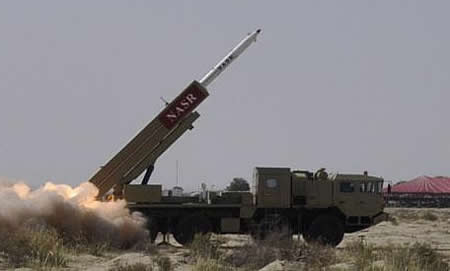 |
| Pakistan’s military describes its new short-range nuclear NASR missile as a “shoot and scoot…quick response system.” Image: ISPR |
.
By Hans M. Kristensen
Andrew Bast at Newsweek was kind enough to use our estimates for world nuclear forces in his latest article on Pakistan growing arsenal.
Of special interest is Pakistan’s production of the NASR (Hatf-9), a worrisome development for South Asia and the decade-long efforts to avoid nuclear weapons being used. With its range of only 60 kilometers, the multi-tube NASR system is not intended to retaliate against Indian cities but be used first against advancing Indian army forces in a battlefield scenario.
Pakistan’s military’s Inter Services Public Relations (ISPR) describes NASR as a system that “carries nuclear warheads of appropriate yield with high accuracy, shoot and scoot attributes” developed as a “quick response system” to “add deterrence value” to Pakistan’s strategic weapons development program “at shorter ranges” in order “to deter evolving threats.”
“Shoot and scoot…quick response system” ??
That sounds like an echo from nuclear battlefields in Europe at the height of the Cold War. It is time for Pakistan to explain how many nuclear weapons, of what kind, and for what purpose are needed for its minimum deterrent.
As bad as it is, though, talk about Pakistan’s nuclear arsenal passing the size of France at some point is, at the current rate, probably one or two decades ahead.
Don’t forget: Pakistan’s nuclear arsenal is not equal to the number of warheads that could potentially be produced by all the highly-enriched uranium and plutonium Pakistan might have produced. The size also depends on other factors such as the number of delivery vehicles and other limitations.
More information in the next Nuclear Notebook scheduled for publications in the Bulletin of the Atomic Scientists on July 1st.
This publication was made possible by a grant from Carnegie Corporation of New York and Ploughshares Fund. The statements made and views expressed are solely the responsibility of the author.
It is difficult to assess from photos whether the Sentinel missile is longer or wider overall than the Minuteman, but the Sentinel clearly has a thicker second stage, which could potentially contribute to the missile’s extended range.
This is not the first time Google has agreed to censor imagery at the behest of governments, but be warned: obfuscation at this broad level poses a direct threat to the public’s ability to monitor and scrutinize government operations.
As humans expand our geographic reach, encroach on untouched natural territories, and interact more with animal populations, we will encounter novel zoonotic diseases that threaten the human body. The sooner we act to address these risks, the better.
“One thing became increasingly clear: AI doesn’t simply introduce a new category of risk. It changes the speed, scale, complexity, and interaction of risks that already exist.”