May 09

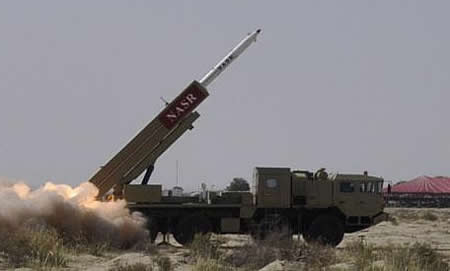
Shaheen 2 launch

By Hans M. Kristensen

Pakistan is preparing its next-generation of nuclear-capable ballistic missile for deployment. A satellite image taken on June 5, 2005, shows what appears to be 15 Transporter Erector Launchers (TELs) for the medium-range Shaheen 2 fitting out at the National Defense Complex near Fatehjang approximately 30 kilometers southwest of Islamabad.

The vehicles were discovered as part of preparations for the latest Nuclear Notebook on Pakistani nuclear forces published in the May/June issue of the Bulletin of the Atomic Scientists. The Notebook is written by Hans M. Kristensen of the Federation of American Scientists and Robert S. Norris of the Natural Resources Defense Council.

The authors estimate that Pakistan currently has an arsenal of about 60 nuclear weapons. In the last five and a half years, Pakistan has deployed two new nuclear-capable ballistic missiles, entered the final development stages of a potentially nuclear-capable cruise missile, started construction of a new plutonium production reactor, and is close to completing a second chemical separation facility. As Pakistan completes development of two more nuclear-cable ballistic missiles and a cruise missile in the next few years, the nuclear arsenal will increase further.

Pakistani
government responds to blog:
The government downplayed a report by
an organization of American scientists that Pakistan is preparing
its next generation nuclear-capable ballistic missile for
deployment.
“This is a speculative report which contains part fact and part
fiction,” is how the spokesperson characterized the report.”
Source:
Dawn, “N-Capable Missiles,” May 11, 2007.

The main driver for Pakistan’s nuclear modernization appears to be India’s nuclear build-up, although national prestige probably also is a factor. The two countries appear to be entering a new phase in their regional nuclear arms race with medium-range ballistic missiles gradually replacing aircraft as the backbone of their nuclear strike forces. In contrast to aircraft, ballistic missiles have a very short flight time and cannot be recalled once launched.
Continue reading »

written by Hans M. Kristensen

Dec 22

(Updated January 3, 2007)

North Korea may have gotten all the attention, but all the nuclear weapon states were busy flight-testing ballistic missiles for their nuclear weapons during 2006. According to a preliminary count, eight countries launched more than 28 ballistic missiles of 23 types in 26 different events.

Unlike the failed North Korean Taepo Dong 2 launch, most other ballistic missile tests were successful. Russia and India also experienced missile failures, but the United States demonstrated a very reliable capability including the 117th consecutive successful launch of the Trident II D5 sea-launched ballistic missile.

The busy ballistic missile flight testing represents yet another double standard in international security, and suggests that initiatives are needed to limit not only proliferating countries from developing ballistic missiles but also find ways to curtail the programs of the existing nuclear powers.
Continue reading »

written by Hans M. Kristensen

Jul 23

At Thursday’s hearing on the sale of 36 F-16 aircraft to Pakistan, Assistant Secretary of State John Hillen endured tongue-lashings from several members of the House International Relations Committee (HIRC), who objected to the manner in which his bureau has managed the $5.1 billion arms package. Of particular concern was the administration’s unilateral decision to waive the customary 20-day pre-notification for major arms sales, which many members viewed as a deliberate attempt to circumvent the committee’s authority. The decision – and the confrontation it provoked – could have far-reaching consequences, not only for Congressional oversight of arms sales but also several key State Department initiatives.
Continue reading »

written by Matt Schroeder \\ tags: , ,

Jul 06

On Monday, the Bush administration announced a massive $5.1 billion arms package for Pakistan, the largest arms sale to the Indian subcontinent since US sanctions were suspended in 2001. The package includes 36 F-16 fighter jets, armaments, and upgrades for its existing fleet of F-16s. The announcement came five days after the administration officially notified Congress of the sales.

The deal is significant for many reasons. It will help to modernize Pakistan’s aging airforce, and help pave the way for an even larger fighter jet sale to India. The sale also has tremendous symbolic significance. In 1991, the first Bush Administration imposed various sanctions on Pakistan for its nuclear weapons program, the most high profile of which was the impounding of 28 F-16s purchased by Pakistan in the 1980’s. Pakistan lobbied hard for their release but the Bush and Clinton administrations held firm, and the planes came to symbolize the post-Cold War deterioration of US-Pakistani relations. Following the September 11th attacks, the US hastily sought to mend diplomatic fences with Pakistan, which has provided critical support in the War on Terror. The Bush administration immediately lifted the ban on military aid to India and Pakistan and gradually increased the quantity and sophistication of weapons exports to both countries. The F-16 sale, which still tops the list of weapons sought by the Pakistani government, signifies a completion of the rapprochement between the US and its erstwhile ally.
Continue reading »

written by Matt Schroeder \\ tags: , ,

Jun 15

The Air Force has published a new report about the threat from ballistic and cruise missiles. The new report, Ballistic and Cruise Missile Threat, presents the Air Force National Air and Space Intelligence Center’s (NASIC) assessment of current and emerging weapon systems deployed or under development by Russia, China, India, Pakistan, North Korea, Iran, Syria and others.

Among the news in the report is a different and higher estimate for China’s future nuclear arsenal than was presented in the previous NASIC report from 2003. Whereas the previous assessment stated that China in 15 years will have 75-100 warheads on ICBMs capable of reaching the United States, the 2006 report states that this number will be “well over 100″ warheads. NASIC also believes that a new Chinese cruise missile under development will have nuclear capability.

Also new is that NASIC reports that the Indian Agni I ballistic missile has not yet been deployed despite claims by the Indian government that the weapon was “inducted” into the Indian Army in 2004. Contrary to claims made by some media and experts, the NASIC report states that the Indian Bramos cruise missile does not have a nuclear capability. The Babur cruise missile under development by Pakistan, however, is assessed to have a nuclear capability.

A copy of the report, which was published in March 2006 and recently obtained by the Federation of American Scientists, is available in full along with previous versions here.

written by Hans M. Kristensen

© 2011-2012 FAS Strategic Security Blog All Rights Reserved -- Copyright notice by Blog Copyright