United States Removes Nuclear Weapons From German Base, Documents Indicate
 |
|
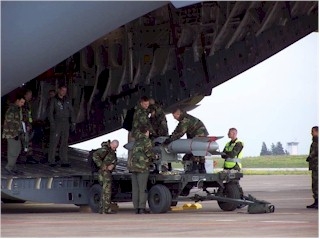
The United States appears to have quietly removed nuclear weapons from Ramstein Air Base. Here a B61 nuclear bomb is loaded unto a C-17 cargo aircraft. |
By Hans M. Kristensen
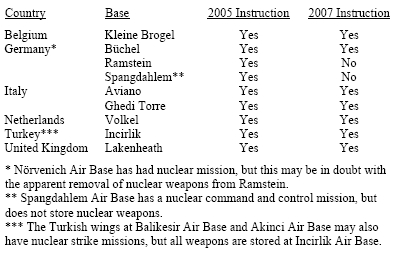
The U.S. Air Force has removed its main base at Ramstein in Germany from a list of installations that receive periodic nuclear weapons inspections, indicating that nuclear weapons previously stored at the base may have been removed and withdrawn to the United States.
If correct, the withdrawal reduces the number of U.S. nuclear weapons deployed in Europe to an estimated 350 B61 bombs, or roughly equivalent to the size of the entire French nuclear weapons inventory.
New Nuclear Inspection List
The new nuclear inspection list is contained in the unclassified instruction Nuclear Surety Staff Assistance Visit (NSSAV) and Functional Expert Visit (FEV) Program Management published by the U.S. Air Forces in Europe (USAFE) on January 29, 2007. The instruction supersedes an earlier version from March 29, 2005, which did include Ramstein Air Base.
The NSSAV team includes 14-31 inspectors with expertise in the different areas of nuclear weapons mission management. The NSSAV normally takes place six months prior to the a Nuclear Surety Inspection (NSI), and the visit is intended to help prepare the unit for the much more rigid NSI, which units with nuclear weapons mission responsibilities must pass at least every 18 months to remain certified to handle and store nuclear weapons. During the visit, which normally lasts a week, the NSSAV team observes and evaluates how the unit conducts day-to-day operations and administers nuclear surety program management. A typical visit includes uploading and downloading of training nuclear weapons on strike aircraft.
|
|
 |
|
Sources: U.S. Air Forces in Europe, Instruction 91-125, Nuclear Surety Staff Assistance Visits (NSSAV) and Functional Expert Visits (FEV) Program Management, January 29, 2007; U.S. Air Forces in Europe, Instruction 91-125, Nuclear Surety Staff Assistance Visits (NS SAV) and Functional Expert Visits |
A Brief History of U.S. Nuclear Weapons in Europe
The current number of approximately 350 nuclear weapons is only a fraction of the force level the United States deployed in Europe during the Cold War. That level reached a peak of 7,300 weapons in 1971. The number dropped to 4,000 by the end of the Cold War in 1990, plunged to 700 in 1992, and leveled off at approximately 480 weapons (all bombs) in 1994. This ended the dramatic period of nuclear disarmament initiatives, which has since been replaced by a period of relative stability with slow and gradual reductions happening mainly due to base closures rather than arms control initiatives.
One of the last acts of the Clinton administration in late 2000 was to authorize deployment of 480 nuclear bombs at nine bases in seven European NATO countries. Twenty of the bombs were withdrawn in 2001 after Greece pulled out of the NATO nuclear strike mission, and another 20 were withdrawn in 2003 when Germany closed Memmingen Air Base.
The Bush administration updated the deployment authorization for Europe in May 2004 to reflect these changes, and it is possible that the authorization may have cleared the withdrawal from Ramstein Air Base. But as of late March 2005, Ramstein was still on the updated list of installations receiving nuclear surety staff assistance visits. The report U.S. Nuclear Weapons in Europe published by the Natural Resources Defense Council in February 2005 estimated 440-480 nuclear bombs deployed in Europe.
|
US Nuclear Weapons in Europe, 1954-2007 |
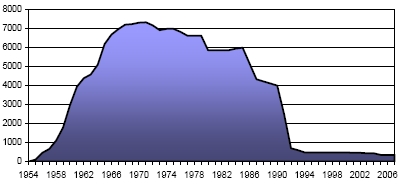 |
| The U.S. deployment of nuclear weapons in Europe peaked in 1971 at 7,300 weapons, was reduced significantly a decade and a half ago, but has remained comparatively stable since then. |
Then in May 2005, the German magazine Der Spiegel cited unnamed German defense officials saying that the U.S. had quietly removed nuclear weapons from Ramstein Air Base during major construction work at the base. The assumption was that the move was temporary, but the German officials hoped they would never return. Their wish seems to have come through with Ramstein’s removal from the updated Air Force instruction published in January 2007.
Both the U.S. government and NATO have always refused to disclose the number of weapons deployed in Europe but occasionally have provided the approximate range of the force level or the percentage of reduction since the Cold War. In an interview with Italian RAINEWS in April 2007, NATO Vice Secretary General Guy Roberts also refused to disclose the number weapons, but explained: “We do say that we’re down to a few hundred nuclear weapons.”
Seen in Cold War context, 350 bombs may not seem like a lot, but for the post-Cold War era it is a significant force. It is roughly equivalent is size to the entire French nuclear arsenal, larger than the Chinese nuclear arsenal, and it is larger that the nuclear arsenals of all the three non-NPT countries Israel, India and Pakistan combined.
Recent Reaffirmation of Nuclear Mission
Despite the apparent reduction, NATO’s Nuclear Planning Group (NPG) as recently as June 15, 2007, reaffirmed the importance of deploying U.S. nuclear weapons in Europe. NPG stated that the purpose of the weapons is to “preserve peace and prevent coercion and any kind of war,” and that NATO places “great value” on the U.S. deployment in Europe. The NPG did not identify any particular enemy that the weapons are intended to protect against, but instead said they “provide an essential political and military link between the European and North American members of the Alliance.”
|
|
 |
|
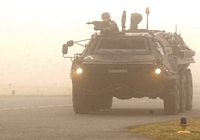
The only nuclear weapons storage site in Germany now appears to be Büchel Air Base, where theft – not enemy attack – is the main threat, as practiced by these security forces in February 2007. |
Germany’s Nuclear Decline
The apparent withdrawal from Ramstein Air Base also raises questions about the continued nuclear strike mission of the German Tornado squadron at Nörvenich Air Base. The base previously stored nuclear weapons, but they were moved to Ramstein in 1995 with the intent that they could quickly be returned to Nörvenich if necessary. A withdrawal from Ramstein would indicate that the 31st Wing at Nörvenich probably no longer has a nuclear strike mission, and that Germany’s contribution to NATO nuclear mission now is reduced to Büchel Air Base.
A reduction to a single German nuclear base with “only” 20 nuclear bombs is a dramatic change from the late-1980s, when more than 2,570 nuclear weapons were deployed at dozens of locations across the country. The latest withdrawal follows a political seachange in German voters’ views on nuclear weapons in the country. A poll published by Der Spiegel in 2005 revealed an overwhelming support across the political spectrum for a complete withdrawal of nuclear weapons from Germany.
The German government said in May 2005 that it would raise the issue of continued deployment within NATO, but officials later told Der Spiegel that the government had changed its mind. Yet the withdrawal from Ramstein indicates that the government has been more proactive than thought or that the Bush administration “got the message” and decided not to return the weapons. The withdrawal reduces Germany from the status of a major nuclear host nation to one on par with Belgium and the Netherlands, both of which also only have one nuclear base. The German government can now safely decide to follow Greece, which in 2001 unilaterally left NATO’s nuclear club. This in turn would open the possibility that Belgium (and likely also the Netherlands) will follow suit, essentially throwing NATO’s long-held principle of nuclear burdensharing into disarray.
A New Southern Focus
For now, the withdrawal from Ramstein Air Base shifts the geographic focus of NATO’s nuclear posture to the south. Before the withdrawal, a clear majority of NATO’s nuclear weapons were deployed in Northern and Central Europe. After the withdrawal, however, more than half (51%) of the weapons are deployed in Southern Europe along the Eastern parts of the Mediterranean Sea in Italy and Turkey.
The geographic shift has implications for international security issues that NATO countries are actively involved in, such as the attempts to create a Mediterranean Nuclear Weapons Free Zone, and the efforts to persuade countries like Iran not to develop nuclear weapons. The new southern focus of NATO’s nuclear posture will make it harder to persuade other countries in the region to show constraint.
Background: Satellite Images of U.S. Nuclear Weapon Bases Europe | U.S. Nuclear Weapons In Europe (report from 2005)
As humans expand our geographic reach, encroach on untouched natural territories, and interact more with animal populations, we will encounter novel zoonotic diseases that threaten the human body. The sooner we act to address these risks, the better.
“One thing became increasingly clear: AI doesn’t simply introduce a new category of risk. It changes the speed, scale, complexity, and interaction of risks that already exist.”
In the current environment of declining trust and magnifying strategic competition, banning debris-creating tests is a concrete step towards stability that favors interests of all states seeking to conduct space activities.
Google’s motto famously used to be “don’t be evil.” However, its latest feature has just made being evil a whole lot easier.