
United States Discloses Nuclear Warhead Numbers; Restores Nuclear Transparency
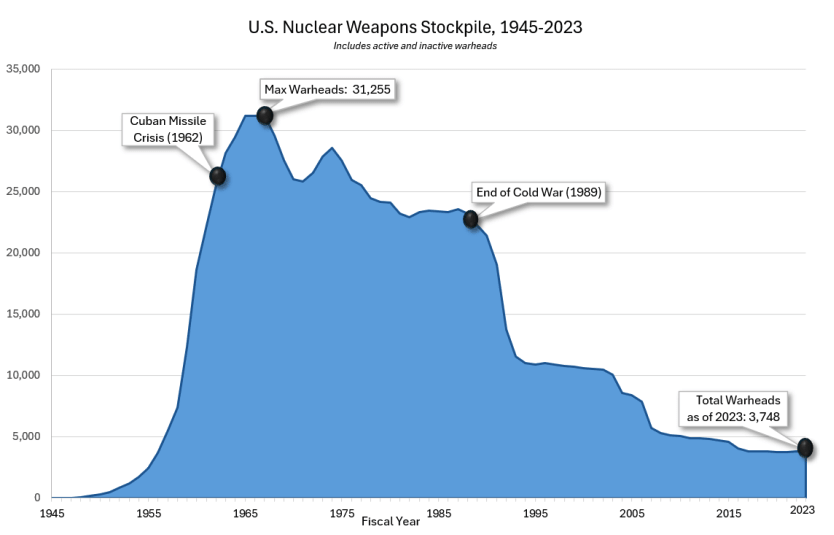
Note: The initial NNSA release showed an incorrect graph that did not accurately depict the size of the stockpile for the period 2012-2023. The corrected graph is shown above.
[UPDATED VERSION] The Federation of American Scientists applauds the United States for declassifying the number of nuclear warheads in its military stockpile and the number of retired and dismantled warheads. The decision is consistent with America’s stated commitment to nuclear transparency, and FAS calls on all other nuclear states to follow this important precedent.
The information published on the National Nuclear Security Administration (NNSA) web site today shows that the U.S. nuclear weapons stockpile as of September 2023 included 3,748 nuclear warheads, only 40 warheads off FAS’ estimate of 3,708 warheads.
The information also shows that the United States last year dismantled only 69 retired nuclear warheads, the lowest number since 1994.
FAS has previously requested that the United States release the size of the US nuclear arsenal for FY2021, FY2022, and FY2023, but those requests were denied. FAS believes the information was wrongly withheld and that today’s declassification decision vindicates our belief that stockpile disclosures do not negatively affect U.S. security but should be provided to the public.
With today’s announcement, the Biden Administration has restored the nuclear stockpile transparency that was created by the Obama administration, halted by the Trump administration, revived by Biden administration in its first year, but then halted again for the past three years.
While applauding the U.S. disclosure, FAS also urged other nuclear-armed states to disclose their stockpile numbers and warheads dismantled. Excessive nuclear secrecy creates mistrust, fuels worst-case planning, and enables hardliners and misinformers to exaggerate nuclear threats.
What The Nuclear Numbers Show
The declassified stockpile numbers show that the United States maintained a total of 3,748 warheads in its military stockpile as of September 2023. The military stockpile includes both active and inactive warheads in the custody of the Department of Defense. The information also discloses weapons numbers for the previous two years, numbers that the U.S. government had previously declined to release.
Although there have minor fluctuations, the numbers show that the U.S. nuclear weapons stockpile has remained relative stable for the past seven years. The fluctuations during that period do not reflect decision to increase or decrease the stockpile but are the result of warheads movements in and out of the stockpile as part of the warhead life-extension and maintenance work.
Although the warhead numbers today are much lower than during the Cold War and there have been reductions since 2000, the reduction since 2007 has been relatively modest. Although the New Start treaty has had some indirect effect on the stockpile size due to reduced requirement, the biggest reductions since 2007 have be caused by changes in presidential guidance, strategy, and modernization programs. The initial chart released by NNSA did not accurately show the 1,133-warhead drop during the period 2012-2023. NNSA later corrected the chart (see top of article). The chart below shows the number of warheads in the stockpile compared with the number of warheads deployed on strategic launchers over the years.
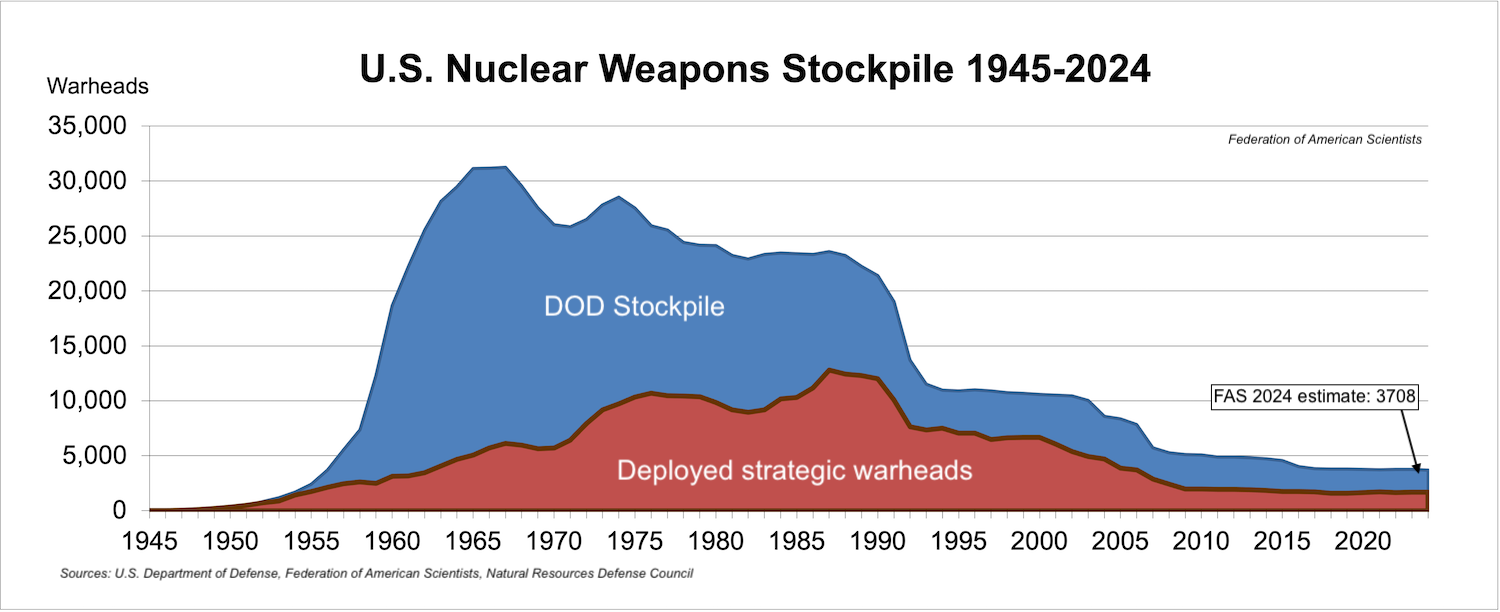
This graph shows the size of the U.S. nuclear stockpile over the years plus the portion of those warheads deployed on strategic launchers. The stockpile number for 2024 and the strategic launcher warheads are FAS estimates.
The information also shows that the United States last year dismantled only 69 retired nuclear warheads. That is the lowest number of warheads dismantled in a year since 1994. The total number of retired nuclear warheads dismantled 1994-2023 is 12,088. Retired warheads awaiting dismantlement are not in the DOD stockpile but in the DOE stockpile.
The information disclosed also reveals that there are currently another approximately 2,000 retired warheads in storage awaiting dismantlement. This number is higher than our most recent estimate (1,336) because of the surprisingly low number of warheads dismantled in recent years. Because dismantlement appears to be a lower priority, the number of retired weapons awaiting dismantlement today (~2,000) is only 500 weapons lower than the inventory was in 2015 (~2,500).
FAS’ Work For Nuclear Transparency
The Federation of American Scientists has worked since its creation to increase responsible transparency on nuclear weapons issues; in fact, the nuclear scientists that built the bomb created the “Federation of Atomic Scientists” to enable some degree of transparency to discuss the implications of nuclear weapons (see FAS newsletter from 1949). There are of course legitimate nuclear secrets that must remain so, but nuclear stockpile numbers are not among them.
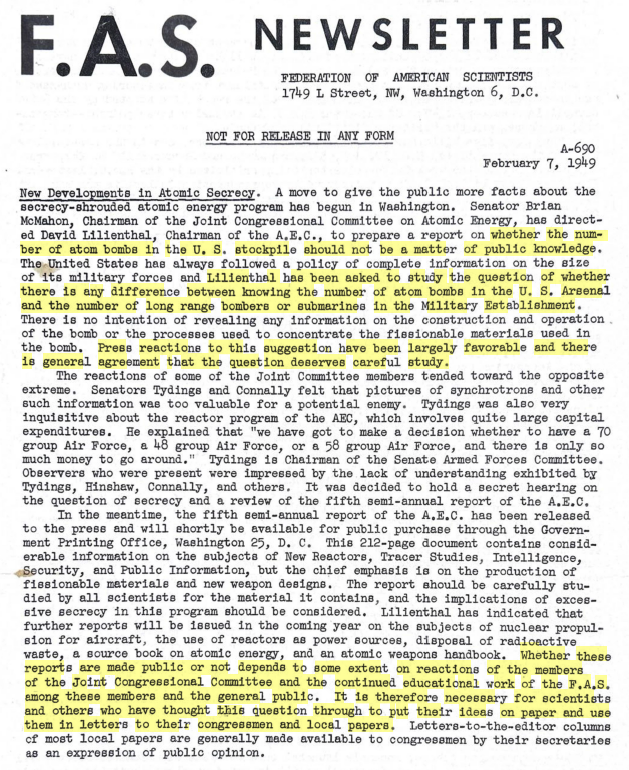
This FAS newsletter from 1949 describes the debate and FAS effort in support of transparency of the US weapons stockpile.
One part of FAS’ efforts, spearheaded by Steve Aftergood who for many years directed the FAS Project on Government Secrecy, has been to report on the government’s discussions about what needs to be classified and repeatedly request declassification of unnecessary secrets such as the stockpile numbers. This work yielded stockpile declassifications in some years (2012-2018, 2021) while in other years (2019-2020 and 2022-2024) FAS’ declassified requests were initially denied. Most recently, in February 2024, an FAS declassification request for the stockpile numbers as of 2023 was denied, although the letter added: “If a different decision is made in the future, we will notify you of this decision” (see rejection letters). Given these denials, FAS in March 2024 sent a letter to President Biden outlining the important reasons for declassifying the numbers.
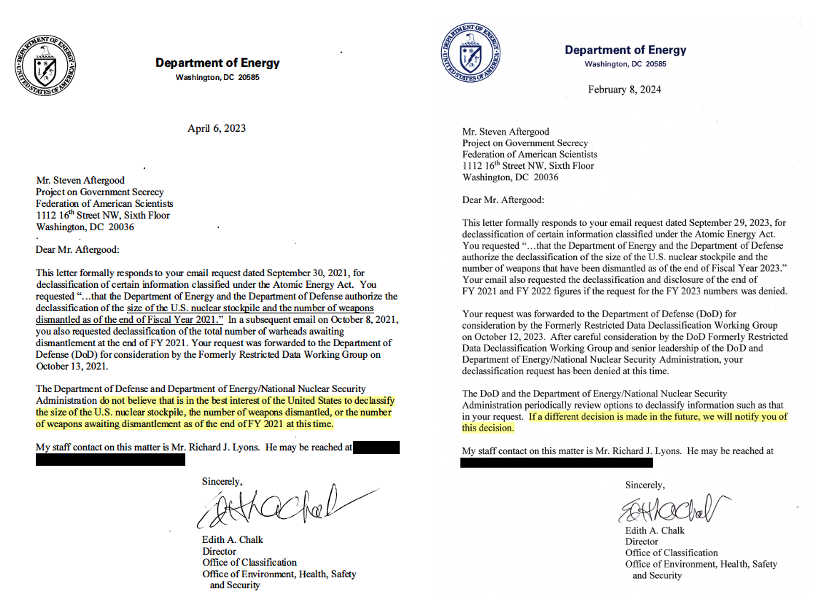
The new disclosure of the stockpile numbers suggests that denial of earlier FAS declassification requests in 2023 and 2024 may not have been justified and that future years’ numbers should not be classified.
The other part of FAS’ efforts has been the Nuclear Information Project, which works to analyze, estimate, and publish information about the U.S. nuclear arsenal. In 2011, when the Obama administration first declassified the history of the stockpile, the FAS estimate was only 13 warheads off from the official number of 5,112 warheads. The Project also works to increase transparency of the other nuclear-armed states by providing the public with estimates of their nuclear arsenals. The project described the structures that enabled Matt Korda on our team and others to discover the large missile silo fields China was building, and NATO officials say our data is “the best for open source information that doesn’t come from any one nation.”
Why Nuclear Transparency Is Important
FAS has since its founding years worked for maximum responsible disclosure of nuclear weapons information in the interest of international security and democratic values. In a letter to President Biden in March 2024 we outlined those interests.
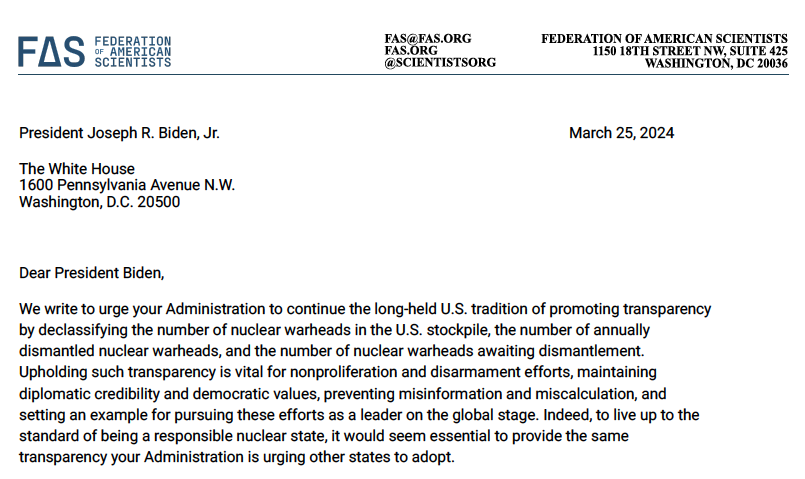
After denials in 2023 and February 2024 of FAS declassification requests, FAS in March sent President Biden a letter outlining why the denials were wrong. Click here to download full version of letter.
First, responsible transparency of the nuclear arsenal serves U.S. security interests by supporting deterrence and reassurance missions with factual information about U.S. capabilities. Equally important, transparency of stockpile and dismantlement numbers demonstrate that the United States is not secretly building up its arsenal but is dismantling retired warheads instead of keeping them in reserve. This can help limit mistrust and worst-case scenario planning that can fuel arms races.
Second, the United States has for years advocated and promoted nuclear transparency internationally. Part of its criticism of Russia and China is their lack of disclosure of basic information about their nuclear arsenals, such as stockpile numbers. U.S. diplomats have correctly advocated for years about the importance of nuclear transparency, but their efforts are undermined if stockpile and dismantlement numbers are kept secret because it enables other nuclear-armed states to dismiss the United States as hypocritical.
Third, nuclear transparency is important for the debate in the United States (and other Allied democracies) about the status and future of the nuclear arsenal and strategy and how the government is performing. Opponents of declassifying nuclear stockpile numbers tend to misunderstand the issue by claiming that disclosure gives adversaries a military advantage or that the United States should not disclose stockpile numbers unless the adversaries do so as well. But nuclear transparency is not a zero-sum issue but central to the democratic process by enabling informed citizens to monitor, debate, and influence government policies. Although the U.S. disclosure is not dependent on other nuclear-armed states releasing their stockpile numbers, Allied countries such as France and the United Kingdom should follow the U.S. example, as should Russia and China and the other nuclear-armed states.
Acknowledgement: Mackenzie Knight, Jon Wolfsthal, and Matt Korda provided invaluable edits.
More information on the FAS Nuclear Information Project page.
This research was carried out with generous contributions from the Carnegie Corporation of New York, the New-Land Foundation, the Ploughshares Fund, the Prospect Hill Foundation, Longview Philanthropy, and individual donors.
FAS and FLI partnered to build a series of convenings and reports across the intersections of artificial intelligence (AI) with biosecurity, cybersecurity, nuclear command and control, military integration, and frontier AI governance. This project brought together leaders across these areas and created a space that was rigorous, transpartisan, and solutions-oriented to approach how we should think about how AI is rapidly changing global risks.
AI is already consequential, but its future trajectory remains contested. Policymakers should make their assumptions explicit, focus on what can be shaped rather than what can be perfectly predicted, and build institutions that can learn and respond as evidence changes.
From grassroots community impacts to global geopolitical dynamics, understanding developing data center capacities is emerging as a critical analytical challenge.
The last remaining agreement limiting U.S. and Russian nuclear weapons has now expired. For the first time since 1972, there is no treaty-bound cap on strategic nuclear weapons.