Main

January 29, 2008

Bush Administration Unveils New Export Control Directive

At a press briefing on Wednesday, John Rood, the Acting Under Secretary of State for Arms Control and International Security, fielded questions about the Bush Administration's new Export Control Directive - the latest attempt to reduce delays and inefficiencies in the State Department's export control system. If implemented properly, some of the proposals could help to address long-standing staffing shortages, jurisdictional issues, and Information Technology (IT) problems. Improvements in these areas could help to reduce licensing delays, which, in turn, could alleviate pressure on the State Department to relax export controls.

Continue reading "Bush Administration Unveils New Export Control Directive" »

December 18, 2007

White House Announces (Secret) Nuclear Weapons Cuts

The W62 is the only nuclear warhead that has been publicly identified for elimination under the Bush administration's secret nuclear stockpile reduction plan.

By Hans M. Kristensen

The While House announced earlier today that the President had "approved a significant reduction in the U.S. nuclear weapons stockpile to take effect by the end of 2007." The decision reaffirmed an earlier decision from June 2004 to cut the stockpile "nearly 50 percent," but moved the timeline up five years from 2012 to 2007.

Not included in the White House statement, but added by other government officials, is an additional decision to cut the remaining stockpile by another 15% percent, although not until 2012.

The announcement of these important initiatives unfortunately was hampered by Cold War secrecy which meant that government officials were not allowed to reveal how many nuclear weapons will be cut or what the size of the stockpile is. As a result, news media accounts were full of errors, and one can only imagine the misperceptions this misplaced secrecy creates in other nuclear weapon states.

Continue reading "White House Announces (Secret) Nuclear Weapons Cuts" »

November 15, 2007

US Arms Sales to Pakistan: New CRS Report

A new Congressional Research Service report on "U.S. Arms Sales to Pakistan" recently obtained by the FAS provides a succinct overview of recent U.S. arms sales to General Pervez Musharraf's regime, the tumultous fifty-year history of US security assistance to Pakistan, and presidential authority to stop such sales. The release of the report coincides with a worsening political crisis in Pakistan and growing Congressional and public discontent over the United States' multi-billion dollar military aid program for General Musharraf's beseiged and increasingly authoritarian regime.

Continue reading "US Arms Sales to Pakistan: New CRS Report" »

November 05, 2007

White House Guidance Led to New Nuclear Strike Plans Against Proliferators, Document Shows

The U.S. nuclear war plan that entered into effect in March 2003 included new executable strike options against regional states seeking weapons of mass destruction.
(click on image to download PDF-version)

By Hans M. Kristensen

The 2001 Nuclear Posture Review (NPR) and White House guidance issued in response to the terrorist attacks against the United States in September 2001 led to the creation of new nuclear strike options against regional states seeking to acquire weapons of mass destruction, according to a military planning document obtained by the Federation of American Scientists.

Rumors about such options have existed for years, but the document is the first authoritative evidence that fear of weapons of mass destruction attacks from outside Russia and China caused the Bush administration to broaden U.S. nuclear targeting policy by ordering the military to prepare a series of new options for nuclear strikes against regional proliferators.

Responding to nuclear weapons planning guidance issued by the White House shortly after the terrorist attacks on September 11, 2001, U.S. Strategic Command created a series of scenario driven nuclear strike options against regional states. Illustrations in the document identify the states as North Korea and Libya as well as SCUD-equipped countries that appear to include Iran, Iraq (at the time), and Syria - the very countries mentioned in the NPR. The new strike options were incorporated into the strategic nuclear war plan that entered into effect on March 1, 2003.

The creation of the new strike options contradict statements by government officials who have insisted that the NPR did not change U.S. nuclear policy but decreased the role of nuclear weapons.

Continue reading "White House Guidance Led to New Nuclear Strike Plans Against Proliferators, Document Shows" »

October 25, 2007

FAS Obtains DHS Report on Programs to Counter the Shoulder-fired Missile Threat

In response to a Freedom of Information Act request filed by the FAS, the Department of Homeland Security has released a December 2005 report to Congress on the status of DHS's efforts to counter the threat from man-portable air defense systems (MANPADS) to commercial airliners.

The report, which Congress required as part of the Intelligence Reform and Terrorism Prevention Act of 2004, sheds new light on several key DHS counter-MANPADS efforts, including airport vulnerability assessments, contingency plans for MANPADS attacks, and intelligence sharing and law enforcement training. These efforts are part of a multi-faceted U.S. campaign to deprive terrorists of access to these weapons and mitigate the threat from missiles that are already in terrorist arsenals.

Continue reading "FAS Obtains DHS Report on Programs to Counter the Shoulder-fired Missile Threat" »

September 05, 2007

Flying Nuclear Bombs

The Air Force is reported to have loaded and flown five (some say six) nuclear-armed Advanced Cruise Missiles on a B-52H bomber - by mistake. This image shows a B-52H will a full load of 12 Advanced Cruise Missiles under the wings.

By Hans M. Kristensen

Michael Hoffman reports in Military Times that five (some say six) nuclear-armed Advanced Cruise Missiles were mistakenly flown on a B-52H bomber from Minot Air Force Base in North Dakota to Barksdale Air Force Base in Louisiana on August 30.

I disclosed in March that the Air Force had decided to retire the Advanced Cruise Missile (ACM), and the Minot incident apparently was part of the dismantlement process of the weapon system.

Update September 23, 2007:
Contributed information to story in the Washington Post.

Update September 6, 2007:
The Air Force has issued a statement on the B-52 incident.

Continue reading "Flying Nuclear Bombs" »

Article: U.S. Nuclear Stockpile Today and Tomorrow

The latest FAS-NRDC estimate of the U.S. nuclear weapons stockpile has been published in the Bulletin of the Atomic Scientists.

By Hans M. Kristensen

The U.S. nuclear weapons stockpile currently contains an estimated 9,900 nuclear warheads of 15 different versions of nine basic types, according to the latest FAS-NRDC Nuclear Notebook published in the Bulletin of the Atomic Scientists. By 2012, approximately 4,470 of the warheads will have been withdrawn, leaving a stockpile of roughly 5,500 warheads.

The administration insists that the size and breakdown of the stockpile must be kept secret in the interest of national security, but a growing number of lawmakers argue that some stockpile information is not necessary to classify.

The Nuclear Notebook is written by FAS' Hans M. Kristensen and NRDC's Robert Norris.

Background: Administration Increases Submarine Warhead Production Plan | Estimates of the U.S. Nuclear Weapons Stockpile, 2007 and 2012 | U.S. Nuclear Forces, 2007

August 30, 2007

Administration Increases Submarine Nuclear Warhead Production Plan

The slim Mk4A reentry body for the W76-1 warhead. The administration plans to produce 2,000 between 2007 and 2021.

By Hans M. Kristensen

The Bush administration has decided to more than double the number of nuclear warheads undergoing an expensive upgrade for potential future deployment on the Navy’s 14 ballistic missile submarines, according to answers provided by the National Nuclear Security Administration in response to questions from the Federation of American Scientists.

The decision preempts a debate in Congress about how the United States should size its future nuclear weapons arsenal.

The upgrade concerns the W76, the most numerous warhead in the U.S. nuclear weapons stockpile. The Clinton administration decided to upgrade 25 percent, but the Bush administration’s Nuclear Posture Review (NPR) in 2001 recommended that significantly more warheads had to be upgraded. An assessment completed by the Department of Defense in 2005 increased the plan to 63 percent of the W76 stockpile, corresponding to an estimated 2,000 warheads.

More than just a refurbished weapon, official sources indicate, the new weapon will have significantly increased military capabilities against hard targets.

Continue reading "Administration Increases Submarine Nuclear Warhead Production Plan" »

August 14, 2007

National Bio-Surveillance Integration System Program has been mismanaged

Department of Homeland Security's Inspector General released a stinging new report that details serious issues facing the National Bio-Surveillance Integration System (NBIS). NBIS was launched in 2004 with the goal of integrating all of the biosurveillance programs across the US into a single system to enhance our capability to detect agents and disease trends and respond rapidly. For example, the Centers for Disease Control and Prevention operates their BioSense program, to collect data on human health, but the data from that system is not integrated with data from the Department of Homeland Security's BioWatch program, which is designed to detect the release of airborne biological agents. There are other surveillance systems in place and in development as well, and although you would be hard pressed to find anyone that thinks any of the systems are working optimally it is still important to try to integrate the programs into a single system (in case they ever do become robust and efficient).

The US has spent an estimated $32 billion on electronic surveillance systems and various other IT initiatives to address biodefense since 2001.

The report tells of inconsistent leadership and staffing, which has hampered NBIS delivery. In some cases many months were wasted with unnecessary administrative hurdles delaying the program. The few contracts that have been awarded under the program seem of questionable value, sometimes because the contractor was not given sufficient guidance to complete the work.

Most shocking to me was the fact that they have yet to finish a plan for implementation. The report stated plainly that, "As a result of the repeated transitions and staffing shortfalls, planning documents needed to guide information technology (IT) development have yet to be finalized. Program management has not effectively communicated and coordinated with stakeholders to secure the data, personnel, and information sharing agreements needed to support system development. Additionally, program management did not provide the contractor with adequate guidance, requirements input, or data sources to deliver a fully functional system. As such, the contractor may not fulfill NBIS capability and schedule requirements, which potentially could result in cost increases to the program."

Assistant Secretary for Health Affairs and Chief Medical Officer, Jeffrey Runge MD, agreed with all of the findings and recommendations in the report and provided very constructive comments that indicate a sincere willingness to improve the program and stated that many of the IG's recommendations were already being addressed. That is the nugget of good news here.

July 20, 2007

Licensing Exemptions, Round Two: The Defense Trade Cooperation Treaty

At a press briefing on Monday, Assistant Secretary of State John Rood elaborated on the Bush Administration’s latest attempt to secure license-free defense exports to the UK, a contentious issue that sparked a bruising battle between the administration and House Republicans three years ago. This time the exemptions are packaged in the form of a Defense Trade Cooperation Treaty (DTCT), the stated goal of which is to “improve transatlantic defence information sharing by reducing the barriers to exchanges of defence goods, services and information between the US and UK.” By pursuing a treaty, the administration avoids another confrontation with the House, but it remains to be seen whether the Democrat-controlled Senate will tolerate what appears to be an end-run around their colleagues, especially given the administration’s apparent failure to adequately consult either chamber before negotiating the treaty.

Continue reading "Licensing Exemptions, Round Two: The Defense Trade Cooperation Treaty" »

New Jersey Woman finds "missile" in her front yard

Note: After this entry was posted, the Associated Press revealed that the item in question is actually a 20-year-old expended AT-4 anti-tank missile launcher that posed no threat.

This morning a woman from Jersey City discovered a "missile" lying in the grass on her front lawn. Niranjana Besai showed the missile to her neighbor, who told CBS 2 News that at first he thought the 6-foot-long item was just a pipe. Upon closer inspection, he concluded that it looked like the missile launchers he'd seen on TV. The New Jersey television station said that their "sources" told them that the "device is the type used ot shoot shoulder-fired rockets and is capable of taking down an aircraft."

Little else is known about the item, but initial descriptions are consistent with the physical appearance of many man-portable air defense systems (MANPADS), the launch tubes of which are approximately 5 to 6 feet long and look a bit like a pipe. Private ownership of MANPADS is ilegal in the United States, and the version used by the US military - the Stinger missile - is one of the most tighly guarded weapons in its arsenals. If the item is indeed a MANPADS, it would have profound national security and policy implications.

Continue reading "New Jersey Woman finds "missile" in her front yard" »

July 19, 2007

Targeting Missile Defense Systems

By Hans M. Kristensen

The now month-long clash between Russia and the West over U.S. plans to build a missile defense system in Europe should warn us that - despite important progress in some areas - Cold War thinking is alive and well.

The missile defense system, Moscow says, is but the latest step in a gradual military encroachment on Russian borders by NATO, and could well be used to shoot down Russian ballistic missiles. The head of Russia’s Strategic Missile Forces and President Putin have suggested that Russia might target the defenses with nuclear weapons. The United States has rejected the complaints insisting that Russia has nothing to fear and that the defenses will only be used against Iranian ballistic missiles. European allies have complained that the Russian threats are unacceptable and have no place in today’s Europe.

That may be true, but the reactions have revealed a frightening degree of naiveté about strategic war planning in the post-Cold War era, a widespread belief that such planning has somehow stopped. It has certainly changed, but all the major nuclear weapon states insist that they must hedge against an uncertain future and continue to adjust their strike plans against potential adversaries that have weapons of mass destruction. Russia continues to plan against the West and the West continues to plan against Russia. The plans are not the same that existed during the Cold War, but they are strike plans nonetheless.

The argument made by some officials that missile defense systems are merely defensive and don’t threaten anyone is disingenuous because it glosses over a fact that all planners know very well: Even limited missile defenses become priority targets if they can disturb other important strike plans. The West concluded that very early on in its military relationship with Russia.

Continue reading "Targeting Missile Defense Systems" »

July 11, 2007

FAS Statement on Recent Testimony by Surgeon General Carmona

The Federation of American Scientists is profoundly disturbed by the testimony of former Surgeon General Richard H. Carmona at the July 10th hearing of the House Government Reform and Oversight Committee. At the hearing, Surgeon General Carmona described a dismaying number of cases where he was forced to weaken or suppress reports providing public health information that should have been available to the public. He also reported that he was repeatedly instructed not to speak on a wide array of important health issues including stem cells, emergency contraception, and mental health.

While political pressure on government scientists is not new, the size and scope of the effort reported by Dr. Carmona are shocking. This is the first time an official of this rank has described in detail a persistent, long-term pattern of distorting science advice to the public. As America’s “chief health educator,” the Surgeon General’s office has a clear obligation to provide the public with timely, accurate, and accessible information about matters of health and medicine. The public needs this information to provide good care for themselves and their families and they need it to make informed decisions about health care policy. The public should never have to wonder whether statements made by high public officials can be trusted to be accurate and complete.

Dr. James Holsinger, nominated to be the next Surgeon General, will face Senate confirmation this week. FAS urges the Senators examining him to get assurances that he will always provide the public with the most complete, timely, and accurate health care information available to him. And we urge them to get assurances that he will bring important health care matters to public attention without regard to the effect these facts will have on partisan political debates.

Read Surgeon General Carmona’s testimony here.

July 09, 2007

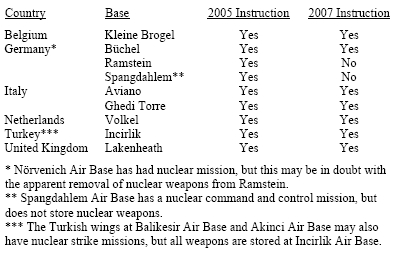
United States Removes Nuclear Weapons From German Base, Documents Indicate
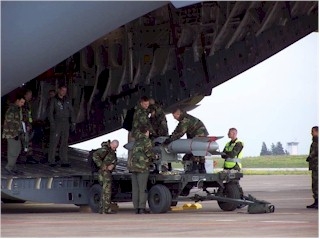
The United States appears to have quietly removed nuclear weapons from Ramstein Air Base. Here a B61 nuclear bomb is loaded unto a C-17 cargo aircraft.

By Hans M. Kristensen

The U.S. Air Force has removed its main base at Ramstein in Germany from a list of installations that receive periodic nuclear weapons inspections, indicating that nuclear weapons previously stored at the base may have been removed and withdrawn to the United States.

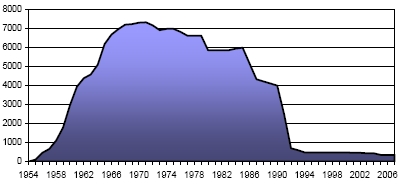
If correct, the withdrawal reduces the number of U.S. nuclear weapons deployed in Europe to an estimated 350 B61 bombs, or roughly equivalent to the size of the entire French nuclear weapons inventory.

Continue reading "United States Removes Nuclear Weapons From German Base, Documents Indicate" »

May 02, 2007

Estimates of the US Nuclear Weapons Stockpile, 2007 and 2012

Click on figure to open full fact sheet. For an updated stockpile estimate, go here.

The Bush administration announced in 2004 that it had decided to cut the nuclear weapons stockpile "nearly in half" by 2012, but has refused to disclose the actual numbers. Yet a fact sheet published by the Federation of American Scientists and Natural Resources Defense Council estimates that the stockpile will decline from approximately 9,938 warheads today to approximately 5,047 warheads by the end of 2012.

FAS and NRDC publish the fact sheet now because Congress is considering whether to approve a proposal by the administration to resume industrial production of new nuclear weapons, and because government officials have told Congress that production of new warheads will make it possible to reduce further the size of the stockpile in the future.

The fact sheet estimates are based on information collected by the authors over several decades about production, dismantlement and operation of US nuclear weapons.

Continue reading "Estimates of the US Nuclear Weapons Stockpile, 2007 and 2012" »

March 14, 2007

Small Fuze - Big Effect

"It is not true,” British Defence Secretary Des Browne insisted during an interview with BBC radio, that a new fuze planned for British nuclear warheads and reported by the Guardian will increase their military capability. The plan to replace the fuze “was reported to the [Parliament’s] Select Committee in 2005 and is not an upgrading of the system; it is merely making sure that the system works to its maximum efficiency," Mr. Browne says.

The minister is either being ignorant or economical with the truth. According to numerous statements made by US officials over the past decade, the very purpose of replacing the fuze is – in stark contrast to Mr. Browne’s assurance - to give the weapon improved military capabilities it did not have before.

The matter, which is controversial now because Britain is debating whether to build a new generation of nuclear-armed submarines, concerns the Mk4 reentry vehicle on Trident D5 missiles deployed on British (and US) ballistic missile submarines. The cone-shaped Mk4 contains the nuclear explosive package itself and is designed to protect it from the fierce heat created during reentry of the Earth’s atmosphere toward the target. A small fuze at the tip of the Mk4 measures the altitude and detonates the explosive package at the right “height of burst” to create the maximum pressure to ensure destruction of the target. The new fuze will increase the “maximum efficiency” significantly and give the British Trident submarines hard target kill capability for the first time.

Continue reading "Small Fuze - Big Effect" »

March 07, 2007

US Air Force Decides to Retire Advanced Cruise Missile

The U.S. Air Force has decided to retire the Advanced Cruise Missile, the most modern and capable nuclear cruise missile in the U.S. arsenal, according to information obtained by the Federation of American Scientists.

The decision affects approximately 400 ACMs (AGM-129A) currently deployed at Minot Air Force Base in North Dakota and Barksdale Air Force Base in Louisiana. Each missile carries a W80-1 warhead with a yield of 5-150 kilotons. The ACM is designed for delivery by B-52H strategic bombers.

FAS analyst Hans Kristensen noticed elimination of funding for the ACM in the Air Force’s FY2008 budget request, and a subsequent email to the Air Force confirmed the decision to retire the weapon system. The Air Force has not announced when the retirement will be completed, but it appears to be within the next year.

Continue reading "US Air Force Decides to Retire Advanced Cruise Missile" »

February 22, 2007

Divine Strake Experiment Canceled

The Defense Threat Reduction Agency announced today that it has canceled the controversial Divine Strake experiment.

A 700 tons chemical explosion at the Nevada Test Site was intended to provide data for calibration of nuclear and conventional weapons against underground targets. Local fear that the explosion would kick up and disperse radioactive material from the ground - as well concern about Divine Strake's role in calibrating the use of low-yield nuclear weapons against underground targets - prompted members of Congress to raise questions about Divine Strake.

The Federation of American Scientists was the first to obtain and publish confirmation from DTRA that Divine Strake was the same experiment described in the FY2006 and FY2007 DTRA budget requests as intended to "improve the warfighter’s confidence in selecting the smallest proper nuclear yield necessary to destroy underground facilities while minimizing collateral damage." DTRA public affairs officials subsequently denied Divine Strake had any connection to nuclear missions, but were later contradicted by senior DTRA officials saying that it was nuclear related.

Background: Divine Strake

February 05, 2007

Bush Gets it Right on Small Arms Threat Reduction

The President's foreign aid budget request for FY2008 contains an unexpected and laudable surprise: a five-fold increase in funding for the State Department's Small Arms/Light Weapons Destruction initiaitive. If approved by Congress, the additional funding will bolster US efforts to stem the illicit trade in deadly light weapons.

Continue reading "Bush Gets it Right on Small Arms Threat Reduction" »

January 24, 2007

No Need to Replace UK Nuclear Subs Now, FAS Board Member Tells Brits

(Updated January 26, 2007)

British Vanguard-class ballistic missile submarines have at least 15 years more service life in them, and the U.K. government does not have to make a decision now on whether to replace them with a new class of submarines, Richard Garwin told BBC radio Tuesday.

Garwin, who is a member of the Federation of American Scientists Board of Directors and a long-term adviser to the U.S. government on defense matters, is in Britain to testify before the House of Commons Defence Select Committee on the future of Britain's nuclear deterrent.

The U.K. government announced on December 4, 2006, that it had decided to replace its current Vanguard-class sea-launched ballistic missile submarines (SSBNs) with a new class to enter operation in 2024. If approved by the parliament, the plan would extend Britain's nuclear era into the 2050s.

According to the U.K. government, a decision to build a new new class must be made now because the Vanguard-class SSBNs only have a have a design life of 25 years. But Garwin says that the submarines have a minimum design life of 25 years, which can be extended by at least another 15 years. A decision made now is premature and unwise, Garwin told BBC, because the large Trident missiles may not be necessary 15 years from now.

New additions: Garwin testimony / House of Lords debate

Background: BBC Today | Garwin Archive at FAS | Britain's Next Nuclear Era

December 22, 2006

Nuclear Missile Testing Galore

(Updated January 3, 2007)

North Korea may have gotten all the attention, but all the nuclear weapon states were busy flight-testing ballistic missiles for their nuclear weapons during 2006. According to a preliminary count, eight countries launched more than 28 ballistic missiles of 23 types in 26 different events.

Unlike the failed North Korean Taepo Dong 2 launch, most other ballistic missile tests were successful. Russia and India also experienced missile failures, but the United States demonstrated a very reliable capability including the 117th consecutive successful launch of the Trident II D5 sea-launched ballistic missile.

The busy ballistic missile flight testing represents yet another double standard in international security, and suggests that initiatives are needed to limit not only proliferating countries from developing ballistic missiles but also find ways to curtail the programs of the existing nuclear powers.

Continue reading "Nuclear Missile Testing Galore" »

December 15, 2006

U.S. Nuclear Posture at a Crossroad, Defense Science Board Says

The Defense Science Board concludes in a new report that the United States has lost its "national consensus" on what the nation's nuclear deterrent should look like and the role it should serve. The consensus has been replaced by an “entrenchment” of “sharp differences" of opinion. Therefore, urgent action is needed by the White House and senior leaders to “engage more directly to articulate the persuasive case” for how modern nuclear weapons serve U.S. national security policy.

U.S. nuclear policy has come to a crossroad because the current formula is no longer sustainable.

Perhaps not coincidently, the DSB report comes as the administration is preparing to persuade Congress to pay for a new nuclear weapons complex (Complex 2030) to resume production of nuclear weapons for the first since since the end of the Cold War. To that end, the report presents a wide range of recommendations for how to revitalize the U.S. nuclear posture.

Continue reading "U.S. Nuclear Posture at a Crossroad, Defense Science Board Says" »

December 07, 2006

Britain's Next Nuclear Era

After having spent the last several years sending diplomats to Teheran to try to persuade Iran not to develop nuclear weapons, the British government announced Monday that it plans to renew its own nuclear arsenal.

If approved by the parliament, Monday’s decision means that the United Kingdom will extend its nuclear deterrent beyond 2050, essentially doubling the timeline of its own nuclear era.

Doing so is entirely consistent with the United Kingdom’s international obligations under the Non-Proliferation Treaty (NPT) and with a policy that favors complete elimination of nuclear weapons, the government insisted in a fact sheet, because the British nuclear arsenal today is smaller than during the Cold War, and because the Treaty does not say exactly when nuclear disarmament has to be accomplished. In fact, the new plan has "the right balance," the government claims, between working for a world free of nuclear weapons and keeping those weapons.

Continue reading "Britain's Next Nuclear Era" »

November 30, 2006

New Report: Chinese Nuclear Forces and U.S. Nuclear War Planning

An incipient nuclear arms race is emerging between China and the United States, according to a new report published today by the Federation of American Scientists and the Natural Resources Defense Council.

The 250-page report, Chinese Nuclear Forces and U.S. Nuclear War Planning, outlines the status and possible future development of China's nuclear weapons, describes the history of U.S. nuclear targeting of China, and simulates nuclear strike scenarios between the two nuclear powers.

Both countries are pointing to the other as an excuse to modernize nuclear forces. In the United States the report finds that the Pentagon, the intelligence community, congressional committees, private institutes and the news media frequently overstate Chinese capabilities or present dramatic new developments out of context to underscore a threat.

China, for its part, cloaks its nuclear forces in a veil of secrecy, which creates suspicion and fear in other countries about Chinese intentions.

The report, which is based on analysis of declassified and unclassified U.S. government documents as well as commercial satellite images of Chinese installations, urges both countries to take steps to halt and reverse the tension and military build-up.

Continue reading "New Report: Chinese Nuclear Forces and U.S. Nuclear War Planning" »

November 09, 2006

New Article: Where the Bombs Are

B83 thermonuclear bombs at Barksdale Air Force Base,
Louisiana.                     Image © Paul Shambroom
Ever wondered where all those nukes are stored?

A new review published in the November/December issue of the Bulletin of the Atomic Scientists shows that the United States stores its nearly 10,000 nuclear warheads at 18 locations in 12 states and six European countries.

The article's authors - Hans M. Kristensen of the Federation of American Scientists and Robert S. Norris of the Natural Resources Defense Council - identified the likely locations by piecing together information from years of monitoring declassified documents, officials statements, news reports, leaks, conversations with current and former officials, and commercial high-resolution satellite photos.

Continue reading "New Article: Where the Bombs Are" »

October 20, 2006

Reaffirming the Nuclear Umbrella: Nuclear Policy on Autopilot

In condemning the North Korean nuclear test and repeating its call for a denuclearized Korean Peninsula, one of the Bush administration's first acts ironically has been to reaffirm the importance of nuclear weapons in the region.

"The United States will meet the full range of our deterrent and security commitments," President Bush told Japan and South Korea after last week's test. On Wednesday, Secretary of State Condoleezza Rice strongly hinted that the commitments potentially include nuclear strikes against North Korea.

But is it helpful or counterproductive at this stage to threaten North Korea with nuclear weapons?

Continue reading "Reaffirming the Nuclear Umbrella: Nuclear Policy on Autopilot" »

September 21, 2006

Article: Nuclear Threats Then And Now

A decision to trim a tree in the Korean demilitarized zone in 1976 escalated into a threat to use nuclear weapons. After a fatal skirmish between U.S. and North Korean border guards, U.S. forces in the region were placed on heightened alert (DEFCON 3) and nuclear forces were deployed to signal preparations for an attack on North Korea. The North Koreans did not interfere with the tree trimming again, so the threat must have worked, the Pentagon concluded.

Thirty years later, North Korea has probably developed nuclear weapons and is trying to develop long-range ballistic missiles to threaten you-know-who, and the United States has ventured into a multi-billion dollar effort to build a missile defense system and a "New Triad" to better dissuade, deter, and defeat North Korea and other "rogue" states.

So, did the threat work?

The "tree-trimming incident," as the U.S.-North Korean scuffle has come to be known, and other examples of using nuclear threats are described in the article "Nuclear Threats Then And Now" in the Bulletin of the Atomic Scientists.

View Article | Korea Background | Global Strike Mission

August 02, 2006

Divine Strake Explosion Delayed Again, Possibly Moved

Update (February 22, 2007): DTRA announces that Divine Strake has been canceled.

The controversial Divine Strake explosion has been delayed again, this time "at least several months into calendar year 2007," according to a statement distributed in Congress by the Defense Threat Reduction Agency. "We have stood down the experiment site and the workforce that was preparing the site for the experiment," DTRA said.

The delay comes after DTRA told Senator Orrin Hatch (UT) that it will “look into the possibility of other locations” for conducting the Divine Strake test.

Divine Strake was initially scheduled to take place on June 2, 2006, but disclosure that the experiment was in fact intended to calibrate the use of low-yield nuclear weapons against underground targets, combined with lawsuits from local communities, caused the government to withdraw its "no impact" environmental assessment shortly before the scheduled test and delay it until September 2006.

Although DTRA has repeatedly stated that the experiment did not pose an environmental hazard, the agency now says that it is "developing a plan that would permit the conduct of the DIVINE STRAKE experiment if it is determined that the experiment can be conducted safely, is in compliance with NEPA, and there is a favorable court ruling."

The decision to possibly move the test to another location is especially interesting because the current site was "carefully chosen" so that it "simulates the characteristics of important potential, global adversaries," according to the DOE's environmental assessment: "As a number of potential adversarial military targets are based in similar limestones, [Divine Strake] needed to be sited in a similar geological setting to actual military targets." Previous high-explosive tests have been conducted at the White Sands Missile Range in New Mexico and at Misers Bluff at Planet Ranch in Arizona. We'll see what Senator Pete Domenici from New Mexico and Jon Kyl from Arizona say about that.

The DTRA statement is not available on the web sites of DTRA, NNSA, or the Nevada Test Site. A search for Divine Strake on DTRA's site gave "no results." An on-line Divine Strake briefing previously posted on the DTRA web site has also been removed.

More Information On Divine Strake

July 27, 2006

Article: US National Security and Preemption

The French magazine Défense Nationale asked me to submit an article about the new U.S. National Military Strategy published by the Bush administration in March 2006 and how it relates to the so-called preemption doctrine announced by the administration in 2002. The article is included in the July 2006 issue which focuses on the nuclear deterrence debate following the announcement by French president Jacques Chiraq in January that France has adjusted its nuclear posture to target regional adversaries armed with weapons of mass destruction. The magazine is published by the Committee for National Defence Studies, an independent research institution which includes several retired generals and admirals from the French military.

Download article

Pentagon Doubles Plan For New Warheads

The Pentagon is considering acquiring up to four types of Reliable Replacement Warheads (RRW), twice as many as reported so far, according to an overview discovered by the Federation of the American Scientists on a Pentagon web site.

The Department of Energy told Congress in April that Los Alamos National Laboratory and Lawrence Livermore National Laboratory were working on "an RRW design" for completion later in 2006. The Washington Post added last month that a Senate subcommittee had added $10 million to next year's budget to fund a design of a second RRW.

According to the new DOD overview, which looks beyond 2030, the future nuclear weapons stockpile would be made up of 4-6 different types of warheads (down from nine types today). A decision would be made mid-next decade about whether to have a mix of RRWs and existing warhead types or transition to an all RRW-stockpile.

In an apparent response to the Bush administration's decision to reduce reliance of reserve warheads and instead transition to a "responsive infrastructure" that will produce warheads when needed, the DOD plan envisions "steady-state production of warheads for deployment" in the long term.

The plan also forecasts decisions on developments of warheads for the next generation of nuclear weapon delivery systems (missiles and aircraft).

The U.S. nuclear stockpile currently contains approximately 10,000 nuclear warheads of nine principle designs: B61, W62, W76, W78, W80, B83, W84, W87 and W88. The Bush administration has decided to reduce the total stockpile "almost in half" which is estimated to leave a stockpile of some 6,000 warheads in 2012.

Visit the Pentagon web site.

June 23, 2006

Effort Underway in European Parliament Against US Nuclear Weapons in Europe

A Written Declaration presented in the European Parliament calls for the withdrawal of US nuclear weapons from Europe by the end of 2006. The Declaration has until December 10 to gather support from at least half of the Parliament's 732 members to be adopted and formally submitted to the US government. The initiative comes as Russia refused last week to discuss tactical nuclear weapons with the United States. Most European want the US to withdraw its remaining nuclear weapons from Europe.

Background report: U.S. Nuclear Weapons In Europe

June 15, 2006

US Air Force Publishes New Missile Threat Assessment

The Air Force has published a new report about the threat from ballistic and cruise missiles. The new report, Ballistic and Cruise Missile Threat, presents the Air Force National Air and Space Intelligence Center's (NASIC) assessment of current and emerging weapon systems deployed or under development by Russia, China, India, Pakistan, North Korea, Iran, Syria and others.

Among the news in the report is a different and higher estimate for China's future nuclear arsenal than was presented in the previous NASIC report from 2003. Whereas the previous assessment stated that China in 15 years will have 75-100 warheads on ICBMs capable of reaching the United States, the 2006 report states that this number will be "well over 100" warheads. NASIC also believes that a new Chinese cruise missile under development will have nuclear capability.

Also new is that NASIC reports that the Indian Agni I ballistic missile has not yet been deployed despite claims by the Indian government that the weapon was "inducted" into the Indian Army in 2004. Contrary to claims made by some media and experts, the NASIC report states that the Indian Bramos cruise missile does not have a nuclear capability. The Babur cruise missile under development by Pakistan, however, is assessed to have a nuclear capability.

A copy of the report, which was published in March 2006 and recently obtained by the Federation of American Scientists, is available in full along with previous versions here.

June 09, 2006

NATO Nuclear Policy at Odds with Public Opinion

Almost 70 percent of people in European countries that currently store U.S. nuclear weapons want a Europe free of nuclear weapons, according to an opinion poll published by Greenpeace International. In contrast, Defense Secretary Donald Rumsfeld suggested in an interview with Der Spiegel last November that the Europeans want to keep U.S. nuclear weapons.

Question: "Do You Want Europe to be Free of Nuclear Weapons or Not?"

Background: U.S. Nuclear Weapons in Europe

June 07, 2006

Turkish Parliament Debates US Nuclear Weapons At Incirlik Air Base

Deployment of U.S. nuclear weapons in Turkey was brought up in a debate in the Turkish Parliament today by Turkey's former Ambassador to the United States, Sukru Elekdag. According to an article in the Turkish paper Hürriyet, Elekdag called attention to a report, US Nuclear Weapons In Europe, which asserts that the U.S. Air Force stores 90 nuclear bombs at the Incirlik Air Base in southern Turkey.

The report was published one year ago, but the initiative by Elekdag, who represents the Republican People's Party (CHP), is the first time the findings have been brought before the Tuskish Parliament. The Tuskish debate follows calls last year in Belgium, Germany and the Netherlands for a withdrawal of U.S. nuclear weapons from Europe, something NATO and the Pentagon have rejected. Elekdag pointed out that nuclear weapons were removed from Greece only a few years ago and that Turkey's continued allowance of U.S. nuclear bombs at Incirlik is hard to explain to Muslim and Arab neighbors.

May 31, 2006

NNSA Walking a Fine Line on Divine Strake

Update (February 22, 2007): DTRA announces that Divine Strake has been canceled.

In a surprising move, the National Nuclear Security Administration last week withdrew (!) its Finding of No Significant Impact (FONSI) for Divine Strake, a document issued in April that declared that a planned detonation of 700 tons of chemical explosives at the Nevada Test Site "would not result in the suspension or dispersion of radioactive materials or human exposure to radioactive materials."

The question therefore is: Does this mean that Divine Strake could result in the suspension or dispersion of radioactive materials or human exposure to radioactive materials? And do other assurances about the test need to be reassessed?

Continue reading "NNSA Walking a Fine Line on Divine Strake" »

May 04, 2006

Secret Nuclear Assurance

The administration has a new plan: as it prepares for production of the Reliable Replacement Warhead (RRW) to replace most of the nuclear warheads in the operational stockpile, it will "accelerate" dismantlement of retired nuclear warheads to "assure other nations that we are not building up our stockpile."

According to this plan, Deputy Secretary of Energy Clay Cell told the House Energy and Water Subcommittee last week, the DOE will "increase dismantlements planned for FY 07 by nearly 50% compared to FY 06," and is "committed to increasing average annual warhead dismantlements at the Pantex Plant by 25%."

Big percentages sound good, but here's the problem: Since the DOE didn't plan to dismantle very many warheads in 2007 anyway, increasing the rate by 50% won't dismantle much either. As congressional and administration sources told the Washington Post, fewer than 100 warheads have been taken apart annually in recent years.

Under the new plan, assuming an increased annual dismantlement rate of 150 warheads, it will take the DOE over 28 years to dismantle the roughly 4,300 warheads it has pledged will be cut from the stockpile by 2012. To meet the deadline, DOE will have to increase the dismantlement rate to more than 700 warheads per year.

What does "accelerated dismantlement" look like? It looks like what we did back in the 1990s, when the United States scrapped some 11,000 nuclear warheads! Since then, the DOE's priorities have changed from nuclear dismantlement to life-extension of the "enduring" nuclear stockpile. For the next decade, unless Congress or a new administration intervenes, DOE will be busy extending the life of the stockpile rather than dismantling it.

But since an official objective of the administration's new plan is to "assure other nations," why not tell them what the warhead numbers are? Why this Cold War nuclear secrecy? The numbers need to be kept secret, the nuclear custodians warn, because if we told other nations how many warheads we dismantle, they might be able to figure out the size of our stockpile, and that would be bad for national security. But how does the administration plan to assure other nations if they cannot be told? While we wait for the administration to figure that out, here is the stockpile number: today, roughly 9,960 warheads; in 2012, nearly 6,000 warheads. Reassured?

April 03, 2006

Non-Nuclear Test Will Simulate Nuclear Weapon Strike

Update (February 22, 2007): DTRA announces that Divine Strake has been canceled.

The Defense Threat Reduction Agency (DTRA) today confirmed to FAS that the upcoming Divine Strake test widely reported in the media to be a non-nuclear event is in fact a low-yield nuclear weapons calibration simulation against an underground target.

A few, including Albuquerque Journal and disarmamentactivist.org, have speculated that Divine Strake was a nuclear-related event, but DTRA has up till now declined to confirm or deny the nuclear connection.

In response to an email earlier today, a DTRA spokesperson confirmed that Divine Strake is the same event that is described in DTRA budget documents as being a low-yield nuclear weapons shock simulation designed to allow the warfighters to fine-tune the yield of nuclear weapons in strikes on underground facilities.

It also turns out that Divine Strake is "an integral part" of STRATCOM's new Global Strike mission, which is normally reported to develop mainly non-nuclear capabilities against time-urgent targets. Global Strike is one of the pillars of the Bush administration’s so-called New Triad which is said to be reducing the role of nuclear weapons.

According to a Department of Energy document associated with Divine Strake, the event comes only two years after President George W. Bush in Summer 2004 signed a presidential decision directive that ordered STRATCOM to "extend Global Strike to counter all [Hard and Deeply Buried Targets] to include both tactical and strategic adversarial targets."

Divine Strake was not mentioned during last week's Senate hearing on the Global Strike mission.

More: Divine Strake Background | Global Strike Chronology

March 29, 2006

Will The Right Nuclear Policy Please Stand Up!

Will the New Triad of nuclear and non-nuclear capabilities reduce or increase the role of U.S. nuclear weapons? To get an answer to that question I went to a hearing the Senate Armed Services Committee held earlier today on the Pentagon’s new Global Strike mission. But instead of giving a clear answer, the Pentagon muddled the issue by saying that it is reducing its dependence on nuclear weapons while at the same time increasing the nuclear strike options.

Continue reading "Will The Right Nuclear Policy Please Stand Up!" »

March 27, 2006

Senate To Hold Long-Overdue Hearing on New Global Strike Mission

The Senate Armed Services Committee plans to hold a hearing on Wednesday, March 29th, on the Pentagon’s new offensive Global Strike mission. The Committee has asked the following officials to testify:

* Peter C. W. Flory, Assistant Secretary of Defense for International Security Policy
* General James E. Cartwright, USMC, Commander, U.S. Strategic Command
* Rear Admiral Charles B. Young, USN, Director Strategic Systems Programs, Department of the Navy
* Major General Stanley Gorenc, USAF, Director, Operational Capabilities and Requirements, Deputy Chief of Staff for Air and Space Operations, Headquarters, U.S. Air Force

This is Congress’ first hearing on this critical new mission, which includes strike options that span from information warfare to preemptive nuclear attacks against weapons of mass destruction targets around the world.

The long-overdue hearing comes three and a half years after the White House published the so-called preemption doctrine (National Strategy to Combat Weapons of Mass Destruction), three years after STRATCOM was tasked to prepare strike plans against WMD targets around the world, nineteen months after Rumsfeld signed the Alert Order that directed STRATCOM to put Global Strike into effect, and six months after the new Joint Functional Component Command for Space and Global Strike became operational at Offutt Air Force Base.

More: Hearing Page | Global Strike Chronology

March 15, 2006

Report Shows Prominence of Nuclear Weapons in Global Strike Mission

Nuclear weapons are surprisingly prominent in the Pentagon’s new offensive Global Strike mission, according to the new FAS report Global Strike: A Chronology of the Pentagon’s New Offensive Strike Plan. The 250-page report traces the development of Global Strike through a comprehensive compilation of guidance documents, public statements, budget program descriptions, contracts, and declassified military documents obtained under the FOIA.

One of the FOIA documents is the Concept of Operations for the Joint Functional Component Command for Space and Global Strike, the new organization established in 2005 at U.S. Strategic Command to prepare and execute the Global Strike mission. The mission is normally portrayed as a conventional mission, but the Concept of Operations reveals the prominent nuclear role the command has.

Publication of the FAS report coincides with a Senate Armed Services Committee hearing on Global Strike on March 16. [Update: Hearing postponed. Check link for details.]

Download: The full report | Background information and FOIA documents.

February 08, 2006

Navy Personnel Ordered Not To Discuss Public Nuclear Policy

The US Chief of Naval Operations has publicly issued an Instruction that orders US Navy personnel not to tell anyone that US warships do not carry nuclear weapons. Yet the same Instruction states that it is US policy not to deploy nuclear weapons on the ships.

The new Instruction, “Release of Information on Nuclear Weapons and on Nuclear Capabilities of U.S. Forces,” was published on February 6 and updates a previous version from 1993. Both versions state that nuclear weapons were offloaded from the ships in 1992.

The reason for updating the Instruction is to incorporate four guided missile submarines (SSGNs) that are being converted from ballistic missile submarines (SSBNs). The SSBNs carry nuclear weapons, but the SSGNs will carry conventional weapons, the publicly available Instruction helpfully informs (!).

Background and analysis here.

February 07, 2006

German Parliament To Debate US Nuclear Withdrawal

A resolution introduced in the German Parliament last week calls for the withdrawal of U.S. nuclear weapons from Germany. The resolution, which was submitted by nine parliamentarians from the newly formed party Die Linken, also calls for the German Air Force to end its controversial NATO mission to deliver U.S. nuclear bombs in times of war.

The U.S. Air Force currently has some 440 nuclear bombs in Europe deployed at eight bases in six NATO countries. About 76 percent of Germans favor a withdrawal, but NATO insists the weapons provide a crucial bond between Europe and the United States.

NATO’s defense ministers are set to meet in Taormina, Italy, on February 9-10 for an informal meeting. Nuclear weapons are not on the agenda.

February 02, 2006

Pentagon Cancels Controversial Nuclear Doctrine Documents

The Pentagon has formally cancelled a controversial revision of its Doctrine for Joint Nuclear Operations after the document was exposed last year in an article in Arms Control Today and described in the Washington Post.

The revised draft doctrine included for the first time descriptions of preemptive use of U.S. nuclear weapons, which prompted the Senate Armed Services Committee to ask the Pentagon for a briefing, and 16 lawmakers to protest to President Bush.

The decision to cancel Doctrine for Joint Nuclear Operations, and with it three other related nuclear documents, was confirmed today by the Pentagon. The cancellation of the documents does not change U.S. nuclear policy which continues to include options for nuclear preemption.

See background briefing and analysis and copies of the doctrine documents.

December 08, 2005

Article: Preparing For The Failure Of Deterrence

The Royal Canadian Military Institute (RCMI) has published an article by FAS's director of the Nuclear Information Project about how U.S. nuclear planners are preparing for the failure of deterrence by putting new strike plans into operation onboard long-range bombers and strategic submarines. This includes options to strike preemptively with nuclear weapons, if adversaries make preparations to use weapons of mass destruction. Some U.S. lawmakers (see below) recently objected to such a broadening of the role of U.S. nuclear weapons.

Download article | Global Strike background

December 06, 2005

Lawmakers Object To Nuclear Doctrine

Sixteen members of Congress have asked President George W. Bush to intervene in the Pentagon's revision of Doctrine for Joint Nuclear Operations. In a joint letter published by Representative Ellen Tauscher's office, the lawmakers object to language that appears to broaden the role of U.S. nuclear weapons. The letter follows my critique of the doctrine in Arms Control Today and a subsequent front-page story in the Washington Post.

Doctrine background

December 01, 2005

Global Strike Command Achieves Initial Operational Capability

On November 18, 2005, U.S. Strategic Command's new Space a Global Strike command achieved Initial Operational Capability (IOC) at Offutt Air Force Base, Nebraska. The new command, is tasked with implementing the new Global Strike mission assigned to STRATCOM in 2003. This includes CONPLAN 8022, a new strike plan that includes preemptive nuclear strike against weapons of mass destruction facilities anywhere in the world.

Global Strike background

November 03, 2005

Rumsfeld: Europeans Keep Nukes In Europe

During an interview with the German magazine Der Spiegel on October 31, U.S. Defense Secretary Donald Rumsfeld suggested that it is European governments, not the United States, that are responsible for the lingering deployment of U.S. nuclear bombs in Europe. Rather than defending the mission of the weapons, Rumsfeld said: "Some European countries in Europe made the decision to allow them to be on the continent. It was seen to be in their interest and is still seen that way today."

Background: U.S. Nuclear Weapons In Europe