[BACK]
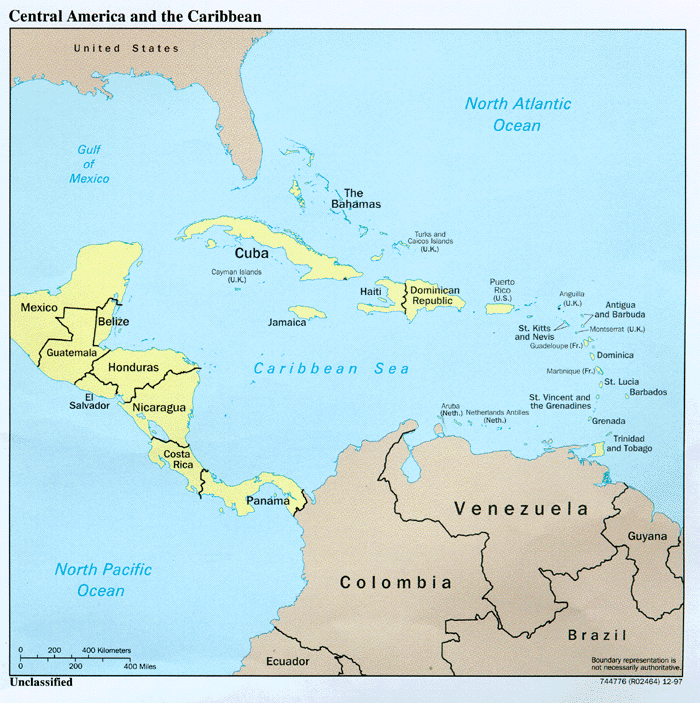
Central America and the Caribbean Map
SOUTHERN FRONT CONTRAS
What drug trafficking allegations was CIA aware of, and when,
involving Southern Front Contras? How did CIA respond to this information, and
how was this information shared with other U.S. Government entities?
The Southern Front Trafficking Reports
Agency Knowledge and Handling of Allegations of Southern Front
Involvement in Drug Trafficking
General Summary and Background. In October 1984, CIA
began receiving reporting that Southern Front ARDE leaders had agreed to assist
a Miami-based drug trafficker in bringing narcotics into the United States. The
information from this series of reports was furnished to senior officials of
U.S. intelligence and law enforcement agencies.
CIA Records. In January 1984 Headquarters received information
that indicated that helicopters purchased by Cuban-Americans on behalf of Eden
Pastora's Contra organization--ARDE--were being held in a Miami warehouse owned
by a businessman. A Miami-based Cuban-American was identified as the donor of
the helicopters. In January a Headquarters cable noted that CIA had been
advised by the FBI that Sarkis might be "subject to judicial [sic]
investigation connected with alleged illegal activities." As a result, the
Headquarters cable also advised that any Agency asset who was in contact with
Sarkis be warned that "Sarkis may be involved in alleged drug trafficking."
In May 1984, Headquarters received a cable regarding Carol Prado, a
senior ARDE official. The cable noted that there was "little to add at
this time to what has already been reported [concerning] Prado's involvement in
illegal drug and gun activities." The cable noted that the Department of
the Treasury, the U.S. Customs Service and the FBI were "aware of the
activities of this group and are watching them closely."
First Report. In October 1984, CIA received information
indicating that senior ARDE officials, including several of Pastora's close
associates--Adolfo Chamorro, Carol Prado and Gerardo Duran--had established a
working relationship with a Miami-based drug trafficker. An October 1984 cable
to Headquarters indicated that Adolfo Chamorro--Pastora's
second-in-command--had just consummated a "mutual assistance agreement"
with a Miami-based narcotics trafficker whose name was not known at the time of
the report. The cable reporting this information to Headquarters noted that:
[ARDE] would provide [ARDE] operational facilities in Costa Rica and
Nicaragua to facilitate the transportation of narcotics, and would obtain the
assistance of Costa Rican Government officials in providing documentation, in
exchange for financial support, aircraft, and pilot training for the [ARDE].
Further, the cable indicated that the unnamed Miami-based drug trafficker
had:
- Turned over helicopters to ARDE and made arrangements for a C-47 to be
flown to El Salvador; and
- Promised to pay ARDE $200,000 per month once the narcotics operations were
underway. . . .
In October 1984, a cable asked Headquarters for permission to share this
information with the local Department of Treasury office. The cable noted that
Treasury had an ongoing investigation of suspected arms smuggling by ARDE
elements in the Miami area, and that the Department had previously said that
ARDE representatives "were in contact with [a Miami-based Cuban-American].
. . who is suspected of trafficking in narcotics." No
information has been found to indicate a Headquarters response to this cable.
However the information was disseminated by Headquarters to a senior officer in
the Department of Treasury and other senior U.S. Government, intelligence, and
law enforcement officials in Washington shortly thereafter.
October 1984 Sensitive Memorandum Dissemination. In
October 1984, Headquarters disseminated a Sensitive Memorandum based upon the
information that had been provided in mid-October. All the information was
disseminated, except that a general reference to El Salvador as the destination
for the C-47 flight was substituted for the specific reference to Ilopango Air
Base.
A "Headquarters Comment" was included in the disseminated
Sensitive Memorandum that indicated it was not known "whether Pastora
himself was aware of the narcotics angle of the agreement." An additional
Headquarters Comment pointed out that confirmation had been received
that the ARDE had recently acquired two helicopters and a DC-3 transport plane.
The Sensitive Memorandum was disseminated to 13 senior U.S. Government,
intelligence, and law enforcement officials by position title. Within CIA, this
Sensitive Memorandum was also disseminated to senior officials.
Second Report. An October 1984 cable to Headquarters reported
that the name of the Miami-based drug trafficker with whom ARDE officials were
dealing was Jorge Morales. The cable restated the terms of the mutual
assistance agreement that had been reported in mid-October and added the
following details:
- On October 31, Gerardo Duran, an ARDE pilot who was flying on Morales'
behalf, was scheduled to fly from Miami to the Bahamas.
- Morales and Adolfo Chamorro were in the process of setting up "bank
accounts in Miami through which to funnel the monthly payments to the ARDE once
the working relationship between Morales and the ARDE is in full operation."
No mention was made of Pastora in this report, except to identify him as the
head of the ARDE.
November 5, 1984 Sensitive Memorandum Dissemination.
On November 3, 1984, a Headquarters cable stated that the information provided
on October 31 was being prepared for limited dissemination. Further, the cable
advised that Headquarters intended to discuss with DoJ during the week of
November 5 how to proceed regarding the handling of the source of the
information--presumably in light of the information the source had provided
regarding alleged narcotics trafficking. The cable advised that no direct
action was to be taken with regard to Pastora. The Headquarters cable noted
that:
Given the volume and the detail of the evidence we have received, it is
difficult to believe that an operation of this magnitude could be conducted
within the [ARDE] without [Pastora's] approval. We have been fastidious about
insuring that all information is passed to appropriate agencies on a timely
basis and we must avoid at all costs an accusation that [CIA] condoned narcotics
trafficking by [ARDE].
On November 5, 1984, the information provided on October 31 was
disseminated in Sensitive Memorandum format to 16 senior U.S. Government,
intelligence, and law enforcement officials by position title.
CIA Report to DoJ. On November 7, 1984, CIA General Counsel
Stanley Sporkin attached a cover memorandum to the October Sensitive Memorandum
and forwarded it to DCI Casey. Sporkin's memorandum indicated that the
information had already been shared with appropriate officials in the U.S.
Government, but stated that he intended to have OGC directly contact DoJ
Criminal Division Deputy Assistant Attorney General Mark Richard in order to
protect "the public as well as the Agency's interests." On November
19, 1984, according to a January 15, 1985 OGC memorandum, an OGC representative
orally briefed the Assistant Attorney General for the Criminal Division
regarding the information.
A November 26, 1984 OGC memorandum for the record (MFR) indicated that
OGC and DO officers had met with DoJ, FBI and DEA representatives on November 9
and November 19 to discuss the substance and implications of the information
that had been disseminated in October and November. According to the MFR, DEA
reported at the November 19 meeting that Jorge Morales was awaiting trial in
Miami, along with 13 other defendants, on federal charges of engaging in a
Continuous Criminal Enterprise. It was agreed at that meeting, stated the MFR,
that DEA would brief an Assistant United States Attorney (AUSA) in Miami about
the information and that the AUSA would be asked, in turn, to discuss the matter
with the Deputy Assistant Attorney General for the Criminal Division. Further,
the MFR stated that the CIA representatives had agreed to make the source of the
information available to be debriefed by DEA, the FBI and the AUSA.
Third Report. According to a November 1984 cable to
Headquarters, Pastora, Adolfo Chamorro and Roberto Chamorro were scheduled to
travel to Miami on that same day and that two ARDE pilots--including Gerardo
Duran--had already arrived in Miami. The purpose of this travel was for Pastora
and the two Chamorros to meet Morales. Reportedly the pilots were probably
going to undertake a narcotics-related flight on behalf of Morales.
The report also indicated:
- Adolfo Chamorro had established a bank account in Miami and that, to date,
Morales had transferred approximately $30,000 to the ARDE.
- Morales appeared to be attempting to relocate his operations from the
United States to Central America and the Bahamas.
- Morales had indicated that he occasionally met with Fidel Castro in Cuba.
According to a December 1984 cable to Headquarters, Pastora and his
associates had arrived in Miami and were staying at the home of a Miami-based
Cuban-American. Further, Pastora was scheduled to meet with Morales.
December 1984 Sensitive Memorandum Dissemination. In December
1984, the information reported in November was disseminated in Sensitive
Memorandum format to 13 senior United States Government, intelligence, and law
enforcement officials by position title.
A December 1984 OGC MFR by Assistant General Counsel Betty Ann Smith
indicated that OGC and DO officers had met on December 6, 1984 with
representatives of DEA and the United States Attorney's Office in Miami and
briefed them regarding the information that had been provided in November.
Further, according to the OGC MFR, the source of the information had been
debriefed by a DEA agent during this same meeting.
According to a December 1984 cable from Headquarters, CIA and DEA
agreed during the December 1984 meeting that the source would report on any
further ARDE/FRS narcotics trafficking. It was also agreed that subsequent
information would be shared by CIA with the DEA and the Department of Justice.
According to a December 1984 cable, Pastora had met with Morales,
Sarkis and a Miami-based Cuban-American. Reportedly Pastora said that the
meeting with Morales had not gone well. Pastora "did not like Morales'
pressuring him to immediately meet [Pastora's] end of their arrangement, which
is providing pilots and operational facilities in Costa Rica for Morales' drug
operations." No information has been found to indicate whether this
information was shared with U.S. law enforcement agencies or disseminated
outside the DO.
Eden Pastora
Background. Eden Pastora Gomez, whose "war name" was
Commandante Zero, joined the Sandinistas in the early 1970s to seek the
overthrow of Somoza. Especially popular after he stormed Somoza's National
Palace in 1978, he was nonetheless excluded in 1979 from the Sandinista National
Liberation Front's (FSLN's) nine-man Directorate and given relatively minor
positions in the post-Somoza Sandinista Government. These setbacks displeased
Pastora, and he also claimed to be dismayed by the leftward turn of the
Sandinista regime. In 1981 Pastora broke with the Sandinistas, and he went into
self-imposed exile in Costa Rica shortly thereafter.
Pastora formed the FRS in early 1982 and allied his group with several
other Contra organizations to form the Costa Rican-based ARDE in September 1982.
Pastora led ARDE's military struggle against the FSLN until July 1984, when the
organization's leadership replaced him. An ARDE spokesman attributed Pastora's
replacement to injuries received in the May 1984 bomb attack against him at La
Penca, but Pastora's leadership had also been undermined by his refusal to join
forces with leaders of the Northern Front. Pastora left ARDE in 1986 and
withdrew from the military effort.
Between early 1982 and mid-1984, Pastora was the main recipient of the
funds CIA channeled to Contras fighting on the Southern Front. However, the
funding allocated by Congress for the Contras had been expended by August 1984,
and CIA was forced to cease its material support. More comprehensive
congressional restrictions on the Agency's ability to support the Contras took
effect in October 1984 and remained in place until December 1985.
The cutoff of U.S. funding led associates of Pastora to begin looking
for alternative sources of funds. In October 1984, CIA began
receiving the reporting mentioned earlier that Southern Front leaders allied
with Pastora had agreed to help Miami-based trafficker Jorge Morales bring drugs
into the United States in exchange for his material and financial help to the
Southern Front. A subsequent October Headquarters cable instructed those
dealing with Pastora:
. . . not to take definitive action to declare the relationship with
[Pastora] terminated. Rather, we want to back away from the man leaving him
guessing as to the status of his relationship with [CIA]. . . . We do not want
to initiate contact with him under any circumstances, unless it is done for the
purpose of manipulating him towards some objective clearly consistent with
[U.S.] policy in the region.
The Agency's relationship with Pastora was one of its most significant
with a Contra leader. While the drug trafficking allegations were a factor in
the decision to terminate that relationship, the October 1984 Headquarters cable
indicated that the Agency was responding to other factors as well. CIA also
judged that the advantages of dealing with Pastora were outweighed by the poor
performance of his Southern Front fighting forces, by counterintelligence issues
arising from his contacts with the Sandinistas in Managua, and by operational
restrictions imposed by Congress.
In November 1984, Headquarters instructed that "no direct action
is to be taken with [Pastora]. Ideally, you will be able to avoid him
altogether." A November reply stated that only four meetings
with Pastora had occurred since July 1984 and that the last of these was on
October 18. At the last meeting, it had reportedly been made clear that CIA
could no longer provide any support, direct or indirect, to Pastora's
organization.
Allegations of Drug Trafficking. An October 1982 cable to
Headquarters reported that INS had received information indicating that a
meeting of Contra members was to be held in Costa Rica to discuss an exchange in
the U.S. of arms for narcotics. A November 1982 cable identified Pastora as one
of those who would be attending.
CIA began receiving reporting in October 1984 indicating that
associates of Pastora in ARDE had agreed to work with known narcotics trafficker
Jorge Morales. That same month Harold Martinez Saenz--a former deputy FRS
commander--said that he could no longer support ARDE due to Pastora's
ineffective leadership. Martinez had also stated that he did not want to become
involved in drug and arms smuggling activities and corrupt handling of money,
thus inferring that Pastora and his staff were involved in those activities.
Regarding the arrangement allegedly worked out with Morales by
Pastora's FRS associates in 1984, Adolfo Chamorro says that Pastora was not
aware of Morales' drug trafficking activities until after the meetings in
October 1984 and after Pastora himself had met with Morales in December 1984.
Cables in 1985 indicate that Pastora "temporarily discontinued" the
arrangement with Morales in early January 1985 when he realized the potential
political fallout from dealing with narcotics traffickers. Pastora
says that he ordered that the planes donated by Morales be returned when he
learned that Morales was a drug trafficker.
In April 1985, according to a Headquarters cable, the text of a
February Sandinista radio broadcast from Managua alleged that Pastora and his
associates were completing construction of three landing strips in the
Guanacaste area of Costa Rica for light aircraft to be used for drug
trafficking. The drug trafficking was being undertaken, the radio broadcast
said, to substitute for the financing that was no longer available in the wake
of a Congressional cutoff of Contra funding.
An April 1985 cable to Headquarters reported that an
employee of Alpa Airlines had said that the company was concealing cocaine in
yucca shipments destined for the United States. The cable reported that two of
the five persons reported to be owners of Alpa were Gerardo Duran and David
Mayorga. Duran had already been identified as a close associate of
Pastora. In addition, one of the planes allegedly used by Alpa Airlines was
reported to belong to Pastora and ARDE.
A December 1985 Headquarters cable stated that Adolfo Chamorro had told
a Southern Opposition Bloc (BOS) member that a Panamanian, Cesar Rodriguez, was
gathering drug money for Pastora. Rodriguez was identified in this cable as a
narcotics trafficker who had business ties to Panamanian leader Manuel Noriega.
A January 1986 cable reported to Headquarters that a Costa Rican
associate of Pastora reportedly said that he had 200 kilograms of cocaine he
wished to use in helping to finance Pastora's Contra activities.
In June 1986 and July-August 1987, CIA was told of a trip to Panama by
Jose Davila, Carol Prado and Pastora. During the trip, Pastora reportedly had
accepted $10,000 from Cesar Rodriguez, who was described as a narcotics
trafficker from Colombia.
CIA Response to Allegations of Drug Trafficking. CIA
terminated its relationship with Pastora in October 1984, within two weeks of
receiving the first reporting about ARDE's drug-related dealings with Morales.
While other factors were involved, the drug trafficking allegations weighed in
the decision.
A February 1986 cable requested an inter-Agency review of the
information implicating David Mayorga in narcotics trafficking because he was
one of Pastora's closest advisors. The same cable noted that this information "needs
to be made available to those still bent on seeing that [Pastora] is given . . .
funding." No information has been found to indicate that such a
review took place.
On March 1986, a Station asked Headquarters for specific instructions
regarding what role Pastora was to play in the Contra unification agreement.
The Station outlined the drug allegations against Pastora's associates in the
cable and stated that:
. . . .
in COS' view, a political or other kind of accommodation with [Pastora]
in which [the Agency] plays a known mediating role places [the Agency] in an
untenable and unjustifiable position for which, in COS' view, there can be no
reasonable or acceptable explanation.
. . . .
We will work through one united command structure, built around the one
which is currently in place. We [w]ill not work through the existing FRS
structure because, simply put, it is too badly penetrated by Sandinistas and too
many of the players have been associated with narcotics smuggling. We will be
willing to incorporate members from the FRS structure into t[h]e unified
structure, but only after they have been given a thorough security screening. .
. .
. . . .
Information Sharing with Other U.S. Government Entities. As
explained earlier, the reporting tying Pastora and senior members of his group
to drug smuggling operations into the United States was disseminated by CIA to a
broad range of senior USG intelligence and law enforcement officials.
OCA files indicate that the Agency forwarded to Steven Berry, Associate
Counsel of the House Permanent Select Committee on Intelligence (HPSCI), on
January 29, 1985, a response to a question regarding Pastora's possible
consummation of a working arrangement with Colombian drug dealers. The Agency
response noted that all relevant details had been reported in the program
summaries to HPSCI. The response added that:
To summarize, . . . intelligence reporting indicates that members of
Pastora's organization (FRS) have agreed--either with Pastora's direct knowledge
or tacit approval--to provide pilots and landing strips inside Costa Rica and
Nicaragua to a Miami-based Colombian drug dealer in exchange for financial and
material support. Information pertaining to Pastora's involvement in drug
trafficking has been forwarded to the appropriate Enforcement Agencies.
[sic]
On August 1, 1986, CATF legal officer Louis Dupart forwarded to CATF
Chief Fiers, LA Division Chief and LA Division Deputy Chief a MFR for a meeting
with HPSCI Staffer Mike O'Neil held on July 9, 1986 in CATF Chief's office at
O'Neil's request to discuss another topic. The memorandum stated that, in
response to other questions from O'Neil, Chief/CATF said that Pastora had
voluntarily renounced his role as a resistance leader.
On April 25, 1986, Headquarters authorized the sharing with DEA
of documents that described the October 1984 agreement between ARDE officials
and Morales. DEA reportedly planned to use the documents as background
information prior to debriefing Adolfo Chamorro in Miami.
In July 1987, a Station reported to Headquarters that, unless advised
otherwise, the Station intended to provide the local DEA office with a message
from Octaviano Cesar. The message indicated that Marcos Aguado wanted to
contact the CIA to provide specific information that tied Eden Pastora to "past
drug trafficking."
On July 31, 1987, CATF Chief Alan Fiers testified to the Senate
Select Committee on Intelligence (SSCI) concerning the allegations that Morales
had made in testimony at the Kerry Subcommittee of the Senate Foreign Relations
Committee (SFRC) regarding Contra involvement in narcotics trafficking. Fiers
discussed what CIA knew about drug trafficking allegations concerning Pastora
and a number of former FRS/ARDE members. Fiers stated that the Agency did not
have knowledge that Pastora was directly involved in the Morales narcotics deal,
but also said:
We have a significant body of evidence with regard to involvement of the
former members of ARDE in the Southern Front--Pastora's people being directly
involved in cocaine trafficking to the United States . . . .
In addition, according to SSCI transcripts, Fiers used one of his
biweekly meetings with the SSCI to share information with that Committee
regarding allegations that Southern Front personnel were involved in narcotics
trafficking. On October 14, 1987, Fiers stated to the SSCI regarding Pastora's
plans to return to Nicaragua:
We frankly don't very much care what [Pastora] does right now. We don't
think it would be a terrible problem for us. You must always remember that the
Sandinistas know what we know. This guy is a cocaine runner. Period. He ran
cocaine. And they know that and we know that and they don't want him back.
He's a hot potato for anybody.
A January 4, 1988 MFR drafted by Robert Buckman, OCA, indicated that
CATF provided a summary briefing on the Nicaraguan program for SSCI on the same
date. At that briefing, Senator Bill Bradley inquired about allegations of drug
trafficking, and Fiers responded that "Pastora had been involved with a
Colombian trafficker, but the FDN was clean."
Adolfo Jose Chamorro
Background. Adolfo Jose Chamorro Cesar, also known as "Popo,"
is a Nicaraguan citizen currently residing in Managua. He had U.S. Permanent
Resident Alien (PRA) status from 1983 until 1990, when he became the Nicaraguan
Consul General in Miami. He is the nephew of Violetta Chamorro, the
first elected president of Nicaragua after the Sandinista regime, and the uncle
of Roberto "Tito" Chamorro, another Contra figure.
Adolfo Chamorro fought in the revolution to overthrow Somoza. Following
Somoza's ouster in 1979, he served as an official of the FSLN.
Chamorro's tenure as a government minister was short-lived, however, due to his
arrest in 1981 in connection with a counter-revolutionary plot against the
Sandinista Government. He then went into exile in Costa Rica. There
he joined forces with Eden Pastora, his former FSLN commander, and the
anti-Sandinista organization ARDE. In June 1983, Chamorro became the
chief of military intelligence for ARDE.
In the summer of 1984, Eden Pastora left the ARDE and reorganized the
FRS. Chamorro followed Pastora and became the FRS Deputy Military Commander.
In October, Chamorro traveled to Miami to raise funds to support the FRS/ARDE
coalition. In October 1984, Chamorro's name was linked with possible
drug trafficking. On July 26, 1985, Chamorro broke with Pastora and
the FRS and aligned himself with the newly formed BOS.
Allegations of Drug Trafficking. The Southern Front trafficking
reports that began to be received in October 1984 stated that Adolfo Chamorro
had been instrumental in making the arrangement for drug trafficker Jorge
Morales to supply monetary support and aircraft in exchange for the use of FRS
pilots. Chamorro reportedly set up a bank account in Miami through which money
from Morales could be transferred to FRS/ARDE.
The reporting indicated that Chamorro and Morales had met again on
October 30 to discuss their concerns about who within the Contras might have
informed CIA about one of the aircraft that Morales had provided.
Another meeting between Chamorro and Morales was reportedly planned for late
November, this time to include Pastora. Chamorro says he was present
at that meeting and that no conditions were attached to Morales' offer of
support to the Contra cause.
In January 1986 cables noted that Chamorro had a relationship with
Gerardo Duran, an FRS pilot who was arrested in Costa Rica for smuggling
cocaine. Although no direct connection could be made between Duran's smuggling
activities and Chamorro, the relationship between the two men had been noted
with interest by a Central American Station and the local DEA office.
In October 1990, after the Contra war had concluded, the Miami Herald
and El Nuevo Herald carried front-page articles charging that Chamorro,
who was then serving as the Nicaraguan Consul General in Miami, had trafficked
in narcotics from 1984 to 1986. The article stated that a Colombian pilot had
testified during the trial of a Medellin drug lord that he had flown arms to
Contra forces in Central America and cocaine shipments to Florida and that
Chamorro was part of this arms/drugs network.
Chamorro characterizes his meetings with Morales in late 1984 as
appropriate since he was the director of logistics for FRS/ARDE. He maintains
that the purpose of the meetings was to discuss support to FRS/ARDE and that
neither he nor anyone in FRS/ARDE knew at that time of any drug trafficking
allegations against Morales. Chamorro states that FRS/ARDE contact with Morales
was terminated when the drug allegations became known. Chamorro says that none
of the members of FRS/ARDE were involved in drug trafficking and they never
knowingly accepted drug money. While Chamorro admits to having met
Duran on several occasions, he states that he was not aware of any agreement
between Duran and Morales. He explains, however, that Duran may have made his
own deal with Morales to ship drugs.
CIA Response to Allegations of Drug Trafficking.
By September 1986, Chamorro was one of the five BOS directorate officers.
CIA was no longer opposing BOS and was providing support. A September 1986
cable to Headquarters had noted a suggestion made to BOS leader Alfredo Cesar
that Chamorro should be interviewed by CIA Security because of his alleged
involvement with drug trafficking. In January 1987, Headquarters
instructed that it was to be emphasized to Cesar that U.S. Government funds
could not be used to support Chamorro until the allegations against him were
resolved.
Chamorro thereafter agreed to be interviewed by CIA Security. Based on
the results of that interview, CIA Security was led to believe it was highly
probable that Chamorro was involved in drug trafficking. A February
1987 cable reported that BOS had accepted Chamorro's resignation and removed him
from the BOS payroll.
Information Sharing with Other U.S. Government Entities. As
explained earlier, the 1984 Southern Front trafficking reporting was
disseminated by CIA to a broad range of senior U.S. Government intelligence and
law enforcement officials. The reporting noted that Chamorro had reached an
agreement with a Miami-based drug trafficker to provide FRS facilities to
transport narcotics in exchange for financial support, aircraft and pilot
training, named the narcotics trafficker with whom Chamorro had struck the deal
as Jorge Morales, and stated that another meeting was planned between Morales,
Chamorro and Pastora.
In January 1986, Chamorro was scheduled to travel to Washington, D.C.,
as part of a BOS delegation lobbying for support for the Contra movement. CIA
Headquarters stated in a January 1986 cable that it was "attempting to
highlight [Chamorro's] known involvement in drug activities to convince
appropriate parties to forego meetings with BOS in [Washington]."
On January 22, 1986, Acting DCI John McMahon sent letters to the Chairmen of
the SSCI and HPSCI informing them that Chamorro would be visiting members of
Congress during that week. McMahon wrote, "While I would not normally
comment on visitors to Congress, I believe it essential that I provide you with
some highly derogatory information on Chamorro . . . . Our information
indicates that Chamorro . . . has been involved in drug smuggling to the United
States." The letter went on to detail Chamorro's association with Jorge
Morales. In addition, it gave information about other contacts
Chamorro had with suspected drug traffickers and offered a briefing concerning
Chamorro's activities.
On January 24, 1986, a Central American Station informed Headquarters
that it had discussed Chamorro several times with local DEA officers. The
January 8, 1986 arrest of FRS pilot Gerardo Duran on drug charges in Costa Rica,
explained the cable, made Chamorro's connection with Duran highly suspect. The
Station stated that it had informed DEA of its interest in what Duran might have
to say about that relationship when DEA questioned him after his release, which
was "expected momentarily due to lack of Costa Rican willingness to
prosecute."
On January 6, 1986, the SSCI requested Agency comments regarding a
December 27, 1985 article in The Washington Post alleging a link between
the Contras and drug trafficking. The information from the 1984 reporting about
Chamorro and his dealings with Morales was included in CIA's January 13, 1986
reply.
On April 25, 1986, a Station requested that DEA officials be alerted
that Chamorro was due to arrive at Miami Airport after being arrested and
expelled for illegally entering Costa Rica. The Station suggested that DEA
officers in Miami might want to question Chamorro about possible drug
trafficking. According to an April 1986 cable to Headquarters,
Chamorro had been interviewed by DEA in Miami on April 25 and named others whom
he alleged to be trafficking in narcotics, but did not incriminate himself.
DEA chose to maintain contact with Chamorro, but a July 1986 Headquarters cable
declined CIA participation, asking only that DEA keep the Agency informed.
On April 15, 1986, a Memorandum entitled "Contra Involvement in
Drug Trafficking" was prepared by CIA in response to a request from
then-Vice President Bush. This Memorandum, which was delivered to Bush by a CIA
officer on April 15, 1986, was a summary of the 1984 Southern Front trafficking
reporting concerning Chamorro's and Pastora's contacts with Jorge Morales. The
CIA analyst who drafted the Memorandum says that there was no request for
follow-up regarding the reporting that was summarized in the Memorandum. The
analyst also says she was aware of no further mention of the Contras'
involvement in drug trafficking in Agency intelligence disseminations until
early 1987.
On January 21, 1987, ADCI Robert Gates provided Morton Abramowitz,
Assistant Secretary of State for the Bureau of Intelligence and Research, with a
Memorandum that had been prepared by CIA to address all allegations then known
to CIA regarding alleged Contra/drug trafficking connections. The Memorandum
included the information from 1984 regarding Chamorro and his connections to
Morales. DoS responded on February 9, 1987 by demanding that
Chamorro be removed from BOS membership, stating that "the law specifically
directs that no funds are to be distributed to or through any resistance group
that retains in its ranks any individual who has been found to engage in drug
smuggling." CATF Chief Fiers replied to DoS, in an undated
Memorandum, that CIA had taken immediate steps on learning of Chamorro's
affiliation with BOS to have Chamorro removed as a member or affiliate of BOS.
Fiers' Memorandum went on to say that CIA believed it was highly probable that
Chamorro was involved in drug trafficking, and that all relevant information
known to CIA had been shared with DEA and the FBI.
On March 10, 1987, CATF provided CIA's OGC with two cables from
February 1987 and March 1987, concerning Chamorro's "suspicious activities."
These activities reportedly included dealing in stolen electronic equipment and
allegedly warning his employees to inspect all incoming packages for drugs
because he thought the FBI was watching him. CATF recommended on a routing
sheet attached to the cables that OGC "report this information to the
Department of Justice." A handwritten, but unsigned, note attached to the
cables stated that the drug-related information was "probably reportable
but does [Chamorro] have a direct role in the activity--he hasn't admitted to
involvement." No information has been found to indicate how or
whether this question was resolved. As explained in further detail below, this
information was not reported to DoJ by OGC until January 1988.
On March 5, 1987, according to an OCA Memorandum for the Record written
by Robert Buckman, CATF Chief Fiers briefed the SSCI on the situation in
Nicaragua. Fiers told the Committee that CIA believed it was highly probable
that Adolfo Chamorro was involved in drug trafficking and that BOS risked losing
its U.S. aid "if it did not fully sever its ties with Chamorro."
On July 31, 1987, CATF Chief Fiers testified before the SSCI and stated
that CIA had "unimpeachable" information that Chamorro had planned to
meet Morales in November 1984.
On January 5, 1988, CIA General Counsel David Doherty sent a letter to
William Weld, Assistant Attorney General for DoJ's Criminal Division, informing
him that the Agency was forwarding information concerning Adolfo Chamorro in
accordance with Section 1.7(a) of Executive Order 12333. The letter stated that
Chamorro might be involved in smuggling drugs into the United States and that
the Agency had information that Chamorro might have been involved in the sale of
stolen electronic merchandise in Miami. The letter went on to say that "although
this non-employee crime is not required to be reported, . . ." the Agency
thought it sufficiently serious to share the information with DoJ.
The General Counsel's letter was brought to the attention of the Iran-Contra
Independent Counsel and DEA by Associate Attorney General Stephen S. Trott as an
enclosure to a March 17, 1988 letter to Associate Independent Counsel Guy Struve.
Roberto Jose Chamorro
Background. Roberto "Tito" Jose Chamorro, a nephew of
both former Nicaraguan President Violetta Chamorro and prominent Contra leader
Adolfo Chamorro, was a Contra commander associated with the Southern Front
forces. CIA records indicate that Roberto Chamorro first came to the attention
of the Agency in 1984 when he was FRS Chief of Operations under Pastora's
command. As of mid-1985, Chamorro reportedly was one of the FRS
commanders who favored unification with other member groups in the
anti-Sandinista forces. However, he reportedly believed that Pastora would have
to be removed from military command for this to occur. By August 28,
1986, Chamorro had aligned himself with Alfredo Cesar's BOS organization.
According to a March 1, 1989 Department of Defense (DoD) cable, Roberto
Chamorro "retired from the fight" in 1986 after learning that he would
not be a commander in UNO.
Allegations of Drug Trafficking. The October and November 1984
reporting indicated that Roberto Chamorro--along with Adolfo Chamorro and Eden
Pastora--would be attending a late November meeting with indicted drug
trafficker Jorge Morales. No information has been found to indicate
that Roberto Chamorro was actually present when the meeting took place in
December 1984.
In August 1985, Headquarters requested immediate "talking points"
regarding U.S. objectives in Nicaragua. Included in the undated
response were allegations of narcotics trafficking by some members of the FRS.
This included Roberto Chamorro, but no details were provided to substantiate the
allegation against him.
In April 1987, a cable informed Headquarters of information from a DoS
Embassy officer who reportedly had heard from a contact that Chamorro was part
of a group involved in shipping cocaine from Nicaragua via Costa Rica to the
United States. The cable reported that it had no way to evaluate the
authenticity of the information.
In July 1987, Jorge Morales testified before the SFRC Subcommittee on
Terrorism, Narcotics and International Operations that he had met Roberto
Chamorro in Costa Rica in 1984. He said he had asked Chamorro to supply him
with bodyguards, but the bodyguards were never provided. When asked whether he
had discussed drug trafficking while in Costa Rica, Morales replied
affirmatively. However, he did not identify Roberto Chamorro as one of those
with whom he reportedly had such discussions.
CIA Responses to Allegations of Drug Trafficking. In August
1986, Chamorro was interviewed by CIA Security. On the basis of that interview,
CIA Security did not have concerns about Chamorro's possible involvement in drug
trafficking. Based on subsequent security interviews in January 1987, Security
continued to not have concerns about Chamorro and drug trafficking.
Information Sharing with Other U.S. Government Entities. As
explained earlier, the 1984 Southern Front trafficking reporting included Robert
Chamorro among those meeting with drug trafficker Morales. This information was
disseminated by CIA to a broad range of senior U.S. Government intelligence and
law enforcement officials.
On July 31, 1987, CATF Chief Fiers testified before the SSCI that CIA had
a "brief period of contact" with Roberto Chamorro, the purpose of
which was "damage limitation." Fiers further stated that the Agency
was aware of Chamorro's "checkered background" but opted to "take
that tack [of having contact with him] to limit [Chamorro's] potential to do
damage" to the unification process.
A July 1987 cable to Headquarters indicated that senior ARDE/FRS pilot
Marcos Aguado wished to discuss alleged drug trafficking within Pastora's group
because Morales had reportedly implicated Aguado and Roberto Chamorro. The
Station reported that it was not going to meet with Aguado due to
counterintelligence concerns but had shared this information with the local DEA
office.
Marcos Antonio Aguado
Background. Marcos Aguado was a Sandinista Air Force pilot
(1979-1980) and then an Aeronica Airlines commercial pilot until his defection
in 1983 when he joined the Contra resistance. By September 1984, he was
appointed Chief of Air Operations for the FRS/ARDE and was a personal
pilot to FRS/ARDE leader Eden Pastora. Aguado made numerous flights over
Nicaragua to supply FRS/ARDE troops and later was named Chief of Staff of the
FRS/ARDE General Staff. Aguado, according to Eden Pastora, is also
Pastora's son-in-law. According to an April 1983 Headquarters cable,
Aguado had been offered a job flying an aircraft for the Southern Front.
A December 1984 cable advised:
. . . .
. . . [Aguado] actively assisted [two individuals], Duran and Carol
Prado in disruption of ARDE/MDN flight activities, and according to [another
asset] was being sent to Ilopango to destroy the Islander aircraft, circa July
84. In addition, [Aguado] assisted in the [Pastora] [sic] search for the Cessna
310 that crashed 9 August on [Hull's] property, and the search for the pilot and
helicopter stolen from [Pastora]. During this period, hostile threats against
[CIA], [John Hull] and the former [Southern Front] pilot were noted.
. . . .
The cable also pointed out that Aguado had not flown any missions inside
Nicaragua since September 1983. The cable also noted that Aguado "is
closely associated with" Pastora, Adolfo Chamorro and Duran; "as such
he may very well be actively participating in alleged narcotics activities . . .
or at least aware of such activities."
According to a December 1984 cable to Headquarters, Aguado "has
been designated by Pastora as one of his 18 commandantes, to be in charge of air
operations and logistics at Ilopango."
Allegations of Drug Trafficking. The first indications to CIA
of Aguado's possible involvement in drug trafficking were included in the
October 1984 Southern Front trafficking information that:
1. During a mid-October 1984 visit to Miami, Florida, Sandino
Revolutionary Front (FRS) official Adolfo "Popo" Chamorro, reached an
agreement with an unidentified Cuban narcotics trafficker whereby the FRS will
provide operational facilities in Costa Rica and Nicaragua plus assistance with
Costa Rican government officials in obtaining documentation in exchange for
financial support, aircraft and pilot training for the FRS. The Cuban . . .
made arrangements for a C-47 to be flown from Haiti to El Salvador by FRS pilot
Marco [sic] Antonio Aguado Arguello on 16 October 84.
2. The agreement with the Cuban also includes the training of two FRS
pilots in Miami. The pilots will continue their FRS duties after the training
but will also serve the traffickers by flying narcotics from South America to
the FRS provided landing fields in Costa Rica and Nicaragua. From these staging
areas the narcotics will be moved to the U.S.
. . . .
In April 1985, a Station reported to Headquarters that Aguado had
used a DC-3—the civilian designation for a C-47—to deliver supplies to
FRS/ARDE forces in southern Nicaragua on March 29, 1985.
A January 1986 cable stated that:
[Marcos Aguado] should have knowledge of the recent arrest of Gerardo
Duran Ayanegui regarding his alleged involvement in a shipment of 600
kilo[gram]s of cocaine from Jorge Morales (Colombian Mafia) to the U.S. Duran
and Morales are closely associated with [Eden Pastora], [Aguado], Carol Prado,
David Mayorga, . . . and others, all of whom, including [Aguado], are listed in
Duran's phone book. Morales supplied [Pastora] with a C-47 aircraft and other
air support; [Aguado] has piloted the C-47 for [Pastora] and is believed to
maintain close contact with the above personnel.
The next Agency reporting of a drug-related allegation against Aguado
came in an April 1986 cable to Headquarters. According to that cable, Adolfo
Chamorro "plans to denounce Carol Prado, Eden Pastora and Marco [sic]
Aguado as being the ones involved in drug-trafficking activities. Chamorro
claims to have the evidence to prove this allegation."
Headquarters was informed in an April 1986 cable that DEA had
debriefed Chamorro on April 25, 1986 and obtained no information concerning
narcotics trafficking. According to the cable, "all Chamorro wanted to
talk about were politics and war."
In April 1987, a Station relayed to Headquarters information
provided by a U.S. Embassy officer. The Embassy officer reported being told by
a contact that Aguado, along with Carol Prado, David Mayorga, Adolfo Chamorro,
Gerardo Duran, and another individual "are presently involved in shipping
cocaine from Nicaragua via Costa Rica to the United States."
In March 1988, a cable reported to Headquarters that a
suspected Guatemalan drug trafficker--Reyner Veliz Cruz--had recently been
traveling with Aguado and described Veliz and Aguado as "new inseparable
friends." Although not specifically alleging drug trafficking, the cable
reported that Veliz, with co-pilot Aguado, arrived at Ilopango air base from
Guatemala in February 1988, in a twin engine aircraft. The cable also reported
that the two arrived at Ilopango from Pavas in another twin engine aircraft
later in February 1988. Finally, the cable reported that Veliz and Aguado
arrived at Ilopango in March 1988 in the same twin engine aircraft after customs
officials had departed and the airfield was supposedly closed. The same cable
noted that Aguado could not obtain a U.S. visa due to his suspected links in the
past with drug traffickers. However, Aguado reportedly "has bragged that
he still works for CIA" and "the customs personnel at Ilopango assume
that Aguado has connections with drug trafficking, as well as good contacts
within the Salvadoran Air Force . . . ." In this cable, the Station stated
its approval to share the information with DEA personnel in Guatemala.
Enrique Miranda Jaime, a convicted drug trafficker, claims
that Aguado flew weapons to Medellin, Colombia, during the 1980s and returned
with cocaine that he stored at Ilopango. Miranda also alleges that Aguado was
involved with Norwin Meneses and the movement of narcotics through Nicaragua.
No information has been found to support Miranda's allegations.
CIA Response to Allegations of Drug Trafficking. No
information has been found to indicate that CIA ever attempted to develop
additional independent information that would confirm or refute the allegations
against Aguado. No information has been found to indicate whether CIA
considered, or the reasons why they may have decided not to take, such steps.
Information Sharing with Other U.S. Government Entities. The
October 1984 reporting included information about Aguado's
alleged role in moving a C-47 from Haiti to El Salvador. This information was
disseminated as a sensitive memorandum to senior U.S. Government intelligence
and law enforcement officials.
According to a SSCI transcript entitled CIA Briefing on Drug
Running, CATF Chief Alan Fiers, briefed SSCI Staff members on July 31, 1987
concerning allegations of Contra involvement in drug trafficking. The
transcript shows that Fiers included information relating to Aguado in this
briefing and described Aguado's alleged involvement in the October 1984
Morales-Chamorro agreement.
The transcript shows that Fiers also detailed for the SSCI Staff
members Aguado's role in taking possession in Haiti of the C-47
aircraft provided by Morales that was later used by Aguado in March 1985 to
deliver supplies to ARDE forces. In the briefing, Fiers also provided the SSCI
Staff members with a summary of information concerning four or five flights by
Gerardo Duran to Miami on behalf of Morales.
Gerardo Duran
Background. Gerardo Duran was a Costa Rican national who had
close ties to Southern Front Contra personalities, including Eden Pastora, Carol
Prado, Adolfo Chamorro, Jose Robelo, and Marcos Aguado. He served as a personal
pilot for Pastora from 1984 until sometime in early 1985. He was employed as
chief pilot for the Costa Rican-based aviation company, Alpa Aerolineas del
Pacifico Fumigacions (Alpa Airlines), between 1985 and 1986.
Allegations of Drug Trafficking. CIA first received allegations
of Duran's possible involvement in drug trafficking in the October 1984 Southern
Front trafficking report. That report included
information that Duran was scheduled to make a flight for Jorge Morales in
October 1984 from Miami to the Bahamas.
In November 1984, a cable informed Headquarters that Duran and another
pilot were in Miami. According to the cable, the presence of Duran indicated a
flight to move narcotics from Colombia to the Bahamas was imminent.
In December 1984, a cable advised Headquarters of allegations that Duran
had recently returned to Costa Rica, had access to a Cessna 404 Titan aircraft
and appeared to be involved in drug trafficking.
A February 1985 cable to Headquarters reported a possible connection
between Duran and Pedro Portu, who "has a well-known background in
narcotics trafficking." In February 1985, a Station reported to
Headquarters that, according to "Popo" Chamorro, Duran was aboard an
FRS Baron aircraft that had crashed in the Pacific Ocean while transporting an
aircraft generator from Pavas airfield in Costa Rica to Ilopango air base in El
Salvador. According to the cable, Marcos Aguado "believes that Duran was
on another type of mission, possibly drug related."
A March 1985 cable to Headquarters reported that "both
[Adolfo] Chamorro and Geraldo [sic] Duran have accompanied [Jorge]
Morales to the Bahamas to look over his operations." The cable noted that
a belief "that Duran and Quesada [sic] travelled to the Bahamas
from Miami and made flights for Morales."
In March 1985, a cable noted that Duran had been suspected of
making drug running flights to Miami and the Bahamas. Further, the cable stated
that the "local [DEA] rep[resentative] reported that Duran is on their
records as a trafficker and also for involvement in running Cubans into Mexico."
An April 1985 cable to Headquarters reported that Marcos
Aguado had said that "Duran is suspected of being involved in drug
trafficking . . . ." The cable did not, however, state why Duran was
suspected of drug trafficking.
An April 1985 cable listed several names and noted that the majority of
the reporting available to CIA concerning the listed persons, including Duran,
had to do with alleged connections to narcotics trafficking. Also in April
1985, a cable to Headquarters reported that an employee of Alpa Airlines
suspected that the company was transporting cocaine to the United States in
yucca shipments and noting that Duran was the "chief pilot" for Alpa
Airlines.
In May 1985, a Station sent a cable to Headquarters that summarized
reporting from two sources regarding the involvement of FRS personnel in
narcotics trafficking. It noted that, although there was "a lack of hard
evidence," Duran was one of "the two individuals consistently named by
both sources" as being involved in narcotics trafficking.
A May 1985 cable to Headquarters noted that, according to a
contact, "Duran was on a drug flight when he ditched the Baron . . . in the
Pacific [Ocean]." This was an apparent reference to the crash of an
FRS-owned Baron aircraft while en route from Costa Rica to Ilopango air base in
El Salvador that was described in a February 1985 cable.
A July 1985 cable to Headquarters noted suspicions that Alpa "is
being used as a front for narcotics operations," and that reportedly on
June 8 David Mayorga had said that:
… the 150 kilograms of cocaine that were captured near Barra Del
Colorado, Costa Rica . . . in a Cessna Citation . . . were destined for
Frudaticos to be packed into yucca for delivery to the U.S.
The cable also reported that there were suspicions "that Sergio
Sarcovik and [Carlos] Vikes arranged for the pilots of this aircraft to leave
the country, probably in the Cessna 206 . . . with Gerardo Duran as the pilot."
In January 1986, Duran was arrested by the Costa Rican Office of
Judicial Investigation (OIJ) for his alleged involvement in cocaine trafficking.
His arrest was the focus of a number of cables. A January 1986 cable
advised Headquarters that:
[Marcos Aguado] should have knowledge of the recent arrest of Gerardo
Duran Ananegui regarding his alleged involvement in a shipment of 600
kilo[gram]s of cocaine from Jorge Morales (Colombian Mafia) to the U.S.
In January 1986, Headquarters sent a cable asking for a
query to be made to the local DEA offices for information they might have
linking Gerardo Duran, "Popo" Chamorro, Jorge Morales, and David
Mayorga to narcotics trafficking. A January 1986 cable to
Headquarters stated:
. . . Gerardo Duran, who is presently in jail after witnesses put him at
the scene of a 600 kilo[gram] coke deal in Guanacaste, is Costa Rican, not
Nicaraguan. We have reported on his recent arrest.
In January 1986, Headquarters sent a cable that stated:
Please provide whatever details are available . . . on ref[erenced]
arrest of Gerardo Duran for alleged involvement in smuggling of 600 kilo[gram]s
of cocaine to the United States. FYI: [w]e reported [Chamorro's] involvement
in drug smuggling to Co[n]gress via [DCI] letter to Intelligence Committee
Chairmen. Letter included reference to Duran arrest and we would appreciate
details in event there is follow up inquiry from Congress.
In January 1986, a cable to Headquarters noted obtaining
from DEA a copy of the OIJ report of Duran's arrest and provided information
based on that report. The cable stated that Duran was arrested on January 8,
1986 and had admitted to loading "bundles"—the cable did not
specify that the bundles included narcotics—onto an aircraft at Tamarindo
airport in Guanacaste Province in December 1985. The cable stated further:
[OIJ] is still holding Duran but the decision to try him is pending.
[Headquarters] will recall that [Manuel "Pillique"] Guerra and
[Pastora] are quite close. In any event, [DEA] is certain they can get an
indictment of Duran in Miami and they are pursuing that goal.
A cable to Headquarters in March 1986 stated:
Gerardo Duran, a [Pastora] pilot who [DEA] says was introduced to major
narcotics trafficker Jorge Morales by [Pastora], is known by [DEA] to have
participated in the air shipment of several hundred kilo[gram]s of cocaine from
Liberia (Costa Rica) airport to the West Indies for onward shipment to the U.S.
Duran himself was arrested by Costa Rican authorities for in-country possession
of seven kilo[gram]s of cocaine and [DEA] is pursuing that case . . . and with
the U.S. attorney.
According to an April 1987 cable, the Costa Rican press
reported that "Duran was re-arrested this last week as a suspect in having
helped transport 450 kilo[gram]s of cocaine through Costa Rica." The cable
did not specify the destination of the cocaine. According to the cable, Duran
was "first arrested in December 1985 with the same charge, but skipped
bail." The cable also noted that Costa Rican "authorities suspect
Duran of having ties with a smuggling ring which has used numerous airstrips in
Guanacaste Province (Costa Rica) for clandestine drug flights."
CIA Response to Allegations of Drug Trafficking. In May 1985,
a cable advised Headquarters that "the Station is attempting to
gather solid evidence . . . to confirm alleged weapons and/or narcotics
trafficking by Duran and his [Contra] associates." The cable also
suggested that:
It would be useful if future messages regarding alleged
narcotics/weapons trafficking indicate approval of passage to [DEA], or whether
the data is already shared with [DEA] office.
No information has been found to indicate that Headquarters responded to
this suggestion.
In January 1986, Headquarters sent a cable asking Stations to "query
local [DEA] offices for information they may have linking the following
[including Duran] to involvement in narcotics trafficking." A Station
responded in January 1986, saying:
[DEA] is aware of our interest in what Duran has to say about [Eden
Pastora] and [Popo Chamorro] involvement in trafficking and will question him
again after he is released. His release is expected momentarily due to lack of
Costa Rican willingness to prosecute. However, [DEA] plans to prosecute him
under a . . . law dealing with international trafficking; they think they can
make the case stick, whereas [the Costa Ricans do] not.
A January 1986 response from another Station stated:
[DEA] records indicate that Gerardo Albert [sic] Duran Ayaneque,
[sic] . . . was arrested for cocaine smuggling in January 1986. He had
previously been suspected of smuggling drugs via aircraft in September 1985 . .
. . Additional information on Duran is available to [DEA]/Miami case agent. If
desired, please advise.
No information has been found to indicate any response by Headquarters to
the cable.
Information Sharing with Other U.S. Government Entities. As
explained earlier, the 1984-85 reporting that included information about Duran's
alleged participation in the Morales-ARDE narcotics trafficking discussions was
disseminated to a broad range of senior U.S. Government intelligence and law
enforcement officials.
A January 24, 1986 letter from ADCI John McMahon notified
the SSCI and HPSCI that CIA had information concerning Adolfo Chamorro's
involvement in narcotics smuggling. The letter reported Duran's arrest in Costa
Rica for his alleged involvement "in a shipment of 600 kilo[gram]s of
cocaine from [Jorge] Morales to the U.S." This letter was followed by a
Headquarters cable requesting:
. . . whatever details are available to Station on ref[erenced] arrest
of Gerardo Duran for alleged involvement in smuggling of 600 kilo[gram]s of
cocaine to the United States. FYI: [w]e reported [Popo Chamorro's] involvement
in drug smuggling to . . . Intelligence Committee Chairmen. Letter included
reference to Duran arrest and we would appreciate details in event there is
follow up inquiry from Congress.
As mentioned earlier, the Station responded in January 1986 with
a cable providing Headquarters with details regarding Duran's arrest.
An April 1986 CATF cable included detailed information
concerning the 1984 arrangements between Chamorro and Morales. The cable also
detailed Duran's 1986 arrest in Costa Rica as background material for an
interview of Chamorro and authorized sharing the information with the local DEA
office.
On January 21, 1987, ADCI Robert Gates forwarded to Ambassador Morton
Abramowitz, Assistant Secretary of State for Intelligence and Research, a
memorandum that discussed allegations in CIA's possession regarding connections
between drug traffickers and members of the Contras. This memorandum included
Duran's connection with Morales, as well as his arrest in January 1986 "by
Costa Rican authorities for his alleged involvement in transporting 600
kilo[gram]s of cocaine to the United States for Jorge Morales."
On November 2, 1988, DEA sent a request to CIA for any
information in CIA's possession concerning four people, one of whom was Duran.
On December 14, 1988, CIA responded that it had no relevant
information that had not been provided previously to DEA.
Alfonso Robelo
Background. Alfonso Robelo was active in Nicaraguan
politics for over 30 years. He was an original member of a five-person ruling
junta of the Sandinista Government, a Southern Front Contra political leader and
later Ambassador to Costa Rica during the presidency of Violetta Chamorro.
Robelo's opposition to the Sandinistas crystallized in mid-1980 when he resigned
his position on the Sandinista Council of State to protest the Council's
expansion and addition of FSLN members. By early 1982, Robelo--along
with Eden Pastora and Brooklyn Rivera--formed ARDE.
Allegations of Drug Trafficking. An October 1984 cable to
Headquarters reported that a Sandinista newspaper, El Nuevo Diaro, had
stated on October 10, 1984 that Robelo and ARDE had accepted help from an
unidentified drug trafficker in Miami. The article also said that two FRS/ARDE
helicopters had been painted with a black substance to make them invisible to
radar.
In June 1987, CIA learned that Robelo had been contacted by two
Bolivians--Enrique Crespou and Fernando Perou--who had offered to make a "significant"
monetary contribution to the Contras. Robelo said that they offered $150
million to the Contras with "no strings attached." Robelo said that
the Bolivians were evasive in their answers about the origins of the funds.
Robelo was advised not to accept any money from the Bolivians until its origins
could be determined.
CIA Response to Allegations of Drug Trafficking. No information
has been found to indicate that CIA took any actions to follow up on the 1984
Sandinista newspaper allegation that Robelo and ARDE were involved in dealings
with a drug trafficker.
In October 1988, a cable reported to Headquarters that Perou and Crespou
had been accused during a press conference by Roberto Suarez Levy, son of
imprisoned cocaine "king" Roberto Suarez Gomez, of being CIA agents.
Suarez Levy also alleged that CIA and DEA were operating a cocaine lab in "Huanchaca,"
Bolivia. A Headquarters response stated that the only relevant information it
had regarding Perou and Crespo was that they had met with Robelo in June 1987
and offered him $150 million for the Contras.
Robelo says he does not recall the meeting with the Bolivians or their
reported offer of $150 million. He does not deny that the meeting may have
taken place, but states that he participated in approximately 10 situations when
people offered to donate large sums of money to the Contras but did not do so.
Information Sharing with Other U.S. Government Entities. No
information has been found to indicate that CIA informed U.S. law enforcement or
other agencies or the Congress about the 1984 Sandinista newspaper allegation.
CIA informed Congress about the alleged offer of $150 million from the Bolivians
in 1997 in the context of another matter.
Jose Salvador Robelo
Background. Jose Salvador Robelo Ortiz was a major
figure in the Sandinista Party, serving first as an insurgent and later as a
Sandinista Government official. By 1981, he devoted his full attention to
Nicaraguan Democratic Movement (MDN) activities in San Jose with his cousin,
Alfonso Robelo. His brother was Silvio Robelo, who was imprisoned by
the GRN. Circa 1983, Jose Robelo became the Air Operations
Coordinator within ARDE. He was later put in charge of maritime operations.
Robelo gained a reputation for being disruptive and was considered to be of
dubious reputation by the FDN. In September 1985, he was suspended
indefinitely as Chief of UNO/Nicaraguan Revolutionary Armed Force (FARN)
operations as a result of an internal investigation that held Robelo fully
responsible for ordering the torture and execution of an alleged Popular
Sandinista Army collaborator in August 1985. Although it is unclear
when, Robelo later became active with the Southern Front again.
Allegations of Drug Trafficking. The first allegations of
Robelo's involvement in drug trafficking were received by CIA in December 1984
when he was identified as a continuing associate of Jaime Ibarra Pasos, a.k.a.
Pachelli. Pachelli was reportedly a known drug dealer in San Jose who
trafficked approximately two kilograms of cocaine each month within Costa Rica.
Pachelli was reportedly a close associate of Sebastian Gonzalez.
Also in December 1984, a CIA contact said that Gerardo Duran, a
part-time FRS pilot, had recently returned to Costa Rica and had access to a
Cessna 404. According to the contact, Duran reportedly had flown missions for
Pastora and Robelo and might be involved in drug trafficking activities.
In April 1985, a cable reported that Robelo was associated with David
Mayorga and another individual. Mayorga and the other individual reportedly
were involved in drug trafficking.
In May 1985, a cable provided Headquarters with a summary overview of
involvement of FRS personnel in narcotics trafficking. According to that
overview, an ARDE Islander aircraft had made several trips to Miami and one to
the Dominican Republic carrying Adolfo "Popo" Chamorro, who was
implicated in drug trafficking. This aircraft reportedly was under the control
of Robelo at the time. There was no indication of involvement by FRS personnel.
The April 17, 1989 edition of the Nicaraguan newspaper La Republica
included a story that international agencies had published statements, based on
information from the SFRC, that Robelo was involved in drug trafficking. The
accusations of his involvement were based on comments made to the SFRC by Robert
Owen. In the story, Robelo reportedly denied participation in any drug-related
activities and criticized Owen because his statements were unfair and Robelo
could not defend himself. Robelo also reportedly emphasized that he always
adhered to the laws and would be willing to answer any questions in order to
prove his innocence.
CIA Response to Allegations of Drug Trafficking.
A January 1987 cable to Headquarters noted that Robelo had been alleged
historically to be involved in narcotics trafficking and that the Station had
successfully obtained Robelo's severance from all Contra elements. A
September 7 cable to Headquarters describing Robelo noted that "in the past
[Robelo] has been accused of possible involvement in narcotics trafficking to
support the Nicaraguan resistance military efforts."
Sharing of Information with Other U.S. Government Entities. No
information has been found to indicate that any of the information available to
CIA regarding Robelo's alleged involvement in drug trafficking was shared with
other U.S. Government agencies or the Congress.
Octaviano Cesar
Background. During the 1980s, Octaviano Cesar, brother of BOS
leader Alfredo Cesar, played a role in the Southern Front. Agency officers met
occasionally with Cesar--usually in the United States--to gather information and
to help promote unity among the Southern Front groups. These infrequent
meetings ended after Cesar was interviewed by CIA Security in April
1987. Based on this interview, CIA believed it was highly probable that Cesar
was involved in drug trafficking.
Allegations of Drug Trafficking. The October 1984 Southern
Front trafficking reporting noted that Miami-based drug trafficker Jorge Morales
had a relationship with Octaviano Cesar and that Cesar had unsuccessfully sought
to sell Morales blank Nicaraguan passports for $5,000 each. A
second report claiming that Cesar had a relationship with Morales was received
by Headquarters in January 1985 when Morales reportedly had described Cesar as a
close friend.
On April 6, 1987, the CBS television program West 57th Street
related allegations by Morales that Octaviano Cesar was his link to high levels
of the U.S. Government regarding drug and arms smuggling.
Further, the program reported that Cesar had accompanied Morales and Adolfo
Chamorro on a trip to the Bahamas in late 1984, with Cesar and Chamorro agreeing
to Morales' request that they carry checks for large sums of money through U.S.
Customs on their return.
An April 1988 cable notified Headquarters that Octaviano Cesar had been
arrested by Costa Rican authorities. The charges were described as credit
payment default to a local business. There was a suggestion made
that the arrest was part of a harassment campaign by Costa Rican authorities due
to Cesar's alleged ties to drug trafficking.
CIA Response to Allegations of Drug Trafficking. As mentioned
earlier, CIA disseminated the October 1984 information regarding Octaviano
Cesar's links to Morales as a sensitive memorandum. Cesar was forced by CIA to
resign from BOS, although he continued for some time thereafter to be involved
in the group's affairs. In April 1987 CIA received a letter from
Octaviano Cesar in which he denied the accusations by Morales and put
himself at the disposal of the U.S. Government to proceed with any investigation
that would clear his name.
In April 1987, Octaviano Cesar was interviewed by CIA
Security. Cesar was asked about his past association with Morales
and allegations of drug trafficking. He reportedly stated that he had first
been introduced to Morales around 1984 by Adolfo Chamorro's former wife,
Marta Healy, and that he had been involved in additional meetings concerning
Morales' offer of aircraft to the Southern Front forces. Regarding the 1984
trip to the Bahamas, Cesar said that the purpose was to test the flying skills
of Marcos Aguado, and that he did not know of any other specific purpose until
the return flight when Morales asked Cesar and Chamorro to claim when clearing
U.S. Customs that several checks were theirs. Cesar reported that he had
suspected that Morales was involved with drug money, but that his desire to help
the Southern Front drove him to work with Morales. Cesar reportedly
denied ever using or taking any money from Morales, except reimbursement for
travel expenses. Cesar reportedly also said that Marta Healy had contacted him
in late 1986 with a request from Morales that Cesar testify in the United States
that Morales' drug trafficking had been undertaken to assist the Contra
resistance. Cesar said that he had refused this request.
Based on Cesar's interview, CIA Security believed it was highly probable
that Cesar was involved in drug trafficking and involved in taking money from
Morales. On May 4, 1987, CATF Chief Fiers prepared and sent a detailed report
to Elliott Abrams, Assistant Secretary of State and Chairman of the Interagency
for Nicaragua, regarding concerns about Cesar and drug trafficking.
On July 21, 1987, Headquarters instructed several Latin America Stations
to advise all personnel who were talking with Alfredo Cesar that Octaviano Cesar
must avoid even the appearance of being involved in BOS activities.
That same month, Alfredo Cesar agreed to bar Octaviano from serving in any
official or unofficial BOS capacity.
A cable notified Headquarters in September 1988 that Cesar had informed
Southern Front leaders that he intended to return to a prominent role in the
resistance. This was reportedly because he had received a letter from the SFRC,
signed by SFRC Chairman Senator John Kerry, absolving Cesar of all drug
trafficking charges.
Information Sharing with Other U.S. Government Entities. As
explained earlier, the 1984 reporting, which included the information connecting
Cesar to drug trafficker Jorge Morales, was disseminated to a broad range of
senior U.S. Government intelligence and law enforcement officials.
An unsigned memorandum dated April 15, 1987 indicated that CIA had
notified DEA's Miami office in January 1985 of Cesar's close association with
Morales. The Agency informed DoS of suspicions regarding Cesar's
involvement in drug trafficking in a July 20, 1987 memorandum from the Deputy
Director for of the Office of African and Latin American Analysis of the CIA
Directorate of Intelligence (DI), to Ambassador Morton Abramowitz, Assistant
Secretary of State for Intelligence and Research. The memorandum responded to a
DoS request for information concerning alleged Contra-drug trafficking
connections and stated that Cesar was probably involved in the Morales and ARDE
narcotics-related arrangements. It further stated that Cesar had resigned from
BOS following public accusations of his involvement in drug trafficking.
Attached to the memorandum was a copy of the January 21, 1987 memorandum
concerning alleged Contra-drug trafficking connections that had been sent to
Abramowitz by ADCI Gates.
On April 30, 1987, CATF Chief Fiers briefed the SSCI regarding the
Contra program. As described in a May 1, 1987 Memorandum for the Record, Fiers
explained the background of allegations of Contra involvement in drug
trafficking dating back to November 1984. He added that Octaviano Cesar had a
close relationship with Morales, was interviewed by CIA Security when this
connection became known and that the focus of the interview related to concerns
about drug trafficking.
According to a July 31, 1987 Memorandum for the Record, Fiers briefed
the SSCI and a HPSCI Staff member that same day and stated that Cesar had been
interviewed regarding drug trafficking when the Morales allegations arose.
Fiers said CIA believed it was highly probable that Cesar was involved in drug
trafficking. Fiers noted that this was reported to DoS and that the Agency had
informed Cesar's brother Alfredo that Octaviano Cesar must step down from his
BOS leadership role immediately.
Edmundo Jose Chamorro
Background. Edmundo Chamorro was, like his brother Fernando
Chamorro, one of the principal members of the Eleventh of November movement that
was involved in armed opposition to the Somoza regime in Nicaragua in the 1970s.
A March 1981 cable informed Headquarters that Edmundo Chamorro had become one
of the leaders of UDN/FARN.
In a July 1, 1982 cable, Headquarters expressed "grave doubts"
about Edmundo Chamorro's reliability and security consciousness. A
January 1983 cable informed Headquarters that a senior UDN/FARN member had
expressed concerns that Edmundo Chamorro was engaged in the "misuse of
[resistance] funds and inciting the people to premature guerrilla and sabotage
acts." In early February, Fernando reportedly removed Edmundo
from the movement. In April 1983, a Headquarters cable indicated
that Edmundo Chamorro had "no leadership position of any sort in the UDN
and has been excluded from active participation in the group's activities."
The cable went on to say that Edmundo had "some serious character defects"
and that his remarks were "often motivated by insecurity and
vindictiveness."
In response to a January 1986 request from Headquarters for updated
information concerning Chamorro, a cable provided background information
regarding Chamorro's "baggage." No information has been
found to indicate any CIA contact with Edmundo Chamorro after 1983.
Allegations of Drug Trafficking. A June 1986 cable to
Headquarters stated that a local newspaper had published an article linking
Edmundo Chamorro with drug traffickers. The Costa Rican Judicial Police
reportedly had wiretapped conversations between convicted drug trafficker
Horacio Pereira and Contra commander Sebastian Gonzalez Mendieta. The
transcripts of the wiretaps allegedly indicated that Pereira and Gonzalez
discussed the participation of several Contra leaders, including Edmundo
Chamorro, in drug smuggling operations. In one conversation, Gonzalez
reportedly advised Pereira to seek Edmundo Chamorro's assistance in providing
logistics for drug transport.
CIA Response to Allegations of Drug Trafficking. Upon learning
of the Costa Rican newspaper allegations against Edmundo Chamorro, a June 1986
Headquarters cable asked for copies of the Pereira/Gonzalez wiretap transcripts
that were mentioned in the article. Headquarters commented that "as it
stands now it appears we are dealing with innuendo rather than hard facts about
Edmundo and his connection to Gonzalez." In July 1986,
Headquarters again cabled and stated, "Allegations of drug trafficking
continue to plague our operations. Request status of . . . attempt to obtain
[referenced] transcripts." A July 1986 reply expressed doubt
that they could be obtained since they were being held as evidence to be used in
court. No information has been found to indicate that the
transcripts were pursued any further.
Information Sharing with Other U.S. Government Entities. No
information has been found to indicate that any information regarding Edmundo
Chamorro's alleged involvement in drug trafficking was shared by CIA with any
other U.S. Government entity or the Congress.
Fernando Jose Chamorro
Background. Fernando "El Negro" Chamorro Rappaccioli,
brother of Edmundo Chamorro, began his revolutionary career in the 1960s as the
leader of a militant anti-Somoza organization known as the Eleventh of November.
Although Fernando Chamorro's group was non-Marxist in doctrine, it worked
closely with the FSLN to oust Somoza. In September 1978, Chamorro
was arrested by the Somoza Government for anti-government activities. He was
released, along with other political prisoners, in response to demands by FSLN
activists who took over the National Palace in Managua. Upon his
release, he left Nicaragua and was granted political asylum in Costa Rica.
As of January 1982, Fernando Chamorro was based in Honduras and was
playing a major role in the Contra movement. He was a leader of both the UDN
and FARN--the military arm of UDN.
CIA contact with Chamorro began in 1982, but according to a March 1985
cable to Headquarters, Fernando Chamorro's "ineffective actions" had
negatively influenced his relationship with the Agency. Thus, Station suggested
that CIA sever its contact with him.
An April 1986 cable informed Headquarters that Carlos Calvo, a former
member of UDN/FARN, had been arrested at the Miami airport in October 1984 for
attempting to leave the United States with $250,000 concealed in his clothing.
According to the source, Calvo told the U.S. Customs Service that the money had
been raised to support UDN/FARN and Fernando Chamorro had written a letter
corroborating Calvo's story. A September 1986 cable verified to
Headquarters that, although Fernando Chamorro reportedly had no previous
knowledge of the money and no claim to it, he wrote a letter on Calvo's behalf
on March 22, 1985 informing Customs that the money was meant to "help in
the vital costs of the armed struggle for the liberation of Nicaragua."
The letter also asked for assistance "in obtaining these, our sacred funds
back." The money was not released by Customs. According to the
September 1986 cable, Chamorro admitted that he believed Calvo was involved in a
money laundering operation, but said that he did not believe that the money was
drug-related. He rationalized that "if the money was going to
be lost, it might as well go to a worthy cause."
A December 1986 cable to Headquarters reported that Chamorro had become
the Southern Front Commander for UNO in December 1986. According to
a December 29, 1986 cable to Headquarters, that "difficult as it may be to
understand, [Chamorro] continues to hold considerable sway on most of the [UNO]
commanders in the south." Fernando Chamorro resigned from UNO's
political and military structures in March 1987.
A December 1987 cable informed Headquarters that Chamorro's wife had been
diagnosed with a malignant brain tumor. In August 1988, Chamorro was
hospitalized after suffering a cerebral hemorrhage and subsequently died. Later
that month, his wife died.
Allegations of Drug Trafficking. On March 16, 1986, the
San Francisco Examiner published a story alleging that a UDN/FARN
official--Francisco Aviles--had three years previously been involved in writing
a letter to the San Francisco U.S. Attorney requesting that $36,000 seized from
California-based drug trafficker Julio Zavala be returned to Zavala because it
was Contra money. An April 1986 cable to Headquarters stated that Chamorro had
questioned Aviles about the allegation after learning of the story. When Aviles
could not provide satisfactory answers, Chamorro reportedly expelled him from
the UDN/FARN. No information has been found to indicate that Chamorro was aware
of Aviles' actions prior to 1986, or that Chamorro himself had ever been tied to
California-based drug trafficker Julio Zavala.
A June 1986 cable stated that reportedly in August or September 1984 "Costa
Rican drug trafficker Norvin [sic] Meneses sought the cooperation of 'El
Negro' [Fernando Chamorro] to move drugs" to the United States.
CIA Response to Allegations of Drug Trafficking.
In March 1986, when the San Francisco Examiner published its story
linking Aviles to Zavala and a California drug trafficking ring, CIA began an
immediate inquiry into the matter. An April 1986 Headquarters cable was sent to
several Stations asking for all available information regarding the allegation
that Aviles, a member of UDN/FARN under Fernando Chamorro, provided funds to
Zavala. The cable stated that "we must act swiftly to ascertain the true
facts. . . . We need to get the entire story immediately." In
April 1986, a Station informed Headquarters that it had ascertained that Aviles
was not personally associated with Chamorro, but served in the UDN/FARN as a
human rights representative. Another Station reported in April that
the FBI had found no evidence to link Zavala and the other arrested drug
traffickers with Contra groups. A third Station also reported to
Headquarters in April that its inquiry indicated that Chamorro had no links
with, or knowledge of, any of those who had been arrested in connection with the
California drug trafficking ring. According to an April cable to Headquarters,
Chamorro stated that:
UDN/FARN has never accepted large denominations of monies from any
organization which did not first state the source of the contributions;
Francisco Aviles was not involved in Southern Front activities in 1983 - the
timeframe [of the California arrests]; . . . and Aviles has been informed
verbally that he has been expelled from UDN/FARN, a written order to follow
shortly.
No information has been found to indicate that CIA took any actions to
follow-up or verify the June 1986 allegation that Costa Rican drug trafficker
Norwin Meneses had sought Chamorro's cooperation to move drugs to the United
States.
Information Sharing with Other U.S. Government Entities. An
April 1986 Headquarters cable stated that DoS had been advised of the San
Francisco Examiner story and of the Agency's findings regarding Chamorro's
actions against Aviles. According to an April 1986 Station cable to
Headquarters, the story was also the subject of discussions between that Station
and the FBI's Field Office.
In February 1988, Chamorro was the subject of an ongoing criminal
investigation by the FBI that reportedly had been initiated on the basis of
information that a Station had provided to Headquarters in a July 1987 cable for
passage to DoJ. According to the July cable, Chamorro allegedly had purchased
several vehicles with funds that were intended for humanitarian aid. The cable
requested that Headquarters "inform [FBI] and [DoJ] of [Chamorro's]
appropriations of [Contra] property." No information has been
found to indicate whether or how this request was acted upon by Headquarters.
No information has been found to indicate that information regarding
Chamorro's alleged involvement in drug trafficking was shared with other U.S.
Government entities or the Congress.
Sebastian Gonzalez
Background. Sebastian Gonzalez Mendieta (a.k.a. "Commandante
Wachan") was a veterinarian by training who was involved in the effort to
overthrow Anastasio Somoza in the late 1970s. He served briefly--in assignments
relating to agricultural issues--in the post-Somoza Government established by
the Sandinistas. However, Gonzalez claimed in 1981 that he had become
disillusioned with the leftward turn of the Sandinista regime and relocated to
Panama. There he joined forces with Eden Pastora and other disaffected
Nicaraguans.
During the early period of the Contra resistance, Gonzalez was initially
associated with ARDE, primarily as a logistics coordinator, and played a liaison
role between ARDE and the Panamanian Defense Forces (PDF). By late 1983,
Gonzalez' relationship with ARDE had deteriorated, however, and he attempted to
form a small band of fighters known as the Third Way Movement. Gonzalez
subsequently moved to Panama and gradually lost touch with the Contras.
Allegations of Drug Trafficking. A September 1984 cable to
Headquarters, based on indirect information from Fernando Chamorro, alleged that
Gonzalez had used several flights to Costa Rica from Panama to carry cocaine
along with the communications gear he was transporting for the ARDE. The cable
went on to report that Gonzalez had stored 11 kilograms of cocaine in Liberia,
Costa Rica, and had taken 10 of those kilograms to an unknown location.
According to the cable, Chamorro had also said that Panamanian leader Manuel
Noriega, as well as Gerardo Hidalgo Abaunza--who was arrested by the Government
of Costa Rica while in possession of the one additional kilogram of cocaine that
Gonzalez had stored--were involved in the drug trafficking operation.
In late September 1984, a cable reported to Headquarters that a Costa
Rican press report stated that Gonzalez and another individual were involved in
a flight that had crashed in the Pacific Ocean the previous week. It was
implied that the plane, a Cessna 182 connected to Pastora's group, had no
apparent business in the area of the crash and the crash would be investigated
by the Government of Costa Rica.
In February 1985, a cable to Headquarters stated that Gonzalez
was "well known in police circles in Costa Rica," and that it was
likely that the case involving Hidalgo's possession of a kilogram of cocaine
would not be followed up. Another Station, commenting in a cable to
Headquarters on the same day, referred to this cable and stated:
[The cable] appears to indicate that case against [Gonzalez] rested
solely on allegations made by Gerardo Hildago, who was caught red-handed by the
Costa Ricans with several kilos of cocaine. . . . Assume from the overall tenor
of [the cable] that drug case against [Gonzalez] is too weak to take to trial
and that he is thereby to be cleared of the charges.
A March 1985, cable reported to Headquarters that ARDE's security chief
had linked Gonzalez to Alpa Aviation. Alpa Aviation was reported to be
partially owned by drug trafficker David Mayorga.
In May 1985, a Station reported its belief to Headquarters that Marcos
Aguado, a Contra pilot, could provide "concrete evidence" of drug
trafficking on the part of various Southern Front leaders, including Gonzalez.
In August 1985, the Station reported to Headquarters that Alfonso Robelo had
said that Gonzalez was linked to Tuto Munkel, a Nicaraguan who was reportedly
engaged in drug trafficking, weapons smuggling and money laundering. Munkel,
the cable said, reportedly supported Gonzalez' drug activities in Costa Rica.
In October 1985, a Station reported to Headquarters that it had been
informed by the local DEA office that Hugo Spadafora had made vague allegations
to DEA several weeks earlier that Gonzalez, Manuel Noriega and Jose Ortiz Robelo
were engaged in drug trafficking. The chief of the local DEA office met
Spadafora twice and, according to the cable, Spadafora had promised that he
would provide evidence of drug trafficking by Gonzalez. Spadafora was murdered
in September 1985 and no information has been found that Spadafora furnished any
information to DEA after his second meeting with the chief of the local DEA.
An October 1985 cable to Headquarters discussed PDF requests that
Gonzalez assist in:
. . . defusing an effort by family members of slain rebel Hugo Spadafora
to implicate Manuel Antonio Noriega in drug trafficking. [Gonzalez] has been
asked to participate in a popular morning radio talk program scheduled for 21
Oct, in which [Gonzalez] will reveal and denounce a not yet public plan by
Spadafora's brother, Winston, to obtain documents in Costa Rica which allegedly
show that [Gonzalez] was involved in drug trafficking.
A handwritten notation on this cable stated " . . . if the truth be
known, we had reason to believe that [Gonzalez] has been involved in drugs about
a yr [sic] - 1 1/2 yrs ago. . . ."
According to a June 1986 cable to Headquarters, the June 13 edition of
the San Jose English language newspaper, the Tico Times, reported the
sentencing of three people for drug trafficking. The article stated that local
police had wiretapped conversations between Gonzalez and Horacio Pereira, one of
those who had been arrested. Gonzalez allegedly had advised Pereira, described
as a pool hall operator, to seek Edmundo Chamorro's assistance in providing
logistics for transporting drugs.
According to a February 1988 Headquarters cable, former Panamanian
Consul General in New York Jose Blandon had linked Gonzalez to narcotics
trafficking in testimony before a congressional subcommittee the previous week.
The Headquarters cable asked for comment on the allegation. In
response, with regard to the narcotics allegation, a February 1988 cable
replied:
. . . .
6. Regarding Blandon's accusation, we also have no details and I agree
that whatever Blandon said could well relate to the earlier Costa Rican-related
allegations.... Those allegations periodically arose . . . . Each time,
[Gonzalez] firmly denied them, saying that the allegations originated with, as I
recall, Eden Pastora or "El Negro" Chamorro to discredit him as a
potential rival. We don't have any records here on that whole affair . . . .
A former CIA independent contractor officer recalls that he was in
Pastora's house in October 1983. The independent contractor says this was after
the La Penca bombing and the situation was extremely tense. He says
it was at this time that Spadafora told him that Gonzalez was involved in drug
smuggling. The independent contractor says that he had a very close
relationship with Spadafora, who "hated" Noriega and the United
States, but saw the independent contractor as a Latin and not a person from the
CIA. The independent contractor says Spadafora was the first to tell him that
Noriega was smuggling drugs with the Contras and that Gonzalez was involved.
The independent contractor states, however, that he and his colleagues never
received any proof of the drug trafficking allegations against Gonzalez.
The independent contractor says that Gonzalez ran a shoe
store in Costa Rica and used shoe boxes to transport drugs. He says he never
learned anything about the route used in Gonzalez' drug smuggling, other than
that the drugs went from Panama to Costa Rica and then maybe on to the Dominican
Republic.
The independent contractor adds that he reported the Gonzalez-drug
allegation in October 1983 to his superior, who replied that CIA had heard some
rumors of drug trafficking involving the Contras. The independent contractor
says they discussed the situation at his superior's home, including what was
going on with Gonzalez as well as drug trafficking allegations involving Contra
pilots and the nephew of Alfonso Robelo. The superior says he cannot recall who
Gonzalez is.
CIA Response to Allegations of Drug Trafficking.
In response to the allegations regarding drug trafficking by Gonzalez
received in September 1984, it was reported in September 1984 that DEA had been
asked for "assistance in verifying the story" and the local DEA office
had confirmed the arrest of Gerardo Hidalgo in Costa Rica for possession of one
kilogram of cocaine. It was requested that permission be granted to provide
leads to the Government of Costa Rica as to the whereabouts of Gonzalez.
In September 1984, authorization was provided to furnish information to
the Government of Costa Rica regarding Gonzalez' whereabouts.
An October 1984 cable to Headquarters on Gonzalez stated
that reportedly Gonzalez denied any involvement in the cocaine trafficking
incident that had been described in the September 1984 cable. The
October cable stated that Gonzalez had seen his accuser, Hidalgo, only twice in
his life, once in the early summer of 1984 and again in September 1984 in
Liberia. Gonzalez claimed that someone else was using his previously lost
identification card to register at a hotel in Liberia and that he has a "Panamanian-issued
travel document to show that he was in Panama at the very time he is said to
have been visiting Hidalgo" in Liberia and that "he will use the
document to clear himself with the Costa Rican authorities." In regard to
the aircraft that was ditched off the coast of Nicaragua, the cable stated that:
. . . [Gonzalez] said that he may have been mistakenly placed in the
plane due to a similarity of names. The plane was piloted by [an individual
with a similar surname]. According to [Gonzalez, this individual] is a pilot
for [Fernando Chamorro]. [Gonzalez] said his own name is associated with the
aircraft because he helped [Chamorro's] movement buy the aircraft and is listed
as a [sic] owner of record.
In response to the June 1986 San Jose Tico Times report of
wiretapped conversations linking Gonzalez to a pool hall operator who had been
arrested for drug trafficking, Headquarters sent a cable in June 1986:
Appreciate heads up contained in [June 1986] cable re: Allegations of
drug trafficking by Edmundo Chamorro and Juan [sic] Sebastian "Wachan"
Gonzalez. Allegation also surfaced in evening news and has received some play
here. In order to get a handle on allegation and in particular blow back on "El
Negro" Chamorro, request station . . . obtain copies of transcripts of
conversations outlined in para two ref. As it stands now it appears we are
dealing with innuendo rather than hard facts about Edmundo and his connection to
Gonzalez. Transcripts will shed light on nature of involvement with drug
trafficking.
In July 1986, another cable from Headquarters requested a status report
regarding the Station's attempt to obtain the transcripts. A response on July
16, 1986 stated it would be difficult to acquire tapes being held as evidence in
court. No information has been found to indicate that the transcripts were ever
obtained, or that this matter was the subject of further cables.
Information Sharing with Other U.S. Government Entities.
According to a September 1984 cable to Headquarters, the San Jose DEA
Office confirmed the arrest of Gerardo Hidalgo Abaunza on narcotics charges and
the implications of Gonzalez' involvement. The cable also requested
Headquarters "approval to provide leads [to Costa Rican law enforcement
authorities] to whereabou[t]s of [Gonzalez] . . . ." The next day,
Headquarters sent a cable that approved the request. An October 1985
cable to Headquarters noted that several weeks prior to that date
Hugo Spadafora had made vague allegations to a local DEA officer concerning
Gonzalez' links to narcotics trafficking. No information has been found to
indicate that the allegations against Gonzalez were otherwise the subject of
discussion between CIA and U.S. Government law enforcement agencies.
Then-DDCI Gates sent a memorandum to the DDI and DDO on
March 28, 1988 asking for a briefing regarding Contra involvement in narcotics
activities. The information that was provided to DDCI Gates in response
on March 31, 1988 included information then available to CIA regarding
individuals who were allegedly involved in or knowledgeable of ARDE narcotics
trafficking. Allegations that Gonzalez was involved in narcotics trafficking
were included in one of the documents that was compiled to support the briefing.
No information has been found to indicate what was done by CIA on the basis of
the information provided to DDCI Gates or whether it was shared further with the
congressional oversight committees or other intelligence and U.S. law
enforcement agencies.
Carol Prado
Background. Carol Prado Hernandez was a civil engineer who held
several key positions in the FRS. In 1983, he assumed responsibility for
operation of a Nicaraguan exile press office in Miami, and also
worked on acquiring arms for ARDE. From late 1983 to 1985, Prado was working in
the ARDE's logistics, propaganda and public relations sections and also serving
as the communications chief. He was a close confidant of and advisor to Eden
Pastora and headed the ARDE Headquarters staff in San Jose for a period of time.
A May 1984 Station cable considered Prado to be a "troublemaker"
and possible agent of the Sandinista Government. From 1984 through
1987, however, Station Officers had occasional contact with Prado as part of
their liaison with ARDE.
Allegations of Drug Trafficking. In January 1984, based on
information provided by the FBI, a Headquarters cable noted that a contact of
Prado's, arms dealer Sarkis Garabed Soghanalian, might be involved in drug
trafficking. At this time, Prado reportedly was a Miami resident.
In May 1984 a cable to Headquarters reported an allegation that Prado was
linked to drug trafficking. The cable reported that there was a request that
CIA conduct an investigation of Prado's activities in Miami because of a belief
that Prado had Pastora involved in "some kind of a drug deal."
A May cable to Headquarters indicated that there was a report of a conversation
between Prado and a Miami-based Cuban who helped fund and equip FRS/ARDE
regarding the smuggling of Cubans into the United States. Reportedly there were
also suspicions that Martinez and his colleagues were involved in drug
trafficking.
A February 1985 cable informed Headquarters that Prado had appointed
Carlos Pacheco to coordinate all air drop supply deliveries to the Contras.
Pacheco was described by the cable as a close friend of alleged drug trafficker
Gerardo Duran. The cable also reported that the Pacheco appointment
had led to speculation among Southern Front members that Prado had selected
Pacheco in order to coordinate drug trafficking flights better.
A March 1985 cable to Headquarters reported information that indicated
that Prado's reputation was so tarnished by drug trafficking allegations that
Pastora was prepared to remove Prado from ARDE as part of a proposed
agreement with other Contra leaders to create a single opposition group and
joint military command.
A May 1985 review was cabled to Headquarters of allegations that FRS
personnel were involved in drug trafficking. The review cited Prado
and Duran as the Contras who were most frequently linked to drug trafficking
allegations. It also contained information that Prado had started looking for
alternative sources of funding for ARDE activities in 1983. Prado reportedly
had made several trips to Miami, Haiti and the Dominican Republic with
Miami-based drug trafficker Jorge Morales to look at unspecified "operations."
A May 1985 cable to Headquarters stated that FRS/ARDE pilot Marcos Aguado
could "easily" provide concrete evidence linking Prado, Pastora and
other Southern Front Contras to drug trafficking. A June 1985 cable
to Headquarters contained additional allegations of narcotics trafficking by
Prado and Duran. According to this cable, it was alleged that Prado
periodically received funds suspected of being drug profits from Duran.
In a December 1985 cable to Headquarters, it was reported that Pastora had
instructed Prado to obtain money from Duran and another individual, who was also
alleged to be involved in drug trafficking.
An April 1986 cable to Headquarters stated that Adolfo Chamorro had been
arrested on April 22, 1986 for entering Costa Rica illegally. Chamorro asserted
while in custody that Pastora should be replaced because he was incompetent and
Prado should be removed because he was involved in drug trafficking.
It was reported to Headquarters in an April 1986 cable that Chamorro had
been interviewed by a Miami radio station after his return to the United States
from Costa Rica. According to the cable, Chamorro claimed that Prado had been
involved in illegal narcotics trafficking.
A June 1986 cable to Headquarters passed an allegation that reportedly
linked Prado to drug money by stating that Prado had accepted $10,000 from Cesar
Rodriguez, a known drug trafficker.
CIA Response to Allegations of Drug Trafficking.
The May 1984 cable to Headquarters that contained allegations of drug
trafficking against Prado also included a request for further information about
Prado from the Departments of Treasury and Justice. No information has been
found to indicate that this request was pursued or that any other CIA response
resulted from the allegations of Prado's connections to drug trafficking.
The May 1984 cable also suggested that the Agency conduct an
investigation into Prado's activities. No information has been found to
indicate that this occurred.
Information Sharing with Other U.S. Government Entities. No
information has been found to indicate that information regarding Prado's
alleged involvement in drug trafficking was shared with other U.S. Government
intelligence or law enforcement agencies or the Congress.
Jenelee Hodgson
Background. Jenelee Hodgson, a Creole member of the United
Indigenous Peoples of Nicaragua (KISAN), was a leader of the Southern Indigenous
Creole Community (SICC). In early 1980, she decided that the
Sandinista revolution had lost its original direction and began opposing FSLN
policies. After release from being jailed for three months because of her
participation in 1980 Creole protests in Bluefields, Nicaragua, she was harassed
by the Sandinista police. In 1982, she went into exile in Costa Rica.
Allegations of Drug Trafficking. A May 1986 cable advised
Headquarters that Max Ewart, a Canadian who worked in KISAN's San Jose office,
had claimed at a SICC meeting that Hodgson maintained close ties to
the Sandinista regime through her two brothers, one of whom ran drugs into the
United States for the Sandinistas. Ewart also reportedly claimed that Hodgson
was closely associated with two other specifically named drug traffickers, and
that she had arranged the release of one of them from imprisonment in Costa Rica
for drug trafficking. The cable added the comment that it was believed Ewart
had deliberately sought to discredit Hodgson and other members of the KISAN
leadership group.
A June 1986 cable to Headquarters stated that Hodgson reportedly answered
the charges against her at a June 1986 SICC meeting by pointing out that most of
the accusations were based on hearsay and propaganda printed in the Sandinista
newspaper Barricada. She reportedly presented evidence of
her finances and supplies to the troops in the field and succeeded in making her
case before the Creoles.
CIA Response to Allegations of Drug Trafficking. According to a
May 1986 cable to Headquarters, Hodgson had said that in mid-1985 she had stayed
in the Miami home of a Nicaraguan Creole whom she had met through a cousin who
was also living with the Nicaraguan Creole at the time. The cousin reportedly
told Hodgson that he suspected that the Nicaraguan Creole and others were
involved in illegal activities and urged Hodgson to leave. Hodgson said she met
Ewart and witnessed the arrival of several crates of cocaine and its subsequent
distribution to dealers at the Nicaraguan Creole's home. Hodgson reportedly
said that the Nicaraguan Creole had supervised the distribution of this cocaine
for Ewart. The May 1986 cable commented that Hodgson's story was credible. No
information has been found to indicate that the Agency attempted to investigate
further the drug trafficking charges that had been made against Hodgson.
A March 1987 Headquarters cable stated that Ewart had an unsavory record.
The cable reported that he was involved in cocaine dealings in Florida and that
it had been learned that in 1986 that Ewart was plotting, via unsubstantiated
accusations of wrongdoing, to dispose of Hodgson and assume a leadership role.
Information Sharing with Other U.S. Government Entities. No
information has been found to indicate that the Agency disseminated to U.S. law
enforcement agencies the Ewart allegations regarding drug trafficking by Hodgson
that had been reported in May 1986. However, a June 1986 Headquarters cable
indicated that CIA shared Hodgson's allegations about Ewart's drug trafficking
with both the FBI and DEA. Headquarters also recommended in the June cable that
this information be shared with the INS office in Miami. No information has
been found to indicate that this was done, or that any of this information was
provided to the Congress.
Alfredo Cesar
Background. In the late 1970s, Alfredo Cesar Aguirre left
Nicaragua and arrived in the United States where he became a spokesman for the
FSLN. When the Sandinistas came to power in 1979, Cesar returned to Nicaragua
to become the Chairman of the Central Bank, a ministerial position.
In May 1982, Cesar resigned from the Central Bank and went into exile in San
Jose, accepting a position with the Costa Rican Government as a financial
advisor. Shortly thereafter, Cesar joined Eden Pastora, also in exile in San
Jose, in the Contra movement.
In the mid-1980s, the United States sought to unify the splintered Contra
movement. Cesar, as leader of BOS, opposed the signing of a unity accord.
Headquarters stated in a January 1986 cable that Agency officers met with Cesar
in December 1985 and January 1986 to discuss efforts to achieve political unity
among the Contras, as well as the need for him to distance himself from
Southern Front leaders who were alleged to be involved in drug
trafficking.
A June 1986 Headquarters cable stated that Cesar had advised in June 1986
that he had signed the unity agreement with UNO.
By late October 1986, Cesar still had not fully integrated BOS into UNO.
Cesar was informed that there would be "no [repeat] no additional funds"
without integration into UNO.
A February 1987 cable informed Headquarters that financial support had
been resumed for BOS in February 1987, but that it had been made clear that
all future funding would be made through the unified Nicaraguan resistance. BOS
was then incorporated into the unified Nicaraguan resistance.
In August 1988, Cesar was selected as the chief Contra negotiator for
talks with the Sandinistas. In June 1989, Cesar returned to
Nicaragua.
Allegations of Drug Trafficking. No information has been found
to indicate that Cesar was the subject of any drug trafficking allegations, but
his brother, Octaviano Cesar, was the subject of such allegations.
CIA Response to Allegations of Drug Trafficking. According to a
January 1986 Headquarters cable, CIA informed him when urging Cesar to join with
UNO in January 1986 that he would have to divest BOS of drug-related "baggage,"
specifically Adolfo Chamorro. A September 1986 cable to Headquarters
noted that Cesar had been reminded "on more than one occasion" that
Chamorro had a "possible association with narcotics trafficking."
In January 1987, Headquarters cabled instructions for Cesar to be informed that
U.S. Government funds could not be used to support any BOS member, such as
Chamorro, until drug allegations against them were resolved. In
February 1987, it was reported to Headquarters that Chamorro had been removed
from the BOS payroll.
In April 1987, Cesar's brother, Octaviano Cesar, was interviewed by CIA
Security regarding drug trafficking. CIA Security believed it was highly
probable that Cesar was involved in drug trafficking.
Jose Davila
Background. Jose Davila Membreno was a vice president of the
Social Christian Party--a democratic opposition party in Nicaragua, a Social
Christian Party delegate to the National Assembly and a member of the
post-Somoza Council of State. Also a member of the editorial staff of La
Prensa until 1982, he went into exile in Costa Rica after Managua's
imposition of a state of emergency. In September 1982, Davila was a founding
member of the Nicaraguan Assembly of Democratic Unity--an exile group dedicated
to political and civil action--but this group disintegrated within a year. At
that point, Davila helped form another group--the Christian Democratic
Solidarity Front--which joined ARDE in early 1983. Shortly thereafter, Davila
became one of ARDE's leaders.
By 1984, Davila's influence within ARDE was in decline even though he
remained a top official of the Christian Democratic Solidarity Front.
In 1985, Davila aligned with BOS and was soon listed as a member of the BOS
Executive Committee along with Adolfo Chamorro, Alvaro Jerez, Alfredo Cesar, and
Bayardo Lopez. In May 1986, Davila, along with other ARDE field
commanders under the command of Pastora and the FRS, agreed to align with UNO
under the leadership of Fernando Chamorro. Davila also agreed to assume the
responsibility for coordinating ARDE's political dealings with Chamorro and his
staff. Davila then renounced his affiliation with BOS and Alfredo Cesar.
Davila was pivotal in encouraging leaders of BOS to join forces with UNO,
and was a key figure in the restructuring of the Southern Front in August 1986.
Allegations of Drug Trafficking. Agency records
include no allegations that Davila had engaged in drug trafficking. Issues did
arise in regard to his admissions of affiliation with Pastora's associates who
were connected to drug trafficking.
CIA Response to Allegations of Drug Trafficking.
In view of Davila's associations, he was interviewed by CIA Security. CIA
Security believed his denials of involvement of drug trafficking were highly
questionable. On November 3, 1987, Headquarters advised that Fiers had briefed
SSCI Senators Bradley and Cohen and SSCI Staff members on October 14, 1987
regarding the problems associated with Davila. Fiers reportedly had stated that
the Agency had no narcotics-related information regarding Davila other than his
unfavorable interviews with Security. According to the Headquarters cable, it
was the conclusion of the SSCI staffers that to cease contact with an individual
solely on the basis of a security interview would be premature and ill advised.
No information has been found to indicate that CIA took any further
action to attempt to resolve the drug trafficking issues relating to Davila.
Information Sharing with Other U. S. Government Entities.
A July 1987 CIA cable to the FBI reported that CIA Security had concerns
regarding Davila and the issue of narcotics trafficking.
On October 14, 1987, Fiers briefed SSCI Staff members and two U.S.
Senators regarding Davila's unfavorable security interviews due to
narcotics-related issues. The SSCI transcript of that briefing and
an October 14 Office of Congressional Affairs (OCA) memorandum for the record
(MFR) regarding that briefing do not indicate the basis for the statement in the
November 1987 cable that it was the conclusion of the SSCI staffers that to
cease contact with an individual solely on the basis of a security interview
would be premature and ill advised.
The then-NOG Chief says that the lack of support in the SSCI transcript
for the cable's assertion regarding Davila could have resulted from an informal,
off-the-record discussion with the SSCI Staff members following the formal
briefing. He states that there were always informal discussions following the
official briefings and that guidance by Staff members was routinely proffered
during these discussions.
According to the SSCI transcript, DCI George Tenet--then a SSCI Staff
member--was present at the October 14, 1987 briefing. He says he does not
recall the Fiers briefing, although he recalls that Fiers briefed the SSCI on a
weekly basis on the Nicaraguan activities. While he says there may well have
been a briefing on Contra involvement in narcotics, he has no recollection of
such a briefing. Concerning whether guidance was given to Fiers by
the SSCI Staff regarding Davila, Tenet says he
believes that while SSCI Senior Staff may have provided the advice
referred to in the 1987 cable--he was not a member of the Senior Staff at the
time[,] had no responsibility for covert action programs . . . and would not
have been aware of discussions between SSCI and CIA which would have led to CIA
[sic] staff advice.
Fiers responded in writing to questions and stated that he only has a
vague recollection of the briefing. Regarding the cable assertion that SSCI "staffers"
concluded that the relationship with Davila should not be terminated based
solely on the basis of a security interview Fiers wrote, "I don't recall
which particular staffer approved it."
The former Minority Staff Director James Dykstra says that it was
unlikely that the SSCI Staff would express such a conclusion. He adds that
Staff members might concur with something, but "not give direction that
could be construed as a conclusion." He adds that "[The cable]
doesn't have the ring of truth to it." He also notes that a statement by
Fiers in the transcript regarding Davila that ". . . our druthers would be
to continue to use him . . . " probably represented Fiers' request for
permission to keep using Davila.
With regard to SSCI protocol, the former Minority Staff Director James
Dykstra says that Fiers could have had "an off-line conversation" with
the Staff and could have interpreted a casual remark as "direction" or
approval because it was what he wanted to hear. Dykstra also says that, if the
Staff had provided Fiers with any sort of advice, he would hope it would have
been followed with a written document. Dykstra goes on to say that, if the
Davila case was a real issue, it would been raised with himself or SSCI Staff
Director. He says that this kind of issue was clearly in the domain of the
Chairman or Vice Chairman of the Committee. He adds that "advice like this
[conclusion to keep Davila] would have been cleared through the Staff Directors
who would have briefed the [SSCI] Chairman or Ranking Minority Member." He
continues that the matter probably would have been discussed between the
Chairman and the DCI at one of their meetings.
No information has been found to indicate that the Davila issue was
discussed between Fiers and SSCI Staff members at any time after the October 14,
1987 briefing.
Louis Dupart, former CATF Compliance Officer and author of the November
3, 1987 cable, says that he does not specifically recall the October 14, 1987
SSCI briefing. He says that he would not have written anything in a cable that
he did not believe to be true. Dupart says that he was "ultra sensitive"
to such matters at the time. What likely happened, according to Dupart, was
that Fiers explained the situation to the SSCI members and Staff and no one said
during the testimony--or in the discussion after it was over--that the Agency
had to get rid of Davila. Dupart believes that Fiers likely inferred,
therefore, that it was "okay" to continue to use Davila in the Contra
program.
Harold Martinez
Background. Harold Martinez became deputy commander of FRS in
circa 1982. He resigned this position in 1984 to join the ARDE. In 1986, he
became a principal member of BOS. In May 1988, he became the second-in-command
under the Nicaraguan Resistance/Southern Front.
Allegations of Drug Trafficking. An October 1984 cable to
Headquarters reported that Martinez alleged drug involvement by Pastora and
Pastora's chief military officers. Then Deputy Commander of the FRS, Martinez
had said that he could no longer work or remain affiliated with Pastora because
of what he reported to be FRS leadership involvement with drug trafficking, arms
smuggling and mismanagement of funds. Martinez provided no details
or evidence to support his belief regarding corruption within the FRS, but he
terminated his association with Pastora shortly thereafter.
In January 1987, CIA received information of Martinez's possible
involvement in drug trafficking. In a December 1988 cable to Headquarters, it
was reported to have been stated that Martinez " . . . undoubtedly had a
connection with Pastora's drug activities" and warned against direct
contact with either of the Martinez brothers.
CIA Response to Allegations of Drug Trafficking by Martinez. A
July 1987 Headquarters cable reported that a new BOS leadership was elected
during its transformation into a political party, and a five member directorate
was chosen that included Martinez. Alfredo Cesar, who had been selected to be
president of the directorate, had reportedly said that Martinez' support within
BOS was too strong to be opposed. A December 1988 cable reported
that Martinez was second-in-command under Nicaraguan Resistance/South Commander
Ganso in May 1988.
Sharing of Information with Other U.S. Government Entities. No
information has been found to indicate that information regarding Martinez'
potential involvement in drug trafficking was shared with other U.S. Government
intelligence or law enforcement agencies or the Congress.
Rene Corvo
Background. Rene Corvo, a Cuban-American veteran of the 2506
Brigade and the Bay of Pigs invasion, was the leader of an independent, heavily
armed, anti-Sandinista military unit consisting of approximately eight
Cuban-Americans and 40 Nicaraguans based in Costa Rica. Corvo reportedly stole
equipment destined for the Southern Front to maintain his own force and divided
equipment donated by Cuban-Americans between himself and Eden Pastora.
In the late 1980s, according to information provided to the Agency by the FBI,
Corvo was investigated for various Neutrality Act and arms trafficking
violations and was rumored to be associated with plots against the lives of
Pastora and U.S. Ambassador to Costa Rica Lewis Tambs.
Allegations of Drug Trafficking. According to a December 1984
cable to Headquarters, it was reported that Rene Corvo's unit was supported by
Frank Castro and Corvo might be involved in drug trafficking by Castro.
According to a December 1984 cable to Headquarters, Frank Castro reportedly was
installing, or attempting to install, a cocaine processing laboratory in
northern Costa Rica and was exploiting widespread paramilitary activities in
northernmost Costa Rica as a cover for drug trafficking. Reportedly, Frank
Castro sent his middleman to Costa Rica to purchase a ranch with a landing
strip. Corvo was reportedly involved with Frank Castro and his middleman in
this operation, and Corvo had traveled to Colombia shortly after returning to
Costa Rica from Miami in November 1984, with the implication that this travel
may have been drug-related. Further, Cuban-Americans supporting the
Contra movement resented the alleged use of military activities as a cover for
drug trafficking and feared that discovery and public exposure of the alleged
drug trafficking would discredit Cuban-Americans and the insurgency in general.
It was reported to Headquarters in December 1984 that reportedly:
There are fears that Corvo, who has received support from Frank Castro,
may be exploiting the military infrastructure in northern Costa Rica as cover
for engaging in drug trafficking.
In August 1985, it was reported to Headquarters that a clandestine
landing strip at a ranch in Guanacaste Province of Costa Rica was under
investigation by the Costa Rican Narcotics Division. There were suspicions,
reportedly, that Fernando Chamorro and Jose Robelo Ortiz might have been
involved in drug trafficking because they had visited the ranch on several
occasions and were closely involved with Corvo.
On March 6, 1986 and on March 17, 1986, the FBI interviewed Jack
Terrell. Information obtained in those interviews was sent to CIA Headquarters
in cables dated March 11 and March 24, respectively.
According to the FBI cables, Terrell was associated with the Civilian Military
Assistance (CMA) and said that he had met Corvo and several others in a Miami
motel in either late 1984 or early 1985. The cable reported that "tactics
in Nicaragua" was the subject of discussion when Terrell was asked to leave
the room and meet "Rene Corbo." According to Terrell, he
was advised not to meet Corvo "because he is into drugs and arms and he
works directly for Francisco Chanes." The cable said that Tom Posey told
Terrell that Corvo could provide the CMA with money, weapons, transportation,
and "everything we've been looking for." According to the cable,
Terrell met an individual early the next morning who confirmed what Terrell had
been told earlier:
. . . regarding drugs, arms, Chanes, and Frank Castro and their
relationship with Rene Corvo. [This individual] told Terrell that Frank Castro
was the main liaison between the Colombian drug dealers and the Cubans.
CIA Response to Allegations of Drug Trafficking. No information
has been found to indicate that the Agency took any action to follow-up or
verify any of the drug-related allegations against Corvo.
Information Sharing with Other U.S. Government Entities. In
April 1986, CIA responded to a March 7, 1986, FBI request for information
concerning Corvo and several other individuals. The CIA cable to the
FBI noted that the Agency had received reports that Corvo was:
. . . the leader of an independent, well-equipped, heavily armed
anti-Sandinista military unit consisting of approximately eight Cuban-Americans
and 40 Nicaraguans based in Costa Rica along the Costa Rican-Nicaraguan border.
Corvo was described by members of his unit as a dedicated anti-Communist and Bay
of Pigs veteran who is unpredictable and violent. In November 85 [it was]
reported that Corvo is an uncontrollable hothead and infamous for his drinking
bouts in Costa Rica. He is a divisive element in the Southern Front armed force
and has also absconded with equipment destined for the Southern Front to
maintain his own force. He also divided equipment donated by Cuban-Americans
between himself and Eden Pastora for whom the equipment was not intended. In
Dec 85 it was reported that Corvo was involved with Frank Castro's drug
activities in Costa Rica.
According to an October 16, 1986 OCA MFR, CATF Chief Alan Fiers briefed
Senator John Kerry on October 15, 1986 in response to questions Kerry had raised
after an October 10, 1986 Fiers briefing regarding the Nicaraguan Resistance.
According to the MFR, Fiers
. . . passed a series of prepared sheets responding to the questions to
Senator Kerry, who read each one carefully and occasionally asked additional
questions. These sheets concerned: . . . Rene Corvo . . .
Also found in the OCA file is a separate, undated MFR that, although not
described as such, may have been a copy of what was passed to Kerry regarding
Corvo. That MFR contained a detailed summary of the reporting in December 1984
that alleged Corvo was involved with Frank Castro in installing a cocaine
processing laboratory in Costa Rica. It also detailed the December 1984
reporting of possible drug-related travel by Corvo to Colombia and the
allegations that the military infrastructure in Costa Rica was being used as a
cover for narcotics trafficking. The summary also noted that a search of Agency
records regarding Rene Corvo for the prior four years, including a complete
listing of messages from other agencies concerning Corvo, had revealed no
indication that Corvo had ever been "indicted, charged or arrested for
narcotics trafficking."
At the conclusion of this briefing, according to the OCA MFR, there was
an exchange between Fiers and Kerry concerning the possible complicity of
various Contra personalities in drug trafficking to finance weapons purchases.
The MFR stated that:
Fiers' position was that there was no Agency evidence to support this
charge. Senator Kerry responded that while he accepted CIA might not have
evidence to this effect, his own investigations have produced evidence to the
contrary. Fiers said he would be interested in seeing this evidence and Senator
Kerry implied he would make the evidence available to Fiers.
Carlos Alberto Amador
Background. Carlos Alberto Amador Perez was a pilot for the
Southern Front Contra forces during the 1980s. Although he was based in Costa
Rica, he flew missions from Ilopango air base in El Salvador to deliver materiel
to Contra forces inside Nicaragua as well as northern Costa Rica.
An August 1984 cable to Headquarters requested information
concerning five new ARDE pilots, one of whom was Carlos Amador. The cable noted
no derogatory information concerning the five pilots. Headquarters responded in
an August 1984 cable that it had no information concerning Carlos
Amador.
A November 1984 cable to Headquarters identified Amador as the
primary ARDE Islander aircraft pilot.
A November 1984 cable to Headquarters identified Amador as one
of ten investors in the 1981 creation of an aero taxi company at Los Brasiles
airport in Nicaragua. According to the cable, the company, Alas De Nicaragua,
S. A. (Alas), was a front for the FSLN and had five aircraft. As of October
1984, eight pilots, one of whom was a member of the Nicaraguan General
Directorate of State Security (DGSE), were known to be working for Alas.
A February 1985 cable to Headquarters focused primarily on
Ricardo Roberto Espinoza Castro, but referred to Espinoza and Carlos Amador as "the
two new FDN pilots."
In an August 1985 Headquarters cable, Amador was described as "an
exmember [sic] of the National Guard, [who] became disaffected by the
FSLN's gradual takeover of [Alas] and dropped out." According to an April
1986 cable:
Circa August to December 1984, Amador was flying the ARDE Islander on
these flights and his copilot was Roberto Espinoza. Amador stopped flying for
the [Southern Front] in early 1985 and worked with the FDN in Honduras for a
short period. After this, he went into "private business."
The drafter of this cable says that his use of the term "private
business" was a euphemism that related to what he thought were the Private
Benefactors. The term was not, he says, intended to suggest narcotics
trafficking.
Allegations of Drug Trafficking. A February 1985 cable
reported that Ricardo Roberto Espinoza Castro had been formerly employed by
David Mayorga, who was suspected of being involved with the Southern Front in
narcotics trafficking. According to a November 1984 cable, Espinoza
had been flying and working with Amador. A July 1985 cable stated
that Espinoza "was flying as a co-pilot and mechanic for Carlos Amador"
in October 1984.
A July 1985 cable indicated that David Mayorga had been overheard
telling Carlos Amador on June 8 that a 150 kilogram shipment of cocaine that had
been seized in a Cessna Citation near Barra Del Colorado, Costa Rica, was
destined for Frudaticos to be packed into yucca for delivery to the
United States. The cable also reported that an aircraft that was to be
purchased by Sergio Sarcovik had been ferried by Amador from the
United States to Panama and that Amador used Marcos Hernandez to " 'fix'
flight plans for flights into/out of Panama area."
An August 1985 cable to Headquarters stated that reportedly
there had been an August 14 meeting that had involved four individuals at Pavas
airfield near San Jose, Costa Rica. According to the cable, plans were made at
that meeting to ferry two airplanes from Miami to Colombia and those planes were
to be used in a drug smuggling operation at a future, but unspecified, date.
Further, Amador was to ferry these aircraft from Miami to Colombia, via Belize
and Panama, and was scheduled to depart San Jose for Miami. Reportedly, Amador
was to fly a Cessna 206 to Colombia and then return for a Titan aircraft.
Referencing the August 1985 cable, another cable was sent on
August 1985 to Headquarters providing additional information regarding Amador.
According to the cable, Amador was scheduled to fly a Cessna 206 from Miami to
Costa Rica, via San Salvador and Belize. Alpa had an airfield near Liberia in
Guanacaste Province "which is used to receive and transship drugs."
According to the cable, the "drugs are brought up from Colombia through
Panama up to Limon, Costa Rica and then on to Alpa's private strip near Liberia."
The cable identified other persons involved as probably Gerardo Duran, Sergio
and Jorge Zarcovich, Carlos Viques, and a fifth individual. The cable explained
that the information was viewed as "suspect," that is, not necessarily
true, but noted that all of the information in the cable had been passed to the
local DEA office.
In April 1986, a cable to Headquarters reported information
from a March 18, 1986 DEA report regarding Carlos Amador. According to the
cable, the DEA report noted that Amador had recently flown a Cessna 402 from
Costa Rica to San Salvador where he had access to Hangar 4 at Ilopango air base.
The cable also indicated that a"[DEA] source stated that Amador was
probably picking up cocaine in San Salvador to fly to Grand Caymen [sic]
and then to south Florida." The cable also reported that "[DEA] will
request that San Salvador police investigate Amador and anyone associated with
Hangar 4." The same cable included information from another DEA report,
dated April 8, 1986, that linked Amador with Hangar 14 at Tobias Bolanos
International Airport in San Jose. The cable also stated that Hangar 14 was
allegedly owned by Sergio and Jorge Zarcovic. These two individuals reportedly
were under DEA investigation in connection with a shipment of cocaine that was
seized in Miami.
A June 1986 cable to Headquarters requested information
concerning Carlos Amador. According to the cable, an Embassy officer who served
as the point of contact for the regional DEA officer requested any information
concerning Amador. According to the cable, the regional DEA representative said
that Amador was suspected of being heavily involved in narcotics smuggling.
Also according to the cable, the DEA representative had explained that:
Amador is a Nicaraguan who has a US passport, operates out of Costa
Rica, allegedly is helping the Contras, frequently flies into Ilopango airport
in San Salvador, and carries unspecified official credentials. No information
was provided as to why Amador is suspected of narcotics trafficking. The
Embassy officer said that if Amador is connected to [CIA], [DEA] will leave him
alone, but if not they intend to go after him.
As explained later, Headquarters responded to this request the following
day.
A September 1986 cable from a Latin American Station
reported the:
. . . names of two individuals linked with Carlos Amador, a
Nicaraguan-born legal resident suspected of involvement in narcotics smuggling
(subject of previous traffic). The two periodically fly with Amador from
Colombia to El Salvador, and recently flew from El Salvador to Curacao under
suspicious circumstances. (They carried several barrels of ether as cargo, and
after departing San Salvador turned off their radio navigation equipment.)
The cable identified the two as Colombian pilots Victor Hugo Torres and
German Vanegas. A September 1986 cable from a Latin American Station
and an October 1986 cable from Headquarters indicated no information
concerning Victor Hugo Torres or German Vanegas.
Three years later, in September 1989, a Headquarters cable
referred to the September 1986 cable and stated that Amador was suspected of
narcotics trafficking. The cable also linked Vanegas, described as holding a
Colombian pilot license, with Carlos Amador and noted that Vanegas "periodically
flies with Amador from Colombia to El Salvador."
CIA Response to Allegations of Drug Trafficking. An April 1986
cable responded to the April 1986 cable that had connected Amador to
probable movement of cocaine to Grand Cayman and south Florida. The cable
stated
. . . . that the only thing Amador … transported during these
flights [from Ilopango in late 1984] was military supplies. [It has been]
reported that Amador did fly into Ilopango several times during 1985 in light
twin engine aircraft on trips from [the U.S.] to either Costa Rica or Panama.
[There were suspicions that] . . . Amador was involved with narcotics.
The cable also stated:
would appreciate Station advising [DEA] not to make any inquiries to
anyone re Hanger [sic] no. 4 at Ilopango since only legitimate . . . .
supported operations were conducted from this facility.
No information has been found to indicate whether this information was
shared with DEA or that any response was received from DEA regarding the request
that DEA be asked to avoid inquiries regarding Hangar 4.
The drafter of the April 1986 cable says that he does not
recall whether he followed up on the drug allegations reported in the cable.
However, he says he is certain that Amador did not pick up cocaine from Hangar 5
and he is not aware of Amador ever being inside Hangar 4. Further, he states
that these Contra supply aircraft either dropped their cargo in Nicaragua, or
landed and were unloaded in Costa Rica. He also says that, "We were still
out there looking in aircraft. They were empty and they would load supplies."
He also says, "I was not aware of anything else they carried in the
aircraft."
The drafter of that cable notes that another entity conducted
operations from Hangar 4. He says he is not certain about the nature or
affiliation of that entity, but surmises it may have been associated either with
Oliver North, the Private Benefactors, or the Nicaraguan Humanitarian Assistance
Office (NHAO). In any event, he says he had no contact with anyone associated
with Hangar 4. As for his request that DEA be asked not to make any inquiries
regarding activities in Hangar 4, the officer says his statement was not
intended to thwart an investigation of activities in Hangar 4. He
concedes, however, that the language in the cable could be read to suggest a
meaning he did not intend.
According to the drafter, Amador could have come to Ilopango and
visited the civilian portion of the air base, and the credentials issued to him
by the El Salvadoran Air Force would have been effective on that side of the
base as well.
The June 1986 cable to Headquarters that requested
information concerning Carlos Amador also noted that an Embassy officer who
served as the point of contact for the regional DEA officer had requested
information concerning Amador. According to the cable, the regional DEA
representative had said without further explanation that Amador was suspected of
being heavily involved in narcotics smuggling but that DEA would leave him alone
if he were connected with CIA. On June 1986, a response to the cable
stated:
A. In November 1984 a Carlos Amador was reported to be a pilot with
ARDE.
B. In 1984 a Carlos Amador (born 1937) was reported to have been one of
the original investors of the "Alas De Nicaragua, S.A." aerotaxi
company, based in Los Brasiles airport. This company was at that time a front
organization for the Sandinista National Liberation Front (FSLN). Amador had
been a member of the National Guard but became disaffected by the FSLN's gradual
takeover of above company and dropped out.
C. In 1985 a Carlos Amador was reported to be involved in a Colombia to
Miami drug smuggling operation. He was to serve as the pilot.
In June 1986, Headquarters responded to the cable of June
1986. The Headquarters response provided essentially the same information as
the previous June response, but with the following additional details:
. . . .
4. In April 1986, [Amador], described as a former ARDE member, flew a
Cessna 402 from Costa Rica to San Salvador where [Amador] has access to Hangar
no. 4. It is believed that [Amador] was picking up cocaine in San Salvador to
fly to Grand Caymen [sic] and then to south Florida. [Amador] has a
valid Salvadoran government I.D. that allows [Amador] to operate freely in that
country.
Amador was one of many pilots flying into and out of Ilopango. Each
of the pilots who flew into Ilopango in support of the Contras had an identity
document, issued at the direction of the Salvadoran Air Force Commander, that
would allow the pilot to fly into Ilopango without having to clear Salvadoran
Customs. There was no CIA involvement in the issuance of these documents. No
information has been found to indicate how Headquarters knew that Amador had
such a credential in June 1986.
Information Sharing With Other U.S. Government Entities. In
August 1985, Headquarters responded to the cable of the same date
that reported that Amador was planning to ferry aircraft from Miami to Colombia
for use in a planned drug smuggling operation. The Headquarters response
stated:
1. This cable documents for the record [the authorization]. . . . to
pass substance of [the August 1985 cable] to [DEA]/Miami. We will provide
identical information to [DEA Headquarters].
2. Carlos Amador is possibly identifiable with Carlos Amador Perez, a
pilot of Nicaraguan citizenship. Per . . . . [cable] dated . . . . November 84,
Carlos Amador Perez is an ARDE pilot. Per . . . . [cable] dated . . . . August
84 is [sic] part of the new ARDE structure. Per . . . . [cable] dated .
. . . November 84, Carlos Amador Perez was one of the initial investors of the
Alas De Nicaragua SA, an aerotaxi company, based at Los Brasiles airport, which
served as a front for the FSLN. Carlos Amador Perez, an exmember [sic]
of the National Guard, became disaffected by the FSLN's gradual takeover of the
company and dropped out. Per . . . . [cable]
dated . . . . August 84, [Amador] was to travel with [an individual],
piloting a Cessna with tail number "Titans." (Note: Titan is perhaps
a model rather than number.)
The Headquarters cable also provided information regarding Jorge Zarcovik,
and three other individuals. No information has been found to indicate whether
CIA Headquarters actually passed this information to DEA Headquarters.
Referencing the August 1985 cable, a cable to Headquarters
later in August 1985 provided additional information regarding Amador.
According to the cable, Amador was scheduled to fly a Cessna 206 from Miami to
Costa Rica, via San Salvador and Belize, on August 24, 1985. Alpa had an
airfield near Liberia in Guanacaste Province "which is used to receive and
transship drugs." The cable stated that the "drugs are brought up
from Colombia through Panama up to Limon, Costa Rica and then on to Alpa's
private strip near Liberia." The cable identified other persons involved
as probably Gerardo Duran, Sergio and Jorge Zarcovich, and two other
individuals. The cable explained that the information was viewed as "suspect,"
that is, not necessarily true, but noted that all of the information in the
cable had been passed to the local DEA office.
No information has been found to indicate that information concerning
allegations of drug trafficking by Amador was shared with the Congress.
Jose Orlando Bolanos
Background. Jose Orlando Bolanos was a Nicaraguan who resided in
the United States as a young man, was sent to a youth reformatory in New Jersey
in the mid-1950s for one year for breaking and entering, served in the U.S. Air
Force for six years, was convicted of burglary in New Jersey, and was deported
in December 1961.
According to Agency records, Bolanos fled Nicaragua in mid-1979.
Bolanos claimed in June 1981 that he was UDN's principal fund raiser and that
he had elicited the support of the Argentine Government to support his
anti-Sandinista activities.
According to an August 1982 cable to Headquarters, Bolanos had said in
June 1982 that he did not see the possibility of a Nicaragua free of communism
and had retired from active participation in anti-Sandinista activities.
A January 1989 cable to Headquarters reported that the FBI office in
Tallahassee had provided Bolanos' name. Following a review of Agency records,
Headquarters responded in a February 8, 1989 cable that provided a summary of
information relating to Bolanos from Agency files. The summary included
information regarding Bolanos' prior criminal record and his alleged involvement
in a potential drug-related transaction in 1982--discussed further below.
Allegations Of Drug Trafficking. A May 1982 cable reported to
Headquarters that a DEA report indicated Bolanos had met in January 1982 with
undercover DEA agents in Florida for the purpose of negotiating the sale of
1,000 kilograms of cocaine. Bolanos was reported to have asked for $25,000 to
cover the expenses of introducing the undercover DEA agents to the Bolivian
supplier of the cocaine.
The cable added Bolanos was considered to be "strongly anti-drug but
at the same time as an operator committed to the Nicaraguan counter revolution"
and that Bolanos "is attempting to garner expense money to continue his
fund raising efforts for the counter revolution."
An officer says he recalls the 1982 DEA report and his May cable, and
comments that Bolanos told him about a "scam" Bolanos was going to
participate in to raise "expense money." The officer says it is his
opinion that the events described in the May cable pertained to the scam and
that Bolanos' intent was not to engage in drug trafficking but to " . . .
take the [$25,000] and run."
CIA received other allegations of possible illegal conduct by Bolanos
unrelated to drug trafficking:
- A February 1982 FBI report stated that Bolanos had claimed that a group of
anti-Sandinistas he was affiliated with was responsible for a lethal bomb attack
on the Nicaraguan Embassy in El Salvador.
- In May 1986, a cable reported to Headquarters that Bolanos was implicated
in an FBI investigation into a 1981 shipment of "light weapons" from
Miami to "anti-Sandinista forces." The cable did not state whether
Bolanos was the subject of the investigation.
A December 23, 1992 U.S. Embassy/Guatemala telegram to DoS--with an
information copy to the FBI--discussed a visa request by Bolanos. Citing
information provided to the U.S. Embassy via a telephone call from a U.S. law
enforcement agency, the Embassy telegram described Bolanos as someone who "
. . . has been and continues to be extremely valuable to [two] government
agenc[ies]."
The Embassy telegram also referred to a Bolanos claim in an interview
with a U.S. Embassy official that he had worked with the FBI on a plan to bring
a controlled delivery of cocaine from Bolivia to Guatemala for eventual shipment
to the United States. The telegram cited Bolanos as claiming that he " . .
. did not want to miss an opportunity to secure extra funds for the Contras"
and that "his assistance would contribute to the war on drugs (a personal
passion) . . . ." Bolanos claimed, according to the telegram, that he "
. . . . would [in return] keep the advance payment on the first delivery for
transfer to the Contra organization."
CIA Response to Allegations Of Drug Trafficking. In response
to the May 1982 cable, Headquarters attempted to obtain from DEA Headquarters a
copy of the report regarding Bolanos' meeting with undercover DEA agents to
negotiate a cocaine sale. When this was unsuccessful, CIA asked a field Station
to send a copy. No information has been found to indicate that CIA
received a copy of the DEA report or took any other action in response to the
allegations that had been received from DEA in 1982.
Information Sharing with Other U.S. Government Entities. All
allegations of possible drug trafficking by Bolanos were received by CIA from
other U.S. Government entities. On February 7, 1982, DEA requested that CIA
conduct a records check on Bolanos in connection with "an ongoing
investigation" of an unspecified nature. CIA's February 1982
response provided information pertaining to Bolanos' anti-Sandinista activities
and other biographic information that included his early criminal activity in
the United States in the 1950s and 1960s. CIA also advised DEA to contact the
FBI and DoS for additional information regarding Bolanos.
The May 1982 allegation from a DEA report that Bolanos met with
undercover DEA personnel to discuss a cocaine transaction in January 1982 was
discussed in a January 21, 1987 Memorandum concerning alleged Contra drug
trafficking connections that was coordinated with other Intelligence Community
agencies and DEA. This Memorandum was prepared in response to a request from
Morton Abramowitz, the DoS Assistant Secretary for Intelligence and Research at
the time, for allegations in CIA's possession regarding connections between the
Contras and drug traffickers. The Memorandum noted that Bolanos had been
offered expense money by undercover law enforcement officers in connection with
the proposed cocaine transaction, but had refused and the transaction was never
consummated.
A March 31, 1988 OCA MFR indicated that, on March 29, 1988, SSCI Staff
Director Sven Holmes was provided a copy of the January 21, 1987 Memorandum that
had been sent to Ambassador Abramowitz. A May 18, 1988 letter to the
DCI from SSCI Chairman David Boren and Vice Chairman William Cohen indicated
that the SSCI had "determined to commence an inquiry into those aspects of
the narcotics trafficking problem in Latin America that fall within the
Committee's jurisdiction." A June 6, 1988 DO position paper
prepared for OCA in response to questions posed in the SSCI letter that were to
be discussed in a June 8, 1988 meeting between CIA officials and SSCI Staff
indicated that allegations against Bolanos were discussed in the January 21,
1987 Memorandum. The DO position paper did not describe the specific
allegations against Bolanos.
No information has been found to indicate that CIA officials discussed
the drug trafficking allegations against Bolanos at the June 8, 1988 meeting
with SSCI Staff members. A June 9, 1988 DO MFR describing the meeting did not
refer to the Bolanos allegations.
Subsequent to the February 1989 cable noting the FBI had provided
Bolanos' name, a February 1989 Headquarters cable authorized passage to the FBI
the "substance" of the file summary that Headquarters had provided in
its February cable. The February Headquarters cable made clear, however, there
was no authorization to pass any information to the FBI office relating to the
January 1982 meeting between Bolanos and undercover DEA personnel. Instead,
there were instructions to "advise [the FBI office] that they may wish to
check with [DEA] for further information."
Markings on a December 2, 1992 unclassified U.S. Embassy/Guatemala
telegram relating to a visa request by Bolanos indicate that the Agency informed
DoS on March 19, 1993 that it should " . . . refer to the FBI, DEA and INS
for possible information on Subject, as well as the [State] Department's own
files."
A May 1993 cable to Headquarters reported that the Immigration and
Naturalization Service (INS) was conducting an investigation into allegations
that Bolanos was engaged in cocaine trafficking, arms smuggling and illegal
immigrant smuggling into the United States. The cable did not provide any
specific information regarding the allegations, but asked Headquarters to
provide information from Agency files pertaining to Bolanos that could be shared
with the INS office.
Headquarters responded in a June 1993 cable indicating that, since
Bolanos was the target of a criminal investigation in the United States,
information in CIA files pertaining to Bolanos should be disseminated "at
Headquarters level." Nevertheless, a June 1993 cable from
Headquarters provided a brief file summary relating to Bolanos' prior criminal
record and his business interests and indicated approval to pass this file
summary to INS. Moreover, the Headquarters cable stated that "INS should
also be referred to DEA and the FBI for additional information . . . relating to
Bolanos." However, the following day Headquarters sent a cable
directing that the summary be used for internal purposes only and reiterated
that INS should direct its inquiry to Headquarters. No information
has been found to indicate any communications between INS and CIA Headquarters
in this regard.
Moises Nunez
Background. During the 1980s, Cuban-American Moises Nunez was
affiliated--either as an owner or a senior manager--with three seafood
companies: Productos Del Atlantico in Limon, Costa Rica; Ocean Hunter/Mr.
Shrimp in Miami; and Frigorificos De Puntarenas in Puntarenas, Costa Rica.
Frigorificos was among the companies that were used by the Department of State
in the mid-1980s to channel humanitarian aid to the Contras. In the mid-1980s,
Nunez was also a narcotics officer with the Government of Costa Rica.
Allegations of Drug Trafficking. According to a November 10,
1986 DEA Investigation Report, the DEA office in Costa Rica had, over two or
three years, "received information from various sources regarding Nunez'
alleged involvement in cocaine smuggling through Frigorificos De Puntarenas."
The DEA Report noted that Nunez had entered the United States from Costa Rica
in late 1985 in the company of a documented money launderer and that Nunez' name
had been found among the personal papers of an individual arrested in connection
with the seizure of cocaine.
The November 1986 DEA report also cited "hearsay" information
obtained from two sources who alleged that cocaine was flown from Colombia to
Costa Rica, where it was unloaded at airstrips owned by John Hull and another
U.S. citizen. The cocaine was then reportedly transported to Frigorificos for
shipping as frozen seafood to Ocean Hunter/Mr. Shrimp in Miami. These sources
identified Nunez and Frank Chanes as running the Frigorificos
operation. No information has been found to indicate that either this November
1986 DEA Report or the information on which it was based was made available to
CIA at that time.
A September 1984 cable to Headquarters indicated a request had been made
for traces concerning Nunez from the DEA. The cable indicated the response
received was "no derogatory results from these traces," although no
information has been found to indicate that the Agency requested traces on Nunez
from DEA Headquarters at that time.
A Headquarters cable in April 1986 provided a synopsis of an April 11
article in The Washington Post regarding an FBI probe into
allegations that the Contras and their U.S.-based supporters were engaged in
arms smuggling and narcotics trafficking. The last paragraph of the article
noted that one Contra cocaine smuggling operation centered on an unnamed leading
member of the 2506 Brigade who owned a seafood export business he was allegedly
using to smuggle cocaine into the United States. An April 1986 Headquarters
cable indicated that Headquarters believed Chanes was the individual referred to
in this paragraph of The Washington Post story.
American journalists Martha Honey and Tony Avirgan filed suit in U.S.
federal court in May 1986 against individuals whom they alleged had been
involved in the 1984 La Penca bombing and in drug trafficking to support the
Contras. Nunez was among those named in the suit, the details of which were
obtained at the time by CIA.
According to the December 1988 Report of the Senate Foreign Relations
Committee's Subcommittee on Terrorism, Narcotics and International Operations,
titled "Drugs, Law Enforcement and Foreign Policy," Senator John Kerry
had advised CIA, the Justice Department, DEA, State Department, and the NHAO in
May 1986 of allegations he had received that Luis Rodriguez and his
companies--Frigorificos and Ocean Hunter--were involved in money laundering and
drug trafficking. No record has been found to indicate that CIA ever
received this information from Senator Kerry.
CIA Response to Allegations of Drug Trafficking. Immediately
following the April 11, 1986 Washington Post story, a Headquarters cable
asked for a determination to be made concerning the nature of the business
relationship between Nunez and Chanes. The April response noted that
the source of the information contained in the FBI report that was cited as the
basis for The Washington Post story was Jack Terrell. It was
noted that it had been reported many times that "Chanes is a close personal
friend and business associate" of Nunez.
An April 1986 response from Headquarters stated that the basis for the
Agency's concern about Nunez was FBI information indicating that Chanes and "his
partner" had offered the Civilian Military Assistance Group ten percent of
the profits from the sale of frozen lobster. The cable indicated that this
allegation, coupled with The Washington Post claim that one of
the cocaine traffickers owned a seafood business, could cause trouble for Nunez
if Chanes should be involved in "illegal activity." Headquarters
acknowledged that it was aware of the Nunez-Chanes business relationship, but
stated that it had no record of the precise nature of that relationship.
A September 1986 Headquarters cable contained information from CIA files
concerning Chanes. Among the reports cited was a January 1986 cable reporting
that DEA had seized over 400 pounds of cocaine that was concealed in cargo
addressed to Ocean Hunter. The cable noted, however, that "there is no
information to substantiate or refute that Chanes was either directly or
indirectly involved in drug trafficking." No information has been found in
CIA records to indicate that Chanes was ever arrested for or charged with drug
trafficking.
On March 25, 1987, CIA questioned Nunez about narcotics trafficking
allegations against him. Nunez revealed that since 1985, he had engaged in a
clandestine relationship with the National Security Council (NSC). Nunez
refused to elaborate on the nature of these actions, but indicated it was
difficult to answer questions relating to his involvement in narcotics
trafficking because of the specific tasks he had performed at the direction of
the NSC. Nunez refused to identify the NSC officials with whom he had been
involved.
Headquarters cabled in April 1987 that a decision had been made to "debrief"
Nunez regarding the revelations he had made. The next day however, a
Headquarters cable stated that "Headquarters has decided against . . .
debriefing Nunez." The cable offered no explanation for the decision.
Then-CATF Compliance Officer and Policy and Plans Chief Louis Dupart does
not recall why the decision was made not to send anyone to debrief Nunez. He
says, however, that the Agency position was not to get involved in this matter,
and to turn it over to others because "it had nothing to do with the
Agency, but with the National Security Council. We. . . . told Congress and
[Independent Counsel for Iran-Contra] Walsh. That's all we had to do. It was
someone else's problem."
Information Sharing with Other U.S. Government Entities. According
to an April 13, 1987 MFR written by OCA's David Pearline, CIA
Counterintelligence Chief Gus Hathaway and Dupart briefed Senators Rudman and
Cohen of the Senate Select Committee on Secret Military Assistance to Iran and
Nicaraguan Opposition on April 10, 1987 regarding Nunez' claim of his
involvement with the NSC. Rudman and Cohen reportedly asked that the Senate
Committee Staff interview Nunez on these matters. Dupart offered to facilitate
an interview in a third country. No information has been found to indicate
whether such an interview occurred.
In his written response to CIA/OIG questions, Fiers states that he does
not recall "precisely" why no one was sent to debrief Nunez. However:
My recollection is that because of the NSC connection and the
possibility that this could be somehow connected to the Private Benefactor
program (otherwise known as the Iran Contra affair) a decision was made not to
pursue this matter, but rather to turn it over to Judge Walsh [the Independent
Counsel for Iran-Contra]. I don't recall exactly the decision making process;
it is my recollection, however, that this was a group/consensus decision.
Perhaps legal records will shed more light on this.
In September 1987, Nunez was interviewed in San Jose. The interview
report indicated that Nunez denied any relationship with the NSC or with anyone
doing work for the NSC. The report made no mention of drug trafficking.
A February 1988 CIA memorandum indicated that information on Nunez was turned
over to the Iran-Contra OIC in response to its requests for information relating
to its investigation.
In a December 12, 1991 memorandum, the DEA Administrator requested
information from CIA concerning Nunez and any association he may have had with
the Agency, indicating that Nunez had become involved in a criminal
investigation. The U.S. Customs Service sent a request to CIA for
information concerning Nunez on December 17, 1992. The Agency's responses to
DEA on December 13, 1991 and to Customs on December 14, 1992, respectively, made
no mention of Nunez' possible involvement in drug trafficking, although Customs
was referred to the Agency's Office of Security (OS) for additional information.
No information has been found to indicate any further request from, or any
further response to, DEA or the Customs Service in regard to Nunez.
Gustavo Quezada
Background. Gustavo Quezada Acuna, also known as "Waykie,"
was a former Chief of Transportation in the Nicaraguan Air Force who left
Nicaragua in March 1982 and was granted political asylum in the United States.
Quezada joined the FDN air arm in early 1985.
Allegations of Drug Trafficking. A March 1985 cable to
Headquarters relayed information regarding connections between Contra figures
and the Miami-based drug trafficker Jorge Morales. Contra and Costa Rican
pilots were making drug flights for Morales in accordance with an agreement
between Morales and "Popo" Chamorro. Reportedly Quezada and Gerardo
Duran had been in contact with Morales and had made flights for Morales. The
implication was that the flights that Quezada and Duran were making for Morales
were drug-related, but the cable did not specifically state this.
In a March 1985, a cable informed Headquarters that there were "rumors"
among the Contras that Quezada "had become involved with narcotics
traffickers." In addition, the local DEA representative had indicated that
Quezada was "definitely in contact with known narcotics traffickers"
and was involved in activities that had resulted in DEA confiscation in the
United States of an aircraft, 400 kilograms of cocaine and U.S. currency. The
nature of Quezada's "involvement" or "contact with known
narcotics traffickers" was not specified in the cable. The March cable
did, however, offer the opinion that there was "no evidence at this time
connecting [Quezada's] activity with [Pastora's] narcotics operation."
A May 1987 U.S. Customs Service response to a CIA trace request stated
that a 1986 Treasury Department record referred to Quezada's alleged involvement
in narcotics smuggling via aircraft. No information has been found
to indicate whether this information was based on the same allegations that were
reported by DEA in March 1985, or on other activities by Quezada.
CIA Response to Allegations of Drug Trafficking. The March 1985
cable to Headquarters indicated that Quezada had provided both verbal and
written reports in his defense. The cable noted, however, the written report
had been reviewed and found not to address the allegation that he had been
involved in activities relating to the DEA seizure of 400 kilograms of cocaine
in the United States. The written report provided by Quezada had been shared,
according to the cable, with the DEA Country Office.
The March 1985 cable also expressed the opinion that whether Quezada was "a
witting or unwitting accomplice [in drug trafficking] has yet to be determined,
although all indications are pointing towards [Quezada] being aware of more
significant information" than he had provided in his report. The cable
indicated that CIA was sending a representative to a meeting between Quezada and
representatives of a U.S. law enforcement agency in an effort to obtain his
cooperation.
A March 1985 cable reported to Headquarters that Quezada had met and
agreed to cooperate with a U.S. law enforcement agency. The cable reported that
the DEA representative had said that Quezada "possibly was unwitting of the
recent narcotics trafficking activity as arrests and confiscation of materiel [sic]
occurred after [Quezada] had broken contact." The cable reported that DEA
would continue investigating to clarify Quezada's involvement in illegal
activities in the United States.
In May 1985, a cable informed Headquarters that Quezada had been
contacted by the "infamous Gerardo Duran" and that Duran had told
Quezada that Marcos Aguado--a pilot for Pastora--wanted to talk to Quezada.
No information has been found to indicate that any further action was
taken by CIA to resolve these allegations. No information has been found to
indicate that CIA was ever advised after March 1985 of the results of the DEA
investigation into Quezada's possible involvement in drug trafficking.
Information Sharing with Other U.S. Government Entities. According
to cables reporting in March 1985, CIA and DEA officials met to discuss the
allegations against Quezada. DEA was the source of the most specific
allegations received by CIA regarding drug trafficking on the part of Quezada.
CIA reportedly assisted the local DEA representative in gathering information
that would clarify the validity of the allegations.
No information has been found to indicate that information relating to
allegations of drug trafficking by Quezada was provided to Congress by CIA.
Felipe Vidal
Background. Felipe Vidal del Calvo, a Cuban-American, was
associated with John Hull and, Moises Nunez.
Vidal served as a logistics coordinator for the Contras. In
November 1988, Vidal became an independent contractor for the Agency, continuing
to work with the Contras.
His employment with CIA was terminated in February 1990 because he had
been linked in the Costa Rican press to the La Penca bombing. This media
attention had, according to a January 1990 cable to Headquarters, "raised
his profile to an unacceptable level."
Allegations of Drug Trafficking. A June 1986 FBI response to a
trace request by CIA indicated that he had been convicted in Miami of several
felonies between 1969 and 1980, including a 1971 conviction for conspiracy to
violate U.S. narcotics laws. The FBI response also indicated Vidal had been
arrested in January 1977 for selling marijuana and conspiracy to sell marijuana,
although those charges had been dismissed. Vidal's complete arrest
record was included in the Agency's Office of Security (OS) file regarding him.
Other CIA records included a reference to his conviction for illegal possession
of a firearm, but included no mention of his 1971 conviction, or 1977 arrest, in
connection with narcotics trafficking.
A December 1984 cable reported to Headquarters that Vidal had ties to
Rene Corvo, a Cuban-American who might be involved in drug trafficking with
Frank Castro. A June 1986 MFR written by CATF's Costa Rica desk officer
concerning Vidal noted that Vidal had helped Corvo raise funds in Miami for the
Contras and that he had joined Corvo's Cuban-American brigade in Costa Rica in
mid-1983. This relationship ended in mid-1984, according to the MFR.
In May 1986, American reporters Martha Honey and Tony Avirgan filed a
civil suit against Vidal, Hull, Nunez, Adolfo Calero, and others, alleging that
they were behind the 1984 La Penca bombing attempt on Eden Pastora's life and
were funding their conspiracy through cocaine trafficking. These allegations
were widely publicized in the U.S. and Costa Rican media. In 1990, a new round
of press accounts, published in connection with a Costa Rican Public Ministry
report on the bombing, identified Vidal and Hull as the masterminds behind the
plot and said that the official report had called for charging the two with
murder.
CIA Response to Allegations of Drug Trafficking. A June 1986
internal CIA OS memorandum noted that FBI trace results regarding Vidal "reflect
an assortment of assault, robbery, narcotics and firearms violations."
No information has been found to indicate that the information regarding
Vidal's record that was made available to OS by the FBI was shared outside OS.
CATF Compliance Officer Louis Dupart says that he was not aware of
Vidal's 1971 conviction for narcotics trafficking, but notes that the OS would
not have shared the arrest record with the DO because Vidal was a U.S. person.
Dupart states that he would have questioned whether "we need this guy"
had he known about Vidal's arrest record at the time of his recruitment.
CATF Chief Fiers, in his written response to CIA/OIG questions states
that he:
. . . was aware that [Vidal] had a record of misbehavior and general
thuggery as youth. I do not recall nor do I believe that it was ever mentioned
that this included a drug conviction.
The June 1986 memorandum from OS stated that Vidal had completed a
favorable security interview in February 1986.
In January 1987, CATF advised the Station by cable that Vidal should
have another security interview to determine whether he was involved with drug
traffickers. Although the CATF cable dismissed the allegations in the Costa
Rican press as a "rehash of Honey/Avirgan stories," it noted that it
would be "prudent" to reexamine Vidal.
Vidal was interviewed again by CIA Security in January 1987. According
to a February 11, 1987 report, CIA Security did not have concerns about Vidal's
alleged involvement in drug trafficking, since being involved in the Contra
movement. On the basis of this report, a February 1987 Headquarters
cable indicated that CATF had provided Vidal with documentation so he could
continue working for CIA.
In July 1987, CATF cable cited two worrisome concerns about Vidal. The
first was that Vidal recently listed his former employer as Ocean Hunter, a firm
allegedly linked to narcotics trafficking activity. Second, Vidal
had recently been mentioned several times "by true name" in television
and news commentaries regarding Contra involvement in narcotics trafficking.
A July 1987 cable responded to Headquarters that the "negative
repercussions" from Vidal's past employment with Ocean Hunter were balanced
by the fact that he had favorable security interviews, and there were other
indications of his reliability. In July 1987, the LA Division Chief
asked OS to continue security processing. An August 10, 1987
response indicated that the Director of Security declined to continue security
processing and that OGC had concurred in that decision.
An August 5, 1987 memorandum explained OGC's reasoning for its
concurrence in not continuing security processing involving Vidal again.
According to the memorandum, Associate Deputy General Counsel Gary Chase advised
against further security processing of Vidal because "narcotics trafficking
relative to Contra-related activities is exactly the sort of thing that the U.S.
Attorney's Office will be investigating." Thus, Chase reportedly expressed
"concern over the possibility that the [security] process . . . could be
exposed during any future litigation."
No information has been found to indicate that Vidal was questioned a
third time by the Office of Security. According to an August 1987 cable,
however, Vidal was questioned by a CATF attorney in "July/August
87" regarding allegations of Contra involvement in drug trafficking.
According to the cable, Vidal's answers satisfied the attorney. CATF
Compliance Officer Dupart recalls that he was the attorney and that he was
satisfied that Vidal had not been involved in drug trafficking during his
relationship with CIA.
In January 1990, after Vidal had again been accused in the Costa Rican
press of being involved in the La Penca bombing, Headquarters decided
to end his employment.
Information Sharing with Other U.S. Government Entities. According
to the December 1988 Report of the Senate Foreign Relations Committee's
Subcommittee on Terrorism, Narcotics and International Operations, Senator John
Kerry had informed CIA, DoJ and the Nicaraguan Humanitarian Assistance Office in
May 1986 of allegations that Luis Rodriguez and two of his
companies--Frigorificos De Puntarenas and Ocean Hunter (which employed Vidal in
1985)--were involved in drug trafficking. No information has been found to
indicate that CIA ever received this information from Kerry.
A January 1986 cable provided a biographic profile of Vidal to
Headquarters. The profile included information that Vidal had been employed by
Ocean Hunter in 1985. However, no information has been found to indicate that
CIA was aware of Ocean Hunter's link to drug trafficking until a September 1986
Headquarters cable noted that DEA had seized 414 pounds of cocaine in Miami in
January 1986 that was concealed in a shipment of yucca from David Mayorga and
was "allegedly addressed to Ocean Hunter, Inc."
According to an October 16, 1986 MFR written by OCA's Deputy Director
of Senate Affairs Alvin K. Dorn, CATF Chief Fiers briefed Senator John Kerry on
October 15. The MFR indicated that Fiers provided Kerry with several "prepared
sheets" responding to questions raised by Kerry following an October 10
Fiers briefing. One of the sheets provided information concerning Vidal,
including his employment with Ocean Hunter, his relationship with Rene Corvo and
his two convictions for illegal possession of firearms in the early 1970s.
There was no mention in this sheet, however, of Vidal's arrests and conviction
for drug trafficking.
According to a July 10, 1987 OGC memorandum, the U.S. Attorney's Office
for the Southern District of Florida was investigating neutrality and gun
running violations by Contra-related individuals and was concerned that some of
these individuals would "allege that they were conducting their activities
on behalf of CIA or the National Security Council" if they were indicted.
Consequently, in order to determine whether such a defense "would have any
viability," the U.S. Attorney's Office had requested that CIA provide "any
documents" in its possession "which report on the Contra-related
activities" of 18 named individuals and companies. Vidal and Ocean Hunter
were among the names on the U.S. Attorney's list. The OGC memorandum requested
that the DO indicate whether CIA had a relationship with any of these
individuals or companies. Handwritten notations on the list
indicated that the DO advised OGC that no information had been found regarding
Ocean Hunter. No information has been found to indicate why information in CIA
files pertaining to Ocean Hunter was not reported to OGC at this time or whether
the incomplete information was provided to the Florida U.S. Attorney's Office.
A September 1988 Headquarters cable indicated that the Iran-Contra
Independent Counsel had requested in April 1988 an interview with Vidal in
connection with its prosecution of CIA employee Joseph Fernandez. The cable
requested that the Station verify whether it had informed Vidal of the
Independent Counsel's request in April. A September cabled response to
Headquarters indicated that Vidal had been informed of the Independent Counsel's
request, and that he had refused to meet with the Independent Counsel.
Nonetheless, a March 1989 memorandum to then-General Counsel Russell Bruemmer
from an OGC attorney indicated that CIA was trying to persuade Vidal to consent
to an interview with the Independent Counsel and that consideration was being
given to paying any legal expenses Vidal might incur. No information
has been found to indicate whether Vidal ever met with the Independent Counsel.
[BACK]