Russia in the International System
Conference Report
01 June 2001
CR 2001-02
The views expressed in this conference summary are those of individuals and do not represent official US intelligence or policy positions. The NIC routinely sponsors such unclassified conferences with outside experts to gain knowledge and insight to sharpen the level of debate on critical issues.
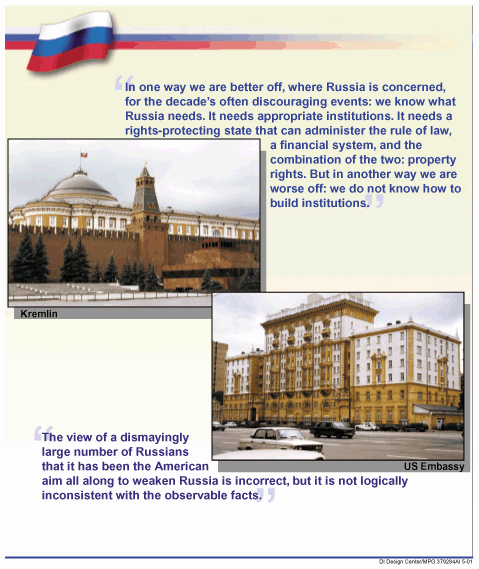
All photographs were provided by NIMA Ground Photography.
Contents
Panel I - Russia's Evolution
Panel II - Russia's Foreign and Security Policy
Luncheon Roundtable: Impressions from Russia's Regions
Panel III - Russia Viewed From the Outside
Panel IV - Russia Viewed From the Outside (Continued.)
Panel V - Russia in the Global Context
Panel VI - Concluding Session: Highlights and Implications for the United States
Introduction
Russia (map)In February 2001, the National Intelligence Council sponsored a conference that examined Russia's evolution and its role within the international system over the next three to five years. The conference brought together approximately 100 government and outside experts. It consisted of six panels with presentations by more than 20 US and European nongovernmental experts, followed by question-and-answer sessions. The purpose of the conference was not to arrive at a consensus but to deepen understanding of Russia and how it interacts with the outside world. The views expressed are those of the individual participants and do not represent in any way official US intelligence or policy positions.
This conference report consists of the précis of each speaker's on-the-record presentation, which were provided by the speakers, and a summary of the ensuing not-for-attribution discussions. The report is intended to capture the salient points and original arguments of the proceedings. During the panel discussions, no attempt was made to ascertain the general view of the panel or audience. Many of the points highlighted in this report were noted because they were thought-provoking or outside the conventional wisdom. They illustrate the richness of the discussion, but they do not necessarily reflect accepted or prevailing views at the conference.
Executive Summary
Russia's Foreign Policy
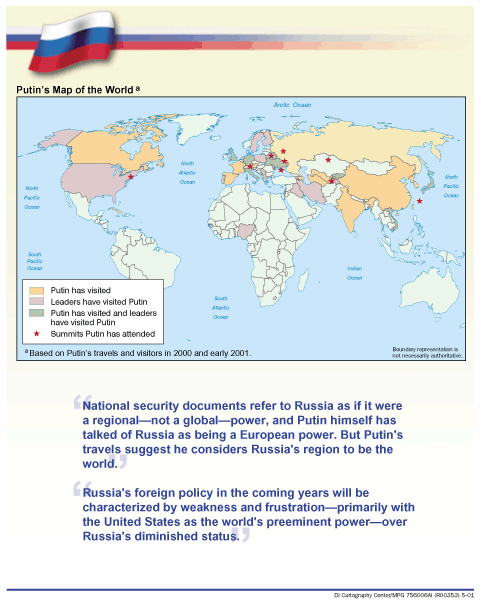
Russian foreign policy in the coming years will be characterized by weakness; frustration--primarily with the United States as the world's preeminent power--over Russia's diminished status; generally cautious international behavior; and a drive to resubjugate, though not reintegrate, the other former Soviet states.
- The international situation affords Russia time to concentrate on domestic reforms because, for the first time in its history, it does not face significant external threats. But rather than use the breathing space for domestic reforms, Putin is as much--if not more--focused on restoring Russia's self-defined rightful role abroad and seeking to mold the CIS into a counterweight to NATO and the European Union.
The Outside World's Views of Russia
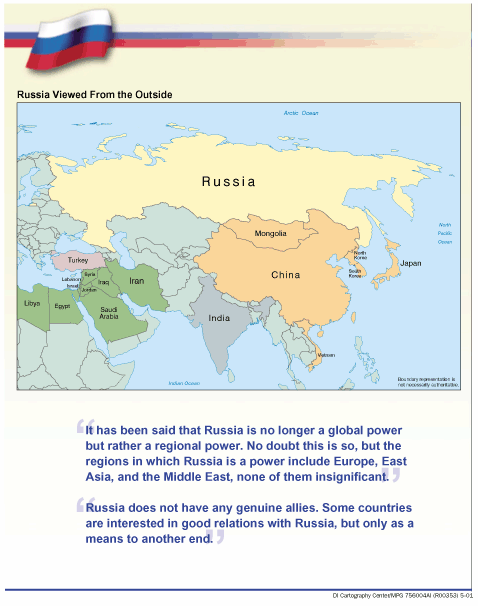
Russia does not have any genuine allies. Some countries are interested in good relations with Russia, but only as a means to another end. For example, China sees Russia as a counterweight to the United States but values more highly its ties with the United States. Some countries see Russia as a vital arms supplier but resent Russia also selling arms to their rivals (China-India, Iran-Iraq). Pro-Russia business lobbies exist in Germany, Italy, Turkey, and Israel (one-fifth of whose population now consists of Soviet émigres), but they do not single-handedly determine national policies.
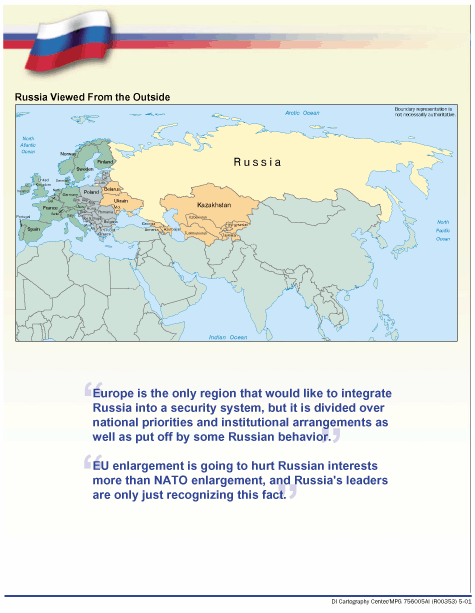
Europe is the only region that would like to integrate Russia into a security system, but it is divided over national priorities and institutional arrangements as well as put off by some Russian behavior.
Most CIS governments do not trust their colossal neighbor, which continues to show an unsettling readiness to intervene in their internal affairs, though they know Russia well and are to a considerable degree comfortable in dealing with it.
Turkey has developed an improved dialogue and an unprecedented number of economic ties with Russia during the post-Cold War period, but this more positive pattern of relations has not fully taken root, and Ankara remains suspicious of Moscow's intentions.
Since the collapse of the Soviet Union, Moscow's role in the Middle East has been reduced, but Israel, Syria, Egypt, Libya, and Iraq all favor good relations with Russia. Mutual interests also override disagreements in Russian-Iranian relations, but Tehran is wary of Russian behavior, particularly toward Saddam Hussein.
India still trusts Russia--a sentiment that is perhaps a residue of the genuine friendship of Cold War days--but clearly not in the same way it once did, and New Delhi fears that weakness will propel Russia into doing things that could drive India further away.
In East Asia, the most substantial breakthrough has been the resurrected relationship between Russia and China, one that entails significant longer-term risk for Russia. Other countries in the region value their links with Moscow as a means to balance a more powerful China, or as a useful component of their larger political and economic strategies, but Russia's role in East Asia--as elsewhere--remains constrained by the decline in its political, military, and economic power over the last decade.
Russia's Weakness
Russia's weakness stems from long-term secular trends and from its domestic structure. In essence, the old nomenklatura and a few newcomers have transformed power into property on the basis of personal networks and created an equilibrium resting on insider dealings. These insiders may jockey for position but have a vested interest in preserving the system. The public does not like the system but is resigned to it and gives priority to the preservation of order. As for the economy, it is divided into a profitable, internationally integrated sector run by oligarchs and a much larger, insulated, low-productivity, old-style paternalistic sector that locks Russia into low growth.
No solace will be forthcoming from the international business and energy worlds. They do not expect the poor commercial climate to improve greatly and will not increase investments much beyond current levels until it does.
Militarily, Russia will also remain weak. Its nuclear arsenal is of little utility, and Moscow has neither the will nor the means to reform and strengthen its conventional forces.
Hope for the Future?
The best hope for change in Russia lies with the younger generation. Several participants reported that under-25 Russians have much more in common with their US counterparts, including use of the Internet, than with older Soviet generations. But there was some question over whether the new generation would change the system or adapt to it.
- Others placed some hope in international institutions, for instance the World Trade Organization, eventually forcing Russia to adapt to the modern world.
Dissenting Views
Some participants dissented from the overall forecast of depressing continuity.
The keynote speaker, James Billington, stated that Russia would not be forever weak and that the current confusion would end in a few years either through the adoption of authoritarian nationalism or federated democracy.
One scholar felt the Chechen war was feeding ethnic discord in other areas of the Federation to which Moscow would respond with increased authoritarianism, not necessarily successfully.
Finally, a historian observed that the patience of Russians is legendary but not infinite, meaning that we should not be overly deterministic.
Panel I
Russia's Evolution
GraphicThis panel examined the current internal situation in Russia, analyzing the political system, the economy, ethnic nationalism, and public opinion. The panel also explored how Russia's domestic landscape is likely to change in the next three to five years.
Chairman: George Kolt
National Intelligence Council
The Political System: From Soviet Past to Post-Yeltsin Future
Geoffrey Hosking
School of Slavonic and East European Studies, University College LondonThe comparison of post-Soviet Russia with Weimar Germany is often made, and there are good reasons for it. But there are two overriding reasons why, overall, it fails to convince:
In Germany, national feeling long preceded the formation of a German state; Germany was a country of super-saturated national identity with positive attitudes toward the state. In Russia, on the contrary, the state long preceded the nation--if a nation can be said to exist, even now. As a result, most Russians distrust their state, or at least identify weakly with it.
Most Russians are not interested in joining political parties. They do not feel that their problems are best solved through the organization or program of a party, let alone through paramilitary squads such as those that disfigured the late years of Weimar Germany.
For historical reasons, Russia has built up its state system not through institutions and laws, but through persons. Owing to its over-stretched and vulnerable geopolitical position, from the sixteenth century onwards Russia's rulers have had to improvise the mobilization of resources in situations of emergency, and they have done so by using whatever means lay at hand, usually the power of local strongmen, rather than through institutions and laws. This is what I call the statization of personal power.
In tsarist Russia, the networks of personal power ran from the court outwards through landed nobles, provincial governors and police chiefs; in Soviet Russia, the networks ran through the nomenklatura appointments system controlled by local party committees and were directed from the top by the Central Committee of the Communist Party. At each level of political and professional life every employee depended greatly on the personal power and patronage of his superior or employer, not just for pay and conditions of work, but also for housing, food supplies, education, medical care and other basic facilities necessary to everyday life. The Soviet Union was not, as planned, an egalitarian society of abundance, but rather an unequal and shortage-ridden society whose hierarchy was determined by the devices needed to get around the shortages.
The political history of the Soviet Union is the story of the attempts of its various rulers to combat the excesses of the nomenklatura system that they themselves had created. As a result, certain restraints did operate: the NKVD, Gosplan, the party hierarchy itself. Under Gorbachev and Yeltsin, however, those restraints were finally removed. Nomenklatura appointees, especially those at the mid- and lower levels, were able to use their position to turn administrative control into personal possession and to exploit the resources of Soviet society to make considerable personal fortunes. In the process, they allied themselves with operatives from the old underground extra-legal "black" economy, an alliance which helps to explain the widespread criminality that characterizes the post-Soviet economy.
So the contours of post-Soviet society are, literally, post-Soviet. The economy is grouped around large corporate conglomerates, led by individual "oligarchs," who typically have a stake in industry, commerce, finance, and the media. The political system revolves around loose and fluctuating coalitions of activists, each led by an individual, rather than around political parties. In the provinces, the elected governor becomes his own oligarch in both the economy and politics. Society is fragmented and poorly organized to respond to or resist initiatives coming from above.
This political and economic system has now become rather stable, and it may be time to talk of the end of the "transition." Russia has a democracy and a market economy of sorts, even if we in the West do not approve of many of its features.
If that were all there was to say, then one would have to be pessimistic about the future. But there is another side to developments in Russia. That is that Russia is becoming a nation, which it has never been before. Wholly contrary to the intentions of its leaders, the Soviet Union did a great deal to advance the cause of the national consciousness of its constituent peoples, both Russian and non-Russian.
Its education system gave the great majority of the population the elements of literacy in their own
language, subordinated to an overall Russian concept of culture, history and social evolution.The social security system gave the population the sense of having certain entitlements which they had never had before--to education, health, housing, pensions, and so on. Even if the expectations were only imperfectly fulfilled, nevertheless a kind of passive citizenship was thereby established.
Victory in the Second World War gave many of the nationalities, and above all the Russians, a sense of their own historical destiny.
However, the sense of nationhood thereby generated is still incomplete. Few Russians regard the present Russian Federation as constituting what they understand as Russia, and some of the gains of the Soviet period in education and social security have been jeopardized.
Nevertheless, there is now for the first time a state called Russia--not the Russian Empire or USSR--with its own boundaries, its own flag and its own national anthem.
Russia's leaders and politicians are now democratically elected, even if doubts remain about the full legitimacy and fairness of the elections.
A lively mass media exists, even though it is increasingly under pressure from the oligarchs who own it and from the state, which regards information as part of national security.
Putin would like to strengthen this new Russian state and give it a firmer identity, but the methods he has chosen are contradictory, as will come out later in this conference.
There are dangers in the growth of Russian national feeling. In the past it has tended to be imperialist rather than national. However, I believe there are good reasons for believing this is not necessarily the case right now.
The Economic Transition
Pekka Sutela
Institute for Economies in Transition, Bank of FinlandIt was always known that Russia's economic transformation would be more arduous than that of countries outside the former USSR. Historical, mental, geographical and economic "distance" from a market economy was longer. Contrary to other countries, socialism was endogenous: it had been established, developed and defended by the Russians themselves. What is more, in many respects the Soviet Union was the proudest achievement of Russia. Its geographical expansion, military might and global position were stronger than ever before. Even more importantly, contrary to the Central European countries, there was no widely shared understanding of the systemic goal to be adopted.
For the Central Europeans, the overarching goal of "returning to Europe" meant joining the European Union, NATO, the OECD and the rest of the Euro-Atlantic alphabet soup as soon as possible. Joining these clubs with their sometimes hugely detailed membership requirements--the EU Acquis run to some hundred thousand pages--sets a strict conditionality upon the institution-building and policies of the applicant countries. This conditionality may not be the best imaginable, but it has a degree of consistency and proven applicability in other countries. Therefore, though governments and other decisionmakers have changed, the Central European countries have had a high degree of policy consistency, which may have made the most important single contribution to their unexpectedly positive economic and social progress.
Such conditionality was not available to Russia and the rest of the USSR. The European nations have--perhaps unwisely, at least after the status of Turkey as a potential member has been reasserted--denied Russia the prospect of eventual EU membership, usually giving the size of Russia as the reason. By doing this, the incentives of the only unifying goal that Russia might have had were abolished. Most Russians, on the other hand, have been keen to emphasize that Russia has never been and never will be a "normal European country." But like earlier in history, they have been unable to provide the nation with any other consistent and well-defined goal. And like the Cheshire Cat taught Alice in Wonderland, if one does not know where to go, any road will take one there. The conditionality of the international financial institutions has been almost the only one available. Even under the best of circumstances, it will be narrow and technical. In Russia's case, the circumstances were not the best ones, as the IFI's have been under much unfortunate political pressure to use money.
This is probably the single most important explanation for the divergence of Russia's economic performance from that of the Central European countries. The lack of a well-defined and widely accepted goal has tended to shorten decisionmaking horizons and has facilitated the frequent capture of policies by established interests. On one hand, the state has been weak in the sense of lacking a strategy and being unable to act in a consistent way. On the other, it has remained the major route toward power and privilege, disposing of even the seemingly most entrenched persons and groups when their services are no longer needed. Still, Russia has not chosen "any road." The return to the previous regime was never an alternative seriously supported by a major political force. Russia was always in a transition to something new, but it remained unclear what this "something new" would be. Also, the Russian elites have been able to learn from their mistakes. It was possible to argue in the early 1990ís that large budget deficits and high inflation were a means to provide jobs and welfare. Such arguments have lost all credibility. This was shown by the chasm between the rhetoric and actual policies of the Primakov-Maslyukov government. The set of possible policies has shrunk over time. Most talk of some specific Eurasian system has died away. There is a wide consensus on basic macroeconomic policies, but a clear-cut model of institutions and legislation is still missing.
Clearly, this is not a situation where piecemeal social engineering should be attempted. But quite as clearly, arguments about the weakness of the Russian state have been used to justify the lack of consistency and comprehensiveness. This still remains the case. The attempt to combine economic market orientation and political authoritarianism, together with the actual weakness of the presidency hidden behind rhetoric and symbolism, produce hesitancy, a lack of decisions, and a tendency to balance conflicting interests. Equaling the restoration of Russia's might with an unchallenged prestige of the president adds the dimension of attempted "verticalization" of the society, with little room left for an independent society and media. In the economic sphere, the outcome is an almost complete lack of meaningful structural reform.
Russia has become a market economy, but a market economy that is unique in many respects.
The Russian large-scale privatization was based on two explicit considerations. First, it was (probably wrongly, given that a return to the past was not an alternative) asserted that there was a need to secure irreversibility by creating a wide class of property owners. Second, there was need for political compromise with the Duma. These considerations combined to produce Option Two of the privatization program, in fact making wide insider ownership inevitable. As some two-thirds of Russian industry was privatized, in about two-thirds of the cases about two-thirds of the stock ended up being owned by insiders--that is, managers and employees. The dilution of insider ownership has since been much less than expected by the optimists, and in many cases the presumed outsiders are acting for the managers.
Most Russian enterprises are manager-dominated, with employees still an important though usually silent group of owners. Managers often claim to speak for the "work collective" and take a very cautious view of outside investors or even bank credit, as those are deemed to limit their power. Investment, structural change and growth suffer. Economic theory suggests that an insider-dominated economy fails to reach the dynamism connected with more usual distributions of property rights.
Insider privatization partly explains the low degree of monetization of the economy. Meager financial intermediation and the relative lack of financial institutions--including proper banks--are also due to a history of high and variable inflation and the policy mistakes leading to the financial crisis of 1998. Though the role of money as a means of exchange strengthened much in 1999-2000, about a fifth of industrial production is still based on barter, and there is little evidence of financial deepening. Modern growth theory argues that financial depth is a major contributor to growth and welfare. Financial sector reform seems to have little priority in Russian policymaking. Real investment grew strongly in 2000 from a low level, but as most of it is financed from retained earnings, the investment pattern tends to strengthen the inherited structure of production. New enterprises, in particular, remain constrained by the availability of finance.
The relative lack of new private activities separates Russia (and other states of the former Soviet Union) from the Central European countries. The number of legally registered enterprises has not grown for several years; nor is there evidence of an ever-growing share of the second economy. New activities are not only hindered by the lack of finance, but also by the neglect or hostility of local authorities. On the average, Russian regions are small entities, often dominated by a single plant or a few large plants, usually in alliance with the authorities. Quite often, such powers see new entrepreneurs either as a milking cow or as an alien element to be suppressed. If Putin's campaign to cut the regional barons down to size indeed brings about a more unified economic space with a more level playing field for entrepreneurs, it should be welcomed on economic grounds. So far, Russian regionalization has tended more to worsen economic behavior than to make room for local initiative.
The border between legal and not legal has remained fuzzy. This is another defining feature of Russia's economic environment. Putin's regime promises political stability and greater clarity of rules across the country. There are also the well-known cases of political misuse of the legal system. The poor performance of Russia's capital markets shows that the investors do not trust Putin to deliver a working combination of political authoritarianism and economic liberalism.
GDP growth since 1999 has been fueled by a stiff undervaluation of the ruble, responsible macroeconomic policies, the adaptation of many enterprises, and by high commodity prices that have not been fully reflected in domestic markets, thus generating a huge implicit subsidy to domestic users. Following a tremendous export surplus, the economy has been partly monetized, fiscal revenue has ballooned and the greatly improved enterprise profitability has translated into investment, settling of arrears and higher wages and consumption. Net exports are bound to diminish, but still the economy should be able to grow for a year or two more. After that, growth depends much more on necessary structural reform. This need is generally recognized, but in 2000 only tax reform had some success.
In spite of the currency undervaluation, Russia has no new export commodities. Most growth has been in import substitution. Only traditional Soviet goods are exported. This suggests the probability of a traditional dual economy in Russia. Most export revenue would be earned by selling resources and other basic commodities abroad, primarily to the European markets. Most employment would be generated by home market industries producing low quality commodities for poor consumers. Such an economy would be sustained either by currency undervaluation or other restrictions of trade. The lack of market-based policy instruments makes the latter alternative more probable.
These peculiarities of the Russian market economy may well be systemic and not just the unfortunate consequences of the macroeconomic circumstances of 1985-1998. They do seem to characterize an economic system of some consistency and, therefore, staying power, but one that is badly suited for efficiency, equity, growth and welfare. If so, Russia would tend to remain what it is today: an economy the size of a smallish European nation; a factor in the global economy much weaker than, say, Sweden; and a country of large welfare gaps and little dynamism. It would sustain itself by exporting basic commodities and by subsisting on goods and jobs created by protected home market industries. The outward capital flow might well continue to dwarf the inward flow, as is the case now. There would be links between domestic and world financial systems, also some necessary inward productive investment, but as a whole Russia's economic marginalization would continue. Only the most optimistic spokesperson of globalization would argue that this is an impossible outcome. A nation can still step aside from the great change underway.
This is an outcome that the Russian authorities fear. Economic marginalization cannot support great power ambitions. Vladimir Putin has been very explicit on this, but the track record of 2000 tells of an inability to make and implement the needed reforms. The Russian economy may in a sense be less virtual than a couple of years ago, but Russian economic policies remain very much so. The Putin regime had in 2000 a great chance to create the foundations of Russia's future growth. After 2001, that chance may not come again.
The final downside of Russia's economic transition is the inability to address the underlying trends that have been there for so long. The list of these ills is all too long and well-known. Current forecasts for medium-term growth are coming down to three percent annually. If at best the economy will grow quite modestly, the struggle over the meager additions to available resources will to a great extent determine Russian politics in the coming years and decades. As the increase available will in any case be insufficient to cover all urgent needs and there is little reason to expect highly rational decisionmaking and implementation, the probability of ruptures, disconnects and fissures increases alarmingly. The international community has already learned that the possibilities of making a crucial difference in Russia's development do not exist. If the arguments outlined above have any value, then the question will increasingly become one of damage control and limitation.
Ethnic Nationalism and Russia's Republics
GraphicEmil Pain
The Kennan InstituteThe problem of ethnic separatism is undoubtedly of primary significance among the ethnic problems that directly influence Russia's political stability. The main reason for this is the interrelation between federal authorities and the non-Russian-majority republics. If there is a probability of the dissolution of Russia, it is related to these republics.
Accepted public opinion would have us believe that under President Yeltsin, anarchy grew between Moscow and the republics of the Russian Federation, while President Putin has brought order and stability to the situation. An examination of Putin's relations with the republics shows that this is not true. Yeltsin became president of Russia at a very critical period in its history. Russia was feeling the consequences of, and the inertia resulting from, the disintegration of the USSR. He managed, however, to stabilize the situation by making concessions to the republics in exchange for their cessation of separatist agendas. This stability has begun to unravel since Putin began to exert pressure on the leaders of the republics. In response to this pressure, they have revived their nationalist and separatist tendencies. The leaders of the republics do not exhibit their negative sentiments toward Putin's policies openly. Instead, they secretly allow nationalistic movements in their republics to develop.
The creation of the seven federal regions has already created new tensions in the governmental structures of the country. Federal ministers are suspicious of attempts by the President's regional representatives to control the flow of finances from the center to the regions and refuse to cooperate with Moscow's efforts to coordinate the activities of the regional offices of their ministries.
This kind of competition during Nikita Khrushchev's leadership in the USSR led to the collapse of his favorite brainchild, the sovnarkhoz--the prototype of the present-day administrative region. The sovnarkhozy were comprised of 3-4 oblasts, republics, or krays and were often very large territories that were poorly governed. The present-day administrative regions are even bigger (comprising 12-13 regions) and more poorly governed due to the disappearance of the Soviet command hierarchy that had previously provided discipline through the Communist party.
This alone condemns Putin's administrative system to failure. The power of regional leaders should be limited. However, this should be done from below, through the development of municipal self-government, rather than from above, at the risk of concentrating even more power in the Kremlin. Putin's reforms aim to compensate regional leaders for a loss of power on the federal level by giving them more control over the municipalities. This could lead to a further weakening of the already insignificant role that municipal authorities play.
The situation of local self-government is worsening as a result of the changes Putin has made in the proportion of revenue going to federal and regional budgets. Before the changes, the proportions were almost equal: 51 percent went to the center and 49 percent to the region. That 49 percent included 32 percent that went to the municipalities. Today the federal share has increased to 63 percent and the regions' has dropped to 37 percent. But it was the municipalities that got hit the hardest, with their share cut in half, to only 17 percent. At the same time, the municipalities' expenses did not decrease--they retain responsibility for almost three-quarters of the entire housing and municipal infrastructure. As a result, local budget deficits are growing, and many cities have no money to pay for electricity, gas, and coal. It is mainly because of these financial difficulties that many Russian cities and villages (especially in the Urals, Siberia, and the Far East) spent months without electrical lighting and heat this past winter. Municipalities do not have sufficient means to make needed repairs to heating and ventilation systems, and as a result the number of accidents is growing.
Concentration of resources in the federal budget destroys commercial spirit and stifles initiative on the part of regional leaders. The Russian government is fooling itself into believing that regions thus controlled will be easier to rule as they become more pliant. In reality, the opposite is true--less money for regional and municipal budgets means less responsibility on the part of their leaders, and so less can be demanded of them. It should be expected in the near future that the residents of the provinces will increasingly direct their displeasure toward the Kremlin. For the non-Russian peoples, that means a growth of anti-Russian sentiment because federal rule is seen as
Russian rule.Such feelings were seen in the results of an opinion poll taken in January 2001. Only 5 percent of respondents thought that relations between different nationalities in Russia had improved since Putin's reforms, while 37 percent thought that they had worsened.
The war in Chechnya has contributed significantly to the perception that center-region relations have worsened. Since the beginning of the war, solidarity with Chechnya has grown among non-Russian populations. Practically all Caucasians, including those who traditionally do not like the Chechens, are experiencing some of the same pressures as the Chechens: for the majority of the Russian people, all Caucasians have one face--they are all "dark" and "terrorists."
Even in a strictly military sense, there is little probability of a victory for Moscow in Chechnya, and there is even less probability of an economic victory there. The history of colonial wars in the 20th century shows that when a war drags on for a long time the intervening party will not win for the following reasons:
The army cannot be located for long--more than
5-7 years--in a hostile occupied territory before it will begin to become demoralized.As the war drags on, a larger part of the home country population becomes dissatisfied with it.
The economic burdens of the war increase.
Perhaps most importantly, the rebels stop being afraid of an army that for a long time has failed to achieve victory--in this case encouraging not only the Chechens but other nationalities. The loss of the army's ability to induce fear could be a factor in accelerating the breakup of Russia.
The changing ethnic composition of the population is the biggest challenge facing Russia. In almost all of the republics of the North Caucasus, Russians are already in the minority. In the Far East and in Siberia, Russians are in the minority only in Tuva, but they will soon become the minority in Buryatiya and Yakutiya. According to some projections, within 10-15 years, there will be about 10 million Chinese living in Siberia and Russia's Far East. This would make them the predominant nationality in this--the largest--area of the federation. But the main danger lies in the Povolzh regions, where Russians already are in the minority in Chuvashiya and soon will be in the minority in Tatarstan and Bashkortostan. The Tartars and Bashkirs increasingly speak of uniting to create one federation. If they were to form such a federation--in the very middle of the country--Russia could split into two poorly connected pieces.
The threat of the disintegration of the country could lead the Russian government to adopt one of two fundamentally different political doctrines. The first is consolidation based on a multicultural society. Unfortunately, I can say that the idea of a multicultural society is absolutely foreign to the present Russian authorities. For this reason, the government probably will use the second doctrine--consolidation based on the growth of Russian nationalism. The last gubernatorial elections left no doubt that the Kremlin is exploiting Russian nostalgia for the Soviet Union and nationalist sentiments in hopes of receiving support in the regions from former Soviet officials and generals.
Current trends in the development of Russia's economy--in particular, the protection of national industry, overdependence on oil and gas, and the arms trade--will also lead to the strengthening of nationalism and imperialist sentiments. These trends, especially in the arms trade and arms production, increase the role of social groups that are the main carriers of the Soviet imperialist mentality and foster a confrontational attitude toward the West. These sources of economic development are unstable, and Moscow may be tempted to explain away a worsening of the economic situation as interference by external enemies, thereby inflaming Russian nationalism to support the consolidation of society.
This is the current situation in Russia: xenophobia, suspicion toward the West, and imperialist sentiments are growing. Therefore, for nationalist consolidation there needs to be an image of an external enemy--"worldwide Islamic terrorism" or "world imperialism."
If nationalism and imperialist militarism become firmly established in Russia, it could be catastrophic for the country. Moreover, past examples of doomed regimes suggest that such a Russia could present a serious threat to the surrounding states.
Russian Society: The View From Below
Vladimir Shlapentokh
Michigan State UniversityBefore the collapse of the USSR, there was a consensus among Soviet sociologists about the opinions of the masses. Over the last decade, the situation has changed significantly. Today, there is a broad range of views among Russian politicians and intellectuals about public attitudes. These images are determined to a great extent by two questions. First, in view of the success of democratic reforms in the Baltic states, who is to blame for Russia's failure to build a new democratic society--the masses, or the ruling elite? Second, considering the character of these actors, what are the prospects for Russian democracy and liberal capitalism in the future?
There are at least three very different models for describing the Russian masses. Each is based on at least some empirical data.
The first--the "eclectic model"--suggests that post-Soviet Russians have an extremely eclectic mind, bordering on schizophrenia. Its most eloquent advocate is Boris Grushin, a famous Russian sociologist. According to various polls, it is true that the Russians maintain opinions that seem, to some degree, contradictory. They reject the Western model of life, but do not want to lose their political and economic freedoms. They accept the idea of having a market economy, yet they favor regulations on prices and upper income levels. They see America as an enemy, but they "like" Americans. They look to the Communist past as a Golden Age, but do not advocate its return. No more than 25 percent of the population votes for the Communists. Almost all Russians despise Yeltsin, yet they support Putin, who was Yeltsin's chosen successor. Furthermore, while they approve of Putin's first year in power, they complain about the rise in prices and the persistent problems of crime and corruption.
The second model--the "uncivilized model"--was developed by Lev Gudkov, a sociologist from the All Russian Center of Public Opinion Studies (VTsIOM) polling firm. This model describes the Russians as uncivilized people who are unable to live under democracy and whose opinions have no value for those who are trying to build a normal society. The masses are said to be lazy drunkards and thieves, who refuse to work hard and honestly but constantly complain about their salaries. They are seen as passive individuals, weary of change, unaccustomed to lofty motives, and prone only to deviant and deeply individualistic actions. Their vision of themselves borders on fantasy. They believe, for instance, that sobornost (collectivism) plays a central role in the life of the people. They suppose, without grounds, that the Russian people are highly spiritual, hospitable, and ready to make sacrifices for others.
Most of the data used to support these two models cannot be disputed, but the interpretation of this information is problematic. A third model is needed to better describe Russian public opinion. Labeling it the "rational model," I suggest that in general the behavior of the masses has been rational in view of the given historical context.
There is no doubt that Russians live in troubled times. Their country is faced with a deeply corrupt and immoral ruling class, to an extent unprecedented in its history. All levels of the bureaucracy--from the Kremlin to the local police--regularly ignore the law. The economy is said to be a free market, when in fact it is dictated by monopolists and criminal structures. The political system allows the Kremlin to prearrange, or even fake, the results of elections. It also allows local authorities to wield arbitrary power. What is more, considering the historical memory of most Russians, they are not prepared to counteract these forces. They see major political protests, such as riots and revolutions, as acts that will only make matters worse.
Under these conditions, the hierarchy of values in the Russian mind looks quite rational. It is only normal for people to value, first and foremost, order in society (in the Hobbesian sense). It is no less rational to sacrifice democracy for this end, especially when the country faces chaos and disintegration (at the same time, most Russians want both order and freedom). According to a VTsIOM survey conducted in 2000, the vast majority of Russians--80 percent--were ready to make such a sacrifice. The yearning for order explains why the people support Putin, even though he is the heir of despised former President Yeltsin. Russians are more concerned about a smooth transition of power and the avoidance of crisis than the leadership's adherence to democratic procedures. This is also why Putin has become known as the "Teflon" president. Any weakening of his authority generates political instability and heightened fear in society, which prompt the reinforcement of his power.
Russians understand that life under the Communist regime was better for most of them, but they realize that a return to the old system is impossible and that any attempt to do so would make life much worse. What is more, they appreciate and are fearful of losing the freedoms that came when the old system collapsed. In the same way, the Russians bemoan the collapse of the Soviet empire, but believe that it belongs only to the past and are against any attempt to use force to control Ukraine and other republics.
Russian attitudes toward the present economic system are quite rational. The majority of the people subscribe to the social-democratic ideals that hold sway in Western Europe and, to some extent, in the United States. They want both economic freedoms and state intervention. They favor a moderate level of inequality as long as there are social guarantees for those who are less successful.
At the same time, Russians would deem it utopian to believe that their society can develop along the same lines as the West. For this reason, they hope it is still possible to maintain some political and economic freedoms, combined with strong authoritarian power. They see this combination as "the Russian road to the future."
Of course, Russians are exposed to the official propaganda. As developments during the Yugoslavian crisis in March-April 1999 showed, anti-Americanism increased dramatically under the influence of this propaganda. However, a few months later the Russians returned to their semi-friendly, semi-hostile attitudes toward America, which are almost mirror reflections of American attitudes toward Russia.
There is no question that the process of desocialization--the rejection of social norms--is taking place in the country. Alcoholism is a growing problem, particularly in the countryside, as are drug abuse and the decline of morals. However, these problems are strongly exaggerated by the ruling elite, who try to shift the blame for their failures onto the masses. Putin is regarded by the people as a strong and reasonable leader, which sharply distinguishes him from the former president. Barring an economic or technological disaster, he should feel confident that the masses will remain eager to preserve order in society, and having no alternative (he and his retinue are sure to quash all competitors), they will support his reelection in 2004--this being the primary goal of the Putin regime.
Highlights From the Discussion
Stability
Putin is popular because of the perception that he has brought stability. This may be, however, a false sense of stability. Putin has been in power for only one year, and while he is enjoying widespread support at present, Yeltsin became a hated figure after three years in power.The economic constraints and growing geopolitical threats to Russia may be indications of future instability. The conditions are ripe for the emergence of an authoritarian regime. Not even a dictator, however, can fix Russia's domestic situation, make Russia more attractive to foreign investors, and attract the massive investment needed for real economic growth.
Elites and Masses
The level of patience among the Russian people is extraordinarily high. In general, Russians do not protest. They understand the reality of their situation but fear that any action to ameliorate it could result in worsening it. To them, it is not worth the risk.The masses do not have leaders, per se. They allow the elite to rule, even though the masses are aware of their corruption. At the same time, the masses are dependent upon the elites to keep what little order Russia currently has--they have no one else to turn to.
Economy
Progress toward a market economy in Russia seems to be at an impasse. The economy could improve if Russia were to attract massive foreign investment. Though it is difficult to imagine Russia accomplishing significant improvement to attract the necessary foreign investment, one can imagine a peaceful society. Living in the post-Cold War era has lent some air of stability--a peace dividend--to life in Russia. This may have a positive effect on the development of the economy and democratic institutions.Russia missed the technological revolution, and, as such, has missed the opportunity to join the global economy. It has few finished goods to offer commercial markets, leaving only raw materials for export. Russia's natural resources and raw materials are currently the only incentive Russia can offer for foreign investment, but they may not be enough. Foreign investors are also looking for stability, rule of law, protection of property rights, and a predictable tax system--all of which Russia is lacking.
Panel II
Russia's Foreign and Security PolicyThis panel examined the factors affecting Russia's foreign and security policy as well as the possible progression of Russian policy in the next three to five years and implications for the West.
Chairman: Stephen Maddalena
Defense Intelligence Officer for Russia and Eurasia
Russia's Current Trajectory
James Sherr
Conflict Studies Research Centre, Royal Military Academy SandhurstIf we seek to influence Russia's foreign policy trajectory, then changes in our thinking as well as our priorities are unavoidable. The collapse of the world system of socialism might have delegitimized geopolitical thinking in the West, but the scale of the process and the traumas engendered by it have relegitimized it in Russia. If the mnogogolosiye (multi-voicedness) of the Yeltsin era camouflaged this fact, it should now be apparent. The new leadership is acutely conscious of power relations, extremely conscious of Russian weakness, but determined to use Russian power where it exists and use it toughly.
In two other respects Putin is challenging patterns to which we have grown accustomed and comfortable. During the Gorbachev era and the first half of the Yeltsin era (when a Yeltsin policy was plainly discernible), Russia sought to create the international conditions necessary, in former Soviet Foreign Minister Shevardnadze's words, "to bring about change inside the country." Putin has reverted to a much older pattern established by Stalin and, with modifications, continued by Khrushchev. By means of change inside the country--by addressing internal weaknesses and restoring "the vertical of power"--Putin would restore Russia to its rightful position as a "great power." Internal change (not least of all Chechnya) is now "Russia's business." And our joint business, foreign policy, is not Putin's main priority.
The third discomfiting change is that the area of foreign policy that does have priority is the area closest to internal policy: relations with the "near abroad."
The "Near Abroad:" Antecedents and New Departures
The principle that Russia must be the leader of stability and security on the entire territory of the former USSR is not a new principle, and on more than one occasion it has been applied by means of force. Nevertheless, during the Yeltsin era, there was also a record of accommodation: to the emergence of normal state-to-state relations with neighbors (e.g., the May 1997 "Big Treaty" with Ukraine), to the right of these neighbors to draw closer to NATO (but not join it), and to the appropriateness (on a limited basis) of involving external powers and bodies in regional security arrangements (e.g., the US-Russia-Ukraine Trilateral Agreement, OSCE missions in Moldova, Armenia, etc).The emergence of a tougher, more active and more aggressive Russian policy is directed not toward integration of Russia's neighbors, but rather their subordination in three areas that the Foreign Policy Concept deems essential to Russian interests: security and combating "extremism," "joint rational use of natural resources," and the "rights and interests of Russian citizens and fellow countrymen." The means to this end are as much transnational as interstate; they also include a more intense and focused active measures component. To Russian security elites, Western conduct virtually mandates such a course:
Kosovo. In military terms, Operation Allied Force is seen as a rehearsal for more ambitious exercises in "coercive diplomacy" and, in political terms, a
testing ground for using human rights as a flag of convenience for breaking up "problematic states." This perception has greatly sharpened the geopolitical stakes for Russia in the Caucasus and in Central Asia (where US sponsorship of the Taliban's precursors is never forgotten).NATO enlargement. If not a military threat, the Alliance is viewed as a means of excluding Russia from Europe and delegitimizing its interests.
EU enlargement. Despite strong hopes for "strategic partnership," there is now recognition that the EU is not, in essence, a counterbalance to US dominance, but a mechanism of integration. The unspoken, but widespread, perception is that Russian integration with this entity is, at best, a distant prospect.
Set against these developments, the transformation of the CIS into a bloc and an internationally recognized Russian sphere of interest is seen not only as a defensive measure but as a precondition for giving Russia equality in the international system. Determination to exclude the OSCE "east of Vienna" suggests that there even might be areas outside the former USSR--Yugoslavia, Bulgaria, Romania--where the future is deemed open.
Policy Toward the "Far Abroad"
To a significant degree, the policy emerging toward the "far abroad" supports the "near abroad" priority. Russian strategic partnership with the European Union, which many Americans fear is intended to distance Europe from the United States, also has more compelling, eastern dimensions: developing lucrative but also geopolitically driven gas and pipeline projects, which in themselves consolidate influence in the CIS; and securing European allies in keeping the former USSR off limits to further NATO expansion. The Shanghai Forum directly engages China--a state as resolutely opposed as Russia to overriding state sovereignty "on the excuse of protecting...human rights"--as co-guarantor of a brittle and repressive status quo in Central Asia. In rattling the saber against the Taliban, the intended audience is probably wayward Uzbekistan rather than this putative enemy (with whom, to judge from Russian initiatives in Pakistan, Russia might be seeking a form of accommodation).Yet even if we exclude the self-evident, there are other issues which have saliency in their own right. It is now clear (contrary to some speculation in early 2000) that promoting "multipolarity" remains a transcendental cause. But unlike issues closer to home, Russian policy lacks the focus and sureness of touch that Primakov imparted to it. Relations with NATO (a more accurate term than "cooperation") are not a high priority. The proposition that relations between Russia, a single state, and NATO, an alliance of 19 states, should be based upon equality would be difficult for NATO to accept even if, contrary to its own undertakings, it were willing to recognize Russia as leader of the CIS. Yet in the absence of such acceptance, Russia treats the 44-member Euro-Atlantic Partnership Council as a theater of diplomatic struggle. Russia has not allowed dialogue to extend beyond platitudes, it has not permitted participation to affect mindsets, and in drawing up and implementing agreements--e.g., reopening the NATO liaison office in Moscow--it has been determined to keep the devil in the details. Determined for their part to get the relationship back on track, many NATO representatives have been more concerned about having meetings attended, programs submitted, deadlines met, and boxes ticked than using the Permanent Joint Council (PJC) and other forums to address issues of genuine substance.
An issue of high saliency to the United States and United Kingdom--the growing menu of relationships, open and concealed, between Russia and Iran and Iraq--is an example of promoting multipolarity not only outside Europe but within it, bearing in mind French opposition to, and German and Italian ambivalence about, the Anglo-American approach. But it also makes a more generic point: that in the absence of countervailing costs, enterprises that weaken US positions, disrupt Western unity, and bring commercial reward to Russia will be seen by Moscow as intrinsically worth pursuing. An issue of growing anxiety, Russo-Chinese strategic partnership--founded on joint views about the UNSC and excluding the US from "zones of interest," as well as on a vigorous inventory of defense cooperation--remains constrained by issues endemic to the Russo-Chinese relationship: Russia's primordial distrust of China and China's determination not to be shackled by Russia in its relationship with the United States. And on the key issue, Russia-US relations, one may doubt whether Putin has a policy at all.
Russian policy since late 1999 poses opportunities and dangers. The opportunities arise because the new Russian leadership is fatigued and irritated by the pieties of "partnership," the mechanics of "cooperation," and the courtesies that in the PJC and other forums have made it difficult to raise and pursue specific issues of substance. The lesser danger arises because after a period of romanticism, Russia became a variable in Western policy rather than a focus of policy. The greater danger arises because nine years of Western platitudes have left Russians profoundly confused about the extent and limits of Western interests and about what the West wants from Russia. Both opportunity and danger are present in the possibility--whether the issue be Iraq or Ukraine--that the West will react early, toughly, and in ways that focus Russian minds. At that point, President Putin is bound to ask us, "What do you want?" Let us hope we have answers.
Moscow's Perceptions of the Outside World
Celeste Wallander
The Council on Foreign RelationsTo address Russian perceptions of its external environment, I would like to begin by outlining Russia's main threat perceptions in connection with the international system. From there, I will outline how this perception will affect Moscow's actual foreign policy in the next few years and then close with an assessment of the implications for American policy.
The current Russian leadership perceives five types of threats to its interests that involve the outside world. Four of these are familiar from discussions throughout the 1990s: national economic and military weakness, American hegemony or unilateralism, exclusion from the most influential political and economic circles in the international system, and instability and regional conflicts around Russia's Eurasian borders. A fifth perceived threat has moved into the main rank only in the last year and was articulated with the government's Information Security Doctrine, signed by Putin in September 2000: information can destabilize Russia's social and political scene, undermine the government's policies, or reveal security secrets of the country.
The first three threats, though distinct, are closely related in assessing how the outside world is perceived in Russian foreign and security policy. Various official documents--including the National Security and Foreign Policy Concepts--state unambiguously that the primary threat to Russia's national interests is its internal economic situation, as well as the failure to undertake serious and responsible reform. Nonetheless, they also state clearly that opportunities to participate in international security, political, and economic forums in the international system affect whether Russia will be able to achieve its objectives for renewal and growth.
This is why, for example, Russian relations with China, India, and Iran are not merely about trading in arms-for-influence but about sustaining and modernizing its defense industry as a component of building the post-Soviet economy. International trade--even the arms trade--is an important engine for internal economic modernization and growth. Given the link between the economy, national power, and security, Russian access to the international system is a matter of security.
Therefore, the current Russian leadership views obstacles to access as at best indifference to Russian national interests and at worst a deliberate policy to undermine the country's efforts to establish a sound economy on the path to consolidating its power and place in the international system. So, for example, American pressure to limit sales to Iran is not merely about loss of a given sale but about undermining Russia's defense industries, military reform, modernization, and so on. Even Russia's emerging problems with the European Union, especially how enlargement will extend trade restrictions and visa regimes to Central and Eastern Europe, is not merely about trade but about security and national power.
In this context, it is impossible to escape the reality that one of the main features of the international system in all its dimensions--military, political, and economic--is that American unipolarity coexists with a system of multilateral institutions (such as the World Trade Organization), regimes (such as nonproliferation), and groupings (such as the G-8) that are overwhelmingly influenced, if not quite determined, by American power and preferences.
This very modern package of national interests and the elements of globalization coexist with the perceived threat of instability, primarily in Central Asia and the Caucasus, and the concrete reality of armed conflict in Tajikistan, Afghanistan, Chechnya, Abkhazia, and Nagorno-Karabakh. Without doubt, Russian policy in the 1990s contributed to these threats through the use of force and interference to maintain Russian influence and presence in the region.
That misguided policy was largely a result of the Russian leadership's inability to distinguish between two variants of the threat and to prioritize them: the threat posed by weak, underdeveloped, and even failing states in the Caucasus and Central Asia, and that posed by the erosion of Russian influence and presence that attended the breakup of the Soviet Union. Despite its liberal and reformist credentials, the Yeltsin leadership never quite repudiated the latter, although it sought to meet the perceived threat posed by the loss of its southern sphere only half-heartedly. The Putin leadership has clearly rejected disentangling the two and more firmly links this regional instability with Russian weakness.
In addition, two new dimensions to this threat perception complicate Russia's policy in the region: Islam and international terrorism. The Chechens' separatist war, in this context, is just one manifestation of Islamic radicalism with international ties and terrorist means stretching from Afghanistan to the Black Sea. It is crucial to understand how instability, Russian weakness, Islam, and international terrorism are linked in the Russian perception, precisely because it means that the policies and attitudes of the outside world are perceived as directly affecting Russian interests. So far, the Putin leadership distinguishes between the regional external influence (which it views as primarily negative because it is the source of Islamic anti-Russian sentiment and the methods by which Russia itself is attacked in the terrorist campaign) and the broader international context. On the latter, the Russian perception is that the West is a potential ally against this threat, because it too has been a target. This perception is the reason Russian officials have suggested joint operations against Usama bin Laden in Afghanistan. However, this could change quickly, as evidenced by the suspicion with which Western support for Georgia is held (given that in the Russian view Georgia contributes to terrorists' access to Chechnya).
All this is recognizable in foreign policy analysis. The new threat--information security--adds a new and troublesome dimension. The Russian perception that information has a strong effect on politics and that in our globalizing world international information influences can play a large role in security is astute. However, the lesson learned appears not to be that a state cannot control information, but rather that it is all the more important to control information, especially that which complicates government policies. Instead of learning that it cannot lie about the Kursk, the Russian leadership appears to believe that you have to lie louder and more consistently and cast aspersions on the sources of alternative information.
This perspective sets up an intrinsic conflict of interest between Russia (or at least the state) and external influences. Good information is necessary for good policy of all sorts, including those central to international economics and investment. Western firms do not want to invest in Russia without access to good information on economic performance and corporate governance. The US Congress does not want to spend more money on CTR without good information about how the money is being spent and what effects the programs have. By establishing a presumption that seeking good information about Russia is a threat to Russian security, the information security doctrine could insinuate an assumption of hostility and conflicting interests in Russia's engagement with the international system.
The result of these perceptions is an ambitious Russia that seeks access and engagement for the right reasons from the American perspective--that is, for economic reform and prosperity--but from presumptions that do not quite fit with the realities of the modern international system in an era of a globalizing economy and the information age. The Russian leadership's fundamental presumption that the United States would prefer to keep Russia weak leads it to assume ill-intent and deliberate policy when problems or obstacles arise, such as desultory progress on WTO accession or criticism of Russian trade with Iran. The very real threat of instability, armed conflict on its borders, and transnational terrorism reinforces the tendency to see larger forces at work that can be met only by force and toughness rather than by long-term political and economic development.
Central to this leadership's perception is that engagement with the international system and practical cooperation with the United States are inescapable realities for achieving national interests. The United States is likely to be faced, in consequence, with a Russian foreign policy that is activist and assertive. It will be pragmatic in its readiness to make deals and to accept compromise in pursuit of its primary economic objectives. However, because these deals are likely to come in areas of Russian weakness relative to the United States and the international system it strongly influences, agreements will be perceived to favor the United States (or West) disproportionately, and therefore are unlikely by themselves to serve as the building blocks of a general improvement in relations.
Russia's Foreign and Security Policy Goals
Mikhail Alexseev
San Diego State UniversityWhose Goals Matter?
From the perspective of elites in Russia's executive branch, the legislature, leading businesses, state-run industries, science and the media, the goals of Russian foreign and security policy reflect the interests of a three-tiered hierarchy of actors. According to an opinion survey of these elites conducted by the ROMIR polling agency in September 2000, the upper tier is comprised of the Foreign Ministry (named as the principal actor by 92 percent of the 500 respondents) and the administration of President Putin (named by 86 percent of respondents), which incorporates the Security Council and oversees Russia's intelligence services. The second, lower tier of goalsetters is represented by Russia's business leaders (named by 56 percent of respondents) and the Defense Ministry (named by 42 percent of respondents). Regional leaders and the State Duma comprise the third tier, with 35 percent of the elites polled by ROMIR saying these actors exert influence over Russian foreign policy.What Motivates the Principal Actors?
Delegitimation of ideology. Russia's key decisionmakers were politically socialized and advanced their careers in the context of wholesale corruption of Marxist-Leninist ideology in the Brezhnev era, the delegitimation of Leninism in the Gorbachev era, and rapid disillusionment with free market liberalism in the Yeltsin era. Delegitimation of ideological commitments weakens constraints on power-maximizing behavior. The arrival of President Putin enhanced the political legitimacy of predominantly functional, instrumental approaches to policymaking. In the words of one observer at the East-West Institute in Moscow, "Putin has no mission and is all about function.""Effectiveness," "pragmatism," and "feasibility" have become buzzwords in formal and informal policy discourses in Russia. One of the central tenets of Russia's Foreign Policy Concept, adopted in June 2000, is that "a successful foreign policy of the Russian Federation must be based on maintaining observance of a reasonable balance between its objectives and possibilities for attaining these objectives." According to Sergey Ivanov, Secretary of Russia's Security Council, the Council used "the standard integrated 'effectiveness - cost - feasibility' criterion" when choosing among five armed forces development programs for the period up to 2010.
Institutional uncertainty (arising from persistent dependency of laws and institutions on individual preferences of the chief executive). Since his arrival in power, Putin has introduced significant changes in key government institutions, such as the Federation Council, that amount to de facto constitutional changes. Some reports suggest he has been considering rewriting Russia's 1993 Constitution.
In the absence of ideological prescriptions and institutional constraints, Russian policymakers have strong incentives for short-term, rent-seeking behavior resulting in what the economists call "institutional traps," or the emergence of small groups of actors with high stakes in preserving the uncertainty and inefficiency. Such traps make manipulative, deceptive behavior a rational norm.
"Reversed anarchy" (a situation arising when chiefs of government facing strong domestic challenges to sovereignty interact with increasingly interdependent international actors, as has been the case with post-Soviet Russia). The collapse of the Soviet bloc and the Soviet Union meant that Russia found itself without in-group identity at the international level. Moreover, Moscow's hold on power at home was challenged by separatist movements in the North Caucasus and the Volga region as well as by regional fragmentation of the domestic economy. In contrast, since the late 1980s key international actors outside Russia have become increasingly integrated economically and institutionally, especially with the enlargement of NATO and the EU. These contrasting trends have keyed perceptions in Moscow that Russia faces a twin threat of being marginalized internationally and of having its domestic weaknesses exploited by other actors. In line with such perceptions, Moscow is likely to assess the costs and benefits of international interactions with regard to their effect on the president's capacity to centralize and consolidate political power domestically.
In the context of a persistent and intractable military conflict in Chechnya, Moscow is acutely sensitive to international influences that may undermine decisionmaking centralization at home. Russia's Foreign Policy Concept denounces "attempts to introduce into the international lexicon concepts such as 'humanitarian intervention' and 'limited sovereignty'."
The Principal Actors' Goals in the Global Arena
Ideological delegitimation, institutional uncertainty, and reversed anarchy provide powerful incentives for decisionmakers to keep their commitments to policy goals fluid, flexible, and fungible. These motivations are likely to make the Kremlin seek quick political and economic gains by maximizing returns on Russia's existing strengths in the military, industrial, and science and technology sectors. At the same time, these motivations prompt Moscow to seek quick symbolic gains to build a positive image in the global arena. The pursuit of status enhancement warrants a strong preference for multipolarity, associated with a reduced capacity of the United States to influence other international actors and enforce rules constraining Russia's quick-gain strategies. Bilateral relations and ad hoc coalitions and alliances are likely to be preferred over longstanding commitments to international institutions and norms, especially those that may undermine the domestic agenda of centralization of political power.Moscow's principal goals in foreign and security policy are 1) centralization of foreign policy decisionmaking, 2) synergy between political influence and economic gain, and 3) promotion of Russia's great power identity.
Centralization of foreign policy decisionmaking. Moscow currently seeks to reduce the number of competing foreign policy goals and agendas, especially in Russia's constituent regions and republics, seeing this effort as essential to both domestic power consolidation and Moscow's capacity to project influence outside Russia's borders. In a telling example, Russia's Foreign Ministry held a special meeting on January 30, 2001, attended by President Putin and a group of governors, at which the President criticized the Ministry for not doing a better job in coordinating foreign policy. Responding to the criticism, Foreign Minister Igor Ivanov warned the governors that they should not pursue foreign relations without prior approval from Moscow. Moreover, Ivanov criticized the governors for friendly ties with Belarusian President Alexander Lukashenko, stressing that "the national interests of Russia and Belarus are not identical," thus suggesting that decisionmaking centralization supercedes the stated goal of CIS integration.
Synergy between political influence and economic gain. Specifically, Moscow has sought to:
Attract foreign investment into Russia, seen by Foreign Minister Ivanov as "crucial for resolving the central strategic task of our diplomacy, i.e., to ensure that Russia becomes one of the poles in the emerging multipolar world capable of actively influencing world affairs."
Reestablish influence in the former Soviet republics--especially in Ukraine, the Caucasus, and Central Asia--with the view to securing energy export outlets, most of which are located in the Western CIS and in the former Soviet bloc states of Eastern Europe. (In a new development vis-á-vis the Yeltsin era, Putin emphasized the need to increase support of the Russian diaspora, especially ethnic Russians in the former Soviet republics.)
Use energy resources, nuclear and space power status, and military capabilities to enhance political influence and economic gains.
Increase economic benefits from new weapons system applications and sales regardless of security concerns of other players, as well as boost payoffs from arms reduction and conversion.
Intensify economic and political interactions with major states in Europe and Asia as a counterbalance to US power and influence in the global arena. (In the September 2000 ROMIR survey of Russian elites, 94 percent of respondents said Russia's foreign policy priorities should be in Asia, 92 percent in Europe, 57 percent in North America, and 53 percent in South America.)
Advertise Russia's capacity to combat international terrorism and Islamic fundamentalism, to lead peacekeeping operations in the former Soviet space, to contribute to theater missile defense systems, and to ""boldly engage" engage'" with states such as Iran and North Korea as "selling points" warranting both political respect and economic support from the US and its allies.
Russia's elites see economic power as crucial to forging this synergy. Thus, in the ROMIR survey of elites, 99 percent of respondents named economic interests as the top priority, well ahead of defending the Russians living abroad (73 percent) and reaching military parity with the West (68 percent). Three times as many respondents (75 percent to 23 percent) said that economic power was more decisive than military power in achieving foreign policy goals. Perceptions in the Kremlin that the Russian economy is on the rise are therefore likely to make Russia's pursuit of its stated goals more assertive.
Promotion of Russia's great power identity. Specifically, Moscow has sought to:
Focus cooperation with the United States on issues that would emphasize Russia's capacity to cooperate on equal terms with the leading world power. Thus, Russia's Foreign Policy Concept mandates focusing bilateral cooperation on disarmament, arms control, nonproliferation, and regional conflict resolution (as opposed to, for example, economic or humanitarian issues).
Maximize political influence derived from being a permanent member of the UN Security Council, including by pushing for extension of UN Security Council veto power over other international organizations, most notably NATO.
Demonstrate power projection capabilities restoring the image of Russia as a global player and enhancing a sense of national pride and self-importance domestically (e.g., a surprise march on Pristina ahead of NATO forces, a dispatch of strategic bombers to Iceland, a dispatch of nuclear submarines to the Mediterranean, a surprise overflight of the US aircraft carrier Kitty Hawk in the Far East, the deployment of three Russian warships near India in early 2001, and the development of a "high seas" naval doctrine).
Conduct a global public relations campaign in support of Russian government policies, especially in cases where such policies may violate international law or human rights, as in Moscow's military campaign in Chechnya.
The Principal Actors' Goals and Public Opinion
As long as power politics in Russia ultimately depends on electoral outcomes, the elites need to take into account public opinion--if only for the reason of manipulating it. Russian public opinion is ambivalent when it comes to supporting the foreign and security policy goals of Putin's government. In January 2001, a ROMIR survey found that only 1 percent of 1,500 respondents said that Putin's primary goal should be to "recreate Russia as a strong power"at the international level. Most respondents want Putin to focus instead on raising their living standards (34 percent) and on increasing efficiency of government agencies (31 percent). My September 2000 survey of 1,010 respondents in Primorskiy Kray found the local public divided over reestablishing Moscow's control over the former Soviet space. The same survey also showed that ordinary Russians still see the United States, Canada and Australia as the best places to work (65 percent) and to live (71 percent). These surveys imply that the Russian people will ultimately judge the Kremlin's foreign policy goals by its capacity to bring living standards closer to those of the leading Western nations. Yet, to the extent that the Kremlin believes that these economic goals can be achieved without modeling free market democratic systems, these opinions are unlikely to persuade the Kremlin to make cooperative and rule-abiding behavior vis-á-vis major Western powers and their institutions one of its principal goals.Highlights From the Discussion
Missile Defense (MD)
Opinions differed on whether there has been a change in Russian policy toward MD:
Some stated that there has not been a change in stated policy and public opposition. If there has been a change it has been in the reinvigoration of the opposition to MD. There is a continuing failure on Putin's part to enact real military reform. The need to undertake military reform was driving a deal on MD that was compatible with the Clinton administration's ideas about what might be done with limited interceptors in Alaska. That deal has now disappeared. In Moscow, it would seem, the decision has been made to bolster the nuclear deterrent over the conventional forces.
Others contended that considerations of military power and status are very important in regard to the Russian view of MD. Even if the United States does not succeed in implementing MD, it is pursuing a track that undercuts Russia's main claim as a major player in the international arena. On the other hand, Russia has been talking about participating in theater missile defense. So what seems to be offensive to Russia about MD is the national aspect of it.
Mr. Putin originally flagged MD as a major issue under the assumption that it could be used to advance multipolarity--that European security and defense elites would accept Russia's position and that strategic partnership with Europe could advance in this way. Putin does not understand the way that Western security communities work, and he does not appreciate that every European country is conscious of living in a highly transnational security community. A major shift in US policy does not produce something called European opposition; it produces changes in power relations. Putin is beginning to see this now and to realize that Europe is not willing to make a cause célèbre out of the MD issue.
Russian Imperialism
Russia's real capabilities vis-á-vis the West are weak, but vis-á-vis its neighbors they are not and they are being used. Nevertheless, Russia faces the danger of overestimating its capabilities in the North Caucasus and Ukraine. Russia still sees Ukraine as part of the Russian state and does not realize the extent to which Ukraine will resist Russian imperialism.Luncheon Roundtable
Impressions From Russia's RegionsDuring the lunch session, a number of recent travelers to Russia shared their insights into life in the provinces and the views of average Russians:
One participant described life in the Russian Far East. When his daughter was born in Vladivostok in April 1997, Primorskiy Kray was in the midst of an extended financial crisis. He recalled power outages that lasted most of the day, massive gridlock caused by powerless traffic lights, and heaping mounds of garbage in front of every building. The rat population exploded, and disease spread. In his apartment building, the power was out for hours at a time, and when it came back on, everyone immediately raced to turn on the stove, the washing machine, and other appliances. The sudden surge caused a short in the underground power line leading to his building, and it took the city three days to fix it. The follow-on surge shorted it out again after just ten minutes, and the building was again without power for days. After that spring, he and his family decided to move to Sakhalin Island, thinking that a place with its own offshore oil reserves would be much better off. They were mistaken, as Sakhalin was just entering a similar crisis. The energy shortage got so bad in parts of Sakhalin that entire villages froze and had to be permanently evacuated.
According to another, though Russians will admit among themselves that they are a Third World nation with Fourth World leaders, they are quick to become defensive when a foreigner brings this up. Russians are tired of being treated with disdain by the West (or more commonly NATO, as they like to refer to the West), and especially by the United States. The further you travel from Moscow, however, the less you hear diatribes against NATO and the United States. When Russian people do mention the United States, it is always in reference to the government, not the American people. For in spite of what is commonly written in the Western press, anti-American feeling is rarely directed toward individuals. Mention should also be made of the remarkable inroads American "soft power" has made in Russia. Much has been made of Russian pop singers and movies lambasting the United States, but at the end of the day, the majority of Russians in the provinces and the great cities go home and watch American programs and movies on their televisions or turn on their stereos and listen to American music. The influence of American pop and fashion culture should not be overstated, but neither should it be underestimated.
Though ashamed at Russia's loss of international significance, ordinary Russians today worry more about their own personal standard of living than global status. While some unhappiness is due to greater information about living standards in advanced industrial nations, greater discontent has arisen as people have seen their own fortunes decline and their lives become more difficult than during the Soviet era.
Everyday life in contemporary Russia is characterized by instability and uncertainty. Political events, such as presidential succession or the Chechen war, were responsible for some uncertainty in 1999-2000. However, political conditions fundamental to the post-Soviet era, including the total lack of the rule of law, discretionary legal enforcement and the discrepancy between written rules and actual practices, are a greater cause of uncertainty. Likewise, inflation, wage arrears, unemployment, unpredictable tax laws and poverty are sources of economic instability and are of grave concern for ordinary Russians.
Highlights From the Discussion
Distance Between the Government and the Governed
Average Russians feel that they cannot influence the course of the country's affairs and that they have little control over their personal destinies. Excessive bureaucracies and the inability of the government to provide basic utilities often thwart the efforts of entrepreneurs in Russia. Vague and randomly applied trade and commerce laws hamper the development of local business and impede access to Russian domestic and foreign markets.Lack of Unifying Russian Identity
In addition to the considerable wage gap and disparate opportunities that exist in Russia today, other social tensions threaten to undermine the unity of the nation. Russians have little that connects their personal fate with that of the state. The Great Patriotic War was an effective Soviet propaganda tool until the 1970s because it was the sole experience that unified the nation with the state. Now the debate over such things as the national flag and anthem represent an attempt to rekindle that spark in the national consciousness. Posturing against NATO and the United States also symbolizes an attempt to unify public opinion and build a post-Soviet national identity. Language has been the cornerstone of Russian culture for centuries, but the re-emergence of ethnicity within Russia poses a serious challenge to the notion of Russian identity in the future. For example, in Tatarstan Russian is still the official language and is spoken by all citizens. However, the Tatar language has gained more prominence in schools, business, and local government. Tatars have begun to identify themselves by ethnicity first, rather than nationality. Most Tatars do not feel that they are being disloyal to the Russian state, but rather that they are returning to their culture and heritage after decades of oppression.Chechnya
The war in Chechnya has produced conflicting opinions. There are segments of the population which oppose the war because they believe that it cannot be won and that Russian society is paying too high a price for fighting in Chechnya. Others see the war in Chechnya as a rallying point of national pride and a necessary effort by Moscow to control renegade
provinces.Patience Versus Determinism
A debate arose over whether Russia's apparent passivity--as evidenced by the lack of public protests against the war in Chechnya and other hardships and social ills--represents patience or determinism in the national character. Some contend that Russians are a patient people, who will suffer quietly the transgressions of the state against its citizens. Others maintain that Russians are determinists, a people who have resigned themselves to an existence of disappointment, hardships, and injustices due to the harshness of past tsarist and Communist regimes.Panel III
Russia Viewed From the OutsideThis panel examined how Russia is viewed by key outside actors. Specifically, panelists explored how Russia fits into the foreign and security policies of the following states and regions: Iran/Middle East; Turkey; India; and China/East Asia.
Chairman: Enders Wimbush
Strategic Assessment Center, Science Applications International Corporation
The Iran/Middle East Perspective
Geoffrey Kemp
The Nixon CenterKey Middle Eastern countries have different perspectives on Russia. During the Cold War, the Soviet Union aligned itself with radical Arab countries and provided abundant weapons, often as grant aid or at cut-rate prices. It also provided political support in international fora. Today, Russia's role has been reduced, but it remains an important actor with very different relations with a number of Middle Eastern countries.
The Soviet Union was extremely hostile toward Israel despite its early support for the state at its creation. Today, with nearly one million Russians living in Israel, the relationship has become much more fluid. The Russian constituency in Israel is growing in importance, politically and economically, and this has reverberations in Moscow. Hence, despite Israel's concern over Russian support for Iraq and Iran and its meddling in Syria and Egypt, Israel regards Russia as an important country that can, at times, be helpful in both political and economic arenas. Several of the niche markets that Israeli high-tech industry wishes to exploit have potential outlets in countries of the former Soviet Union--hence the frequent visits by Israeli businessmen to Russia and vice versa. There is every indication that Israel wishes to have good relations with Moscow and that President Putin will sustain this relationship. The Russians are well aware that adopting a hostile attitude toward Israel would hurt their interests, including their relationship with the United States. Israel also needs to cooperate with Russia to counter the criminal activities of the Russian mafia, which uses Israel as a base.
Syria and Egypt both had close ties to the Soviet Union at various times during the Cold War. They now are willing and eager to be friends with Russia, though Egypt is in no position to resume an arms relationship and has no interest in doing so. Syria would like to receive further Russian weaponry, provided that the financial dimension can be resolved. Syria still owes Russia billions of dollars for arms purchased from the Soviet Union. Likewise, Libya still retains a military relationship with Moscow and sees Russia as a supplier of weapons that it cannot get from the West.
Russia has retained close ties with Saddam Hussein despite the fact that Mikhail Gorbachev and the Soviet Union supported Operations Desert Storm and Desert Shield (though it will be recalled that in the last days before the war began the Soviet Union intervened diplomatically, hoping to prevent a war). Close ties have been particularly evident in the relationship between Yevgeniy Primakov and the Iraqi regime. Baghdad clearly regards Russia as one of the key powers capable of offsetting American pressure. Russia has been a leading voice, along with France and to a lesser extent China, at the UN Security Council to remove sanctions, or at least dramatically reduce them. Moscow has also been vague about condemnation of Iraq over UNSC violations. Russia clearly has financial motives. It is owed billions of dollars for arms that Iraq purchased from the Soviet Union. Russian companies would benefit greatly if sanctions were lifted, and Iraq would be in the position to eventually rebuild its military arsenal, if and when sanctions are removed. However, this mutual cooperation has its limitations, and one should not assume that a full-fledged alliance between these two countries is possible anytime soon, so long as the Saddam Hussein regime continues to obfuscate on the WMD issue. Yet, from the Iraqi perspective, Russia must be high on its list of foreign policy priorities.
Iran also sees Russia as a strategic ally. Mutual interests override disagreements (the latter include disputes over the ownership of the Caspian and the potential for Russia and Iran to be competitors in the energy field). The two countries share common ground in opposing American policies in the Caspian Basin. Russia is a source of military equipment that Iran cannot get from the West. It is also providing Iran with the nuclear technology to complete the Bushehr nuclear reactor. Moscow and Tehran strongly object to the American policy of promoting east-west oil and gas pipelines in the Caspian region that would bypass both Russia and Iran. Iran assists Russia by downplaying the Chechnya crisis and generally being more supportive of Armenia than Azerbaijan, which is in keeping with Russian policy. Iran and Russia share suspicions of Turkey and NATO, especially NATO expansion. Iran sees Russia as an ally in the context of its worsening relations to the east--especially with Afghanistan and Pakistan. Both Iran and Russia regard the Taliban and its supporters in Pakistan as being the pathfinder for dangerous, radical Sunni Islam movements that could spread across Central Asia and ultimately into Russia itself. Ironically, Iran, which was the object of vehement opposition in the early days of the revolution when it was spearheading revolutionary change, now sees itself as a status quo power, resisting the radicalism of the Taliban and its supporters in Pakistan. Furthermore, both Russia and Iran have good relations with India.
Despite common interests, Iran is wary of Russian behavior, particularly toward Saddam Hussein. Iraq remains the most serious threat to Iran, no matter what rhetoric it uses to demonize the United States and Israel. As a consequence, the rehabilitation of Saddam and the rearmament of Iraq would be a matter of grave concern in Tehran and would strengthen the case for both an Iranian nuclear capability and further modernization of its conventional armed forces. Supporting such programs might be tempting for Russia, but doing so would also raise problems. Russia has gotten into deep trouble with the United States over the support Russian entities have provided to the Iranian surface-to-surface missile program. Iran is aware that if Russia has to choose between the United States and Iran, it will probably choose the former. Iran recalls that China also supported Iran's nuclear industry a few years back but then cut off most of the ties once it became clear that the United States demanded that it do so.
Turkey's Perspective
Alan Makovsky
Washington Institute for Near East PolicyAmong Turkey's major bilateral relationships, those with Russia are probably the most complex. There are four, often non-complementary, dimensions to Turkish-Russian ties. Ankara simultaneously sees Russia as a significant security threat; a rival for political influence in the Caucasus, Central Asia, and elsewhere in the region; an important trading partner and market for Turkish construction companies; and a crucial source of energy. These four dimensions overlap, clouding Turkey's view of bilateral ties, with one element or the other dominant at different times and for different Turkish constituencies. Leading analysts differ over how best to characterize contemporary Turkish-Russian relations. One of Europe's leading Turkey scholars, Heinz Kramer, describes it as a "cold peace;" one of Turkey's leading Russia scholars, Duygu Bazoglu Sezer, describes it more optimistically as "virtual rapprochement."
This complexity is a post-Cold War phenomenon. During the Cold War and even in the first years after it, Turkey saw Russia, almost without differentiation, as an enemy and a threat. The blossoming of economic ties; the easing of bilateral conflicts over CFE, Kurds and Chechens, and the Straits; and the reassuringly poor performance of the Russian military in the 1994-96 war in Chechnya softened Turkey's attitude, however. Turkish-Russian relations have not settled into a stable post-Cold War pattern yet, and Turks remain suspicious of Russian intentions. Nevertheless, in a post-Cold War world that has seen numerous examples of "return to history," Turkey and Russia--whose imperial forebears fought over a dozen wars--have forged hopes for manageable relations. Indeed, defying the odds of history, there has even emerged in Turkey a pro-Russia lobby of sorts, consisting of businessmen who do business in Russia and are highly influential in the Motherland Party of Mesut Yilmaz, a former prime minister and now Deputy Prime Minister of Turkey.
Probably acting at the behest of his pro-Russian supporters, Yilmaz was the driving force behind a controversial project that is emerging as the centerpiece of Turkish-Russian relations: the so-called "Blue Stream" project, a trans-Black Sea pipeline that would deliver some 16 billion cubic meters (bcm) per year of natural gas to Turkey. Turkish decisionmaking on this project, which, if realized, would probably render Turkey energy-dependent on Russia for years to come, was shaped by urgent national energy needs, as well as the pecuniary motives of Turkish businessmen centered in Yilmaz's party. However, it is also justifiable in wider strategic terms, and it is unlikely that it would have progressed as far as it has without the acquiescence of Turkey's military-dominated security establishment, which presumably views the matter strictly from a strategic viewpoint. There is still some possibility that Blue Stream could be derailed by technical infeasibility or by an ongoing corruption scandal plaguing Turkey's energy ministry, which has spearheaded the project.
Security
Turkey sees Russia as considerably weaker than it was during the Cold War but nevertheless as the strongest (and only nuclear-capable) power in Turkey's region and far stronger than Turkey itself. Less intimidated by Moscow than it was during the Cold War, Turkey is still loath to confront Russia directly. A recent regional threat assessment prepared in the Turkish War Academy was surprisingly mild regarding Russia. Taking into account Russia's "important economic, social and political internal problems," it noted simply that "uncertainties in Russian foreign policy need to be closely monitored."Turkey provides military training and other assistance to Azerbaijan and Georgia. Yet it would not risk military confrontation with Russia in defense of either of these states. Rather than antagonize Moscow, and under US prodding, Turkey accepted increased CFE ceilings for Russian troops and armor in the Russian Caucasus in 1999 (Ankara remains discomfited, however, by Russia's ongoing troop presence in and arms transfers to Armenia, as well as its failure to meet even the enhanced CFE limits).
Whereas Ankara strongly criticized Russian actions in the first Chechnya war of 1994-96, it has been far more restrained during the more recent conflict, notwithstanding the considerable sympathy the Chechen cause evokes in Turkey, particularly among the tens of thousands of Chechen-origin citizens there. While raising humanitarian concerns, Prime Minister Ecevit has publicly acknowledged that the Chechen war is a Russian "internal affair." There are several reasons for the greater Turkish restraint. Most important and obvious is realpolitik. Ankara wants to avoid unduly antagonizing Moscow, which suspected Turkey of aiding the Chechen fighters during the fighting in 1994-96. Likewise, Turkey generally looks askance at any breakaway movement anywhere, given its preoccupation with its own territorial integrity. Moreover, Turkish restraint regarding Chechen rebels is a disincentive to Russian support for Kurdish rebels in Turkey. During Ecevit's November 1999 visit to Moscow, Turkey and Russia signed an anti-terrorism agreement, in which each side pledged not to harbor terrorist opponents (read: Chechens and Kurds) of the other's regime.
But there are other reasons for Turkish restraint on the Chechnya issue that suggest a newly perceived commonality of interests with Russia on Ankara's part. The aforementioned War Academy report acknowledges that the Chechen conflict "worries us with the possibility of a spillover into the region." Although unstated in the report, this worry probably focuses on the Islamic fundamentalist dimension of the current phase of the Chechen struggle. Many critics charge that Russia has exaggerated the Islamist threat in Chechnya, but no issue is more sensitive for the secular Turkish establishment than fundamentalism. Further, some Turkish officials privately express concern that a Russian defeat in Chechnya could inspire other breakaway movements in the Russian Federation, leading to its unraveling and ensuing regional chaos. Turkey prefers a Russia that is relatively weak but also one that is intact.
Political Rivalry
Turkey is Russia's main competitor for political influence in the Turkic-language states of the former Soviet Union as well as Georgia. Initiated by Turkey, six Turkic Summits have been held since 1992. The summits generally avoid sensitive political issues despite Turkey's initial effort to guide them in that direction.Turkey and Russia also often find themselves at odds on various regional issues, both inside and outside the former Soviet Union. On the Nagorno-Karabakh dispute, for example, Turkey is Azerbaijan's strongest backer, while Russia is Armenia's. In the Balkans, Turkey strongly backed the Bosnians and Kosovars, while Russia backed the Serbs. Ankara also sees Russia as sympathetic to the Greek Cypriots, based on Moscow's efforts to sell them S-300 anti-aircraft missiles and the presence of considerable Russian off-shore banking activity in Cyprus. Russia is also perceived as close to Iran, Turkey's ideological foe. At one time, Turks spoke frequently of an "Orthodox alliance"--consisting of Greece, Serbia, Russia, and Armenia, with Iran and Syria sometimes cited as fellow travelers--seeking to encircle Turkey. That type of accusation has become less common, however, as Turkish-Russian relations have improved in recent years.
The arena of most intense Turkish-Russian competition concerns oil and gas pipeline routes for transporting the energy resources of the Caspian Sea. Backed by the United States and its concept of an "East-West energy corridor," Turkey has advocated a pipeline that would carry Azerbaijani Caspian Sea oil westward from Baku through Georgia to the Turkish Mediterranean port of Ceyhan--the so-called Baku-Ceyhan pipeline. Turkey has also supported the so-called Trans-Caspian Pipeline (TCP), which is projected to carry Turkmenistani gas across the Caspian and then follow the same route as Baku-Ceyhan. Russia has sought to undermine both of these projects, which would weaken Moscow's leverage over its former Soviet provinces. Russia apparently wants to monopolize the importation and distribution of Turkmenistani gas and wants a pipeline from Baku to the Russian Black Sea port of Novorossiysk to serve as the main export pipeline for Azerbaijani Caspian Sea oil.
Other areas of post-Cold War Turkish-Russian competition have eased in intensity in recent times. Compromise, facilitated by bilateral contacts, have brought Turkish and Russian positions closer regarding CFE, Turkish safety provisions in the Straits, and, as noted, the separatist threats faced by both states.
Economic Partnership
Russia has emerged as one of Turkey's most important economic partners in recent years. In fact, before its 1998 economic collapse, Russia had become the number-two consumer of Turkish goods (after Germany). Officially recorded Turkish exports to Russia reached $2 billion in 1997, with perhaps another $4-5 billion in unrecorded--so-called luggage--trade. The official figures for 1999 and 2000 were little more than a quarter of the 1997 total, and luggage trade likewise has dwindled, but overall trade volume remains high. Thanks mainly to gas purchases, Turkish imports from Russia amounted to roughly $2 billion annually from 1995 to 1999; in 2000, with gas prices soaring, the figure surpassed $3.5 billion. Turkish investment in Russia, mainly by the construction sector, remains significant; estimates vary between $6 billion and $12 billion. Economic relations with Russia mainly reflect economic interest, of course. At the same time, it has contributed to a growing sense of economic interdependence, which has eased somewhat Turkey's security concerns about Russia.It is doubtful that Russian imports of Turkish goods will reach pre-1998 levels anytime soon. Nevertheless, Turkey and Russia are likely to remain important trading partners for the foreseeable future.
Strategic Energy Resources
Of all the bilateral economic projects, none has wider implications--nor is more controversial in Turkey--than Blue Stream. Already the major component of Turkish imports from Russia consists of natural gas. In fact, Turkey is increasingly dependent on Russia for gas to meet rising domestic energy demand. For some time, Turkey has been receiving 6 bcm of natural gas annually from Russia. This arrives via a pipeline that circumscribes the western portion of the Black Sea, traversing Ukraine, Romania, and Bulgaria on the way to Turkey. This pipeline is being expanded and soon will carry 14 bcm of gas to Turkey. If Blue Stream is successfully completed, Turkey's annual natural gas imports from Russia will rise to 30 bcm, perhaps some 80% or more of Turkish consumption. Turkish officials say this figure would gradually decrease to approximately 35% as significant amounts of natural gas from other sources--Azerbaijan, Iran, Iraq, and possibly Turkmenistan--come on line.Blue Stream critics fret that this situation will give Russia unprecedented political leverage over Turkey, and they charge that Turkish businessmen and officials, motivated by legal and illegal gains, have effectively hijacked the nation's national security interests. Proponents offer a variety of justifications. Foremost, they cite Turkey's rapidly growing energy needs and the fact that Blue Stream, if technically feasible, offers a direct and legitimate gas route without the political complications of challenging US-led sanctions (Iran, Iraq) or arranging transit (Azerbaijan, Turkmenistan) from other sources. Some proponents deny that the project will give Russia leverage; a hard-currency-starved Russia, they say, would be just as dependent on Turkish payments as Turkey would be on Russian gas. Other advocates say that the timing of the project mitigates its strategic risks--that is, that Russia is likely to remain relatively weak and preoccupied with internal affairs during the period of greatest Turkish gas dependency. Some Blue Stream supporters even claim to see strategic advantage for Turkey in the project--as a means to foster Turkish-Russian economic interdependence and thus enhance regional stability, or as a "payoff" to Russia to encourage Moscow not to block Baku-Ceyhan.
Conclusion
Turkish-Russian relations are generally a post-Cold War success story. Ankara has developed an improved dialogue and an unprecedented level of economic ties with Russia, which gives both states an important stake in a peaceful, stable relationship and increases the prospect that they will pursue their political rivalry in the Caucasus and Central Asia without resort to overt hostilities. This more positive pattern of relations has not fully taken root, however. Ankara remains wary of Moscow's intentions and worries that it will regain its former strength. With memories of historical hostility never far below the surface, this newer pattern of ties must prove durable before mutual suspicions, now somewhat in abeyance, fully abate.India's Perspective
Enders Wimbush
Strategic Assessment Center, Science Applications International CorporationMany states along Russia's periphery have developed mutually convenient relationships with Russia, and occasionally even strategic alliances (for example, China several decades ago and Iran today), while for others Russia embodies all that their strategic cultures have evolved to resist (for example, Poland and Turkey). In contrast, a defining element of India's strategic culture virtually since independence has been its relationship with Russia, a symbiosis that yielded significant dividends to both parties.
Since the collapse of the USSR, this symbiosis has eroded, but the relationship has endured. However, today Indians view Russians through a different set of prisms and filters, and the image of Russia in the international system that comes through to them has a very different strategic texture from only a decade ago. One could see this clearly during Putin's visit to India last year. He was received warmly as an old friend, and much of the media commentary about the visit stressed the importance of their historic cooperation and friendship. But there was another side to the commentary in the private remarks of policymakers and strategists. "What can Russia do for India today?" they asked. Most concluded that Russia would remain a friend--even a close friend--but instead of offering a more comprehensive sense of strategic security, Russia could now only sell them arms.
Indians now have different expectations of how Russia will behave in the international system and a different way of calculating the meaning and importance of Russian behavior for India's own strategy making. Nowhere is this clearer than in what has happened to the old notion of strategic equality. During the Cold War, most Indians insisted that their relationship with Russia was one of equals, that India was not just a client state. Few outsiders accepted this claim, and it is reasonably clear that the Russians did not believe it either, no matter how ardently they proclaimed it for the Indians' benefit. India was largely viewed by outsiders as the junior partner. Today most Indians insist that the relationship is no longer one of equals, that India is preeminent because it is rising while Russia is declining. During his recent visit to Delhi, Putin was frequently characterized in Indian media as arriving with his hat in his hand, the supplicant. This played well to the Indians' sense of pride at having arrived, or at least of being well on the way toward becoming a serious power, but there was no sense of schadenfreude. Russia's decline is a serious worry to Indians.
On the one hand, Russia remains their principal supplier of high-tech weaponry and other artifacts of national security. Evidence from just the last 18 months demonstrates conclusively that the armaments umbilical cord from Moscow to Delhi is as strong as ever, perhaps even more so now that it is loaded with cash heading north. India has signed agreements to buy a large number of sophisticated SU-30 fighter/interceptors and will produce several hundred more on license. The same is true with tanks. Just this week, India signed a multi-billion dollar commitment to buy 132 fully assembled T-90 tanks--thought by many experts to be the equal of any in the world--and, again, they will build many more on license. For the navy, Russia is selling India submarines and a second aircraft carrier, the Admiral Gorshkov. These marquée items are in fact just part of a substantial technology transfer from Russia to India that covers a number of key security sectors. In this respect, an impoverished Russia that needs to sell its best assets is nicely in balance with an India that is expanding the inventory of things it needs to achieve its national security objectives and has more to spend to achieve them.
On the other hand, India worries that its advantage is fleeting because Russia is selling similarly sophisticated military equipment and associated technologies to India's principal adversary, China. Thus, while Russia remains visibly engaged in the part of the international system that affects India most, the strategic component of Russia's engagement, from an Indian perspective, is eroding from being once highly favorable to India toward uncertainty and perhaps toward a dangerous strategic schizophrenia. While Russia is still there for India, it is now also there for India's enemies.
Moreover, many Indian military specialists wish to wean India from its near total reliance on Russian hardware because Russia often cannot provide spares or repairs (currently about half of the SU-25 fleet is grounded for lack of spare parts, and to renovate their aging fleet of MiG-21s India has had to go to Israel). And while most Indian military planners will acclaim the quality of Russian armaments, most confide that they would prefer to develop new supply relationships with the West, particularly with the United States, where the technology is believed to be superior. The sense that buying Russian is buying second-rate is an increasingly powerful sentiment.
Russian efforts to put a political band-aid on these apparent contradictions--for example, by repeated offers to create a "strategic alliance" among Russia, India, and China--are transparent to Indians, who say privately that the only reason Russia proposes such things is not because it is strong but because it is so weak.
In fact, the concern one hears most frequently expressed by Indian strategists is that Russia will become too weak. Unlike other states on Russia's periphery, for whom Russian weakness is on balance a boon, for India the specter of a weak Russia is disturbing for three main reasons. First, as India's strategic counterweight to China in Eurasia, Russia, as noted, is now actively upsetting the balance or even tilting it in favor of China, which creates a new range of challenges and threats that India has never had to address and that it is currently ill-prepared to address. According to a number of Indian strategists, India's decision to become an openly nuclear power in 1998 was based in part on Russian weakness.
Second, Russian weakness in Central Asia compounds India's immediate and long-term problems there. In the short term, the chaos in Afghanistan and parts of Central Asia over which Russia might once have exerted a strong restraining influence is now free to spread, and most Indians believe--correctly it appears--that it will spread southward, infecting Pakistan and, eventually, possibly India's large northern Islamic population. In the longer term, Russian weakness in the core of Central Asia creates a vacuum, especially in energy-rich Kazakhstan, into which China will expand. Among Indian strategists, one frequently hears the term "encirclement" by China, and they view Central Asia as part of the top of a China-dominated circle of states that includes most of Southeast Asia, Burma, Bangladesh, and Pakistan. In this sense, Indian national security specialists believe that Russia's weakness encourages India's encirclement.
Third, a weak Russia leaves India with no conceivable strategic anchor in Asia, a deprivation it has never had to face. When Russia was strong, India had the luxury of not having to develop strategies and capabilities for much more than its frequent conflicts with Pakistan. Today, it faces a range of challenges that formerly might have been obviated or eased with Russian assistance--for example securing energy flows overland from Eurasia or by sea from the Persian Gulf, or securing a seat on the UN Security Council. Indian strategists tend to see Russia as grasping mightily for its slipping greatness but in fact able to provide little more to India than what India can buy from Russia with hard cash.
Indians still trust Russia, which perhaps is a residue of the genuine friendship of Cold War days, but clearly they do not trust it in the same way they once did, and they fear that weakness will propel Russia into doing things that could drive India further away. For example, one finds little support in India for Russian adventures in Chechnya or the South Caucasus, which draw the West's ire at a time when India seeks to explore new strategic relationships with the West, especially with the United States. In fact, Indian reaction to most Russian foreign policy initiatives--in the Arab world, in Iran, in Cuba, etc.--has been muted, if not ignored altogether.
India's view of Russia in the international system can thus be summarized generally as follows:
Russia will continue to be a purveyor of key military equipment and technologies on a business basis. India's dependence on Russia as a supplier will remain and perhaps even grow in the short term, as it strives to address national security threats from several directions.
The strategic synergies between Russia and India that formerly characterized the relationship are disappearing. Indians are uncertain where Russia is going or how it might behave, but increasingly they see Russian behavior as strategically contradictory for India.
Russian efforts to entice China into an anti-American relationship, driven largely by transfers of technologies from Russia to China, are deeply worrisome to India.
Russia's weakness could upset the geopolitical balance in Eurasia to India's disadvantage.
The China/East Asia Perspective
Jonathan Pollack
Naval War CollegeRussia at present occupies a constrained but potentially more important role in East Asian geopolitics and economics. Its liabilities and limitations as a major regional actor derive from its severely degraded political, military, and economic position within the region following the collapse of the Soviet Union, and its inability since then to reconstitute its power and position on an alternative and more sustainable basis. Its most substantial breakthroughs (but also the ones entailing the most significant longer-term risks for Russian strategic interests) concern a resurrected relationship with China encompassing negotiated border settlements; security and confidence building measures among Moscow, Beijing, and the Central Asian successor states; and the resumption of strategic ties, including political-military consultations and a growing arms transfer relationship. After a partial political pause following Vladimir Putin's assumption of power, these relations now appear to have gained additional momentum, with Russia's defense industries ever more dependent on Chinese purchases and coproduction arrangements to maintain their viability. In addition, Chinese officials proved far more prepared to explore enhanced political-strategic understandings with Moscow in the aftermath of NATO's intervention in Kosovo and the US bombing of the Chinese embassy in Belgrade. But a long-sought political breakthrough with Japan--as distinct from the development of non-adversarial relations, and upon which a truly consequential strategic transformation could well depend--continues to elude Russian policymakers.
Though many analysts assert that East Asian actors see relations with Russia as secondary to their larger strategic calculations, this judgment neglects or minimizes the prospective value that various states attach to Russia, albeit for different reasons. For the Chinese, in particular, the characterization of Russia as "strategic partner" is more than a label, though this should not be construed as providing Russia with major leverage over Chinese decisionmaking. This includes negotiations over a new political treaty that could be signed later this year. Some of China's senior leaders were educated and trained in the Soviet Union, speak Russian, and acknowledge the vital role of Soviet assistance in China's industrialization and modernization efforts of the 1950s. They also tend to view closer ties with Moscow as a prudent and necessary step in response to the predominance of American global power, though a more formal, binding coalition does not seem warranted by either under prevailing circumstances. In addition, Russia and China maintain shared interests in curbing potential dangers around their periphery, including the risks posed by ethnic and religious activism in or near vulnerable border areas.
But Russia has as yet been unable to vest China in a more durable relationship premised on complementary developmental needs. Potential development of Siberian energy resources and the investment resources, for example, constitutes a long-sought but still elusive goal for Russian policymakers. But longer-term regional energy requirements (and not only in China) would appear to favor far more meaningful Russian involvement in East Asian development as a whole. This could include the construction of additional Russian nuclear power plants in eastern China as well as collaboration in petroleum and natural gas development. Russian prospects could also be enhanced by the large-scale infrastructure requirements likely to be generated by China's ambitious plans for development of its western regions. But such possibilities have yet to be realized, and Russian officials were deeply chagrined by their failure to win any major contracts in the Three Gorges Project, China's most ambitious development initiative of the last half century. In addition, bilateral trade ties (though increasing somewhat during 1999 and 2000) constitute a pittance compared to China's links with Japan, the United States, South Korea, and Taiwan. Many Russian observers, therefore, see a risk that bilateral relations will remain far too weighted toward Chinese military modernization and potential Chinese expectations of access to ever more sensitive technologies, to the detriment of a more prudent, diversified set of bilateral relationships.
Despite such disappointments, Chinese leaders value fuller relations with Russia for political, strategic, and developmental reasons, and are therefore unlikely to ignore such ties. Indeed, some Chinese seem persuaded that negotiated understandings reached with Moscow at a time of Russian weakness could diminish the possibilities of a resuscitated Russia challenging Chinese interests at a future date. At bottom, a weak or severely incapacitated Russian state does not favor Chinese interests, though some local elites (especially in China's northeast) might well seek opportunity in Russia's economic and demographic vulnerabilities. Predominant Chinese incentives would therefore appear to favor a recovering and more authoritative Russian state, but not one able to reassert its imperial prerogatives in the region. The major limiting factor in this regard may be more on the Russian than the Chinese side, inasmuch as there is a clear wariness among Russian policymakers of an overly encumbering relationship with China. The predominant fear would be Russia's potential complicity in China's emergence as a far more powerful state, which could pose a major longer-term risk to Russian national security interests in Asia, while limiting Russia's prospects for realizing fuller integration with its European neighbors and (quite possibly) endangering the prospects of credible long-term relations with the United States. Inescapably, Russian policy must look east as well as west (and also south), but the balance among these alternative possibilities still remains highly unsettled.
Looking beyond China, states such as North Korea, Vietnam, and Mongolia see continued links with Moscow as tacitly balancing against a more powerful China. Major US allies such as Japan and South Korea also see partnership with Russia as a useful component of their larger political and economic strategies. Officials in Tokyo readily acknowledge the abnormality of relations with Moscow more than five decades since the end of the war in the Pacific, though both sides have made substantial strides in moving toward non-adversarial ties in the absence of a peace treaty or a territorial settlement. A fuller relationship with Moscow would clearly be beneficial to Tokyo's desire to achieve a more credible standing as a major power, but the Japanese as yet seem disinclined to fully pursue such possibilities. But a quasi-normal relationship with Japan remains a distinct improvement over the poisonous ties of the past and could afford Russia more opportunities in the region as Japan moves toward a more diversified set of international strategies. The same holds true for South Korea, which views Russia as a selective source of weapons systems and (potentially) as a partner in curtailing North Korea's missile and strategic weapons programs, as well as a potential partner in enhancing trade ties across Asia to Europe.
The possibilities for a larger Russian breakthrough in East Asia, however, would still appear to depend on: (1) a major deterioration of US ties with Russia, China, or both that provides them with incentives for a much more interdependent relationship than either seems prepared to pursue at present; (2) a significant weakening of US regional alliances that opens the door to a fuller Russian diplomatic and arms supply role; or (3) acute instability in Central Asia and in nearby border areas that compels much closer Sino-Russian collaboration. Though none of these scenarios may seem likely, neither are they wildly implausible. But the possibilities in any area would still depend on the fuller reconstitution of Russian economic,
scientific, and military capabilities, without which Russia's longer-term opportunities and ambitions cannot be realized.Highlights From the Discussion
China and Russia
Moscow's relationship with China is a double-edged sword. One participant asked how, as a rational actor, Moscow can entertain thoughts of selling weapons and military equipment to China, given that as long as Russia shares a border with China, it will face a threat from Chinese imperialism. The participant added that Moscow must realize that the United States and Europe are natural allies for Russia against Islamic fundamentalism and China. Other participants responded that the Chinese have been "very mindful of not kicking the Russians while they are down" and that Russia believes that it has enough of a technological lead that military sales to China do not pose a threat. Another reason offered for why, in Moscow's eyes, the benefits of the relationship outweigh the risks is that military sales to China have been a stable source of income for Russia. In addressing the issue of whether military sales to China will come back to haunt Russia in the long term, one discussant argued that the most notable changes associated with China's modernization of its military have occurred in the ground forces--changes that offer no threat to the West but could pose a threat to Russia.Blue Stream
Blue Stream presents numerous potential problems. Gazprom has yet to secure the funds necessary to begin construction of the pipeline, let alone those needed for maintenance and operating costs. Because the pipeline will transit across the bottom of the Black Sea--a highly caustic body of water capable of dissolving normal pipe materials in less than a year--special materials must be used. Although the Blue Stream agreement, signed by Turkey and Russia in 1997, represents increased Russo-Turkish cooperation, it threatens the Trans-Caspian pipeline, an initiative supported by the United States. The political maneuvering and power struggle over Caspian oil is likely to have a destabilizing effect on the entire region.Panel IV
Russia Viewed From the Outside (Continued)This panel continued the examination of how Russia fits into the foreign and security policies of other states. Specifically, panelists explored how Russia is viewed by the following regions: Europe; the Commonwealth of Independent States (CIS); and Central Europe.
Chairman: Mary Desjeans
Office of Russian and European Analysis, Central Intelligence Agency
Europe's Perspective
Alexander Rahr
Korber-Unit for Russian and CIS Studies, German Society for Foreign AffairsGood news is coming from Russia. Vladimir Putin has stopped the financial downfall of his country, has filled the state budget with petrodollars, and presides over steady growth of the national economy. He has installed a government of liberal-minded professionals, has revamped the tax system, and plans to fully legalize private ownership. The framework for the market is set--what Russia needs next is foreign investment. But rather than applaud these positive changes, the West has remained skeptical.
A glance behind the scenes indicates that real power in Russia is held by a handful of Putin-loyalists from the former Leningrad KGB. They have embarked on a road of building a market economy without a civil society. Russia is developing according to a quasi-authoritarian, managed democracy model typical of Latin American countries.
Never before in Russia's modern history has a leader--be it the tsar, general-secretary or president--achieved such strong public support after just one year in power. Putin faces absolutely no opposition. Chechnya has been recaptured by brute force, and other regions have been brought under firm central control--more gently than Chechnya but nevertheless resolutely. The two chambers of parliament, the Duma and the Federation Council, were emasculated. Even journalists, who had for the past decade defended press freedom, have deliberately submitted to Putin's strong hand. A majority of Russians, who lost faith in the state during Boris Yeltsin's confusing reform era, applaud enthusiastically.
The West can do little to change the mood inside Russia. It is, however, worried about how Putin will handle all of his powers. Is he going to translate economic stability into a civilized market and trim Russia for globalization in partnership with the West, or will he establish authoritarian rule and choose confrontation? Western leaders are worried about their loss of influence over Russian policy. Appeals to stick to European "democratic norms" were completely ignored during the war in Chechnya. The former Western approach of "softening" Russia's stance during NATO enlargement or the Kosovo conflict through IMF and World Bank credits is gone. Russia is, at least at its current stage, rich enough to survive on its own
capacities.The West still has one last tool, however, to prevent Russia from sliding down a confrontational path: the huge $160 billion debt that Moscow must repay. Private creditor institutions, assembled in the London Club, already agreed to restructure part of Russia's debt. But creditor nations in the Paris Club, particularly Germany, have been reluctant to follow suit. Russia's recent suggestion that it would postpone payments due the Paris Club have provoked an outcry in the EU and the United States. The West is not interested in seeing Putin invest his petrodollars into the modernization of his army, fleet and possibly in a
Russian MD system.Putin understands the West very well--he has studied Western policies all his career. He wants to make Russia strong, while carefully avoiding annoying the West. His recovery program for Russia seeks to conquer lost arms and energy markets. Ambitious pipeline projects have been successfully implemented to secure Russia's monopoly over energy flows from the Caspian region and Siberia to Europe and Asia. The recently announced German-Russian cooperation on modernizing Russian MiG fighters for customers in Asia and Central Europe is another cornerstone in Putin's skillful strategy to involve his Western partners in a new "pragmatic relationship."
The CIS View of Russia: Fears, Vulnerabilities, and Attractions
Stanley Escudero
Former US Ambassador to Azerbaijan, Uzbekistan, and TajikistanDuring my nearly nine years in Central Asia and the Caucasus, I was often asked how this or that newly independent state felt about Russia. Circumstances vary from one CIS nation to another, and, in fact, the differences are often substantially greater than the similarities. As a result, some nations--Tajikistan or Armenia, for example--might favor a close relationship with Moscow, while others--such as Uzbekistan or Azerbaijan--might prefer greater distance. But difficult as it is to generalize about the attitudes of states as varied in history, language, culture, resource base and potential as the CIS countries, I have often thought that they probably feel about Russia a lot like old Jonah must have felt just after he was delivered from the belly of the whale.
There Jonah was, in the water next to this huge whale that had just proven that it could and would swallow him. He had to be concerned that it might do so again. And Jonah's problem was: how could he establish a safe perch for himself without irritating Leviathan in the process? But Jonah had several good cards to play: if he could reach dry land the whale could not get him, and he knew that, in a pinch, he could count on the support and intervention of the Supreme Being. The CIS states are not that lucky. After all, there is no dry land for them to escape to--geography dictates that they remain there in the water, next to the whale. And, while they fear the great whale, many among them recognize that there were some advantages in being part of the larger animal, and some of their people would not be displeased if it were to swallow them again. Moreover, swimming on their own is proving a challenge. The whale is not the only large predator in the sea. If they do not keep stroking they will sink, and, though there are many willing to tell them how to swim, no one will stroke for them. There are others who might keep the predators at bay--one even more powerful than the whale--but the price for its support is not religious worship but economic and societal reform, a change of stroke that is proving very daunting for the authoritarian elites of the CIS. So, there they are--swim, sink, or be swallowed.
Weak Feelings of Nationhood
To translate this analogy into specifics, let us begin with feelings of nationhood and independence. There were those among the CIS states that did not warmly welcome independence when it was thrust upon them in 1991 with the collapse of the Soviet Union. But, for the most part, they adjusted readily enough. Most of the CIS states now hark back to periods of pre-Soviet independence, or, if their history is inconvenient in that regard, they are busy inventing their past. Thus, government propaganda in the countries of the South Caucasus stresses their brief efforts at independence during the early twentieth century and the khanates and kingdoms that preceded tsarist conquest. Uzbekistan has elevated Tamerlane to the status of national hero, Kyrgyzstan has Manas, Tajikistan recalls the glories of the Soghdian empire, and so on. But the fact is that a number of the CIS states had no prior existence in their present form and owe their current independence, boundaries, and in some cases their very names to their former status as republics of the USSR. Obviously, this makes for a weak sense of nationhood and multiplies the tasks of the post-Soviet leaderships, which must develop societal and political entities that can stand on their own. As these same leaderships regard the colossus to their north, they cannot but be concerned that a soft commitment to nationhood and independence on the part of their peoples--and even some of their elites--would make things easier for Moscow, should it decide to reassert what it regards as its traditional influence or control.Fear of an Aggressive Russia
Historically, fear of Russian expansion into the territory of its neighbors has been well-founded. Some historians argue that much of the history of Russia's relations with its neighbors for the past 600 years can be described as the acquisition of territories in the search for secure frontiers. There are some in the West who believe that Russia has changed, or is changing, and that a reformed Moscow now seeks relations with its neighbors in keeping with international norms. But the CIS--with the notable exceptions of Belarus, Armenia, and Tajikistan--would offer little support for this belief, and, privately if not publicly, they would express concern that Russia continues to view the "near abroad" as its particular sphere of influence.In support of this interpretation, various CIS leaders have adduced to me the following:
Russia continues to regard itself as the defender of the borders of the former Soviet Union. To this end it maintains military bases and border guard divisions in most CIS countries. It uses the CIS as a vehicle to press for general adherence to such Russian military mechanisms as the mutual air defense agreement. It frequently presses CIS nations that successfully engineered the departure of Russian military units, such as Uzbekistan and Azerbaijan, to agree to their return.
Russian troops have intervened in civil conflicts in Tajikistan, Nagorno-Karabakh, and Abkhazia. Russian peacekeeping efforts have resolved none of the conflicts that they addressed; at best they have frozen the disputes and left them to fester, while at worst they have kept the pot boiling to sustain a level of instability sufficient to ease future Russian intervention. In the latter regard, note the recent provision of S-300 SAM systems and MiG-29s to largely ethnic Armenian Russian military units stationed in Armenia.
There is strong evidence that Russian intelligence services were behind two attempts to assassinate Georgian President Shevardnadze.
The second Chechen War and related threats and warnings to Georgia and Azerbaijan, as well as the "dash" of a Russian armored column to Pristina Airport in Kosovo, are evidence that Moscow has not abandoned its reliance on the use of force to solve complex social/political problems, especially when dealing with non-Russian peoples of the former empire.
Russian opposition to the development of Caspian Basin oil and gas resources by non-Russian companies and to pipeline routes that do not pass through Russian territory shows that Moscow continues to regard Caspian hydrocarbon resources as a Russian preserve. Participation by Lukoil in consortia with Western companies is dismissed as an accommodation to distasteful current reality.
Russian insistence on constraining schemes for the division of the Caspian (first as a lake with narrow national territorial strips and the vast bulk held in common, and then with national sectors owning the seabed but with the column and surface of all water located outside national territorial seas held in common) shows that Russia aspires to a position that would enable it to veto any Caspian energy or other development project not in its interest.
- Vladimir Putin may be the strong man that Russia needs to get its house in order (and a weak unstable Russia is a nightmare for virtually all CIS states), but there is a risk that he will lead a revivified Russia in the reassertion of its traditional regional influence or that he would subsume Russian internal problems in an external adventure.
There is more but that is certainly enough to convey the nature of CIS fears, with the restated caveat that some CIS nations feel more strongly than others on these issues and that others, particularly the three closest to Moscow, would likely reject some of these concerns altogether.
Seeking Extra-Regional Support
Some CIS countries have sought--without notable success--to convince NATO or the United States to extend them a protective umbrella. Virtually all CIS nations, including Russia, belong to NATO's Partnership for Peace, but those members more desirous of a closer relationship with NATO, such as Azerbaijan, have been especially diligent in participating in as many joint exercises as possible. Ukraine has succeeded in establishing a special relationship with NATO, leading similarly inclined CIS countries to conclude that Ukraine can one day aspire to full NATO membership, and so several other CIS states press for special relationships for themselves. To date no additional requests for such special relationships have been accepted. One senior official of the Government of Azerbaijan went so far as to call publicly for the establishment of a NATO or American base on Azerbaijani soil, a proposal that did not find favor either in Brussels or Washington. However, building on its non-lethal military assistance relationship with Turkey, Azerbaijan dispatched a platoon as part of the Turkish battalion serving with international peacekeepers in Kosovo.In an attempt to modernize some units of their armed forces and bring them up to NATO standard, Uzbekistan, Kazakhstan and Kyrgyzstan formed the Central Asian Battalion (CENTRASBAT) with a view to the creation of a multinational unit that would be available only to the UN Secretary General for UN peacekeeping duties. With foreign participation, including that of Russia and the United States, CENTRASBAT conducted several joint exercises, including one impressive affair in 1997 in which the United States flew C-17s non-stop from the American mainland and arrived over Kazakhstan exactly on time to drop paratroops into the exercise. However, full development and performance of the battalion has been weakened by rivalries between the participating Central Asian governments.
Thinking to create their own mutual support structure, CIS members Georgia, Ukraine, Uzbekistan (joined later), Azerbaijan and Moldova established GUUAM. Though made up of the nations that take the most independent stances within the CIS, GUUAM members insist that the organization is not directed against Russia or anyone else. Moving slowly through its formative stages, the organization has accomplished little. To my knowledge, there has been no discussion of creation of a GUUAM-related military structure.
None of these military arrangements or relationships are envisaged as offering any degree of commitment from any Western nation to protect any CIS state against Russia. But their existence does appear to indicate that some CIS countries are sufficiently apprehensive as to initiate processes that they may hope might someday lead to something more concrete.
Comfortable But Inadequate and Risky Trading Relationships
Somewhat offsetting these and other apprehensions is the need to come to terms with life as neighbors of what is still a major power that has had and retains extensive and important trade, cultural, linguistic, and assistance ties to the newly independent nations of its former empire.Recall that, as with the colonial economies of the European imperial powers of the nineteenth and twentieth centuries, the economies of the Soviet republics were subordinated to the needs of the Union as a whole. Generally speaking, this meant that the non-Russian republics produced raw materials (as with the cotton monocultures of Central Asia) and the bulk of the value-added manufacturing took place in Russia proper. The transportation nets, commercial legal codes, and personal relationships that supported and grew out of this structure still exist. Although they are changing and are by no means as important or exclusive as they were even five years ago, they are still very significant for the emerging and slowly reforming economies of the CIS states. For example, in Azerbaijan, which prides itself on its independence from Russia, the collapse of the Russian economy in the late nineties so deflated the Azerbaijani economy that the IMF and World Bank successfully advised devaluation of the otherwise healthy Azeri manat.
There remains a certain comfortable familiarity for the CIS nations in trading with their traditional Russian partners. Longstanding personal relationships--so important throughout Central Asia and the Caucasus--are reinforced by familiarity of products and a willingness to accommodate the corruption that greases almost all commercial transactions in the former Union. But Russia no longer is in a position to serve as the primary market for CIS products, nor can it satisfy from its own production demands for high-tech or high-quality imports. In some areas, such as hydrocarbons and caviar, Russia competes directly with Caspian Basin states. Moreover, Russia lacks the financial and technical capacities to develop Caspian Basin oil and gas resources or to resurrect defunct Soviet-era industrial plants. Especially for CIS countries whose immediate development plan is based on exploitation of hydrocarbons or other minerals, Russia is relegated to secondary status. At the other end of the spectrum, Armenia, which has very limited natural resources, works to balance its intimate military and political alliance with Russia and development assistance, which the well-organized Armenian diaspora either provides or obtains as aid from
Western governments.Trade with Russia often carries with it certain risks. Russian hard currency is in short supply, and deals are often conducted on a barter basis. Even then, as Turkmenistan learned in its several attempts to sell gas to Gazprom at something approaching world prices, a deal made is not necessarily a deal paid. Another example was Azerbaijan's agreement to ship a certain amount of its oil to market via the Russian pipeline that passed from Baku through Dagestan and Chechnya to the Russian Black Sea port of Novorossiysk. When the Chechen conflict cut off the line, Russia quickly expended some $100 million and in only six months had a Chechen bypass line up and running. This remarkable achievement is an indication of the importance that Moscow attaches to the export of Caspian Basin energy via pipelines that pass through Russian territory. Yet before the sweet light Azeri crude carried by this northern pipeline reaches Novorossiysk, it is joined by another line carrying heavy tarry Urals crude, and the combined crude is sold as Urals Blend. As the Urals crude is worth substantially less than that from Azerbaijan, at current oil prices the Azeris are owed an adjustment net-back of over three dollars per barrel. I leave it to you to imagine whether the Russians pay this adjustment or keep it for themselves.
Finally, reliance on Russia as a trading partner can carry with it certain political risks. Over several years, Armenia and Georgia ran up substantial debts, which they could not pay, for the use of Russian gas delivered through the old Soviet-era pipeline system. Gazprom discounted these debts to its rather interesting subsidiary Itera, and the latter negotiated controlling equity in the Armenian gas distribution system in return for cancellation of the gas debt. Itera is attempting to do the same in Georgia, so far without success. Now it could be argued that, as no western pipeline routes are currently planned through Armenia and as Yerevan enjoys a close cooperative relationship with Moscow, the arrangement with Itera is little more than a mutually beneficial convenience. But in the case of more independent Georgia, which, along with Azerbaijan, is the necessary route for any pipelines carrying energy from the Caspian Basin that are not to pass through either Russian or Iranian territory, and which is already subject to considerable Russian pressure via Georgia's ongoing civil conflicts, the presence of Russian bases, and the war in neighboring Chechnya, control by Itera of the nation's vital gas distribution system could be politically fatal. In fairness, Russia cannot be expected to provide free gas to Georgia, and Georgia's economy--weak, inefficient, and riddled with corruption--is unable to pay. The solution may lie in a combination of trade and assistance from the West.
Unwelcome Reforms Key to Entry into the Marketplace
That said, trade with the West poses its own set of challenges for the officials and businessmen of the newly independent states. The concepts of sanctity of contracts, adherence to international accounting standards, and coherent and consistent taxation practices, among many other common Western business practices, were all foreign to traditional CIS economic activity. The extensive reforms required of the CIS economies and governments if they are to integrate into the international marketplace are unsettling to systems mired in Soviet methodology and to elites who benefit personally from existing practices. This is not the place to discuss the reforms that will be needed if these economies are to grow out of their Soviet-era inertia, create productive middle classes, and, in the cases of the coming petro-states, avoid the catastrophes that plagued the newly wealthy oil states of the 1970s, save to note that demands for these extensive and politically difficult reforms increase the discomfort index of doing business with the West.Russia: A Questionable Protector Against Islamic Activism
Anyone who has dealt at length with the peoples of Central and Southwest Asia will have discovered that they do not share the Western need for philosophic and intellectual consistency. So it should come as no surprise that a number of the nations that most fear Russian political or military activity in the CIS also look to Russia for possible protection against Islamic activism from Afghanistan and Iran. More for political than religious reasons, the Islamic nations among the CIS have been critical of Russia's military interventions in Chechnya. The governments of the Islamic CIS nations are quite secular, and--with the exception of the inhabitants of areas of Tajikistan and parts of the Fergana Valley in Uzbekistan--this is generally true of their people as well. For some years, elements in Afghanistan have targeted the nations of Central Asia, either to seek revenge for the Soviet invasion of Afghanistan, to overthrow what they regard as neo-Soviet successor governments that oppress their Muslim populations, or simply to spread the benefits of strict adherence to the faith.The civil war in Tajikistan lent impetus to these aspirations as defeated fighters and civilian supporters of the losing, pro-Islamic side in that conflict were driven in 1992--primarily by the intervention of Russian and Uzbek forces--into Afghanistan. There they were organized into refugee camps, some controlled by Islamic organizations, where the fighters and military-age men found ample opportunity for refitting, retraining and reindoctrination into the joys of Islamic fundamentalism, preparatory to returning to Tajikistan to renew the conflict.
A UN cease-fire was negotiated, then violated many times. Russian border guards were reinforced by units from Uzbekistan and Kazakhstan, and a truly bizarre situation developed along the Afghan frontier. At some points the border was tightly controlled, and cross-river exchanges of fire were commonplace, while at others opposition forces with arms crossed freely under the noses of Russian units. Eventually much of the border area of the remote Pamiri province of Nagorno Badakshan was de facto ceded to the opposition. If their forces moved too far and too openly into Tajikistan, they were engaged by government units, but successful guerilla penetration of most of Tajikistan became commonplace, and nominally progovernment warlords operated in their home areas virtually without government control. At this point the Russians claimed that they would guard the border and protect certain "strategic objects" inside Tajikistan but that they would not join in battle against opposition units inside Tajikistan away from the
borders.Violence continued and continues sporadically to this day despite creation of a government of national unity (a repeat of a failed effort undertaken in the summer of 1992). Meanwhile, elements of the opposition, government officials, and Russian border guards have established an alliance of convenience based on the vast amounts of money to be made from smuggling opium and heroin from Afghanistan. Some Tajik sources have claimed to me that profits from the drug trade are the primary reason for Moscow's continuation of its costly military deployments in Tajikistan. Whether that is true or not, it is clear that the presence of two Russian divisions in Tajikistan, while temporarily stabilizing in the fall of 1992, has failed to keep the peace in Tajikistan or to prevent the return of once-exiled opposition leaders and their armed forces to a share of power.
This cannot be comforting to the Uzbeks, who have recently become targets of an Islamic opposition of their own. This opposition movement grew out of an uprising in the strongly conservative Fergana Valley city of Namangan. When the uprising was forcefully put down by Tashkent authorities, some of its leaders and supporters fled to Afghanistan, where they found the same fertile ground as did their Tajik compatriots. By late summer of 1999, Uzbek fundamentalists had begun operations in the upper Fergana near the Kyrgyz city of Osh. This city, though in Kyrgyzstan, is located in a region inhabited largely by Uzbeks; in 1990, Osh was the scene of severe Uzbek-Kyrgyz disturbances, which were only put down through intervention by units of the Red Army. With Kyrgyzstan unable to cope with these new rebels, it is interesting that the Russian high command proposed a joint Russian, Uzbek, Kazakh, and Kyrgyz effort to reestablish order, making it plain that the Russian direct involvement would be minimal.
In 2000, the focus of events shifted to Uzbekistan with five nearly simultaneous explosions in Tashkent, followed after some months by guerilla attacks on Uzbek territory mounted from mountainous regions of neighboring Tajikistan. Some Uzbek territory was occupied, and regular Uzbek troops were killed trying to regain it. Under President Putin, Russia's response was different. Russia, he told Uzbek President Karimov during a visit to Tashkent, will protect Uzbekistan from the Islamic menace. Putin scored short-term points with a number of CIS governments via this forthright statement. But upon consideration of the Russian track record against Islamic guerillas in Tajikistan, Chechnya, and, of course, Afghanistan, and in light of the strains placed on Russian financial and military capacities by the second Chechen War, Uzbek and other CIS leaders could be forgiven for asking themselves what real benefits might accrue from this proffered Russian assistance. I am not aware of any really significant Russian military assistance to Uzbekistan in the wake of Putin's offer, but it may be instructive that Karimov has since acted to recognize the Taliban as the government of Afghanistan, despite their earlier conquest and domination of the ethnic Uzbek sector of the country.
Not surprisingly, the nature of the Islamic challenge in the Caucasus is different, largely because any immediate threat would come primarily from Iran, and Iran appears to be acting more in support of its national interests than in furtherance of the Faith. Iran has sided politically with Armenia and against its Shia brethren in the Nagorno-Karabakh conflict, while it was Azerbaijan that brought in Islamic fighters from Chechnya and Afghanistan (with limited success). Iran has undertaken intelligence activities directed against the Baku government. Tehran's antipathy toward Azerbaijan appears to stem from irritation with Azerbaijani President Aliyev for inviting American companies to help develop the energy resources of the Caspian and from a very Persian desire to prevent the development of a prosperous, stable Azerbaijan that could serve as a model and magnet for Iran's enormous Azerbaijani minority. Finally, and despite the potential for a future clash of interests in the Caspian, Iran presently enjoys close trade, military, and technological relations with Russia. As earnest of the importance it attaches to these relations, Iran withholds support from its fellow Islamists in Chechnya.
For the Islamic members of the CIS, principal concerns over the second war in Chechnya are twofold, both ominous:
As noted above, Putin's military occupation of Chechnya demonstrates that he and his government have not abandoned force as a means of resolution of political or social disputes. Should Russia win, many in Azerbaijan and Georgia fear that they would become the next targets of more assertive and demanding Russian policies in the Caspian Basin.
Should Russia lose in Chechnya, the resulting Chechen entity could resemble Afghanistan, threatening the stability of other Islamic members of the Federation in the North Caucasus. It could press its secular Islamic neighbors in the South Caucasus and Central Asia to adhere more closely to the tenets of the Sharia. It could serve as haven to terrorist groups and rebel movements that could be unleashed against regional governments found to be inadequately responsive to Chechen concerns. In this regard, it is worth noting that at least two of those held responsible for the Tashkent bombings were apprehended while trying to cross into Chechnya.
The CIS Dilemma
The CIS states are not without other friends. The scope of this paper precludes examination of the relationships of the nations of the South Caucasus and Central Asia with Turkey and of Turkey with Russia. But with the possible exceptions of Ukraine and Moldova, which benefit from closer proximity to the EU and NATO Europe, the CIS countries face a multi-faceted dilemma.They live next to a mighty nation that, even in its current and probably temporary weakened state, could crush them if it chose to. They do not trust their colossal neighbor, which continues to show an unsettling readiness to intervene in their internal affairs, though they know it well, understand it, and are to a considerable degree comfortable in dealing with it. But a close relationship with Russia does not feed the bulldog! Moscow cannot offer effective protection for friendly governments against enemies--foreign or domestic--and it cannot offer assistance of the scope and kind needed to enable the CIS nations to resurrect their economies and make best use of their potential in the global marketplace.
The West will not offer direct protection against threats either from Russia or from Islamic nations to the south. However, it does offer a paradigm for the prosperous development and continued stability of at least some of the CIS countries, stemming from a combination of government aid and foreign business investment and leading eventually to participation as a player in the international market system. The catch is that the paradigm requires and depends upon successful reforms that contravene accepted ways of doing things that have endured for centuries. Rapid implementation of these reforms would threaten the stability upon which all successful reform must depend; at the very least it would threaten the political positions and personal cash flows of the current ruling elites. And so the elites strive for maximum participation in Western markets and maximum assistance levels with minimal amounts of reform. They argue, with considerable justification, that complete reform will take a generation. But they may not have a generation.
From the perspective of the CIS states of the South Caucasus and Central Asia, the best outcome would be the peaceful evolution of Russia into a more democratic, free market state interested in the development of mutually rewarding economic and political relationships with friendly countries along its southern rim. Such a Russia would presumably be more tolerant of regional idiosyncrasies and less demanding than the West about adherence to what the West regards as universal legal and moral norms. But this rosy outcome does not appear likely to eventuate anytime soon, certainly not in this generation. Meanwhile, for the current generation of CIS leaders, civil and regional conflicts fester unresolved, reforms demanded by the West are becoming more difficult either to implement or defer, and even the most firmly seated of CIS rulers cannot count on their people to remain quiescent forever.
Central Europe's Perspective
Ronald Asmus
The Council on Foreign RelationsWhat is Central Europe and where does it begin and end? For the purposes of this discussion, Central Europe is everything east of France and west of Ukraine. In some ways, the most interesting question is the difference in attitudes toward Russia among Europeans. The old East/West divide in Europe is an increasingly anachronistic indicator. We must develop new ways of assessing European attitudes toward Russia, and there are two things we should keep in mind:
Rule of Thumb #1: The more secure a Central European country feels in its relations with the West, the more interested it is in maintaining or expanding cooperation with Russia.
Rule of Thumb #2: The basic divide is between those Central European countries which feel secure and those which do not; the other interesting divide is security versus economics--Central Europeans are more conservative in security issues and more forward and liberal in economics than their Western European counterparts.
It is important to understand the history of the region so as to understand its attitudes toward Russia. The historical legacy and instincts in Central and Eastern Europe (CEE) are to distrust Russia. Fifty years of forced occupation tends to do that to you. Central Europeans also generally think Western policy toward Russia is either naive or cynical. The United States is generally seen as the former and major European powers as the latter.
Many of the dissidents who came to power in the CEE after the revolutions of 1989 were committed to rejoining the West. But they were not all anti-Russian--they were anti-Communist. Many of them knew and admired Yeltsin and his initial reform team. Many shared the dream of a new democratic Russia. That hope has been gradually shaken by the results of the December 1993 and December 1995 Duma elections, shifts in Russian debates, and Yeltsin's move to the right.
The window of opportunity for close cooperation with Russia is seen as having closed around 1996--beginning with the replacement of Russian Foreign Minister Kozyrev by Yevgeniy Primakov. This was viewed as a return to a more negative Russian policy stance toward the West and an attempt to stop Russian integration with the West. This hardening of Russian attitudes has led the CEE either to give up on relations with Russia or to assume that they cannot change this calculus. The CEE feel that they must first strengthen their own integration into the West, establish Russian integration with the West, and then try to build better relations with Russia.
Actual political, economic, and cultural ties between Russia and the CEE have largely collapsed or atrophied. Russian policies to isolate or to punish these countries for "going West" have only reinforced this trend. Many in the West do not realize how little presence Russia has in these countries except for the large embassies and the intelligence presence. There is no effective Russian social or economic presence in the CEE.
Putin has been widely viewed as a thug. The CEE feel they know his type well from their experience with Russia and its leaders. They see much of the (West) European fascination with and admiration of Putin as a "modernizer" as misplaced and bizarre.
The CEE have found NATO enlargement and the dialogues on EU expansion to the Baltics and the Balkans reassuring. But these countries feel they need concrete security and economic relations with the West soon, or else they will face the threat of Russian imperialism once again by the middle or end of the decade.
The CEE worry about new opportunities for Russian mischief due to Western policy and Putin's superior ability to exploit Western mistakes. In the Balkans, the CEE are worried about US withdrawal making Russia a more major player in their backyard. The Stability Pact is seen as losing steam, and none of the Balkan countries is on the short list for EU enlargement. The Balkan countries themselves worry about Russia becoming the major player in the region, and they are eager to join Europe through EU and NATO
enlargement.The Baltics are on the short list for EU enlargement, but they worry that the EU may deny them accession because of strategic concerns. They know there is little European support for extension of NATO membership to the Baltics. These countries fear that the new Bush administration may not be able to do both MD and NATO enlargement over Russian objections--and that they may be sacrificed.
The growing crisis in Ukraine scares the CEE. The CEE do not think the West appreciates the importance of Ukraine. They have gotten used to Ukraine as a buffer between them and Russia over the last decade and assumed it was a quasi-permanent piece of the European security landscape. The prospect of the destabilization of Ukraine is truly scary for them.
CEE Policy Evolution
The top priority of CEE nations was and is to secure their place in the West--and then to reach out to Russia from a position of security. CEE countries need to "cage the bear" before they can "tame him." But they also know better than anyone else that Russia is not going away and that they have to live with Russia in the same neighborhood. The Western stereotype of these countries as congenitally anti-Russian and uninterested in any kind of cooperation is often misleading. One does not have to be a strategic genius to understand that it is much easier to be in favor of cooperation with Russia once you feel secure and no longer fear Russian encroachment. All the CEE countries become much more interested in expanding cooperation once they get into NATO or feel that the prospect of becoming secure is very real. If they are all successfully integrated into the West, will they all turn within a decade into major proponents of Ostpolitik with Moscow? Probably yes, and that would be a success.Current CEE Policy Preferences
The CEE countries generally still want more, not less, security. They want more, not less, America. Whereas many "old" West European allies may be rebelling against pervasive US influence and real or imagined domination (the hyper-superpower syndrome), there is almost none of this in Central Europe. CEE policy attitudes toward key NATO and EU issues are an interesting barometer. On NATO and NATO-Russia issues, the CEE countries tend to be on the cautious or conservative end of the spectrum in terms of guarding Alliance equities.On NATO enlargement, they are strongly in favor. They see the window of opportunity and tend to line up with the United States. The CEE countries worry about other European allies going soft. On ESDP, they are solidly pro-Atlanticist and distrustful. Central Europe does not think Europe can or will stand up to Moscow on its own. The CEE think Russia's flirtation with ESDP is an obvious "divide and concern" tactic, and they cannot understand why their allies are so dumb as to fall for it.
On NATO-Russia, they are firm on existing NATO red lines regarding decisionmaking but fully supportive of practical cooperation. As for the EU, CEE countries are far more forward-leaning than the EU or European mainstream. The reason is simple: EU membership draws a much clearer line on their eastern borders than NATO membership does. NATO membership makes it easier for them to cooperate with Russia. EU membership sometimes makes it harder.
None of these countries have secured membership in the EU yet, but the EU accession process is already forcing them to cut back on bilateral and local cooperation. They are all pushing the EU--thus far without success--to adopt more flexible rules so that they can sustain local bilateral cooperation. They also generally favor expansion of the EU-Russian relationship.
The New Dividing Line(s) Among Europeans
European attitudes on Russia today can be divided into three overlapping categories or circles.
The first group consists of those--largely West European--countries that feel plenty secure, want somewhat more autonomy from the United States, and have on their agenda, among other issues, an expanded European-Russian cooperative agenda. They tend to see Putin more as opportunity than problem, and they worry about US policy on Russia in general and MD in particular.
The second group includes those countries--both old and new allies--that feel largely secure but still want to preserve and, in some cases, expand the trans-Atlantic link because they do not think Europe can or should pursue its own agenda with Moscow.
The third group consists of those countries which do not feel secure, which fear Russian neo-imperial revival, and for which Western integration remains the top priority. They have not yet transitioned to the "let's also cooperate with Russia" agenda.
The real issue is not the United States versus Europe versus Russia, or even which countries fall under which group. The crux of Central European attitudes toward Russia can be seen in the US-European relationship, especially in terms of the coalitions built within the EU or within NATO for cooperation with Russia--where these countries are lining up and what kinds of coalitions are forming. The EU tends to be more forward-leaning, while NATO tends to be more conservative in its approach to dealing with Russia. It will take at least a decade of feeling secure for the CEE countries to be comfortable enough to reengage Russia through normal relations.
Highlights From the Discussion
OSCE
The OSCE's future does not look good. It was a good institution for the Cold War, but it is not really applicable to today's international system. It needs to be remodeled with new ideas and new visions or it will be forgotten and pushed aside. Neither the United States nor Europe has an interest in bolstering or even furthering this institution. In the last five years, even Russia has lost interest in the OSCE and its future.The OSCE has no real mechanisms for pushing through policies. The Russians feel that the OSCE is being used by the West to put pressure on Moscow. Russia does not see any role for itself inside OSCE, nor does it see any role for OSCE activities outside of post-Soviet states. Russia sees the OSCE as a failed institution, as evidenced by its inability to solve the problems in the Caspian region and in Tajikistan.
EU Enlargement
EU enlargement is going to hurt Russian interests more than NATO enlargement, and Russia's leaders are only recently recognizing this fact. In terms of economic, political, and social integration, EU enlargement is cutting Russia out of Europe in a far more real and tangible way than on the security side.EU enlargement, as presently conceived and designed, has real potential to damage European security. There was a window in the early to mid-1990s for US involvement in EU enlargement; however, that opportunity is now gone. Europeans do not believe the United States should play a role in the development and future of the European Community.
The EU is focused very heavily on the economy, but Europe is also seriously considering security questions. The debate over admitting Turkey to the EU is not only about economics, but also about creating a European security institution in which Turkey would become a kind of cornerstone. Europe also is seriously thinking about how to create stability in the Caspian Basin--a critical region with great potential for crises. The EU thinks that it can play a role in the economics, security, and stability of that region. Germany and the UK have each taken steps toward more active roles in the Caspian, and the EU as a whole has made statements of its intent to help with stability in the region.
No matter how much effort European countries seem to exert toward creating a European security policy, there are plenty of examples of their failure to reach agreement on security issues. We have been talking about Caspian stability, but we have seen that Europe cannot even agree on a policy for Balkan security. We have been talking about Europe taking over a dialogue with Russia from the United States, but there is no indication that Europe can agree on how to approach or incorporate Russia. These examples serve to remind us that Europe still has a long way to go before it forms coherent policies on security and Russia.
Panel V
Russia in the Global ContextThis panel examined the role Russia plays on the international scene. Panelists explained Russia's importance to the energy world, business and banking, and the international system.
Chairman: John Evans
Bureau of Intelligence and Research, Department of State
Russia and the Energy World: Looking 3-5 Years Ahead
Robert Ebel
Center for Strategic and International StudiesAttempts to understand Russia's place in the international energy scene are constrained by this relatively short time period. The energy industry itself is not likely to change much, except for continuing price volatility and perhaps the discovery of a commercially significant oil or gas field. For the most part, where Russia will be in the energy world 3 to 5 years from now will not be--and cannot be--much different from the position held today. That, of course, presumes no change in Russian politics and no devastating industrial accident.
Why will there be so little change? It simply takes time to develop an oil or gas field, build pipelines, upgrade refineries, and generally expand or renovate the energy infrastructure. A world recession would be reflected in oil price declines, but would Russia cut exports because of that? No, it would not, at least not on the basis of past practice.
On the political side, we can expect Russia to continue to press for any advantage it can secure in the movement of oil and natural gas from the Caspian region to world markets. After all, the foreign oil companies are playing in Russia's backyard, developing oil fields that were discovered by Soviet geologists and where some early development had been achieved.
Russia does have a piece of the action in key projects, but it wants more than that. By serving as a transit country for oil and gas flows, several advantages accrue. First, there are considerable transit fees to be earned. Second, there will be employment opportunities along the pipeline route. Third, and most important, the transit country holds implicit control over pipeline operations, which carries considerable political leverage with it.
Beyond Caspian oil and gas issues, Russia likely will concentrate on CIS countries, working to develop close political cooperation in a number of ways, including through energy linkages. Many of these countries have accumulated large debts for energy supplied but not paid for, and Russian pressure to repay is increasing.
The year 2000 was quite good for Russia, at least in terms of its energy sector. Except for natural gas, all other forms of energy--crude oil, coal, and nuclear electric power--demonstrated measurable growth. Exports of crude oil and petroleum products, natural gas, and even coal to Western markets were expanded, supporting the country's economic growth.
For some years now Russia--and the Soviet Union before it--has been exporting about 6 out of every 10 barrels of oil produced, and about 1 out of every 3 cubic meters of natural gas. During 2000, Russian oil exports, which approached 4 million barrels per day (b/d), were exceeded only by oil exports from Saudi Arabia. Russia solidified its role as the world's leading trader in natural gas. Total natural gas exports declined, however, which reflected reduced deliveries to insolvent CIS markets, a reduction sufficient to more than offset a small increase in exports to non-CIS markets.
Continued high crude oil prices have been of particular benefit, but there is a downside to these financial gains. The very high export-derived income from crude oil, petroleum products, and natural gas exports--approaching $29 billion--works against reform and hides the many ills of the economy.
Crude Oil
Production of crude oil and condensate in 2000 totaled roughly 6.5 million barrels per day, an increase of 5.9 percent. Growth should continue as Russian oil companies are driven by the profit motive, and they understand that future profits depend on investments made now, not later.The high oil prices of the past months have imparted a certain arrogance to Russia, in my estimation. Why do we seek foreign investors, they may ask themselves, if all we want is their capital? We are accumulating capital of our own, and our performance is such that we can borrow what we need from the world financial markets. We can hire the technical expertise and managerial know-how; we do not need to give up any portion of our resource base.
Yet, in Russia's judgment, the future of its oil sector is directly linked to Western commitments to production sharing agreements (PSAs), which will provide the capital and technology that sector requires. As President Putin has said, "Money does not smell. What difference to us if it is foreign or Russian?"
The scale of US and Western oil company commitments to Russia will be determined by the availability of a workable PSA. Why is a PSA so important? Stated simply, a PSA is a contract between a company and a sovereign nation. If Russia fails to honor the terms of the contract, then the matter can be taken to international arbitration.
Future Oil Exports
Russian oil and gas exports continue to be absolutely essential to the federal budget. Because of that, Russia has been careful not to play politics with the volumes sold. There are always exceptions to the rule, but these exceptions are rare and have not diminished Russia's reputation as a reliable supplier.Natural Gas
Gazprom is the largest natural gas company in the world in terms of annual output levels, in terms of exports, and in terms of its reserve base, which today accounts for almost one-third of the world total. Gazprom, despite enduring a 22 billion cubic meter (bcm), or 4.1 percent, decline in gas production in 2000, nonetheless was able to marginally expand its gas deliveries to hard currency markets, from 126.8 bcm in 1999 to 130 bcm in 2000. The production decline has been attributed to depleting old gas fields and to a failure to invest in the development of new production capacity. Funds were available but were directed elsewhere--for example, as interest-free loans to businesses outside the natural gas industry.Nuclear Power
Power generation by nuclear plants increased by 7.25 percent in 2000, totaling almost 131 billion kilowatt-hours. The head of the Russian Atomic Ministry, Yevgeniy Adamov, has laid out ambitious long-term goals for his Ministry. Expanded use of nuclear fuel is to displace natural gas for the export market. In turn, some of the revenue derived from such exports is to be employed in the construction of new nuclear reactors.Minister Adamov's ambitions extend far beyond Russia's borders. Expansion of the nuclear electric power base will be costly. Where will the capital come from? An investment of $14 billion reportedly will be needed for 2000-2010 and a further $34.5 billion for 2010-2020. The Ministry hopes to cover some 60 percent of such financial requirements through the export of nuclear goods and services, particularly to markets in Iran, China, and India, and through the processing of spent nuclear fuels from foreign sources. However, neither such exports nor fuels reprocessing can necessarily be viewed as a given.
Summing Up
There is a vulnerability to the Russian energy sector in that much of the hoped-for future prosperity appears tied to international trade rather than to support of a flourishing economy. This dependence makes Russia perhaps as vulnerable to a worldwide economic slowdown or recession as any OPEC country.Should the West encourage investment in the Russian oil and gas sector to help bolster production and export levels? We certainly would have our own self-interested reasons for doing so. We care about the Russian oil industry because we care about their ability to provide crude oil and petroleum products to the world market, just as we track the natural gas industry because of its role as the dominant player in world natural gas trade. These exports, beyond the importance attached to their high volumes, offer importing countries security of supply through diversity of
supply.Nonetheless, expanded export levels present two drawbacks. First, Russia becomes more exposed to the dangers of the dreaded "Dutch disease," and second, Russia becomes more exposed to the volatility of the world market. Can Russia respond appropriately to these two threats to the country's economic stability?
The energy sector as a whole awaits a massive infusion of capital, a large portion of which must originate outside the country. Whether this capital will be forthcoming in the required amounts will depend on Russia's willingness to accept the conditions that will attract the needed funds and on whether Russia in the coming years will be viewed as politically and economically worthy of such commitments.
Russia and International Business and Finance
Margaret Richardson
Ernst & YoungI was asked to discuss today how Russia is likely to fit into the international system in the next three to five years from the perspective of the business community. I have had a unique opportunity to give some thought to this issue from my work at Ernst & Young with the Foreign Investment Advisory Council (FIAC). The Chairman of Ernst & Young International and the Russian Prime Minister have co-chaired the FIAC since it was organized at the request of Viktor Chernomyrdin in 1994, with the goal of building relations between the foreign investment community and the Russian government.
The FIAC's members are major corporate investors in Russia from the United States, Europe and Asia--companies representing about 90 percent of foreign direct investment in Russia. The FIAC develops recommendations designed to improve the foreign investment climate in Russia, although everyone recognizes that if the climate for foreign investment is improved then the climate will also be more hospitable for domestic investment as well. Plenary sessions of the FIAC, attended by CEO's of the member companies, are held every 8-10 months; the day-to-day work is coordinated by a Standing Committee, chaired by the Russian Minister of Trade and Economic Development. Regular participants at FIAC meetings are representatives of all the government ministries, in addition to major foreign business associations in Russia, such as the American Chamber of Commerce, the European Business Club, Petroleum Advisory Forum, and the German Business Association.
I also spent four years (from 1993-97) as the Commissioner of Internal Revenue, and during that time I had the opportunity to work with Russian officials who were trying to improve the Russian tax administration system--one of the keys to improving the investment climate.
I do not and could not purport to represent the views of the entire business community concerning investment prospects in Russia. Undoubtedly there are a variety of views--many conflicting. But I believe that you would find virtual unanimity about a few critical points that the business community looks for when considering investments, particularly foreign investments. The business community, not surprisingly, looks for stability, predictability, and transparency--in the political climate, the economy, the legal structure, and the overall investment climate.
Other speakers have focused on the political climate in Russia, so I will not dwell on it here, except to note that since President Putin's election there have been some positive signs and some negative ones. On the positive side, Putin and members of his government recognize the need for reform. There is a recognition that structural changes in the economy and in the bureaucracy and its attitudes are needed. There is a recognition that public and private corruption must be addressed, and there is a recognition of the need for transparency in government. Two of the major barriers to reform--the oligarchs and the independent governors--appear to have had their wings clipped somewhat.
The more negative political signs include concerns about what President Putin means when he says there will be a "dictatorship of the law;" about the stifling of free speech, particularly in light of the raids on Media Most; and about how the Chechen conflict has been handled ("fear" is a word some in the business community have started to use again).
The business community also looks for a stable economic situation--another topic addressed in more detail by earlier panels. The economic signs in Russia are generally positive--probably the most positive sign was the recognition that something serious and coherent had to be done about the economy (Putin has said that for most of its history Russia has been a rich country inhabited by poor people). German Gref, Minister of Trade and Economic Development, authored the "Gref Plan," which has been adopted as Russia's new economic policy framework. That plan was based on a recognition that Russia currently has a Third World economy and is doomed to remain one unless sustainable economic growth can be achieved.
Earlier reform projects also called for reforming the tax structure, providing a reasonable investment climate, and protecting property rights. What seems promising this time is that the role of the government is viewed as more of a "helping hand" than a "heavy hand." It appears that economic reform efforts have been fairly well received, and they appear to be off to a good start. Many of the economic indicators for 2000 appear positive. GNP increased 7.3 percent in the first 6 months of the year; real incomes were up 9.5 percent over 1999. Average wages were up; corporate profits were up; and tax revenues were higher in 2000. Inflation was about 20 percent--not good, but better than the 2000 percent just a few years ago. But given the condition of the infrastructure, a serious commitment of resources is needed to modernize plants, equipment, and transportation systems if the economy is to grow at a rate that will keep Russia from remaining a Third World economy for many years.
The 1998 banking crisis appears to have been a significant turning point for the Russian economy. A sharp increase in world energy prices and a steep drop in imports that Russians could no longer afford also have helped the economy. But there is also a belief on the part of a number of commentators that the Gref plan and the commitment to it have contributed to the positive economic indicators. A balanced budget may be in store this year, and some foreign debt repayment looks likely, although that is still a major political issue, especially for Prime Minister Kasyanov. In short, there seems to be less cynicism and more optimism, especially among Russians.
Legal reforms have a long way to go before significant investment will move into Russia. Again, there is a recognition that reforms are needed, but accomplishing meaningful reforms will be much more difficult in a country without a tradition of private property and personal rights. There is certainly no consensus about what should be done, but efforts are underway to try to improve the legal system, particularly the judiciary.
But ultimately businesses considering investing in Russia are looking for something more specific than political, economic and legal stability. Foreign investors want to see the following: 1) the adoption of international accounting standards; 2) changes in the tax system to make it more transparent; 3) a major overhaul of the banking system; 4) bankruptcy reform; 5) protection for intellectual property; 6) production sharing agreement legislation and enabling regulations that would make it more attractive to invest in oil and gas ventures; and 7) last, but perhaps most important, a corporate governance regime that would protect shareholders' rights and promote disclosure of information. These items top the FIAC agenda, but they are also on the agenda of every other group wanting to invest in Russia.
Why are these items important? Without international accounting standards, it is very difficult for businesses and investors to assess the financial health of an enterprise. Without a more predictable tax administration system, companies cannot plan transactions. The banking system in Russia is not trusted by anyone--domestic or foreign. Production sharing agreement legislation, as discussed earlier, is critical to attracting investment in Russia's oil and gas sector.
Corporate governance issues are also critical. Protection of shareholder rights, especially the rights of minority shareholders, is critical to attracting investment. Disclosure of information, including disclosure of shareholder meetings, is basic but vital. The example of RAO UES is illustrative: the company was restructured without consultation with its shareholders, causing a 43 percent decline in the value of the shares. Investors want the opportunity to have a say in major company matters.
Corporate governance issues are actively being discussed in Russia. The Chairman of the Federal Securities Market Commission (the Russian SEC) and its former Chairman recognize the importance of corporate governance issues in reducing investment risks, and they are actively promoting reform. The Prime Minister is also supporting reform efforts, and he has indicated that he will be pushing for legislative changes.
What about investment prospects for the next three to five years? The good news is that the government recognizes that many obstacles to investment exist and is willing to tackle those obstacles. But the Russian bureaucracy is very entrenched, and it will be hard to overcome more than a thousand years of history.
On the positive side, Russia is blessed with many natural resources and terrific human resources. The population is very bright, but it is shrinking, and, by all accounts, the education system is deteriorating because of a lack of resources. For a while it appeared that more capital was staying in the country, at least according to some indicators. Recently, however, that trend appears to be reversing.
What is the outlook for the next three to five years? Business is cautiously optimistic that the climate is improving, but most companies are still waiting to see more tangible signs of change. It is very unlikely that we will see any major increase over the current $2 billion a year in foreign investment. Investors have too many other opportunities for their money where the risks are less or at least perceived to be less.
The Evolving International System and Russia's Relevance
Helmut Sonnenfeldt
Guest Scholar, The Brookings InstitutionThe term "international system" is used in these comments to connote something both less and more than the notions of regularity, orderliness, and deliberate arrangement that one usually associates with the concept of a "system." The term connotes something less in the sense that the world remains highly diverse and the plethora of inter-state and inter-governmental institutions that have emerged over the centuries and continue to do so are limited in their roles by the sovereignty and frequently incompatible purposes and needs of their members. It connotes something more in the sense that the interaction of states at times displays commonalties that are not necessarily the product of deliberate commitments and understanding. In the cultural and economic spheres, for example, a particular society may be the source of habits, practices, and institutions that spontaneously spread around the world because they are found to be attractive, useful, and rewarding. Conversely, the international system contains antagonisms, grievances, divergent perspectives, and adversarial individual or collective purposes despite the existence of governmental and non-governmental arrangements to curb such impulses. To make matters more complicated still, the international system displays many instances of cooperation among competitors or enemies and of suspicions, double-dealing, and incompatibilities among friends. "Globalization" is a pervasive phenomenon marked by such seeming contradictions.
In recent years and for some time to come, the United States has been and will be the single most powerful and influential actor in the global arena. It is not, however, nor will it be, omnipotent or invulnerable. In some respects the gaps between the United States and other countries are still growing. But precisely because of the far-flung interests of the United States and its growing reliance on diverse and rapidly changing technological devices and innovations, the country becomes more vulnerable the more it advances. In addition, the international system is honeycombed with innumerable criminal groups engaged in assorted activities injurious to the well-being, health, and safety of people around the world. Some of these activities are targeted against Americans and their property as well as the official US presence in various parts of the world. Despite various kinds of internationally organized countermeasures in which the United States participates, these activities are likely to increase rather than abate.
In recent years, implicit as well as explicit coalitions have formed to resist or at least dilute what their members see as American hegemony within the international system. In some instances, formal allies of the United States participate in rebellions against what is frequently called "unipolarity" (a term that ignores the fact that "pole" is usually defined as either repelling or attracting another "pole"). The Russians, along with the Chinese and French, have been most direct in deploring "unipolarity" and in constructing, by declaratory and sometimes operational policies, what they see as counterweights to US dominance. There are numerous historical precedents, not only in the international state system but also in social groupings, for such strategies. Richard Nixon thirty years ago spoke of an international structure of five great powers, each balancing the other, as an effective arrangement to maintain peace. Russians, Chinese, and others nowadays talk of a "multipolar" system within the global system. Modern multiple power balances, whether directed against a single power or against each other, on the whole have been more rather than less likely to generate conflict.
In the case of Russia, the quest for multipolarity results from its dissatisfaction with an international system in which the United States, the erstwhile principal obstacle to Soviet global ambitions, is preeminent. In its early years, the USSR challenged virtually all aspects of the international system, although its physical power was inadequate to pursue its purposes successfully. The predicted proletarian revolutions failed to materialize. International resistance to Soviet pursuits spawned a sense of isolation and a siege mentality, deriving some of its characteristics from tsarist times. Basic elements of these anxieties as well as the Soviet Union's organizational structures that were intended to cope with the "class enemy"--again in part derived from tsarist precedents--persisted throughout the Soviet period, even in the years of the Cold War, when Soviet leaders and much of the outside world believed the Soviet Union had acquired superpower status comparable to the United States.
In fact, the Soviet Union squandered its potential dynamism and maneuvered itself into a race for preeminence with an industrialized world led by the United States that steadily outdistanced the USSR in virtually all measures of modern power. Even so-called Third World countries outstripped the USSR in accumulating wealth and improving the well-being of their people. When Gorbachev recognized the truth and attempted to arrest the slide it was too late, and to his credit, instead of resorting to a suicidal effort to preserve the Soviet power elite and indeed the Soviet Union itself, he chose to yield to reality. In the process, both the domestic system and the internal and external empires of the Soviet Union were sacrificed or collapsed.
Yeltsin's transition years were a time of ambivalence, experimentation, and confusion. The outside world, including the United States, saw prospects for a more "normal" Russia, both internally and externally. Former secretiveness about Russia's military forces and equipment gave way to greater transparency. Police power seemed on the way to curtailment. Interest in a more predictable judicial system developed. Private property and entrepreneurship made their appearance. Foreign links were cultivated. Cooperative relationships, with caveats, developed with the United States and others both bilaterally and multilaterally. Yeltsin himself, as Gorbachev had done (to his eventual great personal cost), cultivated contacts with other world leaders and vice versa.
Various factors, not least Yeltsin's physical and mental deterioration, led to widespread disenchantment with the post-Soviet shape of things in and about Russia. The dawn of the Putin era, given birth by Yeltsin and his "family," ushered in a new generation of leaders, one raised within the Soviet elite and evidently committed to a new regime of recentralization and a greater Russian say in the international system and its regional and functional subsystems. Putin appears to recognize that Russia cannot lay claim to great power status solely by virtue of history, size, and the substantial military arsenal left behind by the Soviets. He supports economic reforms and variations of a market economy and seeks to turn earnings from Russian energy and military exports into capital for improving the domestic economy. He tries to curb capital flight and corruption and to stimulate foreign investment. But how credible the legal system and open the Russian economy will really become over the years remains to be seen. Whether under Putin military and space technology will become more available for adaptation to the civilian economy than in Soviet times is also an open question. The culture of secrecy, which contributed to Soviet backwardness, has not been eliminated.
While Russia wants to be treated as a partner by the United States, the KGB alumni now in power seem convinced that the US purpose is to prevent Russia from rising to the status of a peer power. Furthermore, as was already evident in Yeltsin's final months, they see the United States as exploiting Russian weakness by such actions as enlarging NATO; building missile defenses and, if necessary, scrapping the ABM Treaty; intruding, including by military intervention, into Russia's traditional spheres of influence; hampering Russian relations with countries considered hostile by the United States; and a host of other activities. Although Russian comments suggest that Republican presidents are seen as preferable to Democrats, their assessments for the next few years are cautious.
Russian strategy seems to assume that resentment against US domination of the international system is becoming so widespread that it will offer Russia opportunities to affiliate itself with various groupings sharing such sentiments. However, Putin must realize that getting into the World Trade Organization, for example, cannot be accomplished without US support. Russian leaders will also have to reckon with US countermeasures if Russian arms exports contravene various sanction regimes. Moscow and Washington in the past agreed that the threat of proliferation was increasing, and certain joint measures to cope with this danger have been agreed on. At some point in the next few years, the Russians will have to decide how far they can go in promoting proliferation without increasing threats against themselves or jeopardizing joint programs with the United States.
Moscow's moves to co-opt NATO and EU members to inhibit US actions on missile defense, military interventions, NATO enlargement, breaking up residual Yugoslavia, maintaining sanctions, and other matters will probably continue but will also encounter limits beyond which the Europeans will be reluctant to go, and Russia itself will be made to pay a price by the United States.
Some Russians see promise in attempting to put together some sort of trilateral relationship with India and China. The latter seems to toy with similar notions. While resentments against the United States may give some life to such a configuration, there will remain disincentives to pursuing it very far. Each of the three suspects the other and has interests that would be endangered by excessive hostility toward the United States. There is little doubt that both China and India want Russian military sales and licenses, but the equipment involved in many cases does not match that of the United States in sophistication. And if such equipment were used in threatening ways against US interests, it would almost certainly not be without response.
In sum, over the next several years, Putin's Russia will view the international system as an arena for inhibiting American freedom of action and for manipulating various members of the system to advance Russian interests, especially Russian desires to be seen and heard as an actor to be reckoned with on major international issues. But this kind of approach can land Russia in the same trap as its Soviet precursor. Besides granting satisfaction, it does relatively little to enable the Russians to construct the political, economic, and social base at home that is an imperative for becoming a significant "pole" in the "multipolar world" they profess to be eager to construct.
Russia's Capacity and its Role Within the International System
Lt. Gen. William Odom (Ret.)
The Hudson InstituteThat the Soviet Union occupied a central place in US foreign policy is not surprising; that Russia has retained it is puzzling. It no longer poses a serious military threat, and beyond commodity exports it offers little as a trading partner. Today Russia is not all that important because it no longer has either the military power to pose a serious threat or the political and economic institutions to play the role of a constructive great power.
Critics will object, declaring that Russia remains just as important but in a new way. Because Russia is committed to political and economic reform, the United States has an overriding strategic interest in seeing it succeed. Moreover, it is on the road to liberal democracy and a market economy, although it occasionally suffers temporary setbacks. This has been the mainstream view for nearly a decade, and it goes on, following several lines of analysis.
For example, there is the "pay-off to the West" line: if Russia succeeds in becoming a liberal democracy, that bodes well for Western security because liberal democracies do not fight each other. And there is the "punishment for the West" line: if Russia fails at reform, it will likely become another "Weimar Germany-to-Third Reich" case, a powerful and menacing "Brown-Red dictatorship." And there is the "cataclysm for the West" case: while Russia may look like a Third World country, its nuclear weapons make it different. These weapons will fuel nuclear proliferation or be used to intimidate the West or both. These arguments share the assumption that Russia's weakness is temporary, that it will soon return to great power status.
Does such reasoning make sense? No. Most of it rests on fallacious assumptions and misjudgments about what is happening in Russia and how long Russia's weakness will endure. Consider the assumptions.
What if we knew that Russia is neither on the road to liberal democracy and a market economy nor able to get on it? If this were the case, then a lot of the subsequent reasoning would collapse. There is a tendency to assume that there is only one road for political and economic change. All countries are on it, some moving faster than others. In fact, when the concepts of Nobel Prize economist Douglass North are applied to Russia, focusing on institutions as the matrix that determines economic performance, they reveal very perverse realities (for example, no real progress toward a liberal regime and an effective market economy). The lack of stable property rights and the utter absence in Russian history of limits on state power do not accommodate Western formal political, legal, and economic institutions.
Could it be that there are other paths than the one to liberal democracy? Indeed, we see that there are many when we consider North's idea of "institutional path dependence," meaning that once institutions, formal and informal, take root, they are extremely difficult to change. The phenomenon of "increasing returns" takes over, and it becomes cheaper to continue to accept poorly performing institutions than to pay the high price of destroying them and starting over with more effective institutions. In fact, the chance of getting on the institutional path to liberal democracy is small. A "lock-in" to other institutional paths is far more probable, and Russia appears to be "locking-in" on a non-liberal path today.
By drawing heavily on North's theories, Stefan Hedland, a Swedish economist, has documented compellingly how the Russian economy got into its present trap. Leaders have little incentive to seek a way out because the present institutional equilibrium pays them well.
This means that Russia cannot recover as Germany did in the 1930s. Germany's institutions, demography, and military capacities were dramatically different from what exists in Russia today. The Germanies and Japans are exceptional. Most countries in the world are caught in non-liberal "path dependence" with poorly performing institutions and are doomed to remain there. It also means that the West can do little to limit Russia's contribution to nuclear proliferation. The government is too weak to prevent it even with US money. Moreover, wringing our hands about nuclear weapons only encourages Moscow's illusions about Russia's real military capabilities. Playing down nuclear weapons makes more sense.
Other analytic approaches encourage the same conclusion about Russia's capacities. Applying Joel Migdal's "weak state" syndrome suggests that Russia is in it and will remain there indefinitely. Using Paul Pierson's variant of "path dependence" confirms Hedland's analysis. Huntington's "political decay" versus "political development" suggests long-term decay and little development.
The West cannot significantly change these realities by inclusion, financial assistance, or other devices. Top-priority attention to Russia is more hurtful than helpful. We must learn to live with a Russia too weak to play a constructive "great power" role, still able to engage in mischief-making diplomacy, and strong enough to cause trouble within the former Soviet republics.
Highlights From the Discussion
Proliferation
It is possible that Russia's weakness is precisely what makes it important in the international system, particularly with respect to weapons, both conventional and nuclear. Participants did not agree on the extent to which the West can expect Russia to cooperate in nonproliferation efforts. One participant concluded that proliferation was inevitable, that Iran and Iraq will acquire nuclear weapons, and that the United States will have to adapt to this reality. Participants also discussed the importance of institutional analysis as a means of explaining Russian behavior that the West finds difficult to understand.Investing in Russia
Russia needs to undergo serious economic reforms to attract foreign investment. Western investors do not shy away from other countries that need to undergo the same economic reforms. Why do they avoid investing in Russia? The reasons, while not entirely known, have to do with the stability of the government, economy, and production. Other countries often have a more hospitable business climate for foreign investment than Russia. The Russian bureaucracy is difficult to deal with, and investors feel that trying to survive in Russia is not worth the bother.Panel VI
Concluding Session: Highlights and Implications for the USIn the concluding session, the panelists focused on the highlights of the earlier discussions as well as the likely implications of Russia's near future for the United States.
Chairmen: George Kolt and Enders Wimbush
Blair Ruble
The Woodrow Wilson CenterWhat role will Russia play in the international system in the months and years ahead? The discussion over the past two days has been too intense and interesting to summarize in a few minutes. These remarks, therefore, will seek to identify only a handful of themes for further consideration beyond this conference.
Our deliberations have outlined a starkly bifurcated choice of Russian futures. On one extreme, there has been concern expressed over the growth of an authoritarian nationalism; on the other, hope for a possible federal democracy. Reality undoubtedly will prove to be more complex, which may be why such polar opposite visions of the future command our attention. Will Russia fall back into an historic cycle of state collapse followed by more assertively authoritarian rule? Will it be the Russia of our fears? Will Vladimir Putin become a Russian Milosevic? Or is this the historic moment--the pivotal quarter century or so--when Russia will finally break out of its mold and become the Russia of our hopes? Will Putin become a Russian FDR, Adenauer, or DeGaulle?
One answer to questions about Russia's future will be found in the quality of Russian leadership. Is Putin Milosevic? Adenauer? In fact, he most likely is neither. President Putin thus far has not demonstrated the same capacities for leadership of either Milosevic or Adenauer, which, in fact, may be a significant source of his strength. Putin is a reflection of Russia rather than a creator of it. He is the Russian "every man," serving more than anything else as a mirror of the contemporary Russian soul. He may grow in the job, to be sure. Nevertheless, the Russian future--and hence the country's place in the international system--is likely to be shaped from below as well as from above. To emphasize this point, it is important to explore three dimensions of present Russian and global reality that have the capacity to influence the outcome of Russia's post-Soviet transition: the Russian search for identity, Russia's internal diversity, and Russia's economic realities and capacities.
The present moment is marked by continuing confusion over what it means to be Russian. Russians are searching for a national mission and identity that will help place them into the twenty-first century international system. Like Italy and Germany in the nineteenth century, the Russian world and the Russian state are not coterminous. Like Italy and Germany over a century and a half ago, Russia is only now becoming a nation state. Such comparisons should give pause as both Italy and Germany found national form together with surface stability though pursuit of an expansionist authoritarian impulse that eventually brought both states to ruin. A similar authoritarian impulse resonates in a contemporary Russia torn by instability, even though excessive rule from above may only compound the country's long-term economic and social difficulties. More profoundly, a search for cultural identity and meaning appears to animate Russian life more than either economic or geopolitical forces. This is so, in part, as a consequence of the Russian Federation's expansive diversity, which makes any definition of Russian identity problematic.
Russia is presently divided by as many factors as can divide human beings. For example, no single religion can serve as a defining characteristic of a state as religiously diverse as the Russian Federation. Islam (both domestic and international) inevitably will play a powerful role in Russia's clarification of self. Neither can ethnicity delineate a state consisting of so many different national communities; nor can shared landscape delimit a country as geographically diverse. Russia has no easily ascertainable niche in either Asia or Europe. From vibrant Moscow to places in which survival cannot be taken for granted, the Russian Federation is full of contradictions that remain to be negotiated. Any artificial centralization imposed from above could well weaken rather than strengthen a state that must accommodate the economic, geographic, ethnic, and spatial diversity of eleven time zones.
Economic realities will also define the Russian future. With an economy similar in total value to that of a small European state (smaller than that of Sweden, for example), today's Russia is hardly an economic power regardless of the number of its nuclear warheads. Russian elites have yet to commit themselves to developing rules of the game compatible with market-oriented economic life. The Russian economy requires another round of profound, sustained, and painful economic reform and restructuring rather than mere tinkering at the margins of legislative and customary rules and regulations. The growing official perception of threat from the free flow of information will only prove counterproductive in a global economic age. Russia must develop a vibrant and viable economy if it is to be more than a supplicant in the international system. Russia cannot become what its elites want it to be--a major player on the global stage--unless Russia evolves into something those same elites might not want it to be--a global society. Herein lies another contradiction that will shape the future of Russia's place in the international system.
In conclusion, Russia requires tranquility and time to define itself in a post-imperial manner if any Russian future will be one that we in the West will find congenial. Such profound concerns press upon Russian elites and ordinary citizens alike, with no quick and easy solutions in sight. The United States and Europe must seek to safeguard our own national interests in a manner that will not be perceived as a threat within Russia. This will be no easy task, which is precisely why meetings such as this one are so valuable at this formative and difficult moment in Russian history.
Michael Mandelbaum
The School of Advanced International Studies, Johns Hopkins UniversityRussian-American relations in the first post-Soviet decade hold three lessons for the United States. The first is what we might call, after the opening sentence of Pride and Prejudice, the truth universally acknowledged: Russia is important but not as important, nor important for the same reasons, as it was during the Cold War. Russia is important because it is a poorly guarded warehouse of dangerous materials, some of which can reach the West and all of which are grouped together under the name "weapons of mass destruction."
Russia is important as well by virtue of where it is situated. An old adage has it that the three most important things in real estate are "location, location, and location." The same is true of geopolitics. Russia either shares borders with, or is near, many countries of consequence. It has been said that Russia is no longer a global power, but rather a regional power. No doubt this is so, but the regions in which Russia is a power include Europe, East Asia, and the Middle East, none of them insignificant.
For the nearby countries, a successful Russia would be both a virtuous model and a good neighbor. A failed Russia would affect and perhaps infect them. From this follows a now familiar conclusion that bears repeating: unlike in the Cold War, the West is now as threatened by Russia's weakness as by its strength--perhaps more threatened.
The definition of success is straightforward. A successful Russia would be a country with a functioning democratic political system and effective free markets. This leads to the second lesson of the first post-Soviet decade: building democracy and free markets is easier said than done. Despite Western efforts, it did not prove possible to construct either in Russia in the first post-Cold War decade. At the outset of that decade it was said, by way of justifying what seemed to be radical reform, that it is not possible to cross a chasm in two leaps. It turned out that post-Soviet Russia could not cross this chasm in one leap either, and as a consequence finds itself, metaphorically, at the bottom of it.
In one way we are better off, where Russia is concerned, for the decade's often discouraging events: we know what Russia needs. It needs appropriate institutions. It needs a rights-protecting state that can administer the rule of law, a financial system, and the combination of the two: property rights.
The absence of all of these is the reason that schemes such as massive American investment in Siberia never get off the ground. Investors invest where and when they think they can make a profit. Without property rights, they know that they will make none.
Here two additional points are worth noting. The first is that corruption per se is not Russia's problem. Corruption is not an insuperable barrier to economic growth, as demonstrated by the countries that have experienced robust corruption and rapid growth simultaneously. Corruption, if it is predictable and sufficiently modest, is simply a tax. Investors are accustomed to dealing with taxes. It is the magnitude and the unpredictability of the corruption, and the absence of secure property rights, that drag down the Russian economy.
The second observation is that the principal source of desperately needed capital investment in Russia is not the United States or the West; it is Russians themselves. Although the ratio of capital flight to capital inflow for Russia in the first post-Soviet decade can never be known, a figure of ten to one--ten dollars leaving the country for every one coming in--seems not unreasonable. So the Russian government does not have to persuade us that Russia is a good place to invest; it has to persuade its fellow Russians. So far it has failed to do so. In the one indubitably free election that has been conducted in Russia since the collapse of the Soviet Union, Russians themselves have voted with their money--against the regime.
If in one way we are better off after a decade, in another way we are worse off: we do not know how to build institutions. Institutions do of course get built, and cultures do change, but they are not built or changed by the deliberate use of foreign policy instruments at the disposal of sovereign states, even one as powerful as the United States. And this means that where Russia is concerned, on what is arguably the most important foreign policy issue the United States faces, we are in the sad position of Nathan Rothschild, the richest man in the world in 1836, who died of an infection that could have been cured easily a century later by commonly available antibiotics, but from which all his wealth could not save him because the remedy had not yet been discovered. The West today, with its unprecedented wealth and power, simply does not know how to solve what is perhaps its most pressing foreign policy problem: helping Russia develop the institutions it needs to become a normal, liberal state.
It should not, however, be thought that we have no influence at all over Russia. To the contrary, the United States has had a profound impact on Russian foreign policy, and it is that impact that is the subject of the third lesson. The international system is a society. It has rules and norms, which were reset with the end of the Cold War and the beginning of the post-Cold War order. Such rules are normally established by the strongest power, and in the post-Cold War period that was and is the United States. In the international system the weak learn from the strong, just as in human societies the young learn from the old.
The great instructional moments for Russia in the post-Cold War era are familiar. Despite what the Russians believed was a commitment to the contrary by the West at the time of German unification, NATO expanded toward their border. Despite what they thought was a commitment to give them a full voice in deliberations about the use of force in Europe, NATO waged war against Yugoslavia over their objections. Now they face the prospects of further NATO expansion toward their borders and of the development of a ballistic missile defense system in violation of the ABM Treaty, a thirty-year-old agreement that they say is critical for their security. What conclusion is it reasonable to draw, and what conclusion do the Russians seem to have drawn, from these experiences? That conclusion seems, unfortunately, to be one that can be stated by paraphrasing something that Stalin said in launching his program of forced draft industrialization in the late 1920s: we must be strong or we shall be beaten.
Despite the lurid fantasies of some Russians, their country is not going to be attacked, conquered, or occupied by NATO. But it is certainly true that Russia has been and is being ignored where its own definition of its interests is concerned, and being ignored contrary to what Russia believes were Western assurances to the contrary. And it is certainly also true that none of the policies that so offend Russia would have been carried out, or even have been contemplated, but for Russia's unprecedented post-Soviet weakness. And that in turn means that, whether we admit it to ourselves or not, Russian weakness is a fundamental condition of important aspects of post-Cold War American foreign policy. The view of a dismayingly large number of Russians that it has been the American aim all along to weaken Russia is incorrect, but it is not logically inconsistent with the observable facts.
The worth of post-Cold War American initiatives that violate Russians' definition of their interests must be calculated by weighing the benefits, whatever they may be, against the costs that have to be paid in relations with Russia and in Russia's view of the world. The failure to make such calculations would be, and perhaps was, a species of foreign policy incompetence. And this leads to the third lesson of Russian-American relations for the United States.
When public television was established in the United States in the 1960s, it initially had another name--it was "educational television." A member of the Federal Communications Commission was asked what he thought of educational television. He replied: "All television is educational television."
Similarly, for the United States in the post-Cold War era, and in an odd echo of a truism of the Cold War, it is well to remember that whatever the motives behind a particular initiative, all foreign policy is Russian
policy.Pierre Hassner
Université Science PolitiquesI will focus on three topics: first, a summary of the points of agreement and disagreement that have emerged in this conference; second, a summary of the complexities of the international system, which go a long way toward explaining the contradictions in our observations; and third, a conclusion about what lessons one can draw from US-Russian relations.
We all agree that Russia is no longer a superpower but desperately wants to be seen as one. This is a great driving force of its foreign policy, this desire to be considered a great power. There is great poverty in Russia and a great gap between the elites and masses, but a system of a sort is functioning. The economy has shown signs of improvement that are very uneven but real. There has also been an improvement in diplomatic relations with countries like Iran and Turkey.
But we have had a number of discussions in which we have been unable to agree. There appears to be evidence that Russia is moving toward stability, as well as some sort of authoritarian regime. The second point of contention focused on whether the Russian evolution is rapidly approaching either democracy or fascism, or whether Russia is stagnating in its current system.
Next we heard conflicting views on geopolitics: Russia needs foreign help and economic intervention to preclude the possibility of Chinese intervention, yet Putin makes geopolitics a high priority and intends for Russia to be a geopolitical counterweight to the United States and to dominate neighbors like Georgia and Ukraine. Yet another point on this issue is the notion that Russia now talks about the high priority given to geopolitics to disguise its weakness, whereas in the Soviet era they appeared peaceful when they were geopolitically ambitious.
These conflicting opinions help keep the discussion of Russia's future interesting. There is even some debate as to who should help Russia--Europe or the United States, or both. I think that these different opinions arise out of the dynamics of the subject: regional versus global, and short-range versus long-range.
So, here I would like to make several distinctions regarding the study of the international system. First, there are three great motivations: security out of fear, interest out of greed, and pride or glory. Second, Russia is not a great power, while America is a superpower. The important point is the changes in the different dimensions of power--the tradeoff or the rate of exchange between economic and military power, hard power and soft power, and negative power and positive power. Third, it is important to distinguish three dimensions of the international system: strategic, diplomatic interaction; economic interdependence; and interpenetration (social and cultural) and networking (leading to the politics of inclusion and exclusion rather than domination). What bearing do these concepts have on our discussions?
One lesson is that there is an abstract concept of multipolarity in politics that has no corresponding counterpart in tangible economic or military matters. This means that on paper you can have five powers, but their real power is so varied--based on economics, politics, and military strength--that it is impossible to compare them on a level playing field. Yet, it is important to understand that there is power in the ability to be a nuisance to the United States.
In the politics of interdependence, obviously the outside world has a great impact on what happens in Russia. However, this interdependence and cultural exchange do not lead automatically to improved relations between the West and Russia. The Russians will not learn to love Americans simply because American businessmen invest in the development of Siberia.
To keep a balance, one must distinguish between the global and the regional. It is interesting that everyone seems to agree that Russia presents no major military threat today to the United States and Western Europe and that its relations with several of its neighbors have improved. However, as far as the republics and Russia's smallest neighbors are concerned, Russia still is powerful enough to constitute a threat. Is the balance between Russia and its smaller neighbors of any concern to the West or not? The answer will depend on the tone of these relations in the next few years.
How do Russian policies, the evolution of the republics and Russia's small neighbors, and the countervailing role of the West play in the international system? It can only be analyzed on a case-by-case basis. It is clear that there is a delicate balance at work here that must be maintained.
Russia's importance in the international system seems to be found in the issues of crime, drug trafficking, and corruption. Russia's ability and willingness to participate in monitoring and interdicting these activities will be a major factor in the success of efforts to eliminate them on a global scale. Russia is also a crucial actor in guarding against the proliferation of weapons-grade nuclear material.
Thomas Graham
The Carnegie Endowment for International PeaceThere was a rich discussion at the conference, in which agreement outweighed disagreement. There appears to be a consensus that a stable, dysfunctional political and economic system has emerged that will keep Russia weak for years to come. This may be true, but we need to be on guard against intellectual laziness that could blind us to key trends running contrary to our assumptions. We need to test our assumptions repeatedly, asking whether the facts as we know them might fit another pattern or lead to different conclusions about Russia's future.
The Nature of Russia's Political and Economic System
The first panel concluded that the transition is over and that a new system has taken shape. It may be dysfunctional, but it has proven capable of reproducing itself. Despite some surface turmoil, it is stable at the macro level.This is a persuasive description. Indeed, it is hard to discern any dynamic forces that could push Russia in a radically different direction, toward a tough authoritarian or a democratic regime--the alternatives James Billington spoke of in his keynote address--in the near future. The younger generation, it has been suggested, could be such a force, and it is true that it is more proreform than older generations. But two points need to be kept in mind: (1) the overwhelming majority of the younger generation is in fact not proreform, although a much greater share of it might be more proreform than in other age cohorts; and (2) life experience counts. Will young Russians ultimately be co-opted by the system?
Blair Ruble has suggested that Russians' fundamental European identity will pull them in the direction of European values. This may be true, but we should remember that Russians have held such views for hundreds of years, and this has not produced free-market democracy yet. Moreover, historically, it has been massive external shocks--the Crimean War or World War I--that have urgently posed the question of survival and produced systematic change in Russia.
Russia has been in decline for the past quarter of a century, and there are vast obstacles to its recovery, including the public health crisis, replacement of antiquated physical plants, and building the infrastructure of the new economy. Massive infusion of capital is needed, but not likely, in the near- to medium-range future.
Clearly, countries are already adjusting to Russia's weakness, but the big question is at what point will countries be tempted or compelled to intervene directly in Russia for their own national interests? For example, at what point will China be tempted to move northward for living space and resources? There is also a question of world order. What are the consequences of Russian weakness for the United Nations, particularly for the Security Council, where Russia holds a veto?
Does Russia Have a Foreign Policy?
James Sherr made a good case for a coherent policy toward the CIS, with the goal of resubordinating, not reintegrating, the countries of the former Soviet Union. But farther afield the question of Russian foreign policy becomes more problematic. Take, for example, Putin's busy travel schedule. National security documents talk as if Russia were a regional--not a global--power, and Putin himself has talked of Russia as being a European power. But Putin's travels suggest he considers Russia's region to be the world.It is not clear, however, what Putin's priorities are, or whether Russia has the resources to sustain Putin's activist foreign policy. The trips have not been particularly well prepared. For instance, deals were not ready for signing in India, as originally thought. Putin went to Austria to try to sell jet fighters the Austrians had already clearly said they did not want. (It is also curious that Putin is traveling so often, given that one would think he would be spending much of his time consolidating his power position in Moscow. Are some people interested in having Putin out of town so that they can solve their own political and commercial problems, much the way they did when Yeltsin was out of pocket in the hospital or Sochi?)
This raises the question of the decisionmaking process. Clearly the Ministry of Foreign Affairs is not playing the key role (it is too busy preparing Putin's trips). Is the key player really Sergey Ivanov? How are commercial and regional interests factored in? Is there a structured decisionmaking process?
This brings me to the final question of whether Russia's perception of its own role in the world is in accord with reality. Russia is operating within a 19th-century geopolitical or Cold War framework with Russia as a major pole. Security is the key concern. Economics is important only as the handmaiden of security concerns. Russia is seeking to divide Europe from the United States, to build an anti-American strategic triangle in Asia, and to use Iran to enhance its position in the Persian Gulf. Its thinking is zero-sum.
But, interestingly, the quality of Russia's relations is changing. It is not that Russia is being marginalized, but increasingly it is being treated as an object and an instrument, not as an actor. Take North Korea--Kim Jong Il used Putin as a way of opening a dialogue with the United States, after which he had little need for Putin. India clearly sees itself as the superior partner in its relations with Russia. China is exploiting Russia's weakness and anxieties to build up an arsenal and acquire technologies that could eventually be used against Russia. Kostunica of the former Yugoslavia has made it clear he would rather deal with the West than with Moscow. Finally, Europe is using Russia as a way of influencing US behavior, but it is not about to side with Russia against the United States on any key issue.
Asymmetry in US-Russian Relations
Over the past decade a gaping and growing asymmetry in power, attitudes, and fortunes has emerged between the United States and Russia. The United States is enjoying the longest period of economic expansion in its history. Russia has suffered a socioeconomic collapse unprecedented for a great power not defeated in a major war. The United States is the world's preeminent power, with no serious security challenge looming on the horizon. Russia is deeply concerned about its loss of status and sees a multitude of threats both at home and abroad. The United States exudes optimism and wants to seize the moment to shape the international environment in ways that will perpetuate its prosperity and preeminence well into the future. Russia is mired in an identity crisis and self-doubt. It wants to delay the consolidation of a new international system until it has recovered sufficient strength to play a major role in shaping it. This asymmetry will have a profound impact on the quality of US-Russian relations.Highlights From the Discussion
Russian Imperialism
Russian policy itself has taught states along its borders that they had better seek security from the West or face Russian imperialism. NATO expansion is not only the result of Western priorities but also of Russian actions. Examples include Russian actions in Georgia and Tajikistan. Russia tried to destabilize Georgia by support to the Abkhaz. When Russian border guards went into Tajikistan to fight Islam, they became part of the narcotics trafficking business there.Russia's Great Power Status
Russia is doomed to remain a great power. Russia has complex interests on a wide scale that compel it to pursue grand geostrategic policies and to try to maintain the military capabilities of a "great power." Sudden decreases in power are inescapably threats to the power of the Russian state. Despite all that Russia has undergone, it remains an intellectual and a diplomatic superpower. The West must not underestimate this fact.EU Expansion
EU expansion is not an immediate threat to Russia. There are sharp reservations and disagreements on how to proceed with eastward expansion that will slow the process. There is also an increasing realization among applicant states that qualifying for entrance into the EU is extremely difficult, requires some sacrifice, and cuts very deeply into the internal politics and social fabric of countries that are not all that strong.Asymmetry
The buzzwords now in Russia are "asymmetry" and "asymmetric responses." There was a series of hysterical, rhetorical attacks on NATO enlargement in the mid 1990s. Russia realized that these attacks did not have an impact because it was not credible that Russia would ever carry though on the threats to mass troops on the border.Russia and the CIS
The Russians appear to have come to the conclusion that although the United States claims to support the sovereignty of the CIS it is not prepared to provide the resources necessary to defend these countries. Whether Russia has the resources to dominate the former Soviet Union over the long term is still not clear. The effort to reestablish a presence in the region, which the Russians can do in the short term, may come back to haunt them in the long term, when they find out that this is a greater drain on their resources than they expected.
Appendix A
Conference Agenda
Russia in the International System
Airlie House, Warrenton, VirginiaFebruary 21-23 2001 February 21 5:30-8:00 Opening Reception and Dinner 8:00 Keynote Address
Reflections on RussiaIntroduction
John Gannon, Chairman, National Intelligence CouncilSpeaker
James Billington, Librarian of CongressFebruary 22 8:30-10:15 Panel I: Russia's Evolution Chairman
George Kolt, National Intelligence Officer for Russia and EurasiaThe Political System: From Soviet Past to Post-Yeltsin Future
Geoffrey Hosking, School of Slavonic and East European Studies,
University College LondonThe Economic Transition
Pekka Sutela, Institute for Economies in Transition, Bank of FinlandEthnic Nationalism and Russia's Republics
Emil Pain, Kennan InstituteRussian Society: The View from Below
Vladimir Shlapentokh, Michigan State University10:15-10:30 Break 10:30-12:15 Panel II: Russia's Foreign and Security Policy Chairman
Stephen Maddalena, Defense Intelligence Officer for Russia and EurasiaRussia's Current Trajectory
James Sherr, Conflict Studies Research Centre, Royal Military Academy SandhurstMoscow's Perceptions of the Outside World
Celeste Wallander, Council on Foreign RelationsRussia's Foreign and Security Policy Goals
Mikhail Alexseev, San Diego State University12:30-14:45 Luncheon Roundtable
Impressions From Russia's Regions15:00-17:00 Panel III: Russia Viewed from the Outside Chairman
Enders Wimbush, Science Applications International CorporationThe Iran/Middle East Perspective
Geoffrey Kemp, Nixon CenterTurkey's Perspective
Alan Makovsky, Washington Institute for Near East PolicyIndia's Perspective
Enders Wimbush, Science Applications International CorporationThe China/East Asia Perspective
Jonathan Pollack, Naval War College18:30-21:30 Dinner February 23 8:30-10:00 Panel IV: Russia Viewed from the Outside (continued) Chairman
Mary Desjeans, Office of Russian and European Analysis, CIAEurope's Perspective
Alexander Rahr, German Society for Foreign AffairsThe CIS View of Russia: Fears, Vulnerabilities, and Attractions
Stanley Escudero, Former US Ambassador to Azerbaijan, Uzbekistan, and TajikistanCentral Europe's Perspective
Ronald Asmus, Council on Foreign Relations10:00-10:30 Break 10:30-12:15 Panel V: Russia in the Global Context Chairman
John Evans, Bureau of Intelligence and Research, Department of StateRussia and the Energy World: Looking 3-5 Years Ahead
Robert Ebel, Center for Strategic and International StudiesRussia and International Business and Finance
Margaret Richardson, Ernst & YoungThe Evolving International System and Russia's Relevance
Helmut Sonnenfeldt, Brookings InstitutionRussia's Capacity and its Role Within the International System
William Odom, Hudson Institute12:30-13:45 Lunch 14:00-16:15 Panel VI: Concluding Session: Highlights and Implications for the United States Chairmen
George Kolt, Enders WimbushBlair Ruble, Woodrow Wilson Center Michael Mandelbaum, School of Advanced International Studies, Johns Hopkins University Pierre Hassner, Université Sciences Politiques Thomas Graham, Carnegie Endowment for International Peace
Appendix B
Participants
Mikhail Alexseev, San Diego State University
Ronald Asmus, Council on Foreign Relations
James Billington, Librarian of Congress
Mary Desjeans, Central Intelligence Agency
Robert Ebel, Center for Strategic and International Studies
Stanley Escudero, Former US Ambassador to Azerbaijan, Uzbekistan, and Tajikistan
John Evans, Department of State
Thomas Graham, Carnegie Endowment for International Peace
Pierre Hassner, Université Sciences Politiques
Geoffrey Hosking, University College London
Geoffrey Kemp, Nixon Center
George Kolt, National Intelligence Council
Stephen Maddalena, Defense Intelligence Agency
Alan Makovsky, Washington Institute for Near East Policy
Michael Mandelbaum, Johns Hopkins University
Lt. Gen. William Odom (Ret.), Hudson Institute
Emil Pain, Kennan Institute
Jonathan Pollack, Naval War College
Alexander Rahr, German Society for Foreign Affairs
Margaret Richardson, Ernst & Young
Blair Ruble, Woodrow Wilson Center
James Sherr, Royal Military Academy Sandhurst
Vladimir Shlapentokh, Michigan State University
Helmut Sonnenfeldt, Brookings Institution
Pekka Sutela, Bank of Finland
Celeste Wallander, Council on Foreign Relations
Enders Wimbush, Science Applications International Corporation
The National Intelligence Council
The National Intelligence Council (NIC) manages the Intelligence Community's estimative process, incorporating the best available expertise inside and outside the government. It reports to the Director of Central Intelligence in his capacity as head of the US Intelligence Community and speaks authoritatively on substantive issues for the Community as a whole.
Chairman
(concurrently Assistant Director of
Central Intelligence for Analysis
and Production)John Gannon Vice Chairman Ellen Laipson Director, Senior Review,
Production, and AnalysisStuart A. Cohen National Intelligence Officers
Africa Robert Houdek At-Large Stuart A. Cohen Conventional Military Issues John Landry East Asia Robert Sutter Economics & Global Issues David Gordon Europe Barry F. Lowenkron Latin America Fulton T. Armstrong Near East and South Asia Paul Pillar Russia and Eurasia George Kolt Science & Technology Lawrence Gershwin Strategic & Nuclear Programs Robert D Walpole Warning Robert Vickers