
CONTRACT AIRCRAFT REPAIR
LEAN LOGISTICS
A HANDBOOK FOR SYSTEM PROGRAM OFFICES
IN CONTRACTING
PROGRAMMED DEPOT MAINTENANCE
Shifting Roles and Responsibilities between the Government and Industry

Prepared for Warner Robins Air Logistics Center
Robins Air Force Base Georgia
October 1996
Contract Aircraft Repair (CAR) Lean Logistics Study:
A Handbook
Table Of Contents
Executive Summary 4
Chapter 1. Background 12
CAR Focus 14
Project Purpose/Goal
16CAR Lean Logistics Team
17Methodology (Overview)
17The Process Stakeholders and Their Objectives
19
Chapter 2. Initiatives 21
Workloading
22Scheduling
29Material Support
36Over & Above Process
42Engineering Support
50Organizing for Success
55Incentives for Contractors
61Metrics
64Chapter 3 Lessons Learned from C-130 PDM Contract 68
Chapter 4. Project Summary 72
Summary 73
Cost Benefit Analysis
75
Appendix A—Depot Level Maintenance 77
A-1. Policy Extract of Depot Level Maintenance and Repair
77A-2. Description of PDM
79A-3. Depot Maintenance Business Area (DMBA)
81A-4. Unscheduled Depot Level Maintenance (UDLM)
85A-5. C-130 Aircraft Outyear Projected PDM Requirements
87
Appendix B--Study Methodology 88
Appendix C--IDEF0 Model 91
Appendix D--IDEF3 Processes Model 95
Appendix E--Contractor Perspective 104
E-1. Contractor Symposium
104E-2. Site Visit
111Appendix F--ALC Perspective 113
Appendix G--Customer Perspective -- Customer Symposium 118
Appendix H--Commercial Comparison -- FedEx Site Visit 121
Appendix I—Shop Service Center 125
Appendix J—C-130 PDM Contract Lessons Learned Comments 127
J-1. Statement of Objectives
127J-2. Section L
129J-3. Section M
142J-4. Minimum Mandatory Requirements
149J-5. Baseline Requirements
153J-6. Section F and H Clauses
155J-7. Section B Clauses
163J-8. Pricing Proposal Format
169J-9. Appendix B
182Appendix K--CAR Core Team Biographies 194
Appendix L—References 197
Appendix M—Acronyms 198
Appendix N—Distribution 203
EXECUTIVE SUMMARY
In late 1995, the Warner Robins Air Logistics Center (WR-ALC) Commander established 6 center level Lean Logistics teams to develop plans for product directorates use in changing the way key products and services are provided to customers. One of the teams was tasked to focus on the contract aircraft repair (CAR) process. Simply put, the CAR team was challenged to develop initiatives and ideas that WR-ALC aircraft "companies" and support agencies could use in preparing, administering and supporting aircraft repair contracts that could result in reducing throughput (flow days) by 50%, reducing cost by 30% and improving customer satisfaction by 20%.
A cross-functional team was formed with representatives from the major ALC aircraft System Program Offices (SPOs) and support agencies, the Defense Logistics Agency, the Defense Contract Management Command, contractors and customers. Two contractors (Intergraph Corporation and Modern Technologies Corporation) assisted with the study. This document is a result of the team's research and effort and provides recommended initiatives/actions SPO program managers should consider when contracting, administering and supporting contract aircraft repair. If implemented and institutionalized, the CAR team has high confidence all three goals will be met--and in some cases exceeded.
The CAR team found that there were no quick or easy solutions in making contract aircraft repair cost and time more effective. There were no "silver bullets" that will transform it into a model of efficiency. Rather, the team found that the contract aircraft repair process needs a re-emphasis of basic economic and management principles.
The CAR team focused on one sub-process of the entire contracting process--aircraft repair contract execution. A closer examination of this sub-process led to the determination that five areas contain the most potential for achieving the project goals: (1) workloading, (2) scheduling, (3) material support, (4) over and above support, and (5) organizing for success. There were several other areas that were also studied that resulted in team recommendations. This report suggests ways in which improvements can be applied to these areas
.
Although the government determines what work is to be done and when, it is not, however, free to mandate how contractors perform that work. In fact, the government is specifically limited in its involvement in contractor processes by the Federal Acquisition Regulation (FAR). This being the case, any initiatives put forth in this report addressed how the government should influence how the contractor accomplishes its activities and performance without specifying and requiring specifics in the contract.
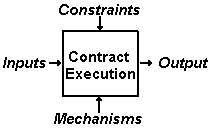
Because of the necessity to "stay out of the contractor box", the team’s initiatives are intended to address the things that are external to the contractor but controlled by the government--the inputs, constraints and mechanisms of the process. The focus areas mentioned earlier--workloading, scheduling, material, over and above, organizing for success, plus others--are areas where government changes can influence contractor output.
In studying the CAR process, the team found some key concepts or "truisms" that applied to the contract aircraft repair process:

Any cost to the contractor becomes a cost to the customer.
The ability to achieve production efficiency is directly related to production quantity.
Effective contract execution requires effective planning; planning requires early and complete knowledge of what is to be done.
Contractors will not improve performance unless doing so has a clear, significant impact on their bottom line
.
All the factors of production (facilities, material, labor, equipment, and technical data) must come together--synchronization.
The following sections highlight each of the CAR team’s major study areas and initiatives/recommendations in changing the way the contract aircraft repair process is contracted, administered and supported.
Workloading
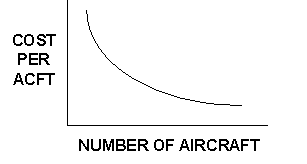
The team found that the most significant area impacting PDM contract aircraft repair cost and flowdays was a steady and sufficient amount of workload. A relationship between the number of aircraft worked and production cost follows a curve like the one shown above. Repetition allows workers to become better at their jobs and encourages specialization. As operators move down the learning curve, efficiency and quality gains are realized.
On the negative side, a lack of sufficient workload can increase flowdays and impact cost significantly. Unless workload is steady, some expensive skilled mechanics have reason to "stretch" work out to remain employed in lean times. They wind up sweeping hangar floors until more work arrives. All of these conditions are anticipated when contractors develop bids.
It is important to remember that the goal of this study was not to give all the government workload to the contractor. Overloading a contractor with work has the negative effect of increasing flowdays as requirements outpace resources. There is, however, an optimal range that efficiently utilizes the contractor’s resources and will produce savings. Determining that optimal range and then contracting quantities within it, is crucial in meeting the reduction goals
.
Scheduling
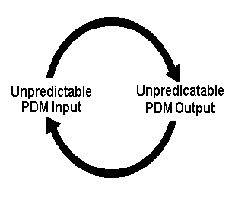
Scheduling is a basic function of any production effort. Clearly, in performing contract aircraft repair, the development and execution of a schedule for aircraft going in and out of a contract facility has a major impact on the contractor's ability to satisfy the contract and for the customer to receive the services/products when promised. Failing to schedule aircraft with production needs in mind sets up the cycle shown below. Customers have missions to fly, and often cannot input an aircraft into PDM until a replacement is completed. Uncertainty of aircraft input for PDM prevents contractors from delivering aircraft to the output schedule as well. Unlike workloading, which determines the number of aircraft to be worked and manpower allocation, the schedule determines when the work is to be accomplished. Knowing and being able to predict when a production effort is to commence is a major and critical step in resource planning.
An equally important factor that greatly impacts production is unchanging or stable workload. An input schedule that allows the contractor to "normalize" operations at steady manpower and facility utilization levels goes a long way toward delivering aircraft on promised due dates.
Material Support
Failure to put emphasis on material support will undermine the best efforts to properly workload and schedule aircraft repair. The CAR team discovered that unless it is known what parts are needed and aggressive actions to have the parts in place, delays are going to occur. The CAR team used many of the concepts coming out of the WR-ALC Lean Logistics organic aircraft repair team study in its recommendations. Foremost among those is the need for the development of an accurate bill of materials for each weapon system and a call for overhaul of the parts requisitioning system. Also, because aircraft repair contracts historically use Government Furnished Material (GFE), incentives need to be exerted to make the contractor more accountable for parts and shift the risk for schedule to the contractor. There will always be times when an unanticipated part need--a "stumble-on"--occurs. When this happens, it is imperative the government supply system, that contractors rely on for material support, is efficient and responsive. Creating and deploying a Shop Support Center (SSC), similar to those being established in the organic repair functions, addresses this need. Simply put, the SSC is a support team that includes the expertise and authority to handle many contractor issues--the greatest one being material.
Over And Above
Not surprisingly, despite all the best planning, unexpected inspection and repair work occurs on every aircraft. Consequently, aircraft repair contracts employ the use of over and above clauses to handle this work. This study identifies concrete recommendations for expediting these efforts to reduce the impact on schedule and cost. The CAR team member from Defense Contract Management Command (DCMC) played a crucial and major role in addressing this area. The CAR team found that a lot of historical information concerning PDM has been compiled over the years--and it's not only available at the ALCs. A wealth of knowledge can be gleaned from this data--knowledge that can help the government work smarter in the area of over and above support. The application of statistics to this information can help, for instance, in predicting an expected over and above allowance for a weapon system. Historical data, from both the ALC and DCMC databases sources, can better tell which items should have standards developed, and what those standards should be. Applying this information in the early stages of contract formulation, intelligent partnering with contractors, and allowing DCMC the opportunity to provide the total oversight streamlines the over and above process for both the government and contractor--resulting in faster throughput and at a reduced cost.
DCMC is the government representative at the contractor’s facility. The CAR team, as well as a joint AFMC and DCMC team, found this valuable resource is often under-utilized, as the ALCs historically retain control and management oversight over many support functions from a remote location. Utilizing the DCMC asset to its fullest potential would have a significant positive impact on contract PDM production and reduces redundant government resources.
ORGANIZING FOR SUCCESS
One of the areas the team found needing change concerned the organizational structure of the Air Logistics Centers. This became apparent during a visit to a private company that contracted its aircraft heavy maintenance. The team found a clean organization that focused solely on maintenance actions--both organic and contractual. In the contracting portion of the organizational structure, the perspective was not solely procurement actions, but focused on total program management--especially as it related to partnering with contractors and getting the most benefits for both--a WIN-WIN situation! Based on DOD guidance and current events, the team sees contract aircraft repair activities increasing in the DOD as downsizing, privatizing, outsourcing and budgetary crunches become worse--not better. The CAR team also found that aircraft repair, in itself, was a service that delivered a specific product to a customer. In itself, aircraft repair did not appear to fall into the Integrated Weapon System Management (IWSM) preview of having to have, under a single weapon system manager, a production function. Instead, the CAR team concluded that aircraft PDM inspection and repair was just another service (an extremely big and costly one) that customers expected ALCs to provide them. Generally, from the customer perspective, it did not matter to them whether their PDM work was accomplished organically or by contract--just so long as it was done in a predictable and effective method.
The scope of aircraft repair is large and is somewhat a discipline in itself. Division of this function into weapon system unique organization is somewhat inefficient, has duplication of effort and fragments support. Contract aircraft repair actions accomplish the identical work of organic maintenance functional--just not under the day-to-day management of the government. It is in this area that the CAR team felt realignment of responsibilities by organizational changes could be made. Doing so would result in more efficient, effective and institutional changes that allow, across the ALC and other support agencies, significant improvements in the throughput, cost and customer satisfaction of aircraft undergoing PDM inspections and repair--at both the organic and contract activities. One possible organizational change the CAR team considered revolved around removing the production activities from the individual SPOs and aligning them under a single function responsible for depot level aircraft repair. (Of particular note is that the CAR team did not advocate eliminating or transferring the single weapon system manager’s responsibility of satisfying the customers need for aircraft repair--the SPO still retains the single manager responsibilities and is the single "face to the customer"). The CAR team looked at a possible change using the concept that would have the SPO "hire" an aircraft repair function to repair the customer's aircraft--determining the WHAT AND WHEN. The aircraft repair function would determine the WHERE and HOW.
Although the CAR team did not recommend a specific organization to support the CAR initiatives, the team does recommend that another team be formed. The purpose of the team would be to study the need for organizational change and if warranted, recommend an organization that would better support the CAR process.
The results of the CAR team’s study provides 30 plus specific recommendations for improving the CAR process. The major ones being: (1) provide a economic workload to the contractor, (2) develop and follow an input schedule, (3) overhaul the government parts requisitioning system, (4) create and operate a Shop Service Center to support the contractor, (5) turn over more responsibility to DCMC, and (6) form another team to study and if warranted recommend organizational changes at the ALC to support the CAR process. Most of the recommendations mean minor changes in philosophy or direction at the SPO level in applying smart decisions to the CAR process; however, some recommendations require changing the very way the government approaches the business of aircraft repair--THINKING OUT OF THE BOX! Those recommendations needing center level or MAJCOM approval can best be processed first at the SPO level by requesting the support agencies/functions obtain the policy/guidance changes necessary to implement these recommendations.
CHAPTER 1
Background
LEAN LOGISTICS BACKGROUND
In late 1995, the Warner Robins Air Logistics Center (WR-ALC) Commander established 6 center level Lean Logistics "Chain" teams, in concert with 8 Lean Logistics "Link" teams, to develop implementation plans for changing the way the center provided core services and products to the war-fighters--the CUSTOMER!
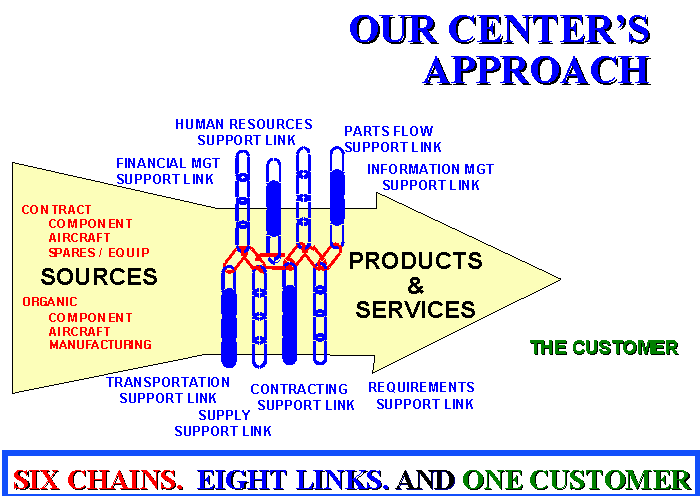
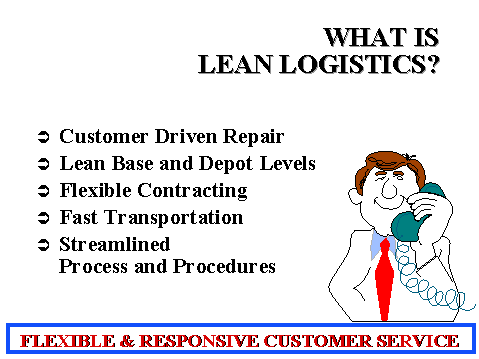
The task of each team was to use the umbrella principles of LEAN LOGISTICS and the specific initiatives and concepts of reengineering, acquisition reform, 2-level maintenance, just-in-time inventories, intelligent partnerships, integrated product teams, and all the other smart business practices available to the teams. The basics of Lean Logistics are defined below:
COMMERCIAL PRACTICES VERSUS GOVERNMENT PRACTICES
The CAR team recognized that government and commercial contracting practices differ in several fundamental ways. Commercial procurement actions attempt to obtain best value for the company to maximize profit. Government actions, however, are geared, by public law, to:
The government’s goals are more complex than those of the commercial sector, but the government can consider, at least in parts, many of the commercial acquisition practices. Some that the CAR team felt may be considered in contracting for aircraft repair services are:
This study addresses many of these practices. Use of these practices to the maximum extent possible under the Federal Acquisition Regulations (FAR), DOD guidance and good business practices during the procurement process of contracting aircraft repair, coupled with the other initiatives in this report, can and will result in providing to the user faster, cheaper and higher quality aircraft.
CAR FOCUS – CONTRACT PROGRAMMED DEPOT MAINTENANCE
Air Force weapon systems are routinely scheduled for Programmed Depot Maintenance (PDM) at predetermined intervals to accomplish the heavy maintenance and inspections. Appendix A--Description of PDM--contains an overview of how the PDM process takes place. The majority of PDM work is accomplished "in-house" or organically, yet the trend is to contract more of this type work in the private sector. Although there is more aircraft repair work that is contracted (i.e., unscheduled depot-level maintenance, modifications, time compliance technical order, etc.), the CAR team focused primarily on those areas relating to contracting of aircraft PDM.
Even though the CAR team did not study CORE issues, it is important background to consider. As the DOD solidifies the definition of CORE depot maintenance capabilities to meet essential wartime demands, promote competition and sustain institutional expertise, the considerations to contract workload will adjust as necessary. The recently published Policy Regarding Performance of Depot-Level Maintenance and Repair, March 1996, by the Office of the Secretary of Defense is must reading for ALC managers as they consider workload factors--now and the future.
STUDY PURPOSE/GOALS
The purpose of the CAR Lean Logistics study was to examine the aspects of the CAR process in which government participation can be used to enhance the overall CAR performance, and to recommend any appropriate process modifications.
Simply put, the charter the team was given was to develop ideas/initiatives that system program offices could use in preparing, administering and supporting contract aircraft repair actions that would result in substantial improvements in throughput (flowtime), cost and customer satisfaction.
CAR CHARTER
DEVELOP IDEAS AND INITIATIVES
WR-ALC AIRCRAFT COMPANIES (SPOs) CAN USE TO
REDUCE THROUGHPUT (BY 50%),
REDUCE COST (BY 30%), AND
IMPROVE CUSTOMER SATISFACTION (BY 20%)
IN THE CONTRACT AIRCRAFT REPAIR CAR PROCESS
(EMPHASIS ON PDM PROCESS)
CONTRACT AIRCRAFT REPAIR TEAM CHAMPION
The CAR Team was provided advice and assistance from the past and current C-130 System Program Directors and Deputy System Program Director (WR-ALC/LB):
Col Ben McCarter (past C-130 SPD)
Col Greg Siegel (Current C-130 SPD)
Mr. Mike Hatcher (GM-15) (Deputy C-130 SPD)
THE CAR LEAN LOGISTICS TEAM
The initial CAR team was formed in September 1995 and consisted of representatives from various Air Logistics Center support functions, WR-ALC aircraft single manager program offices, Defense Logistics Agency (DLA), Defense Contract Management Command (DCMC), contractors, and customers associated with contracting aircraft repair--especially as it related to programmed depot maintenance (PDM). Since there was an on-going effort to renew the C-130 weapon system PDM contract, a large majority of the team consisted of representatives from the C-130 System Program Office (SPO). The team composition changed throughout the study based on findings and new areas of study; however, a core number of people were members during the duration of the study. Individual members of the CAR Team are:
Name Organization
Name Organization* Tim Annis (Team Lead) WR-ALC/LBP Florine Crane WR-ALC/LBRA
* Ed Humphreys WR-ALC/LB (MTC) Jenny Thompson WR-ALC/LKSA
Denise Yawn WR-ALC/LBPLC Mike Earehart DCMC/PEMCO
Carolyn Green WR-ALC/RE/LL Bill Clark WR-ALC/LBRSD
Hugh Nelson WR-ALC/LBRA Chuck Gibson HQ AFRES/LGMA
Ed McDowell McDonnell Douglas Capt. Mike Nowaczyk WR-ALC/FML-1
Perry C. Doyle 78ABW/LGSP Wade Summer WR-ALC/FMLMC
Ralph Hill WR-ALC/FMLMC * Franklin Kee WR-ALC/LJK
Gerald Barron WR-ALC/LBPCA John McGraw 78ABW/LGSIC/LBP
Tammy Phelps WR-ALC/LBRS Annick Woodlock WR-ALC/PKPB
Margie Tyner WR-ALC/LBKA * Joel Murphy WR-ALC/LFPC
Maj. O.B. Mercer DLA/DDWG/E Lt. David Flynn WR-ALC/LB-PIT
Melvin Gillis 78ABW/LGTPL Mike Bishop DCMDE-AOB
Glenna Abney 78ABW/LGTPM Jim Harper WR-ALC/LBRA
Cheryl Maddux DCMDE-AT * Jimmy Rogers WR-ALC/FMLMC
* John McDonald WR-ALC/LBRA Roy Abbot WR-ALC/RE/LL
* Ron Harlow Intergraph * Mike Denson Intergraph
Carol Thomas WR-ALC/LU
* Core Member (Core Team biographies are at Appendix K)
METHODOLOGY (OVERVIEW)
As part of the CAR study, information about the current processes was gathered through team modeling meetings, interviews, symposiums, site visits and surveys.
Intergraph Corporation used the following software tools to model and simulate portions of the CAR "As-Is" process:
Deliverable Software Tool Vendor
IDEF0 Model AI0Win KBSI
IDEF3 Model Prosim KBSI
Simulation Witness AT&T Istel
DOCUMENTING A PROCESS
Although the "As-Is" portion of the CAR study contains Integrated Definition model levels (IDEF) process models and computer process simulations, it is much more than that. There are several areas of consideration that have to be taken into account when documenting a process
:The Stakeholders And Their Objectives
--most processes are shared by several groups of people, and each group is a stakeholder in that process. It is important to understand who those stakeholders are as well as their interests (or objectives) in the process. The importance and relevance of any portion of the process are different from stakeholder to stakeholder, and each perspective has to be considered.The Process Steps--processes are composed of process steps, and each step is carried out by some individual, organization or machine at some location and consumes some amount of time and cost. Each process step should contribute in some way to the process itself, and can be characterized as value-added or non value-added. An IDEF model allows the definition and detailing of these steps in a graphical way.
The Process Technology--the mechanisms that are used to carry out a process are important. Many process steps can be automated by taking advantage of current technology in ways that vastly improve the overall process performance.
The Motivational Elements Of The Process
--processes themselves are not always to blame for poor process performance, as many processes are not used, misused and abused. More often than not, process steps are performed by people, and the efficiency and effectiveness with which those process steps are executed depend greatly on the individuals involved. There is more to be gained in overall process performance by providing motivation for performance than by changing and even eliminating process steps.To accomplish the study, the CAR team used the following meetings/symposiums in the fact finding portion of the effort.
Contractor Symposium (See Appendix E for details)--Representatives from twelve different contractor companies gathered to discuss with the CAR team the issues that impacted their performance.
Contractor Site Visit (See Appendix E for details)--The CAR team made a trip to a contractor’s facility to observe the operation first hand, and to discuss the areas being addressed by the team.
Process Modeling (See Appendix D for details)--IDEF process models were developed for three of the focus areas (over and above, parts, and engineering support) by interviewing functional experts in each area.
Customer Symposium (See Appendix G for details) -- Representatives from all of the customer groups met with the team to explain their concerns and priorities as related to CAR.
Commercial Comparison (See Appendix H for details)--The CAR team traveled to Memphis, Tennessee to meet with a representative of FedEx. FedEx contracts out its air fleet for maintenance much the same as the Air Force.
THE PROCESS STAKEHOLDERS AND THEIR OBJECTIVES
In order to fairly and accurately analyze the CAR process, it was necessary to understand and document the perspectives of each of the stakeholders. That information was gathered in the following ways:
THE CAR CONTRACTOR’S PERSPECTIVE
The contractors are businesses independent from the Air Force that provide PDM services to the Air Force for profit. Their role is to bid on work to be done and perform that work in compliance with the time frame and cost of a contract. The contractors are interested in:
THE CAR ALC PERSPECTIVE
The ALC is the Air Force agency that executes the PDM requirements for a given weapon system for the customer group as a whole. The PDM requirements and time window for completion for each weapon system tail number are agreed upon by the customers and the ALC. The ALC is responsible for contracting the work to be done in either organic (Air Force) facilities or contractor facilities. In addition to contracting, the ALC provides a large amount of the support for both organic and contract repair sites. This support includes material, equipment, engineering support, quality support and funding modifications. The ALC is interested in:
THE CAR CUSTOMER PERSPECTIVE
The customers own and fund the aircraft that are inspected and repaired by the PDM activities, which can be carried out by organic (Air Force) depots or contractor depots. For any weapon system, there are multiple customers such as the Air National Guard, Air Force Reserve, Air Combat Command, etc. The role of the customer in this process is to submit aircraft for PDM with as little impact as possible on operations and readiness. The customers are interested in:
With this as background, the next chapter takes a closer examination at the specific CAR team focus areas and the team’s recommendations for improving the CAR process.
Chapter 2
INITIATIVES
This portion of the study focuses on the CAR processes that the CAR team found needed improvement. It outlines the recommended changes to the government controlled conditions, that when implemented, positively alter the contractor’s operations.
The basic premise of the CAR study is that the government, primarily the ALC, cannot, by itself, impose or dictate improvements in the contractor's performance--instead, contractors must be incentivized to improve their own performance. In incentivizing the contractor, the ALC can indirectly influence the contractor's performance by establishing positive conditions for contract aircraft repair:
The CAR team felt that when these conditions are met, contractors will perform up to the goals set forth in this report. This is not wishful thinking, nor is it a hap-hazard guess. During the course of this CAR investigation, the team saw substantial evidence to support this claim. Other organizations that contract aircraft repair --both in and out of the Air Force--experienced performance levels that met or exceeded the goals stated in this study.
In presenting the following CAR team initiatives, the Chapter 2 format was standardized for continuity. The individual initiative discussions start with a general background of the particular area, followed by a short impact summarization on the PDM process. The specific CAR team recommendations are then presented. The individual initiative area is concluded with examples of metrics or measurement tools that SPOs or managers could use in tracking implementation success.
WORKLOADING INITIATIVE
DISCUSSION/BACKGROUND
From the CAR Team’s perspective, providing the contractor a sufficient amount of workload at a steady rate is the most important area that needs to be considered and implemented when contracting aircraft repair--especially programmed depot maintenance. Pre-determining the amount of workload a contractor can efficiently and effectively accomplish, coupled with a firm input/output schedule (discussed in a following section), will ensure achievement of the majority of the expected flowdays and cost savings with the increased customer satisfaction goals detailed in this report.
Workloading refers to the amount of work being submitted for contract aircraft repair. In addition to the number of aircraft input to a contractor’s facility, workloading also defines the type of work to be done on those aircraft. PDM work makes up the majority of work, but other types of work such as modifications, Time Compliance Technical Orders (TCTO), Unscheduled Depot Level Maintenance (UDLM) and Organizational & Intermediate (O&I) level maintenance have significant impact on workload.
At the contractors symposium (see Appendix E-1), contractors told the CAR team that they needed to maintain a stable work force and support core teams if they are to be able to reduce flowdays. The team verified this statement as being valid by thorough research at organic government facilities and other commercial activities. Reducing flowdays provided contractors the opportunity to apply better business practices and reduce operating/overhead expenses which in turn means they will be able to pass the savings on to the government in their bids.
The CAR team found that in today’s CAR process, the priority in assigning workload is to fill--and even overfill--organic facilities first, and send the remainder out on contract. In some cases, this remainder is not enough to allow the contractor to be efficient in the contract execution. In addition, some contracts contain large bid ranges that are designed to give the government maximum flexibility. While this does provide flexibility to the ALC, it also drives up the contractor’s cost because of the impact this uncertainty has on material levels, manloading and facility availability. In short, the ALC is purchasing a high capacity and utilizing only a portion of that capacity. Yet this does allow the government to surge if the need arises.
There is a direct relationship between the amount of work done at a facility and the efficiency, cost and quality of that work. Numerous skills (aircraft mechanic, sheet metal mechanic, electrician, etc.) are needed to accomplish the different work operations in the PDM package. These skills are used throughout the aircraft repair process and are moved to different operations as workload demands. However, there will be some skills that cannot be fully employed and will be idle if there are too few aircraft on station to work. When this constraint is not alleviated, the inefficiencies result in idle time and higher cost to the customer. Government decisions to contract too few aircraft or to provide erratic inputs directly impact the contractor's ability to perform efficiently and cost effectively.
The Cost Of Unlevel Workloading
Contractors, like any other commercial business, are most productive and efficient when the input workload level matches the workforce capacity. In reality though, workload is seldom (if ever) level--even though level workload is the most desirable situation. A fluctuation in workload causes cost and schedule overruns. The production organization, in this case a government contractor for aircraft repair, typically operates in one of four modes depicted in the below chart:
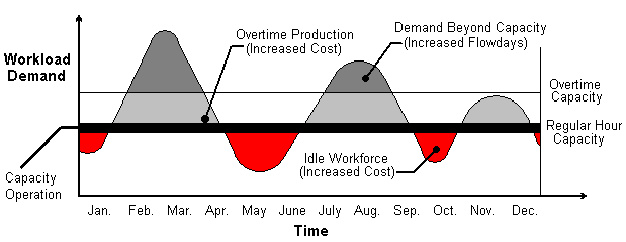
Capacity Operation
--this is the fine line where the amount of work to be done on an ideal schedule matches the man-hours available. This situation is ideal for the contractor, but is not always possible--and almost never happens for a significant length of time. The flexibility of the contractor determines how far above or below the regular hour capacity line that operations can work efficiently.Overtime Production--This occurs when the man-hour demands for a period of time exceed the regular-hour man-hour availability for that same period, but can be met with overtime work. This causes a cost increase.
Demand Beyond Capacity--when man-hour demand rises above even the overtime capacity, there is no other means to increase production. The result of operation in this mode is increased flow days and cost.
Idle Workforce--The skilled workforce employed by the contractor is not a temporary resource pool. Since that workforce cannot be fired and re-hired to match production cycle fluctuations, additional cost is incurred whenever the workload demand drops below the man-hours available. This extra cost is caused by workers remaining on the payroll without production return, and by deliberate cuts in work efficiency in an effort to remain billable--meaning increased flowdays and cost.
Basically, the chart above is depicting that there is a minimum number of aircraft inputs a contractor needs to efficiently and effectively utilize the numbers and skills of the workforce required to accomplish the work requirements of the PDM workload. Without this steady input of work, the dynamics of capacity negatively impact both flowdays and cost. In decreasing both, the contractor must have an efficient quantity and a steady workload.
Another factor in considering workload has to do with properly man-loading the work. Man-loading means applying manpower to the work. Significant flow day reductions can be achieved by fully man-loading the critical path jobs of the work--on multiple shifts. The contractor must know the critical path of the work and identify the manpower quantity and skills, with material, needed to meet the scheduled completion for all major jobs. All things being equal, if decreasing flowdays is the sole objective, this is an important event that needs to occur to reduce flowdays! Since the government does not have direct control or management responsibility over the contractor's workforce, the government must offer incentives to the contractor so the contractor will apply maximum manpower to the critical jobs on at least two shift operations. Doing so will result in reduced flow days. Conversely, spreading the same manpower on a single shift, over multiple aircraft, results in inadequately manloaded aircraft that produces increased flow days and cost. The team found that FedEX Corporation wanted their aircraft down for a minimum amount of time and thus they required 24 hour, 7 day a week contractor coverage on their aircraft. They did this via the contract vehicle.
In order for the contractor to do either of the above, they must have a clear understanding of what the workload is and what will be expected of them. Unknown and undefined work requirements drastically affect contract cost and schedule. Providing the contractor sufficient lead time for developing standardized repair procedures, material requirements and provisioning has a major impact on the contractor reducing cost and schedule impacts to the contract. Another consideration the CAR team looked at was to assess the condition of the scheduled PDM aircraft before it arrived at the contractors facility. Doing so would reduce the uncertainty or unknown work by allowing the contractor to plan and lay in necessary parts to expedite repair actions. Adding Time Compliance Technical Orders ’s (TCTO’s), modifications and AFTO Forms series 781 and AFTO Form 103 discrepancies to a basic PDM work package generate most of the variable unplanned requirements. Although mission requirements may drive accomplishment of these requirements, there is a strong need for analysis of repetitive requirements to allow for the development of standard work packages.
An efficient number of aircraft, properly manloaded on the critical path jobs, will clearly positively impact schedule and cost performance. However, the single most important aspect of ensuring that proper workloading produces savings is having the right part on hand when it is needed. Since most of the parts and material currently provided the contractor are GFM, the government and contractor must have an in-place process that assures material is on-hand, when needed by the mechanic, to complete the job. The Material Support Initiative is discussed later in this report.
IMPACT
The benefits of having an economical number of aircraft are many: work repetition, retention of higher quality skilled workers, justification for multiple shifts and core teams, investment in equipment that reduces man-hours, and so forth. None of these ideal working conditions are possible with less than economical workloads. At the other extreme, too many aircraft create a situation where some constraint limits throughput--whether it be manpower, facilities, tooling, etc. In this case, the flowdays for all aircraft will go up because aircraft are waiting for some resource. With consistent scheduling/workloading, the contractor can retain a stable, trained, experienced work force capable of achieving reduced flow days, reduced cost and increased customer satisfaction.
RECOMMENDATIONS
WORKLOADING METRIC
There are two major metrics to consider in this area. The first is to chart the number of aircraft placed in the contractor facility compared to the computed economical number and at what rate they are placed in the facility. The second area is charting the scheduled amount of work against what is actually accomplished.
SCHEDULING INITIATIVE
BACKGROUND/DISCUSSION
Scheduling is the process by which aircraft are assigned arrival and departure dates at a contractor facility. It attempts to anticipate the flowdays of the aircraft in accordance with the individual work packages, and provide sufficient information prior to aircraft arrival for the contractor to plan work efficiently.
Scheduling is a basic function of any production effort. Clearly, in performing contract aircraft repair, the development and execution of a schedule for aircraft going into and out of a contract facility has a major impact on the contractor's ability to satisfy the contract and for the customer to receive the services/products when promised. Unlike workloading, which determine the number of aircraft to be worked and manpower allocation, the schedule determines when the work is be accomplished. Knowing and being able to predict when a production effort is to commence is a major and critical step in resource planning. And as the CAR team found, resource planning and proper execution are key factors in a contractor being able to satisfactorily perform the contract.
Currently, the PDM schedule for the contractor is driven basically by two things--the ability of the customer to deliver an aircraft for PDM and the workload needs of organic facilities. When an aircraft is projected to be available from the customer, the first decision made is whether or not it can be sent to an organic facility--even if that facility is fully loaded. If the decision is to not accept or perform the work organically, then "it goes to the contractor". Very little consideration appears to be given to the impact of receiving or not receiving an aircraft to the contractor or the timing of the input. In several cases the CAR team found that contractors often are not aware that an aircraft is arriving until it arrives, and the costs of the inability to plan materials and manpower become quite high.
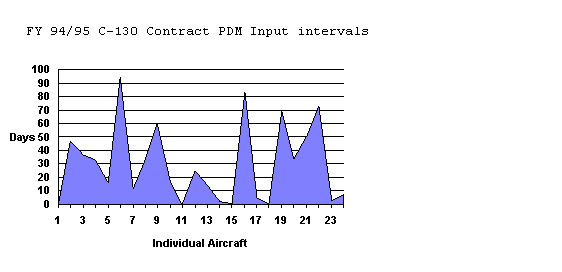
Below is a specific example of a previous input schedule for aircraft into a contractor PDM facility .
PEMCO FY94 C-130 Arrival Intervals PEMCO FY95 C-130 Arrival Intervals
Aircraft Arrival Date Days between arrivals Aircraft Arrival Date Days between arrivals
1 Nov. 3, 1993 N/A 1 Oct 24, 1994 25
2 Dec. 20, 1993 47 2 Nov. 8, 1994 15
3 Jan. 6, 1994 37 3 Nov. 10, 1994 2
4 Feb. 8, 1994 33 4 Nov. 11, 1994 1
5 Feb. 24, 1994 16 5 Feb. 2, 1995 83
6 May 29, 1994 94 6 Feb. 7, 1995 5
7 June 10, 1994 12 7 Feb. 8, 1995 1
8 July 13, 1994 33 8 Apr. 18, 1995 69
9 Sept. 12, 1994 60 9 May 22, 1995 34
10 Sept. 30, 1994 18 10 July 13, 1995 51
11 Sept. 30, 1994 0 11 Sept. 25, 1995 73
12 Sept. 28, 1995 3
13 Oct. 5, 1995 7
In looking at this input schedule graphically (see below) we visually see the disruptive nature of an uneven input schedule, especially when compared to the workflow problems that are depicted in the Cost of Unlevel Workloading portion of this handbook.
Scheduling for contract aircraft repair is not only a contractor issue. The CAR team found that the government’s major focus and reporting/metric products for contract aircraft repair scheduling revolved around when an aircraft is scheduled out of the contractor's facility. And although no one would disagree that this is a primary measurement in depicting the contractor's ability to meet the contract, the government must consider the total schedule performance/execution before judging contractor performance--especially since government’s actions directly impact the contractor's ability to execute the schedule. This scheduling problem is amplified for some weapons systems based on a wide variance in the numbers of aircraft requiring PDM during a given year. Compounding this even further is the difficulty of developing a PDM schedule for weapon systems that have PDM accomplished at multiple facilities (organic and contract) (see C-130 outyear PDM projection chart at Appendix A-5).
IMPACT
During the CAR Contractor Symposium (see Appendix E), discussions with Federal Express Corporation (see Appendix H), and in the "As Is" process (see Appendix D), the CAR team found that improvements in workloading and scheduling were areas that had the most potential for changes that could result in reaching the goals for this effort.
As part of the CAR project, Intergraph Corporation developed or used a computer model to simulate, in a general sense, the process of PDM in a contractor facility. Naturally, the complexity of repairing aircraft cannot be easily captured in a computer model, if at all, however, it was used to illustrate to the CAR team the effect of variability in workload scheduling on manpower needs, which is not as complicated.
In this model, aircraft entering the PDM system were assigned some number of required labor hours between 12,000 and 16,000. In addition, these aircraft entered the PDM facility according to a pre-determined time schedule with built-in variance to that schedule. It was assumed that the available manpower at the facility was divided evenly across all aircraft at the facility. When the assigned labor hours for an aircraft had been accomplished, the aircraft left and the flow days were recorded. From a facility standpoint, the fluctuation in workload--caused by variability in the incoming schedule--resulted in either increased flowdays (requirements greater than resources) or idle manpower (resources greater than requirements).
The results of this simulation verified what the team expected--that the contractor's performance, in terms of cycle time and cost, are greatly impacted by variability in workload.
Scheduling plays a critical role in the production efficiency of the contract facility in several areas. First, the regularity of aircraft arrival impacts the manloading of the tasks to be done. When aircraft arrivals are too far apart, resources are greater than requirements. This results in skilled labor personnel being either temporarily laid off, put to work sweeping floors, or switched back and forth between different jobs such that the learning curve is never fully realized. When aircraft arrivals are too close together, requirements are greater than resources, which result in an increase in flow days. Material and manload planning are also very important. The way scheduling impacts planning is by providing the contractor with as many work package specifics for each tail number aircraft, as early as possible. Many parts have long lead times or are temporarily unavailable, and need attention long before the aircraft arrives. Assessing the aircraft scheduled for contract repair before it arrives can mitigate some of the unknown and result in better planning.
In the CAR Customer Symposium (Appendix E-1), customers (war-fighters) were asked if they would commit to a firm input PDM schedule if it meant a more reliable and predictable output date for their aircraft. The customers indicated they would agree to a more rigid schedule. However, they did caveat their commitment by indicating input dates are normally driven by the output dates of aircraft currently in PDM. This was especially important to those customers who have small numbers of aircraft assigned to various locations and are unable to operationally have more than one aircraft in PDM at any particular time. It was also discussed that since PDM are accomplished at both organic and contractor facilities, sometimes inputs are delayed at one facility due to an output date slippage at another. It was interesting to note that during this discussion, the customers looked to the Air Logistics Center to develop the PDM schedule based on the capabilities of the organic and contractor facilities and the known numbers and dates PDM were due. They implied they would follow the ALC developed schedule.
Breaking the "failure to meet schedule" cycle
Introducing variations and unknowns into the schedule sets up a cycle where unpredictable PDM input results in unpredictable PDM output. On the other side of a coin, the customer cannot input an aircraft until he knows when a replacement will return from PDM, so the unpredictable PDM output results in unpredictable PDM input
.
In order for the contractor to output an aircraft at a predicted time (which is the customers Number # 1 objective) at a reduced cost that meets customer expectations, the contractor must have a firm input schedule. This schedule must be properly executed and with sufficient advanced notice of known workload. Without the government providing the contractor these basic production principles, there can be little expectation from the government that the contractor will be able to meet an output schedule, at a cost or quality product that will be acceptable to the government.
In the workloading section, the CAR team recommended that the government commit to the contractor an optimum or economical number of aircraft to work. This allows the contractor to reach proficient and economical goals that in turn can result in reduced flow days and cost and increased customer satisfaction. To obtain these "rewards," the government must work in concert with the contractor in providing the aircraft on a schedule that allows the contractor to reach and maximize efficiencies
In addition to scheduling an economical number of aircraft into a contractor's facility based on an even and predetermined flow, the team found that contractors needed known, specific aircraft tail number work that could be scheduled into their basic workflow. This work should be known well before the aircraft arrives at their facilities. This workload should include variable work that is associated with each specific aircraft undergoing programmed depot level maintenance. Examples of this variable work would be field level maintenance request (AFTO Form 103 and AFTO Form 781A), modifications and Time Compliance Technical Orders (TCTO). From the contractor perspective, the earlier this information is provided to them, the better they can plan and prepare for the work. Having this information in advance of the aircraft arriving at the contractor facility allows the contractor to lay in the needed materials, ensure the appropriate number of trained, skilled manpower are available and to "blend" in the additive work to the basic PDM workflow package.
RECOMMENDATIONS
SCHEDULING METRICS
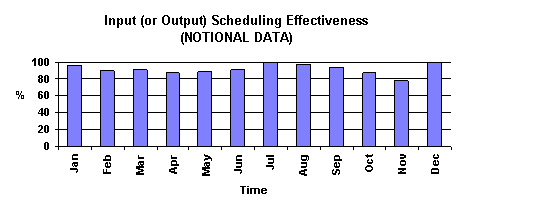
The basic metric for this initiative is scheduling effectiveness. The measurement should consist of how well the customer meets the input "living" schedule and how well the contractor meets the "living" output schedule. The example below is a format with notional data that could be used for each schedule.
MATERIAL SUPPORT INITIATIVE
DISCUSSION/BACKGROUND
Material support is the process by which government furnished material (GFM) is anticipated, requisitioned, and delivered to contractors. The CAR team, as well as several other study teams/efforts, came to the same conclusion: there is only one way to describe the government material support system today--broken! For example, in many cases, once a part is requested by a contractor it takes as many as five days just find out the status of a needed part in the government system; much more time is required to actually receive the part. The Bill Of Material (BOM) for the PDM aircraft is notoriously inaccurate, which produces an additional load on the part's acquisition system, further slowing the system.
The CAR team looked at how the AF requires contractors to obtain parts on aircraft repair contracts. Parts can be divided into three categories, contractor furnished material (CFM), government furnished material (GFM) and contractor acquired property (CAP). CFM as the name implies are those parts and materials the contractor furnishes as he performs the maintenance. The cost for these materials are recouped through his bid price. These materials are primarily indirect materials or in other words, materials that do not remain on the aircraft. Some examples would be rags, sanding discs for corrosion removal, masking tape during paint and stripping operations and so forth. The team found that it is very rare for indirect parts to cause delays in aircraft repair flowdays.
GFM is material requisitioned by the contractor from the government and is provided at no cost to the contractor. These parts are usually classified as direct parts, or in other words, parts that remain on the aircraft. Some examples of GFM would be fasteners, structural parts, paint, and avionics equipment. These parts are requisitioned by the contractor through the D034 system and tracked at the contractor’s facilities through the G009 system. Typically, these parts are responsible for most of the delays in PDM aircraft.
The last category of parts is CAP. CAP is a term used to denote those parts that the government would normally furnish as GFM but is unable to do so in a timely manner (these are non-RSD items). After requisitioning the part and receiving an unacceptable due-in date, the contractor is authorized to purchase these parts on his own and is reimbursed on a cost plus administrative fee basis. This is usually spelled out in detail in the appropriate contract vehicle.
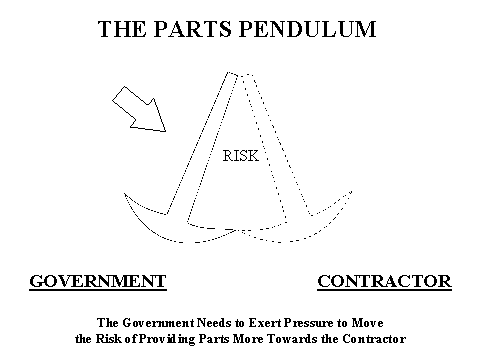
Currently most of the risk for providing parts rests with the government. Ideally, the government should shift the risk for supplying parts to the contractor. When asked at the contractor symposium about complete CFM contracts or increasing the amount of CFM, contractors expressed reluctance to sign up to such an effort. They are more comfortable with the government assuming the majority of the risk
Some of their reasons are not without merit. For instance, many of the parts that are required for PDM inspections/repair are only available from the government since some sole source suppliers will only sell to the government. Also, because the government is buying many of these parts on a recurring basis to support every day requirements, it is difficult for contractors, needing small quantities, to match the discounts the government receives for large quantity buys. Consequently, it currently makes sense to have some level of GFM--but this should be less and less as the government becomes "leaner". However, conscience decision should be made, depending on the weapon system and the capability of the contractor, on what that level should be.
Many of the contractors expressed dissatisfaction with the untimely support of GFM. After a requisition is requested from the government by the contractor, a significant amount of time elapses (as much as 3-5 days) before they are provided a status. Consequently, if the part is not available or has an unacceptable estimated delivery date (EDD), valuable time was lost which the contractor could have used to develop an alternative strategy for obtaining or repairing the needed part (i.e., CAP or cannibalization). When work stoppage parts are required, delays translate directly into increased flow days. Because of the importance of knowing the status of a part requirement, the CAR team felt that it would make sense for the contractor to share or have access to the government material system.
Direct information links with government legacy systems could give the contractor real-time status of his parts requisitions giving them additional time to make sound business decisions. During the CAR team visit to FedEx, the team found that FedEx maintenance contractors have shared access to the FedEx material system. This allowed them to obtain the parts status within 2 hours after requesting the part--not days like the government system (see Appendix H).
We asked the CAR customers at the Customer Symposium what they thought about allowing the contractor to supply more of the parts. They said they did not care who bought the parts as long as the parts conformed to the technical order requirements. They did express some reservation about not having government oversight on parts purchased by the contractor. However, the CAR team found in follow-on discussions that most of the customer representatives were unaware that DCMC has a government property manager providing oversight on contractor purchased items for government PDM contracts.
Another problem the CAR team identified had to do with timely identification and requisition of parts requirements. Many times government parts could have been made available in time if enough lead-time was provided. Currently, few weapon systems have an accurate, up-to-date material requirements list or Bill of Materials (BOM). Though there will always be "surprises" when performing maintenance, steps need to be taken to minimize the unknowns. Systematic reviews and updates of the BOM is a MUST!
The CAR team identified another constraint in the area of Readiness Spares Division (RSD) parts. PDM contractors are not allowed to perform repair on RSD items slated for overhaul. Consequently, when a reparable item fails, the contractor must requisition another part, ship the carcass to the depot, and either wait for it to be repaired, hope a replacement is shipped or cannibalize the part from another aircraft. Waiting for these parts has a significant impact on cost and schedule. In many cases, the contractor has the capability to overhaul the part in-house or can subcontract with a vendor (in many cases the contractor would go to the same vendor the government uses to perform the repair). This has the advantage of allowing the contractor to assume more risk, still maintain the RSD asset under government control and maintain RSD requirements and funding.
IMPACT
At the contractor symposium, the contractors indicated that the material support issue has a great effect on performance. Most contract flowday extensions requested are in relation to some part need. A properly manloaded aircraft, in a properly equipped facility, becomes nothing but an inefficient effort when parts are not available to repair the aircraft. An accurate bill of materials (BOM) for the basic PDM is critical for the contractor to lay in the known material requirements, and a responsive parts acquisition system is imperative to support the unknown material requirements.
RECOMMENDATIONS
1. The SPO should invest the time to ensure the accuracy of the bill of materials (BOM) and establish a Material Requirements List (MRL) for aircraft PDM. An accurate bill of materials (BOM) must be developed and utilized to ensure required parts are on-hand when needed. Waiting to order parts the day the aircraft arrives is courting disaster since lead-time for some parts are as long as the PDM flow cycle. To reduce this, there has to be an early "shake-down" and inspection of the aircraft once it is placed in the contractor facility and advance notice of work to be done so that up front planning is accomplished to get the parts when they are needed.
2. The contractor’s access to the government parts system should be enhanced. The communications technology to accomplish this is readily available. The data systems used for requisitioning need to be overhauled. Technology is available that could provide real time data for contractors. Current lean logistics efforts underway to revamp the legacy systems need to exploit this technology so that contractors are able to have all the information they need to make smart business decisions.
MATERIAL SUPPORT METRICS
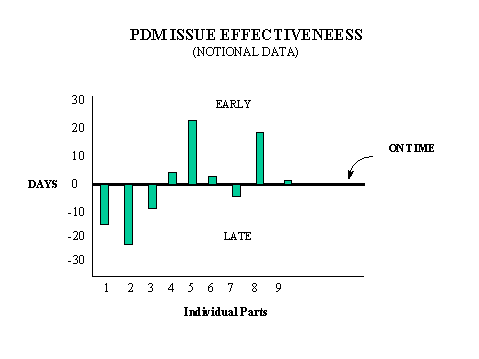
In measuring this initiative, there should clear evidence that there is a direct correlation in moving the material support risk from the government to the contractor by seeing reduced flowdays and cost. The notional chart above tracks what some could call ISSUE EFFECTIVENESS and can be used by both the government and the contractor to see how well implantation of the above recommendations are affecting operations. Other measurements to consider are the number of cannibalization actions, the size of the GFM inventory, plus others that portray how well material support is being provided to the PDM process.
THE OVER & ABOVE PROCESS
DISCUSSION/BACKGROUND
Over and Above (O&A) is work discovered during the course of performing overhaul, maintenance, and repair efforts that is: (a) within the general scope of the contract; (b) not covered by the line item(s) for the basic work under the contract; and (c) necessary in order to satisfactorily complete the contract.
Over and Above Work performed on aircraft during Programmed Depot Maintenance (PDM) can be divided into two categories:
Normally in PDM contracts, a period ranging from 10 to 20 days is allotted for the contractor to perform an initial inspection of the aircraft. The purpose of this inspection is to determine what work needs to be performed on the aircraft. Contractors estimated to the CAR team that approximately 70-80 percent of unanticipated repair items, or over and above items, are discovered during this inspection.
Before the inspection period is complete, the Administrative Contracting Officer (ACO) issues a blanket work request authorization that provides the funding and authorization for the contractor to work over and above discrepancies. Individual work requests are submitted to the DCMC Quality Assurance Representative (QAR), who performs the initial review and determines if the repair is covered under the basic contract provisions and if not, whether the repair should be made. Once the determination has been made to work the discrepancy, the DCMC Industrial Specialist (IS) and the contractor enter discussions/negotiations to reach an agreement on the number of hours required to perform the work. Unless there is a work stoppage situation, agreement must be reached prior to contractor commencement of work. Once all over and above negotiations are complete, (usually when the PDM is complete), the contractor submits a consolidated work request package of all completed work requests to the ACO for definitization and incorporation into the contract.
The primary tool used by DCMC to track the over and above process is the Over and Above Centralized Information System (OACIS). OACIS is a database developed and administered by DCMC to provide visibility of the O&A process. It provides the following over and above information on each aircraft: a description of each discrepancy; the proposed hours to repair the discrepancy; the DCMC IS recommended hours; the negotiated hours; the material associated with the work request; the total dollars authorized for the over and above effort; and the balance remaining after negotiation of each work request. In addition, the system provides a total of all costs of over and above effort per aircraft.
IMPACT
As outlined above, the over and above process is labor intensive for both the contractor and the Government. The greater the number of people involved and the more checkpoints required, the slower the process.
A major drawback of over and above work is the unpredictability of the cost associated with the effort. By definition, the cost of over and above work is not included in the basic effort of the contract. Therefore, it is difficult for the customer to determine up-front the total cost of PDM for each aircraft. Some of that uncertainty can be reduced by providing firm-fixed prices (FFP) for as much over and above effort as possible. There are also hidden costs involved in the processing of work requests. DCMC informed the CAR team that the average administrative cost associated with processing one over and above work request is approximately $275.00.
The O&A process is time consuming because it requires the input of various technical specialists. The time spent determining to work or not work a discrepancy, and then agreeing to the amount of time required to perform the work could possibly have an impact on the schedule of the aircraft. Also, if additional funding requirements are not identified early, there could also be a delay in receiving funding and the authorization to work. Each day the aircraft schedule slips increases the likelihood of customer dissatisfaction. Streamlining the entire over and above process will greatly enhance savings in cost and time, which will ultimately result in customer satisfaction.
RECOMMENDATIONS
1. Involve the Defense Contract Management Command (DCMC) in the pre-contractual phase of acquisitions and delegate complete responsibility of contract administration to DCMC.
Air Force Material Command (AFMC) Re-engineering Initiative # 14, Increase Reliance on the Defense Contract Management Command (DCMC), dated 6 May 1996, addresses this issue in its entirety. The purpose of the initiative was to identify duplication of effort between AFMC and DCMC as well as unexploited DCMC capabilities. The key recommendations of the initiative are highlighted below.
In the past, DCMC did not become involved in the acquisition cycle until late in the process, usually after contract award. Early Contract Administration Services, or Early CAS, allows AFMC to take advantage of the wealth of DCMC expertise available in the pre-award phase. DCMC maintains historical data to determine contractor capabilities and performance as well as over and above data to facilitate the identification of fixed-priced over and above candidates. Recommendation 1-1 from the study suggests that "Buying activities involve DCMC in pre-contractual efforts leading to a solicitation or award." DCMC is the primary agency established to provide contract administration for all of the Department of Defense. In many instances, AFMC and even the using agency are integrally involved in contract administration of the PDM process, duplicating many of DCMC’s efforts. Recommendation 1-3 states "Program managers establish and annually update a joint DCMC/buying office Memorandum of Agreement or similar document that outlines roles, responsibilities, resources, and structure of the Integrated Product Team (IPT)." Recommendation 2-1 states "Restrict the practice of withholding normal contract administration functions delegated to the CAO." Formal retention of any of these functions must be approved by the Contract Clearance Approval Authority." The study also addressed government oversight of contractor technical and quality functions. In this area, the following recommendations were made, which would also be applicable in the PDM environment: 4-1 Require AFMC program offices to rely primarily on DCMC to conduct in-plant review, witness and verify in-plant testing, and approve all related test procedures; 4-2 Require AFMC program offices to eliminate the duplication of contractor document reviews; 4-3 Require AFMC to eliminate the duplication of evaluating Engineering Change Proposals (ECPs) and ensure all possible ECP functions are delegated to DCMC. Following these guidelines will streamline the process and eliminate duplication of effort, resulting in reduced cycle time.
2. Include a detailed Over and Above Clause in the contract.
As a minimum, the over and above clause should include a listing of the information to be included on each work request (compatible with OACIS), a definition of hands-on labor, and a general description of how work requests will be processed. Though it should provide detail, it should also allow the contractor some flexibility to adapt to the processes already in use at the facility. Specific detail on the requirements for the processing of over and above is usually documented in a Memorandum of Agreement (MOA), which should be developed as soon as possible after contract award. The ACO and the contractor mutually agree to the procedures for Government administration and contractor performance of over and above work requests. The MOA is the vehicle used to clearly delineate the responsibilities of the Government representatives and the contractor.
The requirements of the clause will ensure that the key players involved in the process know exactly what their roles and responsibilities are, thereby making the process flow more smoothly and efficiently. Including the correct information on the work requests will provide the historical data necessary for the development of standards and identification of FFP candidates.
3. Develop/maintain a historical database of over and above actions to facilitate the development of standards and FFP of over and above effort.
As stated earlier, the over above process is labor intensive and involves unpredictable costs. The optimum contracting situation for over and above is to significantly reduce the number of over and above discrepancies requiring negotiation by developing standards and firm-fixed prices for the effort up-front. This can only be accomplished if complete and accurate over and above historical data exists.
The information can be used in numerous ways. If an item is occurring frequently, there will be a historical record of the discrepancy and the time required to repair it. This information can be used to identify candidates for FFP and standards development. Once the information from several aircraft has been consolidated, an average cost of over and above per aircraft can also be provided. Better estimates of the total cost of O&A work per aircraft can be provided, which will reduce the uncertainty associated with the effort. Requiring the use of the OACIS database provides all of these benefits. Additionally, contractors should be allowed READ ONLY access to the OACIS.
4. Reduce the number of over and above discrepancies requiring negotiation.
Paragraphs a, and b are recommended methods for reducing O&As requiring negotiation before contract award and are initiated by the buying activity:
This method requires extensive historical data on the O&A tasks commonly performed on the aircraft, which is made available to prospective contractor’s in the buying activity’s bid library. Instructions to offerors on how to prepare the proposal would be listed in sections L and M of the RFP. Using historical data, determine the over and above effort with the highest frequency of occurrence (example: 80 percent of the effort are at 35 hours or less--this will vary by aircraft or program). Determine the cost to perform this effort per aircraft and include the cost in the basic portion of the contract. Any over and above effort up to 35 hours (or what ever limit the program sets) is not negotiated, and is worked at no additional cost. Any work request for 36 hours and above will be negotiated. Since the 35 hours has already been included in the basic effort, the difference between the negotiated amount and the 35 hours will be allowed as additional effort (example: The work request is submitted for 70 hours, is negotiated to 60 hours and the contractor is allowed 25 hours for the work request: 60 - 35 = 25).
If a Fixed Price Over & Above CLIN or a Negotiated standard is used then no negotiations are required for that task. The more Fixed Price Over & Above CLINs and standards are used the fewer negotiations will be required for over and above tasks. Each standard used during in the RFP (as either a Fixed Price Over & Above CLIN or a standard for negotiated Over & Above) will require an occurrence factor based on OACIS database and MRRB historical data. High occurrence and low cost tasks should remain negotiated standards while high cost-low occurrence items should be priced as a Fixed Price Over & Above CLIN. The standards should be reviewed and updated annually during the exercise of the yearly contract option.
Paragraphs c and d are recommended methods for reducing O&As requiring negotiation (during contract performance) and are initiated by DCMC representatives.
c. Develop standards for over and above tasks. Over and above tasks performed on a repetitive basis are candidates for the development of standards. The Industrial Specialist (IS) and the contractor reach agreement on the amount of time required to perform a specific task, and apply that standard each time a work request is submitted for the effort. Pre-negotiated standards greatly reduce the amount of time required to process a work request. Once the decision is made to repair an item, the contractor can proceed with the work. Established standards may be unilaterally withdrawn by either party upon written notice.
The same method can be used to develop firm-fixed prices for O&A tasks. The only difference is that the effort and associated cost are incorporated into the contract.
d. Develop weighted average for over and above tasks
The following method can be used to develop weighted averages for tasks for which standards cannot be developed:
Considering historical data, usually O&A data on several aircraft, determine the O&A occurrences with the highest frequency (example: 80 percent of the work effort is 5 hours or less, per work request--this number will vary by aircraft or program). Develop a weighted average for the effort by determining the average negotiated hours, the average actual hours and then determining the average of the two (example: 2.5 average negotiated hours + 2
average actual hours = weighted average of 2.25 hours). The weighted average is then applied to all work requests submitted at or below the threshold (example: work requests from .10 hours to 5 hours are adjusted to 2.25 hours).
This may not be necessary if there is Fixed Price Over & Above and negotiated standards for tasks less than the weighted average hours. Tasks that require a large amount of man-hours but vary in scope each time might be best left as negotiated maintenance tasks. Tasks that do not vary in scope for each occurrence should have a standard developed. This method reduces processing time because the work request is reviewed by Quality Assurance only and the ACO is not involved. Any effort proposed at or below the threshold will automatically have the weighted average applied; therefore, the need for negotiations is not needed. The actual time to perform each work request is recorded by the contractor and submitted by CDRL to allow the contractor and the government to renegotiate the weighted average, if needed, on a periodic basis.
5. Ensure customer understanding of contract requirements.
Often, the customer does not have a clear understanding of what is actually contained in the Statement of Work and what work the contractor is contractually required to perform. There is often confusion between what meets contract requirements and what the customer considers "cosmetically" acceptable. This can result in increased cost to the customer and also increased cycle time due to rework.
Having the customer participate in MRRB and PDM Specification development and attending Program Management Reviews will enhance the customer’s understanding of the requirements. If the customer has a better grasp of what is required and has participated in the development of those requirements, he will have a more realistic viewpoint of what to expect once the aircraft completes PDM. This also applies to AFTO Form 103 requirements and AFTO Form 781 discrepancies. The customer must know and understand that the only work beyond the PDM specification and Contractor’s SOW that will be accomplished during PDM are approved AFTO Form 103 requirements. and only those AFTO Form series 781 discrepancies that DCMC determines as safety of flight, economical repair, and/or quality defect discrepancies on the aircraft during acceptance inspection.
In addition, every customer should be provided with a copy of the Contractor’s Statement of Work, PDM Specification, and MRRB documents in order for them to reference in preparing and receiving aircraft for PDM input.
OVER AND ABOVE INITIATIVE METRICS
There are quite a few areas that can be measured in tracking Over and Above improvements. In fact, the DCMC is probably ahead of the ALCs in measuring this area because they do it on a day-to-day basis in many contractor facilities. SPOs would be encouraged to review the DCMC metrics on a recurring basis to get a sense of how well this area is being improved. One particular that is a good indicator of how well improvements are progressing is keeping track (hopefully a decreasing amount) of the total number of negotiated O&A actions that occur per PDM. Another important measurement is to track the actual O&A dollars the contractor charges per aircraft--this should progressively decrease as more O&A issues are worked "up front" in contracting and MOA actions. Other specific areas to measure are (1) the Number of O&A Work Request processed per aircraft, (2) the number of actual delays that occurred due to having to negotiate O&A repair actions, and/or (3) the number of Firm Fixed Price O&A Items included in a contract.
ENGINEERING SUPPORT INITIATIVE
BACKGROUND/DISCUSSION
Engineering support is the process by which the ALC oversees and provides assistance for those engineering needs that are outside the contractor’s authority or capability. Engineering support can, and at times does, impact the flow days of an aircraft. It is, however, a necessary part of PDM that engineering authority be at the ALC level in order to maintain configuration control on the aircraft. It is the process for obtaining engineering disposition that can impact flowdays, because the responsible engineers are remote from the contractor and the problem.
Three different perspectives of engineering support from the contractor, the customer and the SPO are summarized below:
"Contractors think that they could process airplanes faster if they were given more engineering authority--either internally or by having more AF engineering authority (responsible persons) on site. Also, contractors perceive that there are too many layers of engineers (contractor, DCMC, ALC, etc.) that slow things down."
"As a customer, I am concerned about configuration control. I would want to have assurance that AF oversight capability is retained."
"As a SPO engineer we have more insight in what’s happening with the weapon system, new problems and repairs, and customer concerns because we deal with all Depots and field units whereas the contractor engineer has very limited insight into anything that is not occurring at the PDM facility where he is located."
Currently the format, process, and level of SPO Engineering support supplied to contractor PDM facilities varies greatly for each weapon system. Each SPO (Chief Engineer) decides what level of engineering authority to give the contractor and the process the contractor must follow to obtain SPO engineering support. Usually the contractor engineering support is limited to one or two engineers who have been certified by the SPO to have limited engineering authority. The majority of engineering support required during a PDM deals with aircraft structure.
Usually the repair of aircraft commodity (RSD) items beyond O & I level T.O. requirements is not allowed during PDM. The item is usually removed and returned to the USAF supply system and a new/overhauled item installed. For many of these items the SPO does not retain engineering authority and thus cannot give the contractor engineering personnel engineering authority for those items.
When any repair is to be done that falls outside of the scope of the negotiated PDM contract or has no standardized procedure, an approved procedure is required to ensure that the repair is performed to design specification. Many times, the repair has been standardized and is documented in the technical manuals for the aircraft. In this case, the contractor need only to follow the technical manual procedure.
When the repair required is not documented in the technical manual, the contractor or SPO engineer must provide an engineering disposition. SPO Engineering support is provided to contractors when technical assistance is needed or required by contract during the course of PDM activity. For the most part, engineering support requirements do not have a direct impact on the flow time of an aircraft, except when a stumble-on repair item is discovered near the end of the PDM schedule.
The discovery of a stumble-on repair item triggers three concurrent processes: (1) Acquisition of the part(s) needed for the repair (if not in contractor’s inventory), (2) Over & Above negotiations to fund the repair (if not fixed- price repair), and (3) Engineering support for technical guidance (if repair is not in tech manuals). The current method of communication between contractor and SPO engineering personnel is usually telephone and FAX.
Today, contractors rely on government engineering services for dispositions during the contract activities. This dependence adds flow days every time a discrepancy is discovered and must be dispositioned. In order to achieve a significant reduction in this process time, contractors must, by contract agreement, maintain some level of engineering capability at the contractor site. A program by which this engineering capability could be certified to perform some of the government engineering functions would greatly reduce the interruptions to the schedule. There is a similar delegation of engineering authority in the Federal Aviation Administration (FAA) by use of a Designated Engineering Representative (DER) certification.
Commercial Process:
FAA rules state that major repairs not in FAA approved maintenance manuals (developed by the original manufacturer) must have engineering approval by the original manufacturer before implementation. All engineering dispositions must be signed by an FAA certified DER.
RECOMMENDATIONS:
1. Contractor Engineering Certification: The weapon system Chief Engineer should certify all contractor engineers prior to them providing any engineering dispositions on the aircraft. The certification process should determine if the engineer has an FAA DER certification (and what type), education, and experience. The review process could also include interviews and training/orientation at an organic PDM facility where government engineers could determine first hand the contractor engineer’s qualification. The weapon system Chief Engineer should certify contractor engineers by letter once satisfied they are qualified. This letter should specifically state the level of engineering authority the contractor engineer is authorized and should match contract language in the PDM contract. At a minimum the DER certification should be a structural DER.
4. RSD items: Review the reparable policy to determine if contractors could make minor part repairs as opposed to submitting a failed part to the repair cycle and having to wait for a replacement. This would require the SPO to obtain engineering authority from each responsible commodity engineering authority.
5. Reporting: All contractor engineering dispositions should be completed on AFMC Form 202 or similar form. A monthly report, to include copies of completed AFMC Form 202s, should be sent to the SPO engineering organization for review and storage. These reports should be sent and stored electronically.
6. Automated discrepancy review (remote teleconferencing): Utilize PC video-conferencing technology for sharing photographic information in conjunction with audio (speaker phones) between contractor and engineering support. Require contractors to have PC video-conferencing equipment per an industry standard. Select the industry standard. Require contractor to have scanning equipment to digitally scan repair sketches to support video teleconferences and electronic submittals and storage of AFMC Form 202s.
ENGINEERING SUPPORT METRICS
Number of AFMC Form 202’s sent to SPO engineering for review and time to respond.
Number of AFMC Form 202’s sent to SPO engineering for assistance and time to respond.
Time required for contract engineers to process AFMC Form 202 requests.
ORGANIZING FOR SUCCESS INITIATIVE
DISCUSSION /BACKGROUND
If one considers the Secretary of Defense’s Depot Maintenance Overview policy paper (a portion of which is covered in Appendix A of this report), and the projected downsizing of DOD compared to scheduled workload (for example: see C-130 PDM projected workload chart, Appendix A), the assumption has to be made that contracting out organic workload is going to increase in the DOD. In considering this, coupled with the CAR teams visit to Federal Express Corporation. and exploring ways the commercial world accomplishes contract aircraft repair, the CAR team believes that there is a need to consider ways to restructure the System Program Offices and/or the Air Logistics Center to better provide the services and products of contract aircraft repair to the customer.
The team looked at several options and spent many hours discussing the pros and cons of each; however, the team quickly found there was not a sufficient number of people, with the right expertise, on the team to consider an organizational change. Nonetheless, the team did study this area as discussed in the following sections. However, there are no specific recommended organizational changes in the SPOs and the ALC. Although the team felt this was a fertile ground for improving and institutionalizing the changes suggested in this handbook, the team felt that a further study should be chartered to propose any specific changes.
1. The CAR team organizational focus considered 4 areas that related to the CAR process. The first area concerned the multitude of services and support ALCs and other DOD agencies provide contractors. In the CAR Contractor Symposium (see Appendix E), the contractors came across loud and clear--if the government wanted decreased flowdays and cost, with the same or higher customer satisfaction, the contractors wanted and needed a single focal point /face to address and solve day-to-day government provided services and support issues. The team initially followed a "rabbit (false) trail" in considering a recommendation to place a customer representatives at contractor facilities to provide fast answers to contractor Over and Above, Funding, Schedule, and Engineering issues. The customer’s reaction at the CAR Customer Symposium (See Appendix G) was "NO WAY". Coupling the customers reply with the DCMC’s representatives who clearly articulated that this was "THEIR JOB", the team got back on track looking for the real fix rather than an "band-aide" approach. Some felt that a SPO PDM Program Manager was what the contractor was suggesting, however, in every case, a PDM Program Manager was identified and worked with the contractor--but so did other ALC people. The team found a lot of different fragments accountable and responsible for their individual portions of the process, but no single entity pulling it all together as a team.
PDM METHOD F-15 C-130 C-141
ORGANIC YES (2)
CONTRACTORS YES (1) YES (4) NONE
3. The third area the CAR team considered was the current Warner Robins Air Logistics Center and SPO organizational structure--especially those that contracted out PDM work. Each had similar organizations using the Integrated Weapon System Management (IWSM) or single manager concept as the basis for their organizational structure. There was no question by any of the team members that IWSM is the right approach in managing a weapon system. Thus, in any recommended structural change, the team unanimously agreed that there had to be no intent to diminish or reduce the single manager’s authority or responsibility or to change the single face to the customer concept. Determining weapon system PDM requirements with the customer and obtaining a source to accomplish PDM is a recognized prime responsibility of a SPO. However, the concept of each SPO, with multiple PDM locations, having management responsibility for only a portion of the programmed depot maintenance program, may not be the best way to manage PDM and efficiently use decreasing resources.
Although the CAR team does not recommend a specific organizational change, there are several that were discussed. The following is but one the team discussed. It shows the depth of the issue that the team considered and how many were THINKING OUT OF THE BOX.
Reorganization Example
Create a new Directorate called Aircraft Repair reporting to the Center Commander. The responsibility of this new directorate would be to provide depot level aircraft inspection and repair to the weapon systems managed at Warner Robins Air Logistics Center. The resources currently assigned to the production divisions of each of the SPOs (F-15, C-130 and C-141) would be reassigned to this new directorate. Under the new directorate, 2 major divisions--one to perform organic depot level maintenance and another to manage contract aircraft repair would be created. Additionally under the directorate, a scheduling function that works with the SPOs in scheduling PDM--whether they be organic or contract based on efficiencies and effectiveness-- would be formed. Under each of these divisions, create and man, from the various SPOs and base agencies, a Shop Service Center responsible for providing all the necessary material and supplies, procurement, financial, engineering, etc. support and services necessary to perform depot level maintenance inspection and repair. A notional organizational chart outlining this proposal is below.
The basic concept of this change would be to create an organization whose sole purpose would be to (1) manage the day-to-day organic maintenance repair and inspection activities, (2) support the contractor in performing depot level aircraft inspection and repair and (3) act as the interface between the SPOs and the customer in scheduling aircraft for PDM. From the SPO perspective, they, acting on behalf of the customer, would continue to determine and generate the requirement for the maintenance and "hire" the Aircraft Repair Directorate to perform the maintenance. It is important to note, that the SPO would still be the single face to the customer and retain the authority and responsibility for depot maintenance actions. With a close interface between the Aircraft Repair Directorate Scheduling function and the SPO, they would jointly develop an aircraft repair schedule determining whether or not the inspection and repair would be accomplished organically or contractually depending on capabilities and core definitions.
IMPACT
The feedback from the government contractors (See Car Contractor Symposium notes at Appendix E) indicates their concern that the current ALC and SPO structure are not providing them the information, the decisions, nor the resources that they need in a timely manner. Having to interface with multiple agencies/offices, rather than a single office/face, hampers their ability to make significant improvements in the PDM process. Thus, with the potential of an increasing amount of aircraft PDM workload being transferred to the private sector, coupled with a pressing requirement to minimize the amount of time an aircraft is out of service due to PDM, reducing cost and improving or increasing customer satisfaction (quality), the timing may be right to restructure the SPOs and ALC to an organization that can focus solely on managing and administering aircraft inspection and repair (PDM)--both organic and contract.
RECOMMENDATIONS
The above discussion barely scratches the surface on all the nuances associated with a major reorganization proposal of this magnitude. The CAR team did not believe the resources, nor the expertise to completely develop a methodology to implement this recommendation, was available during the CAR effort. Thus the CAR Team recommendation is to form another team, with subject matter experts, to study the concept and if warranted, develop an organizational change proposal to implement a reorganization.
ORGANIZING FOR SUCCESS METRICS
No single metric applies to these recommendations. Basically, a review of all the top level and sub-level metrics recommended in this Handbook should be used to monitor and track progress. How a group of people with specific tasks is organized has a direct impact on the results of the changes and actions; thus a good measurement of success is reviewing the critical metrics.
INCENTIVES FOR CONTRACTORS
DISCUSSION/BACKGROUND
All recommendations in this report attempt to do one thing--influence the behavior of contractors to increase performance. The ALC wants contractors to reduce cost and flow days, order parts early, improve quality and perform necessary work only. Currently,
contractors have little reason to accomplish these things; and in some cases, contractors actually have reason not to. There are two approaches to influencing the behavior of the contractor--external and internal. The internal approach is to make the desired performance in the best interest of the contractor, with a definite bottom line advantage for its achievement. This is an incentive approach.
The external contracting approach is difficult to implement, because of various contracting constraints and the difficulty involved with measuring and rewarding performance fairly. Also, experience has shown that contractors have many means of shifting blame for inadequate performance elsewhere. For example, when the required flowdays are not met and a penalty is possible, contractors can easily find an engineering need or a part need to justify an extension without any fault being attributed to them.
An internal incentive approach is much better because it aligns the priority of the contractor with that of the ALC. If the contractor benefits substantially from reducing flow days, he will reduce flow days. If the contractor benefits from making sure parts are ordered as early as possible, he will order parts as early as possible. With the incentive approach, no monitoring effort is needed to artificially
force contractors into compliance with performance goals because those goals are also the contractor’s.
Pursuant to FAR 16.4, Incentive type contracts are appropriate when a firm-fixed-price contract is not appropriate and the required supplies or services can be acquired at lower costs and, in certain instances, with improved delivery or technical performance, by relating the amount of profit or fee payment under the contract to the contractor’s performance.
Generally, a Firm Fixed Price (FFP) type contract is used for Programmed Depot Maintenance (PDM) or other aircraft repair. There is some level of predictable work required which includes both known requirements and uncertainties that can be reasonably identified from historical data.
The work to be performed are divided into three categories:
A firm-fixed price contract provides for a price that is not subject to any adjustment on the basis of contractor’s cost experience in performing the contract. The Firm Fixed Price methodology places upon the contractor maximum risk and full responsibility of all costs and resulting profit or loss. It provides maximum incentive for the contractor to control costs and perform effectively and proposes minimum administrative burdens upon the contracting parties.
IMPACT
Under a firm fixed price contract, the contractor’s incentives for good performance are: (1) all profit earned is kept and (2) favorable performance ratings are given for use in future requirements. Liquidated Damages are used for poor performance. However, failure to properly administer Liquidated Damages in a timely manner may be considered a penalty; thus, will be determined un-enforceable. Consequently, contractors will not have sufficient motivation to perform better because they will receive the same amount of payments whether delivery is on time or not.
RECOMMENDATIONS
1.
Identify as many items as possible during the initial planning phases of the PDM/aircraft repair for firm fixed prices to minimize Over and Above negotiations. This will also reduce alleged Government-caused delays and administration costs of contract modifications. In addition, maximum risk will be placed back on the contractor.2. During the planning phases, customers and the contracting activity should focus on the primary objective of the contract which should be to minimize cost and obtain the earliest possible return of the aircraft. As a result, considerations should be given as to the appropriate contract type to use to accomplish the desired objective, i. e., Firm-Fixed-Price or Incentive contract. The Federal Acquisition Regulations (FAR) may have to be revised to allow a hybrid type of contract (combination of Firm-Fixed-Price and an incentive for Delivery/Performance).
3. Although it is often difficult to ascertain or prove the extent and damages the Government has suffered, the contractor should be assessed liquidated damages to the maximum extent practicable. The contractor oftentimes goes unpunished for failing to meet the obligations under the contract. Assessing the liquidated damages will reduce the contractor’s profit margin and serve as motivation to complete the contract in a timely manner.
4. Government responses should be timely and consistent. Follow-ups with responding parties should be conducted to ensure Government-caused delays are minimized.
CAR PROCESS METRICS
RECOMMENDATION
In order to measure the progress made in implementing any or all of these CAR team recommendations, the right measurement tool or metric must be used. In each of the initiatives this handbook has listed some possible areas to measure. As far as measuring progress in meeting the objectives of the team’s major focus area's--throughput, cost, and customer satisfaction--the following metrics are suggested ways SPO managers can look at top level performance factors.
THROUGHPUT REDUCTION
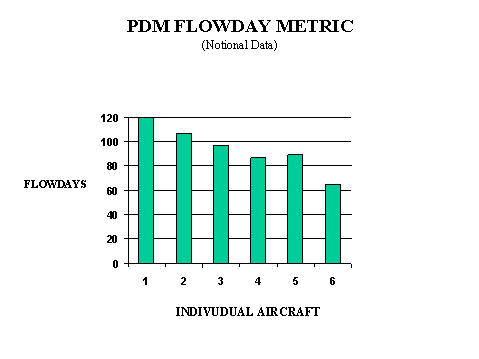
The command definition for throughput, outlined in the AFMC Lean Logistics Repair Implementation Plan, 10 January 1996, is "The rate at which the system turns a demand into a deliverable." In the case of the contract aircraft repair team focus--PDM--this means the number of days it takes a contractor to accomplish the PDM--with the additive work and additive flow days that are negotiated or predetermined with the contractor (the clock should start the day the aircraft arrives at the contractor facility and stop when the DD Form 250 is signed by the government representative). Thus, throughput, or flowdays, for aircraft undergoing PDM can be measured using the following notional chart example.
COST REDUCTION
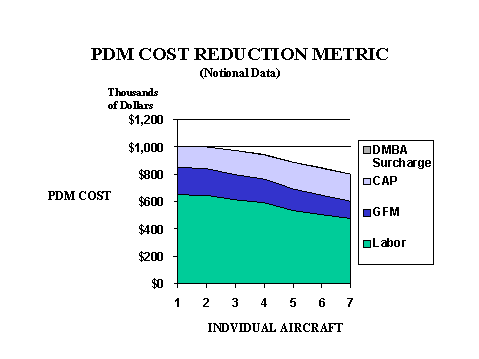
Cost can be measured many ways and the team found this to be quite a complex and complicated area (see Appendix A, Contract DMBA). The critical data must come from the PDM Program Manager that shows the Actual Unit Repair (AUR) Cost. This AUR cost includes the cost of the labor obtained from the basic contract, the over and above labor expense (obtained from DCMC and contract), cost of GFM, Contractor Acquired Property (CAP) plus the standard DMBA surcharge--for each individual aircraft. This cost MUST BE FOR ONLY THE PDM PORTION of the total expenses. It should not include labor nor material cost for modification, TCTOs, etc. The obvious reason to be able to measure to a baseline workload (i.e., PDM) versus a variable workload. This is not to say that other expenses are not important and should not be measured--they should be--but not when measuring the contractor's performance in accomplishing PDM work. The team's recommendation on the master metric that would depict to the SPO, PDM Program Managers and customer a true indication of how well the implemented recommendations affect cost is depicted in the chart on the left.
CUSTOMER SATISFACTION
Measuring customer satisfaction, especially when there are many different customers, can be difficult due to a customer’s subjective application of a wide range of variables in determining their wants, needs and requirements. The secret of developing a solid measurement that is a good indicator of the customer's satisfaction, with products or services, is a customer index--one that is kept to it’s simplest terms (the KISS principle). The best way to obtain this is to interface with the customer(s) and discuss in detail what their expectations are and what they want, what they need, and what they require. "What the customer requires" is the major focus area. This should be a negotiated range of ratings (these ranges should be from one to six, with six being the highest customer satisfaction) for critical mission elements the customers expect to accomplish their mission. Some examples the team anticipated customers would say as they relate to PDM are: Total Number of Aircraft in PDM, Meeting Scheduled/ Projected Output Dates, Number of Safety of Flight Discrepancies Discovered at Home Station Inspection, Number of Days to Return the Aircraft to Flying Operational Missions, etc. In each area, each customer must clearly articulate what they have to have (required), what they need and what they want. These areas should be ranked by the customer by level of importance.
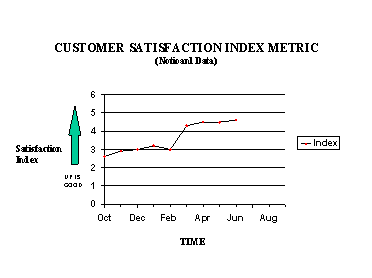
Taking the customers rankings and required numbers as a baseline, this determines their level of satisfaction. If for example, they say that the number of aircraft in PDM status is their number one mission limiting area and that they can only have no more than 20 aircraft at any one time in PDM, this becomes their bottomline satisfaction level for this area. Anything ranging below or above this number increases or decreases their satisfaction level--this becomes a measurable area.
Taking each area’s criteria, with the customers’ ranking, and assigning a numerical rating to each, then adding each area each month (or whatever time period is established) provides a numerical index. This allows the SPO PDM Manager to develop a matrix of the customer's satisfaction factors and develop an index of how well PDM are being accomplished. In most cases the SPO PDM Manager will know the customer's reaction or satisfaction at the same time or even before a customer does. The figure above is one example of a notional chart for displaying customer satisfaction.
CHAPTER 3
LESSONS LEARNED FROM C-130 PDM CONTRACT
Concurrently with the CAR team effort, the C-130 SPO had a ongoing team effort to prepare and award a new C-130 PDM contract. The three current PDM contracts were expiring and a decision had been made to continue to contract C-130 PDM. It was for this reason that a large number of the CAR team came from the C-130 SPO. In fact, several key members of the PDM contract team were also on the CAR team. As a result, several recommendations developed by the CAR team were incorporated in the new C-130 PDM contract effort. On the other hand, some of the CAR team’s recommendations require long lead-time changes/actions in current processes, thus all the CAT team recommendations could not be implemented in their effort. And as would be expected, some of the C-130 PDM contract team experiences in preparing/working a new PDM contract were included in this report. This was especially true in the area of applying Acquisition Reform principles to the contracting action.
Since the PDM contract team was in the requirements determination and Request for Proposal (RFP) phase of the contract process, the CAR team felt it was appropriate, and important, to capture the innovations they used in preparing the C-130 PDM contract and include as lessons-learned comments in this report. These items are not listed in the CAR team summation chapter (Chapter 4).
These lessons-learned comments are in no particular priority order and can be somewhat cryptic without background discussion. It is assumed that program mangers are familiar with the contracting process and acquisition reform principles. When warranted, a particular portion of the C-130 SPO PDM Contract RFP or other reference material is included in Appendix J of this handbook.
1. Use Minimum Mandatory Requirements (MMR) and Baseline Requirements (BR) as evaluation factors (Appendix J). MMRs are primary factors and BRs are secondary factors and should be used to initially evaluate contractor proposals, with either yes or no responses, and to make the first competitive range determination without having to evaluate the contractors entire proposal. Reference the FAR supplement BB for source selection procedures for a more detailed explanation.
2. In preparing sections B, F, L, and M of the RFP, Use multiple bid ranges as discussed in the Workloading Initiative section of Chapter 2.( example in Appendix J).
3. Use Statement of Objectives (example in Appendix J) to define the objectives of the program. Areas to consider include flow days, quality, material support, alternative processes, security, safety, Hazardous Material Management Plan (HMMP), management, etc.
4. Fully explain pricing of proposals in the RFP (Appendix J). Some of the following needs to be specifically addressed: (a) what tasks should be in the Basic Fixed Price for PDM? (b) what tasks should be Fixed Price Over & Above tasks, (c) what tasks should be Negotiated Over & Above either as a standard or a negotiated task, (d) Fixed Price tasks must have occurrence factors assigned for evaluation purposes, (e) Negotiated Over and Above tasks must have a set number of man-hours assigned for evaluation factors, and (f) a detailed input schedule for the entire contract period must also be included in the RFP. There must be an estimate provided to the contractors on the average man-hours per aircraft of negotiated tasks of less than a pre-determined number of hours stated in the RFP as the minimum threshold or negations.
5. In Section L of the RFP, list the complete instructions for preparing the contractor’s SOW (example in Appendix J). During the pre-solicitation phase, consider holding a class for contractors in SOW development. Clearly state that the contractor should not repeat the PDM specification requirements in the SOW, instead they should reference the specification and identify the processes for accomplishing the PDM specification requirements.
6. There should be a section in the contractor’s proposal that allows a contractor to propose alternative processes, specifications, general shop technical orders/manuals, etc. Write Section L and M (example in Appendix J) so it clearly explains how these alternatives should be proposed and how they will be evaluated.
7. For unique and/or program specific areas which cannot be covered elsewhere in the RFP, use H-Clauses. An example might be engineering authority/certification.
8. Include detailed instructions for pricing CFM in Sections B, L and M of the RFP. (example in Appendix J). Reference the Material Support Initiative section in Chapter 2.
9. Involve the contractor as early as possible in the RFP process. At a minimum, contractors should be involved in meetings prior to the Acquisition Plan development followed by a pre-solicitation meeting where the contractors come to discuss the draft RFP after they have had time to review it.
10. Involve all parties EARLY (i.e., Program Manager, Contracting Officer, DCMC, Customers, etc.) that participate in writing the solicitation and evaluating contractor proposals. Doing so eases developing and prioritizing source selection evaluation criteria and standards. All must help decide what is/is not critical and what is/is not important. Get team members that are willing to THINK OUT OF THE BOX!
11. Acquisition reform does not mean that you cannot have detailed inspection and maintenance requirements. They can and should be used as long as they don’t propose a work flow for those requirements. There should be a detailed PDM specification that the contractor will reference in his SOW but does not duplicate in the SOW. T.O.s should be compliant documents. The PDM specification is a contractually binding document.
12. Ensure there is sufficient technical support to evaluate contractor proposed alternatives.
a. Flow Days = PDM total man-hours divided by (8 hours times productivity factor times number of shifts times number of workers on each aircraft) or as defined by the contractor.
b. Once flow days are determined, the minimum facility requirements can be decided, by determining at the highest input rate scheduled, what the maximum number of aircraft is that could be input into a contractors facility during the number of flowdays determined in "a".
15. PDM contracts should minimize the use of GFE. The majority of support equipment required to perform PDM should be the contractor’s responsibility. Only unique items that contractors cannot easily obtain should be listed as GFE in the RFP. (example in Appendix J)
CHAPTER 4.
CAR STUDY SUMMARY
As a summary for the CAR report, the team felt is would be appropriate to list the team recommendations and their relative impact to the 3 major goal areas--reduce flowdays, reduce cost and increase customer satisfaction. As such, a subjective rating is applied to each recommendation. The team used a number to reflect the overall impact the recommendation has on the goal area. The ratings used are: Little Impact--1; Some Impact--3, and Significant Impact--6.
1
3 6LITTLE SOME SIGNIFICANT
IMPACT IMPACT IMPACT
|
CAR RECOMMENDATIONS |
FLOWDAY REDUCTION |
IMPACT COST REDUCTION |
IMPROVE CUSTOMER SATISFACTION |
|
WORKLOADING |
|||
|
1. The SPO should determine if contracting should be done at all. |
N/A |
N/A |
N/A |
|
2. Determine the minimum quantity of aircraft for a consistent workload to a contractor. |
6 |
6 |
6 |
|
3. Support multiple shift man-loading. |
6 |
1 |
6 |
|
4. Require the contractor to develop a critical path for the PDM process, |
6 |
3 |
6 |
|
5. Provide standard workload package vs variables. |
6 |
6 |
6 |
|
6. Develop and implement a Service Support Center (SSC) concept. |
6 |
3 |
1 |
|
7. Request pricing quotes from contractors for an incremental range of aircraft.
|
N/A |
6 |
3 |
|
SCHEDULING |
|||
|
1. Involve contractors in the year-to-year scheduling process. |
1 |
1 |
1 |
|
2. Publish an annual schedule for all aircraft and all PDM facilities. |
6 |
3 |
6 |
|
3. Evolve a "rolling" six month PDM schedule. |
6 |
3 |
6 |
|
4. Provide contractors and customers access to the scheduling program/data. |
6 |
3 |
6 |
|
6 |
6 |
3 |
|
6 |
6 |
6 |
|
MATERIAL |
|||
|
6 |
6 |
1 |
|
2. Enhance the contractor’s access to the government parts system. |
6 |
6 |
1 |
|
3. Add a contract clause permitting contractors to buy material. |
3 |
6 |
1 |
|
4. Establish a Service Support Center (SSC) for PDM contractors. |
6 |
3 |
3 |
|
5. Provide the contractor with more flexibility in establishing stock levels. |
3 |
3 |
1 |
|
6. Authorize the contractor to subcontract or repair reparable components. |
6 |
3 |
3 |
|
6 |
6 |
1 |
|
OVER AND ABOVE |
|||
|
1. Involve DCMC in the pre-contractual phase of acquisitions. |
6 |
6 |
1 |
|
2. Delegate complete responsibility of contract administration to DCMC. |
6 |
6 |
6 |
|
3. Include a detailed Over and Above Clause in the contract. |
6 |
6 |
6 |
|
4. Maintain an historical over and above database for developing standards and FFP. |
3 |
6 |
1 |
|
5. Reduce the number of over and above discrepancies requiring negotiation. |
3 |
6 |
1 |
|
6. Ensure customer understanding of contract requirements.
|
3 |
3 |
6 |
|
ENGINEERING |
|||
|
3 |
1 |
1 |
|
2. Require a FAA DER certification for contractors. |
3 |
1 |
1 |
|
3. Eliminate DCMC review of contractor engineering dispositions for technical content. |
3 |
3 |
1 |
|
Review the reparable policy to determine if contractors could make minor part repairs. |
3 |
3 |
3 |
|
6. Require all contractor engineering dispositions to be completed on AFMC Form 202. |
1 |
1 |
1 |
|
1 |
1 |
3 |
|
ORGANIZE FOR SUCCESS |
|||
|
1. Form another center-level team to study and recommend organizational structure changes. |
6 |
6 |
6 |
COST BENEFIT ANALYSIS
Although the sample data in this report deals with the C-130 weapon system, the scope of CAR applies to multiple weapon systems and multiple contract facilities. This broad scope introduces many variables into the equations by which savings can be realized, such as:
Aircraft age Work package size
Aircraft configuration Contractor capacity
Aircraft PDM interval Organic capacity
Aircraft fleet size
The savings to be gained from the recommendations in this report concerning flow days and cost depend heavily on the combination of these variables. In addition, the majority of recommendations are intended to change the external environment for supporting the contractor rather than the contracting process itself, and as such cannot be directly measured without implementation. The focus has been on identifying specific recommendations that remove the constraints that prohibit contractors from operating in a cost/time efficient manner. Historically, contractors have always had to deal with these constraints, so it is difficult to estimate the potential to be realized without them.
The Value Of Flow Day Reduction To The Customer
It is not obvious what the value of flow day reduction is to the customer, but a simple calculation can demonstrate it. Consider the following scenario:
The combined C-130 fleet is approximately 880 aircraft.
The average PDM cycle interval for the C-130 is approximately 60 months.
Currently, a typical C-130 PDM takes over 120 days (4 months).
Given this information, then 880 / 60 or about 15 aircraft are submitted into PDM each month. The following chart shows the number of aircraft unavailable to the customer for any given month:
4 Month PDM 3 Month PDM 2 Month PDM
15 submitted this month 15 submitted this month 15 submitted this month
15 submitted last month 15 submitted last month 15 submitted last month
15 submitted 2months ago 15 submitted 2 months ago
15 submitted 3 months ago
60 aircraft 45 aircraft 30 aircraft
Reducing the PDM flow days from 4 months to 3 months would allow the Air Force to maintain today’s level of readiness without replacing the next fifteen C-130s due for retirement.
Appendix A
DEPOT MAINTENANCE OVERVIEW
A-1. POLICY EXTRACT ON DEPOT MAINTENANCE
(From, Policy Regarding Performance of Depot-Level Maintenance and Repair, The Office of the Secretary of Defense, March 1996)
Depot-level maintenance and repair entails repair, rebuilding, and major overhaul of weapon systems parts, assemblies, and subassemblies. It also includes limited manufacture of parts, technical support, modifications, testing, and reclamation as well as software maintenance. While depot-level facilities have historically had more extensive technical capability than lower levels of maintenance, the differences between levels are becoming less pronounced, workload is shifting among them, and in some cases intermediate and depot capabilities are being combined. Ongoing reductions in military force structure and weapon systems/equipment stocks are decreasing overall requirements for DOD maintenance support. The increased reliability of newer/modified systems and lower operational tempos of some users also contribute to decreasing depot maintenance support requirements.
Because of their role in supporting contingency requirements, depot maintenance capabilities will continue to be vital in the national security environment. Consistent with the Defense Logistics Strategic Plan (DLSP), depot maintenance operations are focused on providing responsive capabilities to ensure readiness and sustainability for the Total Force in both peace and war. DOD depot maintenance programs are structured and managed to provide reliable, flexible, cost-effective and timely depot maintenance support to the warfighters. Organic depot maintenance facilities are maintained to provide required capabilities essential to each Service’s wartime mission. At the same time, depot maintenance managers are also attempting to create the leanest possible infrastructure consistent with providing essential support capabilities.
Each DOD Component owns and operates its own organic depot maintenance infrastructure. The bulk of the workload is associated with ships and aircraft, with each accounting for about 40 percent (by dollar value) of the total effort. The remaining 20 percent is for missile, combat vehicle, and other ground equipment system workloads. Organic depot maintenance facilities typically employ several thousand people and provide robust maintenance capabilities. The DOD Components are currently downsizing the organic depot infrastructure, primarily by implementing base realignment and closure decisions (BRAC). When the BRAC process is completed in 2001, only 19 of the 38 major organic depots that existed in 1988 will remain in operation as Government activities. Some of the closing organic depots may be transitioned into private sector entities and continue to operate as industrial facilities staffed by non-Federal Government employees. The Department estimates that in FY 1996, about 89,000 Federal employees will be assigned as depot maintenance personnel, down from a high of 156,000 in FY1987.
To provide needed private sector services and materials to support DOD depot maintenance requirements, the Military Services also contract with more than 1,300 U.S. and foreign commercial firms. These commercial firms range from original equipment manufacturers (OEMs) with thousands of employees and extensive capabilities, to small "job shops" with only a few employees and limited or highly specialized capabilities. Between these two extremes, there are increasing numbers of commercial depot maintenance facilities with capabilities that are generally commensurate with, or superior to, those located at the organic depots.
The total magnitude of depot maintenance expenditures, as well as the actual proportions of these expenditures that are consumed by the public depots versus the private sector, are not precisely measured. DOD currently accounts for about $13-$14 billion annually for depot-level maintenance and repair work performed in both the public and private sectors. This number, however, is not all inclusive. Items such as contractor logistics support (CLS) and interim contractor supports (ICS) funds, some major modifications, and parts of software maintenance are not fully captured in depot-level maintenance by the accounting process of some of the Services. Nor does the $13-$14 billion include workload from certain other sources such as other Federal agencies or Foreign Military Sales. It is projected that the size of the depot maintenance effort, as currently depicted, will decline in the future. From FY 1996 to FY 2001, the decline in total DOD funding is currently estimated to total about 6 percent (in constant dollars). This decline is principally due to continuing reductions in military force structure and implementation of BRAC recommendations, but also due in part to more efficient operations.
DOD estimates that, historically, 65-70 percent of the funds specifically appropriated for depot maintenance have been spent in/by public depots. This does not represent the full public sector consumption of funds since a portion of these funds is spent on private sector material and services. Material cost typically represents 30 percent of the total public depot costs of which private sector purchases (i.e., raw materials and replacement parts used in organic depots) are a part. Additionally, maintenance depots contract for services and goods directly, with these costs still being reflected as part of the public sector performed in the field or at other non-depot locations. Thus, clearly the actual portion of organic expenditures is less than 65-70 percent. The Department is well aware of the current extent of private sector capabilities for depot maintenance operations, and believes that private sector support should be used to the maximum extent feasible. The organic depot infrastructure should be sized based on the depot maintenance CORE concept and sound business decisions
.Appendix A
DEPOT MAINTENANCE OVERVIEW
A-2. BRIEF DESCRIPTION OF PDM
Although the type and quantity of required PDM work are unique from aircraft to aircraft, the process for performing this work is the same. Listed below is a brief general sequence of events in a typical PDM lifecycle:
Weapon system managers assigns a life-cycle interval for which the aircraft is required to be submitted to PDM. The design engineers for the weapon system anticipate regular repair and replacement of certain components in the aircraft, and the PDM interval is determined according to the failure expectancy of these parts. (For example, the PDM interval for the C-130 weapon system is 48 to 69 months; the F-15 weapon system PDM cycle is 36 months). As aircraft in the customer’s fleet become due for PDM, the customer levies PDM requirements on the ALC to service those aircraft. Generally, a time compliance window of six months around the due date is considered for each aircraft.
Even though the weapon system PDM interval determines which aircraft are to be serviced and when, additional negotiations are made to further specify what is to be done in PDM. Historical information is reviewed, bills of materials are determined and funding is projected at the MRRB meeting.
The aircraft owners typically have a list of problems that they have been experiencing for each aircraft. These problems are documented on AF Form 103 and supplied prior to the aircraft arriving at the PDM facility. This documentation currently takes place about 30 days before an aircraft is placed in a PDM facility.
When an aircraft arrives at the PDM facility, a pre-dock meeting is held to plan the execution of the PDM activity for that aircraft.
The purpose of the "Shake-Down" inspection is to determine up front what work requirements will be necessary for the aircraft. The inspection follows a check list of suspect areas and problems, based on historical findings. Some parts are changed out or reworked on a regular basis regardless of their condition, others are checked for signs of wear or fatigue. This inspection is described as "nose to tail" in scope, but primarily structural and safety of flight oriented. Finding all of the items in need of repair or replacement is critical at this point, because those problems not identified until later on--called "stumble-ons"--typically cause schedule problems as part needs will be unanticipated.
Once PDM inspection tasks are accomplished and needed repairs are identified, the repair work is performed.
Upon completion and final inspection of the aircraft, a flight operational check is performed by the aircraft owners to verify that all systems are functioning correctly. Successful completion of the flight operation results in customer acceptance of the aircraft.
Appendix A
DEPOT MAINTENANCE OVERVIEW
A-3. CONTRACT DEPOT MAINTENANCE BUSINESS AREA (DMBA)
CONTRACT DMBA
operates as a revolving fund and is used to finance the costs of contract depot level maintenance. Depot level maintenance includes: Overhaul, conversion, maintenance, modernization, modernization-conversions, interim rework, modification installation, and repair of aircraft (i.e., PDM, ISO, ACI, etc.) missiles, drones, engines, engine accessories, communications-electronics (C-E) equipment, support equipment and other major end items (OMEI) and components. Also included is embedded software modification, update, revision, and rehost of software required by the system management activity.Depot Level Maintenance placed on contract imposes responsibilities on the Air Logistics Center (ALC) and Contract Administration Office (CAO) as well as the contractor. Failure of the ALC or CAO to fulfill their obligations according to the contract could cause the contractor to fail in meeting maintenance production commitments, resulting in claims for price and delivery adjustments. Failure of the contractor to produce according to contract terms, for whatever reason, places increased demands on the CAO, the ALC, and AFMC.
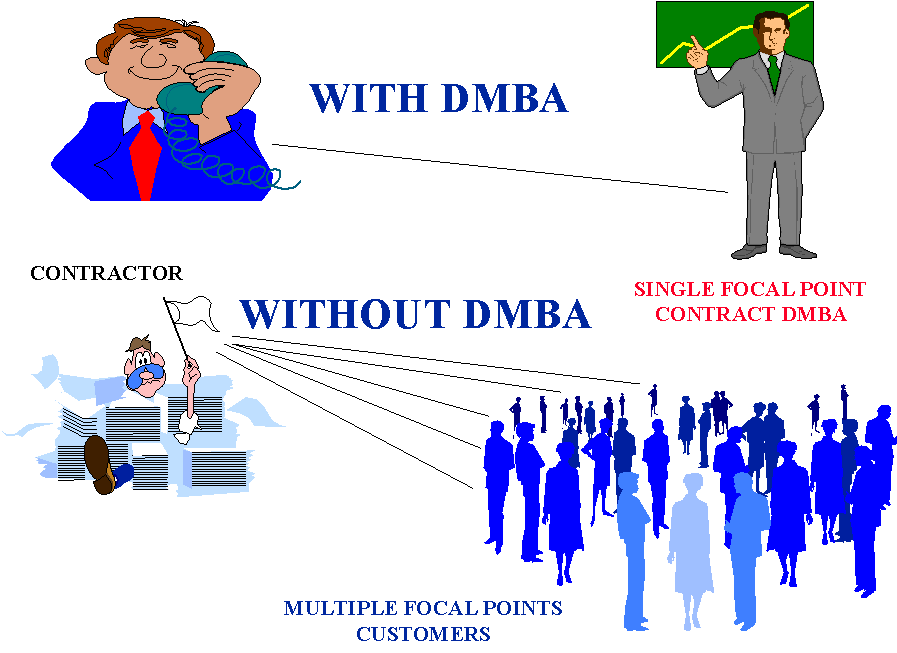
HOW DOES IT HAPPEN?
The actions of placing the customers' requirements and funds on contract rest mainly with the Production Management Specialist (Buyer/Seller) in a weapon system SPO.
The Production Management Specialist (PMS) Buyer acts as an agent for DMBA customers. They usually work for the System Program Director (SPD) and receive requirements and funding from the customer. They also negotiate the work with the organic or contract seller. When the work is to be accomplished by contract, the customer funds are obligated by the Buyer who places the customer order data into the G072D system. A Customer Order Acceptance List (COAL) is generated and passed to the PMS Seller for acceptance. The Buyer then monitors the funding and repair data in the G072D system.
The Production Management Specialist (PMS) Seller acts as an agent for Contract DMBA. They too work for the SPD. The requirements and funding are received from the PMS Buyer and Item Managers (IM). They coordinate activities among PMS Buyer, procurement, and the repair contractor while overseeing finances, contractor production, scheduling, and reporting. They then monitor contractor inventory, Contractor Acquired Property (CAP) acquisitions, and other material movement.
CUSTOMER COST--UNIT SALES PRICE (USP):
The USP is used by the buyer PMS in developing operating budgets and budget estimates and for negotiating the customer workload. The seller PMS provides the buyer PMS all information necessary for the buyer PMS to file maintain the USP in the G072D system to establish the COAL. USPs must include the contract costs (labor), the necessary rate to recover administrative costs funded by the industrial fund (sellers, cost accounting support, TDY, etc.) and the cost of industrially funded GFM. Sale of the End Item (aircraft) generates a bill to the customer that reflects the USP.
FUNDS PROCESS
The process of obligation and expenditure of customer and then DMBA funds is a very complex process. It has a defined path that requires auditable visibility throughout the process. It passes through many data systems and areas of responsibility
.The customers' funds are obligated in DMBA and are not put on the contract. DMBA funds are responsible for the contract cost and the customer funds simply reimburse DMBA upon production of the aircraft. Cost overruns therefore become the responsibility of DMBA after the customer funds have expired for obligation.
CONTRACT DMBA
The chart below shows how the contract DMBA fits into the overall depot maintenance process. The highlighted blocks reflect the areas where contract DMBA pays the bill. As can be seen, there is continuous interaction between DMBA and non-DMBA funded activities.
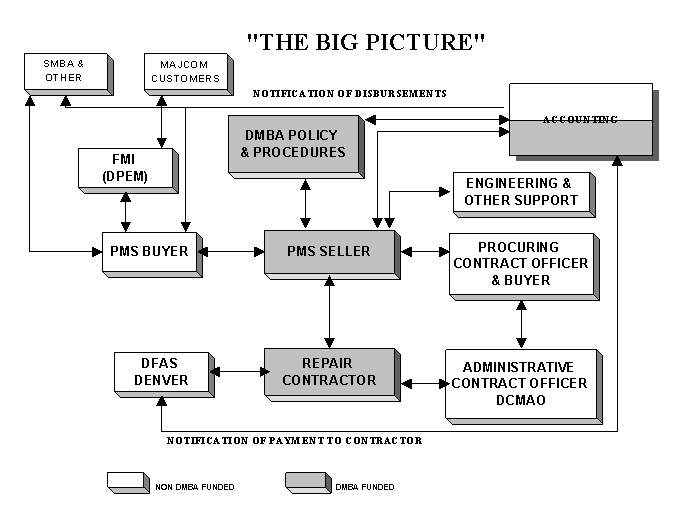
Some of the inputs that drive the DMBA funded portion of the process are: (1) customer requirements and funding from Production Management Specialist (PMS) Buyer, (2) technical data from engineering/support, (3) disbursements and expenses via the G072D system, and (4) signed contracts from procuring contracting agency. Some of the outputs from the DMBA funded area are: (1) a fully assembled Purchase Request (PR) package to the procuring contracting officer (PCO), (2) discrepancy reports to engineering and other support organizations, (3) notification of disbursement and production data, (4) unit sales price, and (5) unit repair cost via G072D system.
Contract DMBA maintains oversight of requirements and financial information through G072D, G009 and H075C systems. The G072D system obligates customer funds, provides visibility of customer dollars and requirements, receives data from numerous systems, and is the financial system for Contract DMBA. The G009 establishes and maintains contractor GFM and end item inventory data, both quantitative & monetary. The H075C system contains the Contract Master File and is designed to control access to GFM and provide billing information. They are tailored for Contract DMBA and provide detailed information to various activities.
Appendix A
DEPOT MAINTENANCE OVERVIEW
A-4. Unscheduled Depot Level Maintenance (UDLM):
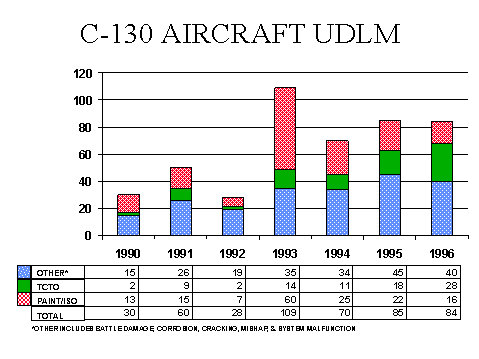
C-130 Aircraft Groups of UDLMs: Repair, Modification, Depot time Changes, and Paint/ISO Inspection.
D DEPOT DFT/CFT
Average Cost $100,000 $50,000
Average Time 3-4 weeks 2-3 weeks
COMMENTS/CONSIDERATIONS
UDLMs for modifications, time changes, and paint/ISO inspections can be scheduled. This schedule needs to be worked by the customer and SPO to identify these requirements early.
Repair UDLMs cannot be predicted. SPOs should consider doing as many as possible UDLM repairs with Depot Field Teams (DFT) and Contract Field Teams (CFT). However, due to resource limitation on manpower, base facilities, and support equipment located at bases, not all repair UDLMs can be accomplished by DFT/CFT. Also CFT are usually in place at a base for modification work and can do only limited UDLM work.
The current process for determining where a UDLM will be accomplished is to offer the work to organic facilities and then to contractor facilities and the first facility to accept the work gets the aircraft. The SPO does not really look at how well a facility is producing before offering the workload to that facility.
UDLMs that must go to depot should be scheduled at the depot facility (contractor or organic) that is in the best condition to accept the aircraft, meaning the facility that is best in meeting output dates or has a hole to fill. Must negotiate a firm output date with the contractor.
Appendix A
DEPOT MAINTENANCE OVERVIEW
A-5. C-130 Aircraft PDM Requirements
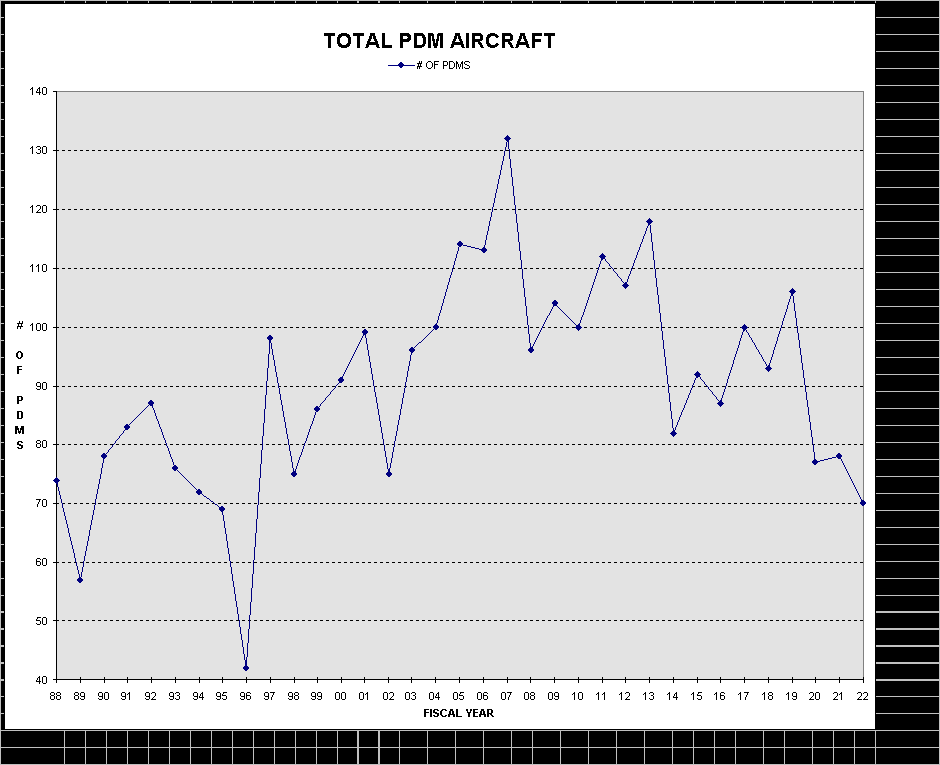
Appendix B
STUDY METHODOLOGY
The information used to construct both the "As-Is" and "To-Be" CAR processes was gathered through team modeling meetings, interviews, symposiums, site visits and surveys.
The following software tools were used to model and simulate the CAR processes:
Deliverable Software Tool Vendor
IDEF0 Model AI0Win KnowledgeBased Sys. Inc (KBSI)
IDEF3 Model Prosim KBSI
Simulation Witness AT&T Istel
Although the project contains Integrated Definition Model Level (IDEF) process models and computer process simulations, it is much more than that. There are several areas of consideration to be taken into account when documenting a process:
The Stakeholders And Their Objectives--most processes are shared by several groups of people, and each group can be thought of as a stakeholder in that process. It is important to understand who those stakeholders are, as well as their interests (or objectives) in the process. The importance and relevance of any portion of the process are different from stakeholder to stakeholder, and each perspective must be considered.
The Process Steps--processes are composed of process steps, and each step is carried out by some individual, organization or machine at some location and consumes some amount of time and cost. Each process step should contribute in some way to the process itself, and can be characterized as value-added or non value-added. An IDEF model allows the definition and detailing of these steps in a graphical way.
The Process Technology--the mechanisms that are used to carry out a process are important. Many process steps can be automated by taking advantage of current technology in ways that vastly improve the overall process performance.
The Motivational Elements Of The Process--processes themselves are not always to blame for poor process performance, as many processes are not used or are misused and abused. More often than not, process steps are performed by people, and the efficiency and effectiveness with which those process steps are executed depend greatly on the individuals involved. There is more to be gained in overall process performance by providing motivation for performance than by changing and even eliminating process steps.
The Computer Simulation
Using AT&T Istel’s Witness product, several simulation models were developed and run. The purpose of developing and running a simulation is to provide a means of evaluating numerically the impact of every process step on process performance as a whole.
In order to have a useful simulation, detail information for each process step must be gathered and represented in the simulation model. Included in this detail information is cycle time, setup time, labor resources required and probability functions for optional process paths.
The "As-Is" Findings
The purpose of "As-Is" modeling is to understand and document the steps of the current process and the constraints that affect its performance. It is imperative to perform an in-depth analysis of the "As-Is" process for the following reasons:
In reality, an "As-Is" development is as much an investigation as an exercise in describing and documenting current processes. There are many components of a given process--they can be process steps, implementation technologies or motivational issues. The importance of those components to the overall process performance can range from the trivial to the very important. Information gathered and considered during the course of "As-Is" modeling allows the team to obtain a general understanding of what those components are and their relative importance.
The result is a better focus on which areas offer the greatest pay-back for money invested in change. At this point in the study, the changes offering the greatest pay-back are listed below:
Stream-line the support processes (part acquisition, engineering support, over & above).
As much of each support process needs to be shifted to the PDM provider as practical, where there is a greater motivation and a higher level of accountability. Currently, there are no real measures of support responsiveness, nor are there rewards or penalties for the performance of these functions. When a capability currently provided by the ALC can be carried out by the contractor without excessive expense or compromise to quality, it should be considered.
Appendix C
IDEF0 MODEL
An IDEF0 model does not deal with process sequence, but rather describes characteristics of the process steps that belong to one of four categories. These categories, called ICOMs, are listed below:
Six teams were established to identify the ICOMs associated with the major CAR process steps.
The listings of team members and the topics covered are shown below. See Appendix D for the resulting IDEF3 model.
Group 1--Identify Requirements
Team Members: Carol Thomas, Hugh Nelson, Chuck Gibson, Lt. David Flynn, Jim Harper
Processes Detailed:
Schedule
Baseline Comparison
Funding
Material Requirements
Man-hour Development
Number of Airplanes
Budgeting
Work Specification
Identify Individual Tasks
Engineer Develop
MRRB
Quality Funding
Customer/ Government Workload Agreement
Group 2--Contract Process (Acquisition/Source Selection/Planning PR)
Team Members: Bill Clark, Glenna Abney, Carolyn Green, Jenny Thompson
Processes Detailed:
Develop Acquisition Plan
Present To Acquisition Strategy Panel
Develop Source Selection Plan
Identify Source Selection Team Members
Develop Source Selection Standard Criteria
Prepare Planning PR (Purchase Requisition)
Identify Data Requirements
Identify Quality Requirements
SOW/Appendix A/SOO (Statement of Objectives)/Performance
Specification
Develop Compression Tab
Identify Tabs And Appendices
Identify Material Requirements
Identify Safety Requirements
Conduct CMRB (Contract Maintenance Review Board)
Group 3--Contract Process (Solicitation, Award, Etc.)
Team Members: Franklin Kee, Annick Woodlock, Margie Tyner
Processes Detailed:
Solicitation
Synopsize CBD
Develop Draft RFP
Pre-Solicitation Conference
Issue RFP
Receive Proposals
Evaluate Proposals
Site Surveys
Source Selection Decision
Obtain Business/Contract Clearance
Award Contract
Post Award Orientation Conference
Fund Requirement
Prepare Funding Purchase Requisition
Group 4--Contract Production (Administer Contract--Government)
Team Members: Florine Crane, Ralph Hill, Cheryl Maddux, Mike Bishop
Processes Detailed:
Negotiate Changes
SOW
Schedule
Over And Above
ECPs
Payment
Clarification of SOW
Material
Transportation
Warranty
Funding
Monitor Contract Compliance
Accept Aircraft For Government
Monitor Contract Production And Quality Functions
GFP (Government Furnished Property)
Contract Modifications
Monitoring And Enforcing Safety
Training
Parts Retrograde
Transportation
Group 5--Contract Production (Contractor)
Team Members: Johnny Jones, Denise Yawn, Capt. Mike Nowaezyk, Perry Doyle, Gerald Barron, John W. McGraw, Joel Murphy, Major OB Mercer, Ed McDowell, Tammy Phelps
Processes Detailed:
Personnel
Workload Planning
Facilities--Tools, Equipment
Material
Scheduling
Safety
Quality
Parts Control
Inventory Management
Property Control
Contract Administration
Contractor Data Reporting
Warranty Repair
Aircraft Repair
Engineering
Manufacturing
Functional Test And Acceptance
Records Maintenance
Environmental Responsibilities
Group 6--Customer Acceptance
Team Members: Melvin Gillis, Ed Humphreys, Chuck Gibson, Tammy Phelps
Processes Detailed:
Home Station Inspection
Warranty Claims
Transportation (Ferrying), Discrepancy Reporting
Appendix D
IDEF3 PROCESS MODEL
Using KBSI’s Prosim software tool, the "As-Is" process was modeled. The first step in the modeling exercise was to determine which processes were to be modeled, based on what is pertinent to the scope of our project.
The Process Modeling Approach
Since the activity of the contractor is encapsulated in the contract aircraft repair process as a whole, it would seem that the contractor processes should be part of the model. This approach, however, presents some difficulty in preparing "As-Is" and "To-Be" models. Here are some reasons why modeling contractor processes as a part of CAR would not be practical:
Instead of modeling the process itself, it is best to model the process interruptions (interface issues for the sake of this argument) to the process that can be affected from the government side. Each issue between contractor and government has its own resolution process, and those processes can be collectively modeled and simulated. It follows that reductions to these processes multiplied by their number of occurrences will yield a flow reduction for the contract activity.
One possible approach to this process representation would be to model and simulate a process "black box" that represents a single unit of depot activity, such as an operation. Rolled into this "black box" would be all of the implied activity of an operation, but since our project scope does not include resources and constraints that are internal to the contractor, the model will neither define nor quantify those. This process block would be performed repetitively to simulate the repetitiveness of the depot operation.
For each type of interface issue, a probability function will be assigned to represent how often it occurs (x occurrences per y operations). When an interface issue occurs, the sub-process defined for resolving that issue is invoked and time is consumed and tracked.
IDEF3 Process Model Details
CAR Overview Process
|
Process Number |
Name |
Description |
Cycle Time |
Setup Time |
Performed By |
|
1 |
Begin PDM Task |
This represents any PDM task activity. |
N/A |
N/A |
Mechanic |
|
2 |
No Stumble-On Found |
State condition -- not a process |
N/A |
N/A |
N/A |
|
3 |
Stumble-On Found |
State condition -- not a process |
N/A |
N/A |
N/A |
|
4 |
Order Replacement Part |
The process of a contractor part need becoming a ready-to-fill part requisition (See Decomposition) |
10 min. |
3--5 days |
ALC systems |
|
5 |
Obtain Over & Above Funding |
The process of submitting, negotiating and obtaining approval for funding (See Decomposition) |
|||
|
6 |
Obtain Engineering Support |
The process of identifying, documenting and obtaining disposition and corrective action (See Decomposition) |
|||
|
7
|
Obtain Quality Support |
(See Decomposition) |
|||
|
8 |
Government Locates Part |
The ALC identifies a source for the needed part. |
N/A |
N/A |
ALC |
|
9 |
Government Ships Part |
The process of the ALC moving the part from the source to the contractor (See Decomposition) |
ALC |
||
|
10 |
Make Repair |
Repairing the aircraft with the new part according to the engineering support instructions |
Mechanic |
||
|
11 |
Complete PDM Task |
The completion of the activity begun in process number 1. |
N/A |
N/A |
Mechanic |
Parts Process--Placing a Requisition
|
Process Number |
Name |
Description |
Cycle Time |
Setup Time |
Performed By |
|
12 |
Contractor Logs Onto DAMES System |
DAMES is the M024 system that is a remote access for PDM contractors to the ALC.
|
|||
|
13 |
D034A Receives and validates requisition |
D034A checks the requisition for completeness and correctness. |
N/A |
Over-night |
System |
|
14 |
Validation Passes: Send To Source Of Supply (SOS)
|
State condition--not a process |
N/A |
N/A |
N/A |
|
15 |
Validation Fails: Return Delay Status
|
State condition--not a process. |
N/A |
N/A |
N/A |
|
16 |
Request Is Forwarded To D035A (AF SOS) |
D035A is the Air Force Source of Supply (SOS) system |
N/A |
Over-night |
System |
|
17 |
Request Is Forwarded To Other SOS |
If the part is unavailable in an AF system, it is located elsewhere. |
N/A |
Over-night |
System |
|
18 |
SOS BD (Delayed) Status |
A message returned to confirm the requisition |
N/A |
Over-night |
System |
|
19 |
SOS Sends Req. To D034A For AX1 Card (Validation) |
In order to prevent "back-door" requests that by-pass process 13, this additional (redundant) validation is carried out. |
N/A |
Over-night |
System |
|
20 |
Requisition Returns To SOS Upon Validation |
Once this validation is successfully completed, the SOS is electronically notified clearance to process the requisition. |
N/A |
Over-night |
System |
|
21 |
Status=BB (Backordered) |
This message is returned to the contractor, meaning that a part is not immediately available for shipment.
|
N/A |
System |
|
|
22 |
Status=BD (Delayed) |
This message is returned to the contractor, meaning that a part may be available, but subject to be prioritized to another need pending management review. |
N/A |
N/A |
System |
|
23 |
Status=BA (Released For Shipment) |
This message is returned to the contractor, meaning that a part has been identified for delivery. |
N/A |
N/A |
System |
|
24 |
Requisition Is Canceled |
For some reason, the part request is rejected either by the requester or the ALC. |
N/A |
N/A |
|
|
25 |
Contractor Receives AS Status (Shipping) |
This message is returned to the contractor, meaning that the part is being shipped. |
N/A |
N/A |
System |
|
26 |
System Determines Status |
Based on the availability information in the system databases and other part requests with their priorities, the system determines a status request. |
N/A |
Over-night |
System |
|
27 |
Part Is Not Ordered |
State condition--not a process. |
N/A |
N/A |
N/A |
|
28 |
Part Is Ordered |
State condition--not a process. |
N/A |
N/A |
N/A |
Parts Process--Shipment of the Part
|
Process Number |
Name |
Description |
Cycle Time |
Setup Time |
Performed By |
|
29 |
Req. Is Forwarded To D035 Or Equivalent (Costing) |
This process is where the part charge is accounted for and posted against the requester |
N/A |
N/A |
System |
|
30 |
Req. Is Forwarded To D035R (Warehousing) |
The requisition is released for the part to be pulled from inventory at the source of supply. |
N/A |
N/A |
System |
|
31 |
System Issues 1348-6 To Warehouse |
The requisition is formatted into a 1348-6 form for the warehouse |
N/A |
N/A |
System |
|
32 |
Asset Is Already Packaged For Shipment |
State condition--not a process. |
N/A |
N/A |
N/A |
|
33 |
Asset Is Not Packaged For Shipment |
State condition--not a process |
N/A |
N/A |
N/A |
|
34 |
Warehouse Workers Package Asset |
The asset to be shipped must be boxed and labeled appropriately for shipment |
Warehouse Workers |
||
|
35 |
Workers Compare 1348-6 And Shipping Label |
A visual check to make sure that the right part has been selected and prepared for shipment.
|
Warehouse Workers |
||
|
36 |
Shipment Planner Determines Mode Of Shipment |
The appropriate transportation is selected for efficiency and expediency |
Shipment Planner |
||
|
37 |
Asset Is Shipped By Parcel Post |
FedEx, UPS, Priority Mail is used to ship small items to the contractor |
Parcel Post |
||
|
38 |
Asset Is Shipped By Surface Freight |
Larger items require contracted trucking services |
Surface Freight |
||
|
39 |
Asset Is Received By Contractor |
The asset arrives at the contractor’s facility. |
N/A |
N/A |
N/A |
Over And Above Process
|
Process Number |
Name |
Description |
Cycle Time |
Setup Time |
Performed By |
|
40 |
Contractor Generates AF202 |
AF202 (Form 202) is a standardized request for engineering assistance that documents the problem encountered. |
Contracting Engineer |
||
|
41 |
DCMC Engineer Reviews AF202 |
The government representative at the contractor’s facility is made aware of the engineering need. |
DCMC Engineer |
||
|
42 |
ALC Engineering Assistance Required |
State condition--not a process. |
N/A |
N/A |
N/A |
|
43 |
ALC Assistance Not Required |
State condition--not a process. |
N/A |
N/A |
N/A |
|
44 |
Contractor Faxes AF202 To ALC Engineering |
This is just a notification of the occurrence of a problem that the contractor could resolve per standards, submitted for historical record. |
5 min |
N/A |
Contracting Engineer |
|
45 |
ALC Engineering Responds To Fax |
The ALC engineer that receives the fax reviews it and verifies that the procedure recommended by the contractor is correct. |
5 min |
1 day |
ALC Engineer |
|
46 |
Contractor Engineer Responds To AF202 |
Since the repair procedure has been standardized, the contractor engineer provides those instructions to the mechanic. |
4 hrs |
Contractor Engineer |
|
|
47 |
ACO Reviews AF202 And Negotiates Manhours |
The ACO and a contractor representative discuss and decide the time requirements appropriate for the repair. |
1 day |
4 hrs |
ACO/ Contractor |
|
48 |
ACO Modifies Contract To Compensate Over And Above |
A clause must be added to the contract to identify the over and above work to be done and provide funding for it. |
1 day |
ACO |
|
|
49 |
Contractor Is Authorized To Perform Work |
State condition--not a process. |
N/A |
N/A |
N/A |
Engineering Support Process
|
Process Number |
Name |
Description |
Cycle Time |
Setup Time |
Performed By |
|
|
50 |
Contractor Engineer Generates AF202 |
AF202 is a standardized form for reporting a request for engineering support and detailing the corrective procedures. |
1 hr |
1 day |
Contractor Engineer |
|
|
51 |
Problem Does Not Require ALC Involvement |
State condition--not a process. |
N/A |
N/A |
N/A |
|
|
52 |
Problem Requires ALC Involvement |
State condition--not a process |
N/A |
N/A |
N/A |
|
|
53 |
Repair Is Made Per Standard Procedures |
The repair is common enough to have an established standard repair procedure -- the contractor prepares a copy for the mechanic. |
4 hrs |
1 day |
Contract Engineer |
|
|
54 |
Contractor Sends AF202 And Procedure To ALC |
The contractor details a repair procedure and submits it to the ALC engineers for approval. |
1 day |
1 day |
Contract Engineer |
|
|
55 |
Contractor Sends AF202 Only To ALC |
The contractor sends the AF202 noting the problem occurrence to the ALC engineer, but fails to detail a repair procedure. |
1 hr. |
1 day |
Contract Engineer |
|
|
56 |
Contractor And ALC Conduct Investigation |
The specifics of the problem must be conveyed to the ALC engineers before a corrective procedure can be created . |
1 day |
1 day |
Contract Engineer/ ALC Engineer |
|
|
57 |
ALC Reviews/ Corrects/ Returns Repair Procedure |
The ALC engineer makes sure that the repair procedure recommended by the contractor engineer complies with specifications. |
4 hrs |
1 day |
ALC Engineer |
|
|
58 |
ALC Generates Repair Procedure For Contractor |
Once the specifics of the problem are known, the ALC engineer details a repair procedure and faxes it to the contractor engineer. |
1 day |
1 day |
ALC Engineer |
|
|
59 |
Contractor Implements Repair |
The procedure supplied to the mechanic is followed to repair the aircraft. |
Mechanic |
|||
Appendix E
THE CONTRACTOR’S PERSPECTIVE
E-1. THE CAR CONTRACTOR SYMPOSIUM
Contractors have a business perspective of the CAR process, where the margins of profit and loss are of great importance to the survival of their business. The team felt that contractors would have an insight into which of the processes involving government had the largest effect on them and possible alternatives for those processes. One way to capture and understand the customer’s perspective was to hold a contractor symposium as an open forum for discussion of these processes, another way was to visit a contractor’s operation.
Findings From The Contractor Symposium
As part of the "As-Is" investigation, a contractor symposium was held at Warner Robins on March 18, 1996 to examine the contract aircraft repair processes from the contractor’s perspective. The attendees of this symposium were:
Name Contractor Name Contractor
Saul Rendon DME Corp Gary Morissette Dynamics Research
Freda Maddox SAIC Manny Macias Smith Aircraft
Ernnish Ester TRW Duke Derrick E-Systems
George Humphrey E-Systems John Chamber E-Systems
Bill Landers PEMCO Paul Nicklas Dyncorp
Cliff Hunter Lockheed Jim Jones Chrysler
Technologies
Phil Guy Chrysler Nick McCollough Chrysler
Technologies Technologies
Rick Reeds Eagle Systems Tom Schlesing Chrysler
Technologies
The intent of the symposium, more specifically, was to discuss how government involvement in contract aircraft repair can impede contract performance as measured by flow days and cost. The government roles under consideration covered a broad spectrum, from the definition of contract requirements to the support of contract execution. Because matters internal to the contractors themselves are out of the scope of this project, the topics of the discussion were limited to only those items that have government involvement and can be addressed in process analysis from the government side, particularly the ALCs
The results from this discussion was a list of common contractor issues---each playing a significant role in determining the flow time, cost and quality of contract PDM activity.
This list of issues formed the foundation of the project study, but because the time and funds for the CAR project are limited, the scope must also be limited. The next task of the team was to develop a strategy to best use the time available to the greatest possible results. To that end, it was necessary to:
The issues provided by the contractors in the symposium that were worthwhile and "fixable" fell into two general groups, referred to here as "Direct Flow Issues" and "Indirect Flow Issues."
Direct Flow Issues--these are any problems that arise during normal PDM work that causes a flow day increase and require government assistance to obtain resolution. The issues selected for analysis, that the team designated as "direct flow issues", are:
Indirect Flow Issues--these are issues that create an environment of uncertainty in production flow, and therefore incur a time and dollar cost to the contractor that is ultimately passed on to the government. Issues identified as "indirect flow issues" are:
Detailed Remarks From The Contractor Symposium
a) Make MILSTRAP system more responsive
b) Exchange vs. full price
Problem: The MILSTRAP system does not respond fast enough to avoid work stoppages due to part shortages. The lead time to check the availability or status of a part takes at least 3 to 5 day and can be as long as 10 to 14 days. In order to reclaim those valuable lost flow days, either the existing system must be modified or a new system must be put in place.
Vision: The optimal solution is to have all required parts anticipated and on-hand when needed by the mechanic. Since many part needs cannot be anticipated, wasted flow time could be eliminated with a system that would provide part availability and/or status within 48 hours of the request. Another remedy would be a contract clause permitting the contractor to procure needed parts when they are unavailable in a time frame to accommodate the schedule. Providing the contractors with one place to get parts--a Contractor Logistics Readiness Center--would also reduce the time required to obtain needed parts.
Problem: The economic order quantities of many parts often require the contractor to place a heavy inventory investment. When a contract quantity is less than that anticipated by the contractor, these inventories become a sunk cost that adds to the contractor’s overhead and ultimately to the government’s price.
Vision: A mechanism is needed in the contracting process to allow the contractor to sell unused inventories to the government.
Problem: Efficient depot level work depends heavily on a consistent, level workload. Delays and interruptions to this workload incur cost at the facility and manloading levels, as well as inherently adding flow days to the cycle. In addition, a large bid range on contracts requires contractors to anticipate a number of work scenarios. Unanticipated over and above work such as TCTOs also create scheduling problems.
Vision: An increase in the accuracy and dependability of the government’s estimates on quantity, schedule and over & above would translate directly into flow day savings. The only way for programmed work to be performed in an efficient and effective manner is for a stable schedule to be in place.
Problem: Many different government agencies are involved with various aspects of the Contract Aircraft Repair process. In unpredictable situations such as work/ no work, over and above, cannibalization and price negotiations, flow days increase as the different government organizations are brought into the process.
Vision: A single representative or point of contact for an aircraft would expedite the decision-making process from the government side. An additional benefit would be that some perhaps inter-related problems with an aircraft during the repair cycle would be handled by the same individual.
Problem:
The government places constraints on how much profit a contractor can make on a given contract. While it is true that flow day reduction (and consequently cost reduction) on the part of the contractor increases the probability of winning and retaining contracts, it at the same time reduces revenue and profit. A contractor that is currently filling its capacity with work has no real reason to find ways to out-perform the contract.Vision: It is unrealistic to expect contractors to become more productive unless added productivity helps the bottom line. A mechanism in the contracting process must be developed that provides the contractor with a worth-while incentive for increased performance.
Problem: The government provides quality assurance at most work levels, frequently causing delays and even repeated processes for the sake of a "witness" inspection. Because operations are many and government inspectors are few, flow days are increased to accommodate the government inspection requirements.
Vision: Quality requirements should not be eliminated, but rather performed in a manner that does not have an appreciable effect on productivity. Where practical, commercial quality practices should be adapted such as ISO 9000. Contractors should be certified by the government to verify work that is not safety-of-flight related, with the stipulation that an abuse of those responsibilities results in de-certification. Home station inspections--typically performed by the aircraft owners--could be carried out at the contractor’s facility and shorten the aircraft acceptance process.
Problem: Both GFE and CFE have their advantages and disadvantages, mostly dependent on the contract situation and the assets of the contractor. On one hand, GFE can limit the capability of a contractor that has already invested in equipment. On the other hand, GFE can allow smaller contractors to participate in contract aircraft repair without prohibitive equipment investments.
Vision: All GFE that is available for a contract should be made known and available to the contractor, and the contractor should make the choice whether or not to use the GFE.
Problem:
The administration of aircraft repair contracts requires the flow of information from the government to the contractor and from the contractor to the government. This data includes material and equipment needs and availability, schedule information and performance reports. The lack of standards in format and communication makes information transfer a cumbersome process. Untimely information causes inefficiencies in the contract maintenance that can result in increased flow days.Vision: Develop a set of standards by which contractors and the government can exchange data and reports in an automated fashion. This will make the process more responsive and efficient.
Problem:
A source of frequent contract cycle interruption is lack of funds. Not all contractors are able to capitalize the contract effort when funds are unavailable. In addition to normal funding shortfalls, over and above activities--which are largely unanticipated--are not usually funded immediately. The government also requires many labor and material accounts to track expenditures for reporting purposes. This adds constraints to the contractor and inhibits the flexibility of resources.Vision: Contracts should be funded up front for the entire contract cycle, as far as government budgeting restrictions will allow. Historical PDM activities should be used to predict with greater accuracy the over and above activity. During the contract aircraft repair process, all costs should be captured and assigned to the appropriate costing categories to be used for the government reports after the fact.
Problem: Contractors frequently engage in contracts from varied customers, whether they be different air wings or different services altogether. Since these customers are to a degree independent from one another, there are often different versions of procedures and requirements for performing the same tasks. These differences can incur a significant cost on contractors, especially when facility requirements are involved.
Vision: Standardization of common procedural practices and requirements where possible would eliminate this added cost to the contractor, which is ultimately passed on to the customer. The standards of real significance would likely be across services.
Problem: Over time, many standard contract clauses are superseded by other policies or made obsolete by technological advances. Many obsolete clauses remain in current contracts, adding process time to the aircraft flow and cost to the PDM.
Vision: A "hit-list" of inapplicable clauses should be drawn up to be referenced during contract development, or a blanket waiver against these clauses should be put in place to provide relief from the requirements.
Problem: The CDRL in a contract outlines reference material (procedures and specifications) that have a cost and time impact on contract performance. In most cases, these reference materials are necessary to ensure quality and conformity; but many times the same material imposes requirements not intended by the customer. The generic nature of many specifications does not take into consideration limited applications of itself and provide exceptions accordingly.
Vision: Specifications and standardized procedures that are suspect for being non-value-added should be noted for negotiation or elimination from the CDRL. In addition, CDRL’s should avoid "chain" specifications--those in which one specification references another, which references another, and so on.
PROBLEM: There are several levels of engineering support involved in contract PDM. The contractor has his engineering capability as does the DCMC representatives. However, the major engineering support comes from the ALC. Of course there is also the manufacture engineering support when required. This creates some duplication of effort and sometimes delay the decision making process in effecting repairs to aircraft undergoing PDM.
VISION: A program by which the engineering capability at a contractor facility could be certified to perform some of the government engineering functions thus reducing the interruptions to the schedule. There is a similar delegation of engineering authority in the FAA by use of a Designated Engineering Requirement (DER) license.
Appendix E
THE CONTRACTOR’S PERSPECTIVE
E-2. The Contractor Site Visit
On March 23, 1996 selected members of the CAR team made a site visit to PEMCO Aeroplex Corporation, a government PDM contractor in Birmingham, Alabama. Of the three contractors that work PDM for larger weapon systems such as the C-130 aircraft, PEMCO is the only one in the United States and was therefore chosen for the site visit. Besides C-130, PEMCO also performs PDM work on KC-135 aircraft.
The purpose of the on-site visit:
Attendees:
Name Organization Name Organization
C.J. Phillips Director, PEMCO QA Tim Annis WR-ALC/LBP
Terry A. Parker DCMC PEMCO Doris Wood DCMC PEMCO
Ed Humphreys C-130 SPO (MTC) Carol Thomas DCMC PEMCO
Joel Murphy F-15 SPO LFPL Patricia Curry DCMC PEMCO
Bill Landers PEMCO Robert M. Erhart DCMC PEMCO
Jerry Strickler PEMCO Marie Linder DCMC PEMCO
George Caldwell, Jr
. DCMC PEMCO Michael Denson IntergraphFranklin Kee WR-ALC/LJK Ron Harlow Intergraph
Site Visit Findings--Parts Issues
Site Visit Findings--Engineering Support Issues
Site Visit Findings--Quality Support Issues
Appendix F
ALC PERSPECTIVE
CAR From The ALC’s Perspective
In order to capture the ALC perspective of the CAR process, teams were established for "As-Is" modeling of the identified CAR issues. The objective of these "As-Is" sessions was to completely document and detail the steps of the assigned process and to identify any constraints that affect it.
The Parts Acquisition Process
Tuesday, April 9, 8 AM to 2 PM
Jimmy Rogers WR-ALC/FMIC
Flo Crane WR-ALC/LBR
Tammy Phelps WR-ALC/LBR
The part's procurement process for contract aircraft repair can be described as three independent sections:
For the purposes of this study, the part requisition and part delivery processes were analyzed. Ideally, part requisition time should be reduced to near real-time, or at worst, a matter of hours, to be considered a truly responsive process. Part delivery time should be reduced to packaging time (if required) plus shipping time. Today, the part requisition process takes 3 to 5 days, and the part delivery process takes shipping time plus packaging time plus 2 to 3 days.
There are several reasons that a part need can arise during PDM activity. One reason is an inaccurate bill of materials (BOM), which is a parts list for the anticipated work to be done. Another reason is unanticipated repair, otherwise known as over and above repair. There is always a price to pay for not having parts on hand when they are needed. Sometimes that price is in flow days, as is the case when the operation needing a part is on the critical path of the schedule; sometimes the price is in production efficiency as schedules must be changed. The most desirable result from change would be to eliminate unanticipated part needs by doing things like increasing the BOM accuracy and forecasting repair needs better, but there will always be some level of unanticipated part needs.
The Parts Requisition Process
When a part need (request) arises for GFM (Government Furnished Material), the contractor must convey the request and the urgency of that request to the government. For PDM contractors, the mechanism for making the request is the M024 system.
A request received from M024 is passed to D034, which makes a validation check on the request data. After that validation is passed, the request is forwarded to the SOS (Source of Supply) system. Once the request is registered with the SOS system, it is sent back to D034 to validate for a second time the same information validated earlier. Upon successful validation, the request is returned to the SOS system at which time it is available to be filled. All of this request processing would not be a problem in terms of process time was the computer systems carrying out the tasks operating in real time. However, these systems run in overnight batch mode--meaning that each step requires a full day to complete. Two extra days can be added when this process is attempted over a weekend because the systems do not operate on weekends. This constraint on the part requisition process causes a typical response time of 3 to 5 days just to place an order or receive a status.
The Parts Delivery Process
After a part has been identified to fill a requisition, it must be shipped to the contractor. A requisition is delivered to the warehouse as a DD Form 1348-6, and the warehouse workers fill the 1348-6 by shipping the item identified to the contractor requesting it. Some items are pre-packaged off the shelf, and some are not. Time is required to package those items for delivery that are not already packaged. All items leaving the warehouse (by truck) are logged into a record of shipment.
Suggestions
The Over and Above Process
Wednesday, April 10, 8AM-12 AM
Franklin Kee LJK
Margie Tyner LBKA
Charlie Brundage LBPL
Work done on aircraft during PDM can be divided into three categories:
As part of the PDM contract, 20 days are allotted for the repairing contractor to perform an inspection of the aircraft. The purpose of this inspection is to uncover items in need of repair that are outside the scope of the PDM. An inspection list is maintained by the government on those items to be inspected. It is estimated that 70-80 percent of unanticipated repair items are discovered during this inspection.
It is the view of the above group of people that the performance of the over and above process seldom impacts the flow days of the aircraft, because: (a) over and above items are almost never on the critical path (can be performed concurrently with PDM) and, (b) the contractor must demonstrate sufficient capacity to perform over and above concurrently with PDM to qualify for the contract.
Suggestions
The Engineering Support Process
Wednesday, April 10, 1 PM to 4 PM
Hugh Nelson LBRA John McDonald LBRA
Jim Harper LBRA
Engineering support is provided to contractors when technical assistance is needed during the course of PDM activity. For the most part, engineering support requirements do not have a direct impact on the flow time of an aircraft, except when a "stumble-on" repair item is discovered near the end of the PDM schedule.
The discovery of a "stumble-on" repair item triggers three concurrent processes:
When any repair is to be done that falls outside the scope of the negotiated PDM contract or has no standardized procedure, an approved procedure is required to ensure that the repair is performed to design specification. Many times, the repair has been standardized and is documented in the technical manuals for the aircraft. In this case, the contractor need only log the occurrence of the repair item back to the ALC and follow the technical manual procedure. When the repair required is not documented in the technical manual, the contractor must seek guidance and approval from the controlling ALC to perform the repair.
Liquidation, Loss and Damage (LLD) is a penalty charged to the contractor for PDM delinquency. It is not designed as a punitive measure, and is of little economic consequence.
Suggestions:
The Workloading/Scheduling Process
Thursday, April 11 8 AM
Joel Murphy LFPL Keith Barrett LUHB
Denise Yawn LBPLC Carol Thomas LUJP
Jenny Thompson LKSA Robert Bailey LBPL
Outyear scheduler--long range schedules
Current year scheduler--current year
Both get inputs from the aircraft owners (Guard, Reserve, Air Combat Command, Air Force Special Operations Command, Pacific Air Force, USAF Europe, Air Command Training Center, AFMC). The units have additional inputs.
The Technical Order requirements for an aircraft determines the PDM window.
Drop-In Aircraft--Non-scheduled repair (unprogrammed depot maintenance) that cannot be done in the field or by field personnel
Aircraft PDM cycle
Weapon System Specialties
AFMC directives to fill organic facilities
Contracts
When a PDM schedule is being negotiated, an initial inquiry is sent to both customer and contractor, asking for a recommended delivery schedule. Those two inputs are put together for the schedule, with the customer’s needs taking priority.
The main issues voiced by the contractors at the contractor symposium concerning workloading were:
Suggestions:
Appendix G
CAR FROM THE CUSTOMER’S PERSPECTIVE
On June 4, 1996 a Contract Aircraft Repair (CAR) Customer symposium was held at the Non Commissioned Officers Club at Robins AFB. It was important to gain an understanding of the aircraft owner's (the warfighters) perspective of contract aircraft repair to ensure any recommendation's were in keeping with their goals. The CAR team also needed to get buy-in since some of the recommendations being contemplated would require some commitments on the customers part.
CAR Customer Symposium Attendance Sheet
Name MAJCOM/Office Symbol DSN Phone
Lt. Col. Steve Richman HQ AFSOC/LGMW 579-2093
Bobbie Hester HQ AFSOC/LGRF 579-1505
Capt. Robert McCrory HQ AMC/XPQL 576-3471
Maj. Steven Hack HQ AFSOC/XPQL 579-1696
MSgt. Sue Norwood HQ ACC/LGRC 574-7571
CMS Doug McCorkle ANG/135 LGQ 243-6332
Capt. McPartland ANGRC/LGMA 278-8962
Lt. Col. Charles King ANGRC/LG-LL 278-8498
Lt. Col. Jennifer Dieckmann HQ AFRES/LGMA 327-1624
Capt. Spillane HQ AFSOC/LGMW 579-2342
James Harper WR-ALC/LBRA 468-7980
Hugh Nelson WR-ALC/LBRA 468-2716
John McDonald WR-ALC/LBRA 468-2656
Keith Barrett WR_ALC/LUHP 468-1844
Florine Crane WR-ALC/LBRA 468-9884
Denise G. Yawn WR-ALC/LBPLC 468-5175
Melvin Gillis 78ABW/LGTPL 468-3892
Chuck Gibson AFRES/LGM 468-1790
Roy Abbott WR-ALC/RE 468-1274
Cosma O’Bryan WR-ALC/LBR 468-4985
Col. Mansfield WR-ALC/RE 468-1274
Tim Annis WR-ALC/LBPM 468-2080
Col. Siegel WR-ALC/LB 468-2322
Ed Humphreys MTC 468-7205
Mike Denson Intergraph 205-730-3142
Ron Harlow Intergraph 205 730-3125
To stimulate discussion the team shared results of the "AS-IS" model and simulation and outlined the major focus areas for possible improvement for meeting the cost, flowday and customer satisfaction goals.
WHAT THE CAR TEAM LEARNED FROM THE CUSTOMER SYMPOSIUM
WORKLOADING--The customer understood the importance of providing a contractor with an economic workload and with establishing a known requirement. This included balancing the workload among all facilities. In fact, the customers expected the ALC to do these things and to get the best value for their repair dollars. It became apparent that the customers weren't concerned about where their aircraft were worked (organic or depot). The CAR team did get some commitment from the customer that they would work with the ALC to identify requirements as far in advance as possible and reduce as much as possible "surprise " workload.
SCHEDULING--While all customers agreed that reduction in flowdays was desirable, they were also interested in having a greater degree of predictably on output dates. Having a high degree of confidence in the output dates is a tremendous help as they do their mission planning. Consequently, they were very amenable to establishing a firm input schedule if it would enable the contractor to maintain a predictable output schedule. They further committed to working with the ALC at scheduling conferences to establish tail number specific input dates.
PARTS SUPPORT--The customers were in agreement that lack of parts had impacted flow days on their aircraft undergoing depot repair. They supported the CAR team recommendations for improving parts support for the contractors. They did express some concern over allowing contractors to buy critical parts fearing they might get inferior ones in order to meet schedule or hold down costs.
OVER AND ABOVE--The customers recognized over and above was a fact of life for aircraft PDM. They also recognized the need to eliminate it as much as possible and identify the required work as far in advance as possible. There was some discussion about the possibility of putting a customer representative at the contractors plant to assist in making work/no work decisions but most of the customers believe that they didn't have the manpower to do so. The customers did have a desire to have visibility into what items were being worked and what it was costing them. As the discussion continued the consensus was that the ALC was needed to improve the Over and Above process. The customers were receptive to looking at ways they could help reduce the burden of over and above.
ENGINEERING SUPPORT--When asked what they thought about giving the contractor more engineering authority, the customers were universal in their opinion that the ALC should not relinquish it. They seemed to be satisfied with the present process but did want us to explore ways to reduce the negative impact it had on flowdays.
QUALITY--The customers felt strongly that receiving a quality product from the contractor was paramount. Because of the criticality of the work being performed, anything less than first rate quality was unacceptable. Their was some sentiment that quality had generally gone down--not up. The customers insisted that quality needed to be a priority for the contract and that unresponsive contractors needed to be weeded out.
USING BLUE SUIT LABOR--The customers were unanimous in their opinion that we could not consider pushing any work back to the field. Even though it would save costs they are severely limited with manpower resources at the base level.
BREAKING THE PDM INTO MORE FREQUENT YET SMALLER DOWNTIMES--The customers were unconvinced that any change in the current PDM cycle would be beneficial. They preferred less frequent but longer downtimes. Fear was that input preparation costs would outweigh any other potential savings.
CAR Team Conclusions from the Customer Symposium:
Appendix H
COMMERCIAL COMPARISON
The FedEx Aircraft Repair Site Visit
One way to examine a process is to look at another similar enterprise widely thought to be an industry leader--a process called benchmarking.
On May 16, 1996 the CAR team visited Federal Express Corporation (FedEx) in Memphis, Tennessee to perform a benchmarking analysis.
Federal Express is the world’s largest express transportation company, employing 110,000 people worldwide and earning $9.4 billion in revenue for fiscal year 1995. One of the most important resources FedEx has is a fleet of over 500 aircraft. Eight different airframes comprise this fleet and each aircraft is regularly serviced for maintenance over pre-determined intervals. FedEx has the majority of this work performed on contracts. Although there are some marked differences between FedEx and the Air Force between the types of aircraft and the characteristics of the missions flown, enough similarities exist to draw comparisons for the CAR process.
For comparable PDM activity, FedEx achieves much better performance from its contractors than does the Air Force. For nearly the same cost, FedEx contractors perform similar depot overhauls using only one-fifth the flow days with virtually no schedule slippage’s. The FedEx representative attributed this performance for the most part to a partnership philosophy.
Details From The FedEx Site Visit
WR-ALC CAR Lean Logistics Team Meeting with:
Tom Bodamer, Federal Express Headquarters, Memphis, TN
Thursday, May 16, 1996
Attendees:
Tom Bodamer, FedEx Ed Humphreys, Modern Technologies Corp.
Tim Annis, WR-ALC Ron Harlow, Intergraph Corp.
Franklin Kee, WR-ALC Mike Denson, Intergraph Corp.
Purpose of Meeting:
The purpose of this meeting was for the Air Force to gather insight on FedEx’s contracted aircraft repair process. The findings of this study are to be used solely to enhance the efficiency of contracted repair of Air Force aircraft. The Air Force appreciated the candor of FedEx in the discussions regarding how the Air Force could potentially improve the efficiency of its contract aircraft repair process.
Background
FedEx was founded in July 1972 in Little Rock (sending letters), collapsed, and refounded with extended services (sending bulk packages) in Memphis in 1973.
According to Tom Bodamer, FedEx is in the business to ship packages--not aircraft maintenance business. For example, they farm out wheel and brake repair to B F Goodrich presently on a 10-year contract. They find this cheaper than their old way of having internal wheel and brake shops at numerous locations.
FedEx inspection ranges, per plane, average:
Cost makeup is dependent on type of work:
Three Current US maintenance vendors: American Airlines, Tramco, Mobile Aerospace
Some Current Overseas maintenance vendors: Korean Airlines, Varaque, Charles DeGuaelle
FedEx is serious about business process re-engineering. For example, they found that they did nose wheel repair on most of their jobs for a certain "time check" and that the mechanics were having to stop their work to locate a nose wheel or tools, accomplish paper work, etc. They moved a supply of nose wheels, tools, forms, etc. to the point of work for that inspection/repair site which saved substantial time on that endeavor. Tom Bodamer emphasized that they are always looking for ways, on internal and external maintenance, to be more efficient at the lowest level to the highest level. This is just an example of common sense business process re-engineering logic that FedEx employs on a continuing basis.
Specs adhered to:
Noteable Quote: "We found Firm Fixed Price [contracts] cuts contractors so close to the bone that they are forced to cut corners. We want a good job at a fair price. We don’t want contractors doing pencil-whipping exercises and skipping lube jobs, etc."--Tom Bodamer, FedEx.
CAR Team Conclusions from FedEx Visit:
Appendix I
Shop Service Center (SSC)
The concept of a Shop Service Center was originated by a Lean Logistics team focusing on Contract Commodity Repair. The concepts are described below. It is recommended that these concepts be considered for use in CAR reengineering.
Shop Service Center (SSC). The SSC concept is becoming the standard material support function for depot maintenance. The SSC is a mini-supply storage area located in the production work area. It is an aggregate of functional components involved in providing material to mechanics, and acts as a trouble shooter for stopping/solving parts problems, if possible, before they happen. Frequently used material is physically located as close to the aircraft undergoing maintenance as practical. Unserviceable end items are also propositioned to expedite repair. The SSC is staffed by maintenance, supply, and contracting personnel to optimize material support. Some of the main responsibilities of the SSC would be:
Manage AWP Perform supportability analysis
Set levels for/manage bench stock Schedule work through the shop
Perform SSC item management/stock Manage local purchase/emergency buys
Receive/store/distribute material Order material
Control repair cycle assets Manage HAZMAT issue point
Manage Floating Stock Track/control HAZMAT
Maintain BOMs Develops parts availability strategy
Prepare Work Control Documents Measure performance
Provide part status/follow-up
SSC Supervisor. The SSC Supervisor is responsible for directing SSC operations in support of the maintenance effort and coordinating independent SSC functions.
SSC Team. The SSC team is made up of the following disciples:
SSC Item Managers. The SSC Item Manager is primarily a stock control technician. They monitor existing back-orders and requisitions for all shops supported by the SSC and managed stock replenishments. They take action to preclude delinquent requisitions and act on actual delinquents. They also perform item management for government managed items where their assigned SSC is the sole user.
Dedicated Procurement(s). The procurement officer provides all local purchase support for requirements not satisfied or supported by existing government supply system. They make emergency purchases to fill non-standard fixer requirements and when energized by the SSC Supervisor, monitor existing orders for compliance with contract terms. They take action to resolve delinquent contracts or deliveries and establish new contracts with alternate sources when original vendors default on contracts. Finally they monitor demand patterns and characteristics, and recommend the best contracting method to satisfy customer needs.
Material Planner. The Material Planner provides production, engineering services, including: developing workload planning packages; establishes labor, material, equipment, and facility standards; determines technical data requirements and develops work control documents; develops shop layouts, conducts methods improvement and work simplification studies; and provides customer relations for all shop items worked within contract facility. The Planner also prepares, validates, maintains, and updates the Bill of Material, Item Master List and consumption/costing information for all product lines supported by the Service Support Center.
Material Handlers. The Material Handlers provide materials distribution between the SSC and maintenance customers. They also expedite pick-up and delivery of SSC transfers, shipments, and issues from warehouses if required. They store all SSC materials, fill SSC/user bench stocks, conduct bench stock inventories, and manage AWP storage. Material handlers also receive serviceable and unserviceable materials moving through the SSC (includes turn-in function) and perform inspection services on all SSC material. They manage the shelf-life program monitor items with suspected defects, and manage Time Compliance Technical Order (TCTO) items. They are responsible for condition, status, and identification of all SSC material. Finally, Material Handlers operate applicable tool crib, de-pack operation stations, and HAZMAT issue points.
Inventory Managers. The Inventory Managers manage AWP, Bench Stock, Repair Cycle, and Floating Stock programs for the SSC. They perform item research and forward new records for processing. They order replacements, report status to customers, and track SSC delivery to the customer. They also perform customer service functions.
Analyst. The Analyst monitors QPMs, analyzes SSC performance, and prepares information for How Goes It (HGI) meetings.
Appendix J
EXAMPLES FROM C-130 REQUEST FOR PROPOSALS
J-1. STATEMENT OF OBJECTIVES FOR C-130 DEPOT MAINTENANCE
1.0 Program Objective:
The program objective is to provide for C-130 Program Depot Maintenance (PDM), Analytical Condition Inspection (ACI), Controlled Interval Extension Inspection (CIE), unscheduled depot level maintenance (UDLM), modification, flight test, and preparation for delivery of C-130 type aircraft in a serviceable and safe but not like new condition.
2.0 Contract Objectives:
Reduce and minimize C-130 PDM flowtime to less than 100 days beginning with the fourth and subsequent PDM aircraft in an affordable manner. Minimize the variation between planned and actual aircraft delivery commitments.
Accomplish drop-in maintenance on C-130s without impacting the schedule of PDM aircraft.
Effectively research, requisition, purchase, receive, store, ship, and issue materials in support of PDM and in order to avoid PDM delays, while minimizing the amount of GFM stored by the contractor.
Maximize use of proven, and cost effective alternative maintenance procedures and processes, commercial/industry specifications and standards, and materials in place of government specifications, standards, and Technical Manuals (TO).
Implement and maintain a quality assurance program that tracks scrap and rework, ensures control of U.S. Government property, and material, ensures that work is done in accordance with the contract and applicable technical data, ensures proper calibration of test equipment, ensures appropriate corrective action of nonconforming material, and allows use of contractor’s inspection equipment by the U.S. Government’s representative.
Implement a safety program to protect government resources and personnel.
Compress and accelerate the production schedule.
Implement and maintain a security program to prevent random entry into the contractor's PDM/UDLM facilities by unauthorized personnel, to react to emergency situations, to prevent unauthorized removal of GFM, and to protect government personnel and property.
Implement a corrosion control program that maintains corrosion prevention and control during depot maintenance.
Implement a Hazardous Material Management and Pollution Prevention Program, that integrates all pollution prevention efforts including the flow down requirements to associated contractors, sub-contractors, and vendors that meets the local, state, and federal laws and regulations and complies with all U.S or applicable foreign country environmental requirements as outlined in the RFP.
Use electronic reporting whenever possible.
3.0 Management Objective:
The management objective is to allow the offeror the maximum flexibility to innovatively manage the program schedule, performance, risks, warranties, subcontracts, and data to produce an aircraft that satisfies the governments requirements. Another objective is to maintain clear government visibility into program schedule, performance, and risk.
The Contractor and the government shall work together in partnership to work and resolve problems and issues.
Appendix J
EXAMPLES FROM C-130 REQUEST FOR PROPOSALS
J-2. EXTRACT FROM SECTION L OF C-130 PDM CONTACT RFP
1.0 Offerors shall submit technical proposals in six (6) hard paper copies separate from the pricing proposal and other portions of the solicitation. The offeror shall also deliver one copy of the proposal on 3.5" 1.44MB HD virus free computer diskettes or a 120MB virus free mini data cartridge tape compatible with the Colorado Backup system. The diskettes shall contain as much of the offeror’s proposal as possible. The diskettes shall have directories for each volume of the proposal and sub-directories as required. Files on the diskettes shall be clearly named and easily identifiable. The files shall be compatible with either a MS Word version 2.0 through 6.0 or a MS Excel version 2.0 through 5.0. The offeror shall make no reference to price in the technical portion of the offeror’s proposal.
1.1 Offerors may submit more than one proposal. The face page of the technical proposal shall identify which requirement is being proposed (e.g., CONUS/Canada, PACAF, USAFE). The offeror shall not duplicate any portion of the technical proposal. If multiple proposals are submitted, any identical information shall be cross referenced in the offeror’s proposals. Technical proposals shall be submitted in six (6) volumes in accordance with the information requested and in the format set forth below. The offeror’s proposal shall be typed, one and a half spaces, with a maximum of twelve characters per inch, on 8-1/2" x 11" bond paper. The total pages submitted shall not exceed 366 pages excluding the following areas which have no page limit: The Safety Plan identified in Volume 5 and Alternatives identified in Volume 6. Environmental information identified in Volume 5 is also excluded from the page count except for the Hazardous Material Management Plan (HMMP) which has a recommended 15 page limitation. The page limits listed for each volume are recommendations only. Pages submitted in excess of the 366 total page count shall be returned to the offeror without being evaluated. The offeror shall submit maps folded to 8-1/2" x 11". Each map will be counted as one page. No narrative shall be submitted on the maps except for identification and size of the facilities or plant layout. Offerors may submit a cover letter not to exceed four pages. Title pages and Table of Contents/ abbreviations shall not include any narratives and will not be considered in the total page count.
1.2 The offeror shall fill in block 5 on all CDRL’s (DD Form 1423) stating the offeror‘s proposal or SOW reference for each CDRL.
1.3 The offeror shall submit a requirements cross reference matrix that cross references the PDM specification, offeror’s SOW, CDRL, Section L, Section M, Attachments 9, 12, 13, and clause H-906 of the RFP; and any other requirements in the offeror’s proposal. If this matrix conflicts with any other requirement, the other reference shall take precedence over this matrix. Section M references in the matrix are for information purposes only. The Government will evaluate proposals solely in conformance with the provisions of Section M of the solicitation. The offeror’s matrix may have additional necessary requirements to fully explain the proposal and to show how all requirements shall be met. The matrix shall have a format similar to the one shown below. A copy of this matrix shall be put in front of Volumes 2,4,5,6, and 7.
PDM SOW OTHER OFFEROR’S
SPEC PARA CLIN CDRL SEC L SEC M REQ PROPOSAL REF
XXXX XXXX XXXX XXXX XXXX XXXX XXXX XXXXXX
2.0 VOLUME 1 shall contain the offeror’s proposal to meet to the Minimum Mandatory Requirements (MMR) as stated in RFP Attachment 12. The offeror shall provide a response to each individual MMR. For the MMRs not listed below, the offeror need only provide affirmation of meeting the requirement or an explanation of when and how the requirement will be met. The MMRs listed below will require the information identified. The recommended Volume 1 page limitation is 25.
2.1 MMR 4 - Submit a brief description of the depaint/paint hangar(s) including environmental controls, electrical wiring, ventilation, fire fighting systems, and number of aircraft that can be painted in the facility per month.
2.2 MMR 5 - Submit a brief description of ramp space to include size, pavement construction, size of shoulders, tie down grids, and clearance.
2.3 MMR 6 - Submit a brief description of ramp and hangar lighting, electricity and compressed air sources that would accommodate multiple shift operation, if needed.
2.4 MMR 7 - Submit a brief description of runways and taxiways as to construction, load bearing capability, length, width, and lighting.
2.5 MMR 8 - Submit a brief description of the control tower including operating radio equipment (type and condition) and qualification of control tower personnel.
2.6 MMR 9 - The offeror’s Safety Plan submitted in Volume 5 of the proposal shall represent a response to this MMR.
2.7 MMR 10 - Submit a brief description of the facilities and procedures used for refueling, defueling, fluid purging, fuel tank maintenance, and fuel cell foam handling, storage, and disposal to include the size of the foam storage area.
2.8 MMR 13 - The offeror’s Hazardous Material Management Plan (HMMP) submitted in Volume 5 of the proposal shall represent a response to this MMR.
2.10 MMR 15 - Submit a list of the support equipment and tooling required to support the projected PDM and UDLM best estimated quantity (BEQ). The list shall be on a 1.44MB high density computer diskette and shall be readable on a Microsoft Excel 5.0 spreadsheet. Shown below is a sample format. Any contractor format will be acceptable as long as the required information is provided. Attachment 7 of the RFP is a reference listing of C-130 support equipment and tools. The quantities shown in Attachment 7 are estimates based on the BEQ of PDM and UDLM aircraft listed in the RFP.
Equipment the offeror
Possesses/has access to: If Applicable:
NSN Current Future Date Atch 7 Part
Part Number (If applicable) Nomenclature Quantity & Quantity Nr. or NSN
3.0 VOLUME 2 shall contain the offeror’s Statement of Work (SOW) and as a minimum contain the requirements listed below. The offeror’s SOW shall be written in contractually binding language. The recommended Volume 2 page limitation is 225.
3.1 The SOW shall include a listing of the appropriate compliance and reference documents which shall properly identify the revision and any tailoring. As a minimum, the offeror’s SOW shall include the compliance documents listed in the RFP, including tailoring. The offeror may propose additional compliance documents. The offeror may obtain information from reference documents, but is not required to comply with any requirement in a reference document. The SOW shall include the following statement or a similar statement under Applicable Documents: "Only those military, federal, and contractor specifications cited, down to and including the equipment/product specifications and their first-tier references shall be mandatory for use. Lower tier references will be for guidance only and will not be contractually binding unless raised to the direct cite level."
3.2 The Statement of Objectives (SOO) provides the Government’s overall objectives. The offeror shall use the SOO and PDM Specification, together with all other applicable portions of this RFP, as the basis for preparing the SOW and shall ensure all aspects of the SOO are addressed. The offeror’s SOW should specify in clear understandable terms the work to be done by the offeror.
3.3 The SOW shall include data requirements in the form of a Contract Data Requirements List (CDRL), including appropriately tailored Data Item Description (DID) references. As a minimum, the SOW shall include the CDRL and DID requirements specified in the RFP. The offeror may include additional data requirements. All data requirements shall be traceable to specific tasks defined in the SOW. Each specific data requirement shall be specified using DD Form 1423, Contract Data Requirements List. The successful offeror shall submit data in accordance with the information specified in the DD Forms 1423.
3.4 Each inspection/maintenance task in the offeror’s SOW shall list the T.O.s, specifications, standards, and manuals that the offeror proposes to use to accomplish that task. (for example, "The contractor shall correct discrepancies in accordance with T.O. 1C-130A-3, Figure 2-170.") Do not duplicate data provided in Volume 5.
3.5 Each applicable paragraph in the offeror’s SOW should be identified as either Basic, Negotiated Over & Above, Fixed Price Over & Above, or overhead, etc.
3.6 The offeror’s SOW shall include the process for identifying aircraft components removed from the aircraft to ensure that they are reinstalled on the same aircraft unless approved by ACO.
3.7 The offeror’s SOW shall include the process for reporting non-conforming hardware to the government and responding to government reports of non-conforming hardware through the Government Industry Data Exchange Program (GIDEP) or some equivalent program.
3.8 The offeror’s SOW shall describe the process used to ensure the Maintenance Data Collection (MDC), TCTO compliance and status, and repair/ replacement data is correctly and fully entered into the Product Performance Sub-system (PPS) module of Reliability & Maintainability Information System (REMIS) and the WR-ALC Program Management Support System (PMSS) on a weekly basis. The TCTO compliance and status data shall be entered into PMSS for each aircraft within 15 days after aircraft has completed work.
3.9 The offeror’s SOW shall describe the process for finding alternatives/ substitutes for deleted Government standards and specifications that may be listed in T.O.s and drawings. The contractor does not always need to replace a deleted specification or standard, but needs to state a process for doing so when required.
3.10 The offeror’s SOW shall describe the process for developing and approving SOWs for UDLM aircraft. This includes Government approval of all technical requirements and negotiation of costs.
3.11 The offeror’s SOW shall describe the process for incorporating PDM specification changes into the offeror’s SOW.
3.12 The offeror shall format the SOW in accordance with reference document MIL-HDBK-245C and as described below:
Section I - Information
Section II - Incoming Processing
Section III - Work Requirements
Section IV - Final Processing
Section V - Data
Section VI - Other
4.0 VOLUME 3 shall contain the offeror’s proposal to meet BASELINE REQUIREMENTS (BR) as stated in RFP Attachment 13. The offeror shall provide a response to each individual BR. For the BRs not listed below, the offeror need only provide affirmation of meeting the requirement or an explanation of when and how the requirement will be met. The BR listed below will require the information identified. The recommended Volume 3 page limitation is 6.
4.1 BR 13 will be evaluated by the offeror’s response to Section L, Volume 1, paragraph 2.9.
5.0 VOLUME 4 shall contain the offeror’s proposal to meet the EVALUATION CRITERIA in regard to Engineering and Logistics. The recommended Volume 4 page limitation is 30.
5.1 ENGINEERING: The offeror will be evaluated on their ability to provide engineering personnel and services in support of the maintenance requirements contained in the solicitation. To illustrate this capability, submit the following. The recommended Engineering limitation is 20.
a. Explain how engineering responds to requests for engineering assistance and the time required to respond to and answer these requests.
b. A brief description of the procedures, hardware, and software used to comply with and track the reporting requirements of this RFP.
c. A brief description of the personnel qualifications and the process for updating aircraft records and forms.
d. A description of the process used by engineering, planning, and maintenance personnel, including the time required, to access copies of engineering data and technical data.
e. A description of the process that will be used to identify and report engineering data discrepancies and missing engineering data in a timely manner to the government.
f. A description of the process that will be used to identify deviations from engineering data, to approve these deviations, and to report all deviations from engineering data in a timely manner to the government.
g. A description of the process for identifying, authorizing, documenting, and reporting deviations to applicable Air Force technical orders, DOD technical manuals, or commercial manuals. List the number of locations that officially maintained copies of technical data will be kept other than the main technical data library. On the plant layout submitted for Subfactor 1, Aircraft Production, indicate the location of these officially maintained copies.
h. A description of the system used to maintain the configuration control of all technical data associated with this effort to include how new technical data or updates and changes to existing technical data will be received, reviewed, and incorporated into existing technical data. Include the time needed to accomplish this procedure.
i. A description of the process for disseminating technical data for engineering, planning, and maintenance personnel access. In addition, how incorrect and/or incomplete technical data will be identified, documented and reported to include completing AFTO Form 22s. Include the time required to accomplish these actions.
j. A description of the engineering organization. Identify who is responsible for all reporting requirements and maintaining all engineering and technical data. Describe the process/avenue available to engineering personnel that enables them to raise engineering concerns to upper management on issues that may conflict or have an unfavorable influence on production.
5.2 LOGISTICS: The offeror will be evaluated on their ability to effectively research, requisition, purchase, receive, store, ship, and issue materials in support of the maintenance requirements in the solicitation. Submit a description of your parts/material support department to include, as a minimum, the following. The recommended Logistics page limitation is 10.
a. A general description of the parts/material support department’s size and its organizational and physical location within the company.
b. Capability in MILSTRAP requisitioning of parts/materials from the government and your ability to understand and act upon requisition status received.
c. Capability and experience finding and purchasing aircraft parts/materials from commercial sources and your ability to local manufacture assets not readily available from government sources (as limited to expense items per the Appendix B, Supply Information).
d. Procedures for receiving, storing, issuing, and shipping GFM and CAP parts/materials in a sufficient manner to prevent work stoppages in the production areas.
e. For performance outside CONUS, describe your process for shipping and tracking GFM, via your freight forwarder, from the applicable CONUS port of debarkation to your facility. Include procedures to process GFM through customs.
6.0 VOLUME 5 shall contain the offeror’s proposal to meet the EVALUATION CRITERIA in regard to the Production Plan (recommended 40 pages); the HMMP (recommended 15 pages); the Quality Plan (recommended 25 pages; and the Safety Plan (no page limit).
6.1 PRODUCTION: The offeror will be evaluated on their ability to expeditiously acquire the personnel, materials and facilities required to begin work, effectively plan and implement the work requirements contained in the solicitation and their need to subcontract or team with other firms/facilities. Submit a detailed plan which gives a proposed production start date and outlines how you plan to flow the aircraft through your facility in order to meet the proposed delivery schedule. As a minimum the following shall be addressed/ contained in the plan. The recommended Production Plan page limitation is 40.
a. Submit a milestone chart that identifies the steps required to meet the proposed production start date.
b. Show how the aircraft are to be flowed (from arrival to output) through the facility to include the number of flow days required. Identify and sequence the operations necessary to accomplish the maintenance requirements in the offeror’s statement of work and any additional work required by AFTO Form 103. Address your ability to perform major structural repairs and identify any structural components you do not have the capability to work. List the tasks that will always be accomplished in an enclosed hangar. Identify critical paths in the process and flowday milestones for each phase of the various work packages (as a minimum, receipt of aircraft, in-processing, washing/depainting, inspection, determination of material requirements, material requisitioning, correction of defects, painting, out-processing, delivery).
c. Submit a scaled plant layout (1" = 400’) of the facilities (excluding runways) to be used in the performance of this contract. Identify those areas to be used exclusively for this contract and the areas to be shared with other programs. Indicate where and how the aircraft are to be stationed for maintenance/modification both inside hangars (including paint and depaint hangars) and on the ramp which will allow aircraft to be moved without disrupting other aircraft in work, based on the maximum number of PDM and UDLM production aircraft. Provide a contingency plan for weather impacts that could cause a delay in schedule. Show the size, support equipment location, and availability of utilities relative to each work position. The physical location information shall be included on the plant layout specified in Section L, Volume 1, paragraph 2.9.
d. Indicate the number of aircraft that can be worked simultaneously in each portion of the facility (as a minimum, the number of C-130 aircraft that can be washed, stripped, painted, etc.) and describe any backshop capability and/or capacity which exceed the Minimum Mandatory Requirements of the solicitation.
e. Based on scheduled PDM, indicate the number of shifts and days per week to be worked, and the number of personnel by skill and level of experience (journeyman - 3 years or more experience, and semiskilled - less than 3 years experience) to be assigned to each shift.
f. Show how you plan to identify and overcome contingencies (as a minimum, material shortages, induction of drop-in maintenance aircraft, a fluctuation in the number of PDM aircraft inducted, etc.) which may interrupt the normal production flow schedule.
g. Submit Acceleration/Compression plan(s) showing how manpower and facilities will be utilized to compress or accelerate the production schedule if required by the USAF.
h. Indicate the type of work and degree of subcontracting anticipated. If the offeror intends to team with another firm/facility, identify what workload is to be accomplished at each facility. Identify any affect subcontracting and/or teaming will have on the production flow schedule.
i. Submit a brief description of the labor/management relationship and describe how labor grievances are resolved.
6.2 ENVIRONMENTAL: The offeror shall submit the following environmental information: The recommended HMMP page limitation is 15. All other required environmental information is excluded from the page count.
a. A preliminary HMMP in accordance with Aerospace Industries Association, NAS 411 as amended, shall be developed for submission to the contracting officer. This plan shall include but not be limited to the following: how the offeror shall manage the program so as to eliminate, substitute, reduce, control, reuse, and dispose of hazardous materials as defined by 29 CFR section 1910.1000. Offeror shall provide any documentation required to meet federal, state, and local laws. If the offeror is located in a country other than the United States of America, the offeror’s HMMP must be in accordance with NAS 411 unless that country’s requirements are equal to or more restrictive. All offerors proposing in a non U.S. country, shall provide copies of their environmental laws.
b. In addition to the HMMP, the offeror shall provide a plan to comply with the following environmental requirements: 1) For all CONUS/Canada offerors - National Emissions Standard for Hazardous Air Pollutants (NESHAP) effective Jan 1998 and 2) For all overseas offerors - International Standard Organization (ISO) 14000, effective Dec 1996.
6.3 QUALITY SYSTEM: Describe the Quality System by providing the following information in the Quality volume. Excerpts from the offeror’s Quality Plan are acceptable for responses to the information requested below as long as the data is complete for the information requested. The recommended Quality Plan page limitation is 25.
a. Submit a relational matrix that indicates the general relationship between the contractor's quality system procedures/processes and the applicable elements of ANSI/ASQC Q9002-1994. In addition, also include a description of inspection and test records, calibration, scrap and rework tracking, use of government property/material, and use of contractor's inspection equipment.
b. Submit a summary describing contractor's compliance with each element of ANSI/ASQC Q9002-1994, section 4.0.
c. Submit a schedule of quality activities and tasks as they relate to other schedules prepared for work under the proposal.
d. Identify personnel and the organizational relationship of personnel performing the quality function.
(1) Submit qualification and training requirements for quality management/ supervisory personnel and for personnel involved in verification/audit activities.
(2) Submit a plan for recruiting and training personnel required to perform the quality function.
(3) Submit an organizational chart and/or narrative description showing assignment, responsibility, authority, and the interrelationship of all personnel who manage, perform and verify work affecting quality.
6.4 SAFETY PLAN: The offeror will be evaluated on the ability to adequately plan the safety requirements of the solicitation including their ability to prevent fire damage to USAF property. Excerpts from the offeror’s Safety Plan are acceptable for responses to the information requested below as long as the data is complete for the information requested. Submit the following. The Safety plan has no page limits.
a. A copy of the Safety Plan tailored to this program in accordance with reference document Appendix C, WR-ALC/C-130/FY96-26, for the industrial safety program to include hazard reporting procedures, flight safety, system engineering, weapons and explosive safety, storage of explosive items, fire prevention plans and notification procedures to include investigation and reporting of ground and flight mishaps IAW AFI 91-204. The safety plan shall include the qualifications of the safety staff and safety management responsibilities, including an outline of actions to control and prevent damage to Government property or injury to Government personnel, education/training to include safe job procedures, health, and personal protection IAW OSHA safety and health requirements, and the severe weather evacuation plan.
b. Submit procedures for conducting periodic safety inspections including documentation and means for achieving corrective actions.
c. Submit a Foreign Object Damage (FOD) prevention program plan IAW, reference document, Appendix C, that is effective for all phases of the production cycle to include:
(1) Management and technical resources, procedures, controls, etc. needed to assure FOD prevention requirements are met.
(2) Provisions for FOD prevention training, to include as a minimum: maintaining cleanliness of production areas; control of aircraft components, assemblies, tools, fasteners, and materials; tool inventory procedures; spot inspection requirements; and lost tool procedures.
(3) FOD control for flight line operations.
d. Descriptions of safety and fire prevention procedures used when performing fuel system work, fueling, defueling, or purging operations.
7.0 VOLUME 6 shall contain offeror proposed ALTERNATIVES to military specifications and standards, Government regulations, and technical manuals and has no page limits:
7.1 The Government will not accept any alternatives that would have the effect of degrading the Government’s ability to perform maintenance on the aircraft at Government or other contractor facilities.
7.2 MIL SPECS: The offeror may use Military Standards, Specifications, and Handbooks; Federal Standards and Specifications; National Aerospace Standards; and Commercial/Industry Standards and Specifications listed in Attachment 2 to perform maintenance on USAF and USCG C-130 aircraft. The offeror may choose to use an equivalent or alternative document to perform specific maintenance tasks. There are seven (7) Military specifications for aircraft coatings that are compliance documents and no substitutes/alternatives shall be accepted. These specifications are identified in Attachment 2 of the PDM specification.
7.3 The offeror shall use USAF and USCG regulations, manuals, and
instructions listed in Attachment 1 of the PDM specification to perform maintenance on USAF and USCG C-130 aircraft. The offeror may use an equivalent or alternative document to perform specific requirements. For any proposed alternatives to Government specifications, standards, processes, manuals, instructions, regulations, documents, technical orders (T.O.s), etc., the offeror must identify the document/process that would be replaced and submit technical documentation for the proposed alternative. The offeror shall also submit past performance data, cost data, and any other data which can be used to evaluate the proposed equivalent or alternative. Any non-proprietary alternative approved by the Government may be incorporated into Government documentation or technical data as required. Alternatives may not affect the Government’s ability to maintain aircraft, to include future PDM and organizational level maintenance at Government or other contractor facilities, after the aircraft completes maintenance at the offeror’s facility. Proposed alternatives shall be proven and shall not require research, development, and/or testing.
8.0 VOLUME 7 shall contain the offeror’s pricing proposal. There are no page limits. Offeror’s shall submit pricing in four (4) hard paper copies separate from the technical proposals.
8.1 PRICING PROPOSAL: The offeror’s pricing proposal shall be developed in a manner to price as many tasks (offeror’s SOW, PDM specification, CDRLs, and Attachment 9 of RFP) as possible in each Basic PDM CLIN (X001 - X008). If tasks cannot be priced in a Basic PDM CLIN, the offeror shall price the task(s) as a Fixed Price Over & Above CLIN. If the offeror cannot price tasks in either a Basic PDM CLIN or Fixed Price Over & Above CLIN, the offeror shall identify the task and how it shall be priced in the pricing proposal. The pricing proposal shall follow the format shown in attachment 10 and attachment 11 of the RFP and include all CLINs, offeror SOW, and CDRL requirements. CLINS and sub CLINS listed in RFP Attachment 9 may not be further subdivided for pricing purposes.
a. Basic PDM CLINs (X001 - X008): All Basic PDM CLINs shall contain all the access, inspect, clean, test, functional and/or operation checks, desealing, resealing, drilling fitting, deburring, sanding, trimming, rigging, close-up, reinstallation or any and all other activities of a similar nature required to complete each inspection/ maintenance task listed in the PDM specification that occurs on all aircraft associated with each Basic PDM CLIN. Does not include repair or replacement tasks unless accomplished on all aircraft. Does not include inspection/maintenance tasks that do not occur to all aircraft in the Basic PDM CLIN (tasks with occurrence rates of less than 100%).
b. Fixed Price Over & Above CLINs:
1. Attachment 9 of the RFP lists Government proposed Fixed Price Over & Above tasks.
2. All Fixed Price Over & Above CLINs shall be broken down into steps and the man-hours for each step identified in a format similar to the one shown in Attachment 11 of the RFP.
3. If during UDLM multiple Fixed Price Over above CLINs are required and the CLINs have some duplication of effort, then only one Fixed Price Over & Above CLIN shall be utilized. The remainder of the Fixed Price Over & Above tasks shall be incomplete tasks and negotiated with the ACO utilizing the Negotiated Over & Above CLIN identified as less than a complete job.
c. Negotiated hourly rate Over & Above CLINs: Shall be developed by the offeror to cover the Negotiated Over & Above CLINs identified in the RFP and as required by the offeror to fully price the proposal.
Appendix J
EXAMPLES FROM C-130 REQUEST FOR PROPOSALS
J-3. EXTRACT FROM C-130 PDM CONTRACT RFP SECTION "M" INFORMATION
The estimated cost of relocating GFM from its present location at Pemco, Birmingham, AL for the CONUS/Canada requirement or from Airod Sdn, Petaling Jaya, Malaysia for the PACAF requirement, or from Agusta, Brindisi, Italy, to that of the competing firms will be evaluated. The estimated cost of preserving, packaging, packing, marking and shipping GFM will be evaluated as follows: $4,813 per flying hour x flying hours (Special Assignment Airlift Mission (SAAM) transportation rate) x 4 aircraft + $47,326 for Pemco, $25,152 for Airod, or $33,985 for Agusta to cover preserving, packaging, packing and marking costs.
M-901. EVALUATION CRITERIA:
(a) Introduction: This section outlines the basis for evaluating the offerors’ capabilities and proposals submitted in response to the solicitation. The evaluation criteria describe the scope of the evaluation to be performed on each proposal. Section L of the RFP describes the proposal content and format requirements.
(b) Basis for Award: This will be a competitive source selection conducted in accordance with AFFARS Appendix BB and the AFMC FAR Supplement thereto. The Government intends to award one to three contracts to the offeror or offerors whose proposal conforms to the solicitation requirements, who is deemed responsible, and whose proposal is judged, in accordance with the evaluation criteria set forth below, to represent the best value to the Government. Offerors should recognize that subjective judgment on the part of Government evaluators is inherent in the evaluation process. The government reserves the right to:
(1) Award one to three contracts or make no award depending on the quality and/or affordability of proposals received in response to the solicitation.
(2) Award to other than the lowest evaluated cost/price proposal.
(3) Reject proposals that are unrealistic in terms of performance commitments or based on unrealistically high or low cost/price. Such proposals may be deemed to reflect a lack of technical competence, a misunderstanding of the requirement, or an inability to perceive complexity or risks of the requirement.
(4) Consider the "correction potential" throughout the evaluation process when a deficiency is identified.
(5) Require the submission of certified cost and pricing data within a reasonable period of time if adequate competition is not realized.
(6) Make an award without conducting discussions.
(c) Scope of Evaluation: Minimum Mandatory Requirements (MMRs), Baseline Requirements, specific and assessment criteria, cost criteria, and general considerations will be used in evaluation of proposals submitted in response to the solicitation. MMRs represent the absolute lowest threshold acceptable in capacity and capability and will be verified during site surveys. Baseline requirements are necessary for the contractor to successfully accomplish the work specified in the solicitation. Specific criteria relate to important program characteristics. Assessment criteria relate certain aspects of an offeror’s proposal to specific evaluation criteria. Total evaluated cost to the Government is the cost criteria. General considerations are identified below and contribute to the integrated assessment of each proposal.
(1) Each offeror's proposal will be evaluated against the following areas and factors. Area I is more important than Area II. In Area I, Technical, Factor 1 is of the greatest importance with the subfactors being listed in descending order of importance. Factors 2, 3, and 4 are of equal importance. The subfactors under Factor 4 are of equal importance.
AREA I: Technical
Factor 1 - Production
Subfactor 1 - Aircraft Production
Subfactor 2 - Statement of Work
Subfactor 3 - Engineering
Subfactor 4 - Logistics
Factor 2 - Environmental
Factor 3 - Safety
Factor 4 - Quality
Subfactor 1 - Quality System
Subfactor 2 - Personnel
AREA II: Cost/Price
(2) The assessment criteria set forth below are equal in importance. The assessment criteria are:
a. Soundness of Approach - The proposal will be evaluated from the standpoint of adherence to sound practices and a logical approach to accomplishing all requirements set forth in the requirements documents.
b. Understanding of/Compliance with Requirements - The proposal will be evaluated to determine whether the proposed approach demonstrates a complete understanding of the requirements. In addition, the proposal will be evaluated to determine whether the offeror proposes to perform in a manner that does not conflict with the requirements of the solicitation and the proposed result satisfies all minimum requirements.
(3) Total evaluated cost to the Government will be a substantial consideration in the source selection decision.
a. Each offeror’s cost/price information will be evaluated for realism, completeness, and reasonableness. Accepted cost and price analysis techniques (per FAR 15.8 as supplemented) will be used in the evaluation process. Each cost/price proposal will be evaluated to assess:
(1) Cost realism means the costs in an offeror’s proposal are (a) realistic for the work to be performed; (b) reflect a clear understanding of the requirements; and (c) are consistent with the various elements of the offeror’s technical proposal. The offeror’s matrix (reference L-900, paragraph 1.3) and pricing proposal (reference L-900, paragraph 8.0) will be assessed to determine if tasks identified as negotiated hourly rate over and above should be priced in a basic PDM CLIN.
(2) Completeness - Completeness is evaluated by assessing the level of detail the offeror provides in cost/price information for all RFP requirements (to the extent requested) and assessing the traceability of estimates.
(3) Reasonableness - Reasonableness is evaluated by assessing the acceptability of the offeror's methodology used in developing the cost/price estimates. The existence of adequate price competition may support a determination of reasonableness.
b. Total evaluated cost to the Government will be calculated as described below:
(1) FFP CLINs (Basic) - The total evaluated prices for the basic PDM requirement and all options will be calculated by multiplying the Best Estimated Quantity (BEQ) as specified in Section M-900(b) of the solicitation by the unit price for each FFP CLIN. The specific BEQs are furnished for evaluation purposes only and are not a guarantee of the quantity.
(2) FFP Over and Above (FFP - O&A) CLINs - The total evaluated prices for the basic FFP - O&A CLINs and all options will be calculated by multiplying the estimated occurrence factors, as specified in Attachment 9 of the solicitation, by the unit prices for each FFP - O&A CLIN. The occurrence factors represent the Government’s best current estimate as to the frequency with which the items will be required; however, the specific occurrence factors are furnished for evaluation purposes only and are not a guarantee of the frequency with which the items will actually occur nor do the occurrence factors represent either minimum or maximum quantities.
(3) Hourly Rate Over and Above (HR - O&A) CLINs - The total evaluated prices for the basic HR - O&A CLINs and all options will be calculated by multiplying the estimated total number of man-hours per aircraft, based on historical data, as specified by Section M-900(d) of the solicitation, by the proposed hourly rate by the number of aircraft, i.e., BEQs derived for the Basic PDM CLINs. The estimate of total man-hours per aircraft is furnished for evaluation purposes only and is not a guarantee of the number of man-hours that will actually be required.
(4) Unscheduled Depot Level Maintenance (UDLM) - The total evaluated prices for the basic UDLM and all options will be calculated by multiplying the estimated total number of man-hours per aircraft, based on historical data, by the proposed hourly rate by the estimated number of UDLM aircraft as specified in Section M-900(e) of the solicitation. The occurrence of UDLM aircraft represents the Government’s best estimate based on historical data from the current three contractor facilities; however, the specific number is furnished for evaluation purposes only and is not a guarantee of the number of UDLM aircraft or man-hours to be actually incurred, nor does the estimate represent minimum or maximum quantities.
(5) Unscheduled Depot Level Maintenance - Fixed Price Over and Above (UDLM -FFP - O&A) - The total evaluated prices for the basic UDLM - FFP - O&A and all options will be calculated by multiplying the estimated occurrence factors, as specified in Attachment 9 of the solicitation, by the unit prices for each UDLM - FFP - O&A CLIN. The occurrence factors represent the Government’s best current estimate as to the frequency with which the items will be required; however, the specific occurrence factors are furnished for evaluation purposes only and are not a guarantee of the frequency with which the items will actually occur nor do the occurrence factors represent either minimum or maximum quantities.
c. In addition to the above, the following cost factors will be considered in determining the total evaluated cost to the Government at each competing firm’s location:
(1) The estimated cost of relocating GFM from the current locations (AIROD Sdn Bhd, Petaling Jaya, Malaysia; Agusta, Brindisi, Italy; or PEMCO Aeroplex, Birmingham AL) to that of the competing firms will be evaluated. The estimated cost of preserving, packaging, packing, marking, and shipping GFM from the nearest source to the competing firm will be evaluated as follows: The cost per flying hour (Special Assignment Airlift Mission transportation rate) multiplied by the number of flying hours, multiplied by the number of required flights, plus the cost of preserving, packaging, packing, and marking, plus the aircraft loading expense. This information provided by 78 ABW/LGTP will be listed in Section M of the solicitation for evaluation purposes only.
(2) Ferry cost associated with flying aircraft from home station to the competing firm’s PDM facility will be evaluated. The number of aircraft and corresponding base locations will be specified in Section M. Ferry cost will be computed based upon the cost per flying hour (C-130E/H aircraft listed in AFI 65-503, Table A4-1 and HC-130H aircraft secured from USCG), listed below, multiplied by the number of flying hours to the competing firm’s PDM facility, plus Temporary Duty Expense (TDY) for the crew. This information will be listed in Section M of the solicitation for evaluation purposes only.
MDS Flying Hour Cost
C-130E $1,485
C-130H $1,551
HC-130H $2,281
(3) Startup costs for a U.S. Government contract administration office will be added to the offeror’s proposal if one is not currently established on site. The estimated cost will include lay-in of office equipment, permanent change of station expense, and housing costs for U.S. Government contract administrative personnel.
(4) Any offeror proposing the use of Government facilities offered under a government owned contractor operated (GOCO) arrangement, will have the rental equivalent rate of the facilities for the duration of the arrangement added to their price proposal for evaluation purposes. Any offeror proposing the use of Government facilities under any arrangement that will result in cost savings to the Government will have those savings, for the duration of the arrangement, to the extent the proposed savings are validated by the Government, deducted from their price proposal for evaluation purposes.
(4) General Considerations: General considerations include proposed contract terms and conditions, the results of site surveys, and the extent of small business and small disadvantaged business participation in the performance of the proposed effort. Cumulatively, general considerations are of lesser importance than the cost area, but may play heavily in the decision process. Individually, the general considerations are equally important.
(5) Each proposal will initially be assessed to determine whether or not the most important requirement, the MMRs set forth in Attachment 12 of the solicitation, is satisfied. MMRs will be evaluated on a pass/fail basis. If a proposal fails to satisfy the MMRs, it may be eliminated from the competition without evaluation of the balance of the proposal. Baseline Requirements (BRs) will be evaluated as part of each offeror’s technical proposal. The evaluation of BRs 1 through 6, 9 through 11, and 13 will be included in the color/adjectival and proposal risk rating under Area I: Technical, Factor 1 - Production, Subfactor 1 - Aircraft Production. The evaluation of BRs 7 and 8 will be included in the color/adjectival and proposal risk rating under Area I: Technical, Factor 1 - Production, Subfactor 3 - Engineering. The evaluation of BR 12 will be included in the color/adjectival and proposal risk rating under Area I: Technical, Factor 1 - Production, Subfactor 4 - Logistics. The color/adjectival rating for the areas, factors, and subfactors, depicts how well the offerors’ proposal meets the evaluation standards and solicitation requirements. Proposal risk assesses the risk associated with the offerors’ proposed approach as it relates to accomplishing the requirements of this solicitation. Performance risk assesses the probability of the offeror successfully accomplishing the proposed effort. The Government will conduct a performance risk assessment based on the offerors’ relevant demonstrated present and past performance. In assessing this risk, the Government will use performance data to evaluate the areas and factors listed above including cost. Offerors are to note that in conducting performance risk assessments the Government will use both data provided by the offeror and data obtained from other sources. Within each area and/or factor, except cost, each of the three ratings (color/adjectival, proposal risk, and performance risk) shall be given equal consideration in making an integrated source selection decision. The cost area, which will be evaluated as described in Section M-901 (c), will also receive a performance risk rating which shall be given equal consideration with the evaluated cost.
SECTION M INFORMATION
M-900
DROP IN MAINTENANCE (MANHOURS)
120 DAY
97 98 99 00 01
OPTIONCONUS 1,250 1,250 1,250 1,250 1,250 1,250
10 A/C 10 A/C 10 A/C 10 A/C 10 A/C 3 A/C
PACAF 1,250 , 250 1,250 1,250 1,250 1,250
2 A/C 2A/C 2 A/C 2 A/C 2 A/C 1 A/C
USAFE 1,250 1,250 1,250 1,250 1,250 1,250
2 A/C 2 A/C 2 A/C 2 A/C 2 A/C 1A/C
Appendix J
EXAMPLES FROM C-130 REQUEST FOR PROPOSALS
J-4. MINIMUM MANDATORY REQUIREMENTS (EXTRACT FROM C-130 PDM CONTRACT RFP)
The following Minimum Mandatory Requirements (MMR) are the lowest threshold acceptable in capacity and capability. Failure to demonstrate that all of these MMRs will be met by the offeror may cause the proposal to be rejected. No further evaluation of the remainder of the proposal may be made if the MMRs cannot be met. As stated below, "equivalent" means equal to or more stringent that the stated guidance.
1. All hangars shall be free of obstruction to ensure safety of the aircraft and have a minimum door height of 40 feet with a minimum door width of 140 feet. All facilities where U.S. government property will be stored, worked, maintained, repaired, modified or used shall have an automatic fire suppression system which meets the requirements of AFMCI 91-101, ETL 96-1, NFPA 409 and NFPA 410 or equivalent.
2. Enclosed hangar space for the accomplishment of all major component disassembly and assembly, major structural repairs, alignment and symmetry, and wing joint planarity checks for the highest number of aircraft in-work, plus 3 additional unscheduled depot level maintenance (UDLM) aircraft for the CONUS or Canada requirement and 2 UDLM aircraft for each requirement for PACAF and USAFE. A minimum of 7 feet clearance is required between the aircraft and any obstruction. Temperatures in the hangars shall be controllable between 50 to 100 degrees Fahrenheit. A nose dock hangar is considered an enclosed hangar for maintenance work forward of FS 737, it is not considered an enclosed hangar for maintenance work aft of FS 737.
3. Wash rack with the capacity to maintain wash and rinse water at a temperature of 130 degrees Fahrenheit (plus or minus 10 degrees), to clean aircraft at a rate of 5 per month and maintain a temperature that would not allow the water to freeze for the CONUS or Canada requirement. Wash rack with the capacity to maintain wash and rinse water at a temperature of 130 degrees Fahrenheit (plus or minus 10 degrees), to clean aircraft at a rate of 2 per month for each requirement for PACAF and USAFE and maintain a temperature that would not allow the water to freeze.
4. Enclosed hangar(s) to accomplish complete depaint and paint for 5 aircraft per month for the CONUS or Canada requirement. The hangar for depainting and painting aircraft for the CONUS or Canada requirement must be in compliance with federal, state, local or the country’s existing laws and regulations. Enclosed hangar(s) to accomplish complete depaint and paint for 2 aircraft per month for each requirement for PACAF and USAFE aircraft. The hangar for depainting and painting aircraft for each requirement for PACAF and USAFE aircraft must be in compliance with federal, state, local or the country’s existing laws and regulations. A minimum of 7 feet clearance is required between the aircraft and any obstruction. The paint facility shall be environmentally controlled in accordance with T.O. 1-1-8, AFMCI 91-101 and AFI 32-1024 or equivalent and shall have explosive proof electrical wiring and forced ventilation sufficient to provide 100 linear feet per minute air velocity IAW T.O. 42A-1-1 or equivalent.
5. Ramp space, with tie down grids, to meet the maximum PDM and UDLM production requirements with a minimum of 25 feet clearance between parked aircraft and any obstruction or other aircraft. Ramps including shoulders, shall have a minimum clearance space of 125 feet from the edge of the paved surface outward to any obstruction.
6. Ramp and hangar lighting, electricity, and compressed air IAW AFI 32-1024 and AFI 32-1044 or equivalent.
7. A runway with a minimum length of 5,000 feet and minimum width of 150 feet with lighting parallel to the runway and taxi way in accordance with AFI 32-1024, AFI 32-1044 and AFMCI 91-101 or equivalent.
8. A control tower with radio and airfield control facilities available and staffed by qualified personnel in accordance with AFMCI 91-101 or equivalent.
9. Safety standards, fire fighting capability, structural fire fighting capability, personnel and airfield facilities shall meet the industrial safety requirements of AFMCI 91-101 or existing country laws and regulations if they meet or exceed the requirements of AFMCI 91-101.
10. Refueling, defueling, fluid purging, fuel tank maintenance, and fuel cell foam handling/storage capabilities, equipment and facilities in accordance with T.O.s 1-1-3, 1C-130-2 series handbook or equivalent. A minimum of 1,500 square feet available for storage of foam awaiting replacement and/or installation is required.
11. Reserved.
12. Fuel and oil storage capabilities in accordance with MIL-STD-1518 or equivalent. Minimum total fuel storage capacity is 36,000 gallons for the CONUS or CANADA requirement, 15,000 gallons for the PACAF requirement and 9,000 gallons for the USAFE requirement. Minimum oil, and lubricant requirements per aircraft are:
a. Oil IAW MIL-L-23699 - 20 gallons
b. Lubricant IAW MIL-G-23827G - 3 lbs
13. Capable of handling and disposing ALL hazardous waste associated with the performance of this contract including but not limited to paint, paint residue, sealant residue and fuel cell foam disposal IAW NAS 411 and which also complies with federal, state, local or the country's existing laws and regulations if they are equal to or more stringent than NAS 411.
14. The offeror shall own or have access to back shops with manufacturing capability. The back shops shall contain the capability for sheet metal work, machine shop work, plastic shop work, electrical/electronic work and hydraulic work to support this requirement. Back shops shall be equipped with the normal associated equipment to support PDM and modification of C-130 aircraft in quantities shown in Section B of the RFP. This equipment should consist of lathes, milling machines, screw machines, grinders, drills, heat treating and degreasing equipment, presses, shears, plating and anodizing equipment; and machines for cutting, grinding, and buffing plastics. This equipment shall be capable of manufacturing major C-130 structural components such as: main landing gear beams, longeron end fitting, FS 517 main landing gear beam splice repair fittings, contoured angles, bulkhead end fittings, and all T.O. 1C-130A-3 repair components. (Assembly of parts, testing, tubing manufacturing and manufacture of subassemblies can be performed adjacent to aircraft work area provided space is available for required jigs and fixtures, mockups, test equipment and other required tooling). Plating facilities and equipment shall meet MIL-C-83488, type II, class I, QQ-P-416, and MIL-A-8625 requirements or equivalent. The offeror shall own or have access to the following back shops containing adequate space:
Plastic/fiberglass shop Machine shop
Electrical/electronic shop Hydraulic shop
Tire, wheel, landing gear Plating shop
disassembly and buildup shop Sheet Metal Shop
15. Offeror shall have access to C-130 peculiar ground handling equipment and tools. The offeror must possess or be able to obtain the required equipment in sufficient time to eliminate delays or work stoppages of PDM and UDLM aircraft. (Attachment 7 is a reference listing of C-130 peculiar ground handling equipment and tools. The quantities shown are estimates based on the best estimated quantity of PDM and unscheduled depot level maintenance (UDLM) aircraft.)
16. Battery facility capable of storage, servicing, and handling lead acid and nickel-cadmium batteries in accordance with applicable T.O. 1C-130-2 handbook or equivalent.
17. Weighing facilities IAW T.O. 1-1B-40 or equivalent.
18. N1 and C12 compass calibration/swing capability in accordance with T.O.s 1C-130B-2-8 and 5N3-3-7-1 and MIL-STD-765 or equivalent.
19. Offeror shall possess adequate covered storage space for the following:
a. Aircraft components (flight controls, doors, cargo ramp, cargo door, stabilizers, external fuel tanks, etc.).
b. Enclosed secured control of AF 2691 and USCG equipment in accordance with AFI 21-103 and OPNAV 4790 for the CONUS or CANADA requirement only.
c. On-site space for technical and engineering data; and aircraft records and forms listed in PDM Specification File Number WR/C130/FY96-26.
d. Inside storage space of 20,000 square feet to segregate and control government property.
Appendix J
EXAMPLES FROM C-130 REQUEST FOR PROPOSALS
J-5. BASELINE REQUIREMENTS (EXTRACT FROM C-130 PDM CONTRACT RFP)
BASELINE REQUIREMENTS
The following Baseline Requirements are necessary for the offeror to successfully accomplish this effort. Failure to demonstrate that all of these Baseline Requirements will be met by the offeror will not cause the proposal to be rejected initially. However, they will be evaluated as part of the offeror’s overall technical proposal and could result in the proposal being rejected. These baseline requirements will be made a part of the resultant contract.
1. A UHF radio capable of communicating with a C-130 aircraft during the Functional Check Flight (FCF) portion of the maintenance.
2. Shot peening equipment in accordance with MIL-S-13165 requirements or equivalent and facilities for abrasive blasting in accordance with MIL-STD-1504B or equivalent. Shall be capable of shot peening parts up to 6 ft. long x 4 ft. wide x 4 inches thick.
3. Portable nondestructive inspection equipment, X-ray, eddy current, ultrasonic, magnetic particle, and dye penetrate capability IAW T.O. 1C-130A-36 or equivalent and certified NDI personnel.
4. Sealant mixing facility including sealant mixing machines, storage space, and refrigerator in accordance with T.O.s 1-1-3 and 1C-130A-23 or equivalent.
5. Heat treat facilities and equipment shall meet MIL-H-6088 and MIL-H-6875 (Class A & C only) requirements or equivalent. Shall be capable of heat treating a part with the following maximum dimensions: 6 ft. long x 4 ft. wide x 4 inches thick.
6. Breathing oxygen storage and facilities for handling liquid oxygen IAW T.O. 1C-130B/H-2-10 or equivalent.
7. Offeror shall have the ability to fax 8-1/2" x 14" sketches to WR-ALC, C-130 Engineering. The offeror shall have the ability to view and print engineering data from aperture cards. The offeror shall have the ability to read, view and print CALS Type I image files on 63 or 74 minute CD-ROMs. Image viewing software will be loaded on each CD-ROM. In order for the offeror to print drawings on paper larger than 8.5" x 14" the offeror must have a large format printer that will interface with CALS Type I image files and either the MS Windows 3.1 based image viewing software loaded on each drawing CD-ROM or offeror CALS Type I image file viewing software.
8. Key personnel shall be able to fluently read, interpret, and comprehend engineering and technical data written in English.
9. Have two qualified personnel to perform ground engine run operation IAW AFI 11-218 and T.O. 1C-130B-2-4CL-1 or equivalent. Personnel handling and operating aircraft shall be qualified IAW AFI 11-218, AFI 11-205, and AFR 55-22 or equivalent.
10. Possess the equipment and trained personnel to perform complete aircraft alignment and symmetry checks and wing joint (rainbow and corner fittings) planarity checks.
11. Functional areas shall possess a Personal Computer (PC) to support offeror reporting, aircraft forms and records, aircraft planning, aircraft scheduling, engineering, materials, and contracting organizations. All computers shall be 486DX or superior personal computers with a minimum of 120MB high density Hard Disk, a minimum of 4MB RAM, and have a CD-ROM capable of reading 64-74 minute CDs. The following software shall be loaded on all computers: MS DOS Version 4.0 or higher, and Windows version 3.1 or higher. These computers shall be able to transfer, read, and print MS Word Version 2.0 and higher, MS Excel Version 2.0 or higher, MS Access version 2.0 or ASCII database, and CALS Type I image files. The offeror shall have the ability to send and receive E-mail. The offeror shall have the capability to interface with WR-ALC Program Management Support System (PMSS) and the Reliability & Maintainability Information System (REMIS). The following hardware is required: Printers and VGA color monitors for each computer. REMIS and PMSS access shall require a 9600 Baud modem. The offeror shall meet all PDM Specification, Statement of Objective, and Appendix B (Attachment Six) computer hardware, software, and operation requirements.
12. The capability to comply with transportation of GFM IAW FAR 52.247-55.
13. On-site office space to house approximately 18 US Government personnel requiring an estimated 3,200 Sq. ft. for the CONUS or Canada requirement. On-site office space to house approximately 10 to 12 US Government personnel requiring an estimated 1,500 Sq. ft. for each requirement for PACAF and USAFE. Shall have heat and air conditioning, office furniture, local telephone service, and other utilities/services required for administrative purposes associated with this contract.
Appendix J
EXAMPLES FROM C-130 REQUEST FOR PROPOSALS
J-6: EXTRACT FROM SECTION F AND H CLAUSES C-130 PDM CONTRACT RFP
DELIVERY SCHEDULE
a. INPUT
(1) Input of aircraft will be as set forth in Paragraph (5) below based on Contractor's receipt of notification of award of contract on or before 96 OCT 30. For any slippage in notification of award, there shall be a corresponding slippage in input/output schedule. The "date of input" is defined as the first working day after the calendar day the aircraft is received at the Contractor's facility and shall be recorded by the ACO.
(2) In the event an aircraft arrives at the Contractor's facility earlier than the scheduled input date, the Contractor shall accept said aircraft and shall be permitted to begin work on it. The contract scheduled input date will not be adjusted to reflect the earlier date.
(3) In the event an aircraft arrives at the Contractor's facility later than the schedule input date, the output schedule shall be adjusted on a day for day basis. The period of input will not be extended beyond 97 SEP 30 or such other date subsequently designated as the final date for input resulting from exercise of option.
(4) In the event there is a late arrival which would result in the input of two or more aircraft on the same or consecutive days under the provisions of subparagraphs (1), (2) or (3) above, the input date will be adjusted by establishing the input date of the first aircraft arrival pursuant to the above provisions with the input date of the subsequent aircraft established by spacing inputs two calendar days apart.
(5) Tentative input schedule based on award by date stated in paragraph a(1) above is:
CONUS/CANADA PERFORMANCE
AIRCRAFT SEQUENCE INPUT DATE
NR (PDM) (ON OR ABOUT)
1 3 FEB 97
2 3 MAR 97
3 7 APR 97
4 28 APR 97
5 5 MAY 97
6 12 MAY 97
7 19 MAY 97
8 22 MAY 97
9 27 MAY 97
10 2 JUN 97
11 9 JUN 97
12 12 JUN 97
13 16 JUN 97
14 23 JUN 97
15 30 JUN 97
16 7 JUL 97
17 14 JUL 97
18 21 JUL 97
19 28 JUL 97
20 31 JUL 97
21 4 AUG 97
22 11 AUG 97
23 18 AUG 97
24 25 AUG 97
25 28 AUG 97
26 4 SEP 97
27 8 SEP 97
28 15 SEP 97
29 22 SEP 97
30 25 SEP 97
PACAF PERFORMANCE
AIRCRAFT SEQUENCE INPUT DATE
NR (PDM) (ON OR ABOUT)
1 3 FEB 97
2 12 MAR 97
3 14 APR 97
4 8 MAY 97
5 31 JUL 97
6 29 SEP 97
USAFE - GENERATED ACFT
AIRCRAFT SEQUENCE INPUT DATE
NR (PDM) (ON OR ABOUT)
1 6 FEB 97
2 7 MAR 97
3 15 MAY 97
4 7 AUG 97
5 30 SEP 97
(6) No input of aircraft will occur sooner than 90 days after award of this contract. The Government may begin input of aircraft sooner if mutually agreeable.
(7) The input schedule and quantities for the option periods will be unilaterally established by the Government at time of exercise of any options. The spacing of scheduled inputs will be at least 2 calendar days apart.
(1) The Contractor shall, except as provided in paragraph c below, deliver to the Government complete and acceptable aircraft within the following time after the scheduled actual or, if applicable, adjusted input date under paragraph a. above, whichever is later:
AIRCRAFT SEQUENCE NR CALENDAR DAYS (ON OR BEFORE)
1 130 Calendar Days
2 115 Calendar Days
3 and subsequent *100 Calendar Days (110 CALENDAR
DAYS FOR HC-130H)
*INCLUDES ALL OPTIONS
Note: Flowdays are defined as calendar days from the date the aircraft is input into work until the aircraft is output.
In the event the CONUS and USAFE requirements are awarded combined, the first PDM input for both CONUS and USAFE must be completed in 130 flowdays. The second PDM input for both CONUS and USAFE must be completed in 115 flowdays.
(2) In addition, the following maximum calendar days may be added to the calendar days set forth in paragraph b.(1) above provided the following work/reason applies:
(a) Analytical Condition Inspection (ACI) - 10 days
(b) Controlled Interval Extension (CIE) - 7 days
(c) Center wing mill panel replacement - 10 days However, maximum of 30 calendar" days per aircraft regardless of the number of panels requiring replacement
(d) Engine truss mount replacement per aircraft - 2 days
(e) Removal and installation of pork chop fitting; cut off MLG vertical beam: and reinstall steel vertical beam repair on both left and right sides - 7 days
(f) Remove and replace:
( 1) one sloping longeron - 4 days
( 2) one FS 245-737 chine plate - 3 days
( 3) one cargo ramp chine plate - 2 days
( 4) one flap track - l day
( 5) one flight deck chine plate - 3 days
( 6) one FS 517 or FS 597 MLG beam - 3 days
( 7) one FS 528. 577 or 588 MLG beam - 2 days
( 8) lower bulkhead cap - 2 days
( 9) after 4 MLG beam track replacement - one additional day for each additional track
(10) window or windshield - 1 day
(11) rainbow fitting - 3 days
(12) corner fitting - 1 day
(13) trailing edge panel - 1 day
(14) truss mount attach fitting - 1 day
(15) vertical stabilizer, lower attach angle - 1 day
*The extension possible under paragraph b.(2) above shall be determined through negotiations between the Contractor and the ACO and shall not exceed the maximum number of days as specified in paragraph b.(2) above. Note: The maximum number of days allowable for extensions under paragraph (2) is 15 calendar days regardless of the number of tasks performed.
C: EXTENSIONS
Extensions in delivery time may be authorized by the ACO pursuant to paragraphs c.(1) through c.(4) below. The number of days extension shall be determined by negotiation-and is subject to the limitations set forth in paragraph c.(1) through c.(4) below. Requests for extensions must be submitted in a timely manner to the ACO in the format prescribed by the ACO prior to accomplishment of the specific work requiring the extension.
(1) Within twenty (20) calendar days from date of aircraft input, the Contractor shall complete all necessary inspections and determine the extent of work/material required on the aircraft and submit requirements for work requests with appropriate delivery schedule extensions applicable thereto to the ACO. All needed materials, except for bench stock, shall be identified and requisitioned not later than 20 calendar days from the input of the aircraft. Requests for schedule extensions shall contain sufficient information/rationale documentation to permit evaluation/verification of the validity of the requests without extensive investigative effort. The extension, if appropriate, will be as negotiated between the Contractor and the ACO. Except when extenuating circumstances beyond the contractor's control are evident, as determined by the ACO, failure of the contractor to comply with the requirements of this subparagraph c.(1) will result in the loss of the contractor's entitlement to a delivery time extension or any other contractual adjustment or remedy under this or any other terms of this contract. If the parties fail to agree, the ACO shall unilaterally establish a fair and reasonable extension as appropriate under the circumstances. If the Contractor does not agree with a unilateral extension granted by the ACO, such disagreement shall be a question of fact subject to the Disputes clause.
(2) Schedule extensions may be granted for additional "over and above" work directed by or approved by the ACO or PCO not covered in contractual specifications (e.g., but not limited to, added TCTOs, updated T.O.s or regulations).
(3) Notwithstanding anything to the contrary elsewhere in the contract, when delay in the FCF/ACF is caused by inclement weather or the lack of a Government flight crew, an extension may be granted not to exceed the number of calendar days the inclement weather or lack of Government flight crew prevented performance of the flight test. Request for extensions must be submitted to the ACO within the first six (6) hours of the calendar work day following discovery of the delay condition, otherwise no extension will be granted for either reason under this clause nor will any form of contractual adjustment be made under this or any other terms or conditions of the contract.
(4) When extra days are incurred due to work being stopped on aircraft as a result of GFM shortages. These extensions may be approved provided material has been ordered and appropriate follow-up action has been taken in a timely manner as provided in Appendix B. Information provided to the ACO must substantiate that the GFM shortage has delayed the Contractor's performance by the number of days for which an extension is requested.
d. Revised delivery (output) schedules hereunder shall be set forth in Supplemental Agreement issued by the ACO. The Supplemental Agreement shall reflect the original due out date, revised due out date, and basis for revision.
e. General Information:
(1) Situations Impacting Delivery: Any situation arising during the life of this contract that will have an impact on delivery schedule(s) shall be reported to the ACO immediately.
(2) The Contractor shall have personnel available to receive and accept aircraft which may be input during other than normal working hours. The names and telephone numbers (home and office) of such personnel shall be furnished to the PCO and ACO within 10 days after award of contract.
OVER AND ABOVE WORK PROCEDURES
(IAW AFMCFARS 5392.103(a), and/or 5392.411)
(c) The prices for over and above fixed-price items do not include any payment for Contractor furnished direct parts and materials which are priced in accordance with PARAGRAPHS (q) AND (h) OF SECTION B-1 THRU B-6.
(d) Fixed-Price Items: Payment shall be at the fixed-price listed for each item.
(e) Fixed Hourly Rate Items: The price negotiated by the ACO shall be based on "hands on" labor hours multiplied by the contract fixed hourly rate. The number of "hands on" labor hours required shall be negotiated between the Contractor and the ACO. "Hands on" labor hours to be used in negotiating fixed hourly rate items are restricted to those defined in paragraph (g) below. The fixed hourly rate includes charges for: "hands on" labor cost; any labor cost not included in the definition of "hands on" labor for which the Contractor accounts as direct labor; burdens; general and administration expenses; and other allowable costs and profit. The fixed hourly rate does not include direct parts and materials.
(f) At any time during contract performance, when sufficient data becomes available on a repetitive task being performed in the fixed hourly rate category, either the Contractor or the Procuring Contracting Officer (PCO) may request a negotiation to establish a firm fixed-price (fixed-price item) for that item for the remaining life of the contract. The ACO shall advise the PCO of all such agreements in order that changes can be incorporated in periodic contract modifications.
(g) For the purposes of negotiating prices for the Fixed Hourly Rate Items, the "hands on" labor hours to which the fixed hourly rate is applied, are limited to only that labor performed by personnel actually engaged in the direct performance of work required. "Hands on" labor shall not include any labor performed by support or supervisory type personnel, such as, but not limited to: timekeepers, payroll clerks, purchasing, materials handling, quality control, storing and issuing personnel. Quality control personnel are considered as those personnel who apply standards to finished work/products to determine that finished production work is serviceable in all respects.
MAINTENANCE ACCELERATION/COMPRESSION
(JAW AFMCFARS 5392.103(e)
The parties hereto recognize that an emergency situation could occur which would require availability of a method for amending the contract in an expeditious action. If and when such a situation occurs, the Contracting Officer shall issue a directive which will make Supplement CONTRACTOR'S COMPRESSION PLAN, dated to attached hereto operative. When said directive is issued, Supplement CONTRACTOR'S COMPRESSION PLAN to Appendix "A" shall become applicable as a work specification. Price, delivery and other terms and conditions shall be negotiated and reflected in an amendment to the contract in the event this paragraph becomes operative. Said directive shall, if time is available, be in writing. If sufficient time is not available to issue a written directive, it may be issued verbally, by telephone or otherwise. Any such verbal directive shall be confirmed at the earliest possible date, in writing.
MAINTENANCE OF GOVERNMENT-OWNED EQUIPMENT IN POSSESSION OF OVERSEAS CONTRACTORS
(IAW a FMCFARS 5392.103(f))
When normal maintenance of the Government-owned facilities provided hereunder or used in the performance hereof requires parts not available in local markets, the Contractor may requisition any of such parts as are available through the Government supply system after written approval is obtained from the Contracting Officer for each such requisition. The Contractor agrees, upon receipt of such parts, to credit this contract therefore at prices specified in current federal supply catalogs. Such credits will be deducted by the Contractor from the invoices submitted under this contract.
DROP-IN MAINTENANCE
(IAW AFMCFARS 5392.103(g)
Appendix J
EXAMPLES FROM C-130 REQUEST FOR PROPOSALS
J-7: EXTRACT SECTION B CLAUSES FROM C-130 PDM CONTRACT RFP
B-1. BASIC CONTRACT PERIOD (DATE OF AWARD THRU 97 SEP 30)
The Contractor shall furnish and deliver to the U.S. Government Programmed Depot Maintenance (PDM) of C-130 Aircraft. The place of performance for PDM of 23-42 aircraft shall be in the Continental United States (CONUS) or Canada. The place of performance for the PDM of 2-8 aircraft shall be in the PACAF Theater. The PACAF Theater includes the geographical area of Japan, South Korea, Singapore, the Philippines, Australia, Malaysia, New Zealand, Thailand, Indonesia, and Hong Kong (until 1999). The place of performance for PDM of 2-5 aircraft (USAFE-generated) shall be other than the PACAF theater. Each requirement may be proposed separately or as a combination provided the place of performance requirements can be met. The Government reserves the right to make more than one award from this requirement or no award (See Section M-901).
The PDM shall be performed in accordance with Section C and all other terms and conditions of the contract. The total quantity of aircraft and the quantity by Section B-1.(a) line item will be unilaterally determined by the Government within the applicable range specified above and identified at time of award. Prices shall be based on the Government providing all flight test crews.
(a.) The fixed prices for items 0001-0008 encompass all required contractor furnished services and supplies except as specifically set forth in separate item in Section B-1.(c). through B-1.(h.).
The unit price(s) of items 0001-0008 includes all preparation, access, inspection, finishing, close-up, and any and all other tasks that are required to be accomplished 100% for the aircraft assigned to each CLIN. CLINs 0001-0008 shall not include any tasks that are included in a separately priced Fixed Priced Over & Above CLIN. Any task(s) that take 10 man-hours or less shall be included in a Basic CLIN 0001-0008. Tasks of 10 man-hours or less will not be negotiated as Over and Above task(s). All tasks that are not included in a Basic CLIN 0001-0008 or another Fixed Price Over & Above CLIN and that are greater than 10 man-hours shall be over and above (and include all man-hours required to accomplish task) subject to negotiations utilizing the over and above hourly rate. The contractor shall submit a list to the ACO, in a format prescribed by the ACO, of all discrepancies of 10 man-hours or less which were accomplished on each aircraft before tendering to the government.
Fixed Price Over and Above Items
(1) The fixed prices set forth in items 0001-0011 above do not include the following work set forth in items 0012 thru 0699. In the event work is determined to be required under items 0012 thru 0699 below and the Administrative Contracting Officer (ACO) concurs in the requirement, the Contractor shall be directed in writing by the ACO in accordance with the clause hereof entitled "Over and Above Work Procedures" to perform the work required. For the accomplishment of this work, the applicable fixed prices set forth below shall apply. These fixed prices include all charges for direct and indirect labor, indirect parts and materials, all indirect expenses and profit but do not include direct parts and materials.
(2) The prices established for items set forth in section B-1.(c.) include any and all work necessary to accomplish the requirement including but not limited to the following: Removal and replacement of items to gain access to resealing, cleaning, drilling, fitting, deburring, trimming, sanding, rigging, or any and all activities of a similar nature required to perform a complete job. Work specifically excluded within the description of the item and/or set forth as a separate fixed price or hourly rate work request item shall be considered work excluded from that item.
(3) All work accomplished which would otherwise constitute a complete task under items 0012 thru 0699 however is determined not a complete task by the ACO shall be negotiated under item 0701. Failure to agree upon a reasonable price for an incomplete task shall be considered a question of fact subject to the "DISPUTES" clause of the contract.
(1) The unit prices set forth in Items 0001 thru 0699 do not include the following work set forth in Items 0700 thru 0749. In the event work is determined to be required under Items 0700 thru 0749 and the Administrative Contracting Officer (ACO) concurs in the requirement, the Contractor shall be directed in writing by the ACO in accordance with the clause hereof entitled "Over and Above Work Procedures" to perform the work required. For the accomplishment of this work, the fixed hourly rate of (1) $ (CONUS) (2) $ (PACAF) (3) $ (USAFE) will be used in negotiating a price. The number of direct labor hours required will be negotiated between the Contractor and the ACO. The price shall be the product of the negotiated direct labor hours times the hourly rate established herein. Direct labor is defined in Section H hereof. The fixed hourly rate includes all charges for direct and indirect labor, indirect parts and materials, and all indirect expenses and all profit but does not include direct parts and materials.
0700 ADDITIONAL WORK DIRECTED
BY THE ACO OR THE PCO NOT
COVERED BY THE SPECIFICATION
OR ANY OTHER LINE ITEMS,
TERMS AND CONDITIONS
INCORPORATED IN THIS CONTRACT.
0701 LESS THAN A COMPLETE
JOB FOR ANY ITEM.
(ITEMS 0012-0699)
0702- RESERVED
0749
e.) Fixed Price Hourly Rate Over and Above Items for Unscheduled Depot Level
Maintenance
(1) The prices set forth in Section B-1.(a.) through (d.) above do not include the following work set forth in item 0751. In the event work is required under items 0751 thru 0900, the Contractor shall be directed in writing by the ACO in accordance with clause hereof entitled "Over and Above Work Procedures" to perform the work required. For the accomplishment of this work, the fixed rate of (1) $ (CONUS) (2) $ (PACAF) (3) $ (USAFE) per hour will be used in negotiating a price. The number of direct labor hours required will be negotiated between the contractor and the ACO. The price shall be the product of the negotiated direct labor hours times the hourly rate established herein. Direct labor is defined in Section H hereof. The fixed hourly rate includes all charges for direct and indirect labor, indirect parts and materials, and all other indirect expenses and all profit, but does not include direct parts and materials. Delivery of aircraft input hereunder shall be negotiated between the ACO and the Contractor. The ACO and the Contractor shall insure that work on these aircraft is begun in a timely manner and that shop time is kept to a minimum. The ACO shall not issue work requests hereunder until such time as a contract modification specifying the work to be accomplished and the funds obligated therefor have been received.
(2) The prices established for items set forth in Section B-1(e.) shall include any and all work necessary to accomplish that requirement including but not limited to the following: Removal and replacement of items to gain access to the job being performed, testing, functional or operating checks, desealing, resealing, cleaning, drilling, fitting, deburring, trimming, sanding, rigging or any and all activities of a similar nature require to perform a complete job. Work specifically excluded within the description of the items and/or set forth as a separate fixed price item shall be considered work excluded from that item.
(f.) The following item 0901 and those that may be established for items 0902 thru 0910 are for Contractor-furnished direct parts and materials applicable to items 0001 thru 0900.
0901 CONTRACTOR-FURNISHED CAP
"EXPENSE" MATERIAL ITEMS
COVERED IN PARAGRAPH 4
OF APPENDIX "B" HEREOF,
THAT ARE DETERMINED TO
BE DIRECT PARTS OR MATERIALS
SHALL BE REIMBURSED TO THE
CONTRACTOR AND SHALL BE
CHARGEABLE TO THIS CONTRACT
ITEM. DRILL, TRIM AND FIT
REQUIRED TO FIT A PART TO
THE END ITEM WILL NOT BE
CHARGED TO THIS CAP ITEM
0902- RESERVED
0910
B-2. FIRST OPTION PERIOD (97 OCT 01 THRU 98 SEP 30)
Option may be exercised on or before the last day of the Basic Contract Period. The Contractor shall furnish and deliver to the U.S. Government Programmed Depot Maintenance (PDM) of C-130 Aircraft. The place of performance for PDM of 23-42 aircraft shall be in the Continental United States (CONUS) or Canada. The place of performance for the PDM of 2-8 aircraft shall be in the PACAF Theater. The PACAF Theater includes the geographical areas of Japan, South Korea, Singapore, the Philippines, Australia, Malaysia, New Zealand, Thailand, Indonesia, and Hong Kong (until 1999). The place of performance for PDM of 2-5 aircraft (USAFE-generated) shall be other than the PACAF theater. Each requirement may be proposed separately or as a combination provided the place of performance requirements can be met. The Government reserves the right to make more than one award from this requirement or no award (See Section M-901).
The PDM shall be performed in accordance with Section C and all other terms and conditions of the contract. The total quantity of aircraft and the quantity by Section B-2.(a) line item will be unilaterally determined by the Government within the applicable range specified above and identified at time of award. Prices shall be based on the Government providing all flight test crews.
(a.) The fixed prices for items 1001-1008 encompass all required contractor furnished services and supplies except as specifically set forth in separate item in Section B-2.(c). through B-2.(h.).
The unit price(s) of items 1001-1008 includes all preparation, access, inspection, finishing, close-up, and any and all other tasks that are required to be accomplished 100% for the aircraft assigned to each CLIN. CLINs 1001-1008 shall not include any tasks that are included in a separately priced Fixed Priced Over & Above CLIN. Any task(s) that take 10 man-hours or less shall be included in a Basic CLIN 1001-1008. Tasks of 10 man-hours or less will not be negotiated as Over and Above task(s). All tasks that are not included in a Basic CLIN 1001-1008 or another Fixed Price Over & Above CLIN and that are greater than 10 man-hours shall be over and above (and include all man-hours required to accomplish task) subject to negotiations utilizing the over and above hourly rate. The contractor shall submit a list to the ACO, in a format prescribed by the ACO, of all discrepancies of 10 man-hours or less which were accomplished on each aircraft before tendering to the government.
(c.) Fixed Price Over and Above Items
(1) The fixed prices set forth in items 1001-1011 above do not include the following work set forth in items 1012 thru 1699. In the event work is determined to be required under items 1012 thru 1699 below and the Administrative Contracting
Officer (ACO) concurs in the requirement, the Contractor shall be directed in writing by the ACO in accordance with the clause hereof entitled "Over and Above Work Procedures" to perform the work required. For the accomplishment of this work, the applicable fixed prices set forth below shall apply. These fixed prices include all charges for direct and indirect labor, indirect parts and materials, all indirect expenses and profit but do not include direct parts and materials.
(2) The prices established for items set forth in section B-2.(c.) include any and all work necessary to accomplish the requirement including but not limited to the following: Removal and replacement of items to gain access to resealing, cleaning, drilling, fitting, deburring, trimming, sanding, rigging, or any and all activities of a similar nature required to perform a complete job. Work specifically excluded within the description of the item and/or set forth as a separate fixed price or hourly rate work request item shall be considered work excluded from that item.
(3) All work accomplished which would otherwise constitute a complete task under items 1012 thru 1699 however is determined not a complete task by the ACO shall be negotiated under item 1701. Failure to agree upon a reasonable price for an incomplete task shall be considered a question of fact subject to the "DISPUTES" clause of the contract.
INSERT HORIZONTAL PAGE
Appendix J
EXAMPLES FROM C-130 REQUEST FOR PROPOSALS
J-9 EXTRACT FROM C-130 PDM CONTRACT APPENDIX B.
HEADQUARTERS
WARNER ROBINS AIR LOGISTICS CENTER
UNITED STATES AIR FORCE
ROBINS AIR FORCE BASE GA 31098
APPENDIX B
CONTRACT NO.
PRODUCTION MANAGER: COSMA M. O'BRYAN WR-ALC/LBRSM
PHONE: (912) 926-4985
PURCHASE REQUEST NO. FD2060-95-13032 DATE 23 OCT 95
ABBREVIATED CONTRACT NO. L0005037 REVISION 1, 11 APR 96
REVISION 2, 13 JUN 96
REVISION 3, 23 JUL 96
SUPPLY INFORMATION
TYPE WORK: PROGRAMMED DEPOT MAINTENANCE (PDM)/MODIFICATION
TYPE EQUIPMENT: C-130 AIRCRAFT
CONTENTS
PARAGRAPH PAGE
1. Terms Explained 2
2. Government Furnished Property (GFP) 4
3. Government Furnished Property (GFP) Support 4
4. Contractor-Acquired Property (CAP) 4
5. Contractor-Furnished Property (CFP) 5
6. Contractor Property Control Records 5
7. Stock Levels of Government Furnished Material 5
8. Reorder Points 7
9. Requisitions and Priorities 8
10. Production Problems 9
11. Disposition of Government Property 9
12. Disposition of Condemned Government Property 12
13. Contractor Preservation, Packaging, Packing, Marking 12
14. Transportation 12
15. Contractor Reporting 12
16. Visits 12
17. Other 13
ATTACHMENTS
INSTRUCTIONS FOR PREPARATION OF REQUISITION (MANUAL) ATCH ONE
INSTRUCTIONS FOR PREPARATION OF REQUISITION (MECHANICAL) ATCH TWO
INSTRUCTIONS FOR PREPARATION OF TURN-IN DOCUMENTS ATCH THREE
GOVERNMENT FURNISHED MATERIAL (GFM) AUTHORIZED/FSCs ATCH FOUR A
CONTRACTOR FURNISHED MATERIAL (CFM) ATCH FOUR B
GOVERNMENT FURNISHED EQUIPMENT AUTHORIZED (GFE) ATCH FIVE
CONTRACTOR COMMUNICATION NETWORK (CCN) AND G009 ATCH SIX
REQUEST FOR SUPPLY ASSISTANCE FORMAT ATCH SEVEN
PURPOSE STATEMENT
A. This Appendix B is incorporated into the contract to identify and define the government property to be provided the contractor in support of contract performance and to provide instructions/ guidance on how the property is to be obtained, accounted for, maintained, protected, disposed of and controlled.
B. The contractor shall comply with the provisions of the Federal Acquisition Regulation (FAR), Part 45, in effect on the date of contract award, which is hereby incorporated by reference and made a part of this contract.
C. All GFM shall be maintained in a secured store room. However, if it will improve efficiency and timeliness of repair, the contractor is authorized to move a limited quantity of high-usage, low-cost GFM items from the secured store room to bins located in close proximity to the repair area. The quantity of GFM to be moved shall be authorized by the ACO. Floor stock shall be limited to items costing less than $25 per unit and having a demand rate of at least five per month.
1. TERMS EXPLAINED:
a. Government Property (GP): All property owned by or leased to the Government or acquired by the Government under the terms of a contract. Government property includes both government furnished property and contractor acquired property.
(1) Investment Items: These are non consumable items with an Expendability-Recoverability-Repairability Category (ERRC) Designator of XD1, XD2, ND2, of NF2. (ERRC codes C, T, S, and U are non consumable items.)
(2) Expense Items: These are consumable items with an ERRC Designator of XB3 and XF3. (ERRC codes N and P are consumable items.)
b. Government Furnished Property (GFP): All property in the possession of, or acquired directly by, the Government and subsequently delivered or otherwise made available to the contractor.
(1) Special Tooling: All jigs, dies, fixtures, molds, patterns, taps, gauges, other equipment, and manufacturing aids, and replacements thereof, which are of such a specialized nature that, without substantial modification or alteration, their use is limited to the development or production of particular supplies or parts thereof, or the performance of particular services. The term includes all components of such items but does not include consumable property, test equipment, or buildings, nonserviceable structures (except foundations and similar improvements necessary for the installation of special tooling), general or special machine tools, or similar capital items.
(2) Special Test Equipment: Electrical, electronic, hydraulic, pneumatic, mechanical, or other items or assemblies of equipment which are of such a specialized nature that, without modification or alteration, the use of such items (if they are to be used separately) or assemblies are limited to testing in the development or production of, particular supplies or parts thereof, or in the performance of particular services. The term "special test equipment" includes all components of any assemblies of such equipment but does not include consumable property, special tooling, or buildings, nonserviceable structures (except foundations and similar improvements necessary for the installation of special test equipment), general or special machine tools, or similar capital items.
(3) Agency Peculiar: Personal/agency property peculiar to agency operations that is under the cognizance of an inventory control point. It includes weapons systems, components thereof, and related support equipment, but does not include items that are consumed in the performance of a contract or incorporated in the end items produced under a contract.
(4) Government Furnished Material (GFM): Government property that may be incorporated into or attached to an end item to be delivered under a contract or which may be consumed in the performance of a contract. It includes, but is not limited to, raw and processed material, parts, components, and assemblies.
c. Contractor Acquired Property (CAP): Property procured by the contractor, with money designated for CAP purchases, to prevent a work stoppage, title to which is vested in the
government.
d. Contractor Furnished Property (CFP): Property other than GFP or CAP, which is furnished by the contractor.
e. Management of Items Subject to Repair (MISTR) Contracts: Those contracts for repair of component end items including the repair or modification of recoverable spare or replacement items scheduled on depot level contracts to meet worldwide requirements.
f. Centrally Procured Items: Those items that are procured and controlled by the Government through one or more inventory control points. Such items are identified in the source of supply column of the USAF Federal Supply Catalogues by routing identifier codes designating the source of supply. For example: "FHZ" (OC-ALC), "FPZ" (SA-ALC),"S9E" (DESC), "N32" (NASO).
g. Abbreviated Contract Number: An eight position number that represents the contract number. The abbreviated contract number is to be used in columns 73-80 on the DD Form 1348 MILSTRAP requisitions. The first portion is the funding ALC code and the remaining seven positions are the control number.
h. Excess GFP: GFP that will not be required during the performance of the current contract or that is beyond the stock levels indicated by the formula in Para 7 of this Appendix B.
2. GOVERNMENT FURNISHED PROPERTY:
a. GFM requisitioning by the contractor is limited to authorized FSCs as per Attachment Four.
b. The contractor shall requisition the applicable Federal Supply Catalogs required, specified by the ACO, through his Publication Distribution Officer (PDO). The publication required to accomplish this is:
FEDLOG, Logistical Information System (Compact Disk Media).
NOTE: The contractor shall provide their own CD/ROM reader capable of reading a 4.72 inch compact disk. The CD-ROM reader must conform to High Sierra and ISO 9660 standards.
3. Government Furnished Property (GFP) Support:
a. Initial GFM Support: The contractor shall requisition initial GFM stock, using the stock level establishment criteria provided in para 7 of this Appendix B as guidance. It must be noted that the pipeline time will be excluded in determining initial stock levels.
b. Follow on GFM Support: The contractor shall requisition authorized GFM items required to maintain appropriate stock levels in accordance with para 9 of this Appendix B.
c. Contractor shall cancel requisitions for materials that have been purchased with CAP funds. Consumption data on CAP material will be tracked in the MRL update process.
4. CONTRACTOR ACQUIRED PROPERTY (CAP):
a. Contractor acquired property consists of those items prescribed as GFM in Attachment Four of this appendix, but is not readily available from normal government sources to meet production schedules. The contractor shall only procure CAP authorized by the ACO using government funds to prevent production slippage or work stoppage. Acquisition shall not normally exceed quantities required for immediate consumption. CAP shall be retained in a secured storage area and treated as GFM.
b. Each month, billings for actual CAP expenditures, supported by invoices, shall be submitted by the contractor to the Contract Administration Office. These expenditures shall be identified by NSN, Cage Code, part number, noun, ERRC, quantity purchased and cost per item. Expenditures for CAP shall be limited to the amount of CAP funds authorized on the contract.
c. Under no circumstances shall the contractor use CAP funds for other than GFM identified in Attachment Four.
d. The contractor shall acquire only CAP that has been developed and produced to meet federal/military standards and specifications or an industry standard adapted by the Department of Defense. The contractor shall contact the ACO if there is doubt as to whether or not proposed CAP meets appropriate standards and specifications.
e. Under no circumstances will investment material or mod kits be obtained unless funds citations for investment material or mods are included in the contract.
5. CONTRACTOR FURNISHED PROPERTY (CFP):
a. The contractor shall provide and finance as Contractor Furnished Property (CFP), without separate reimbursement, all property not specifically authorized in paragraph 2 and 4 of this appendix.
b. The contractor shall provide and maintain a Contractor Communications Network (CCN) IAW Attachment Six of this Appendix "B". Pricing will be inclusive in Data Item A007 (DI-ILSS-81510 IAW Attachment Six of this Appendix "B").
6. CONTRACTOR PROPERTY CONTROL RECORDS:
a. The contractor shall establish property control records (stock record card or mechanized system for each item) and maintain control of government property, including CAP, according to FAR, part 45 and this Appendix B. All property records are to be current at all times.
b. In addition to the elements of data specified in FAR part 45, the ERRC code, stock number, unit of issue, and price of the item shall be recorded and kept current on the contractor's stock record. This data is contained in the ERRC code column of the MRL or FEDLOG, Logistical Information System.
c. The current replacement factors and the reorder point shall be recorded and kept current on the stock record system.
7. STOCK LEVELS OF GOVERNMENT FURNISHED MATERIAL:
a. Stock levels of GFM shall be initially computed based on the first 30 days requirements for ERRC code "T" (XD2) items and the first 60 days requirements for ERRC code "N" (XB3) and ERRC code "P" (XF3) items. The production quantity covered for the year shall be divided by 12 to determine minimum quantity per month. When quantity is not known, a minimum monthly quantity estimate shall be included. If not over 18 months old, prior history may be used to establish stock levels.
b. This Appendix B specifies the maximum stock levels of government furnished material authorized to the contractor. These stock levels are the maximum days of stock that are authorized to be on hand and on order at any one time. These maximum levels are to be maintained only in those instances where contractor's usage and/or pipeline experience justifies a need for the maximum levels to prevent work stoppage/slippages. Minimum levels shall be maintained as a normal procedure and maximum levels shall be maintained only when a specific need exists.
c. Computation of Stock Levels:
(1) Stock levels consist of a combination of pipeline time (in days) and stockage objective (in days). The stock level is the maximum days of stock authorized to be on hand and on order.
(2) The following elements of information are applicable to the computation of stock levels:
(a) Stock levels for expendability, repairability, recoverability, category (ERRC) code "C" ("XD1") items shall be negotiated with and established by the applicable federal supply class (FSC) item manager (IM).
(b) Pipeline time (in days):
ERRC ERRC
Code Designator CONUS OVERSEAS
(1)* (2)** (3)***
T XD2 31 69 74 84
N XB3 31 69 74 84
P XF3 31 69 74 84
(c) Stockage Objective (in days):
ERRC ERRC
Code Designator CONUS OVERSEAS
T XD2 45 45
N XB3 60 90
P XF3 60 90
(d) Total stock levels (in days) (pipeline and stockage objective):
ERRC ERRC
Code Designator CONUS OVERSEAS
(1)* (2)** (3)***
T XD2 76 114 119 129
N XB3 91 159 164 174
P XF3 91 159 164 174
(1)* To Alaska, Hawaii, South America, Caribbean, or North Atlantic
(2)** To Northern Europe, Mediterranean or Africa.
(3)*** To Western Pacific.
(3) Formula for computing stock levels:
(a) Daily demand rate (DDR):
1. Divide monthly production schedule quantity by 30 and multiply this by the quantity per end assembly. Example: Monthly production schedule quantity is 60 each and the quantity per end assembly is 10 each (60 : 30 = 2, 2 x 10 = 20).
2. Obtain this replacement percentage from the MRL percentage column of the material requirement's list. Example: Replacement percentage for a given item is 50 percent. Multiply this percentage times the gross daily demand rate (DDR) (as computed in previous paragraph) to obtain the applicable net DDR (.5 x 20 = 10 net DDR).
(b) Stock Level. The DDR times the total number of days for stockage objective and pipeline time will provide stock level. For example: for an "XD2" item, the stockage objective of 45 days and 31 days pipeline time is multiplied by DDR of 10 (45 + 31 = 76, 76 x 10 = 760 stock level quantity).
8. REORDER POINT:
a. The reorder point (in days) represents the number of days of stock required to be on hand plus items due in to support issues/demands during the pipeline time required to requisition and receive replenishment requirements. Contractor shall record reorder points on stock record cards.
b. The reorder point (in days) shall be established as the combined total of pipeline time plus a safety level of 5 days for CONUS and a safety level of 10 days for overseas. Example: For "XD2" item-31 days pipeline plus 5 days CONUS safety level equals reorder point of 36 days.
c. The order point quantity shall be established by multiplying the reorder point times the DDR. Example: for "XD2" item-36 days reorder point multiplied by 10 DDR equals 360 reorder point quantity.
d. The quantity to be ordered when on-hand plus due-in stocks are reduced to the reorder point shall be established by subtracting the reorder point quantity from the stock level quantity. Example: for "XD2" item-stock level quantity of 760 minus the reorder quantity of 360 = 400 as the reorder quantity.
e. Whenever the computed reorder point won't maintain sufficient assets on hand to support anticipated demands during the pipeline time, the reorder point shall be adjusted to provide sufficient on-hand assets to support anticipated demands/issues through the pipeline time. A reduced pipeline time shall be used whenever contractor experience reflects pipeline time less than that authorized above. However, an increase to the above authorized maximum pipeline time must be approved through the ACO and PCO.
9. REQUISITIONS AND PRIORITIES: The contractor shall prepare and process requisitions in accordance with DOD 4000.25-1-M, as supplemented by the following:
a. The contractor, in coordination with the ACO, shall ensure that all items and quantities are authorized and the requisitions are properly prepared in accordance with Military Standard Requisitions and Issue Procedures (MILSTRAP). A requisition control record shall be maintained and document numbers assigned to each day's requisition in accordance with DOD 4000.25-1-M. Entries shall be maintained to indicate date, material requisitioned, material on order, and material received.
b. When the stock level reaches the reorder point on his property control records, the contractor shall submit requisitions for a sufficient quantity to maintain the stock levels.
c. In the event an item is urgently required to prevent a production slippage or work stoppage, the contractor shall submit a requisition. Upon receipt of back order status of such requisition, the contractor, upon approval of the ACO, shall locally procure with funds specified in the contract, a quantity not to exceed the quantity required to relieve the production stoppage. Contractor shall cancel previous requisitions in accordance with paragraph 3.
d. The contractor shall submit all requisitions to WR-ALC.
e. FAD III is assigned to this contract. The contractor shall enter the appropriate priority designator in columns 60-61 of requisition. The appropriate priority designator for FAD III is determined by relating the urgency of need designator (UND) to the assigned FAD III as illustrated in AFM 67-1, Volume I, Part 1, Chapter 24, Attachment A-1. Requisitioning priorities shall be established by the contractor using the following urgency of need formula:
(1) MICAP with assigned FAD III, the priority is 02. To be used when a work stoppage exists or will exist if the material is not received within five days for CONUS and ten days for overseas
(2) UND "A" with assigned FAD III, the priority is 03. To be used when a work stoppage exists or will exist if material is not received within ten days for CONUS and 21 days for overseas.
(3) UND "B" with assigned FAD III, the priority is 06. To be used when production capability will be impaired, if material is not received within normal order and shipping times.
(4) UND "C" with assigned FAD III, the priority is 13. To be used in requisitioning initial operating stock required for scheduled contractual commitments and for stock replenishment.
f. Requisitions shall be prepared per instructions on attachments one and two to this Appendix B.
g. Requisition follow-ups, modifiers, cancellations, etc., shall be routed to F2M Routing Identifier Code.
h. Shelf life items shall be requisitioned using advice code 2G.
i. Requisition Status Codes:
(1) Requisition status codes are utilized by supply sources/inventory control points to relay information back to the requisitioning activity. These individual status codes apply to specific requisition document numbers and are not intended to supersede the general requisition routing policy contained in this Appendix B.
(2) The contractor shall utilize the requisition status codes specified in
DOD 4000.25-1-M.
(3) The contractor shall monitor their GFM requisition status to ensure that the estimated delivery dates are compatible with the production schedule.
j. MILSTRAP Shipment Status Cards: Shipment Status Cards (identified by "AS" in CC 1 and 2) are provided to the maintenance contractors by the FSC IM to advise the shipment status of material requisitioned by the contractor. "AS" shipment codes are found in AFM 67-1, Volume I, Part Four, Chapter 1. In addition, shipment status cards are forwarded to the maintenance contractors to advise that reparable end items are being shipped to the contractor for repair.
k. Back Order Validation: Listing of contractor requisitions on back order for ALC managed items that are not available for issue shall be forwarded semi-annually through the PCO to the contractor by the ALCs. Letters of transmittal for these listings shall contain instructions for the contractor's validation or cancellation of back orders.
10. PRODUCTION PROBLEMS: The contractor shall report supply support deficiencies that are causing or may cause production slippage or work stoppage. When applicable, report shall include a list of specific items that are in critical supply status or which have excessively long procurement lead time. For the purpose of resolving supply support/production problems either as listed on the report or as they occur, the contractor shall report them to the ACO. The ACO will forward problems beyond his capabilities to WR-ALC/PCO who in turn will forward any and all problems to WR-ALC/LBRA, phone (912) 926-9884. The contractor shall provide copies of all correspondence to the ACO. A sample of the report format is shown in Attachment Seven to this Appendix B.
11. DISPOSITION OF GOVERNMENT PROPERTY:
a. These instructions apply to all property furnished by or procured with funds of the USAF that are excess to the contractor for fulfillment of the contract.
b. The contractor shall return unserviceable RSD items removed from the aircraft to the source of repair as listed in Reparable Item Movement Control System (RIMCS) per attachment 3. If there are questions about the requirement, contact WR-ALC/LBRA.
c. Unserviceable expense items shall be administratively condemned and disposed of in accordance with Paragraph 12 of this Appendix B.
d. In the event a follow-on contract is to be awarded, only the GFE listed on Attachment Five may be retained. Existing GFP may be retained only to the extent required to support the current contract and the follow-on contract. At no time shall GFP exceed the quantities called for by the formula outlined in Para 7 of this Appendix B. Approval from WR-ALC is required to retain stock for follow-on contracts. The contractor shall inventory existing stock and prepare a list of items to be retained. The list shall identify stock by noun, NSN, P/N and quantity on hand and shall be submitted to WR-ALC as an attachment to the request to retain and transfer. Transfer of GFP, once approved, shall be accomplished as a "ship-in-place" transaction. Copies of transfer documents shall be furnished through the ACO and PCO. The contractor shall make sure that the government receives consideration for the continued use of all GFP transferred from one contract to another.
e. In the event this contract is terminated, disposition of material determined excess to the needs of this contract shall be in accordance with Appendix B paragraph 11e.
f. The contractor shall review stock positions on all XD1 and XD2 items every 30 days and all XB3 and XF3 items every 60 days until contract completion or termination. Concurrently, he shall identify and immediately process items exceeding requirements to support the remaining contract work load. Disposition action on this material shall be initiated by the contractor as it occurs, but no later than 30 days following determination of excess. When contract is within 60 days of completion, requisitions on back order for which positive supply status has not been received, shall be canceled and new requisitions submitted on a fill or kill basis with Advice Code "2C" in Columns 65-66 of the requisitions. The quantity on the new requisition shall be limited to that required to complete the contract. NOTE: Advice code 2c, fill or kill, does not automatically kill previously submitted requisitions for the same item.
g. Disposition of contractor excesses shall be in accordance with the following guidance:
(1) The contractor shall prepare a listing of material by P/N, NSN, quantity, and dollar value considered excess to the contract and submit it through the ACO and the appropriate ALC for disposition instructions. This shall include all excess local purchase (LP), local manufacture (LM), Air Force managed source of supply items coded in stock list as "JCD" (deleted), and items coded "N" (disposal) in stock list, regardless of condition or line item dollar value.
(2) Serviceable CP/AF stocklisted items of $50.00 or more line item value, except DLA/OSSF items, shall be shipped to the ALC assigned management for the Federal Supply Class of the items. DLA/OSSF items of the same value shall be shipped to whichever of the following ALCs is nearest to the shipping point.
(a) Warner Robins ALC, Robins AFB GA 31098-5999 MARK FOR: FB2065
(b) San Antonio ALC, Kelly AFB TX 78241-5999 MARK FOR: FB2059
(c) Sacramento ALC, McClellan AFB CA 95652-5999 MARK FOR: FB2049
(d) Ogden ALC, Hill AFB UT 84401-5999 MARK FOR: FB2029
(e) Oklahoma City ALC, Tinker AFB OK 73145-5999 MARK FOR: FB2039
(3) Such excesses having a line item dollar value of less than $50.00 shall be disposed of by the contractor through plant clearance procedures.
NOTE: All GFP returned under this paragraph is subject to acceptance by the receiving ALC as satisfactory compliance.
h. Directed Disposal:
(1) WR-ALC representatives, may direct the disposition of excesses discovered. Representatives of WR-ALC, the contract administration activity, and the contractor, must be in agreement that such items are excess to total contract requirements prior to disposal action.
(2) The contractor shall be instructed in writing as to the items and quantities to be eliminated from stock.
i. Complete DD Form 1348-1 (as specified in Attachment Three).
j. Action to be taken in disposing of property received which is not acceptable, identifiable, or related to support of the contract are:
(1) Property received against a contractor requisition other than that ordered, or that is not identifiable as an acceptable interchangeable or substitute item, shall be reported on Standard Form 364, (Report of Item Discrepancy) according to discrepancy reporting as prescribed in AFR 400-54. The completed SF 364 shall be forwarded to the shipping activity for corrective action to prevent recurrence. The items received and reported on SF 364 shall be processed according to the disposition of excess government property criteria specified in the following portions of this paragraph. When the shipping activity is an Air Logistics Center (ALC), the focal point for receipt/control of SF 364 is the "DSQ" Quality Management Division.
(2) Property received by a contractor and recognized as misdirected, shall be rerouted to the correct location if known by the contractor. If the correct location cannot be identified, disposition action shall be taken according to the disposition of excess government property criteria specified in the following portions of this paragraph. A discrepancy report, SF 364, shall be prepared and forwarded to the shipping activity for corrective action to prevent recurrence.
k. Property received or shipped by a contractor under the following conditions shall be returned, using DD Form 1348-1. A "Y" code shall be inserted in Column 56 to assure proper crediting:
(1) When the Inventory Management Specialist/ACO directs the contractor to ship defective items under warranty to the manufacturer for the correction of the defect or replacement of the item per AFM 67-1, Volume I, Part One, Chapter 10, Section J.
(2) When quantities received are greater than quantity ordered.
(3) When items are received in error.
(4) When items have a latent defect when issued to the contractor.
(6) When serviceable items issued to the contractor are returned for testing purposes under unsatisfactory reporting (UR) procedures.
12. DISPOSITION OF CONDEMNED GOVERNMENT PROPERTY: The contractor shall process to plant clearance for disposal, as directed by FAR section 45.6, all items condemned during the performance of this contract. These items shall be processed within 30 days from date of condemnation.
13. CONTRACTOR PRESERVATION, PACKAGING, PACKING, MARKING:
a. Reparable, excess and residual parts shall be packaged as prescribed in ASTM 3951, Standard Practice for Commercial Packaging, to afford adequate protection to prevent deterioration due to rust, corrosion or physical damage. Unless otherwise specified, the quantity per unit pack shall be one. For hazardous paint related items, a Material Safety Data Sheet (available from paint vendor) is required. Hazardous materials other than paint related shall be shipped in accordance with Title 49 of the Code of Federal Regulations.
b. The contractor shall also comply with the identification marking instructions specified in paragraph 11.
c. GFM items in their original package shall be shipped as is. All remaining items to be returned shall be packaged as prescribed in ASTM 3951, Standard Practice for Commercial Packaging, to prevent deterioration due to rust, corrosion or physical damage. Unless otherwise specified, the quantity per unit pack shall be one. All items shall be identified with appropriate NSN/Part Number.
14. TRANSPORTATION: The contractor shall comply with FAR 52.247-55.
15. CONTRACT REPORTING: Reports required shall be identified and listed on DD Form 1423 (Contract Data Requirements List).
16. VISITS: Surveillance visits shall be made by the PCO/ACO or their representatives, when such visits are considered necessary, particularly in relation to contract material control and production schedules.
17. OTHER:
a. The contractor shall not order GFM or purchase CAP material for any other contract, utilizing the requisition codes or CAP funds assigned to this contract.
b. The contractor shall not transfer GFM charged to this contract to any other contract, contractor, or activity, without the advance approval of WR-ALC/LBKA.
c. The Government reserves the right to withdraw any Government property in the possession of the contractor to supply other urgent USAF requirements. Warner Robins ALC/LBRA will be the approval office for directed shipments of expense material prior to movement of material. If any item so removed by the Government is still required to complete the contract, the contractor shall take appropriate action to replace the removed item.
d. If it becomes evident, during the last six months of the contract, that an option shall most probably be exercised, the PCO will notify the contractor through the ACO to maintain stock levels necessary to meet the option workload.
e. Fuel, oil and lubricants shall be furnished by the Government. The contractor shall submit quarterly fuel requirements to SA-ALC/SFRF, 1014 Billy Mitchell Blvd, Suite 1, Kelly AFB TX 78241-5603 (Phone 210-925-8891). Requirements forecasts shall be submitted on AF Form 207 IAW the instructions contained in AFM 67-1, Vol I, Part 3, Section H, Paragraph 167.
18. All references called out in this Appendix B are listed as follows:
AF Pamphlet 72-5 FAR 45
AFM 67-1, Vol I FAR 52.247-55
AFR 400-54 FEDLOG
DI-ILSS-81510 MILSTRAP
DOD 4000.25-1-M
APPENDIX B
ATTACHMENT ONE
INSTRUCTIONS FOR PREPARATION OF MANUAL GFM REQUISITIONS
DD FORM 1348-6
Card Column 1-3 Document Identifier. Enter one of the following 3-digit codes.
For Domestic Shipment For Overseas Shipment
WS/NSN/NATO Stock No AOA AO1
W/Part No. AOB AO2
W/Other AOD AO4
W/Written Data AOE AO5
Card Columns 4-6 Routing Identifiers - F2M
Card Column 7 Media & Status Code
Code Media & Status Code
S 100% Supply and Shipment Status to requisitioner by transceiver.
T 100% Supply and Shipment Status to requisitioner by mail.
U 100 percent Supply and Shipment Status to supplementary address by transceiver.
V 100 percent Supply and Shipment Status to supplementary address by mail.
Card Columns 8-22 Stock Number. Enter 13 digit National Stock Number (NSN) when applicable. When manufacturer's part number applies: Enter manufacturer's five digit code. Leave unused space blank. NOTE: If the manufacturer's part number exceeds 10 digits, entire manufacturer's code; part number and T.O., figure and index number must be entered in the remark's block.
Card Columns 23-24 Unit of Issue. Enter unit of issue. (Example: EA for each or FT for feet.)
Card Columns 25-29 Quantity. Enter quantity required and prefix with zeros to fill the field. If quantity exceeds 99,999, prepare additional requisitions as required.
Card Columns 30-43 Document Number. Enter EZ (Contractor's Activity Address Code). If any questions, contact ACO for clarification. Enter last numeric digit of calendar year in which document originated. Enter numeric consecutive day of the calendar year (i.e. Julian date). Example: 4001 is 1 Jan 84). Enter four digit serial number assigned to requisition. Serial numbers shall be assigned by requisitioner and shall not be duplicated on any one day. Serial numbers must have an "M" in the first position.
Card Columns 44 Demand Code. Enter the appropriate demand code as follows:
(a) An "R" shall be used if it is a recurring demand (a demand to replenish material used on a day-to-day basis).
(b) An "N" shall be used if it is a non recurring demand (a demand made on a "one-time" basis).
(c) An "O" shall be used if a requisitioning activity is submitting requisitions for substitute items which are acceptable in lieu of previously requisitioned but delayed items.
Card Columns 45-50 Supplementary Address. Enter Y plus the last digit of the contract year plus the last four digits of the contract number or the order to a basic ordering agreement when shipment is to be made to the requisitioner. Enter Activity Address Code of recipient if material is being shipped to other than the requisitioner.
Card Columns 51 Signal Code. Enter applicable signal code as follows:
"C" - Ship to requisitioner. Bill to activity designated in CC 52.
"L" - Ship to supplementary addressee. Bill to activity designated in CC2. Requisitions for special support items (loaned equipment).
"D" - No billing required. Ship to requisitioner.
"M" - No billing required. Ship to supplementary address.
Card Columns 52-53 Fund Code. Enter "LR", code for Warner Robins ALC Industrial Fund.
Card Columns 54-56 Distribution - Enter "L86".
Card Columns 57-59 Project Code. Leave blank when no project code assigned.
Card Columns 60-61 Priority Code.
Card Columns 62-64 Required Delivery Date. Must Fill (Julian Date)
Card Columns 65-66 Advice Code. Leave blank or enter appropriate advice code.
2A Item not locally obtainable through manufacture, fabrication, or procurement.
2B Requested item only will suffice. Do not substitute/inter-change. Also applies to "obsolete" items previously rejected with status code CJ.
2C Do not back order. Reject unfilled quantity not available to meet standard delivery.
2D Furnish exact quantity requested.
2J Do not substitute or back order any unfilled quantities.
2L Quantity reflected in quantity field exceeds normal demands; however, this is a confirmed valid requirement.
Card Columns 67-72 Leave blank.
Card Columns 73-80 Abbreviated Contract Number. Enter abbreviated contract number assigned to the contract.
APPENDIX B
ATTACHMENT TWO
INSTRUCTIONS FOR PREPARATION OF MECHANIZED GFM REQUISITIONS
DD FORM 1348M
Card Columns 1-3 Document Identifier. Enter one of the following 3 digit codes:
For Domestic Shipment For Overseas Shipment
WS/NSN/NATO Stock No AOA AO1
Card Columns 4-6 Routing Identifiers F2M
Card Column 7 Media & Status Code
Code Definition
S 100% Supply and Shipment Status to requisitioner by transceiver.
T 100% Supply and Shipment Status to requisitioner by mailer.
U 100% Supply and Shipment Status to supplementary address by transceiver.
V 100% Supply and Shipment Status to supplementary address by mail.
Card Columns 8-22 Stock Number. Enter 13 or 15 Digit National Stock Number (NSN).
Card Columns 23-24 Unit of Issue. Enter the two letter abbreviation. (Example: EA for each, FT for feet).
Card Columns 25-29 Quantity. Enter quantity required and prefix with zeros to fill the field. If quantity exceeds 99,999, prepare additional requisitions as required.
Card Columns 30-43 Document Number.
a. Columns 30-35 enter contractor's activity address code (EZ_____).
b. Column 36 enter last numeric digit of calendar year in which document originated. Example, 1981 enter "1".
c. Columns 37-39 enter numeric consecutive day of the calendar year, i.e., Julian date. Example, 0001 is 1 January.
d. Column 40 enter "M".
e. Columns 41-43 enter a three digit serial number assigned to each requisition. Serial number shall be assigned by requisitioner and shall not be duplicated on any one day.
Card Columns 44 Demand Code. Enter the appropriate demand from the following:
a. Enter "R" if the demand is recurring (a demand to replenish material used on a day-to-day basis).
b. Enter "N" if the demand is non recurring (a demand made on a "one-time" basis).
c. Enter "O" if submitting requisitions for substitute items which are acceptable in lieu of previously requisitioned but delayed items.
Card Columns 45-50 Supplementary Address.
a. Enter activity address code (EZ______) of recipient if material is to be shipped to other than the requisitioner.
b. If not used as supplementary address, enter in:
Column 45 Enter Y.
Column 46 Enter the last digit of the contract year.
Columns 47-50 The last four digits of the contract number or order number to a basic ordering agreement.
Card Columns 51 Signal Code. Enter applicable signal code as follows:
"C" - Ship to requisitioner. Bill to activity designated in card column 52.
"L" - Ship to supplementary addressee. Bill to activity designated in card column 52. Requisitions for special support items (loaned equipment) will be signal code "D", no billing required ship to requisitioner, or "M", no billing required ship to supplementary address.
Card Columns 52-53 Fund Code. Enter "LR". (code for Warner Robins ALC Industrial Fund.)
Card Columns 54-56 Distribution Code - L86 (Columns 54-56 shall be blank for government furnished equipment).
Card Column 52-55 Leave blank. For requisitions for special support items.
Card Column 56 Enter "K" for requisitions for special support items (loaned equipment).
Card Columns 57-59 (Project Code) leave blank when no project code assigned.
Card Columns 60-61 Priority Code.
a. Enter 03 if a work stoppage exists or will exist within eight (8) days.
b. Enter 06 if a work stoppage is not involved, but contractor's ability to meet contract commitment is in jeopardy due to non-availability of an item.
c. Enter 13 if item requested is for routine stock replenishment.
Card Columns 62-64 Required Delivery Date. Must Fill (Julian Date)
Card Columns 65-66 Advice Code. Leave blank or enter appropriate advice code. Enter advice code as follows:
2A Item not locally obtainable through manufacture, fabrication, or procurement.
2B Only requested item will suffice. Do not substitute/inter- change. Also applies to "obsolete" items previously rejected with status code CJ.
2C Do not back order. Reject unfilled quantity not available to meet standard delivery.
2D Furnish exact quantity requested.
2J Do not substitute or back order any unfilled quantities.
Card Columns 67-72 Blank
Card Columns 73-80 Abbreviated Contract Number. Enter abbreviated Contract Number assigned to the contract. (Reference cover page to Appendix B.)
APPENDIX B
ATTACHMENT THREE
INSTRUCTIONS FOR PREPARATION OF SHIPPING
DOCUMENT FOR GFM TURN-IN
MANUAL
DD Form 1348-1 is the only authorized return document. DO NOT USE DD Form 1149!"
Card Columns 1-3 Document Identifier - Enter D6.
Card Columns 4-6 Routing Identifier.
a. In column 4 - enter "F".
b. In column 5 - enter the item manager ALC for items supplied by the ALC or the nearest geographical ALC for DLA/OSSF items.
Code ALC
F Sacramento
G Ogden
H Oklahoma
L Warner Robins
P San Antonio
c. In column 6, enter "Z" for items supplied by the ALC or "B" for DLA/OSSF items.
Card Column 7 Status Code - "F" for (GFM) "G" for (GFE).
Card Columns 8-22 Stock Number - Enter National Stock Number of item being returned.
Card Columns 23-24 Unit of Issue - Enter the two-letter abbreviation as shown in the catalog or stocklist. Example: EA for each, FT for feet.
Card Columns 25-29 Quantity - (Must Fill) If card column 72 is "J", then "Quantity" shall be one. If card column 72 is other than "J", then "Quantity shall be the quantity being returned.
Card Columns 30-43 Document Number
a. Columns 30-35 - Enter contractor's activity address code (EZ ).
b. Column 36 - Enter the last numeric digit of the calendar year in which the document originated. Example: 1995 enter (5).
c. Columns 37-39 - Enter the numeric consecutive day of the calendar year, i.e., Julian date. Example 23 March is 082.
d. Columns 40-43 - Enter a four-digit serial number assigned to each turn-in. The serial number will be assigned by the contractor returning the item and is not to be duplicated on any one day.
Card Column 44 Demand Code - Leave blank.
Card Column 45 Enter Code "Y".
Card Column 46 Enter last digit of the contract year identified in the contract number.
Card Columns 47-50 Enter the last four digits of the contract number. If the turn-in is against a basic ordering agreement, enter the same funding ALC that was used when the material was requisitioned.
Card Column 51 Signal Code. Enter "C".
Card Columns 52-53 Fund Code - (Must Fill) Enter "LR".
Card Column 54 Distribution - Enter "L".
Card Column 55 Leave blank.
Card Column 56
a. Enter a "Y" in column 56 if one of the following conditions exists:
(1) If the turn-in is because more material was received than the quantity that was requisitioned.
(2) If the turn-in is because the item had a latent defect when received.
(3) If the turn-in is because the item received is not what was ordered.
(4) If the turn-in is serviceable GFM issued for testing purposes under unsatisfactory report.
(5) If the turn-in is directed by the item manager to satisfy a requirement elsewhere.
b. Enter a "K" in column 56 if the item being returned was originally requisitioned for loan/bailment.
c. If one of the above conditions does not exist, leave column 56 blank.
Card Columns 57-59 Project -Leave blank.
Card Columns 60-61 Priority - Leave blank unless directed otherwise by the contracting officer.
Card Columns 62-65 Leave blank.
Card Column 66 Enter R.
Card Column 67-69 Leave blank.
Card Column 70 Ownership Purpose- Enter "A".
Card Column 71 Condition Code - Enter applicable condition code such as "A" for serviceable, "F" for unserviceable (reparable), etc.
Card Column 72 "Management code - (Must Fill)
Enter "F" when returning serviceable GFM
Enter "L" when returning GFE"
Enter "J" when returning GFM that is unserviceable Reparable Support Division (RSD) material (Budget Code 8 and ERRC "T").
Card Columns 73-80 Leave blank.
APPENDIX B
ATTACHMENT FOUR A
GOVERNMENT FURNISHED MATERIAL (GFM) AUTHORIZED/FSCs
1. The following Federal Supply Classes (FSC's) are authorized as GFM.
1560 1610 1620 1630 1650 1660 1670 1680 2620 2840 2915
2925 2935 2945 2995 3020 3110 3120 3130 4010 4020 4030
4710 4720 4730 4810 4820 5305 5306 5307 5310 5315 5320
5325 5330 5340 5345 5350 5360 5365 5530 5821 5826 5831
5841 5895 5905 5920 5925 5930 5935 5940 5945 5950 5960
5961 5970 5975 5985 5995 5999 6110 6615 6620 6625 6680
6685
on an exception basis by WR-ALC/LBRA. 2. Any non-stocklisted items required should be local manufactured or bought using CAP procedures.
3. Any other specific items required in the performance of this contract for which the FSC is not listed in this attachment, may be ordered by the contractor as GFM and will be approved/ disapproved for release.
APPENDIX B
ATTACHMENT FOUR B
CONTRACTOR FURNISHED MATERIAL (CFM)
The following FSCs are designated as Contractor Furnished Material (CFM) which is expense material to be provided by the contractor as a part of the maintenance service performed. This material is incorporated into or attached to an aircraft to be delivered under the contract or may be consumed in the performance of the contract. CFM is not to be confused with CAP which is purchased by the contractor for the government, using government funds.
6135 6140 6810 6830 6850 8010
8030 8040 8135 9150 9330 9510
9515 9535 9540
APPENDIX B
ATTACHMENT FIVE
GOVERNMENT FURNISHED EQUIPMENT AUTHORIZED (GFE)
The following items are required and will be furnished as loan equipment upon requisition.
NSN PN Description Qty
4920-00-245-4033 607330-9-1 Test Set, Press 1
6110-00-601-2985 SE1076 Distribution Box 1
6625-01-035-0257 361-015-001 Test Set, Fuel System 2
6695-01-101-5691YD 2702701-1A Sampler, Liquid 1
APPENDIX B
ATTACHMENT SIX
CONTRACTOR COMMUNICATIONS NETWORK (CCN) AND G009
1. GENERAL:
1.1 The purpose of this attachment is to provide the specific conditions, hardware specifications, software criteria and communications interface to support contractor Government Furnished Material (GFM) requirements. This system will remotely interface with the Defense Logistics Agency (DLA)/ Defense Automatic Addressing System Center (DAASC) front-end computer, located at Gentile AFS, Ohio.
1.2 The DLA/DAASC front-end computer at Gentile AFS, Ohio will act as host for all CCN and G009 transactions. The contractor shall be required to sign a DAAS Automated Message Exchange System (DAMES) customer license agreement that will be furnished by DAASC.
1.3 The contractor terminal, using the dedicated telephone line provided by the contractor and the software provided by WR-ALC and DAASC, will dial-up the DAASC computer to initiate the transmitting or receiving of GFM related information.
2. BACKGROUND: The CCN/G009 system software provides Air Force contractors having aircraft and equipment repair contracts the capability to electronically process supply requisitions, End Item Transaction Reporting and GFM reporting requirements as required in support of their contracts.
3. TECHNICAL CONSIDERATIONS: The contractor shall provide the following hardware to meet the specifications indicated:
3.1 Personal Computer Hardware
3.1.1 IBM PC, XT, AT or PS/2 Personal computer or IBM compatible
3.1.2 256K minimum RAM.
3.1.3 20 MB Hard Disk Drive.
3.1.4 DOS Version 3.0 or higher. Version of DOS and BASIC Interpreter must be compatible.
3.1.5 BASIC Interpreter: BASIC or GW-BASIC Version 3.2 or higher or Q-BASIC if DOS is 5.0.
3.1.6 Monitor (color or monochrome).
3.1.7 Printer (configured at LPT1:).
3.2 Dames Asynchronous System Requirements.
3.2.1 Hayes Auto-dial model or Hayes compatible.
3.2.2 1200 baud capability minimum.
3.2.3 Modem must be capable of understanding the Hayes AT command set.
3.2.4 Modem must be connected via direct dial telephone circuit.
3.2.5 Asynchronous communications port (Configured as COM1 or COM2).
3.3 Dames Bisynchronous System Requirements (Optional if approved by DAASC).
3.3.1 AST-3780 RJE Package (from AST Research Inc.) (This is a communications board that fits inside the PC in an expansion slot).
3.3.2 External Bell 201-C or compatible modem for 2400 baud communications.
4. Responsibility of Contractor:
4.1 Capability for direct dial telephone line hook-up for the system Data Transmission shall be provided by the contractor with no call waiting or other line interruption features.
4.2 The contractor will receive DAMES software from DAASC. Immediately upon receipt, the contractor shall install the software and make electronic connectivity with DAASC.
4.3 The installation of the GFM software will be assisted by personnel from WR-ALC.
4.4 Initial training on the use of the GFM software will be provided by WR-ALC/FMLMC. Follow-up training shall be the responsibility of the contractor.
4.5 The contractor is responsible for the maintenance of the hardware and for providing supplies (paper, ink, ribbon, extra disks).
4.6 It is the contractor responsibility to keep the system operational and compatible with the DAASC host computer.
4.7 The contractor shall use the CCN/G009 system for all material requisitions and all GFM/production reporting, as appropriate (DI-ILSS-81510, Government Furnished Material Transaction Report).
4.8 System failures that cannot be corrected within 24 hours shall be reported within 24 hours to WR-ALC/FMLMC, phone 912-926-2504 or FAX 912-926-4241.
APPENDIX B
ATTACHMENT SEVEN
REQUEST FOR SUPPLY ASSISTANCE FORMAT
MEMORANDUM FOR WR-ALC/LBRA
FROM: Name of Contractor
Location
Contract Number
SUBJECT: Request for Supply Assistance
1. The following list reflects all items presently critical to the production of C-130 aircraft S/N__________.
REQUISITION CURRENT NEED LBRA
NSN NUMBER STATUS DATE REPLY
Leave
Blank
REMARKS
2. Point of contact is ___________________________(Name and Telephone number).
Appendix K
CORE CAR TEAM BIOGRAPHIES
TIM ANNIS (TEAM LEAD), WR-ALC/LBP
Tim Annis, the CAR Team Leader, has over 19 years of varied civil service experience. He began his civil service career in 1977 as a machinist apprentice in the Maintenance Directorate and moved to the Material Management Directorate in 1985 as a Production Management Specialist. He worked the C-130 PDM program where he gained extensive experience in how the CAR process actually operates. Since 1992 he has been the program manager on the C-130 Bleed Air Duct Replacement and the C-130 Armor Program. He was recently moved to the C-130 Production Division as a deputy branch chief managing organic PDM inspection and repair processes. He has served on C-130 weapon system modification and PDM programs Performance Risk Assessment Groups and Source Selection Teams. This varied background and leadership proved to be invaluable in the CAR Lean Logistics study effort.
JIMMY A. ROGERS, WR-ALC/FMLMC
Currently, and for the last 5 years, Mr. Rogers has been the designated policy and procedures Program Controller for the C-141, C-130 and F-15 aircraft directorates. He also is the designated WR-ALC focal point for Government Furnished Material (GFM) for Contract DMBA. He served as the Centralized Office for Management of GFM supervisor and File Maintenance supervisor of Related Data Systems. For two years he was the WR-ALC G072D system focal point. He held Production Management Specialist positions as a Modification Manager, Seller and also a Buyer on the C-130 weapon system. Additionally, held positions as a C-141 dual skill airframe mechanic, production scheduler, and production supervisor. He has accumulated a total of 28 years experience in weapon system depot maintenance.
JOHN MCDONALD, WR-ALC/LBRA
Mr. McDonald is the branch supervisor of the C-130 SPO analysis and airframe team. He has eight years experience as a C-130 structural engineer with extensive background in working the C-130 Organizational & Intermediate (O&I) and depot level inspection programs. He develops C-130 aircraft PDM requirements and participates on the C-130 MRRB team. He is also a key member of the current team working the new C-130 PDM contract. He has participated in 5 C-130 PDM source selections.
FRANKLIN R. KEE
Mr. Kee is a Contracting Negotiator/Contracting Officer assigned to the C-141 System Program Office. He has over 12 years experience handling a wide variety of procurements ranging from spare parts purchases to complex multi-million dollar repair and modification efforts. Currently, Mr. Kee is the Contract Administrator for the C-141 Drop-In Maintenance Repair Program. Other programs he has administered include the C-130 Secure Voice Modification Program, the C-130 Egyptian/Sudan Non-Standard Repair, C-141 Maintenance Trainer Sets Program and the C-141 Wing Panel Replacement. He provided valuable contracting experience to the CAR Team.
JOEL MURPHY, WR-ALC/LFPL
Joel is the branch supervisor of the F-15 Production Division’s logistics support team. He has 10 years experience in depot aircraft repair. He has a Bachelor of Industrial Engineering degree from Georgia Institute of Technology. Mr. Murphy’s 38 years of government experience has been associated with the support areas of the depot maintenance operations. Seven years were spent in the workloading, four years in the plant management division, two years in quality assurance, and fifteen years providing industrial engineering support to the depot maintenance organization.
CHERYL M. MADDUX, DCMC
Ms. Maddux is a Contract Specialist assigned to the Technical Assessment Group of the Aircraft Program Management Office (APMO) in Marietta, Georgia. She has over eight years of experience in Department of Defense procurement as a buyer, contract administrator, Contracting Officer and Administrative Contracting Officer. Ms. Maddux has worked on such programs as spares, modification, and repair effort on the KC-135 program, construction administration and services buying at an overseas Air Force Base, and contract administration of a wide variety of aircraft overhaul and maintenance contracts administered by DCMC. Her wide range of experience in administering aircraft overhaul, modification and repair contracts for DCMC enabled her to provide valuable input to the CAR team.
RON HARLOW, INTERGRAPH CORPORATION
Mr. Harlow brings 20-years experience in DOD maintenance and logistics program management to the CAR study. His past assignments included managing the NAVSEA ShipALT Maintenance System Upgrades Program, US Navy; Maintenance and Logistics Information Systems Program, Ingalls Shipbuilding; Electronic Maintenance Systems Program, and Automated Publications Production System, U.S. Army . His strong techniques in facilitating the CAR team effort allowed the team to maintain a steady focus on the CAR objectives.
MIKE DENSON, INTERGRAPH CORPORATION
Mike Denson is a re-engineering consultant for Intergraph Corporation. Mike has ten years of professional experience in manufacturing engineering, computer programming and consulting. Mr. Denson’s ability to grasp new and innovative concepts helped the team "think out of the box".
EDWIN C HUMPHREYS III, MODERN TECHNOLOGIES CORPORATION
Ed Humphreys is a Principal Analyst with Modern Technologies Corporation supporting the C-130 System Program Office with maintenance and logistics expertise in implementing Integrated Weapon System Management (IWSM). He is a retired USAF Colonel with over 28 years experience in all levels of aircraft maintenance (both military and FAA certified organizations) and logistics management. He gained wholesale depot level maintenance experience while working at various functions in the Warner Robins Air Logistics Center. He has commanded squadron and group level fighter, tanker and support aircraft maintenance and logistics organizations in both the CONUS and overseas locations. His extensive field level background provided the CAR team an excellent field level customer perspective and an executive level perspective in the study.
Appendix L
REFERENCES
SD-2, Buying Commercial & Nondevelopmental Items: A Handbook, Office of the Under Secretary of Defense for Acquisition and Technology, April 1996,.
Reengineering the Corporation: A Manifesto for Business Revolution, Michael Hammer & James Champy, Harper Collins Publishers Inc., NY, 1994.
Report on Policy Regarding Performance of Depot-Level Maintenance and Repair for the Department of Defense, Office of the Secretary of Defense, March 1996.
Policy Regarding Performance of Depot-Level Maintenance and Repair for the Department of Defense, Office of the Secretary of Defense, March 1996.
Improving the Combat Edge Through Outsourcing, Office of the Secretary of Defense, March 1996.
Final Report, Air Force Material Command (AFMC) Reengineering Initiative #14, Increased Reliance on the Defense Contract Management Command (DCMC), HQ AFMC/DR, 6 May 1996.
General Desktop Procedures Manual, Airframe Vendor Management Department, Federal Express Corporation, 16 April 1996.
C-141 Parts Availability Reengineering Final Report, Intergraph Corporation, October 1995.
USAF Baseline Lean Logistics Master Plan and Road Map, Version 4.0, HQ USAF/LGM-2, 31 January 1995.
Appendix M
ACRONYMS
ABW Air Base Wing
ACC Air Combat Command
ACI Analytical Condition Inspection
ACO Administrative Contracting Officer
ACRN Accounting Classification Reference Number
AMC Air Mobility Command
ANG Air National Guard
APMO Aircraft Program Management Office
AFI Air Force Instruction
AFM Air Force Manual
AFMC Air Force Material Command
AFR Air Force Regulation
AFSOC Air Force Special Operations Command
AFTO Air Force Technical Order
ALC Air Logistics Center
AUR Actual Repair Cost
AWP Awaiting Parts
BEQ Best Estimated Quantity
BOM Bill of Material
BR Baseline Requirements
BRAC Base Realignment and Closure
CAR Contract Aircraft Repair
CAO Contracting Administrative Officer
CAP Contractor Acquired Property
CAS Contract Administration Services
CBD Commercial Business Daily
CDRL Contractor Deliverable Requirements List
CFE Contractor Furnished Equipment
CFM Contractor Furnished Material
CFP Contractor Furnished Property
CFT Contract Field Team
CIE Controlled Interval Inspection
CLIN Contract Line Item Number
CLS Contractor Logistics Support
CMRB Contractor Maintenance Review Board
CCN Contractor Communications Network
COAL Customer Order Acceptance List
CONUS Continental United States
DAASC Defense Automatic Addressing System Center
DER Designated Engineering Representative
DDR Daily Demand Rate
DFT Depot Field Team
DID Data Item Description
DLA Defense Logistics Agency
DLSP Defense Logistics Strategic Plan
DMBA Depot Maintenance Business Area
DCMC Defense Contract Management Command
DOD Department of Defense
EDD Estimated Delivery Date
ECP Engineering Change Proposal
ERRC Expendability-Recoverability-Repairability Category
FAA Federal Aviation Administration
FAR Federal Acquisition Regulation
FCF Functional Check Flight
FFP Firm Fixed Price
FOD Foreign Object Damage
FSC Federal Stock Class
GIDEP Government Industry Data Exchange Program
GFP Government Furnished Property
GFE Government Furnished Equipment
GFM Government Furnished Material
GOCO Government Owned Contractor Operated
HAZMAT Hazardous material
HGI "How Goes It"
HMMP Hazardous Material Management Plan
IAW In Accordance With
ICS Interim Contractor Support
IDEF0 Integrated Definition model level 0
IDEF3 Integrated Definition model level 3
IM Item Management
IPT Integrated Product Team
IS Industrial Specialist
IWSM Integrated Weapon System Support
JCS Joint Chiefs of Staff
KSBI Knowledge Based Systems, Inc.
LP Local Purchase
LLD Liquidation, Loss, and Damage
MAJCOM Major Command
MDS Mission Design Series
MICAP Mission Capability
MILSTRAP Military Standard Requisitions and Issue Procedures
MISTR Management of Items Subject To Repair
MLG Main Landing Gear
MMR Minimum Mandatory Requirements
MOA Memorandum of Agreement
MRL Material Requirements List
MRRB Material Requirements Review Board
NESHAP National Emissions Standard for Hazardous Air
Pollutant
NDI Non-Destructive Inspection
NSN National Stock Number
O&A Over and Above
O&I Organizational & Intermediate
OACIS Over and Above Centralized Information System
OC-ALC Oklahoma City ALC, Tinker AFB OK
OMEI Other Major End Item
OO-ALC Ogden ALC, Hill AFB UT
OSHA Office of Safety and Health Administration
PACAF Pacific Air Forces
PCO Procuring Contracting Officer
PDO Publications Distribution Officer
PDM Programmed Depot Maintenance
PMS Production Management Specialist
PMSS Program Management Support System
PR Purchase Request
QAR Quality Assurance Representative
QDR Quality Deficiency Report
REMIS Reliability & Maintainability Information System
RIMCS Reparable Item Movement Control System
RFP Request for Proposal
RSD Readiness Spares Division
RSD Readiness Base Levels
SAAM Special Assignment Airlift Mission
SOO Statement Of Objective
SOW Statement of Work
SPO System Program Office
SPD System Program Director
SSC Shop Support Center
T & M Time and Material
TCTO Time Compliance Technical Orders
TDY Temporary Duty
TO Technical Order
UDLM Unscheduled Depot Level Maintenance
UND Urgency of Need Designator
USP Unit Sales Price
UR Unsatisfactory Report
USAF United States Air Force
USAFE United States Air Force in Europe
USCG United States Coast Guard
WR-ALC Warner Robins ALC, Robins AFB GA
Appendix N
DISTRIBUTION
WR-ALC
|
WR-ALC/CC/CD/CE 215 PAGE RD STE 245 ROBINS AFB GA 31098-1662 |
WR-ALC/LB/LBR/LBP/LBK (C-130) 265 OCMULGEE COURT ROBINS AFB GA 31098-1647 |
|
WR-ALC/LJ/LJP/LJK (C-141) 270 OCMULGEE COURT ROBINS AFB GA 31098-1646 |
WR-ALC/LF/LFP/LFK (F-15) 296 COCHRAN COURT ROBINS AFB GA 31098-1622 |
|
WR-ALC/FM/FMP/FMI 480 2ND ST STE 200 ROBINS AFB GA 31098-1640 |
WR-ALC/LKS (JSTARS) 460 2ND ST STE 221 ROBINS AFB GA 31098-1640 |
|
WR-ALC/PK/PKP/RFPSO 215 BYRON ST ROBINS AFB GA 31098-1611 |
WR-ALC/RE 320 2ND ST STE 200 ROBINS AFB GA 31098-1638 |
|
WR-ALC/LU (SPECIAL OPERATIONS) 226 COCHRAN ST ROBINS AFB GA 31098-1622 |
WR-ALC/HO 955 ROBINS PKY STE 205 ROBINS AFB GA 31098-2423 |
OTHER GOVERNMENT
|
HQ AFMC/DRX/LGP/LGR/PKA/LG-LL 4375 CHIDLAW RD WPAFB OH 45433-5006
|
HQ ACC/LGR/LGF/DRS 130 DOUGLASS ST STE 210 LANGLEY AFB VA 23665-2791 |
|
NGB/AQM 5109 LEESBURG PIKE STE 302A FALLS CHURCH VA 22041-3201 |
HQ AMC/LGM/XPQ 402 SCOTT DR UNIT 2A2 SCOTT AFB IL 62225-5308 |
|
HQ USAFR/LG 155 2ND ST ROBINS AFB GA 31098-1635 |
ANGRC/LGM 3500 FETTCHETT AVE ANDREWS AFB MD 20762-5157 |
|
78 ABW/LGS 375 PERRY ST ROBINS AFB GA 31098-1863 |
78 ABW/LGT 455 BYRON ST STE 450 ROBINS AFB GA 31098-1860 |
|
SAF/AQX 1060 AF PENTAGON WASHINGTON DC 20330-1060 |
HQ USAF/LGM/LGM-2 1030 AF PENTAGON WASHINGTON DC 20330-1030 |
|
SM-ALC/QLA (F-117A) 3200 PEACEKEEPER WAY, STE 9 McCLELLAN AFB CA 95652-1034 |
ASD/YT (JPATS/T-1) BLDG 56, 2100 MONIHAN WAY WPAFB OH 45433-7014 |
|
SA-ALC/LA (C-5) 375 AIRLIFT DRIVE, STE 1 KELLY AFB TX 78241-6334 |
SM-ALC/LAF (A-10/F-111/T-39) 5020 DUDLEY BLVD McCLELLAN AFB CA 95652-1391 |
|
OC-ALC/LC (C/KC-135) 3001 STAFF DR, STE 2AH1 90B TINKER AFB OK 73145-3019 |
OC-ALC/LH (B-52) 3001 STAFF DR, STE 2AH 77A TINKER AFB OK 73145-3005 |
|
ESC/AW (E-3A) 3 EGLIN STREET HANSCOM AFB MA 01731-2115 |
ESC/JS (E-8) 3 EGLIN STREET HANSCOM AFB MA 01731-2119 |
|
ASC/YS (B-2) B16, 2275 D STREET, STE 4 WPAFB OH 45433-7221 |
|
|
ASC/YD (F-22) 2130 FIFTH STREET, B50 WPAFB OH 45433-7003 |
ASC/YP (F-16) 1918 MONAHAN WAY, STE 105 MONAHAN HALL-WPAFB OH 43433-7205 |
|
ASC/YC (C-17) 2600 PARAMOUNT PLACE FAIRBORN OH 45324-6766 |
ASC/YD (B-1B) 2275 D ST, STE 16, BLDG 16 WPAFB OH 45433-7233 |
|
DEFENSE CONTRACT MANAGEMENT DISTRICT EAST AIRCRAFT PROGRAM MANAGEMENT OFFICE 805 WALKER ST STE 2 MARIETTA GA 30060 |
HQ AFSOC/LGM/XPQ 100 BARTLEY ST STE 305 HURLBURT AFB FL 32544-5273 |
CONTRACTORS
|
PEMCO AEROPLEX INC. MR. BOB LOWDER P.O. BOX 2287 BIRMINGHAM AL 35201-2287
|
SI/SRL/DRC MR. MANNY MACIAS 121 TIBERLEA DRIVE WARNER ROBINS GA 31088
|
|
ADVANCED SYSTEMS TECHNOLOGY MR. TONY WOMBLE 3520 PIEDMONT ROAD, #300 ATLANTA GA 30305 |
MADISON RESEARCH CORP. MR. ROBERT CARTER PARK DRIVE, SUITE 303 WARNER ROBINS GA 31088 |
|
TRW MR. ENNIS HESTER 293 HWY 247 SOUTH WARNER ROBINS GA 31088 |
ASRC CONTRACTING COMPANY, INC. MS. BARBARA PRICE P.O. BOX 359 SLOCOMB AL 36375 |
|
AIL SYSTEMS, INC. MR. HARVEY SCHIRMER 502 ZETA MALL WARNER ROBINS GA 31088 |
DYNAMIC RESEARCH CORP MR. GARRY MORISSETTE 611 RUSSELL PARKWAY, SUITE C WARNER ROBINS GA 31088 |
|
EAGLE SYSTEMS, INC. MR. JACK CICCO 1235 JEFFERSON DRIVE HWY CRYSTAL GATEWAY ONE, SUITE 603 ARLINGTON VA 22202-3283
|
E-SYSTEMS CORP GREENVILLE DIVISION MR. DON MALCOM P.O. BOX 6056 GREENVILLE TX 75403-6056
|
|
DME CORP ORLANDO DIVISION MR. WIL WILSON 12889 INGENUITY DRIVE ORLANDO FL 32826
|
CAE AVIATION LTD MR. TERRY MACEWEN P.O. BOX 9864, EDMONTON INTERNATIONAL AIRPORT EDMONTON, ALBERTA, CANADA T5J2T2 |
|
LOCKHEED MARTIN AEROMOD CENTERS, INC MR. DALTON ALLEN 244 TERMINAL ROAD GREENVILLE SC 29605 |
E-SYSTEM CORP MR. "DUKE" DERRICK 110 ALPHA MALL, PARK DR WARNER ROBINS GA 31088 |
|
CHRYSLER TECHNOLOGIES AEROSPACE SYSTEMS MR. JIM JONES 109 PARK DRIVE WARNER ROBINS GA 31088 |
LOCKHEED MARTIN AIRCRAFT SERVICES MR. SAM CIAFARDONN P.O. BOX 33 ONTARIO CA 91761 |
|
LOCKHEED MARTIN MR. MIKE BROADWAY 600 CORPORATE POINTE WARNER ROBINS GA 31088 |
CHRYSLER TECHNOLOGIES AEROSPACE SYSTEMS MR. NICK MCCOLLOUGH 109 PARK DRIVE WARNER ROBINS GA 31088 |
|
ARIES MR. S.C. MOSS 601 N. FAIRFAX, SUITE 341 ALEXANDRIA VA 22312 |
TLA MR. TEM TEW P.O. BOX 359 SOLCOMB AL 36375 |
|
DYNAMIC RESEARCH CORP MR. STEVE POWERS 2900 PRESIDENTIAL DRIVE, SUITE 385 FAIRBORN OH 45324 |
RAYTHEON AEROSPACE MR. GEORGE HUMPHREY P.O. BOX 6669 GREENVILLE TX 75403-6669 |
|
SAIC MR. ROBERT YEAGER 1000 CORPORATE POINTE WARNER ROBINS GA 31088
|
DME MR. SAUL RENDON 301 PARK DRIVE WARNER ROBINS GA 31088
|
|
DYNCORP MR. PAUL MICKLAS 6500 WEST FREEWAY, SUITE 300 FORT WORTH TX 76116-2187 |
CHRYSLER TECHNOLOGIES AEROSPACE SYSTEMS MR. TOM SCHLESINGER 7500 MAEHR ROAD (MS1023) WACO TX 76705
|
|
LOCKHEED MARTIN LOGISTICS MANAGEMENT MR. CLIFF HUNTER 210 CLAIRMONT DR, ROOM 1088 WARNER ROBINS GA 31088 |
FEDERAL EXPRESS CORPORATION MR. THOMAS E. BODAMER 3101 TCHULAHOMA PO BOX 727 MEMPHIS TN 38194-5436 |