FAS |
Military |
DOD 101 |
Systems |
Aircraft |
ROW ||||
Index |
Search |
Join FAS




Airborne Stand-Off Radar (ASTOR)
Airborne Stand-Off Radar (ASTOR) is a ground surveillance system designed to provide information about the deployment and movement of enemy forces. It will use state-of-the-art radar technology to obtain high resolution imagery of static features and, operating in an alternate mode, it is capable of identifying and tracking moving vehicles. Imagery gathered will be transmitted in near-real-time to a network of distributed Ground Stations deployed with the front-line forces. Facilities within the Ground Stations will permit the display and analysis of imagery, thus ensuring that the tactical commanders are aware of the latest developments on the ground. Under the mid-1980s Staff Requirement (Land/Air) 925, an existing commercial business jet aircraft was to be modified to carry the radar and air-to-ground data links. The aircraft is to be based on a modern, class-leading, large business jet. It will be able to operate above 40,000 ft and have an endurance in excess of nine hours. The aircraft identified as suitable candidates for ASTOR were the Bombardier Global Express and the Gulfstream V. In June 1999 the UK Ministry of Defence selected Raytheon Systems Ltd, the UK subsidiary of Raytheon Corporation, to build ASTOR. The deal, worth £800 million ($1.3 billion), is one of the most intensely competed and thoroughly analyzed multi-mission programs in business aviation history. Two UK-based teams, led by Lockheed Martin Tactical Systems UK and Raytheon Systems Ltd, were in competion following receipt of the 1995 MoD project definition contracts. They were joined by a bid from Northrop Grumman for a deiravtive of the E-8 JSTARS mission systems package on a Gulfstream V. Major components of Raytheon's ASTOR program include the use of five Global Express business jets produced by Bombardier/Shorts. The aircraft are equipped with an advanced version of the ASARS-2 radar technology, used on U-2 reconnaissance aircraft. The Global Express offers numerous advantages over competing aircraft in its category and sets new standards in business aviation. These include the longest non-stop range in corporate aviation and a top cruise speed that reaches nearly the speed of sound, as well as the largest cabin of any corporate aircraft. It also features the highest United Kingdom content by far – 36 per cent of the aircraft is manufactured in the United Kingdom. Bombardier Aerospace Shorts unit designs and manufactures 25 per cent of the Global Express airframe in Belfast Motorola, the world's leader in advanced tactical ground stations, will provide ground systems. Motorola plans to build two types of ground stations for the ASTOR project: Operational Level Ground Stations (OLGSs) for large, centralized headquarters facilities and Tactical Ground Stations (TGSs) for highly mobile, tactical platforms.The dual mode Synthetic Aperture Radar (SAR)/Moving Target Indicator (MTI) is the main sensor in the ASTOR system, enabling radar data to be available in near real time for processing and exploitation both on the platform and the ground. This provides monitoring of land-based targets to assess military capability and behaviour patterns. Targets can be classified at long range for interdiction, with wide area MTI surveillance used to determine the position of a variety of vehicles travelling over a wide range of radial velocities. The ASTOR Dual Mode Radar (DMR) is a developed version of the ASARS 2 radar, Enhanced ASARS, which is currently in use with the U-2R.
ASTOR is not an airborne battle management or command and control system, such as JSTARs, although operators can analyze the imagery on board the aircraft, in the ground stations and at other military sites as ASTOR passes the information in near real-time. The system will provide a 24-hour, all weather, battlefield surveillance capability. The radar range is such that the aircraft will be able to operate successfully at a safe 'Stand-off' distance behind the forward-edge-of-battle, greatly reducing the risk of loss to enemy action. ASTOR will be able to interface with the proposed military communications architecture and to be interoperable with other NATO forces. It will be a new capability for the UK Armed Forces, and the most advanced system of its kind anywhere in the world when it enters service. It will be a vital force multiplier in the modern conflict, where speed of battle is such that up-to-date information is crucial if troops are to be deployed effectively.The ASTOR system is expected to comprise five aircraft and eight Ground Stations, together with comprehensive training and maintenance facilities at the main operating base. The equipment procurement costs will be approximately £800 million. The in-service date [ISD] will be 2004/5, assuming contract award late 1999. Bids for the ASTOR contract have been received from Lockheed Martin, Northrop Grumman and Raytheon. The bids are currently under review and an announcement is expected in April. All the proposed system solutions make extensive use of commercially available equipment to minimise risk and cost. Irrespective of the choice of eventual contractor, there will be a substantial UK industrial participation in the execution of the contract.
Specifications | |
| Country of Origin | UK |
| Builder | Raytheon Systems Ltd [Hughes] |
| Role | battlefield surveillance |
| Similar Aircraft | Gulfstream IV SRA |
| Wing Span | 94 ft |
| Wing Area | 1,022 ft |
| Sweep | 35 deg |
| Wing Aspect Ratio | 8.55 |
| Fuselage Maximum Diameter | 8.83 ft |
| Length | 99.42 ft |
| Height | 24.83 ft |
| Weight |
Maximum Ramp Weight 93,750 lbs Maximum Gross Takeoff Weight 93,500 lbs Maximum Landing Weight 78,600 lbs Maximum Zero Fuel Weight 56,000 lbs |
| Engine | 2 BMW Rolls-Royce BR710 @ 14,750 lbst |
| Maximum speed | Mach 0.89 |
| Cruising speed | Mach 0.80 |
| Range | 6,500 nm |
| Service Ceiling | 51,000 ft |
| Armament | none |
| Crew | |
| Cost | |
| User Countries | UK |

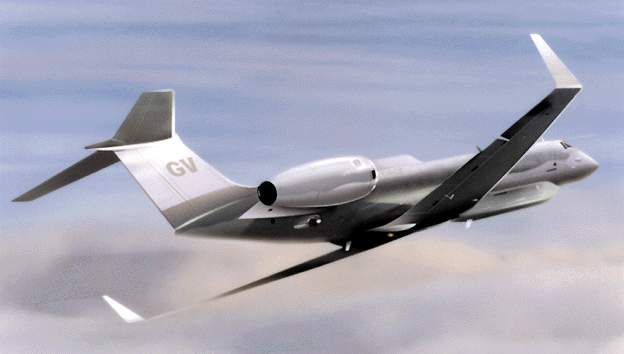
Sources and Resources
- ASTOR COUNTDOWN TO CONTRACT Battlespace TechnologiesVol. 1, No. 1 - November 1998
- Global Express by Bombardier/Shorts
FAS |
Military |
DOD 101 |
Systems |
Aircraft |
ROW ||||
Index |
Search |
Join FAS
http://www.fas.org/man/dod-101/sys/ac/row/astor.htm
Maintained by Robert Sherman
Originally created by John Pike
Updated Monday, September 27, 1999 9:39:25 AM