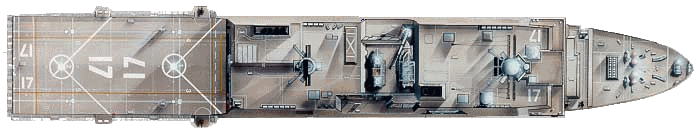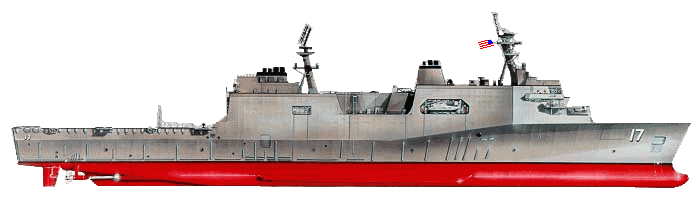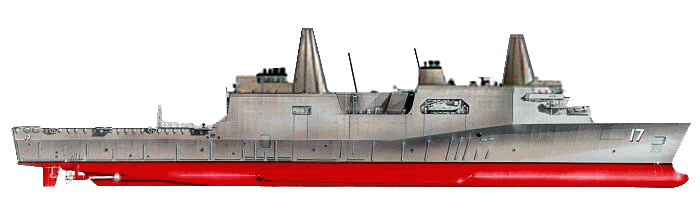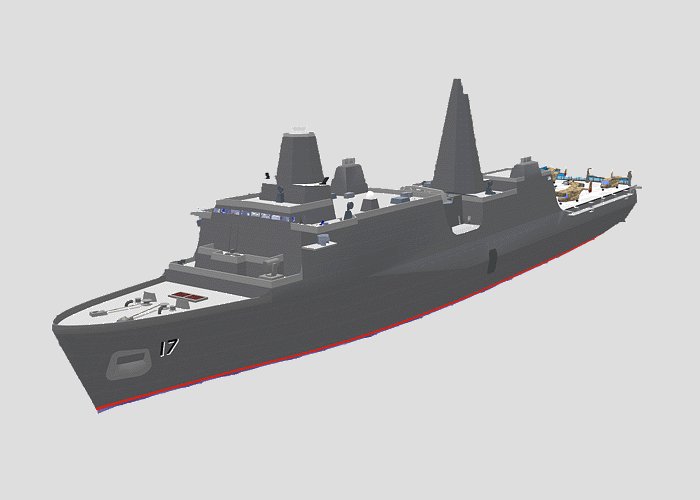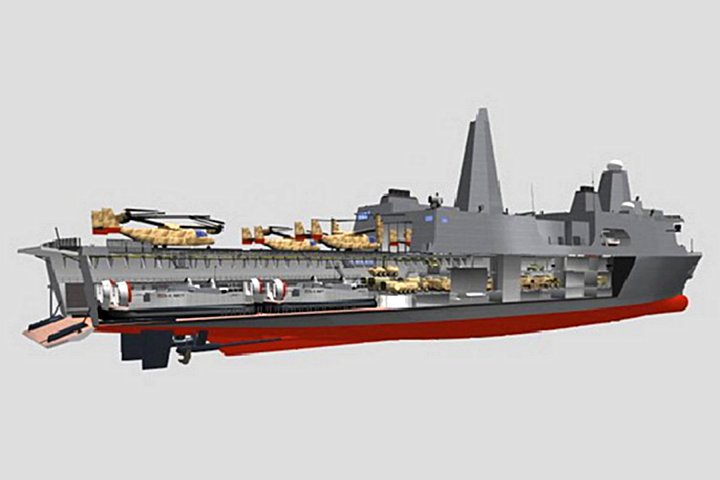


 The SAN ANTONIO (LPD 17) Class of amphibious transport dock ships represents the Navy and Marine Corps' future in amphibious warfare, and is one of the cornerstones in the strategic plan known as "Forward...from the sea". The San Antonio class will be the first designed, from the keel up, to execute Operational Maneuver From The Sea [OMFTS] and Ship to Objective Maneuver. It is designed to support embarking, transporting, and landing elements
of a Marine landing force in an assault by helicopters, landing craft, amphibious vehicles, and by a combination of these methods to conduct primary amphibious warfare missions.
The LPD 17 will integrate with the existing amphibious ship force structure and the Navy's declining shore infrastructure. The LPD 17 class program will be the replacement for three classes of amphibious ships that have reached the end of their service life -- the LPD 4, LSD 36, and LST 1179 classes - and one class that has already been retired, the LKA 113. Naval amphibious ship forces with embarked Marine Corps units provide an essential component of the forward presence mission capability required to implement United States foreign policy. The LPD 17 ship class primary mission is Amphibious Warfare. Thus, LPD 17 must be able to embark, transport, and land elements of the landing force in an assault by helicopters (all USMC helos including MV22), landing craft (LCAC), amphibious vehicles (AAAV), and by a combination of these methods. The combat power of this ship is it's embarked Marines and their
equipment.
Ensuring that the ship maintains a robust self defense capability as threat systems evolve is key to survivability in the littoral environment where the ship will fight. As a class, these ships will overcome amphibious lift shortfalls caused by the decommissioning of aging LPDs, LSTs, LKAs, and LSDs. Maintaining projected delivery schedules and attaining operational readiness of this ship class is key to eradicating existing shortfalls in amphibious lift. Of particular concern is the high
average age of amphibious ships which have high maintenance
costs, higher manning levels, and lower reliability compared to
ships being built today. The introduction of the LPD 17 into the
fleet is intended to mitigate this problem.
The SAN ANTONIO (LPD 17) Class of amphibious transport dock ships represents the Navy and Marine Corps' future in amphibious warfare, and is one of the cornerstones in the strategic plan known as "Forward...from the sea". The San Antonio class will be the first designed, from the keel up, to execute Operational Maneuver From The Sea [OMFTS] and Ship to Objective Maneuver. It is designed to support embarking, transporting, and landing elements
of a Marine landing force in an assault by helicopters, landing craft, amphibious vehicles, and by a combination of these methods to conduct primary amphibious warfare missions.
The LPD 17 will integrate with the existing amphibious ship force structure and the Navy's declining shore infrastructure. The LPD 17 class program will be the replacement for three classes of amphibious ships that have reached the end of their service life -- the LPD 4, LSD 36, and LST 1179 classes - and one class that has already been retired, the LKA 113. Naval amphibious ship forces with embarked Marine Corps units provide an essential component of the forward presence mission capability required to implement United States foreign policy. The LPD 17 ship class primary mission is Amphibious Warfare. Thus, LPD 17 must be able to embark, transport, and land elements of the landing force in an assault by helicopters (all USMC helos including MV22), landing craft (LCAC), amphibious vehicles (AAAV), and by a combination of these methods. The combat power of this ship is it's embarked Marines and their
equipment.
Ensuring that the ship maintains a robust self defense capability as threat systems evolve is key to survivability in the littoral environment where the ship will fight. As a class, these ships will overcome amphibious lift shortfalls caused by the decommissioning of aging LPDs, LSTs, LKAs, and LSDs. Maintaining projected delivery schedules and attaining operational readiness of this ship class is key to eradicating existing shortfalls in amphibious lift. Of particular concern is the high
average age of amphibious ships which have high maintenance
costs, higher manning levels, and lower reliability compared to
ships being built today. The introduction of the LPD 17 into the
fleet is intended to mitigate this problem.
The LPD 17 program represents the Navy's best case of capitalizing on acquisition reform. Examples include:
The SPS-73 system is a commercial surface search radar that replaced the SPS-67 and SPS-64 radars. More reliable than the other two radars, the SPS-73 consolidates training requirements, reduces maintenance, and possesses lower acquisition costs. The net result is a better radar that will save as much as $30 million dollars over the lifetime of the 12-ship LPD 17 class
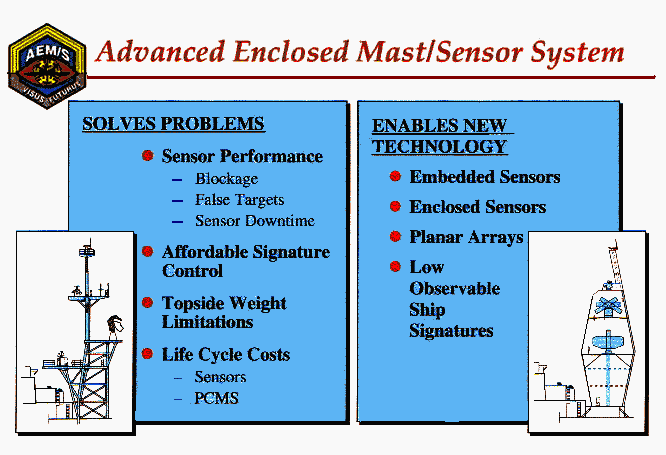 The Advanced Enclosed Mast/Sensor (AEM/S) System was selected for installation on SAN ANTONIO (LPD-17)-class amphibious transport dock ships. The LPD-17 AEM/S System is an octagonal, detachable structure that enables affordable modular upgrade of future combat sensors and Command, Control, Communications, Computer, and Intelligence (C4I) systems. The Office of Naval Research and the LPD-17 program office undertook a risk mitigation effort to leverage the Navy’s investment in the AEM/S System ATD. The LPD-17 transition will build on and
extend the technology developed by the demonstration, significantly reducing cost and risk.
The AEM/S System mast [a 93-foot-high hexagonal structure 35 feet in diameter ] is constructed of a multi-layer, frequency-selective composite material designed to allow passage of own-ship sensor frequencies with very low loss while reflecting other frequencies.
The mast’s shape is designed to provide a smooth silhouette to reduce radar cross section. Signature and electro-magnetic design requirements are based on criteria associated with sensor and antenna performance, electro-magnetic interference, lighting protection electromagnetic shielding, and electrical bonding and grounding.
The AEM/S System mast is an enclosed structure that protects radars and communication antennas from weather exposure and provides access for repairs, thus greatly reducing maintenance costs and risk of failure. The top half is divided into two radome-like compartments; the upper compartment houses the Mk 23 Target Acquisition System (TAS) antenna and the lower encloses the AN/SPS-40 air search antenna. Structural design requirements for strength and stiffness meet Fleet requirements for vibration, shock, and fatigue.
Participating in the development, design, and construction of the AEM/S System were representatives of the Office of Naval Research, Naval Sea Systems Command, Naval Research Laboratory, Carderock and Dahlgren Divisions of the Naval Surface Warfare Center, Naval Command and Control and Ocean Surveillance Center, and Norfolk Naval Shipyard. Industry participants were Ingalls Shipbuilding, Seemann Composites, Mission Research Corporation, Material Sciences Corporation, Ohio State University, and Analysis & Technology.
The Advanced Enclosed Mast/Sensor (AEM/S) System was selected for installation on SAN ANTONIO (LPD-17)-class amphibious transport dock ships. The LPD-17 AEM/S System is an octagonal, detachable structure that enables affordable modular upgrade of future combat sensors and Command, Control, Communications, Computer, and Intelligence (C4I) systems. The Office of Naval Research and the LPD-17 program office undertook a risk mitigation effort to leverage the Navy’s investment in the AEM/S System ATD. The LPD-17 transition will build on and
extend the technology developed by the demonstration, significantly reducing cost and risk.
The AEM/S System mast [a 93-foot-high hexagonal structure 35 feet in diameter ] is constructed of a multi-layer, frequency-selective composite material designed to allow passage of own-ship sensor frequencies with very low loss while reflecting other frequencies.
The mast’s shape is designed to provide a smooth silhouette to reduce radar cross section. Signature and electro-magnetic design requirements are based on criteria associated with sensor and antenna performance, electro-magnetic interference, lighting protection electromagnetic shielding, and electrical bonding and grounding.
The AEM/S System mast is an enclosed structure that protects radars and communication antennas from weather exposure and provides access for repairs, thus greatly reducing maintenance costs and risk of failure. The top half is divided into two radome-like compartments; the upper compartment houses the Mk 23 Target Acquisition System (TAS) antenna and the lower encloses the AN/SPS-40 air search antenna. Structural design requirements for strength and stiffness meet Fleet requirements for vibration, shock, and fatigue.
Participating in the development, design, and construction of the AEM/S System were representatives of the Office of Naval Research, Naval Sea Systems Command, Naval Research Laboratory, Carderock and Dahlgren Divisions of the Naval Surface Warfare Center, Naval Command and Control and Ocean Surveillance Center, and Norfolk Naval Shipyard. Industry participants were Ingalls Shipbuilding, Seemann Composites, Mission Research Corporation, Material Sciences Corporation, Ohio State University, and Analysis & Technology.
Specifications | |
| DIMENSIONS |
Length, LBP 200.0m 661 ft Length, Overall 208.5m 684 ft Beam, Extreme 31.9m 105 ft Draft, FL 7.0m 23 ft |
| Displacement | Full Load: approx. 25000 |
| PERFORMANCE | Sustained Speed, kts ~22 |
| ACCOMMODATIONS |
Current Configuration

 		Total	Ship	Troops	Surge	Transient
Officers		 115	 33	 66	11	6
CPO/SNCO		  82	 34	 42	 6	0
Enlisted		1005	330	591	84	0
Total  		1202	 396	699	101	6


Initial Configuration

                Total   Ship    Troops  Surge
Officers        100     34      66      10
CPO/SNCO        71      30      41      6
Enlisted/Troops 1026    429     597     75
Total           1288    493     704     91
|
| MISSION SYSTEMS |
Vehicles/Carg (Net):
|
| AVIATION FACILITIES |
Hangar: "O" Level Maintenance Facilities for:
|
| MAIN PROPULSION |
4 - Medium Speed Turbocharged Marine Diesels 2 - Shafts 2 - Single Reversing Reduction Gears 2 - Inboard Rotating (top) Fixed Pitch Propellers |
| ELECTRIC PLANT |
5 - 2500 KW Ship Service Marine Diesel Generators 5 - Main Ship Service 60 Hz SWBS 3 - Ship Service 400 Hz SWBS 3 - 60 to 400 Hz solid State Frequency changers Zonal 60 Hz Power distribution system Advanced Deguassing System |
| AUXILIARIES |
7 - 700 KW Non-CFC Air conditioning Plants 5 - 12000 GPD Reverse Osmosis Desalination Plants 10 - 1000 GPM Navy Standard Firepumps 2 - HP Air Compressors 3 - LP Air Compressors 3 - Deballast Air Compressors |
| Navigation |
Digital Flux Gate Magnetic Compass An/WSN-7(V)1 Inertial Navigation System AN/WQN-2 Doppler Sonar Velocity Log Sys AN/UQN-4A Sonar Sounding Set Dead Reckoning System Navigation Telex System AN/SSN-6 NAVSSI |
| Ships Weapons |
1 - MK 41, 16 Cell VLS, (Space & Weight) 2 - MK 31 Mod 0 RAM Launchers 2 - MK 46 Mod 1 30mm Machine Guns 2 - MK 26 Mod 17 .50 Cal Machine Guns |
| Command & Control: |
AN/SPQ-12(V) Radar Display Dist. Distribution System MK 2 SSDS AN/USQ-119C(V)27 JMCIS AN/KSQ-1 Amphibious Assault Direction System MK 91, 2 Channel MFCS AN/USG-2 CEC |
| Radar Systems |
AN/SPS-48E AN/SPQ-9B AN/SPS-73 |
| EW & Decoy Systems |
AN/SLQ-25A NIXIE AN/SLQ-32Q(V)2 MK 36 SRBOC MK 53 / NULKA TISS |
Ships | ||||||
| Name | Number | Builder | Homeport | Ordered | Commissioned | Decommissioned |
| San Antonio | LPD-17 | Avondale | 17 Dec 1996 | Sep 2002 | ||
| New Orleans | LPD-18 | Avondale | 25 Nov 1998 | Aug 2003 | ||
| LPD-19 | Bath | Nov 1999 | Jun 2004 | |||
| LPD-20 | Avondale | Nov 1999 | Dec 2004 | |||
| LPD-21 | Avondale | Nov 2000 | Jun 2005 | |||
| LPD-22 | Bath | Nov 2000 | Dec 2005 | |||
| LPD-23 | Avondale | Nov 2001 | Jun 2006 | |||
| LPD-24 | Avondale | Nov 2001 | Dec 2006 | |||
| LPD-25 | Bath | Nov 2002 | Jun 2007 | |||
| LPD-26 | Avondale | Nov 2002 | Dec 2007 | |||
| LPD-27 | Avondale | Nov 2003 | Jun 2008 | |||
| LPD-28 | Bath | Nov 2003 | Dec 2008 | |||