VERSION 3.0
DEPARTMENT OF THE NAVY
PROGRAM EXECUTIVE OFFICE FOR UNDERSEA WARFARE
UNMANNED UNDERSEA VEHICLE PROGRAM MANAGEMENT OFFICE
(PMS403)
SYSTEM "A" PERFORMANCE SPECIFICATION FOR THE
LONG-TERM MINE RECONNAISSANCE SYSTEM (LMRS)
Approved by:
_______________________
V. R. Fiebig
CAPT, USN
Change Pages for LMRS "A" specification Version 3.0
- Previous Changes -
|
PARAGRAPH ## |
CHANGES UP TO VERSION 2.7 |
RATIONAL |
|
3.2.1.5 |
CLARIFIED REQUIREMENT TO APPLY TO ANY PORTION OF UUV ATMOSPHERE WHICH COULD POTENTIALLY CONTAIN A HAZARDOUS SUBSTANCE |
UUV HULL REPLACEMENT NON-VENTING REQUIREMENT UNCLEAR WHETHER ENERGY ONLY OR ALL UUV HULLS |
|
3.2.1.5, 3.2.1.6, 3.2.1.7, 3.2.1.8, 3.2.1.9, 3.3.6.4 |
CHANGED WORDING TO RETRIEVAL OR JETTISON IN 5 MINUTES |
CLARIFICATION ON WHETHER ALL TUBE LOADED HARDWARE HAD TO GO OVERBOARD DURING JETTISON OR COULD BE RETRIEVED |
|
3.2.1.6.1, 6.3 |
ADDED DEFINITION TO EOR FUNCTION SUBPARAGRAPH, REWORDED PARAGRAPH TO MAKE REQUIREMENT MORE CLEAR |
CLARIFICATION ON DEFINITION OF MISSION CRITICAL PARAMETERS AND WHEN EOR FUNCTION IS REQUIRED |
|
3.2.1.7 |
CHANGED MULTIPLE UUV STATEMENT TO MULTIPLE SORTIES; CHANGED MULTIPLE UUV SUPPORTABILITY STATEMENT |
CLARIFICATION ON MULTIPLE UUV REQUIREMENTS IMPLYING THE NEED FOR LMRS TO HAVE AT LEAST 2 UUVS |
|
3.2.4.1.1 |
CHANGED SYSTEM MISSION RELIABILITY TO FOR A THRESHOLD TAC MISSION |
MISSION RELIABILITY DEFINITION DOES NOT TAKE INTO ACCOUNT ENDURANCE OR AREA COVERED PER SORTIE |
|
3.2.1.7 |
CHANGED TO MINE LIKE TARGETS |
SSF DEFINITION INCLUDES MLOs, IMPLIES THAT CLASSIFICATION FUNCTION IS AUTONOMOUS AND ONBOARD UUV |
|
3.2.1.7.1 |
CHANGED PD WORDING TO BE THE PROBABILITY AT MAXIMUM RANGE ASSOCIATED WITH REQUIRED SWATH WIDTHS |
CLARIFICATION OVER DEFINITION OF PD, PFA |
|
3.2.1.7.2 |
CLARIFIED LANGUAGE ON MANEUVERS FOR CLASSIFICATION BEING AUTONOMOUS |
CLARIFICATION OVER AUTONOMOUS CLASSIFICATION |
|
3.2.1.7.2, 6.2, 6.3 |
DELETED REQUIREMENT |
PFD REQUIREMENT APPLIED NEED FOR ID |
|
3.2.1.7.2 |
CLARIFIED PLAN VIEW DEFINITION (KEEP OUT CYLINDER, VERTICAL) |
CLARIFICATION ON CPA RANGE (CYLINDRICAL VS. SPHERICAL |
|
3.2.1.8 |
ADDED RENDEZVOUS ENDS WHEN SSN COMMANDS ENTRY INTO RECOVERY |
CLARIFICATION ON WHEN RENDEZVOUS STATE ENDS |
|
3.2.1.9.2, 3.2.1.9.3 |
CLARIFIED AS BEING FORWARD, MINIMUM, SPEED THROUGH WATER |
CONFUSION ON RETRIEVAL AND TOWING SPEEDS |
|
3.2.4.1.2 |
ADDED PARENTHESES ON THRESHOLD ENDURANCE MISSION EXECUTION STATE (40 HOURS) |
CLARIFICATION FOR SORTIE RELIABILITY ANALYSIS |
|
3.2.5.1.1 |
CLARIFIED PARAGRAPH |
CLARIFICATION ON CRITICAL VS. NON-CRITICAL SHOCK |
|
3.2.5.6, 3.2.5.11 |
ADDED NOMINAL TEMPERATURE RANGE |
QUESTION ON 1300F TEMPERATURE IN SSN |
|
3.3.11 |
CHANGED DEFINITION CONSISTENT W/ GOVERNMENT INTERPRETATION |
CLARIFICATION ON 50% VS 66% COMPUTER RESERVE |
|
3.2.1.2.1 |
ADDED PARAGRAPH ON SHORE TRAINING |
TRAINING OCCURS ONLY IN PRE-LAUNCH STATE, OR WITH NSE |
|
3.2.1.4 |
ADDED "CHECKED-OUT" AS AN EXIT CRITERIA FOR THE INSTALLATION AND CHECKOUT STATE |
INSTALL AND CHECK-OUT STATE HAS EXIT CRITERIA THAT DOES NOT INCLUDE SUCCESSFUL CHECK-OUT |
Change pages for LMRS "A" specification Version 3.0
- New Changes -
|
PARAGRAPH ## |
CHANGES MADE BETWEEN VERSION 2.7 AND 3.0 |
RATIONAL |
|
2.1 |
OPNAVINST 1500 (series) OPNAVINST 3000.12, 3000.13A |
include reference from sections 3.2.4, 3.6.1, & 3.6.2 |
|
2.1.1 3.2.3.3.1 |
Updated NSSN drawing availability statement |
PMS403/450 have committed to release in March |
|
3.1.1 |
Changed introductory language related to UUV autonomy |
Clarification (Conflicted with other portions of the specification) |
|
3.2.1.2.1 |
corrected spelling |
"troubleshooting" |
|
3.2.1.3 |
clarified requirement for the RFI state to include transportation |
avoid confusion |
|
3.2.1.4.1 |
Added POM CERT requirement.
|
No offload/onload of weapons/LMRS between CERT and deployment |
|
3.2.1.5 |
clarified requirement to index any torpedo stow loaded equipment (not just UUVs) |
Previous wording implied need to index UUVs only |
|
3.2.1.5.1 |
reworded OBT to indicate it is primarily for ship’s force, but augments cadre training |
Preclude false idea that training is strictly "on-the-job" (other training is in 3.2.1.2.1) |
|
3.2.1.5.1 |
Deleted requirement to preclude inadvertent startup in this state (it is precluded in all states in section 3.3.6). |
Implied that inadvertent startup was only a concern if it occurred during OBT. |
|
3.2.1.6 |
modified language on end of the launch state |
to facilitate calculation or other measurement of the duration of the launch state |
|
3.2.1.6.2 |
added 3.2.1.7.3 communication requirement |
match end of launch state |
|
3.2.1.5 3.2.1.6 3.2.1.7 3.2.1.8 3.2.1.9 |
deleted "in any other state" |
Redundant and unclear writing. All states to which this requirement applies have been listed. Also included in section 3.2.3. |
|
3.2.1.6.1 3.2.1.9.1 |
simplified the EOR function |
EOR function was unnecessarily complex |
|
3.2.1.7 |
change multiple state language |
Clarification |
|
3.2.1.7 (last para.) |
changed mission to sortie |
correct error |
|
3.2.1.7.1 |
subtle reword |
clarity on the requirement for BOTH environments |
|
3.2.1.7 |
UUV SDS recorder language changed |
classification not always 15%, recorder must work for all missions |
|
3.2.1.7.5 |
clarified UUV autonomy language |
consistency |
|
3.2.1.7.5 |
changed UUV continuous top speed to at least 7 knots |
clarification to maintain 4 knot ACR in 3 knot current |
|
3.2.1.8.1 3.2.1.9.1 |
shall autonomously transit |
removed "capable of" language (unclear) |
|
3.2.1.9 |
changed recovery duration language |
towing and backhaul are SSN functions/decisions, the duration of which are not under LMRS control |
|
3.2.1.9 3.2.1.9.1 |
defined assumed duration for Towing and Backhaul phases |
support calculation of or measurement of ACR |
|
3.2.1.9.3 |
wordsmithing |
sentence repair |
|
3.2.1.9.5 |
changed ship’s force to ship’s force/cadre |
correct error |
|
3.2.4 |
reworded combination of environments |
clarification |
|
3.2.4.1 |
requirements vs. numbers |
wordsmithing |
|
3.2.4.1.1 |
changed start point to first mission preparation. Included wording to indicate multiple sorties |
included failures that occur during preparation. Clarify sortie vs. mission reliability |
|
3.2.4.1.2 |
changed mission to sortie |
correct error/clarify |
|
3.2.4.2 |
added BRU requirements to maintainability section |
make clear the difference in fault localization on the SSN vs. ashore |
|
3.2.5 3.2.5.1 |
reworded introductory paragraphs to environmental conditions |
clarification |
|
3.2.5.6 3.2.5.11 |
wordsmithing |
run on sentence repair |
|
3.2.6 |
augmented transportability requirements with specifics on C-17/C-130 |
eliminate C-5 option (NMRS lesson learned) |
|
3.3.12 |
removed process language |
wordsmithing |
|
3.3.13 |
added pollution prevention section |
from ORD and SPR, but not in earlier A-Spec. |
|
3.5.1.1 |
Deleted energy hull (can now be any hull) |
clarification hull section replacement is not limited |
|
3.5.1.2 |
added preventative maintenance wording, changed "the contractor" to "a contractor", updated CASS |
eliminate implied restrictions |
|
3.5.4 |
Changed CASS wording |
conflicted with 3.5.1.2 |
|
3.6.1 |
changed cadre wording |
include PERSTEMPO requirements |
TABLE OF CONTENTS
Section Page
1.0 SCOPE 1
1.1 Identification 1
1.2 System Overview 1
1.3 Document Overview 1
2.0 APPLICABLE DOCUMENTS 2
2.1 Government Documents 2
2.1.1 NSSN Drawings 3
2.2 Order of Precedence 3
3.0 SYSTEM REQUIREMENTS 4
3.1 System Definition 4
3.1.1 LMRS UUV 4
3.1.2 LMRS Shipboard Deployed Equipment 4
3.1.3 Non-Deployed Shorebased Equipment 4
3.2 Characteristics 4
3.2.1 Performance Characteristics 5
3.2.1.1 Storage State 5
3.2.1.2 Shore Maintenance State 5
3.2.1.3 Ready for Fleet Issue State 6
3.2.1.4 Installation & Check-Out State 6
3.2.1.5 Pre-Launch State 7
3.2.1.6 Launch State 8
3.2.1.7 Mission Execution State 9
3.2.1.8 Rendezvous State 13
3.2.1.9 Recovery State 14
3.2.1.10 Post Sortie State 15
3.2.1.11 Off-Load State 15
3.2.2 External Interfaces 15
3.2.2.1 Range Tracking 15
3.2.2.2 Retrieval Craft Interface 16
3.2.3 Physical Characteristics 16
3.2.3.1 Protective Coatings 16
3.2.3.2 UUV Physical Characteristics 16
3.2.3.3 Shipboard Deployed Equipment 16
3.2.4 System Quality Factors 17
3.2.4.1 Reliability 18
3.2.4.2 Maintainability 18
3.2.4.3 System Sortie Launch Availability 19
3.2.5 Environmental Conditions 19
3.2.5.1 Shock Environment 19
3.2.5.2 Storage State Environment 21
3.2.5.3 Shore Maintenance State Environment 21
3.2.5.4 Ready for Fleet Issue (RFI) State Environment 21
Section Page
3.2.5.5 Installation and Checkout State Environment 21
3.2.5.6 Pre-Launch State Environment 22
3.2.5.7 Launch State Environment 22
3.2.5.8 Mission Execution State Environment 22
3.2.5.9 Rendezvous State Environmental Conditions 22
3.2.5.10 Recovery State Environmental Conditions 22
3.2.5.11 Post Sortie State Environment 22
3.2.5.12 Off-Load State Environment 22
3.2.5.13 Environmental Conditions Cross Reference Table 27
3.2.6 Transportability 27
3.2.7 Portability 27
3.3 Design and Construction 28
3.3.1 Materials 28
3.3.1.1 Toxic Products and Formulations 28
3.3.1.2 Parts, Materials and Processes 28
3.3.2 Electromagnetic Radiation 28
3.3.3 Nameplate and Product Marking 28
3.3.4 Workmanship 28
3.3.5 Interchangeability 28
3.3.6 Safety 29
3.3.6.1 Operational Safety 29
3.3.6.2 Safety Status Monitoring 29
3.3.6.3 Depth Exclusion 29
3.3.6.4 Submarine Emergency Operations 29
3.3.6.5 Energy System 29
3.3.6.6 Electrical Safety 29
3.3.6.7 Implosion 29
3.3.6.8 Explosive Safety 30
3.3.6.9 SUBSAFE 30
3.3.6.10 Hazards of Electromagnetic Radiation to Ordnance 30
3.3.7 Human Engineering 30
3.3.8 Nuclear Control 30
3.3.9 System Security 30
3.3.10 Government-Furnished Property Usage 30
3.3.11 Computer Resource Reserve Capability 30
3.3.12 Environmental Protection 30
3.4 Deleted 30
3.5 Logistics 30
3.5.1 Maintenance 30
3.5.1.1 On-Board Maintenance 30
3.5.1.2 Shore Based Maintenance 31
3.5.2 Packaging, Storage, Handling and Transportation 31
3.5.3 Facilities 31
3.5.4 Support & Test Equipment 31
Section Page
3.5.5 Standardization 31
3.6 Personnel & Training 31
3.6.1 Personnel 31
3.6.2 Training 31
3.7 Characteristics of Subordinate Elements 32
3.8 Precedence 32
4.0 QUALITY ASSURANCE PROVISIONS 33
4.1 Responsibility for Verification 33
4.2 Special Tests and Examinations 33
4.3 Requirements Cross Reference Table 33
5.0 PREPARATION FOR DELIVERY 37
5.1 Packaging 37
5.2 Marking 37
6.0 NOTES 38
6.1 Intended Use 38
6.1.1 Missions 38
6.1.2 Threat 38
6.2 Acronyms 38
6.3 Definitions 39
LIST OF FIGURES
Figure Page
3.2.1-1 LMRS State Diagram 5
3.2.5-1 Deep Water Environment Sound Velocity Profile 24
3.2.5-2 Shallow Water Environment Sound Velocity Profile 26
LIST OF TABLES
Table Page
3.2.3-1 SSN 688 and NSSN UUV Interface Parameters 16
3.2.3-2 NSSN / SSN 688 Preliminary Interface Dimensions 17
3.2.4.1-1 LMRS Reliability Requirements 18
3.2.4.2-1 LMRS Fault Localization Requirements (Ashore) 18
3.2.4.2-2 LMRS Fault Localization Requirements (Installed) 19
3.2.5-1 LMRS Environmental Conditions 21
3.2.5-2 Deep Water Environment 23
3.2.5-3 Deep Water Environment SVP Data 24
3.2.5-4 Shallow Water Environment 25
3.2.5-5 Shallow Water Environment SVP Data 26
3.2.5-6 Environmental Conditions Cross Reference 27
4.3-1 Requirements Cross Reference Table 33
DEPARTMENT OF THE NAVY
PROGRAM EXECUTIVE OFFICE FOR UNDERSEA WARFARE
UNMANNED UNDERSEA VEHICLE PROGRAM MANAGEMENT OFFICE
(PMS403)
SYSTEM PERFORMANCE SPECIFICATION
FOR THE
LONG-TERM MINE RECONNAISSANCE SYSTEM
1.0 SCOPE
1.1 Identification. This specification establishes the performance, design, development, and verification requirements for the Long-Term Mine Reconnaissance System (LMRS).
1.2 System Overview. The mission of the LMRS is to provide the Ship, Submarine, Nuclear, Fast Attack (SSN) 688, 688I, and New Attack Submarine (NSSN) with an offboard capability to conduct clandestine minefield reconnaissance in support of submarine, battle group, and amphibious operations.
1.3 Document Overview. This system performance specification establishes the performance, system quality factors, design, development, and test requirements for the LMRS, including Unmanned Undersea Vehicle(s) (UUV(s)), Shipboard Deployed Equipment (SDE), and Non-Deployed Shorebased Equipment (NSE). The main body of this document is unclassified and references a separate Secret Appendix A.
2.0 APPLICABLE DOCUMENTS
2.1 Government Documents. The following specifications form a part of this document to the extent specified herein. Unless otherwise specified, the issues shall be the latest available at the time of contract award.
ACGIH ISBN 0-936-712-39-2 Threshold Limit Values and Biological Exposure
Indices
CNO Ltr Ser 87/6U660409 LMRS Classification Guidelines
of 7 Mar 96
ONI-TA-015-94 Mine Countermeasures Systems Threat Assessment
OPNAVINST 1500.8M Navy Training Planning Process (18 Sep 86)
OPNAVINST 3000.12 Operational Availability of Equipment and Weapon
Systems (29 Dec 87)
OPNAVINST 3000.13A Personnel Tempo of Operations (21 Dec 90)
MIL-S-901 Shock Tests, High-Impact Shipboard Machinery, Equipment and Systems, Requirements for
NAVSEA Drawing Submarine SSN 688 Class Weapon Handling
H53711-5337121 and Stowage Mechanical Interfaces
NAVSEA S9070-AA-MME-010/ Guidance Manual for Temporary Submarine
SSN/SSBN Alterations
NAVSEA S9310-AQ-SAF-010 Navy Lithium Safety Program, Responsibilities and Procedures
NAVSEA SW-395-AA-IFM Submarine Torpedo Tubes and Weapon Handling
010/SWIM-1 Systems Interface Manual Drawings (SSN 688)
NAVSEA SW-395-AA-IFM Submarine Torpedo Tubes and Weapon Handling
020/SWIM-2 Systems Interface Manual Drawings (SSN 688)
NAVSEA 0902-018-2010 General Overhaul Specifications for Deep Diving SSBN/SSN Submarines
PPD 802-6337445 Underwater Explosion (UNDEX) Qualification of Submarine Hull Penetrations
2.1.1 NSSN Drawings. NSSN drawings shall be considered preliminary, not all drawings exist. The drawing numbers and names cited herein were valid as of 4 February 1998. The anticipated release date of the NSSN drawings to the LMRS program is March 1998.
|
NSSN Drawing Number |
NSSN Drawing Title |
|
H211-1002 |
Torpedo Room Arrangement |
|
H832-1680 |
Weapon Cradle Assembly |
|
H832-0301 |
Weapon Shipping Arrangement |
|
H547-2001 |
Weapons Shipping Hatch, Upper & Lower Arrangement |
|
H821-0011 |
Torpedo Tube Submerged Upper RH Mk XX Mod 1 |
|
H821-0013 |
Torpedo Tube Submerged Lower RH Mk XX Mod 3 |
|
H832-1601 |
Weapon Stowage and Handling System Arrangement |
|
H841-0301 |
Torpedo Tube Rotary Shutter Upper RH Ass’y & Details |
|
H841-0303 |
Torpedo Tube Rotary Shutter Lower RH Ass’y & Details |
2.2 Order of Precedence. In the event of conflict between the text of this document and the references cited herein, the text of this document takes precedence. Nothing in this document, however, supersedes applicable laws and regulations unless a specific exemption has been obtained.
3.0 SYSTEM REQUIREMENTS
3.1 System Definition. The functions of the LMRS shall be allocated to UUV(s), SDE, and NSE. The UUV(s) and the SDE will be temporarily installed aboard a submarine for specific deployments as an OPALT/TEMPALT In Accordance With (IAW) NAVSEA S9070-AA-MME-010/SSN/SSBN and will be offloaded upon completion of that deployment. LMRS shall be initially designed to be installed as an OPALT/TEMPALT, however, at the Government’s discretion, selected portions of the OPALT/TEMPALT (e.g.: hooks, handles, foundations, and/or external SDE) may be converted to, and pre-installed as, a SHIPALT. The UUV(s) shall be stowed, and most of the SDE shall be installed, in the submarine's torpedo room and shall occupy weapons stows. LMRS shall make use of other SSN systems and equipment, e.g., weapon handling equipment, IAW the requirements of this specification.
The operational and logistics infrastructure for LMRS shall nominally consist of on-board maintenance and shore maintenance. On-board maintenance shall be minimized, but shall include actions necessary to maintain system reliability. Shore maintenance shall be conducted by the contractor at shore-based contractor or government facilities and shall include the majority of maintenance activities.
3.1.1 LMRS UUV. Each LMRS UUV shall be a reusable vehicle capable of being launched and recovered through the submarine's torpedo tubes. Each vehicle shall be autonomous, self-propelled, with navigation and control, communications, data processing, and obstacle avoidance capabilities IAW this specification. The UUV(s) shall support mine detection, localization, discrimination, and classification functions necessary to conduct the clandestine mine reconnaissance mission IAW the requirements described herein. Multiple UUVs may be deployed on the submarine.
3.1.2 LMRS Shipboard Deployed Equipment. The SDE shall consist of all of the OPALT/TEMPALT installed shipboard equipment, excluding the UUV(s) and other SSN systems. The SDE includes elements to support Launch & Recovery (L&R) of UUVs, ship interface, mission planning, mission execution, on-board training, on-board maintenance, and data collection, distribution, display, processing, and communication.
3.1.3 Non-Deployed Shorebased Equipment. The NSE shall consist of additional LMRS equipment required to support shore maintenance, training, preparation for deployment, installation, checkout, and transportation activities that are not required to support shipboard deployment requirements.
3.2 Characteristics. This section defines the characteristics of LMRS. Where parameters have been quantified, the value shall be considered the minimum acceptable, i.e., threshold, requirement unless stated otherwise. Where applicable, both a threshold and an objective have been quantified in the following manner: threshold #/objective #.
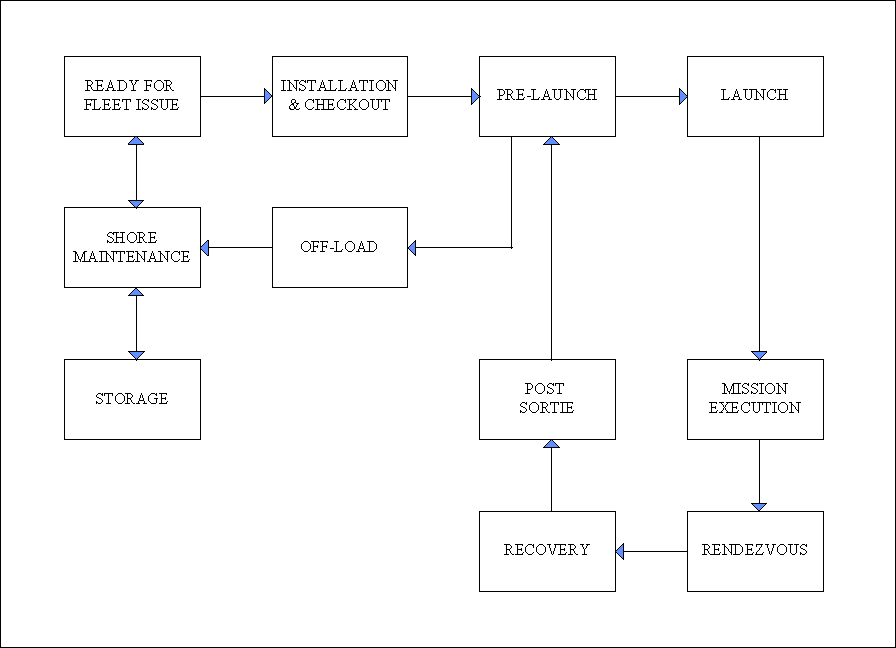
3.2.1 Performance Characteristics. LMRS shall be capable of performing in the states identified in Figure 3.2.1-1, consistent with the requirements stated below. All performance requirements apply to the system as a whole unless explicitly stated otherwise. These requirements shall be met during and after exposure to the environments described in section 3.2.5 and its subsections.
Since multiple UUVs may be deployed on the submarine, each UUV may be found in a different state at any given time. For example, one UUV may be in the Mission Execution state while a second UUV is in the Pre-Launch state, being readied to "relieve" the first UUV after it is recovered. Furthermore, each UUV may undergo multiple cycles through each of the states as necessary to complete the mission, as specified in section 3.2.1.7.
Figure 3.2.1-1 LMRS State Diagram
3.2.1.1 Storage. Storage shall be the state in which LMRS, assembled or disassembled, is placed between SSN deployments or tests. The UUV shall be in an unpowered, non-operational condition in this state. This state includes transportation and handling to and from the shore maintenance facility. LMRS shall be capable of remaining in this state for a period of at least 6 months before requiring additional maintenance.
3.2.1.2 Shore Maintenance. The Shore Maintenance state shall be the state in which the LMRS UUVs and SDE are prepared for the Storage or RFI states. Preparation may include packaging, unpacking, assembly, disassembly, replacement of consumables or expendables, repairs, and testing. The LMRS UUVs and SDE shall arrive in this state from the Storage, RFI, or Off-Load states. The Shore Maintenance state shall also be the state in which the NSE is operated, tested, maintained, and repaired.
In this state, the NSE shall be used for system and subsystem testing, troubleshooting, fault localization, and repairs. Repairs may include Preventive Maintenance (PM), Corrective Maintenance (CM), refurbishment, and replenishment activities. The NSE shall be used to prepare the UUVs and SDE for the RFI state. NSE shall be capable of generating operational (shipboard-like) signals to support testing performed in this state.
3.2.1.2.1 Shore Training Mode. All training, other than On-Board Training (see 3.2.1.5.1), shall occur in the Shore Maintenance state. The NSE, SDE, and UUV shall be designed to support shore training. This training capability shall support cadre and maintenance personnel training in the following: system preparation and checkout for RFI; system turnaround, troubleshooting, and maintenance; and system operation.
The system shall clearly display the training status while in the Shore Training mode.
3.2.1.3 Ready for Fleet Issue. RFI is an unpowered, non-operational state in which the LMRS UUVs, installation support equipment, and SDE, or constituent components, are fully ready for transportation to, and installation on, a submarine. This state shall begin at the shore based facility after successful completion of all functional tests and ends with LMRS (dockside) ready to begin the submarine Installation and Check-Out (I&CO) state. This state includes transportation and handling from the shore maintenance facility to the installation location. Including transportation, LMRS shall be capable of remaining in this state for a period of 60 days. LMRS subsystems and components shall be transported in a packaged condition IAW section 3.5.2.
3.2.1.4 Installation & Check-Out. I&CO shall be the state in which LMRS UUV(s) and SDE (or its constituent components) are transferred from the dock to the submarine, shipboard interfaces and connections are made, functional and diagnostic tests are performed, and all equipment is properly stowed. This state begins with the LMRS delivered to the installation site in the RFI state and ends with all LMRS components installed, checked-out, and stowed for entry into the Pre-Launch state.
The UUV(s) and SDE shall be installable as an OPALT/TEMPALT. The OPALT/TEMPALT shall conform to NAVSEA S9070-AA-MME-010/SSN/SSBN. As an objective requirement, the OPALT/TEMPALT shall not require the SSN to be dry-docked. Check-Out activities, including functional and diagnostic tests, shall be conducted using the SDE and NSE. At the completion of this state, the UUV(s) and the OPALT/TEMPALT installed SDE shall be securely stowed. The completion of this state shall require no more than 7 days/3 days. The SDE shall conform to the physical requirements of section 3.2.3 and the portability requirements of section 3.2.7.
3.2.1.4.1 POM Workup and CERT. Prior to any overseas movement, the SSN will conduct a Preparation for Overseas Movement (POM) workup and Certification (CERT). LMRS Installation and Checkout shall support both the POM CERT and subsequent overseas movement/mission. Specifically, the LMRS shall meet the physical requirements of section 3.2.3 with both CERT and mission assets aboard. The LMRS shall support a CERT of one 4.0 hour sortie, which includes launch, mission execution with communications/GPS, and recovery. LMRS shall be capable of supporting the subsequent overseas movement/mission without additional torpedo room load/unload operations.
3.2.1.5 Pre-Launch. The Pre-Launch state shall consist of all activities after I&CO and prior to the Launch state. Activities include: unpowered shipboard storage; on-board UUV and SDE maintenance; mission preparation and planning; vehicle turnaround and replenishment; and on-board training. LMRS shall enter the Pre-Launch state from the I&CO or Post Sortie states. LMRS shall be capable of remaining in this state for a total of 180 days.
The UUV(s) shall be stowed in the torpedo room, using existing weapon racks (and additional equipment) on the SSN 688/688I, and using existing weapons trays or LMRS carry-on trays on the NSSN. The UUV(s), and torpedo stow loaded SDE, shall be capable of being transferred, i.e. indexed, among stow positions. LMRS SDE, along with other SSN systems/equipment, shall support movement of SDE or UUV components as necessary. While stowed, the SDE and UUV(s) shall not interfere with the submarine's ability to conduct weapon operations and pre-planned maintenance. The LMRS shall not consume, or render inoperable, more than two torpedo tubes at any time in this state.
Mission Preparation and Planning (MP&P) shall be conducted in this state. Preparation shall include, but is not limited to: functional and diagnostic tests; replacement or replenishment of expendable and consumables; and activities necessary for launch.
The UUVs shall have the capability of being used for multiple sorties per deployment and shall only require the replenishment or recharging of consumables between sorties. Replenishment/recharging shall occur in the torpedo room. Energy system replenishment, if required between sorties, shall consist of electrical recharging (in hull) and/or replacement of the UUV energy hull section. If any UUV hull section is replaced while onboard the SSN, for energy replenishment or other reason, this shall be accomplished in a manner which does not vent any portion of the UUV internal atmosphere to the submarine which could potentially contain a hazardous substance and does not result in a hazard due to unconstrained masses within the torpedo room. UUV energy hull section teardown and turnaround, as appropriate, shall occur in the Shore Maintenance state.
Planning shall include, but is not limited to: development and validation of mission data files for use in the Mission Execution state; verification of system configuration to support the Mission Execution state; and downloading and verification of mission data files to the UUV.
Mission data files shall consist of software inputs, which are downloaded to the UUV, to provide any information required for the conduct of the sortie, but not provided for in the UUV embedded software or defaults: e.g., initial position; initial time; waypoints; ceiling; floor; initial run depth; rendezvous location; and sensor settings. Classified mission data files shall be controlled IAW section 3.3.9.
The SDE shall support: system functional testing and repairs; mission data file development, downloading to, and verification with, the UUV; and updating the mission data files. The UUV shall have the capability to perform critical ("Go - No Go") fault detection and report status to the SDE.
After the MP&P and UUV turnaround and replenishment are completed, the UUV shall be in a Mission Ready status. The Mission Ready status shall be maintainable, without further maintenance or replenishment, for a period of 24 hours.
Prior to Launch, the Mission Ready UUV is transferred into the torpedo tube, interfaces and connections are made, and the torpedo tube breech door is secured. When the UUV is loaded in the torpedo tube, the SDE and UUV shall have the capability to communicate with each other for status, fault monitoring and reporting, and for mission data file updating.
At all times in the Pre-Launch state, the UUV shall be capable of being safely returned to an unpowered stowage condition.
During this state, the LMRS shall provide for reliable jettison or retrieval of hardware (UUV and/or SDE) internal to the torpedo tube, launchway, or in any other location which would conflict with weapon launch, in 5 minutes or less, such that the muzzle door can be closed and the tube made ready for weapon launch.
3.2.1.5.1 On-Board Training Mode. The SDE and UUV shall be designed to support On-Board Training (OBT) in the Pre-Launch state. The OBT capability shall support ship’s force training and augment cadre training in the following areas: mission planning; presetting the UUV; assessing mission data; on-board maintenance; and rendezvous/recovery events. The OBT shall be capable of using synthesized data and simulation techniques. Training shall not require the actual launch and recovery of a UUV.
The system shall clearly display the training status while in the OBT mode. The system shall be designed to preclude the inadvertent start-up of the OBT mode during operational use of the LMRS.
3.2.1.6 Launch. The Launch state is defined to comprise the system functions required from the time the operator commands launch until time the UUV has entered the Mission Execution state. During this state, the torpedo tube is flooded and equalized and the UUV exits the torpedo tube. Upon completely exiting the tube the UUV shall safely transit to a position external to the submarine that shall have sufficient horizontal and vertical stand-off such that the UUV is clear of the submarine's hydrodynamic influence. The UUV shall be capable of being safely launched from the SSN without collision or other damage to the UUV or submarine, at ship speeds (through the water) up to 0.5 knots/3.0 knots in the forward direction while the ship maintains a nominal course and depth.
During this state, the LMRS shall provide for reliable jettison or retrieval of hardware (UUV and/or SDE) internal to the torpedo tube, launchway, or in any other location which would conflict with weapon launch, in 5 minutes or less, such that the muzzle door can be closed and the tube made ready for weapon launch. The LMRS shall not consume, or render inoperable, more than two torpedo tubes at any time in this state.
In this state, radiated noise shall not exceed the limits of section 10.2.2 of Appendix A.
The Launch state shall end when the UUV has left the torpedo tube and shutterway, separated from the launch and recovery portion of the SDE (if applicable), is underway on its own power, has achieved a vertical separation from the SSN of at least 20 feet, and has established a communications link with the submarine (see 3.2.1.6.2). The duration of this state shall be 30 minutes or less.
3.2.1.6.1 End-of-Run Function. During this state, and during the Mission Execution, Rendezvous, and Recovery states, the LMRS shall be capable of executing the End-of-Run (EOR) function. The EOR function shall be executed when commanded by an operator or automatically by the UUV after a programmable time of 1 to 100 hours after launch has elapsed.
The EOR function shall have two possible modes, the emergency recovery mode and the scuttle mode. The mode shall be selectable prior to launch and shall depend on whether the UUV is being used for a test/training/CERT mission or an actual mission.
If the emergency recovery mode is selected, the EOR function shall abort the mission and cause the UUV to safely shutdown and float to the surface. After floating to the surface, the UUV shall activate a strobe light (objective requirement), activate a radio beacon (objective requirement), and continue to operate the range tracking pinger (see section 3.2.2.1).
If the scuttle mode is selected, the EOR function shall cause the UUV to rapidly sink after rendering its mission critical parameters (presets), stored data, and classified software, in volatile memory, unrecoverable. Mission critical parameters shall be defined as any information that may expose or allow enemy insight or exploitation of: a) the past, current, or future operating location of the SSN; b) the location(s) of reconnaissance operations; or c) potential future military activities or intentions.
3.2.1.6.2 Communication. The short-range two-way communication requirement of 3.2.1.7.3 shall also be met in this state. The communication shall be of sufficient fidelity to handle status messages and mission update commands necessary to verify that the UUV is ready to proceed.
3.2.1.7 Mission Execution. The Mission Execution state shall consist of two phases: runout and area reconnaissance. This state shall commence when a UUV exits the Launch state. The runout phase shall consist of the UUV transiting through a series of waypoints to arrive at a waypoint which has been designated for the start of the reconnaissance. During the runout phase, the UUV shall only be required to operate sensors as needed for obstacle avoidance and navigation. During the area reconnaissance phase, the UUV shall perform the functions necessary to clandestinely reconnoiter a preprogrammed area, including detection, discrimination, localization, and classification. At all times during this state, the LMRS functions shall be done at a range sufficient to preclude activation of threat mines by the UUV (see section 3.2.1.7.5, 6.1.2, and Appendix A section 10.1).
While a UUV can only be in one state at any time, the system shall be capable of supporting operations in multiple states to allow the reconnaissance area to be sequentially reconnoitered by multiple sorties to meet the Total Area Coverage (TAC) and Area Coverage Rate (ACR) requirements specified below.
Should multiple UUVs be deployed, the system shall be capable of simultaneously supporting one UUV in the Pre-Launch, Launch, Rendezvous, Recovery, or Post Sortie state and one in the Mission Execution state. The system is also required to support two UUVs in the Mission Execution state at a time; however, when this capability is used, it will be the system operator’s tactical responsibility to select search areas far enough apart to preclude interference between UUVs and to coordinate launch, recovery, and communication functions and/or timing to avoid interference.
The LMRS shall provide a Total Area Coverage (TAC) over the system’s mission cycle of 400 nautical miles squared (nm2)/650 nm2. TAC is defined as the summation of area reconnoitered by six individual sorties, not including any coverage overlaps, while satisfying the mine detection, localization, and discrimination requirements of section 3.2.1.7.1.
The Area Coverage Rate (ACR) shall be a minimum of 35 nm2 per day/50 nm2 per day. ACR is defined as the TAC divided by the fractional number of days (duration in hours divided by 24 hours) required to complete the system’s mission cycle. The system’s mission cycle is defined as the period of time from the start of the first Launch State to the end of the last Recovery State, including downtime between sorties.
Each UUV shall have an endurance of at least 40 hours/62 hours at 4 knots through the water. Each UUV shall provide a Vehicle Sortie Reach (VSR), defined as the maximum radial distance the UUV can travel from the start of the area reconnaissance phase of the Mission Execution State and return to the same point at the end of the area reconnaissance phase of the Mission Execution State, of 75 nautical miles (nm)/120 nm.
The LMRS UUV shall autonomously detect, discriminate, and select targets for classification and shall autonomously execute, as required, vehicle maneuvers to safely and efficiently perform the classification function. The TAC, ACR, UUV endurance, and VSR requirements shall be met at 4 knots (through the water), with mine search operations 100% of the time in the area reconnaissance phase, with mine classification operations 15% of the time in the area reconnaissance phase, when the Mission Execution State runout phase and the Rendezvous State (see section 3.2.1.8) both consist of a 5 nm transit, and with a 10% energy reserve in the UUV after each recovery.
During the area reconnaissance phase of the Mission Execution state, the UUV shall autonomously process and store UUV and UUV sensor data for later use by the submarine. The Sortie Data Set (SDS) is defined as the aggregate set of data collected by the UUV during that particular sortie’s Mission Execution state. The LMRS UUV shall process the SDS as necessary to generate and continuously update a Sortie Summary File (SSF). The SSF shall include the vehicle track, vehicle status, and location and characteristics of the mine like targets (see 3.2.1.7.1) encountered. As a minimum, the SDS shall include all of the SSF information plus sufficient raw or processed sensor data to create classification displays/images for each mine like target classified and detection sensor display/images for each volume object discriminated as an MLO (see section 3.2.1.7.1 and 3.2.1.7.2). As a goal, the SDS shall include the aforementioned information for all the mine like targets encountered. The LMRS UUV recording capacity shall be consistent with the SDS recording requirements for the environments (target and MLO density) defined in section 3.2.5.8, regardless of what percent of the mission time is spent for detection/classification. The autonomous processing, storage, selection, maneuvers, and generation of the SDS and SSF shall be organic to the vehicle.
Upon periodic receipt of the SSF updates (from the UUV) on the submarine (see 3.2.1.7.3), the LMRS SDE shall integrate the SSF information with the information sent previously in that particular sortie, and with the information developed in the previous Post Sortie states (see 3.2.1.10).
During this state, the LMRS shall provide for reliable jettison or retrieval of the SDE hardware internal to the torpedo tube, launchway, or in any other location which would conflict with weapon launch, in 5 minutes or less, such that the muzzle door can be closed and the tube made ready for weapon launch. The LMRS shall not consume, or render inoperable, more than two torpedo tubes at any time in this state.
The Mission Execution state is concluded when the UUV enters the Rendezvous state, based on the pre-loaded mission data files, as commanded by an operator, or as a result of a sortie critical fault.
3.2.1.7.1 Detection, Localization, and Discrimination. Detection shall be the sequence of events by which the system indicates the presence of target(s). Discrimination shall be the process of determining whether a detected target exhibits characteristics of a Mine Like Object (MLO). Discriminated targets (mine like targets) exhibit target strength and extent comparable to threat mines, as defined in section 6.1.2 and Appendix A section 10.1, and are stationary with respect to the bottom. Discrimination shall include information/indicators relating to the vertical position of the target in the water column. Discriminated targets clearly in the volume shall be designated MLOs and do not require classification whereas bottom or near bottom objects may require classification (see section 3.2.1.7.2).
Localization of a discriminated target shall be the estimation of the target’s geodetic location (e.g. Latitude and Longitude). Localization of a mine like target shall be sufficient to provide a geodetic Mine Positioning Accuracy (MPA) of 78 yards Circular Error Probable (CEP) for each target and provide a relative UUV to target position accuracy to allow the UUV to execute a classification maneuver (see section 3.2.1.7.2). In addition, the forward field of view of the search sensor shall be sufficient to support obstacle avoidance. The forward field of view, autonomous processing, and UUV dynamics shall be such that the Closest Point of Approach (CPA) to a target shall be 20 yards (see sections 3.2.1.7.2 and 3.2.1.7.5).
The search sensor performance shall be configurable for the best performance over the range of environments specified in section 3.2.5.8. The search sensor detection performance shall be sufficient to provide a swath width, in both of the typical environments of 3.2.5.8, which is sufficient to meet the TAC and ACR requirements of 3.2.1.7. At the maximum range associated with these swath widths, the probability of detection (Pd), for targets consistent with the threat mines, as defined in section 6.1.2 and Appendix A section 10.1, shall be 0.85. The designed false alarm rate shall be 1x10⁻⁵; false alarms shall apply to the detection function and are defined as indications of a target in the case when there is not a target present.
3.2.1.7.2 Classification. Classification is the determination that a bottom/near-bottom target is, or is not, a MLO. MLOs are either mines (see section 6.1.2 and Appendix A section 10.1) or Non-Mine Bottom Objects (NOMBOs). MLOs have target strength, physical dimensions, and shape consistent with mines (see section 6.1.2 and Appendix A section 10.1).
The LMRS classification sensor shall have a resolution sufficient to differentiate between proud mines and the ocean floor. Classification shall be done at a range sufficient to preclude activation of threat mines by the UUV (see section 3.2.1.7.5 and Appendix A section 10.1).
Selection of targets for classification and the execution of classification maneuvers shall be autonomous and organic to the LMRS UUV. The following classification metrics apply to the system and are measured after applicable post-sortie processing and analysis (see 3.2.1.10). LMRS shall have a Probability of Correct Classification (Pcc) of 0.9. Pcc shall be defined as the probability that an MLO is classified as an MLO. LMRS shall have a Probability of Correct Dismissal (Pcd) of 0.9. Pcd shall be defined as the probability that a non-MLO is classified as a non-MLO.
3.2.1.7.3 Vehicle-Submarine Communications Performance Characteristics. While in the Mission Execution state, LMRS shall have the capability of short-range, submerged, Low Probability of Intercept (LPI), two-way communications between the vehicle and the submarine, out to a range of 1000 yards/1500 yards, which is sufficient to support transmission of operator commands, vehicle status, and navigation data. If acoustic communications are used, acoustic frequencies shall be selected to eliminate potential interference with active SSN sensors and weapons. Interference with SSN passive systems shall be minimal.
The LMRS UUV shall be capable of pre-scheduled, two way, full or half duplex, long-range communication with the submarine (directly or indirectly) sufficient to support periodic transmission of the SSF (or the latest update to the SSF) and periodic mission updates from the submarine. The long-range communication function shall provide for direct or indirect (e.g. via a satellite) communication out to the maximum VSR range.
If Radio Frequency (RF) communications are used, the TAC, ACR and VSR metrics of 3.2.1.7 shall be met when the communication interval is consistent with the Fix Reset Interval (FRI) requirement of 3.2.1.7.4. Additionally, the duration of RF communications shall be 10 minutes/5 minutes for each communication interval, when the communications update interval coincides with the FRI.
3.2.1.7.4 Navigation Performance Characteristics. The UUV shall be capable of navigating consistent with the requirements of the Rendezvous state. The UUV shall be capable of navigating on a programmed course or by waypoints. Geodetic positioning errors shall be sufficiently low to meet the MPA requirements of section 3.2.1.7.1, and to permit relocation of the terminus of any prior LMRS reconnaissance sortie within a single pass. The UUV is permitted to periodically stop the reconnaissance and obtain position resets (e.g., via the Global Positioning System (GPS)), provided that the TAC, ACR, and VSR requirements of section 3.2.1.7 are still met. The UUV shall possess relative navigation accuracy sufficient to resume reconnaissance without holidays in coverage following the position reset. The position Fix Reset Interval (FRI) shall be at least 9 hours/12 hours.
3.2.1.7.5 Vehicle Performance Characteristics. The UUV shall have a self contained propulsion subsystem sufficient to meet the endurance requirements of section 3.2.1.7. Each UUV shall have a continuous speed capability sufficient to maintain the ACR requirement of 3.2.1.7 against the worst case adverse current of 3.2.5.8. The UUV shall provide a stable platform commensurate with the requirements of the detection and classification sensors under the nominal environmental conditions of section 3.2.5.8. The UUV shall autonomously maneuver as necessary to meet sensor positioning requirements.
During the runout phase of this state, far field, radiated noise of the UUV shall not exceed the limits specified in Appendix A section 10.2.1. During the mine reconnaissance phase of this state, the total LMRS UUV signature (acoustic, electric, magnetic, pressure, or galvanic) shall be such that the UUV can approach a threat mine, as defined in section 6.1.2 and Appendix A section 10.1, with a two dimensional (plan view, i.e. vertical, cylindrical keep out zone) Closest Point of Approach (CPA) of 20 yards, without causing the mine to detonate. At all times during this state, UUV self noise, at any speed up to the top speed of the UUV, shall be at a level which allows nominal operation of all acoustic sensors.
UUV maximum operating depth shall be 1000 feet/1500 feet.
3.2.1.8 Rendezvous. Rendezvous shall be the state in which the UUV concludes its Mission Execution activities and returns to a geodetic location, via a series of waypoints, in preparation for UUV recovery. The UUV shall enter the Rendezvous state: based upon a planned conclusion of the previous state, as stored in the mission data files; or upon command from the submarine via the long-range communications link; or if the UUV detects a fault which makes continuing the Mission Execution state ineffective. The location for rendezvous shall be stored in the mission data files. During the Rendezvous state, the UUV shall only be required to operate sensors as needed for obstacle avoidance, and navigation. During this state, the LMRS shall provide for reliable jettison or retrieval of hardware internal to the torpedo tube, launchway, or in any other location which would conflict with weapon launch, in 5 minutes or less, such that the muzzle door can be closed and the tube made ready for weapon launch. In this state, far field, radiated noise of the UUV shall not exceed the limits specified in Appendix A section 10.2.1. The LMRS shall not consume, or render inoperable, more than two torpedo tubes at any time in this state. The Rendezvous state ends when the SSN is satisfied that the UUV is safe to recover and commands entry into the Recovery state.
3.2.1.8.1 Navigation and Transit to Rendezvous. Upon entering the Rendezvous state, the LMRS UUV shall autonomously transit to the rendezvous location. The UUV shall reach the rendezvous location within a position error of 300 yards CEP or less. The UUV shall arrive at the rendezvous location with a depth error of no more than 10 feet.
3.2.1.8.2 Communication. The short-range two-way communication requirement of 3.2.1.7.3 shall also be met in this state. The communication shall be of sufficient fidelity to handle all rendezvous and subsequent recovery commands in a timely fashion and to periodically update the UUV status to the submarine.
3.2.1.9 Recovery. The Recovery state shall include all actions which cause the UUV to move from the rendezvous position to a position inside the torpedo room. This state shall consist of four phases, a Homing and Docking (H&D) phase, a Towing phase, a Retrieval phase, and a Backhaul phase.
During this state, the LMRS shall provide for reliable jettison or retrieval of hardware (UUV and/or SDE) internal to the torpedo tube, launchway, or in any other location which would conflict with weapon launch, in 5 minutes or less, such that the muzzle door can be closed and the tube made ready for weapon launch. The LMRS shall not consume, or render inoperable, more than two torpedo tubes at any time in this state.
In this state, the far field, radiated noise of the LMRS (UUV plus SDE) shall not exceed the limits specified in Appendix A section 10.2.2.
The combined duration of the H&D and Retrieval phases of the Recovery State shall be 30 minutes or less. Recovery shall occur in the environments specified in section 3.2.5.10.
For the purpose of calculation of the ACR requirement of section 3.2.1.7, a duration of 5 minutes for the Towing phase and 15 minutes for the Backhaul phase shall be assumed.
3.2.1.9.1 H&D Phase. In the H&D phase, after being commanded to initiate recovery, the UUV shall autonomously transit from the rendezvous location and mechanically dock with the recovery portion of the SDE, while avoiding collision with the submarine.
3.2.1.9.2 Towing Phase. In the Towing phase, the UUV shall remain physically docked with the recovery portion of the SDE. Minimum towing speed shall be 3 knots/7 knots, forward through the water. Towing duration shall be selected by the system operator and will be consistent with the remaining UUV energy.
3.2.1.9.3 Retrieval Phase. The Retrieval phase shall start when commanded by an operator. When commanded, the recovery SDE shall cause the attached UUV to be safely moved into the torpedo tube, while avoiding damage to the UUV and submarine. The LMRS shall be capable of safely executing the Retrieval phase while the submarine maintains a nominal course and depth at ship speeds, forward through the water, of not less than 0.5 knots/3.0 knots.
The Retrieval phase shall end when the muzzle and shutter doors are closed and, after the UUV is determined to be in a safe condition, the tube is drained.
3.2.1.9.4 Backhaul Phase. During the Backhaul Phase, the UUV, having been determined to be in a safe condition, is returned to the torpedo room.
The Backhaul Phase, and the Recovery state, end when the UUV and applicable portions of the SDE are securely stowed in the torpedo room.
3.2.1.9.5 Communication. During the H&D and Towing phases, the short-range communication requirements of section 3.2.1.7.3 shall apply. During the Retrieval and Backhaul phases, if the aforementioned communication is not available, another method shall exist which enables the ship's force/cadre to assess the safety of recovering the UUV IAW section 3.3.6.2.
3.2.1.10 Post Sortie. The Post Sortie state shall begin at the conclusion of the Recovery State. Post Sortie shall be the state in which a UUV is prepared for the Pre-Launch state and in which UUV and SDE recorded data shall be post-processed, displayed, and analyzed. Preparations for the Pre-Launch state shall include, but are not limited to, inspection of the UUV, extraction and analysis of the SDS, and diagnostic tests.
Post-processing, display, and analysis shall be accomplished in this state. Quick look information, as a minimum the last version of the SSF, shall be available within 30 minutes/20 minutes after entering the Post Sortie state.
In this state, the LMRS shall integrate the SSF and the SDS into the Reconnaissance Summary File (RSF) and Reconnaissance Data Set (RDS). The RSF and RDS combine the information from the individual sortie with the information generated in previous sorties.
The RSF shall be compatible with the submarine's existing communication links. Completion of the required post-processing, analysis, and display for an individual sortie, and completion of the update to the RDS and RSF, shall occur within 48 hours/24 hours after the start of this state for that sortie.
3.2.1.11 Off-Load. Off-Load shall be the state in which LMRS or LMRS components are removed from the submarine and transported to the shore maintenance facility. A complete LMRS Off-Load shall include: disconnection of all TEMPALT installed components; off-loading SDE and UUV(s); and restoration of the submarine to pre-I&CO configuration and function. The duration of a complete LMRS Off-Load shall require less than 48 hours. The system shall conform to the portability requirements in section 3.2.7.
3.2.2 External Interfaces. In addition to the operational interfaces described in this specification, LMRS shall be compatible with US Navy underwater ranges which will be used during training and testing. The principle underwater ranges are: Naval Undersea Warfare Center Division Keyport ranges; Atlantic Undersea Test and Evaluation Center (AUTEC) range; Pacific Missile Range Facility (PMRF) ranges; Atlantic Fleet Weapons Training Facilities (AFWTF); and the Southern California Operation Range Expansion (SCORE).
3.2.2.1 Range Tracking. LMRS shall provide a pinger capability to allow acoustic tracking of the UUV (in the exercise and test configurations only) on the underwater ranges during exercise runs. The LMRS pinger capability shall be fully compatible with, and functionally equivalent to, existing Navy range capabilities. The current underwater tracking pingers are:
a. MK 84 Sonar Transmitter
b. Keyport Range Tracking Pinger
3.2.2.2 Retrieval Craft Interface. The LMRS UUV shall be capable of being retrieved, after the execution of the surface mode of the EOR function, by existing Navy range support craft with minimal modification.
3.2.3 Physical Characteristics. The LMRS OPALT/TEMPALT shall consume no more than 10 stows in the torpedo room; this number includes stows which must be left empty to support UUV/weapon movement within the torpedo room. All LMRS OPALT/TEMPALT installed equipment shall have mechanical hard-points, or other restraints, which do not interfere with the submarine's weapon loading/handling equipment (indexing and tube loading of weapons), and are sufficient to restrain the equipment during the environments defined in section 3.2.5. At all times during the submarine deployment with LMRS, a minimum of two torpedo tubes shall remain available for weapon operation.
The total weight of the LMRS OPALT/TEMPALT installed components, including UUVs shall be less than or equal to 4000 lb. times the number of stows consumed in the torpedo room. The maximum mass allowed in any one stow is 4600 lb.
The UUV, and any attached or tube loaded SDE, shall withstand full impulse launch during emergency jettison. Peak axial acceleration during full impulse launch will be between 3 and 10g, with an exit velocity of between 12 and 24 m/s.
3.2.3.1 Protective Coatings. LMRS shall be protected from corrosion, electrolysis, abrasion, or other deleterious action.
3.2.3.2 UUV Physical Characteristics. The UUV and tube loaded SDE shall be compatible with both the SSN 688/688I and NSSN torpedo tubes (Mk 67 in SSN 688/688I and Mk XX in NSSN). The vehicle and tube-loaded equipment shall: have a maximum diameter of 20.95 inches (0.5321 meters), not including alignment and locating components; be contained within a true right cylindrical envelope of 21.010 inches (0.5336 meters), not including alignment and locating components; and have an in-tube length consistent with the maximum limits specified in Table 3.2.3-1.
Table 3.2.3-1 SSN 688 and NSSN UUV Interface Parameters
|
Characteristic |
SSN 688 / Mk 67 Tube |
NSSN / Mk XX Tube |
|
Stowage Length |
252" (6.401 meters) |
248.5" (6.312 meters) |
|
In-tube Length |
253.5" (6.439 meters) |
280.0" (7.112 meters) |
|
Diameter |
20.95" (0.5321 meters) |
20.95" (0.5321 meters) |
|
Shutter Type |
Door |
Rotary |
3.2.3.3 Shipboard Deployed Equipment. LMRS shall not require an increase in capacity of, or interfere with, existing submarine electrical, hydraulic, or pneumatic systems. The SDE interfaces to the submarine shall be designed to preclude disruption of normal ship's functions and operation. The SDE and its interfaces to the submarine shall meet the requirements of NAVSEA S9070-AA-MME-010/SSN/SSBN. The LMRS SDE shall be designed for a maximum degree of commonality between SSN 688, 688I, and NSSN versions.
3.2.3.3.1 NSSN / SSN 688 Interface Preliminary Dimensions. Preliminary NSSN dimensions, which are subject to change, are provided in Table 3.2.3-2 and are compared with the nominal equivalent dimension on the SSN 688.
Table 3.2.3-2 NSSN / SSN 688 Interface Preliminary Dimensions.
|
NSSN |
SSN 688 |
|||||
|
Upper |
Lower |
Upper |
Lower |
|||
|
Tube: |
Barrel I.D. |
23.062" |
23.062" |
22.375" |
22.375" |
|
|
Cant Angle |
5° |
5° |
7° |
7° |
||
|
Longitudinal Lands I.D. |
21.125" |
21.125" |
21.125" |
21.125" |
||
|
Circumferential Lands I.D. |
21.165" |
21.165" |
21.165" |
21.165" |
||
|
Muzzle I.D. |
21.875" |
21.875" |
21.125" |
21.125" |
||
|
Length |
23’-5" |
23’-5" |
21’-4" |
21’-4" |
||
|
Guide Can: |
C-Section Shape |
Round |
Round |
Oval |
Oval |
|
|
Lateral I.D. |
23.75" |
23.75" |
30.5" |
25.88" |
||
|
Vertical I.D. |
23.75" |
23.75" |
23.5" |
23.5" |
||
|
Shutter: |
Type |
Rotary |
Rotary |
Hinged |
Hinged |
|
|
Lateral I.D. |
24.7" |
24.5" |
- |
- |
||
|
Radial Distance, tube C/L to shutter |
- |
- |
14" |
14" |
||
|
Vertical I.D. |
24.7" |
24.5" |
24.25" |
24.25" |
||
|
Opening Length |
12’-7" |
14’-3" |
15’-6" |
15’-2" |
||
|
Launchway: |
Distance, tube muzzle to aft shutter opening |
17’-11" |
10’-6" |
8’-6" |
5’-3" |
|
|
Distance, tube muzzle to forward shutter opening |
30’-3" |
24’-7" |
22’-7" |
20’-2" |
||
|
Distance, tube muzzle to fire centerline/hull mold |
24’-11" |
18’-11" |
18’-9" |
14’-0" |
||
|
Angle, fire centerline/hull mold |
12° |
11.5° |
13.5° |
12.5° |
||
3.2.3.3.2 Command and Control Physical Characteristics. The command and control portion of the SDE shall be designed to be accessible for on-board maintenance and repair and shall be designed IAW section 3.3.7 to provide an effective and efficient transfer of information to and from the operators. System critical equipment may be connected to the ship's vital bus.
3.2.4 System Quality Factors. Reliability, Maintainability, and Availability (RM&A) terms used throughout section 3.2.4 are as defined herein, and in OPNAVINST 3000.12.
The requirements specified in this section apply during and after exposure to the combination of packaging, handling, storage, transportation, and operational environments specified in section 3.2.5 and consistent with this specification and the intended use of LMRS.
3.2.4.1 Reliability. Reliability requirements are specified herein for the system (product of UUV and SDE reliabilities). Two system reliability requirements are quantified: System Mission Reliability and System Sortie Reliability. The reliability requirements shall be IAW table 3.2.4.1-1.
Table 3.2.4.1-1 LMRS Reliability Requirements
|
Threshold |
Objective |
|
|
System Mission Reliability |
0.80 |
0.88 |
|
System Sortie Reliability |
0.93 |
0.96 |
3.2.4.1.1 System Mission Reliability. System Mission reliability is defined as the measurement of the probability that the complete LMRS mission, consisting of the execution of all states from the start of the first mission preparation in the Pre-Launch state for the first sortie to the conclusion of the last Post-Mission state after the last sortie, for a threshold TAC mission (400 sq. nm), is successfully completed without a mission critical fault, i.e., without a mission abort.
3.2.4.1.2 System Sortie Reliability. System Sortie reliability is defined as the measurement of the probability that an individual LMRS sortie, consisting of a complete cycle of preparation, launch, threshold endurance mission execution (40 hr), recovery, and post-mission activities, is successfully completed without a sortie critical fault, i.e., without a sortie abort.
3.2.4.2 Maintainability. Maintainability of the UUV and SDE shall be structured in a way to facilitate ease of removal and replacement of failed modules and shall minimize the need for checkout, calibration, servicing, and preventive maintenance tasks. The LMRS design shall minimize the need for special tools for maintenance or repair. Performance Monitoring (PM), defined as the probability that the system correctly detects a mission critical fault, shall be 0.95/0.97. System Fault Localization (FL) requirements vary as a function of state and are described in the following sections.
3.2.4.2.1 Fault Localization Ashore. FL for the Shore Maintenance state shall be IAW table 3.2.4.2-1. FL shall be defined in terms of the percentage of the time that the LMRS correctly isolates a mission critical fault to the correct Lowest Replaceable/Repairable Unit (LRU) or to the correct Computer Software Unit (CSU). System FL requirements are decomposed into UUV, SDE, and NSE herein; when the system is in the Shore Maintenance State, the NSE may be used to assist the UUV/SDE in meeting the requirements of table 3.2.4.2-1.
Table 3.2.4.2-1 LMRS FL Requirements (Ashore)
|
Threshold |
Objective |
|
|
System FL - Hardware |
95% to 3 LRUs |
95% to 1 LRU |
|
System FL - Software |
95% to CSU |
95% to CSU |
|
SDE FL |
90% to 1 LRU |
95% to 1 LRU |
|
UUV FL |
90% to 1 LRU |
95% to 1 LRU |
|
NSE FL |
90% to 3 LRUs |
95% to 3 LRUs |
3.2.4.2.2 Fault Localization Onboard. FL for the I&CO through the Post-Sortie states shall be IAW table 3.2.4.2-2. FL shall be defined in terms of the percentage of the time that the LMRS correctly isolates a mission critical fault to the correct Basic Replaceable Unit (BRU) or to the correct Computer Software Unit (CSU). System FL requirements are decomposed into UUV and SDE herein; when the system is on board the SSN, the SDE may be used to assist the UUV in meeting the requirements of table 3.2.4.2-2.
Table 3.2.4.2-2 LMRS FL Requirements (Installed)
|
Threshold |
Objective |
|
|
System FL - Software |
95% to CSU |
95% to CSU |
|
SDE FL |
95% to 1 BRU |
98% to 1 BRU |
|
UUV FL |
95% to 1 BRU |
98% to 1 BRU |
3.2.4.3 System Sortie Launch Availability. The System Sortie Launch Availability (A
L) shall be 0.86/0.92. This shall be measured by calculating AL as the probability that the UUVs and SDE can successfully initiate any Launch state when called upon.3.2.5 Environmental Conditions. This section, and the tables herein, specify the range of environmental conditions to which the LMRS shall comply as a function of state. The varied environmental conditions are summarized in Table 3.2.5-1.
The environmental conditions for the inboard portions of the SDE do not vary with state once the system has been installed onboard the submarine and shall be represented by section 3.2.5.6, Pre-Launch state. Paragraphs 3.2.5.6 (Pre-Launch) through 3.2.5.11 (Post-Sortie) indicate the changes in environments as a function of state which shall apply to the UUV and external, wet or tube loaded, SDE equipment. A cross reference table is provided in section 3.2.5.13 to summarize the relationship of system states and Table 3.2.5-1 environments.
LMRS shall withstand inclinations (measured from the vertical) of up to 45 degrees, but is not required to be fully functional during such events. Inclination angle may exceed 45 degrees during the I&CO state.
3.2.5.1 Shock Environment. The LMRS shock and acceleration environment shall include shock due to transportation, rough handling, normal system operation, and underwater explosions (shipboard shock). Shock requirements due to transportation shall apply to all parts of LMRS. Shipboard shock requirements shall apply to UUVs and SDE. Shock values specified herein shall apply to the carrier (e.g. shipping container, weapon stowage racks, weapon tray supports, or equipment foundation/mount). The shock requirements are subdivided in the following sections: shocks for which the component must remain safe and operational (submarine critical components) and shocks for which the component must remain safe but is permitted to be non-operational after shock (non-submarine critical components). The shock environment falls into two distinct categories defined as High Impact (H.I.) shock governed by MIL-S-901, and Underwater Explosive (UNDEX) shock governed by the applicable specification for qualification of submarine hull penetrations.
3.2.5.1.1 Submarine Critical Shock Environment. Submarine critical portions of LMRS shall include: modification to a SUBSAFE boundary; modification or replacement of components used for weapon launch; and any component whose failure could result in a Category I or II hazard for submarine personnel (see 3.3.6).
For SSN688/688I, LMRS modifications to a SUBSAFE boundary shall undergo UNDEX testing and shall meet the Grade A requirements as defined by NAVSEA 0902-018-2010, Section 9400-2. For NSSN, LMRS modifications to a SUBSAFE boundary shall undergo UNDEX testing and shall meet the Grade A requirements as defined by PPD 802-6337445. For both classes, other submarine critical portions of LMRS shall meet the shipboard shock requirements of MIL-S-901 at the Grade A level.
The UUV and tube loaded equipment shall withstand unregulated flooding of the submarine torpedo tube at test depth. The UUV shall withstand impact with recovery systems.
3.2.5.1.2 Non-Submarine Critical Shock Environment. The non-submarine critical portions of UUVs, and non-submarine critical portions of the SDE shall meet the shipboard shock requirements of MIL-S-901 at the Grade B level. The UUVs, and portions of the SDE, which could interfere with weapon launch, shall meet the requirement of this section and be retrievable or jettisonable in 5 minutes or less.
Table 3.2.5-1. LMRS Environmental Conditions
|
TRANSPORTATION |
SHORE |
SUBMARINE DEPLOYED |
LAUNCH AND RECOVERY |
IN-WATER |
||||||||||||
|
TRUCK |
RAIL |
SHIP |
AIRCRAFT |
UN-CONTROLLED |
CONTROLLED |
VEHICLE |
||||||||||
|
CONFIGURATION |
IN CONTAINER, COMPONENTS OR ASSEMBLIES |
OPERATING OR STANDBY |
OPERATIONAL |
|||||||||||||
|
VIBRATION (VIBRATION PARAMETERS APPLY TO THE CARRIER) |
3 TO 150 HZ, PREDOMINANT BANDS 5 TO 30 HZ AND 50 TO 150 HZ ALL VIBRATION AMPLITUDE BELOW 2G |
2.5 TO 100 HZ, PREDOMINANT BANDS 2.5 TO 7.5 AND 50 TO 70 HZ 90% OF ACCELERATION PEAKS BELOW 0.6 G. ALL VIBRATION AMPLITUDE BELOW 1.2G |
2 TO 100 HZ, PREDOMINANT BANDS 2 TO 20 HZ 90% OF ACCELERATION PEAKS BELOW 0.3G, ALL VIBRATION AMPLITUDE BELOW 1G |
5 TO 500 HZ, 90% OF ACCELERATION PEAKS BELOW 4G. ALL VIBRATION AMPLITUDE BELOW 10 G |
CRANE, FORKLIFT, AND SMALL TRUCK HANDLING |
2 TO 100 HZ, PREDOMINANT BANDS IN TORPEDO ROOM 4 TO 30 HZ 90% OF ACCELERATION PEAKS BELOW 0.05G. ALL VIBRATION AMPLITUDE BELOW 0.25G |
TBD |
VIBRATION INDUCED BY MANEUVERS |
||||||||
|
MINIMUM TEMPERATURE |
-40 F (-40 C) |
0 F (-18 C) |
-40 F (-40 C) |
40 F (4 C) |
28 F (-2 C) |
|||||||||||
|
MAXIMUM TEMPERATURE |
130 F (54 C) |
120 F (49 C) |
120 F (49 C) |
160 F (71 C) |
100 F (38 C) |
130 F (54 C) |
95 F (35 C) |
|||||||||
|
RELATIVE HUMIDITY |
100% WITH CONDENSATION |
SEA WATER |
||||||||||||||
|
MINIMUM PRESSURE |
10 psia (70 kPa) |
10 psia (70 kPa) |
13.5 psia (93 kPa) |
1.5 psia (10 kPa) |
10 psia (70 kPa) |
10 psia (70 kPa) |
10 psia (70 kPa) |
See 3.2.5.7 and 3.2.5.10 |
SURFACE |
|||||||
|
MAXIMUM PRESSURE |
15.4 psia (106 kPa) |
30 psia (207 kPa) |
SSN TEST DEPTH |
UUV MAXIMUM OPERATIONAL DEPTH |
||||||||||||
|
CORROSION |
MOIST SALT ATMOSPHERE |
NOT APPLICABLE |
MOIST SALT ATMOSPHERE |
GALVANIC ACTION IS POSSIBLE BETWEEN UUV AND TORPEDO TUBE |
CORROSIVE SEA WATER ENVIRONMENT |
|||||||||||
|
RADIATION |
HAZARDS OF ELECTROMAGNETIC RADIATION TO ORDNANCE (HERO) REQUIREMENTS OF NAVSEA S9070-AA-MME-010/SSN/SSBN TORPEDO ROOM STOWAGE MAY BE IN COMBINATION WITH NUCLEAR WEAPONS |
NOT APPLICABLE |
||||||||||||||
3.2.5.2 Storage State Environment. The Storage state environment shall be IAW the Shore requirements of Table 3.2.5-1.
3.2.5.3 Shore Maintenance State Environment. The Shore Maintenance state environments shall be IAW the Shore, Controlled requirements of Table 3.2.5-1.
3.2.5.4 Ready for Fleet Issue (RFI) State Environment. The RFI state environment shall be IAW all Transportation and Shore requirements of Table 3.2.5-1.
3.2.5.5 Installation and Checkout State Environment. The Installation and Checkout state environment shall be IAW the Shore, Uncontrolled, and Submarine Deployed requirements of Table 3.2.5-1.
3.2.5.6 Pre-Launch State Environment. The Pre-Launch state environment shall be IAW the Submarine Deployed requirements of Table 3.2.5-1. The temperature and humidity extremes of Table 3.2.5-1 do occur, but would generally occur when LMRS was not operating and are transient events. Nominal submarine deployed conditions are 59 to 95 ° F, or 15 to 35 C, non condensing. The Pre-Launch state environment for the UUV includes the transition from the torpedo room into the torpedo tube.
3.2.5.7 Launch State Environment. The Launch state environment shall be IAW the Launch and Recovery requirements of Table 3.2.5-1. The minimum submarine keel depth will be 120 feet/65 feet (periscope depth). Submarine motion will be a function of the actual keel depth, but will be no more severe than the motion at 120 feet when the surface conditions are sea state 2. Although no operational requirement exists for launch from a surfaced SSN, if the system’s design permits, initial testing, checkout, and training may occur with the SSN dockside, at near sea state zero.
3.2.5.8 Mission Execution State Environment. The Mission Execution state environment shall be IAW the In-Water requirements of Table 3.2.5-1, IAW the deep and shallow environments of Tables 3.2.5-2, 3.2.5-3, 3.2.5-4, and 3.2.5-5, and IAW the deep and shallow Sound Velocity Profiles (SVPs) of Figures 3.2.5-1 and 3.2.5-2. The Mission Execution state environment shall include up to 32 Non-Mine Bottom Objects (NOMBOs) and 200 sonar targets (non-MLOs) per square nautical mile.
3.2.5.9 Rendezvous State Environmental Conditions. The Rendezvous state environmental conditions shall be IAW the In-Water requirements of Table 3.2.5-1.
3.2.5.10 Recovery State Environmental Conditions. The Recovery state environmental conditions shall be IAW the Launch and Recovery requirements of Table 3.2.5-1. The minimum submarine keel depth will be 120 feet/65 feet (periscope depth). Submarine motion will be a function of the actual keel depth, but will be no more severe than the motion at 120 feet when the surface conditions are sea state 2. Although no operational requirement exists for recovery from a surfaced SSN, if the system’s design permits, initial testing, checkout, and training may occur with the SSN dockside, at near sea state zero.
3.2.5.11 Post Sortie State Environment. The Post Sortie state environment shall be IAW the Submarine Deployed requirements of Table 3.2.5-1. The temperature and humidity extremes of Table 3.2.5-1 do occur, but would generally occur when LMRS was not operating and are transient events. Nominal submarine deployed conditions are 59 to 95 ° F, or 15 to 35 C, non- condensing.
3.2.5.12 Off-Load State Environment. The Off-Load state environment shall be IAW the Submarine Deployed and Shore, Uncontrolled requirements of Table 3.2.5-1.
Table 3.2.5-2. Deep Water Environment
|
ENVIRONMENTS |
PARAMETERS |
TYPICAL |
RANGE |
|
Sea Conditions |
Current (Surface) |
0.5 knots |
0 to 3 knots |
|
Wind Speed |
8 knots |
5 to 19 knots |
|
|
Sea State* |
1.9 |
1 to 4 |
|
|
Physical |
Temperature (Surface) |
81 ° F (27.2 C) |
28 to 90° F (-2 to 32 C) |
|
Salinity |
39 ppt |
31 to 41 ppt |
|
|
Density |
64.0 lbm/ft3 (1.026 gm/cm 3) |
63.3 to 64.4 lbm/ft3 (1.015 to 1.032 gm/cm 3) |
|
|
Acoustic |
Sound Velocity |
5094 ft/s (1553 m/s) |
4760 to 5100 ft/s (1450 to 1555 m/s) |
|
Sound Velocity Profile |
See Figure 3.2.5-1 and Table 3.2.5-3 |
Strongly Negative, Slightly Negative, Isovelocity, or Slightly Positive |
|
|
Ambient Noise |
30 dB re 1 Pa |
20 to 40 dB re 1 Pa |
|
|
Volume Scattering Strength (VSS) |
-65 dB/m3 in layer |
-70 to -60 dB/m3 |
|
|
Bathymetry |
Bottom Type** |
3 (Cobble, Gravel, Pebble) |
3 to 15 |
|
Water Depth |
300 ft (91.4 m) |
200 to 1640 ft (61 to 500 m) |
|
|
Slope |
1 degree |
0 to 7 degrees |
* World Meteorological Organization (WMO) Code (APL-UW TR-8907).
** APL-UW High Frequency Ocean Environment Acoustic Models TR-9407.
Figure 3.2.5-1 Deep Water Environment Sound Velocity Profile.
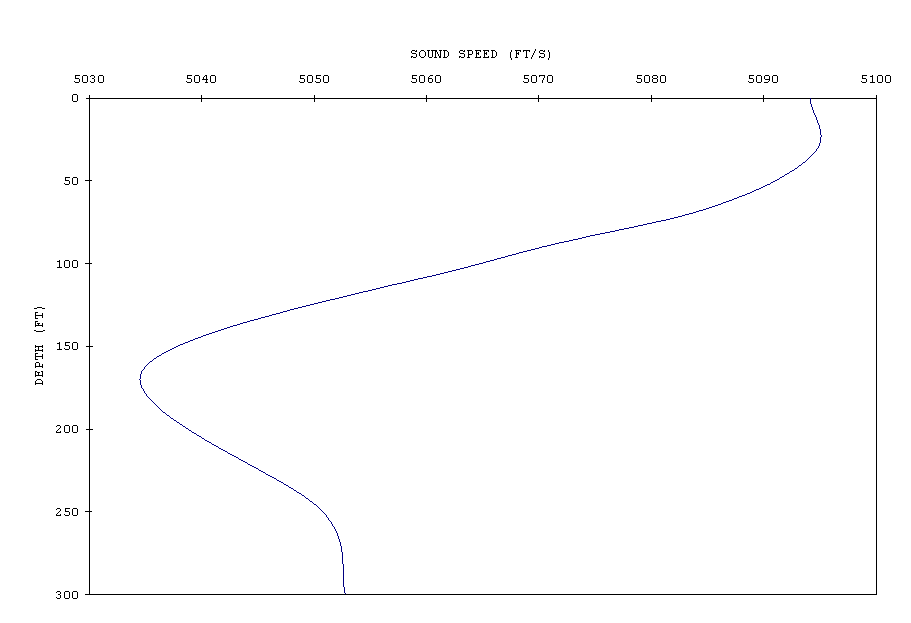
Table 3.2.5-3 Deep Water SVP Data
|
Depth (ft) |
Temperature (° F) |
Sound Speed (ft/s) |
|
0 |
80.98 |
5094.1 |
|
33 |
80.96 |
5094.5 |
|
66 |
78.5 |
5085.3 |
|
98 |
73.9 |
5065.9 |
|
164 |
67.1 |
5034.8 |
|
250 |
70.25 |
5050.8 |
|
300 |
70.48 |
5052.8 |
Table 3.2.5-4. Shallow Water Environment
|
ENVIRONMENTS |
PARAMETERS |
TYPICAL |
RANGE |
|
Sea Conditions |
Current (Surface) |
1.0 knots |
0 to 3 knots |
|
Wind Speed |
13 knots |
5 to 19 knots |
|
|
Sea State* |
2.9 |
1 to 4 |
|
|
Physical |
Temperature (Surface) |
67 ° F (19.3 C) |
28 to 95 ° F (-2 to 35 C) |
|
Salinity |
34 ppt |
31 to 41 ppt |
|
|
Density |
63.9 lbm/ft3 (1.024 gm/cm 3) |
63.3 to 64.4 lbm/ft3 (1.015 to 1.032 gm/cm 3) |
|
|
Acoustic |
Sound Velocity |
5014 ft/s (1528 m/s) |
4890 to 5100 ft/s (1490 to 1555 m/s) |
|
Sound Velocity Profile |
See Figure 3.2.5-2 and Table 3.2.5-5 |
Strongly Negative, Slightly Negative, Isovelocity, or Slightly Positive |
|
|
Ambient Noise |
40 dB re 1 Pa |
30 to 50 dB re 1 Pa |
|
|
Volume Scattering Strength (VSS) |
-75 dB/m3 in layer |
-80 to -70 dB/m3 |
|
|
Bathymetry |
Bottom Type** |
9 (Medium Sand) |
4 to 15 |
|
Water Depth |
40 ft (12.2 m) |
40 to 200 ft (12 to 61 m) |
|
|
Slope |
0.5 degree |
0 to 4 degrees |
* World Meteorological Organization (WMO) Code (APL-UW TR-8907).
** APL-UW High Frequency Ocean Environment Acoustic Models TR-9407.
Figure 3.2.5-2 Shallow Water Environment Sound Velocity Profile.
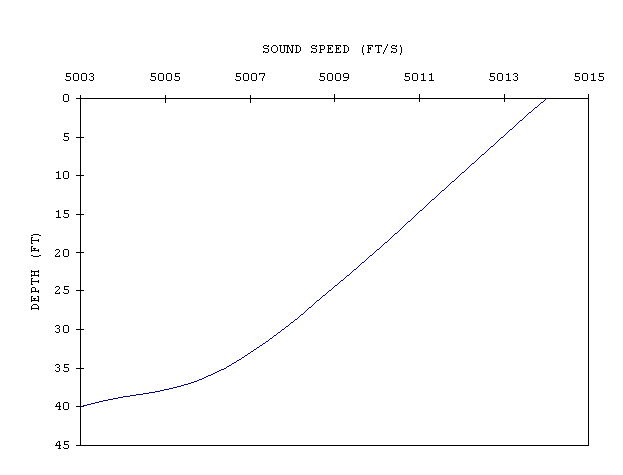
Table 3.2.5-5 Shallow Water SVP Data
|
Depth (ft) |
Temperature (° F) |
Sound Speed (ft/s) |
|
0 |
66.69 |
5014 |
|
33 |
65.96 |
5007 |
|
40 |
65.17 |
5003 |
3.2.5.13 Environmental Conditions Cross Reference Table.
Table 3.2.5-6. Environmental Conditions Cross-Reference Table
|
State Name |
Transportation |
Shore |
Submarine Deployed |
Launch and Recovery |
In-Water |
||||||||
|
Truck |
Rail |
Ship |
Aircraft |
Uncontrolled |
Controlled |
Vehicle |
|||||||
|
Storage |
X |
X |
X |
X |
|||||||||
|
Shore Maintenance |
X |
X |
X |
X |
|||||||||
|
Ready for Fleet Issue |
X |
X |
X |
X |
X |
X |
|||||||
|
Installation and Checkout |
X |
X |
X |
||||||||||
|
Pre-Launch |
X |
||||||||||||
|
Launch |
X |
X |
|||||||||||
|
Mission Execution |
X |
||||||||||||
|
Rendezvous |
X |
||||||||||||
|
Recovery |
X |
X |
X |
||||||||||
|
Post Sortie |
X |
||||||||||||
|
Off-Load |
X |
X |
|||||||||||
3.2.6 Transportability. LMRS shall be transportable by commercial and military marine, rail, truck or air vehicles. LMRS shall be capable of emergency flyaway on the C-17 (Globemaster) aircraft, such that a single C-17 can be used to fly the LMRS assets necessary to support installation and checkout. As a goal, or objective requirement, LMRS shall meet the above requirement, but with the C-130 (Hercules) aircraft.
3.2.7 Portability. The LMRS UUVs, SDE, and installation-support portions of NSE shall withstand frequent transportation, I&CO, and Off-Load cycles. Items which require frequent transportation shall be packaged in ruggedized reusable shipping containers with appropriate handles and lifting pads. Packaged items to be hand carried shall have a mass of 50 lb. (23 kg) or less.
In the I&CO and Off-Load states, the SDE and UUV shall be able to pass through a SSN 688/688I/NSSN class weapons shipping hatch. The UUV and SDE shall be compatible with existing SSN 688/688I/NSSN class weapons shipping and handling equipment, including dockside cranes and forklifts, and existing torpedo handling equipment (within the torpedo room). The non-water proof portions of the SDE shall be easily divisible into units which, with the appropriate protective covers/cases, shall be able to pass through a submarine weapons shipping hatch. The existing weapon shipping hatch clearance envelope (SSN 688) is defined in NAVSEA Drawing H53711-5337121. The NSSN shipping hatch envelope is defined in NAVSEA Drawing H547-2001. The torpedo tube interface for the 688/688I class submarine is defined in NAVSEA Documents SW-395-AA-IFM-010/SWIM-1 and SW-395-AA-IFM-020/SWIM-2. The torpedo tube for the NSSN is defined by NAVSEA Drawing H821-0011.
3.3 Design and Construction. LMRS shall be designed as a carry-on/carry-off system. LMRS shall be designed for economy of operation consistent with the requirements for reliability and maintainability for a service life of at least 20 years.
Alterations that affect weapon capabilities shall be such that, in an emergency situation, the submarine can be converted back to full weapon launch capability while underway. LMRS shall be designed to support conversion back to full weapon launch capability in 60 minutes/30 minutes, not including the time to jettison or recover equipment which interferes with weapon launch, and not including the time required for recertification/testing of any SUBSAFE boundary impacted by the conversion. Any OPALT/TEMPALT to the existing weapon launch system or its components shall maintain the existing weapon launch capabilities.
3.3.1 Materials. The materials used in the fabrication of LMRS shall be of a quality consistent with the performance and environmental requirements of this specification.
3.3.1.1 Toxic Products and Formulations. Toxic products and formulations such as volatile organic compounds shall not be used in the design and construction of the LMRS unless specifically allowed by NAVSEA S9070-AA-MME-010/SSN/SSBN. During the Shore Maintenance state, LMRS shall not expose personnel to toxic substances in excess of the threshold limit values IAW ACGIH ISBN 0-936-712-39-2. Ozone Depleting Chemicals shall not be used in the design, construction, operation, maintenance and support of the LMRS.
3.3.1.2 Parts, Materials and Processes. Parts, materials, and processes used in the fabrication of the LMRS system shall be of a quality consistent with the proposed use and environmental requirements. Commercial Off the Shelf (COTS) and Non-Developmental Items (NDI) are encouraged and shall be used when such products meet program requirements and are cost-effective over the entire system life cycle.
3.3.2 Electromagnetic Radiation. The LMRS shall be designed to achieve electromagnetic compatibility (EMC) among all subsystems and equipment within the system and with the submarine environment. The LMRS subsystems and equipment shall conform to NAVSEA S9070-AA-MME-010/SSN/SSBN.
3.3.3 Nameplate and Product Marking. Nameplate and product markings of subsystems, Lowest Repairable Units (LRUs), and components shall be IAW best commercial practices.
3.3.4 Workmanship. General workmanship shall be IAW best commercial practices.
3.3.5 Interchangeability. For like assemblies, all essential parts including removable units, maintenance parts, and other parts shall be interchangeable physically, electrically, and with corresponding circuits and component parts.
3.3.6 Safety. LMRS shall be designed for safety of the submarine, its crew, and all personnel involved in shipping, loading and handling, operation, and maintenance of the system. LMRS shall meet the safety requirements of NAVSEA S9070-AA-MME-010/SSN/SSBN. No single point of failure or human error shall lead to initiation of a Category I hazard (Catastrophic - defined as death, system loss, or severe damage) or Category II hazard (Critical - defined as severe injury, severe occupational illness, major system or environmental damage). Two or more independent faults, which may result in a Category I or II hazard, shall not be permitted unless their total probability of occurrence is less than or equal to 1 X 10
-6.3.3.6.1 Operational Safety. UUV and SDE design shall minimize the occurrence of potential mishaps or hazards throughout the operational life of the system. Hazards include, but are not limited to: inadvertent or premature propulsor initiation; inadvertent release of stored energy; inadvertent release of hazardous or toxic materials; and inability to execute a commanded shutdown.
3.3.6.2 Safety Status Monitoring. SDE shall have the capability to monitor the safety status of LMRS subsystems and LMRS UUV (when the UUV is in proximity or onboard the SSN) and report it to the ship's force and cadre.
3.3.6.3 Depth Exclusion. LMRS shall have the capability to program and abide by operating ceilings, floors, and exclusion areas for the UUV.
3.3.6.4 Submarine Emergency Operations. SDE that limit submarine maneuverability or weapon capabilities shall be capable of emergency jettison or retrieval in 5 minutes or less.
3.3.6.5 Energy System. Battery charging subsystems, if installed, shall have built-in protection from overcharging, thermal runaway, and cell reversal. Lithium batteries, if included in the LMRS design, shall meet the requirements of NAVSEA S9310-AQ-SAF-010. All energy systems, which include non-inert components that operate at temperatures higher than 212 ° F (100 C), shall employ buffer batteries or other techniques to prevent that component being at temperatures higher than 212 ° F (100 C) during any state other than Mission Execution or Rendezvous. Systems which use molten metal or molten salts shall be designed such that they leave the submarine with all of the molten metal or salt in the solid state and return to the submarine with all of the molten metal or salt and products in the solid state.
3.3.6.6 Electrical Safety. Electrical system design shall be IAW the shipboard safety requirements of NAVSEA S9070-AA-MME-010/SSN/SSBN.
3.3.6.7 Implosion. LMRS shall be designed to preclude a catastrophic structural failure and implosion of the UUV and/or implodable portion of the SDE in the proximity of the submarine. The implodable structure (UUV and/or SDE as applicable) shall be designed to withstand a hydrotest at a factor (typically 1.1, 1.5, or 2.0) times the SSN test depth IAW NAVSEA S9070-AA-MME-010/SSN/SSBN. The factor (1.1, 1.5, 2.0) will be approved by NAVSEA and will depend on the size, material, type or construction, and level of analysis and traceability for the implodable volume.
Cathode ray tubes, and similar devices, shall be designed to preclude hazardous implosions or flying glass fragments in the event of an impact on the face shield.
3.3.6.8 Explosive Safety. Electro-Explosive Device(s) (EED), if used in the LMRS design, shall meet the requirements of NAVSEA S9070-AA-MME-010/SSN/SSBN.
3.3.6.9 SUBSAFE. Alterations to the submarine shall meet the SUBSAFE requirements of NAVSEA S9070-AA-MME-010/SSN/SSBN.
3.3.6.10 Hazards of Electromagnetic Radiation to Ordnance (HERO). The LMRS shall meet the requirements of NAVSEA S9070-AA-MME-010/SSN/SSBN, if explosives are used.
3.3.7 Human Engineering. LMRS shall be designed, and NDI equipment selected, to provide work environments which foster effective procedures, work patterns, and personnel safety and health, and which minimize factors which degrade human performance or increase error. The design shall be such that operator workload, accuracy, time constraints, mental processing and communication requirements do not exceed operator capabilities.
3.3.8 Nuclear Control. Not Applicable.
3.3.9 System Security. LMRS security shall be IAW the Security Classification Guidelines, CNO Ltr Ser 87/6U660409 of 7 Mar 96.
3.3.10 Government-Furnished Property Usage. TBD
3.3.11 Computer Resource Reserve Capability. LMRS computer processor utilization on a system basis, for both throughput and input/output, shall have a reserve capacity of at least 50 percent at full operational loading (i.e. average utilization not greater than 66%). The memory associated with each of the LMRS computer processors shall have a reserve capacity of at least 50 percent. The memory reserve capacity shall be measured at the peak memory loading of the computer resource during its operation.
3.3.12 Environmental Protection. LMRS shall be in compliance with the National Environmental Policy Act (NEPA).
3.3.13 Pollution Prevention. LMRS shall be designed to minimize pollution associated with fabrication, operation, maintenance, or disposal.
3.4 Deleted.
3.5 Logistics.
3.5.1 Maintenance.
3.5.1.1 On-board Maintenance. On-board maintenance shall be performed on board the submarine, in the Pre-Launch state, by LMRS cadre or ship's force. On-board maintenance shall be minimized and shall consist of only those preventive and corrective actions necessary to meet the system performance requirements specified in section 3.2. UUV maintenance shall be limited to activities external to the UUV pressure hull(s), UUV hull section replacement, and electrical recharging. Maintenance activities shall be accomplished using SDE or other submarine equipment.
3.5.1.2 Shore Based Maintenance. Shore based maintenance shall consist of those preventative and corrective actions necessary to meet the system performance requirements. These maintenance activities shall be performed at a contractor operated shore maintenance facility. Shore maintenance shall consist of comprehensive (functional and diagnostic) system tests and inspections, replacement of assemblies and components, repairs beyond those specified in section 3.5.1.1, and any additional actions necessary to place the system in the RFI state. NSE, or existing equipment may be used, whichever is most cost effective over the entire life cycle of LMRS, to meet the requirements of this specification.
3.5.2 Packaging, Storage, Handling and Transportation. LMRS shall be transportable as specified in section 3.2.6. LMRS shall be stored, handled, and transported in containers or packaging appropriate for the level of assembly. Shipping containers for the RFI and Storage states shall be sealed and inert as required to prevent deterioration or damage. On-board storage containers for SDE, carry aboard spares, and tools shall interface with existing weapons stows in the torpedo room. To the maximum extent possible, handling apparatus (i.e., cranes, lifting bars, dollies, etc.) and containers shall be standard equipment existing in the federal inventory.
3.5.3 Facilities. LMRS shall utilize existing facilities to the maximum extent possible.
3.5.4 Support & Test Equipment. The LMRS support and test equipment functions shall be met via selected use of commercial NDI/COTS items, Built-In-Test (BIT), and Built-In-Test-Equipment (BITE), consistent with the requirement to provide the most cost effective solution possible over the entire life cycle of LMRS.
3.5.5 Standardization. New, unique, or non-standard items shall not be used except when cost savings are demonstrable.
3.6 Personnel & Training.
3.6.1 Personnel. The LMRS will be operated by a select cadre and augmented by ship’s force. No new military occupational skills shall be required in order to deploy, operate, or maintain LMRS. LMRS cadre size shall be minimized to the maximum extent which is cost effective and is consistent with the requirements of OPNAVINST 3000.13A. LMRS shall not require a cadre of greater than 8 persons per system. On-Board operation and maintenance tasks for LMRS shall not require skill levels greater than the equivalent of those currently available onboard a submarine. Shore Maintenance functions shall be performed at the contractor’s facility or at a government facility; the personnel skill levels required shall not be significantly different that what is available at an Intermediate Maintenance Activity (IMA) or Depot.
3.6.2 Training. The training necessary for Cadre and maintenance personnel to perform their required tasks shall be established by the contractor based on personnel skill requirements and critical tasks identified through the design process. A Navy Training Systems Plan (NTSP) will document the requirements for training devices/embedded training/interactive courseware as outlined in OPNAVINST 1500.8M.
3.7 Characteristics of Subordinate Elements. Not Applicable.
3.8 Precedence. Tradeoffs or conflicting requirements arising within this specification shall be addressed in the following order of priority: submarine safety; mission performance, program schedule; program affordability; and other performance characteristics.
4.0 QUALITY ASSURANCE PROVISIONS
LMRS acceptance shall be by testing. Requirements of the specification shall be met after acceptance. Conformance to all requirements specified herein will be verified by inspection, analysis, demonstration, test, or a combination of these methods.
4.1 Responsibility for Verification. The contractor shall be responsible for verifying conformance to all requirements of this specification. The Government reserves the right to independently verify conformance to any and all specified requirements.
4.2 Special Tests and Examinations. Verification methods are as follows:
Inspection (I) consists of examining drawings or equipment to verify conformance to drawings, specifications, and other pertinent design data processes and procedures. Inspection is generally non-destructive and includes (but is not limited to visual examination, simple physical manipulation, gauging, and measurement).
Analysis (A) consists of mathematical solutions, study-type comparisons or studies of test data to form logical conclusions. Specifications, drawings, engineering and test data, and other related data are used. Mathematical simulations are considered an analytical tool.
Demonstration (D) consists of readily observable and functional operations that allow limited, partial, or incremental determination of compliance with requirements.
Test (T) is the systematic collection of data under a measured environment with predefined conditions. The data are used to verify that the specified requirements are met.
Combinations of methods are acceptable when cost effective, or when the maturity of the system precludes full verification by a single method. For example: some environments applicable to the Mission Execution State may not be readily available. In such a case, verification by Tests alone may be prohibitively expensive. Therefore, Analyses supported by what data are available from in-water tests is more cost effective.
4.3 Requirements Cross Reference. Methods for verifying specification requirements are summarized in Table 4.3-1. These verification methods are subject to modification and are provided for guidance at this time.
Table 4.3-1 Requirements Cross Reference Table.
|
Quality Assurance Method |
||||
|
Section 3 Requirement |
Inspection |
Analysis |
Demonstration |
Test |
|
3.2.1.1 Storage State |
X |
|||
|
3.2.1.2 Shore Maintenance State |
X |
X |
||
|
3.2.1.3 RFI State |
X |
X |
||
|
3.2.1.4 I&CO State |
X |
X |
X |
|
|
3.2.1.5 Pre-Launch State |
X |
X |
X |
|
|
3.2.1.6 Launch State |
X |
X |
X |
X |
|
3.2.1.6.1 EOR Function |
X |
X |
||
|
3.2.1.7 Mission Execution State |
X |
X |
X |
X |
|
3.2.1.7.1 Detection, Localization, and Discrimination |
X |
X |
X |
X |
|
3.2.1.7.2 Classification |
X |
X |
X |
X |
|
3.2.1.7.3 Communication |
X |
X |
X |
X |
|
3.2.1.7.4 Navigation |
X |
X |
X |
|
|
3.2.1.7.5 Vehicle Performance |
X |
X |
X |
X |
|
3.2.1.8 Rendezvous State |
X |
X |
||
|
3.2.1.8.1 Navigation and Transit |
X |
X |
X |
|
|
3.2.1.8.2 Communication |
X |
X |
X |
X |
|
3.2.1.9 Recovery State |
X |
X |
X |
X |
|
3.2.1.9.1 Homing and Docking Phase |
X |
X |
X |
X |
|
3.2.1.9.2 Towing Phase |
X |
X |
X |
X |
|
3.2.1.9.3 Retrieval Phase |
X |
X |
X |
X |
|
3.2.1.9.4 Backhaul Phase |
X |
X |
X |
X |
|
3.2.1.9.5 Communications |
X |
X |
X |
|
|
3.2.1.10 Post Sortie State |
X |
X |
X |
|
|
3.2.1.11 Off-Load State |
X |
X |
X |
|
|
3.2.2 Ext. Interfaces |
X |
X |
||
|
3.2.2.1 Range Tracking |
X |
X |
||
|
3.2.2.2 Craft Interface |
X |
X |
||
|
3.2.3 Physical Characteristics |
X |
X |
||
|
3.2.3.1 Coatings |
X |
|||
|
3.2.3.2 UUV Physical Characteristics |
X |
X |
||
|
3.2.3.3 SDE Physical Characteristics |
X |
X |
||
|
3.2.3.3.1 Launch and Recovery |
X |
X |
||
|
3.2.3.3.2 Command and Control |
X |
X |
||
|
3.2.4.1 Reliability |
X |
X |
||
|
3.2.4.1.1 System Mission Reliability |
X |
X |
||
|
3.2.4.1.2 System Sortie Reliability |
X |
X |
||
|
3.2.4.2 Maintainability |
X |
X |
X |
|
|
3.2.4.3 System Sortie Launch Availability |
X |
X |
||
|
3.2.5 Environmental Conditions |
X |
X |
||
|
3.2.5.1.1 Submarine Critical Shock Env. |
X |
X |
X |
X |
|
3.2.5.1.2 Non-Sub. Crit. Shock Env. |
X |
X |
||
|
3.2.5.2 Storage Env. |
X |
|||
|
3.2.5.3 Shore Maintenance Env. |
X |
|||
|
3.2.5.4 RFI Envir. |
X |
|||
|
3.2.5.5 I&CO Envir. |
X |
|||
|
3.2.5.6 Pre-Launch Environment |
X |
|||
|
3.2.5.7 Launch Env. |
X |
|||
|
3.2.5.8 Mission Env. |
X |
|||
|
3.2.5.9 Rendezvous Environment |
X |
|||
|
3.2.5.10 Recovery Env. |
X |
|||
|
3.2.5.11 Post-Mission Environment |
X |
|||
|
3.2.5.12 Off-Load Env. |
X |
|||
|
3.2.6 Transportability |
X |
|||
|
3.2.7 Portability |
X |
|||
|
3.3 Design and Construction |
X |
|||
|
3.3.1 Materials |
X |
|||
|
3.3.1.1 Toxic Product and Formulations |
X |
|||
|
3.3.1.2 Parts, Mat., and Processes |
X |
|||
|
3.3.2 Electromagnetic Radiation |
X |
X |
||
|
3.3.3 Nameplates and Product Markings |
X |
|||
|
3.3.4 Workmanship |
X |
|||
|
3.3.5 Interchangeability |
X |
|||
|
3.3.6 Safety |
X |
X |
||
|
3.3.6.1 Operational Safety |
X |
X |
||
|
3.3.6.2 Safety Status Monitoring |
X |
X |
X |
|
|
3.3.6.3 Depth Exclusion |
X |
X |
X |
|
|
3.3.6.4 Submarine Emergency Operations |
X |
X |
X |
X |
|
3.3.6.5 Energy Systems |
X |
X |
X |
|
|
3.3.6.6 Electrical Safety |
X |
|||
|
3.3.6.7 Implosion |
X |
X |
X |
X |
|
3.3.6.8 Explosive Safety |
X |
X |
||
|
3.3.6.9 SUBSAFE |
X |
X |
X |
X |
|
3.3.6.10 HERO |
X |
X |
||
|
3.3.7 Human Engineering |
X |
X |
||
|
3.3.9 System Security |
X |
|||
|
3.3.11 Computer Resource Reserve Cap. |
X |
X |
||
|
3.3.12 Envir. Protect. |
X |
|||
|
3.5.1.1 On-Board Maintenance |
X |
X |
||
|
3.5.1.2 Shore Based Maintenance |
X |
|||
|
3.5.2 Packing, Stor., Handling, & Trans. |
X |
X |
||
|
3.5.3 Facilities |
X |
|||
|
3.5.4 Support and Test Equipment |
X |
|||
|
3.5.5 Standardization |
X |
|||
|
3.6.1 Personnel |
X |
X |
||
|
3.6.2 Training |
X |
X |
||
5.0 PREPARATION FOR DELIVERY
5.1 Packaging. LMRS shall be packaged in such a manner as to ensure the system meets the requirements of this specification after transportation.
5.2 Marking. All LMRS packages and containers shall be marked to identify the contents, and may include any special markings required by carrier. All packages and containers shall be marked to include the contract number and total number of pieces. Items that require special treatment or handling shall be so marked on the exterior and interior of the package and containers.
6.0 NOTES
6.1 Intended Use. LMRS shall facilitate SSN, Battle Group, and Amphibious Operations by conducting remote reconnaissance of potentially mined waters, reliably detecting close-tethered, bottom, and volume MLOs, and providing location information to aid tactical decisions.
6.1.1 Missions. There are no additional mission-unique requirements for LMRS. LMRS operations will be such that the tactics, system deployment, operating locations, and facilities are compatible with the requirements of this specification.
6.1.2 Threat. LMRS shall detect, localize, discriminate, and classify the mine threats summarized in Appendix A, section 10.1. The LMRS mine threat includes volume, close-tethered, and proud bottom mines. LMRS is not required to detect, discriminate, or classify buried MLOs.
6.2 Acronyms.
A
L Launch AvailabilityACR Area Coverage Rate
ASW Anti-Submarine Warfare
BRU Basic Replaceable Unit
C
3I Command, Control, Communication and IntelligenceCASS Consolidated Automatic Support System
CEP Circular Error Probable
CM Corrective Maintenance
COTS Commercial Off-the-Shelf
EED Electro-Explosive Devices
EMC Electromagnetic Capability
FL Fault Localization
H&D Homing and Docking
HERO Hazards of Electromagnetic Radiation to Ordnance
I&CO Installation and Check-Out
IAW In Accordance With
IMA Intermediate Maintenance Activity
LRU Lowest Replaceable/Repairable Unit
L&R Launch and Recovery
MLO Mine Like Objects
MPA Mine Position Accuracy
MP&P Mission Preparation and Planning
NDI Non-Developmental Item
NEPA National Environmental Policy Act
LMRS Long-Term Mine Reconnaissance System
NOMBO Non-Mine Bottom Object
NSE Non-Deployed Shorebased Equipment
NSSN New Attack Submarine
OBT On-Board Training
OPALT Operational Alteration
Pcc Probability of Correct Classification
Pcd Probability of Correct Dismissal
Pd Probability of Detection
PEO-USW Program Executive Office for Undersea Warfare
PM Preventive Maintenance
PMS403 Unmanned Undersea Vehicle Program Management Office
RDS Reconnaissance Data Set
RFI Ready for Fleet Issue
RM&A Reliability, Maintainability and Availability
RSF Reconnaissance Summary File
SDE Shipboard Deployed Equipment
SDS Sortie Data Set
SSF Sortie Summary File
SSN Ship, Submarine, Nuclear, Fast Attack
SVP Sound Velocity Profile
TAC Total Area Coverage
TBD To Be Determined
TEMPALT Temporary Alteration
UUV Unmanned Undersea Vehicle
VSR Vehicle Sortie Reach
6.3 Definitions.
ACR, Area Coverage Rate. The Total Area Covered (TAC) divided by the fractional number of days (duration in hours divided by 24 hours) required to complete the system’s mission cycle.
A
L, Launch Availability. The probability that the UUVs and SDE can successfully initiate any Launch state when called upon.CEP, Circular Error Probable. Probability of greater than or equal to 50% that the estimated position will fall within a circle of a particular size around the true position.
Classification. Classification applies to the side look or classification sensor, and is the process of determining that a discriminated target is in fact an MLO (i.e. is in fact either an actual mine, or a Non-Mine Bottom Object). Classification includes the determination that the target strength, physical dimensions, and shape of the target are consistent with the threat mines.
Detection. The process of determining that a target, i.e. a sonar return that exceeds a threshold, is present.
Discrimination. The discrimination function applies to the forward look, or search sensor, and is the process of determining that a target has the characteristics of a MLO. Targets discriminated as mine like (mine like targets) are stationary with respect to the bottom and have target strength and extent consistent with a threat mine. For non-bottom objects, discrimination also includes the determination of the approximate altitude of the target. All volume objects, which have appropriate target strength and are stationary, are discriminated as MLOs.
Extent. The extent of an object is an approximate size estimation, and usually has only one dimension. Extent applies to the detection sensor (discrimination function) and is usually the downrange dimension (i.e. "extent") of the object (detection sensors usually do not have sufficient cross range resolution to determine size in any other dimension or shape of the target).
False Alarm. False alarm applies to the search sensor and is an indication of a detected target when a target is not present.
H&D, Homing and Docking. A phase which occurs during the Recovery State.
I&CO, Installation and Check-Out. A state during which the LMRS shall be installed and checked to verify correct installation.
Identification. The process of determining, with high probability, that an MLO is in fact a mine. (Not an LMRS requirement.)
LMRS, Long-Term Mine Reconnaissance System. A submarine installed, UUV based, clandestine mine reconnaissance system, planned to replace and significantly improve the NMRS.
Mine Reconnaissance. (Exploratory Mine Reconnaissance). An MCM operation with the objective of determining if mine-like objects are present. If mine-like objects are present, the second objective of exploratory mine reconnaissance is to determine safe routes or operating areas around the potential minefields. Exploratory mine reconnaissance encompasses the detection and classification processes of mine reconnaissance.
Mission Critical Parameters. UUV settings (presets) which include information that may expose or allow enemy insight or exploitation of: a) the past, current, or future operating location of the SSN; b) the location(s) of reconnaissance operations; or c) potential future military activities or intentions.
Mission Cycle. The period of time from the start of the first Launch State to the end of the last Recovery State, including downtime between sorties.
MLO, Mine Like Object. Objects which appear to be mine-like based upon the fact that the target strength, dimensions, and shape of the object are consistent with the threat mines. MLOs could either be Mines or Non-Mine Bottom Objects.
NMRS, Near-Term Mine Reconnaissance System. A stop-gap, submarine installed, UUV based, clandestine mine reconnaissance system, currently under development, with a scheduled IOC in FY98, and a service life of 6 years.
NOMBO, Non-Mine Bottom Object. A NOMBO is an object which has the target strength, dimensions, and shape nominally consistent with threat mines, but is in fact not a mine.
NSSN, New Attack Submarine. A new class of SSNs currently under development. The planned IOC for NSSN is approximately the same as the planned IOC for LMRS.
Pcc, Probability of Correct Classification. Pcc applies to the classification sensor function is the probability that an MLO (either a Mine or a NOMBO) will be classified as such.
Pcd, Probability of Correct Dismissal. Pcd applies to the classification sensor function and is the probability that a non-MLO will be classified as a non-MLO.
Pd, Probability of Detection. Pd applies to the search sensor detection function and is the probability that a target, consistent with an MLO, is detected.
Pfa, Probability of False Alarm. Pfa applies to the search sensor detection function and is the probability that a detection is indicated when a target is not present.
Reconnaissance. Inspection or exploration of an area, especially one made to obtain military intelligence.
RDS, Reconnaissance Data Set. A set of files created and maintained by the SDE, which integrates the SDS information from all of the sorties.
RSF, Reconnaissance Summary File. A file created and maintained by the SDE, which integrates the SSF information from all of the sorties.
SDS, Sortie Data Set. A set of files created and maintained on the UUV, which includes all of the sortie data. The SDS includes, the vehicle track, the locations of all the MLOs encountered, and the characteristics MLOs encountered, all valid classification images (side look classification sensor displays), and all valid discrimination images (forward look search sensor displays).
SSF, Sortie Summary File. A file created and maintained on the UUV, which includes a subset of the sortie data. The SSF includes, the vehicle status and track, the locations of MLOs encountered, and the characteristics of the MLOs encountered. The SSF is the file that is periodically transmitted to the SSN.
SSN 688. A class of SSNs currently in the fleet, commencing with hull 688 and including 688-721, and 751-773.
SSN 688I. The improved version of the SSN 688 class, commencing with hull 751.
TAC, Total Area Coverage. The summation of area reconnoitered by six individual sorties, not including any coverage overlaps, when the UUV travels at 4 knots (through the water), conducting mine search operations 100% of the time, mine classification operations 15% of the time, with a 5 nm transit to and from the reconnaissance area, and with a 10% energy reserve in the UUV after each recovery.
VSR, Vehicle Sortie Reach. The maximum radial distance the UUV can travel from a starting point, and return to that point, while conducting mine search operations 100% of the time both ways, mine classification operations 15% of the time both ways, and have a sufficient energy reserve for an additional 5 nm transit to and from that point, with a 10% energy reserve after UUV recovery.