 e-Printse-Prints
COMMAND DYSFUNCTION:
MINDING THE COGNITIVE WAR
BY
ARDEN B. DAHL
A THESIS PRESENTED TO THE FACULTY OF
THE SCHOOL OF ADVANCED AIRPOWER STUDIES
FOR COMPLETION OF GRADUATION REQUIREMENTS
SCHOOL OF ADVANCED AIRPOWER STUDIES
AIR UNIVERSITY
MAXWELL AIR FORCE BASE, ALABAMA
JUNE 1996
Disclaimer
The conclusions and opinions expressed in this document are those of the author. They do not reflect the official position of the US Government, Department of Defense, the United States Air Force, or Air University.
ABOUT THE AUTHOR
Major Arden B. Dahl was commissioned through the United States Air Force Academy in 1982. Graduating from undergraduate pilot training in 1983, he went on to fly A-10s at RAF Woodbridge, United Kingdom; Suwon AB, Republic of Korea; and England AFB, Louisiana. Following a staff duty assignment at Air Combat Command, he attended Air Command and Staff College and the School of Advanced Airpower Studies at Maxwell AFB, Alabama. Major Dahl is a senior pilot with 2500 flying hours, and a graduate of the A-10 Fighter Weapons Instructor Course. He has a bachelor’s degree in Engineering Physics from the United States Air Force Academy. Major Dahl's current assignment is to the 52nd Fighter Wing at Spangdahlem AB, Germany.
ACKNOWLEDGMENTS
I would like to thank Dr Harold Winton, Major Bruce DeBlois, Dr George Gawrych and Dr David Jones for patiently offering ideas, advice and constructive criticism for this study. In addition, I want to thank Dr James Corum for taking the time to translate some German World War II documents.
I also want to express my appreciation to my wife, Marcia, and children, Rachel, Karin, Eric, Steven, and Pamela, for their patience during the writing of this paper.
ABSTRACT
This paper analyzes the factors and conditions of command dysfunction from the cognitive, or mental, perspective of command and control warfare (C2W). The author examines the limitations of rational decision making and the tension that exists between rational and intuitive processes. Next, the paper examines the vulnerabilities of rational and intuitive processes in order to build a cognitive warfare framework. The framework consists of three categories: the command baseline, stressors, and deception. The stressor and deception categories act on the command baseline. The analysis also suggests that there are a number of possible interactions that exist between the stressor and deception categories. The paper then uses the framework to analyze evidence of command dysfunction in three historical campaigns. The historical analyses study the German command during the Normandy invasion, the Allied command during the first week of the Battle of the Bulge, and the Israeli command during the first half of the Arab-Israeli October 1973 War. In addition to showing that there are interactions between stressors and deception, the analyses highlight the importance of understanding the adversary’s command baseline. The paper concludes that effective C2W is not so much what is done to an adversary’s command, but rather what he does to himself, perhaps with a little help.
CONTENTS
Chapter Page
DISCLAIMER................................................................................................................. ii
ABOUT THE AUTHOR.................................................................................................. iii
ACKNOWLEDGMENTS................................................................................................ iv
ABSTRACT.................................................................................................................... v
1 INTRODUCTION..................................................................................................... 1
2 DECISION PROCESSES.......................................................................................... 10
3 CONSIDERING A COGNITIVE WARFARE FRAMEWORK................................. 34
4 THE NORMANDY INVASION................................................................................ 51
5 THE BATTLE OF THE BULGE............................................................................... 71
6 THE OCTOBER 1973 WAR IN THE SINAI............................................................. 88
7 CONCLUSIONS AND IMPLICATIONS................................................................... 111
APPENDIX A: JANIS VIGILANT PROBLEM SOLVING APPROACH........................ 125
APPENDIX B: BIAS-DECEPTION RELATIONSHIPS.................................................. 126
APPENDIX C: WHALEY’S STRUCTURE OF DECEPTION......................................... 127
BIBLIOGRAPHY............................................................................................................ 129
Illustrations
Table
1 COMPARISON OF THE HISTORICAL STUDIES: STRESSORS........................... 113
Figure
1 THE CONSTRAINTS MODEL OF POLICY MAKING DECISION PROCESSES.. 26
2 THE OODA CYCLE................................................................................................ 35
3 COGNITIVE WARFARE APPROACHES.............................................................. 37
4 COGNITIVE WARFARE FRAMEWORK FOR C2W............................................. 45
5 ORDER OF BATTLE OF OB WEST, 6 JUNE 1944.................................................. 54
6 NORMANDY LODGMENT AND BREAKOUT...................................................... 57
7 C2W FRAMEWORK FOR NORMANDY PRIOR TO D-DAY................................ 63
8 C2W FRAMEWORK FOR NORMANDY AFTER D-DAY...................................... 64
9 GERMAN ARDENNES PLAN................................................................................. 74
10 C2W FRAMEWORK FOR THE ARDENNES.......................................................... 82
11 ADAN’S COUNTERATTACK--8 OCT 93............................................................... 92
12 C2W FRAMEWORK FOR THE ARAB-ISRAELI 1973 WAR--
PRIOR TO 6 OCTOBER........................................................................................... 104
13 C2W FRAMEWORK FOR THE ARAB-ISRAELI OCTOBER 1973 WAR,
6-8 OCTOBER........................................................................................................... 105
Chapter 1: Introduction
While fighting is a physical act, its direction is a mental process.
--B. H. Liddell Hart, Strategy
Command and control warfare attacks the exercise of authority and direction of the enemy commander. It has a long history. In the past, the fall of the national monarch or the commanding general on the field of battle could decide the battle and the fate of the kingdom. The failure sometimes resulted from the physical test of arms in combat, leading to a mortal wound. At other times the fall was psychological, brought about by the dislocation or disordering of the mind. The mechanisms in the latter cases were focused on the mind--caused by surprise, perhaps deception or a sense of losing control. This in turn led to faulty decisions. Whatever the mechanism, the ancients realized long ago that warfare was far less costly if one could disrupt the enemy’s decision making and induce a mental paralysis in the opposing camp.
Joint Publication 3-13.1, Joint Doctrine for Command Control (C2W), defines Command and Control Warfare (C2W) as a military application of information warfare intended for the attack and protection of command and control. The doctrinal definition follows:
C2W is the integrated use of psychological operations (PSYOP), military deception, operations security (OPSEC), electronic warfare (EW), and physical destruction, mutually supported by intelligence, to deny information to, influence, degrade, or destroy adversary C2 capabilities while protecting friendly C2 capabilities against such actions.
Stating it another way-- successful C2W execution enables a friendly commander to reason, decide and act faster and more accurately than the adversary in order to seize and maintain the initiative. The success of this, as emphasized by doctrine, depends on the synergistic integration of all C2W components.
C2W is applicable at all levels of command, from battlefield tactical execution to the strategic level of national military and political leadership. While the allied coalition dominated the electronic spectrum over the Iraqi army, the 1991 Desert Storm air campaign highlighted C2W at the strategic level--by attempting to isolate Iraq’s national leadership. Although it is not certain how effective these attacks were in coercing or degrading Saddam Huessein’s critical command arrangements, the potential of attacking an adversary’s strategic and operational decision makers has appeal. This appeal to focus C2W at the strategic level is fostering a maturing US strategic attack doctrine.
The Merging of Strategic Attack and C2W
According to joint doctrine, attacks against enemy strategic centers of gravity, if not decisive in their own right, are designed to "cause paralysis and destroy cohesion" throughout the enemy’s depth. Although the above term "paralysis" can apply just as well to the collapse of industrial economies and the degradation of transportation nets, it is particularly appropriate to describe C2W objectives directed against an adversary’s leadership. The paralysis objective, in the C2W context, suggests the effective breakdown of an adversary’s ability to sense, orient, decide, and communicate decisions to his operational forces. Of the five C2W elements, the roles for physical destruction and electronic warfare have significantly expanded with the use of long-range precision attack capabilities and the development of sophisticated electronic communications. Whether or not airpower adherents and particularly strategic attack advocates can rightfully claim primacy in the conduct of C2W, the question arises as to the balance of emphasis paid to the other, more psychological, components of C2W.
The problem of emphasizing direct attack C2W targeting is that it potentially underplays the complementary aspect of leadership degradation--the more indirect method of disrupting the enemy’s cognitive decision processes. This battle of the minds, if understood and exploited for advantage, can multiply the effects of destroying significant components of an adversary’s command and control systems. This phenomenon was anticipated by B. H. Liddell Hart: "the impression made on the mind of the opposing commander can nullify the whole fighting power his troops possess." The more prominent role of information management systems in battle, which are vulnerable to manipulation, creates new means to make impressions on the minds of opposing enemy commanders.
A Clarification of C2W Taxonomy: From Paralysis to Dysfunction
The term paralysis is commonly used to describe the desired effects of strategic attack and C2W. However, its wide use in professional military writings and doctrine to describe the demise of an adversary’s decision-making capability masks the true character of a complex phenomenon.
This study defines command paralysis in two components: the degradation of decision speed and decision accuracy. In terms of decision speed, the best case "paralysis" is the complete cessation of decision making. In terms of accuracy, the best case "paralysis" is the utterly mistaken appreciation of reality, regardless of decision speed. The issue here is that paralysis is not an "all or nothing" phenomenon--it occurs along a continuum of failure, from slight to total. The connotation of the term paralysis implies that command function is governed by an "on/off" switch. In actuality, it is governed by a rheostat. A further complicating factor is that the degradation of both speed and perception can occur simultaneously. This point has important implications for manipulating the adversary’s decision making. For example, a C2W strategy that attempts to re-mold an enemy commander’s perception of reality may need give to him plenty of time to think. The fundamental problem, then, is that the term paralysis, which possesses such strong connotations of totality, is patently inadequate to describe the wide range of possible degradations of command function that exist in the richly varied reality of war.
To resolve this conundrum, this paper will employ the term dysfunction, in lieu of the term paralysis. Dysfunction is defined as the abnormal, impaired, or incomplete functioning of a system. It presents a way to capture the "rheostat" nature of command impairment without either requiring or ruling out the possibility of complete stoppage or collapse. The chapters that follow will attempt to alleviate confusion as to the nature of command dysfunction by carefully specifying its types and magnitude in the context of particular circumstances.
Cognition is defined as the act of knowing or perceiving. It is the act of processing perceived sensory inputs to build knowledge and awareness in order to make judgments and decisions.
Dislocation is the act of displacing, disordering, or disarranging. As Liddell Hart noted, it can be applied both physically and psychologically.
The question this thesis seeks to answer is, what factors or conditions lead to command dysfunction? This question leads to a number of others. Are there various types or kinds of decision dysfunction? How does one produce and recognize command dysfunction? Answers to these questions will enhance our understanding of C2W opportunities, limitations and strategies.
Assumptions
The issue of command dysfunction will be addressed in the context of opposing command organizations exercising some form of command and control over conventionally armed forces.
A second assumption is that there is some common or generic set of factors or conditions that affect decision processes in general and military decision making in particular. A related assumption is that there will be individual, cultural and organizational factors that significantly influence specific decision making contexts.
The fourth assumption is that the findings of the behavioral sciences may provide some insight to the nature of decision making to include its defects and limitations. Finally, the study assumes that the insights drawn from behavioral science may be useful in sensitizing the historical examination of command dysfunction to certain categories of relationships.
A critical look at the preceding assumptions and the following chapters highlights some limitations to this examination. First, the cognitive sciences generally deal with universal human traits; however, much of the literature is written from the Western perspective. Conclusions must therefore be tempered in this light. The three historical studies, though varied in culture to include a Middle Eastern adversary, all involve Western "victims." The cases were selected because of their relevance to the issue of command dysfunction and the availability of credible evidence.
Another important limitation is the scope of dysfunctional factors developed into a cognitive warfare framework in Chapter 3. The scope focuses on cognitive weaknesses and tendencies of a rational military commander. It focuses less on the affiliative (political) and egocentric factors that greatly complicate decision processes and outcomes, although these can be significant. Because of this last limitation, the corroboration of dysfunctional factors and conditions upon decision making in the historical evidence may be masked or made inconclusive by the attributes of individual personalities, military traditions and specific organizational behavior. Finally, conditions of combat are not easily studied by the scientific disciplines.
Chapter 2 begins by describing the rational decision process as offered by, among others, James G. March, Herbert A. Simon and Graham T. Allison. The rational decision process produces optimal decisions and forms the underlying basis of normative decision making. Following this, the chapter will examine a number of limitations that degrade rational decision processes. These include the limitations of human information processing; perceptual and cognitive biases; and the effects of stress induced by consequential decisions, uncertainty and time pressure. We will also briefly examine the motivational, cultural and organizational factors that degrade rational decision processes.
The chapter continues with an examination of two decision models that attempt to describe and account for the limits and outcomes of nominally rational processes. The first is Irving L. Janis’ Constraints Model of Policy Making. The second is the Recognition-Primed Decision model developed by Gary A. Klein. Janis’ model imbeds a prescriptive rational process called Vigilant Problem Solving into the larger descriptive model. The larger model contains cognitive, political, and egocentric obstacles that must be overcome to employ the vigilant process. Klein’s model describes how experienced decision makers recognize problems and apply rapid solutions in high-tempo operational environments. Together, the models highlight the tension that exists in military decision environments, the tradeoff between decision accuracy and decision speed. This tradeoff nature of operational decision making will be explored further in Chapter 3.
The intention in Chapter 3 is to develop a framework for cognitive C2W. To begin, the chapter briefly examines John Boyd’s well known Observation-Orientation-Decision-Action ("OODA") Loop as a tool to illustrate the different ways a C2W campaign may address a notional adversary’s decision cycle. A review past and current C2W contributions from historical war theorists and 20th century deception theorists follows. The aim is to gather some insights for a cognitive C2W framework. The basis of this framework will flow from two areas. The first is the nature of a "target" decision process and its limitations, the insights gained from Chapter 2. The second area draws on the theories and methodologies of stratagem--the use of deception and surprise in warfare. Some consideration will also be offered as to the combined effects of deception and operational stress.
The following three chapters examine historical cases in an effort to determine if command dysfunction occurred, its form and extent, and the extent to which it was a factor in the outcome of the campaign. Each case will be analyzed in light of the cognitive warfare framework regarding the impact of the C2W campaign on the target decision makers. Chapter 4 examines the conduct of the German command at the time of the Normandy invasion. Chapter 5 analyzes the conduct of the Allied theater and operational commands in the events leading up to and during the Battle of the Bulge. Chapter 6 analyzes the problems that occurred within the Israeli command echelons before and during the initial stages of the October 1973 Arab-Israeli War.
Chapter 7 reviews the major conclusions of the historical studies for relevance to the cognitive warfare framework developed in Chapter 3. The analysis that follows will include necessary refinements to the cognitive warfare framework and comment on its general utility for analyzing and planning C2W campaigns. The chapter will conclude by noting implications for current C2W doctrine and suggested areas for future research.
Chapter 2: Decision Processes
Military operational commanders make decisions in a wide range of conditions. In peacetime, the scope and pattern of military decision making is not considerably different from that of the civilian sector. However, as the military decision maker transitions toward a combat environment, the conditions become more faster-paced, variable and consequential. The defining distinction is an organized opponent. The question that arises is how decision processes change from more "normal" settings to high-load, fast-paced, ambiguous, and opposed circumstances. This chapter examines that issue in view of rational decision processes, their inherent limitations and how they change in challenging decision settings.
There is good reason for this analysis. Military planning procedures generally follow rational or analytical decision making patterns. How military decision making adjusts or departs from these rational processes under high-load ambiguous operational environments may be important to the design of C2W.
Rational models are consequential and preference-based decision processes. They are consequential in that current decisions are based on expected outcomes. They are preference-based in that consequences are appraised in terms of rank-ordered criteria. Rational processes also follow a logic of consequence by seeking answers to four basic questions:
1. What are the possible alternatives?
2. What possible outcomes follow each alternative and how likely is each outcome?
3. How do the possible outcomes measure up to desired preferences?
4. What decision rule or rules are employed to select an alternative based on their outcomes and the decision maker’s preferences?
Simply put, a rational decision process surveys the environment for all solution strategies, determines their consequences and makes a comparative evaluation of these solutions and their consequences against one’s preferences. Given an intelligent conduct of the process, the rational or analytical approach establishes a prescriptive baseline for decisions. Operative military decisions fall into this category.
Limited rational models have attempted to account for a number of deviations. For instance, not all alternatives can be known, not all discernible alternatives are considered, preferences are inconsistently applied and decision processes do not necessarily simultaneously compare the solution set. The decision makers also bring a number of limitations to the decision environment. These common limitations have given rise to the idea of limited rationality.
The limited rational process generally follows the prescriptive logic of consequence while giving allowance to a variety of human limitations and coping mechanisms. The first limitation is the cognitive inability to handle large amounts of information. Specifically, decision makers have limited abilities to focus attention, remember, communicate, and comprehend large amounts of data. To cope, decision makers typically arrange incoming data into simplified models, stereotypes, typologies or schemas. Four of the information coping mechanisms are described below.
Editing or Elimination by Aspects: The decision maker screens problem data prior to reaching the choice stage by testing a small number of information cues. An example of this includes a sequential test of solution choices on a single dimension or factor--thus eliminating alternatives on the first pass before calling up data for other factors.
Decomposition: In this case, the decision maker breaks down a large problem into its component parts. This can be an effective coping mechanism if the individual sub-problems can be solved independently.
Pattern Recognition: The analyst searches for a recognizable pattern within the problem. If he identifies a familiar pattern, he applies an experience-based solution rule.
Framing: This coping mechanism structures problems into a particular set of beliefs and perspectives that constrain data collection and analysis. The framing usually narrows information search around local outcomes as opposed to issues further distant in effect. For example, an analyst may frame a solution for short run gains, disregarding long term consequences of the decision.
Related to the information coping mechanisms described above, decision makers also employ various cognitive decision rules to work through complex problems. These rules allow decisions in the face of incomprehensible problem issues and limited resources in which to conduct in-depth analysis. A few of these strategies are described below.
Satisficing: Instead of seeking an optimum solution, the decision maker selects the first fix that "is good enough." This provides a workable solution while limiting the expenditure of effort and resources. Standard Operating Procedures (SOPs) are commonly applied if applicable.
Analogizing: The decision maker compares the similarities of the current problem to a historical example. If appealing, the analyst models the problem solution on the historical case. This has a powerful appeal. However, often decision makers only compare the similarities between the two cases, potentially disregarding important dissimilarities.
Nutshell Briefing: This technique saves time and effort by getting an outside agent to look at the problem and brief it concisely in a "nutshell," upon which the decision maker then makes a choice.
Incrementalism: This rule purposely sticks fast to the last decision made about a particular problem. Decision makers make only small changes to alleviate the most pressing aspects of the issue.
Blurring with Statistics. This is the tendency to misuse or misinterpret statistical data to explain complex events or sustain preconceptions.
The above lists are not exhaustive, but they provide a representative sample of the kinds of strategies decision makers use to cope with inherent human information-processing limitations. The next section addresses the cognitive biases that operate alongside these coping mechanisms.
The Perceptual and Cognitive Biases within the Limited Rational Process
Perception and cognition perform distinct roles in the formation of judgment. Perception answers the question: What do I see? Cognition answers the next question: How do I interpret it? However, general perceptual and cognitive biases cause decision makers to deviate from objectivity and make errors of judgment. Perceptual biases occur from the way the human mind senses the environment and tend to limit the accuracy of perception. Cognitive biases result from the way the mind works and tend to hinder accurate interpretation. These biases are general in that they are thought to be normally present in the general population of decision makers--regardless of their cultural background and organizational affiliations.
The tendency is to view "perception" as a passive reception of data from one’s senses. However, perception is not passive. It is an active process of inference in which one builds reality from data input from the senses. We do not understand the mental process of perception with great certainty. We understand that it depends a great deal on one’s experience and background as well as the content of what one senses. There are three perceptual biases that affect the accuracy of one’s view of the environment: the conditioning of expectations, the resistance to change and the impact of ambiguity.
A decision maker’s experience forms the basis for expectations. The expectations predispose a "mindset" to look for certain data in the environment and organize it in a particular way. The mind also organizes various mental schemes to organize expectations. These include simple models, typologies, stereotypes and ready made "plots and narratives." One notable effect of the conditioned expectancy bias is that it takes more unambiguous data to discern an unexpected event than it takes to discern an event one expects.
Another systematic bias of perception is its resistance to change. The related effect is that once decision maker establishes a "mindset" or image, he will assimilate new information to that image. The implication is that it is difficult to detect small changes once one establishes a perception.
The last biasing factor considered is the impact of ambiguity on perception. Decision makers who form an initial but perhaps incorrect impression in the midst of high ambiguity usually need more pieces of unambiguous data to recognize that their initial "picture" is not correct. This relates to the bias of expectations and the bias that resists change to initial images. In effect, an analyst will persistently fit new information to the poor image until the contradiction becomes painfully obvious.
There are three primary areas in which cognitive biases degrade the accuracy of judgment within a decision process: the attribution of causality, the evaluation of probability and the evaluation of evidence.
Attribution of Causality: Although one can witness an event, one cannot in the same sense see the event’s causation--this must be inferred. Psychologically, the mind prefers to have events and causes ordered in a comprehensible pattern, a condition that biases the mind to find order in random or incomprehensible events. The bias causes decision makers to misread the motivational intent behind the action of their opponents. In other words, decision makers tend to overestimate the nature and intentions of other actors and disregard how external constraints affect those actions. Conversely, decision makers tend to analyze their own behavior as being constrained by the external environment and then project this view of themselves into the minds of other decision makers.
Estimation of Probability: Decision makers estimate outcome probabilities in order to make choices among solutions. Three systematic biases that affect this estimation are the availability, anchoring, and overconfidence biases.
The availability bias is a rule of thumb that works on the ease with which one can remember or recall other similar instances--the number of times that an event has occurred. The bias is not necessarily detrimental unless the ease in which an event comes to mind is influenced by its lingering emotional impact or recency--factors that are not necessarily related to the probability of its reoccurrence. Conversely, decision makers have difficulty appreciating the probability of unlikely events. Unlikely events are by definition rare, and thus not mentally available to most decision makers. This can lead to the underestimation of low probability events.
The anchoring bias is a phenomenon in which decision makers adjust too little from their initial judgments as additional evidence becomes available. After making an initial estimate, the bias causes decision makers to make changes within a narrow range of possibilities. The anchoring bias is related to the perceptual bias based on resistance to change.
The overconfidence bias is merely a tendency for individual decision makers to be subjectively overconfident about the extent and accuracy of their knowledge. Another way of saying this is that there is a tendency to overestimate certainty, or downplay uncertainty. The implication in this case is that even if a decision maker hedges his estimate, his high confidence will not encourage the effort to look again.
Other typical problems in estimating probabilities derive from the misunderstanding of statistics. For instance, analysts tend to "overestimate the probability of future-event scenarios constructed from a series of discrete and individually probable events." In other words, many decision makers are unaware of the low probabilities that exist at the end of a long decision tree made of a number of discrete assumptions.
Evaluation of Evidence: Decision makers may also prejudice the way they handle evidence. Generally, the first information a decision maker gets has greater impact than the data that arrive later. Oversensitivity to Consistency, Absence of Evidence and Persistence of Impressions biases describe various forms of this cognitive bias.
Normally consistency in data evaluation is appropriate. However, when very little evidence is available, decision makers tend to value consistent information from a small data set over more variable information from a larger sample. This Oversensitivity to Consistency bias leads decision makers to infer erroneous conclusions from the data, and is caused by the false notion that small and large samples have the same variability.
It is not unusual for decision makers to miss data in complicated problems. In an ideal setting, analysts would recognize that data is missing and adjust the certainty of their inferences accordingly. When this does not happen, it is usually the influence of the Absence of Evidence bias. Simply put, this bias translates to "out of sight, out of mind" and resists mental efforts to give much credit or probability to the "unknown" category.
The Persistence of Impressions bias follows a natural tendency to maintain first impressions concerning causality. It appears that the initial association of evidence to an outcome forms a strong cognitive linkage. The linkage is strong enough to subsequently make the same causal connection despite the presence of contradictory data. This bias appears to be related to the perceptual bias of conditioned expectations and the cognitive availability bias.
Thus far, the argument has established that a decision maker’s inability to process and analyze large amounts of data will limit his rational basis for decision making. Decision makers compensate by employing simple cognitive strategies and rules to sift information and make choices. These tools tend to be useful as long as the decision maker appreciates their limitations and simplifying nature. However, a number of perceptual and cognitive biases also influence the decision process, potentially reducing the rationality of judgment.
There are, however, even more decision factors that complicate the rational decision process. These are examined briefly below to gain an appreciation for how complex the decision environment can become for a military commander.
Organizational Limitations to the Limited Rational Process
A commander’s rational decision process is invariably affected by organizational and political processes both within and without his particular command. Insights into these organizational and political factors can be considered by examining two of the three models that Graham T. Allison developed to explain governmental behavior during the 1962 Cuban Missile Crisis. His second model attempts to describe how organizational processes affect the decision process and is referred to as Model II: Organizational Process. The third model describes how the pursuit of political power within an organization affects decision making; this model is referred to as Model III: Governmental Politics.
Allison Model II: Organizational Process
Allison’s Model II contains several propositions that describe how organizational processes can constrain a commander’s decision process. The first is that organizations run on standard operating procedures (SOPs) and programs. SOPs and programs (clusters of SOPs) are derived from established missions, doctrine, training and historical experience. These in turn produce a set of capabilities for the execution of particular operations. Organizational SOPs and programs are complex and do not lend themselves to rapid change or the flexible implementation of a wide range of options. A second proposition is that organizational SOPs structure both the search for information and the generation of alternatives. In short, Allison’s Model II suggests that the established procedures and capabilities of a military commander’s organization narrow his range of decision options. It may be that the rational choice among the alternatives is not feasible due to the inability of organizational programs to find or analyze the choice.
A third Model II proposition that influences rationality is the nature of the organization’s distribution of responsibility and power. Large complex organizations facing complex environments require a factored division of labor, attention and command authority to perceive and analyze, generate alternatives and execute decisions. While the division of labor and SOP specialization is intended to make the organization efficient, the same division generates requirements to coordinate the intelligent collection and analysis of data. The failure to coordinate the varied perceptions and interests within the organization can lead to a number of uncoordinated rational decisions at the lower echelons, which in turn lead to an overall irrational outcome.
Allison Model III: Bureaucratic Politics
Allison’s Model III views decision making as a process of political bargaining. The bargaining takes place between a number of actors, each whom views the decision issue differently depending on his own goals. Influence depends on a number of factors to include personal prestige and reputation, authority derived from one’s position, persuasive skills, knowledge of the bargaining rules, and personal interest in the decision. For a military commander, for whom the lines of command authority may be well defined (both up and down the chain), organizational discipline may temper the political bargaining that occurs. However, political and personal differences can paralyze even a disciplined organization. The problem is worse when command arrangements are ill-defined or inept. The struggle for power and influence can devastate can devastate the rational decision process.
Cultural and Individual Biases
Before moving on to external effects on the decision process, several cultural and individual biases need addressing. The first of these is cultural bias. Cultural dispositions toward perception are highly contextual and are therefore difficult to incorporate into a general C2W model. Nevertheless, there are two common cultural biases that deserve mention for their role in forming erroneous perceptions: arrogance and projection. Arrogance is the attitude of superiority over others or the opposing side. It can manifest as a national or individual perception. In the extreme case, it forgoes any serious search of alternatives or decision analysis beyond what the decision maker has already decided. It can become highly irrational. The projection bias sees the rest of the world through one’s own values and beliefs, thus tending to estimate the opposition’s intentions, motivations and capabilities as one’s own.
This section concludes with a final mention of three noteworthy and highly contextual motivational biases: risk-taking, overconfidence (hubris), and hubris-nemesis. The motivational bias of risk-taking is unlike the normal deliberation of calculated risk--the rational consideration of possible losses and gains in an uncertain environment. The decision maker motivated by the risk-taking bias gambles as a matter of personality--without considering costs and gains beforehand, or when the risks are so ominous that a rational decision maker would not even consider the question. The overconfidence or hubris bias tends toward an overreaching inflation of one’s abilities and strengths. In the extreme it promotes a prideful self-confidence that is self-intoxicating and oblivious to rational limits. A decision maker affected with hubris will in his utter aggressiveness invariably be led to surprise and eventual downfall. The Hubris-Nemesis Complex is dangerous mindset that combines hubris (self intoxicating "pretension to godliness") and nemesis ("vengeful desire" to wreak havoc and destroy). Leaders possessing this bias combination are not easily deterred or compelled by normal or rational solutions.
At this point, the argument has followed the logic of the rational decision process, the inherent information limitations of rationality, the effects of perceptual and cognitive biases, organizational effects and finally, the potentially debilitating effects of several cultural and individual biases. The next section will examine the effects of stress on the decision process followed by two models that attempt to synthesize the various factors that constrain rational decision making.
Stress Effects on Limited Rational Processes
There is a rich scientific literature concerning the effects of stress on humans. It examines biological processes, physical health, psychological conditions, social relationships and motor performance. In the domain of warfare, stress studies have generally focused at the tactical level, examining the effects of stress on the performance of individual soldiers and reactions to emotional trauma. The knowledge of how stress affects decision making processes is not, however, well understood. The behavioral sciences have only begun to seriously study stress in decision making in the last few years. Stress, however, has a demonstrative effect on decision making, and some studies do exist. Three major stress areas include the consequential weight of the decision, uncertainty and the pressure of time.
Decisions that determine the outcomes of major battles, campaigns or the fate of nations can bear strongly on the mind of a commander. The weight of a decision generally induces an internal stress, which acts differently on each individual. The extent to which this strain of responsibility detracts from a commander’s judgment is also individually dependent. But there is another issue as well--proper judgment does not necessarily lead to a proper decision--knowing the right thing to do does not automatically lead to the right decision. Again, the outcome is dependent on the individual’s moral determination and courage to carry a decision through to the end. An excellent example is General Eisenhower’s monumental and personal decision to launch the Normandy invasion. Given the high stakes of the operation, the uncertainty of its potential consequences (both good and bad) and the vagaries of weather and enemy action, the decision was not easy. Eisenhower made the decision and saw it through, but his words concerning just one aspect of the decision (the airborne drop behind Utah beach) hint at the stress that comes with serious consequences.
I went to my tent alone and sat down to think. Over and over I reviewed each step, somewhat in the sequence set down here, but more thoroughly and exhaustively. I realized, of course, that if I deliberately disregarded the advice of my technical expert on the subject [Air Chief Marshal Leigh-Mallory], and his predictions should prove accurate, then I would carry to my grave the unbearable burden of a conscience justly accusing me of the stupid, blind sacrifice of thousands of the flower of youth.
The other two stressors under consideration, uncertainty and time pressure, are not unique to the field of military decision making. However, in the conduct of military campaigns, they are pervasive. Crisis settings complicate the use of rational and analytical decision processes in two ways. First, they add numerous unknowns, which in turn create many possible alternatives to the decision problem. Second, they reduce the time available to process and evaluate data, choose a course of action, and execute it.
Uncertainty has two connotations. First is the uncertainty that derives from the variability of outcomes. Second is the uncertainty or ambiguity of one’s information about the world, or, in other words, the uncertain accuracy of the data that describes the problem environment. Stress research indicates that intense levels of uncertainty induce increasing psychological stress. The logic proceeds that as uncertainty becomes severe, decision makers begin resorting to maladaptive search and evaluation methods to reach conclusions. Part of this may stem from a desire to avoid the anxiety of being unsure, an intolerance of ambiguity. It may also be that analytical approaches are difficult when the link between the data and the outcomes is not predictable.
Uncertainty derived from inaccuracies of the problem environment may be a product of time stress. The lack of sufficient time to gather and process data may produce low confidence, or uncertainty about one’s conclusions. On the other hand, profound uncertainty may also exist in environments devoid of time pressure. Having too much time may permit one to collect so much conflicting information that one increases rather than reduces uncertainty. Returning to a multiple choice test question and taking a second (and wrong) stab is not an uncommon experience. Generally, this exception to the speed-accuracy trade-off occurs when the initial decision appraisal is mostly correct and the difference between the right and wrong solution is difficult to discriminate.
Time pressure does, however, frequently create stress. While mild time pressure tends to motivate decision activity, the increasing imposition of time pressure frequently degrades decision processes. Whether the degradation is graceful or not depends on the decision maker, his staff and resources. It also depends on the rate of change of the imposed time pressure. Sudden tempo changes tend to shock current decision strategies leading to a drop in performance. Recovery may occur as new decision strategies are adopted.
The logic of dealing with the time pressure normally follows a somewhat standard pattern. Increasing time pressure first leads to an acceleration of information processing. Decision makers and their organizations will pick up the pace by expending additional resources to maintain existing decision strategies. As the pace begins to outrun in-place processing capabilities, decision makers reduce their data search and processing. In some cases this translates to increased selectivity, which the decision maker biases or weights toward details considered more important. In other cases, it does not change data collection but leads to a shallower data analysis. As the pace continues to increase, decision strategies begin to change. At this point major problems can creep into the process. The problems result from maladaptive strategies (satisficing, analogies, etc.) that save time but misrepresent data to produce inappropriate solutions. The lack of time also prevents critical introspection for perceptual and cognitive biases. In severe time pressure cases, the process may deteriorate to avoidance, denial or panic.
While many questions still exist concerning the general effects of stress on decision processes, the evidence seems to indicate that time stress induces decision makers to narrow attention to data, analysis or options. What becomes narrowed will depend on the context of the decision process.
Time pressure and uncertainty operate in two different but related ways within decision processes: externally and internally--or put another way--physically and perceptually. For instance, increasing time pressure by increasing the pace operates "mechanically" or externally against the decision process. It limits the time available to analyze data and generate alternatives. This occurs regardless of whether the decision maker feels "pressured," or is even aware of the limitation. On the other hand, time pressure can be perceived internally in the decision maker’s mind more than it may actually be affecting his problem solving resources. The same can be said for the stress caused by uncertainty. If a decision maker is not mentally "stressed" by his uncertain setting, he must still consider the environment’s variability. Conversely, perceptions of uncertainty can stress some minds to a point that far outweighs the actual ambiguity and variability of the environment.
To summarize, the consequences of decisions can create considerable internal stress. Increasing levels of uncertainty and time pressure can degrade rational decision processes by creating the need to generate additional alternatives while limiting resources to do so. The combined effects of these phenomena have strong potential to degrade decision making effectiveness. In any case, the impact of stress will most likely lead to some narrowing of attention and resources on the part of the decision maker. Some explanation is therefore required to synthesize the problem of rational decision making in a world of limitations, biases and stress.
The Constraints Model of Policy Making Processes
Irving Janis has developed a comprehensive decision model that attempts to capture the difficulty of utilizing rational processes in the real world. The model is called The Constraints Model of Policy Making Processes. It inserts a rational decision procedure into a larger descriptive framework that contains many of the previously discussed limitations. The imbedded rational procedure is called the Vigilant Problem Solving Approach. The overall model illustrates the pitfalls that the vigilant procedure must negotiate to reach a sound decision. It also shows that the vigilant procedure is not necessary for all problems. Appendix 1 depicts the Vigilant Problem Solving Approach.
The Constraints Model of Policy Making Processes is depicted in Figure 1. The logic flow begins when the decision maker (or process) recognizes a problem as either routine or complex--or unimportant or consequential. If the problem is routine or unimportant, the process applies a SOP or simple decision rule to deal with the matter. If the issue is indeed routine, the process incurs little cost and risk. The Vigilant Problem Solving Approach works non-routine and consequential problems (shown at the bottom of Figure 1). However, they must first get by three different hurdles, any of which may deflect the decision maker to another mechanism. An overriding constraint will deflect the process to a simple decision rule. Overriding constraints are limitations in the decision maker’s cognitive resources, affiliative relationships or his personal motives and emotional make-up. The constraints, encountered singly or in combination, induce the employment of simple decision rules from one or more categories (cognitive, organizational-affiliative, egocentric). The fact that a problem does not get vigilant treatment does not necessarily spell disaster. The problem’s consequences may be unimportant in the end. The solution may also be "not too wrong" despite the use of intuitive guesses, political battles and self-serving motives.
Janis’ model is appealing because it incorporates the issues of human limited information capacities, perceptions and biases, and Allison’s portrayal of organizational (Model II) and political bargaining (Model III) decision processes. Nevertheless, Janis’ model does not offer a prescription for decision makers who are overwhelmed by resource constraints such as time pressure (not to mention affiliative and egocentric concerns)--a possibility that looms large for military planners and operational commanders.
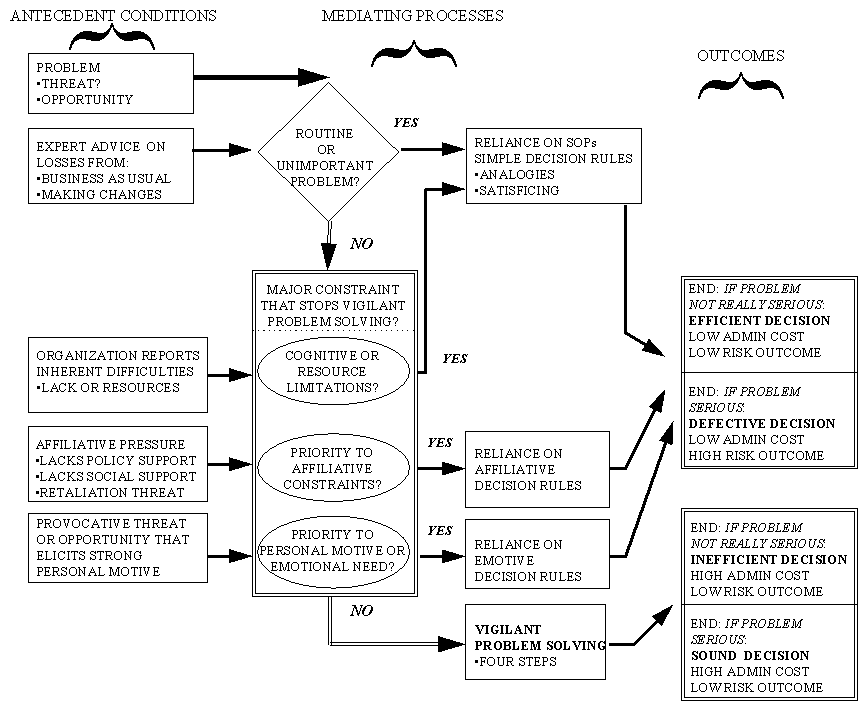
Figure 1: The Constraints Model of Policy Making Decision Processes.
Source: Irving L. Janis, Crucial Decisions, (New York: The Free Press, 1989), 154-155.
In some decision situations, a timely, relatively correct response is better than an absolutely correct response that is made too late. In other words, the situation generates a tension between analysis and speed.
A relatively new family of decision theories known as naturalistic decision making provides some insight into this tension. These theories describe how decision makers make highly consequential decisions in ill-defined, dynamic, high-paced and complex environments. One of the main features of naturalistic decision making is that decision makers do rely on rational decision processes or approaches. Limited time is the defining characteristic of most of these situations.
The Recognition-Primed Decision (RPD) model is one of the more interesting of those derived from naturalistic decision settings. The RPD model was developed out of research findings that decision makers assess their situational problem based on recognition patterns rather than analysis. The key feature is the emphasis on situation assessment, not the generation and comparison of alternatives. Experience is the source of the ability to recognize problems and their solutions.
The RPD process works in the following manner. First, an experienced decision maker recognizes a problem situation as familiar or prototypical. The recognition brings with it a solution. The recognition also evokes an appreciation for what additional information to monitor: plausible outcomes, typical reactions, timing cues and causal dynamics. Second, given time, the decision maker evaluates his solution for suitability by testing it through mental simulation for pitfalls and needed adjustments. Normally, the decision maker implements the first solution "on the run" and makes adjustments as required. The decision maker will not be discard a solution unless it becomes plain that it is unworkable. If so, he will attempt a second option, if available. The RPD process is one of satisficing. It assumes that experienced decision makers identify a first solution that is "reasonably good" and are capable of mentally projecting its implementation. The RPD process also assumes that experienced decision makers are able to implement their one solution at any time during the process.
The RPD is a descriptive model that explains how experienced decision makers work problems in high stress decision situations. From the perspective of effectiveness, however, it is not the best model for all decision environments. Situations that require the careful deployment of resources and analysis of abstract data, such as anticipating an enemy’s course of action, require an analytical approach. If there is time for analysis, a rational process normally provides a better solution for these kinds of problems. The implication is that decision makers who rely mainly on pattern recognition for every decision problem could do better. The RPD model complements the analytical approach. Neither is appropriate for all decision problems.
The RPD model provides some insight as to how operational commanders survive in high-load, ambiguous and time pressured situations. The key seems to be experience. The experience serves as the base for what may be seen as an intuitive way to overcome stress. A decision maker's reliance on pattern recognition appears to the primary difference between rational and intuitive decision processes. Decision makers with more experience will tend to employ intuitive methods more often than analytical processes. This reliance on pattern recognition among experienced commanders may provide an opportunity for an adversary to manipulate the patterns to his advantage in deception operations.
Although normative decision models generally prescribe a rational process to optimize problem solutions, a number of factors tend to limit and degrade its execution. These factors include the limitations of human decision makers to process data and the existence of various inherent biases: cognitive, perceptual, motivational and cultural. Other potential detractors to rational processes derive from organizational processes and politics. Military decision making occurs in operational settings in which the consequences of decisions, uncertainty and time pressure create acute stress. This phenomenon creates a tension between the desire for getting optimal decisions, which usually take time to generate, and the desire for responsive decisions, which may be less than optimal. The Vigilant Problem Solving Approach and the Recognition-Primed Decision Model illustrate normative and descriptive mechanisms for coping with this tension. We will now build upon our understanding of decision making under general conditions of stress to address explicitly the process at work in a combat environment.
Chapter 3: Considering a Cognitive Warfare Framework
Introduction
The analysis that follows re-examines the "mind" side of the C2W equation in light of the limitations and tensions of military decision processes discussed in the previous chapter. It begins with an examination of John Boyd’s Observation-Orientation-Decision-Action (OODA) cycle to illustrate the different ways a C2W campaign may attack an adversary’s decision cycle. This sets the stage for analysis of the particular methods of such attacks. The end product is a simple cognitive warfare framework that will be used to examine the historical evidence of C2W in the following chapters.
The OODA Loop and Two Approaches to Command Dysfunction
John Boyd’s so-called OODA Loop illustrated at Figure 2, is a simple and useful construct for conceptualizing decision cycles. The basic notion is that commanders observe, orient, decide, and act. They then observe the outcome and begin the cycle over again. It is obvious that actual decision cycles are not this simple. Although there may be an overall command decision cycle that approximates an operational OODA Loop, such as an Air Tasking Order (ATO), there are a multitude of decision cycles in every operation. Nevertheless, two cognitive warfare approaches to command dysfunction can be visualized by using the model.
If one compares the decision cycles of two opposing military commands to a "gunfight" between two antagonists, one can appreciate the requirements for good eyesight (Observation), accuracy (Orientation), and a fast draw (Decision and Action). If comparably skilled, the quicker of the two will tend to get the upper hand. However, a faster draw does not necessarily help a skilled gunfighter whose aim is obstructed by blowing dust. So it is with competing decision processes. Both speed and accuracy are required, and they are measured in relation to the speed and accuracy of one’s opponent. These two factors become the basis of a cognitive warfare framework.
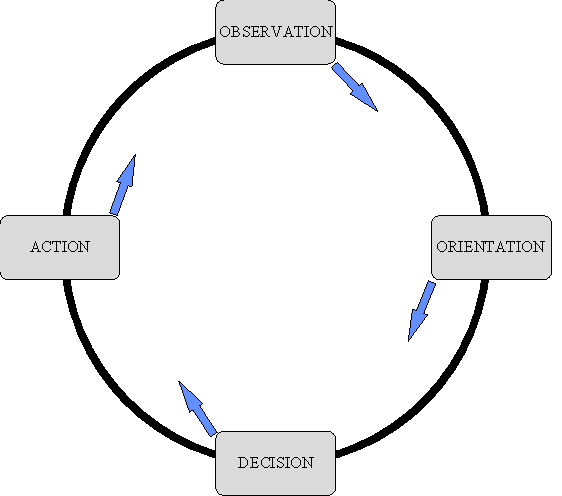
Figure 2: The OODA Cycle
Source: Joint Publication 3-13.1, Joint Doctrine for Command and Control Warfare (C2W)
The "anti-speed" approach attempts to slow an adversary’s decision cycle so his decisions are irrelevant at the time of execution. The focus is on degrading the efficiency of the decision cycle by denying the "observation" function the ability to see and impeding the flow of accurate information through the physical links of the loop. Data denial is usually achieved by preventing the adversary’s observation function, or sensors, from operating effectively in one or more channels. Decisions and accompanying data are also slowed by neutralizing or destroying the communication links that connect the commander to the subordinates who carry out his will. Operations security, electronic warfare (EW) and physical attack are used to execute this approach. Contemporary American doctrine advocates domination of air, space, and the electromagnetic (EM) spectrums to achieve this effect. A successful "anti-speed" strategy also indirectly affects the adversary’s orientation. Late and missing data degrade accurate perceptions of reality.
However, a pure "anti-speed" strategy against an enemy’s communication links and observation functions is not normally sufficient to induce command dysfunction. Cutting communications and blinding sensors can seriously hamper command and control; they will, however, not go unopposed by an adversary who expects these kinds of attacks. An adversary may simply switch to unaffected media to communicate and observe. An adversary can also change his command arrangements, objectives or strategy to compensate for his increased decision cycle difficulties. Potential countermeasures suggest that the effort to slow an adversary’s decision cycles may not always work, and even if it does, other coping mechanisms can reduce the impact of the impediments. This leads us to the second approach.
The second approach attempts to corrupt the adversary’s orientation. The focus is on the accuracy of the opponent’s perceptions and facts that inform his decisions, rather than their speed through the decision cycle. Operations security, deception and psychological operations (PSYOPS) are usually the primary C2W elements in the corruption effort. The corruption scheme’s relationship to decision speed is somewhat complicated. In fact, the corruption mechanism may work to vary the decision speed depending on the objective of the intended misperception. For example, the enemy might be induced to speedily make the wrong decision. Even so, an adversary decision process would likely slow down in an environment of increased ambiguity and apparent contradictions (if discerned). As with the narrow employment of a pure "anti-speed" strategy, the projection of falsehoods and ambiguity into the enemy’s decision cycle is not necessarily a sufficient strategy by itself. Other C2W elements may be needed to isolate the target from information channels that can undermine the corruption endeavor.
In summary, a cognitive warfare strategy can view an opposing decision process from the perspective of decreasing its speed, decreasing its accuracy, or both. The "anti-speed" strategy prevents the adversary’s OODA Loop from keeping pace with events. If successful, the outcome makes the opponent reactive, ceding the initiative to the other side. The corruption approach concentrates on affecting decision accuracy and may or may not degrade the speed efficiency of the opponent. If successful, the adversary makes inappropriate decisions. A more complex strategy would combine the approaches. Figure 3 illustrates the two basic approaches. A closer look at the possible combination of approaches will follow later in the chapter. However, it is appropriate at this point to examine some formal insights into cognitive warfare expressed by military theorists.
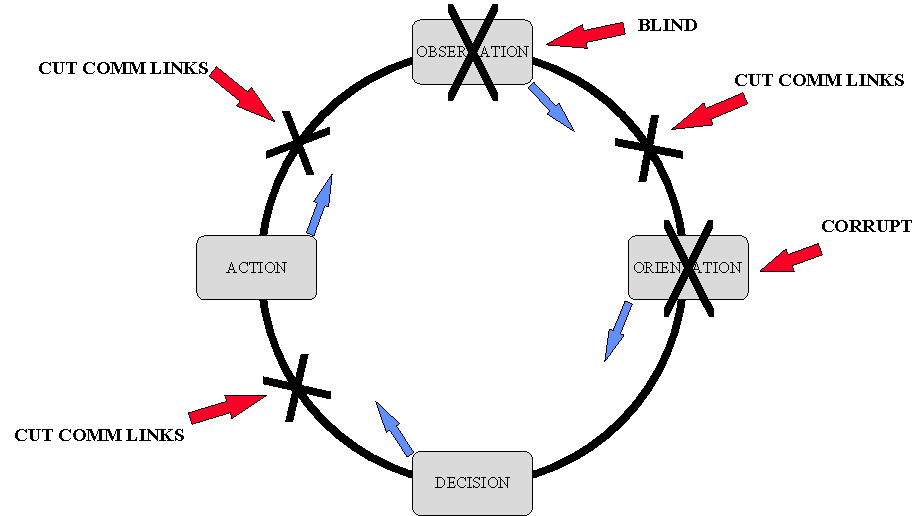
Figure 3: Cognitive Warfare Approaches
Cognitive Warfare Hints from War Theory
Sun Tzu wrote as follows concerning planning and intelligence:
Therefore, regarding forces: By perceiving the enemy and perceiving ourselves, there will be no unforeseen risk in any battle.
So, the battles of those sophisticated at strategy do not have unorthodox victories, are not known for genius, are not acknowledged for valor-- because their victories contain no miscalculations.
Concerning Alternative Objectives:
The enemy must not know where I intend to give battle. For if he does not know where I intend to give battle he must prepare in a great many places. And when he prepares in a great many places, those I have to fight in any one place will be few.
Concerning surprise and deception:
Therefore, have a capability, but appear not to; make use, but appear not to; be near but appear far, or be far but appear near; show gains to lure them; show disorder to make them take chance....Attack their weaknesses; emerge to their surprise.
Sun Tzu’s ledger of war truths can be thought as a list of proverbial wise sayings. They are rationally appealing; simple to remember; and as the expression goes, easier said than done. Michael Handel writes that Sun Tzu’s was a prescriptive optimist regarding the planning and execution of warfare in general and C2W in particular. Sun Tzu’s axioms assume an omniscient ability to gather intelligence in order to make detailed plans to win a victory--a victory that can be forecast. Sun-Tzu’s explicit advocacy for deception in all aspects of warfare is cited regularly as support for its continued importance today. There is, however, an internal contradiction between his assumption of accurate intelligence and the insistence upon deception. The presence of deception in the decision environment would seem to lessen one’s confidence of accurate intelligence. Another note of interest is Sun-Tzu’s position concerning command decision processes. His emphasis on methodical and detailed planning indicates an assumption of analytical decision making. His words on how decisions are made in the battle say little--but perhaps imply the requirement for pattern recognition and intuition:
Turbulence and ferment: while fighting amid chaos, we may not be confused. Rolling and tumbling: while controlling within gyrations, we may not be defeated.
Carl von Clausewitz wrote the following concerning planning and intelligence:
Many intelligence reports in war are contradictory; even more are false, and most are uncertain.
No other human activity is so continuously or universally bound up with chance. And through the element of chance, guesswork and luck come to play a great part in war.
Concerning surprise and deception:
The two factors that produce surprise are secrecy and speed....it is equally true by its very nature surprise can rarely be outstandingly successful. It would be a mistake, therefore, to regard surprise as a key element of success in war. The principle is highly attractive in theory, but in practice it is often held up by the friction of the whole machine.
...plans and orders issued for appearances only, false reports designed to confuse the enemy, etc.--have as a rule so little strategic value that they are used only if a ready-made opportunity presents itself.
Clausewitz’s perspective is vastly different from Sun-Tzu with respect to C2W. Clausewitz was pessimistic in his outlook concerning the costs and benefits of deception and surprise at the strategic and operational levels. This pessimism stemmed from the difficulty of hiding extensive logistics and troop preparations necessary for major campaigns and the relatively limited mobility of the armies of his era. Clausewitz saw more utility of deception and surprise at the tactical level in operations that took little time. Friction and uncertainty also gave him a healthy skepticism for the value of intelligence in planning and conducting the battle. Clausewitz’s major contribution to C2W thought is his realistic appraisal of the friction and chaos that confronts an operational commander and the requirements of courage and intuition to make the required decisions.
Since all information and assumptions are open to doubt, and with chance at work everywhere, the commander continually finds that things are not as he expected...
During an operation decisions have usually to be made at once: there may be not time to review the situation or even to think it through....
If the mind is to emerge unscathed from this relentless struggle with the unforeseen, two qualities are indispensable: first, and intellect that, even in the darkest hour, retains some glimmerings of the inner light which leads to truth; and second, the courage to follow this faint light wherever it may lead.
Sun Tzu and Clausewitz paint different pictures of the command environment. While Sun-Tzu sees a predictable campaign in which deceptive ploys and surprises can be planned, Clausewitz sees fog as the primary instigator of surprise--wielded by chance.
B. H. Liddell Hart wrote as follows concerning movement and surprise:
Strategy has not to overcome resistance, except from nature. Its purpose is to diminish the possibility of resistance, and it seeks to fulfill this purpose by exploiting the elements of movement and surprise....
Although strategy may aim more at exploiting movement than at exploiting surprise, or conversely, the two elements react on each other. Movement generates surprise, and surprise gives impetus to movement.
Concerning alternate objectives:
...the best way is to operate along a line which offers alternative objectives. For thereby you put your opponent on the horns of dilemma, which goes far to assure the gaining of at least one objective--whichever is least guarded--and may enable you to gain one after another.
Concerning deception:
....it is usually necessary for the dislocating move to be proceeded by a move, or moves, which can be best defined by the term ‘distract’ in its literal sense of ‘to draw asunder’. The purpose of this ‘distraction’ is to deprive the enemy of his freedom of action, and it should operate in the physical and psychological spheres. In the physical, it should cause a distention of his forces or their diversion to unprofitable ends, so that they are too widely distributed, and too committed elsewhere, to have the power of interfering with one’s own decisively intended move. In the psychological sphere, the same effect is sought by playing upon the fears of, and by deceiving, the opposing command.
The renewal of maneuver warfare during World War II brought with it a resurgence in C2W thinking--and connected it to maneuver. B. H. Liddell Hart’s contribution to C2W is the indirect approach. The indirect approach avoids enemy lines of expectation (the line of greatest resistance) by taking a line that is not expected, and moves unexpectedly into the rear of the enemy. This physical movement dislocates the opposing forces from their lines of communication. This "sudden" dislocation also causes a mental dislocation in the mind of the commander--a "sense of feeling trapped." The unsettling psychological effect of having unexpected enemy forces in the rear tends to delay the commander’s response. Liddell Hart’s starting mechanism to unleash the war of dislocation rests on the use of a "distracter." This distracter can take two forms. The first is the creation of ambiguity in the enemy’s mind as to one’s real objectives among many (alternative objectives). The other is a deliberate deception ploy to create false certainty in the enemy commander’s mind as to one’s objectives. That said, Liddell Hart’s C2W dislocation effects were for the most part related to maneuver. However, the widespread practice of strategic and operational deception during World War II has also led to a resurgence of deception theory.
Development of Modern Deception Theory
Deception advocates argue that the increasing sophistication and capabilities of battlefield surveillance have paradoxically increased the importance of and opportunities for deception. They are important because the battlefield is only transparent in the physical sense. They are opportune because of inherent perceptual biases--made ready by the mind’s expectations.
The discussion in Chapter 2 on biases presented the concept that expectations influence what is perceived. New data are added to existing conceptions and images. The perceptions that form tend to do so quickly and, once formed, are resistant to change even in the presence of contradictory information. Other cognitive biases affecting probability estimation and the evaluation of evidence tend to reinforce the persistence of these perceptions. This persistence is the key lever for deception. It is easy to reinforce what is already expected. The issue is to understand the victim’s expectations in relation to one’s own objectives and intentions. The task is much tougher when the target’s expectations do not match up with the deceiver’s deceptive story. This is due to the strength of initial impressions. However, deception can also work against the adversary’s current expectations by weakening his confidence in them. Appendix 2 lists the relationships between deception and perceptual and cognitive biases.
Fundamentally, all deception ploys are constructed in two parts: dissimulation and simulation. Dissimulation is covert, the act of hiding or obscuring the real; its companion, simulation, presents the false. Within this basic construct, deception programs are employed in two variants: A-type (ambiguity) and M-type (misdirection). The A-type deception seeks to increase ambiguity in the target’s mind. Its aim is to keep the adversary unsure of one’s true intentions, especially an adversary who has initially guessed right. A number of alternatives are developed for the target’s consumption, built on lies that are both plausible and sufficiently significant to cause the target to expend resources to cover them. The M-type deception is the more demanding variant. This deception misleads the adversary by reducing ambiguity, that is, attempting to convince him that the wrong solution is, in fact, "right." In this case, the target positions most of his attention and resources in the wrong place.
Although the A-type and M-type programs are conceptually different, in practice they are used simultaneously in various shades and emphases. A deception program may start out as an M-type ploy to confirm the adversary’s expectations about what is going to happen (usually what he expects on the basis of logic and experience). However, since most adversaries are prudent enough to consider other possibilities (of which one may be the real solution), the deceiver also may employ an A-type program to increase the number of alternatives. This, if effective, causes the deception target to spread his remaining resources over a number of possibilities. Appendix 2 lists the main principles and techniques of deception.
A Cognitive Warfare Synthesis
A comparison of the insights of Sun-Tzu, Clausewitz, Liddell Hart and the modern deception theorists reveals tension concerning command and the conduct of C2W. A tension exists between Clausewitz’s call for intuitive decision making amidst the chaos and Sun-Tzu’s prescription for detailed planning based on excellent intelligence. There is also a tension between Clausewitz’s skeptical view of the cost/benefit value of deception and surprise and both Sun-Tzu’s and Liddell Hart’s strong advocacy for it. Both Sun-Tzu and Liddell Hart highlighted the dilemma of alternative objectives upon an adversary’s mind made possible by movement. Clausewitz emphasized the weight of chance and consequences upon the commander’s mind concerning the imponderables of battle. 20th Century deception theorists point out the tension between the modern trend of battlefield transparency and the opaque nature of intentions. The discussions of Chapter 2 also presented a number of rational limitations, biases and stress effects that affect decision making. The question, therefore, arises as to how one should use these different insights and issues for military decision making in settings that range from peacetime training to those that are opposed, high-paced, ambiguous and immediately consequential.
Three Categories of Cognitive Warfare
One way to visualize the cognitive warfare approach of C2W is in a three-category framework depicted at Figure 4. The categories include of the adversary’s command baseline, stressors, and deception. The command baseline represents the adversary’s existing decision making characteristics. It consists of his expectations, perceptions, command arrangements, decision procedures, experience, training, tradition, culture and any other significant factors that constitute his decision making. The baseline includes both strengths and weaknesses. Weaknesses include self-induced problems that affect the accuracy and speed of his decision cycle. The command baseline establishes the opportunity "menu" for the other two categories.
The second framework category consists of stressors. "Stressors" come in two sets, physical and psychological. The physical stressors are actions that complicate and degrade the adversary’s decision making by pressuring his capabilities and time resources. This relates back to the "anti-speed" approach discussed earlier. Targeted capabilities include the ability to communicate and use sensors. Increasing the tempo of operations reduces the adversary’s time to make decisions. Other physical stressors that degrade decision making derive from the nature of the operational environment. Briefly, these include environmental extremes (noise, temperature) and physical hardships (lack of sleep, food, water and hygiene). Common to all, physical stressors reduce decision resources in terms of information, time and physical capabilities. However, the introduction of physical stressors leads to the second kind, those that are psychologically felt in the mind of target. For example, while an increase in operational tempo reduces available decision cycle time, the available time may still be sufficient to make effective decisions. Nevertheless, the increased tempo may cause a decision maker to perceive significant time pressure and adjust his decision process. Whether or not this degrades his decisions is dependent on the severity of the perceived time stress and the types of coping mechanisms that are used to compensate. Similarly, other psychological stressors, including uncertainty and high stakes, affect the decision environment. The uncertainty in this case is based on the nature of chance--the unknowable events that are inherent in operational settings. This is in contrast to the uncertainty and ambiguity that is purposely introduced by deception. The other major psychological stressor is the weight of consequential decisions. This is also an internal stress, induced by the adversary’s own moral friction in the face of solving consequential problems.
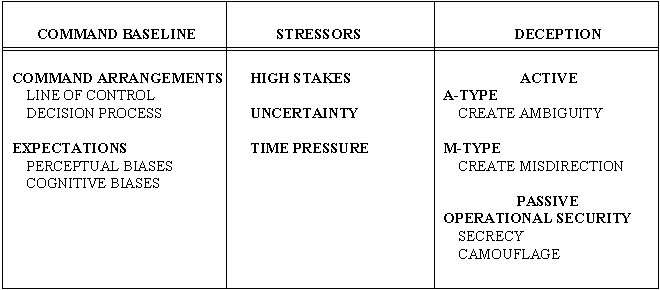 Figure 4: Cognitive Warfare Framework
The final framework category is deception. The A-type deception program increases uncertainty by generating a number of alternatives for the adversary to consider. M-type deception programs work in the opposite direction in terms of uncertainty and seek to convince the victim that he is "right" about the deceiver’s methods and objectives, when he is objectively "wrong." Both deception types exploit the command baseline’s expectations and perceptions. They also both employ operational security measures to hide real capabilities and intentions.
Conjectures and Implications
While it is apparent that there is a "targeting" relationship between the command baseline and the other two C2W "tool" categories, there might also be a number of interactions between the deception and the stressor categories. Examining time pressure and deception, the logic indicates that there may be either mutually reinforcing or interfering interactions. If one assumes the general notion that psychological time pressure causes decision makers to channelize information searches and analyses, then the question as to when to increase time pressure in conjunction with a deception program depends on the victim’s primary attention or expectations. If his attention is already focused on the deceiver’s plausible "story," then time pressure (if applicable to the deceiver’s operational plan) would likely assist. This is because the victim’s channelization will attenuate his data search and analysis on what he considers the peripheral matters--the place where the deceiver has hidden the truth. On the other hand, if the deceiver needs to change an adversary’s expectations, then adding time pressure will likely be counterproductive. In this case, time pressure may deny the victim sufficient time to perceive and consider the deception and reduce the victim’s confidence about existing his perceptions.
The real world application of intentional stressors and varied deception programs will require a sophisticated understanding of the stressor-deception interaction. This is in addition to understanding what cognitive and perceptual vulnerabilities are exploitable in the command baseline and having excellent intelligence resources that return feedback concerning the adversary’s thinking.
In Chapter 2, the discussion ended by describing the latent tension that exists between the requirements for decision accuracy and decision speed. The general idea was that given adequate time and information resources, the preferred way to decide consequential decisions was to use an analytical approach. If this was not possible due to time constraints, there was a need for experienced pattern recognition or some intuition to get an adequate decision in reduced time. The question now is how this tension between decision speed and accuracy fits into the designs of the cognitive warfare framework.
If one had insight to the decision process and expectations of the enemy command, a logical question may follow: On which end of the speed-accuracy tension is the enemy strength? Is it experienced-based intuition or rational analysis? An exploitable weakness on either end may indicate the deception-time pressure strategy to use to manipulate the enemy’s decision process. If the adversary has no weakness on either end of the decision spectrum, then one might determine what strategy places the enemy command in a position in which it has insufficient time to analyze the deception puzzle and not enough intuitive confidence to see through all the alternatives. The point here is that approaching the cognitive side of C2W from the perspective of the adversary’s decision process may provide some insight on the overall C2W operation.
Conclusion
This chapter considered two basic ways to approach a cognitive warfare strategy. The first approach attacked the speed of an adversary’s decision cycle; the second focused the attack on its accuracy. These approaches roughly line up with the two "tool" categories of the Cognitive Warfare Framework: stressors and deception. More often than not, one would expect these approaches to coexist and overlap in use and effects. The idea that there is an interdependent relationship between time pressure and deception was also considered. Although our knowledge of this relationship is incomplete, the logic indicates that there are both reinforcing and interfering interactions.
Most important is the fact that the overall cognitive warfare approach is dependent upon the enemy’s command baseline--the decision making processes, command characteristics and expectations of the decision makers. The skillful employment of stress and deception against the command baseline may be a principal mechanism to bring about its cognitive dislocation.
It is now appropriate to use these insights to examine the historical evidence. We begin with the Normandy campaign of 1944.
Chapter 4: The Normandy Invasion
This chapter examines the Normandy campaign from the spring of 1944 until the Allied breakout in August 1944. Of particular interest is the effect of the Allies’ C2W deception effort to dislocate German forces prior to and after the invasion in light of the dysfunctional command problems that already existed within the German chain of command.
Background and Summary of Campaign
When the Allies selected the site for the long-awaited invasion, they sought to balance a number of important considerations: the state of enemy defenses, the reach of Allied air cover, logistics build-up feasibility, and suitability of the terrain for the subsequent breakout. The two possible landing sites were the Normandy coast and the beaches between Dunkirk and the mouth of the Somme River, referred to as the Pas de Calais. The latter had advantages in distance from embarkation to debarkation and from the beaches to the heart of Germany. On the other hand, because it was such an obvious place to land--it was also the place the Allies expected the Germans to defend most heavily. Therefore, the Allies chose Normandy.
The concept of operations for the Overlord invasion was fairly straightforward:
1. Land on the Normandy Coast.
2. Build up the resources needed for a decisive battle in the Normandy-Brittany region and break out of the enemy’s encircling positions.
3. Pursue on a broad front with two army groups, emphasizing the left to gain necessary ports and reach the boundaries of Germany and threaten the Ruhr. On the right, link up with Allied forces invading France from the south.
In more detail, the invasion plan envisioned dropping elements of the three airborne divisions at night behind the beaches near Carnelian and Caen. The airborne infantry mission was to seize important bridges and causeways that provided exits from the beaches. The initial amphibious assault that followed landed six infantry divisions on five different beaches along a 60-mile front. The landing on the extreme right (Utah Beach) on the Contentin Peninsula sought the early capture of Cherbourg. The American landing at Omaha Beach and the British/Canadian landings at Gold, June and Sword Beaches endeavored to move inland and occupy ground on the open plains south and west of Caen. Their objective was to establish a defensible beachhead for the landing and build-up of 36 divisions. Allied naval forces supporting the landings secured the sea approaches against enemy mines, submarines and surface combatants in addition to providing fire support for the landing force. Allied air forces provided overhead defense, interdiction and close air support.
The Allies labored through 1943 and the first half of 1944 to build the required assault forces and sustainable logistics capabilities to undertake the invasion. They also worked to achieve two other major prerequisites to ensure the success of the lodgment and break-out. The first was to reduce the Luftwaffe fighter force so that it could not threaten the beachhead. This was accomplished as a result of the strategic air campaign against Germany proper, culminating in Big Week in February 1944. The second was to limit the number or effectiveness of German offensive formations in France, especially those reserves the Germans could throw against the beachhead. The attainment of total air superiority over France went far toward achieving these conditions. Beginning in the early spring of 1944, the Allied air forces attacked the French rail system in an effort to isolate the Normandy and Pas de Calais areas. In May they began destroying rail and highway bridges across the Seine between Rouen and Paris. While the rail attacks had minor effects on German rail movement, the bridge campaign made German force movements very difficult. The Allied command was also depending on a deception named Fortitude South to limit the number of German forces confronting the beachhead.
German forces in the theater were deployed in four armies under the command of Generalfeldmarshall Gerd von Rundstedt (OB West): the 1st, 7th, 15th, and 19th Armies. Generalfeldmarschall Erwin Rommel commanded the 7th and 15th Armies (Army Group B). Generaloberst Johannes Blaskowitz commanded 1st and 19th Armies (Army Group G). The armies had a mixture of panzer (armor), panzer grenadier (mechanized infantry), infantry, and static divisions. The infantry and static divisions manned the "Atlantic Wall," a discontinuous series of fortifications, entrenchments and fighting positions along the coast. The panzer and panzer grenadier divisions were positioned inland from the coast as mobile reserves. The static divisions generally lacked the mobility, equipment, training and combat experience of German front-line units. The infantry, panzer and panzer grenadier divisions were more capable, but many were short their full combat equipment and manpower strengths. Some were in the process of formation or rehabilitation from recent combat action on the Eastern Front.
The German 15th Army held the coast from Caen to the Shelde estuary on the Dutch border. Its order of battle on the eve of the invasion consisted of fourteen static divisions, three infantry divisions, and two panzer divisions in reserve. The 7th Army held the Normandy and Brittany peninsulas with five static divisions, seven infantry divisions and one panzer division in reserve. 7th Army forces in the Normandy area consisted of three static, two infantry and the one panzer division. The 1st Army, consisting of one infantry and three static divisions, covered the long Bay of Biscay coast from the Loire River to the Spanish border. One panzer division was positioned in reserve. The 19th Army held the French Mediterranean coast with four static, three infantry divisions and two panzer divisions. OKW controlled the mobile armor theater reserve consisting of one panzer grenadier and three panzer divisions. Figure 5 depicts German force dispositions.
Figure 5: Order of Battle of OB West, 6 June 1944
Source: Gordon A. Harrison, Cross Channel Attack, (Washington: OCMH, 1993), Map V.
The German defense along the Channel coast rested on the timely reinforcement of Rommel’s armor by the OKW mobile armor reserve to the Allied landing sites. Of these, the 1st SS Panzer Division was in Belgium, the 116th Panzer Divisions was north of the Seine behind the bulk of the 15th Army, the 12 SS Panzer and Panzer Lehr Divisions were south of the Seine near the 7th/15th Army boundaries, and the 17th SS Panzer Grenadier was located near the Loire. On the eve of the invasion, Rommel had just one panzer division near the Normandy landing beaches. Two panzer divisions of the OKW theater reserve were relatively nearby, south of the Seine; but required OKW’s permission to employ. Rommel’s two remaining panzer divisions had further to travel, and had to contend with the problem of destroyed Seine River bridges.
As planned, the Allies air-dropped elements of three airborne divisions behind the beaches after midnight on 6 June. Elements of six infantry divisions landed on the Normandy beaches during the day on 6 June. The Allies made limited gains during the first days of the fighting, but suffered fewer losses than expected against uneven German resistance. By the end of the first week, the separate beachheads had linked up to carve out a lodgment eight-to-twelve miles in depth from the area near Caen to Quinneville, south of Cherbourg. The absence of the expected German armored counterattack during this time was remarkable. In fact, this would be the general story for the German defense in Normandy. While the Allies built up forces and expanded the bridgehead, the Germans reacted to fill gaps and hold off the inevitable. The bridgehead slowly pushed southward into the hedgerow country of the Bocages and toward Caen. The most the Germans could do in response was to mount local counterattacks from an increasingly strained perimeter. Allied air interdiction delayed the German reserves that the German High Command sent to Normandy. They were subsequently fed into the line piecemeal to hold the perimeter.
The battles in late June and through July developed into a drawn-out attrition operation among the hedgerows. The Allies continuously wore down German units as they attempted to force a breakthrough into open "tank" country to the south. The Germans hung on to the line while looking for ways to gather enough forces to counterattack. They were constantly in a dilemma. In order to mount a counterattack to drive the Allies into the sea or at least split the beachhead, they had to form a mobile reserve from local resources. As these mobile units were already committed defensively, their withdrawal threatened to collapse the defensive line from which they came, causing additional defensive scrambles. Allied naval gun fire and fighter-bomber attack further aggravated the planning and execution of these maneuvers. Although the Allies were frustrated at times with the slow progress against the German line, the Germans could not afford to fight the costly battle indefinitely.
The Allied Cobra operation west of St Lo (25-28 July) initiated the big push that allowed the U.S. Third Army to break out at Avranches on 1 August. From this point, the battle in Normandy and eastern France turned into one of high-tempo mobility. The German 7th Army made an ill-fated counterattack toward Mortain on 6 August in an attempt to contain the breakout. While the German counterattack advanced toward the west under punishing air attacks, the southerly advance of the U.S. Third Army turned east threatening the 7th Army’s southern flank and the Canadian First Army attacking from the northeast threatened its rear. The German forces paused to deal with these threats while continuing to attack westward toward Mortain. Then, as the Allies moved to complete the encirclement at Falaise, the Germans turned around and attempted to fight their way out back to the east. In the end, the Allies crushed much of German 7th Army and a portion of the 5th Panzer Army, albeit a portion of their forces were able to escape the pocket. Figure 6 depicts the lodgment and breakout battles.
Figure 6: Normandy Lodgment and Breakout
Source: Forrest C. Pogue, The Supreme Command, (Washington D.C.: OCMH, 1954), Map III.
The success of the Allied Normandy campaign owes much to a successful C2W operation against the German Command. The analysis follows.
Allied C2W Operations against the German Command
The German High Command concluded in early 1944 that the Allies were planning to launch a large-scale invasion in western Europe. However, exactly when and where this invasion would occur remained an open question in the minds of the German leadership. Von Rundstedt expected the invasion to take place during the good weather months, April to August. He believed the landing location would be between Le Havre and Calais. He based his estimate on the geographic advantages a subsequent breakthrough would enjoy in threatening the German Ruhr. As he considered the lack of German forces to stop a mobile breakthrough between the northern Channel coast and the German frontier, the Allied advantages appeared compelling. In short, von Rundstedt’s worst case scenario was a landing in the Pas de Calais area because it posed the greatest threat. This predisposition assisted the allies in their C2W efforts to protect the Normandy lodgment.
The primary C2W effort took place at the theater level--an elaborate deception program intended to spread German attentions and forces prior to the landings and to prolong the dislocation for some time afterward. The Fortitude South deception effort aimed to encourage German expectations that the Allies’ main effort in the invasion of western Europe, the schwerpunkt, would indeed take place on the Pas de Calais beaches.
The conceptual basis of Fortitude South was that of maximum plausible Allied strength. This told the story that the Allies had sufficient resources to conduct a diversionary landing in addition to the main assault. Second, it told the Germans that the Allies were going to hit them with the main assault at Pas de Calais. Finally, it told the Germans that the invasion at Normandy was in fact the diversion--that the main landing would come at Pas de Calais six weeks later.
The overall plan developed and executed elaborate security schemes (camouflage, signal discipline, restricted zoning, etc...) to conceal the real invasion force. The Allies fed their "intentions" to German intelligence through a closely controlled set of "turned" double agents. This was the primary channel. Fortitude South employed six supporting deception plans to confirm the "story" in secondary channels. These secondary channels included German radio intercepts, air reconnaissance and German observations of Allied air strikes on the continent. The six supporting operations are listed below:
1. Quicksilver I was the fictional plan that built the First United States Army Group, the force intended for the cross channel assault against the Pas de Calais region.
2. Quicksilver II was the fictional radio deception of FUSAG--This operation attempted to simulate army group radio traffic similar to patterns of other real formations.
3. Quicksilver III was a visual demonstration of simulated landing craft along the southeast and east coasts of England.
4. Quicksilver IV entailed bombing operations against the Pas de Calais beach fortifications.
5. Quicksilver V entailed bombing operations against inland communications behind the Pas de Calais beaches.
6. Quicksilver VI displayed misleading lighting schemes on the coast. In the east the lights simulated numerous port and assembly facilities. On the southwest coast the lights simulated assembly areas and ports in an effort to decoy attention from real sites.
The Allied ability to gain insights into the German High Command’s strategic thinking and to measure German reactions to Allied deception greatly aided their cause. Code named ULTRA, this source gave Allied planners access to German secret wireless communications traffic encrypted by the Enigma machine. The insights gained by Ultra gave the deception planners a critical tool in developing the "stories" the German command was to believe and permitted them to monitor German reactions to the deception plan as it unfolded.
Evidence of German Command Dysfunction
The German command had major problems prior to and during the Normandy campaign. First, it was uncertain about the location of the main Allied landing. As mentioned previously, OB West, von Rundstedt expected the landing to occur in the Pas de Calais region. Rommel, the commander of Army Group B, comprising the 7th and 15th Armies, also believed that the main landings would occur there. The German High Command, OKW, also leaned toward this solution, to include Hitler himself. Nevertheless, they also had doubts. In early April 1944 Hitler suddenly ranked the Normandy area on the same level as Pas de Calais for probable invasion. With this revelation, the German command scrambled to find more reinforcements and build additional fortifications. However, Hitler ordered the Pas de Calais coast defenses not to be weakened. The German dilemma was simple--there were many possible places to defend, but inadequate forces to defend everywhere.
The uncertain aspect of the landing location combined with insufficient infantry divisions would not have been insurmountable if the Germans had possessed sufficient mobile forces. However, Allied air dominance translated this issue into a second dilemma--an uncertainty over defensive strategy. Von Rundstedt wanted to hold the panzers in the theater reserve and move them as necessary once they identified the Allied main effort. His principal army group commander, Rommel, wanted to position the panzers close to the coast in order to repel the landing forces immediately. Rommel had less confidence than von Rundstedt in moving mobile reserves in the face of Allied air attacks. The problem with Rommel’s posture was that one had to guess right. The same Allied air problems that made a rapid response difficult from the theater reserves also made it difficult to move laterally along the coast. On the other hand, if it was equally difficult to move no matter the starting point, at least Rommel’s plan had a chance to place the panzers at the right spot for the counterattack. In the end, the German High Command compromised between these two views--positioning some panzers forward under Rommel while holding the rest further inland in the OKW reserve.
The indecisive compromise on defensive strategy was an indicator of the poor state of the German command. It worsened when the invasion started. The major problem was the lack of freedom of action under a single unified theater command. The army, navy and air forces in theater cooperated in haphazard fashion, answering to independent chains of command that met at OKW. Neither the theater army commander, von Rundstedt, nor any of his subordinates could make a major move without the OKW’s permission. In addition to the use of the theater panzer reserves, this included the movement of forces between army groups and armies and even the tactical placement of individual divisions within sectors. This situation was exacerbated by the fact that these operational and tactical decisions were made in East Prussia, far removed from the action.. Cumbersome and centrally controlled from afar, the German command was incapable of making timely operational decisions.
The most significant consequence of this poor command arrangement was a near paralysis in operational decision-making. The high command handcuffed the operational planning and execution of the counterattacks against the beachhead. Hitler’s instructions included telling Rundstedt what types of artillery to use against specific enemy target sets. Inevitably, the German command lost the "big" operational picture very early in the campaign. Three days after the Allied D-Day, OB West concluded that the German forces in Normandy were insufficient to repel the Allied attack. Von Rundstedt’s suggestion was that the invasion at Normandy was successful and would lead to Germany’s defeat, whether or not the main landing came elsewhere at a later time. The response from Hitler in East Prussia was to trickle in a few divisions from southern France and the Ukraine. Meanwhile, the majority of the divisions along the Pas de Calais coast sat idle, pinned by German expectations and Fortitude South encouragement.
The story of obstinate German command remained consistent through the month of June and into most of July. Orders given to counterattack the bridgehead were rendered nearly impossible by Hitler’s refusal to shorten the defensive line to produce the required forces. At the end of June, OKW decided to hold the line and fight a war of attrition while waiting for the second landing to come. This was done to avoid an implausible maneuver war against superior Allied armor and air forces. The problem was that the attrition campaign was also implausible. In mid-July Hitler still could not overcome his hesitation, despite the urgings of his staff, to release the 15th Army on the Pas de Calais coast. Finally, in the latter part of July, OB West and OKW convinced Hitler to release part of the 15th Army’s reserves, but this action was again too little, too late. When the Allies finally broke out at Avaranches, the German command attempted to fight a war of maneuver to close the breach, but their decisions were never able to catch up with the pace of the Allied advance. Orders arrived at the units already overcome by events.
Analysis in View of the C2W Framework
Figures 7 and 8 present a schematic of the Allied C2W operation, based on the framework established in Chapter 3. Figure 7 depicts the C2W campaign prior to D-Day on 6 June 1944; Figure 8 shows it afterwards. The Allied deception operation influenced the attentions, forces and defensive strategy of the German High Command, OB West and the Army B Group commander prior to and after D-Day. The difference between the role of the deception in the two time periods is subtle. Before the invasion, the program encouraged German beliefs that the assault would occur across the narrow section of the Channel, but that a diversionary landing was possible. The plausible case for a diversion also complicated the German defensive strategy. This relationship is shown by a dotted line in Figure 7.
Later, the deception operation encouraged the Germans to believe that Normandy was the diversion and to expect a second landing (depicted in Figure 8). There were two key factors in the deception. The first was the strong German preconception that the Pas De Calais area was the most likely place for the Allies to attack--because it was the most dangerous for the German perspective. The second was the Allies’ construction of "maximum plausible strength" in the minds of the German command. The creation and maintenance of more divisions in the German planning estimate than actually existed supported the deduction that the Allies could conduct a diversionary landing and a major landing to follow. The success of pre-D-Day Fortitude South can be measured by the German force’s heavier dispositions of 15th Army over 7th Army.
The actions of the German High Command during the first critical days of the invasion, 9-10 June, also illustrate the success of Fortitude South. On 9 June OKW started the 1st SS Panzer and 116 Panzer divisions toward the Normandy area, but then redirected them on 10 June to cover the Pas de Calais coast. The evidence for the tasking change points to three "turned" agents who delivered their reports on 9 June. The consolidated report that went Jodl and Hitler is below.
V-man Alaric network ARABAL reports on 9th June from [his post in] England: After personal consultation on 8th June in London with my agents [D]onny, Dick and Dorick, whose reports were sent today, I am of the opinion, in view of the strong troop concentrations in South-east and Eastern England which are not taking part in the present operations, that these operations are a diversionary maneuver designed to draw off enemy reserves in order then to make a decisive attack in another place. In view of the continued air attacks on the concentration mentioned, which is a strategically favourable position for this, it may probably take place in the Pas-de-Calais area, particularly since in such an attack the proximity of the air bases will facilitate the operation.
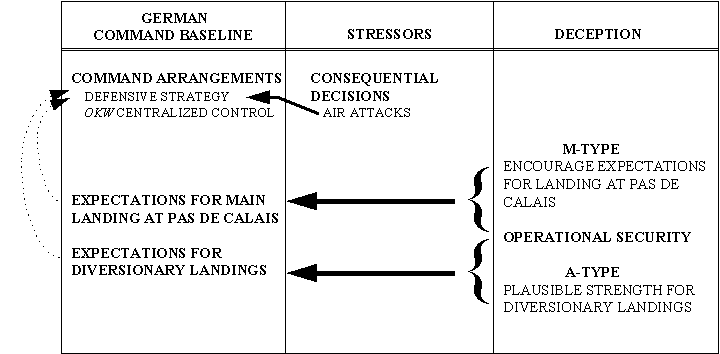
Figure 7: C2W Framework for Normandy Prior to D-Day
Prior to D-Day, Allied airpower was a consequential decision stressor because of the effect it had on the German command’s search for a viable strategy concerning the placement of reserves. While the aim of Allied air operations was not necessarily to frustrate German decision makers, the evidence seems to show they achieved this effect. It was initially important in the mind of Rommel and became so later for the OB West staff that attempted to plan and execute operational maneuvers under daylight air attacks.
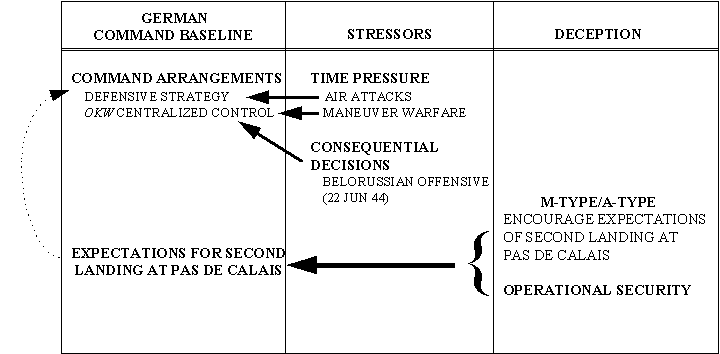
Figure 8: C2W Framework for Normandy After D-Day
The C2W model for the post D-Day period (Figure 8) illustrates the Fortitude South deception’s continuing encouragement for a second landing. This action effectively tied down a number of divisions in the other sectors. Additionally, the effects of the combat stressors increased pressure on a shaky German command arrangement. That Allied airpower caused havoc on German plans was obvious to the field commanders. OB West and his subordinates lacked reconnaissance, close air support and artillery spotting. They suffered from continuous air attack while there was good weather and daylight. Allied airpower (and ship to shore bombardment early on) slowed the German "action" portion of the "OODA" Loop to a crawl in relation to the Allies. This problem was aggravated by the fact that the operational decision makers (Hitler and the OKW) could not adjust to what was operationally feasible given the limited resources they had and the heavy opposition they were facing. The Allied breakout added speed and movement to the dislocation of German decisions and added the stress of uncertainty to the German command’s problems. The Allied war of maneuver, which turned initially to the west into Brittany, and then back to the east, created a classic "alternative objectives" problem. The Germans could not cover all potential offensive objectives. However, the problem was worse. The German command was not only uncertain of the direction and aim of Allied armor, it was slow to react due to their inability to observe Allied moves, decide, and execute a countering move. This furthered the gulf between the German High Command’s desires, perceptions, and reality.
Finally, because Hitler and the OKW were the operational decision makers for Normandy as well every other theater, one must add the distracting consequential decision stresses of other fronts. In the case of Hitler and the OKW in the summer of 1944, the list can get long; the Soviet Belorussian offensive is simply one example.
The Allied deception program, Fortitude South was a major factor in the malpositioning of the German army in the west prior to and after the Normandy landings. The deception operation keyed on two major factors: the strong German preconceptions of an Allied landing against the Pas de Calais coast and the construction of an Allied force structure estimate based on maximum plausible strength. The latter allowed the Allies to sell the Normandy lodgment as a diversion, thus freezing numerous forces along the Pas de Calais coast for six weeks.
While the Allied deception was a success, it acted on a German command that was already in trouble. The German command in the west was dysfunctional on its own--characterized by a non-unified command in which the theater and force commanders had little if any freedom of action. Control was centralized at OKW, which was enmeshed in tactical detail and disconnected from the actual happenings in the operational theater. The Allies aggravated this dysfunction with time pressure in the form of airpower before the break-out and maneuver afterwards. These stressors slowed German operational decision cycles relative to the Allies’ to the point that at the lower echelons (OB West and below), the Germans could only react to Allied moves.
The Germans did not recover from the consequences of their command problems until the Allies ran out of offensive momentum on the German frontier in the Fall of 1944. But even in retreat, Hitler was planning to turn the tables and create havoc for the Allied Command. This planning turned into the Battle of the Bulge.
Chapter 5: The Battle of the Bulge
This chapter examines the operational performance of the Allied command during the opening phase of the German Ardennes offensive of December 1944. The following paragraphs will summarize Allied offensive strategy in late 1944 and German aims and preparations for their winter offensive. After briefly describing the conduct of the battle, the study focuses on the Allied command’s expectations before the German attack, the German exploitation of those expectations and the subsequent Allied response during the first week of the campaign.
Background and Summary of the Ardennes Campaign
By the end of November 1944, Allied strategy pursued a broad front advance toward the Rhine and into the interior of Germany. Strained logistics and stiffening German resistance had dashed the high expectations for a quick end to the war. The long and cumbersome supply lines, supporting seven Allied field armies from the Normandy and Marseilles coast, were responsible for slowing and then halting the advance along the German border. The primary solution to the Allied problem was the capture of the Netherlands port of Antwerp. However, after the Allies captured the port, they were unable to use it for three months. As a consequence, the struggling Germans had time to reorganize a defense.
The Allies planned two main thrusts to penetrate into the German interior. Field Marshal Montgomery’s 21st Army Group and two American field armies of General Omar Bradley’s 12th Army Group, the 1st and 9th Armies, were to attack in the north, battling across the Roer and Rhine Rivers, to close on the Ruhr Valley from the west. The southern thrust employed General George Patton’s 3rd Army to cross the Rhine near Frankfurt and press northeast to envelop the Ruhr area from the south.
Between these two efforts was the Ardennes forest. This region had been a relatively quiet zone since October 1944--used by both the Americans and the Germans to rest weary divisions and train inexperienced personnel. The American 1st Army deployed the VIII corps in this sector, covering a seventy-mile front with two inexperienced and two battle-weary divisions. Eisenhower and Bradley accepted the thin American line here to make additional forces available for the attacks to the north and south.
Ever since the Allied breakout of Normandy and the sweep across France and Belgium, the German High Command had been seeking to turn the tables in the west. At the end of September, Hitler decided that this blow would originate from the West Wall (Siegfried Line). The counteroffensive objective sought the defeat of significant Anglo-American forces in the west in order to release strong German forces for the Soviet front. Hitler’s objective was to gain additional time for further technical developments and to sow political discord between the Americans and the British. The offensive used Germany’s last resources. There were not, however, many other options. Germany could not win a war of attrition against the Allies.
The winter counteroffensive aimed to split the Allied armies along a line from Bitburg through Brussels to Antwerp, capture the port, and destroy the British forces north of the divide. The attack had to catch the Allies by surprise in order to overcome the Germans’ inferiority in ground force ratios and command of the air. The offensive then had to rely on speed to get across the Meuse to Antwerp before the Allies responded with superior resources. The German High Command selected the Ardennes sector primarily because it was thinly manned. Additionally, the Eifel hill region to the east offered concealment from Allied air attack for assembling forces. The inadequacy of the road network, especially during the sloppy winter months, made the sector an unlikely place to attempt a major mobile offensive. Although this inhibited German mobility, it also abetted Allied expectations that an offensive would not occur in the Ardennes. To encourage this expectation, the Germans employed an extensive security and deception effort to hide the assembly of troops and mask their intentions to attack. The next section discusses the impact of this deception in more detail.
The timing for the offensive depended on the Germans’ ability to build up the needed forces and logistics infrastructure to launch the attack. However, the driving factor for an attack date was the requirement for poor weather to neutralize the Allied air forces. For this reason, Hitler set the attack window for 26-28 November. The Germans subsequently postponed the attack to 16 December due to delays in the assembly of forces caused by allied air interdiction. Unfortunately for the attackers, the delay also put the operations nearer to the periods of better flying weather. The German plan is depicted at Figure 9.
The Germans struck in the early hours of 16 December, surprising the American front line troops and the entire chain of command all the way to Supreme Headquarters Allied Expeditionary Force (SHAEF). Twenty-eight panzer, panzer-grenadier and Volksgrenadier divisions pushed into the U.S. First Army’s V and VIII Corps, and quickly threatened a theater-level disaster. Three of the four front line divisions of the VIII corps were either overrun or sent reeling backward. For the Americans, the struggle became a battle of delay, fought by hastily assembled units at isolated crossroads, in an attempt to block the advance of German armor. Surprise gave way to confusion and in some cases panic in the American rear.
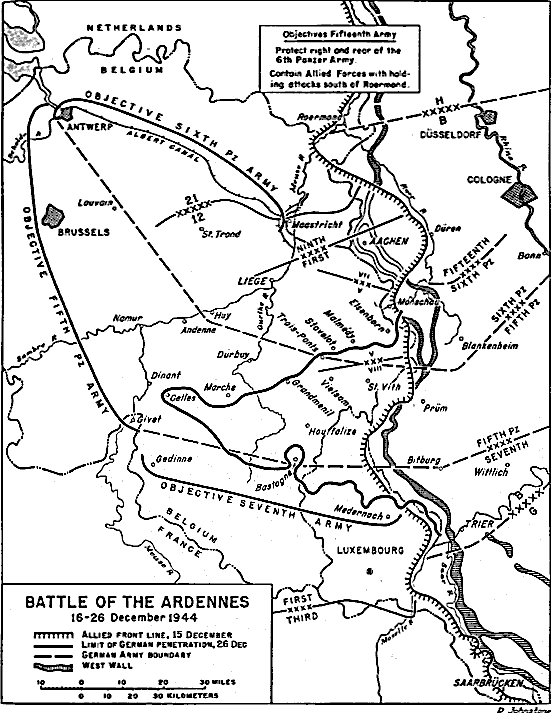
Figure 9: German Ardennes Plan
Source: Forrest C. Pogue, The Supreme Command, (Washington D.C.: OCMH, 1954), 373.
Despite the initial surprise, the Germans were not quick enough. The attack of the 6th SS Panzer Army on the northern flank suffered setbacks and delays against the U.S. V Corps. This was due primarily to the failure of the initial infantry assault to open wide enough gaps for the armor to exploit. Intended to be the main effort to the Meuse, most of the 6th SS Panzer Army eventually became tied up in a slow struggle to clear a route to the west. On the southern flank, the 7th Army was unable to advance to positions to protect the 5th Panzer Army’s southern flank. The 5th Panzer Army made better progress in the center, but could not meet the aggressive time-table to the Meuse River. This happened in part due to the rapid arrival of American reserves ahead of the panzers at two critical road junctions: St. Vith and Bastogne. Although the Germans bypassed both junctions and later took St. Vith, their denial slowed the German advance to the west.
The offensive gained ground for ten days before grinding to a halt a few miles short of the Meuse River. Its failure stemmed from a number of factors. From the German perspective, the list includes insufficient forces, training and transport, poor road conditions, allied air attacks, tough resistance from "weak" troops and the relatively prompt operational measures taken by the Allied command. The last factor is central to the analysis. Although rudely surprised, the Allies responded more quickly than the Germans had anticipated, quickly inserting armor units from the U.S. Ninth and Third Armies as well as the SHAEF theater reserve (XVIII Airborne Corps) into the path of the assault. Additionally, the Allies realigned the command on 20 December placing Field Marshal Montgomery in charge of the northern half of the bulge. This enabled the Americans to commit all their units to the northern shoulder with the knowledge that British reserves were coming (British XXX Corps) to blunt the west end of the German advance. From the south, the U.S. 3rd Army counterattacked into the exposed left flank of the German advance.
German C2W Operations against the Allied Command
To overcome superior forces, the German plan relied on extensive operations security and deception to mask the offensive build-up up in the Eifel. The Germans enforced the following measures to maintain operational security:
1. OKW limited information about the plan to a strict few--who were sworn to a formal oath of secrecy.
a. Orders were hand-carried. OKW avoided using teletype or telephone signals to transmit orders.
b. Dissemination of the plan to the tactical echelons occurred just prior to the attack.
c. The plan contained highly compartmentalized unit instructions. Tactical commanders had few details about other units.
d. Each command echelon used a different revolving code system.
2. Assembling forces took painstaking measures to camouflage their vehicles and positions.
a. Units hid under the forest cover. There were no daylight activities.
b. Units used charcoal for heating and cooking to cut down on visible smoke
c. The plan prohibited the use of signs and unit designators to mark communication stations.
3. The armor divisions of the 5th and 6th Panzer Armies moved into the sector during the last two nights
a. The Luftwaffe increased night operations to mask the noise of the armor movement.
4. 7th Army removed foreign troops (susceptible to desertion) from the attack sector.
While the security plan hid the attacking force, the deception exploited Allied perceptions concerning German capabilities. The Allies perceived the German army to be hard-pressed, short of troops, fuel and options. Still, the Allies knew the Germans were capable of making spoiling attacks against their advances into the Reich. Therefore, the Allies expected Rundstedt to use what armor he could muster to launch conservative counterattacks, especially on the Cologne plain between the Roer and the Rhine rivers. The German plan obliged this thinking by encouraging the obvious. The components of the plan follow:
1. The cover plan communicated a defensive intent to counterattack any Allied breakthroughs across the Roer river and in the direction toward the Ruhr valley.
a. The operation’s "defensive" code name, Wacht am Rhein ("Watch on Rhine") supported this intent.
b. Units destined for the attack concentrated northwest of Cologne to advertise defensive intentions near the Roer.
c. 6 Panzer Army built up the fictitious "25th Army" northwest of Cologne with daylight movements, simulated radio traffic, increased air defense activity, civilian evacuations, and headquarters personnel.
d. The plan used camouflaged unit designations to hide personnel changes.
e. The Germans disseminated the cover plan to the Allies through Neutral governments
2. The Germans maintained normal activity in the Eifel sector.
a. The 7th Army maintained normal radio traffic volume.
b. Visiting officers wore the uniforms of 7th Army units committed to the sector.
c. Units maintained normal patrol activity until the end of November, then ceased.
3. To add to the ambiguity during the final build-up stage, the Germans propagated false rumors about an offensive in the Trier area during the January or February time frame. This was done to explain the inevitable Allied discovery of increased activity, despite the precautions taken.
Of note, the Germans formed one special unit that planned to conduct C2W warfare: a special operations group code named "Greif" under OberstLeutnant Otto Skorzeny. Consisting of a specially equipped panzer unit and a number of small commando teams, this force planned to rush ahead of the fighting units and seize the Meuse bridges. The unit also intended to infiltrate the Allied rear and mislead units by issuing false orders, changing road signs and remarking minefields. Although operation "Greif" never got near the bridges, its limited presence in the American rear caused significant security concerns.
The plan for German success relied on surprise and then speed. The deception program only opened the "door." After this, the speed of the thrust had to stay ahead of Allied recovery. There was no other deliberate C2W plan to prolong the Allies’ surprise-induced command dislocation other than rapid movement through the Allied rear. Whether this would be effective or not depended on the rapidity of the German advance and the speed and appropriateness of the Allied reaction.
It is noteworthy that some of the measures taken to maintain secrecy hampered the speed of the attack’s execution. For example, the prohibition to send out patrols, while deemed critical in maintaining plan security, also deprived the initial assault units of intelligence that might have saved time.
Evidence of Allied Command Dysfunction
As stated earlier, the German offensive surprised the Allied front line as it began to unfold at 0530 hours on 16 December. The committed divisions within of VIII Corps found themselves among infiltrating German infantry intent on opening gaps for the following panzers. So started a day’s worth of scattered but tenacious small unit fire fights along the front. However, the realization of surprise traveled slowly up the Allied chain of command. This happened in part because front line communications were disrupted in the early confusion--a factor that delayed word to higher headquarters that anything unusual was happening. However, this was not the only reason the higher echelons were slow to comprehend.
By 1000 hours on 16 December, the VIII Corps commander, General Troy Middleton realized that something big was happening, although it would be some time before he and his staff would know how bad it was going to get. The First Army commander, General Hodges, on the other hand, was somewhat slower to appreciate that the Germans were initiating a major offensive. All through the day Hodges insisted that General Gerow’s V Corps’ 2nd division continue its scheduled attack toward the Roer dams north of the Ardennes. Hodges refused Gerow’s requests to cancel the attack as the latter dealt with heavy German attacks against his corps’ right flank. By next morning, Hodges realized that the Germans were conducting more than a limited attack. However, by this time the German offensive was splitting Gerow’s and Middleton’s corps from each other and Middleton’s command from Hodges.
On 16 December, four hours passed before word of the assault reached the headquarters of 12th Army Group. The initial 12th Army headquarters response judged the action as something that "should not be misinterpreted." The 12th Army Group G-2, General Sibert, stated that until something of more magnitude and cohesion could be established, "‘the day’s events could not be regarded as a long term threat.’" Late that afternoon word of the assault reached General Bradley while he was visiting General Eisenhower at Supreme Headquarters. Although details were sketchy, the report stated that the Germans had penetrated at five locations on the VIII Corps front. In his memoirs, Bradley concedes that he first thought this attack was nothing more than a diversion--Rundstedt’s ploy to slow down Patton’s Third and Hodges’ First Armies in their respective sectors. As subsequent reports hit SHAEF headquarters later on that evening, both Eisenhower and Bradley were astonished that newly formed Volksgrenadier divisions could mount an offensive.
The erratic and mixed reports coming in from the front line units can in part explain the slow comprehension and skepticism that initially prevailed among Allied operational level commanders. Some reports were optimistic, others not so, many were confused or contradictory, still others reported little if anything. The effect was not conducive to perceiving that a grand assault was taking place. At the same time, the Allied command's strong expectations can also explain this insidious creep of surprise--it was difficult to readily accept what was not expected.
The fact that the Germans could not totally prevent some of their attack details from leaking across the lines shows how difficult it is for one to see the real when it is not expected. This clearly illustrates the requirements for strong and unequivocal warnings to overcome deep-seated perceptions. Forrest C. Pogue in The Supreme Command, succinctly sums up the dysfunctional mindset that led to the Ardennes surprise:
(1) the Allied emphasis on offensive rather than defensive action;
(2) the conclusion that the enemy was straining every nerve to stop the Allied attack against Cologne and would likely attack when the Allies had crossed the Roer;
(3) the erroneous belief that von Rundsedt, a reasonable and cautious man, was controlling strategy in the west;
(4) the view that Germany’s fuel shortage would make any enemy offensive action unsuccessful;
(5) the conviction that any attack the enemy was capable of mounting would lead only to a quicker German defeat.
When the reports of the attack arrived at SHAEF headquarters during the evening of 16 December, it was Eisenhower who first sensed that the Germans were launching a large-scale offensive. He reasoned that were no immediate objectives worth taking in the Ardennes; therefore, the Germans were after something west of the Meuse. Eisenhower’s intuitive grasp established the framework for a series of decisions that enabled the Allies to recover much more quickly than the German High Command had predicted.
First, during the night of 16 December, Eisenhower ordered Bradley to get the first reinforcements moving toward the region. Those reinforcements arrived and fought late on 17 December. On the same day, Eisenhower released his theater reserve to the First Army at Bradley’s and Hodges’ request. On 19 December at a meeting with his American Army commanders at Verdun, he halted all ongoing and planned Allied offensives and adjusted the boundary between Bradley’s Twelfth and Devers’ Sixth Army Groups to the north. This decision permitted Patton to disengage and swing north and attack the south flank of the Bulge within a few days. Eisenhower’s operational decision was facilitated in execution by Patton’s shrewd tactical sense. Several days before the German attack, Patton’s G-2 sensed that something might be brewing in the Ardennes. Based on that hunch, Patton directed his staff to prepare contingency plans for an attack to the north. On 20 December Eisenhower reorganized the theater command, giving Montgomery command of all the forces on the north side of the Bulge, while Bradley retained command of the battle on the southern half of the Bulge. This decision transferred the U.S. First and Ninth Armies to Montgomery.
The decision to give Montgomery the northern half of the battle is noteworthy. Politically, it was a tough decision to give a British commander command of two American field armies and not discredit General Bradley and his 12th Army Group. But there were two good reasons to do it this way--and they prevailed. First, the 12th Army Group forward headquarters in Luxembourg was having a difficult time communicating with the First and Ninth Armies to the north. This became more problematic as the German 5th Panzer Army drove a wedge into the VIII Corps sector. The hasty evacuation of Hodges’ First Army headquarters to a safer location also exposed Bradley’s tenuous command links. Second, General Eisenhower’s most pressing operational concern was to contain the German advance east of the Meuse River. This imperative demanded that reserves be committed without reservation. Giving Montgomery a big piece of the battle was insurance for Eisenhower that this would, indeed, be the case. Thus, by the end of day four, General Eisenhower had made the four crucial decisions that would slow down, blunt and then contain the German offensive.
A schematic of the German C2W campaign model is presented below in Figure 10. Under the Allied Command Baseline, the Germans successfully exploited the Allies’ strong perceptions of German defensive intentions. The Allied perceptions of German intentions were tied to their perceptions of German offensive capabilities as well as to von Rundstedt’s conservative and predictable operational viewpoint. The exploitation used a deception program that cloaked Hitler’s real and desperate operational intentions while advertising what the Allies expected to see from von Rundstedt.
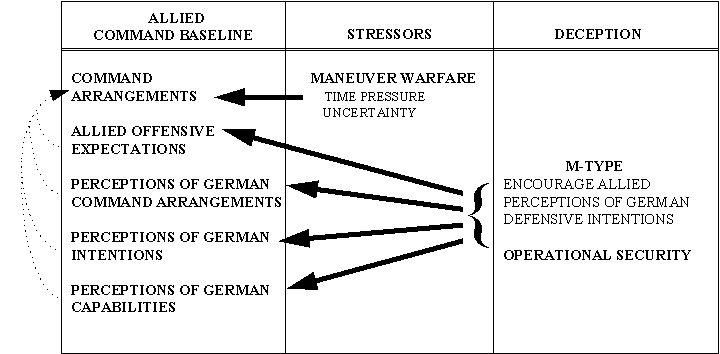
Figure 10: C2W Framework for the Ardennes
The Germans had no other serious C2W component that directly targeted the Allied command baseline. Depending on speed alone, the Germans did not employ another deliberate stressor, for example, a supporting attack in the Ninth Army’s sector north of Aachen. The latter might have added some additional consternation to the Allied command’s recovery from the first surprise. Nevertheless, the Germans did quite well in stressing the Alllies in a negative sense in the Ardennes sector--maintaining a very quiet but crowded neighborhood in the days before the attack on 16 December.
The deception-induced surprise opened the door for the assault, after which the speed of the panzers had to outrun the reactions of the Allied command. Here is where Hitler made the same misappreciation that Eisenhower had made concerning von Rundstedt. If Eisenhower "mirror-imaged" his freedom of decision onto von Rundstedt to run things as he saw fit, then Hitler "mirror-imaged" the limited operational authority he had given von Rundstedt onto Eisenhower. Hitler thought his panzers had time to get to the Meuse and beyond, believing that Eisenhower would have to go to his political superiors (Roosevelt and Churchill) in order to get permission to move reserves and realign commands.
The Allied command was under a tremendous amount of pressure during the campaign. Furthermore, the Battle of the Bulge brought British-American military relations almost to the breaking point. Nevertheless, the Allied command system was able to function sufficiently well to recover from its surprise and develop a feasible plan to halt the Germans east of the Meuse. Eisenhower’s intuition, which may be perhaps a form of accurate pattern recognition, and ability to make good, tough decisions in a stressful situation were a major component of this elasticity.
The German Ardennes offensive surprised the Allied command through the use of extensive operations security and deception. While tight secrecy hid the planning and build-up, the deception plan played directly to the Allied expectation that the Germans were waiting to fend off continued Allied advances into the Reich. The Allies were looking at their own intentions and the Germans’ predictable reactions.
Once the counteroffensive began, however, General Eisenhower’s initial intuitive response set in motion decisions that swiftly countered the German panzer attack in the Ardennes. These decisions tempered the surprise-related command problems during the crucial first week of the German offensive. Also of note, the Germans did not employ any other major C2W stressors, other than speed, to slow the Allied command recovery. In addition to running into numerous small unit road blocks and rapidly appearing reinforcements, the German advance was hampered by the lack of force strength and logistics support. This and the debilitating effects of Allied air attacks gave the Allied command additional time to recover and respond. The Germans’ achievement of a total surprise could not overcome the Allies’ superior material strength and effective command.
The October 1973 Arab-Israeli War also employed deception to launch a surprise offensive. But unlike the German’s Ardennes offensive, the Egyptian achievement of surprise was not intended to make way for a Sinai blitzkrieg. On the other hand, it took a few days for the Israeli defenders to recognize this fact. The analysis follows in the next chapter.
Chapter 6: The October 1973 War in the Sinai
This chapter examines the October 1973 War on the Sinai front from 6 to 14 October 1973. Specifically, the focus will center on Egyptian preparations and Israeli appreciations prior to the conflict, Israeli command problems in the initial days and the subsequent Israeli recovery.
Background and Summary of the Campaign
The October 1973 War was the fourth of a series of major wars between Israel and her Arab neighbors. In the preceding 1967 Six Day War, Israel had won a tremendous victory against a larger Arab force. For their part, the Arabs lost considerable territory in addition to suffering an embarrassing military defeat. Egypt lost the Sinai peninsula and the use of the Suez Canal. Israeli forces occupied the Suez Canal east bank. A tense military and political standoff developed during the period that followed. The stand-off was punctuated by the 1969-1970 War of Attrition, an intermittent series of artillery duels, raids and air attacks across both sides of the canal. Egypt’s leadership acknowledged that they could not quickly gain military parity with the Israelis; however, they were unsatisfied with the political stalemate they referred to as "No Peace, No War." The Egyptians saw the deadlocked status quo as a de facto Israeli annexation of the Sinai. Primarily for this reason, Egypt planned (late 1972) to launch a surprise two-front offensive against Israel sometime in 1973.
Surprise was necessary to offset the Israel’s tactical and technical superiority. The Egyptians also induced Syria to attack on the Golan Heights to make Israel fight on two fronts. The Egyptian objective was to establish a bridgehead on the east bank of the Suez Canal. They believed that by gaining and holding ground on the eastern bank, they could undermine Israel’s security doctrine, which in turn would break the political deadlock. The Israeli security doctrine was based on secure borders, deterrence, holding the initiative and fighting one Arab foe at a time.
The Egyptian plan, Plan Badr, endeavored to force a crossing of the canal, destroy Israeli fortified points and establish defensive positions 10 to 15 kilometers into the Sinai. Comprehensive anti-aircraft defenses were to cover the entire depth of the operation. After gaining the east bank of the Suez, the Egyptians planned to repel expected Israeli armor counterattacks. The initial assault planned for five infantry divisions each supported by an armored brigade. The additional crossing of three mechanized and two armored divisions would put the Egyptian 2nd and 3rd Armies on the east bank within 48 hours. The Egyptians planned to cement the separate bridgeheads into a continuous front by the third day. Follow-on action depended on the progress of this operation against expected Israeli counterattacks and the success of the Syrian offensive on the Golan Heights.
The Israeli plan in the Sinai depended on excellent military intelligence to provide adequate warning for the mobilization of its forces. One regular armor division was positioned in the Sinai behind a series of fortified strongholds positioned along the canal. The strongholds were manned by reserve infantry. The armor division, supported by the Israeli air force, planned to reinforce the strongholds to contain any assault across the canal while waiting for the arrival of the mobilizing reserves. The Israeli Defense Force (IDF) mobilization schedule sent the first mechanized reserves into the Sinai within 48 hours of mobilization. Up to 20 reserve brigades could be available within three to five days.
The Egyptians conducted a major training and re-equipment program from late 1972 through September 1973. Their objectives were to master the technical problems involved in crossing the canal and to train their infantry for employment in an anti-armor defense. The Egyptians mobilized and conducted major maneuvers in December 1972 and even larger maneuvers during April and May 1973. Although Israeli intelligence rated the possibility of war as "low," Israel executed partial mobilizations in response to Egypt’s maneuvers. In September, the Egyptians began a massive mobilization for the annual Tahir 41 exercise, which began on 1 October 1973. They announced a demobilization for 8 October. By this time, the Israelis had observed a total of 20 different Egyptian mobilizations during the period between January and September 1973. Israeli intelligence appraisals continued to rate the probability of war as "low" through this period. In any case, Israeli leadership confidently counted on getting a 48 hour attack warning if this estimation changed.
Due to a significant Syrian force build-up of armor and artillery, Israel focused on the Golan during the latter half of September. The Israelis linked this build-up as a response to a major air engagement on 13 September between Israeli and Syrian fighter aircraft. The assumption was that the Syrian build-up, if not a case of nervous "defensive" saber rattling, was at worst the preparation of a limited reprisal against the northern Israeli frontier. In the first days of October, the Israelis reinforced the Golan front. On 5 October, because of the ever increasing Egyptian activity along the Suez, the IDF put their standing forces on alert on the Golan and in Sinai. Still, Israeli estimates rated war as unlikely, as the activities on both fronts were seen as another repeat of the previous May’s "advancing to the brink."
Israeli intelligence finally concluded at 0430 on 6 October that Egypt and Syria were about to go to war the same day toward dusk. As Israel mobilized, Egypt and Syria launched simultaneous attacks at 1405 hours. The surprise was not a total "bolt from the blue." Nevertheless, Israel unexpectedly found itself unprepared for war at the start of hostilities. During the first two days, the Egyptians achieved their initial objectives with greater ease than anticipated. They crossed the Suez, isolated most of the Israeli strongholds, established a bridgehead on the east bank and repulsed the initial Israeli armor counterattack. During the same period, Syrian armor pressured Israeli defenses on the Golan Heights, penetrating toward the Jordan River in the southern sector. As this threat developed, nearly all Israeli air support on 7 October went to this front to stem the Syrian advance.
During the evening of 7 October, the Israelis planned a two-division counterattack against the Egyptian bridgehead. The plan called for a sequential attack, the first from north to south against the Egyptian 2nd Army (on the Egyptian left) by General Avraham Adan’s division. Adan’s attack planned to converge in front of the second division, commanded by General Ariel Sharon, positioned about 15 miles to the south. Sharon intended to cover the first attack and reinforce it as necessary. If not needed, Sharon’s division was to attack north to south against the Egyptian 3rd Army (on the Egyptian right). Both divisions’ objectives were to roll up Egyptian armor on the east bank, while staying out of range of the infantry positions arrayed near the canal. The plan allowed for crossings to the west bank if things went well..
The execution on 8 October appeared to succeed at first, but then went awry and eventually ended in utter failure. Egyptian infantry mauled two of Adan's brigades, which had frontally attacked with little air, infantry or artillery support. Adan’s attack is depicted in Figure 11. While this was happening, General Shmuel Gonen, the IDF Southern Front commander, ordered Sharon to move his division south to attack west to east at the southern end of the canal. Sharon never got there, but instead was recalled in the middle of the afternoon to return to his starting position. There his division plugged the Israeli center on the left flank of Adan’s battered division to contain a renewed Egyptian advance. In the move south and then back north, Sharon’s division missed the fighting. After all of this, the Egyptians retained the initiative and pressed the Israelis further from the canal. The Israelis lost about 150 tanks.
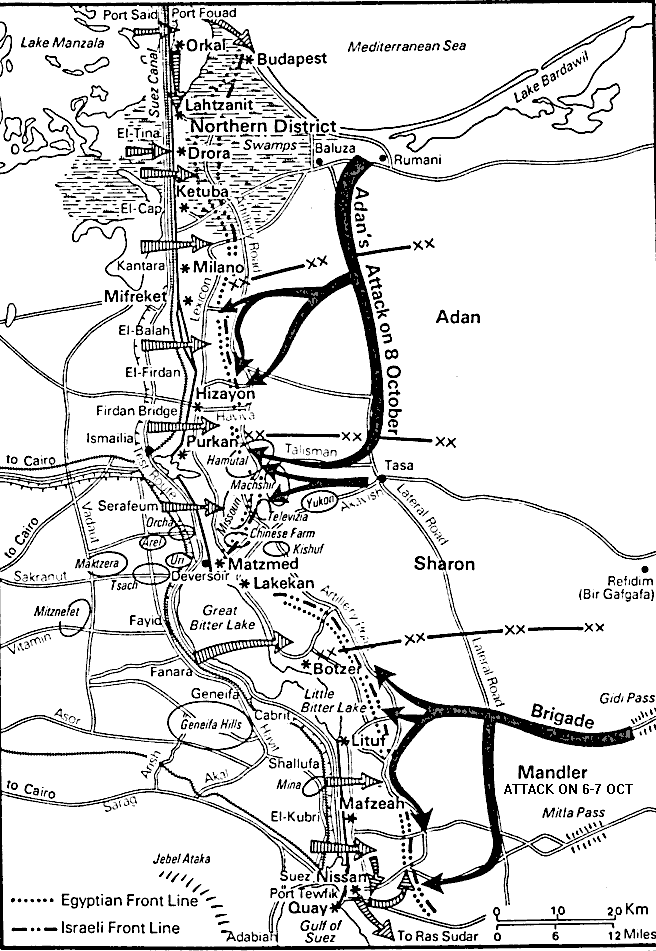
Figure 11: Adan's Counterattack--8 Oct 73
Source: Chaim Herzog, The Arab-Israeli Wars, (New York: Random House, 1982), 252.
After three days of surprises, setbacks and confusion, the Israelis attempted to recover by switching to the defense in Sinai. The IDF reassigned command positions, reorganized forces, and collected their wits. At this point the Israeli leadership decided to wait for the Egyptians to make the next move. Events on the Golan front had in the meantime improved dramatically as Israeli forces steadily pushed the Syrians out of the Golan region and toward Damascus.
Ultimately, this would help turn the tide in the Sinai as well. The Egyptians, under political pressure to assist their Syrian ally, advanced their armor beyond SAM and infantry cover toward the Gidi and Mitla Passes on 14 October. The attack suffered from Israeli air attack and maneuvering armor. The Israelis destroyed a considerable number of Egyptian tanks while only suffering light losses. With the victory, the Israelis regained the initiative in the Sinai and went on to conduct a successful war-ending counteroffensive across the Suez Canal between 15 and 25 October.
Egyptian C2W Campaign against the Israeli Command
The Egyptians needed surprise to unhinge the basis of the Israeli military strategy--the timely mobilization of their reserves. Any attack that commenced prior to or during Israeli mobilization created very favorable force ratios for the attackers. The problem was that Israeli intelligence gathering was quite good. This fact not only made any attempt to hide offensive preparations impractical, if discovered, it also invited an Israeli preemptive attack, something that had occurred before. The solution was an elaborate deception campaign designed to dull Israeli awareness of the impending attack.
The Egyptians planned the deception program after thoroughly analyzing Israeli conceptions and expectations about themselves and Arab fighting capabilities. Not lost on the Egyptian command was a very strong Israeli contempt for Arab unity, combat discipline and the technical capabilities necessary to engage Israeli forces. The Egyptians built the deception plan on two concepts. The first was to encourage existing Israeli expectations about the improbability of an attack due to the Arab inferiority. The second was a deliberate repetitive conditioning of Israeli intelligence concerning Egyptian military activities along the Suez Canal. Together these two components sought to dull Israel’s awareness of the impending attack while stroking Israel’s confidence concerning its conceptions of superiority.
The first component of the deception was fairly straightforward. The Egyptians essentially postured themselves defensively for Israeli consumption. The Egyptians leaked alleged equipment problems to the media and other intelligence channels. They also made extensive defensive preparations in depth behind the front. Additionally, the Egyptians stated their concerns for peace in carefully worded messages to the international media and through diplomatic channels. Whether designed or exploited after the fact, President Sadat’s dismissal of Soviet weapons advisors in 1972 also added weight to the lack of offensive intentions.
The second ploy conditioned the Israelis to view high force levels and a busy state of activity on the west bank as "normal." The Egyptians accomplished this by repeatedly conducting a number of training exercises, both large and small, along the canal region over a ten month period. As the scale of these maneuvers reached unprecedented levels during September, the Egyptians openly conducted normal activities to add ambiguity to Israeli intelligence appraisals. These activities included routine meetings of the high command, state ceremonies, scheduled public speeches and the hosting of international military and political delegations. The lower military echelons kept routine maintenance and "house cleaning" activities in view of the Israelis until just hours prior to the assault. Exercise announcements, the simultaneous set up and dismantling of assault equipment, and the movement of troops both toward the canal and to the rear also added "noise" to the Egyptian signal.
As with all classic deception, secrecy tightly guarded the Egyptians real plans. A select group planned the attack. Dissemination of the plan to the tactical level started on 3 October to the division commanders. Attack details went to the brigade commanders on the 4th, battalion and company commanders on the 5th, and finally to the soldiers during the morning hours of D-Day.
Whether intended or not, there were other distracting incidents complicating Israeli perceptions. The Israelis attributed Syria's force build-up to the 13 September air engagement with Israeli aircraft, rather to some grander design. On 28 September, Arab terrorists seized a train in Austria with Russian Jewish emigrants. This event absorbed the attention of Israeli leaders and the public during the first days of October. The narrow difference between offensive and defensive force postures also increased the IDF's difficulty in appreciating Syrian and Egyptian intentions. Using Soviet doctrine, it took little time for armor and artillery to switch to offensive operations from an initial defensive alignment.
The Egyptian C2W plan after 6 October was much more modest. The Egyptians primarily depended on the shock of surprise to slow Israeli reactions and cause mistakes in the initial IDF counterattacks. Nevertheless, the Egyptians made some effort to increase the IDF’s command difficulties by conducting air attacks against IDF bases and communications centers. On the first day, they also attempted to reach the Giddi and Mittla passes with a light armor unit, coming in close range to the forward IDF Southern Command headquarters. Additionally, special forces units infiltrated in the Israeli rear to attack the C2 facilities and disrupt the organization and approach of the reserves. At the tactical level, the Egyptians jammed radios and used artillery fire to disrupt C2 communications.
Evidence and Analysis of Israeli Command Dysfunction
There were a number of Israeli command problems in the period prior to the attack and during the first three days of the conflict. The following paragraphs examine those problems in light of the failure to avoid surprise and the failure of the 8 October counterattack in the Sinai.
The Egyptians realized they were achieving surprise on 3 October, three days prior to the attack. They had completed their force build-up, yet they saw no indication that the Israelis were responding. Indeed, the Israelis did not conclude that war was at hand until the morning of the attack, three days later. Even at this juncture, Israeli intelligence gave a sure estimate of 1800 hours for the start of the attack, which then occurred at 1400 hours. This four-hour error affected operational command decisions, allowing many tactical units to be caught out of position when the shooting started. After the war, the Israeli government established a commission of inquiry, the Agranat Commission, to determine the underlying reasons for the IDF failure to avoid surprise. The commission’s major conclusions are discussed below.
The commission attributed the failure to three factors in the Israeli Director of Military Intelligence’s (DMI) evaluation of intelligence. The first was an unyielding adherence to "the conception." This was a perception that held to two beliefs: 1) that the Egyptians would not start a war against Israel until they had sufficient airpower to battle for air supremacy and attack Israel in depth; and 2) Syria would not attack Israel unless Egypt also attacked. The second problem was the fact that Israel’s defensive plans rested on a dogmatic assurance of adequate warning to mobilize the nation. Finally, during the days leading up to 6 October, there were many warning indicators that could have prompted DMI’s reappraisal of Arab intentions. These indicators, however, were evaluated incorrectly within the context of "the conception." Thus, the Israelis confidently interpreted the unprecedented Syrian force build-up on the Golan as defensive and the intense Egyptian activity along the Suez Canal as a planned exercise. Israeli logic followed that Syria would not attack because Egypt was not going attack. The reason Egypt was not going to attack was because they did not have the airpower to take on the Israeli Air Force.
Despite significant errors in the evaluation of intelligence, the Agranat Commission also attributed the failure to misappreciations of Israeli Defense Force (IDF) General Staff. The commission concluded that based on known Egyptian and Syrian deployments, the IDF should have partially mobilized shortly after 1 October to maintain an appropriate force balance on each front vis-à-vis the enemy. Additionally, the IDF General Staff’s total reliance on the intelligence branch for sufficient warning led to the omission of any planning for no-warning contingencies. There was no thought as to how the smaller regular standing force would contend with a two-front war while the rest of the IDF mobilized. Another major factor contributed to the overall misperception of the situation. The fact that one organization collected and evaluated all intelligence denied the senior leaders an "official" second opinion. They had nothing on which to anchor their own personal misgivings. DMI’s legendary reputation for being correct made this even more difficult. This organizational arrangement intensified the effect of "the conception."
To summarize thus far, the Israeli command dysfunction prior to the war was its blindness to actual Egyptian and Syrian intentions. "The conception," a persistent capabilities-based perception that confidently assumed that there was no logic for an Arab attack against a superior IDF, contributed significantly to the blindness. The blindness led to surprise and a hurried mobilization to war. Once hostilities began, additional Israeli command problems surfaced, especially at Southern Command in the Sinai. These are addressed below.
Upon receiving word to expect an attack, Gonen directed the regular armor division under General Mandler to deploy in accordance with the standing operational plan, but not until 1600. Gonen selected this timing so as not to appear "alert" to the Egyptians. This plan, named Dovecoat, sent Mandler’s three armor brigades to forward firing positions on the canal to support the strongholds and contest an Egyptian crossing of the canal. The problem was that this deliberate delay assumed that the attack would commence at 1800. When the attack began at 1400, the Israeli tanks were still sitting in the rear. Tactically surprised at the timing of the assault, the closest brigade was in the wrong place and could not execute a plan that was rapidly being overcome by events.
The effects of the strategic surprise swept into the operational and tactical levels in other ways as well. The Egyptian assault precipitated calls for assistance from the strongholds all along the canal. Israeli armor responded in haste, dispersing into small elements everywhere without supporting infantry and artillery. The Egyptians rudely greeted them with anti-tank missiles. This fate befell the first brigade and then the following two brigades some hours later. By the morning of 7 October, Mandler’s division had lost two-thirds of its armor and had been unable to slow the Egyptian assault. Although it took some hours for the bad news to reach Southern Command and the General Staff, it appeared that the higher command echelons quickly appreciated the significance of the new tactical dangers. This awareness was evident in the guidance General David Elazar, the IDF Chief of Staff, gave Gonen the night prior of the 8 October counterattack (the second point given below). The counterattack employed the two reserve armor divisions that were arriving at the front on the night of 7 October. The divisions were commanded by Adan and Sharon. The counterattack objective was to "roll up" Egyptian armor in the bridgehead in a two phase attack. Adan’s division planned to make the first attack, followed by Sharon. Elazar gave his guidance as follows:
(1) The IDF was to conduct the attack east of the canal against armored concentrations in the opposing two armies’ bridgeheads (2nd and 3rd Egyptian Armies).
(2) The attacking forces were not to approach the canal at a range that would leave them vulnerable to the anti-tank missiles set up on the embankment. They were also not to get "bogged down" in the trenches dug by the Egyptian infantry.
(3) Israeli armor would attack in a flanking movement--from north to south or south to north, according to the plan finalized--and not frontally from east to west.
(4) The aim of the attack was not to cross the canal. This would be permitted only if the attack had extraordinary success--meaning the destruction of most of the armor in both bridgeheads. Similarly, the objective of the attack was not to rescue the men in the fortifications. A rescue would be attempted only if circumstances changed.
(5) At every point throughout the day, only one of the three armor divisions would engage in mobile battle. The other two would hold position to support the attacking division. The third division, commanded by Mandler, would not take part in any offensive action.
Elazar’s strategic intent put the main IDF effort on the Golan front where the threat to Israel’s security was more acute. This included the majority of the air support. The IDF attack in the south was not the main effort. Its purpose was to stop additional Egyptian advances and establish the conditions for the IDF to take the initiative--without squandering forces. However, during the early hours of 8 October Gonen began changing the plan to include rescue attempts of the strongholds, which called for close approaches to the waterline, which also implied subsequent crossing attempts. Gonen's plan, submitted later to the General Staff, included the change, but it was apparently missed or misunderstood by Elazar and his staff. Disrupted communications also confused matters. Unable to contact Adan directly, Gonen tried to change Adan’s attack orders (to rescue strongholds and make crossings) prior to dawn through a radio relay. Adan, who did not realize that Gonen was changing the agreed-upon plan, thought Gonen was asking him if it was feasible. Orders also went to Sharon to rescue the strongholds depending on how the situation developed with Adan’s attack. Sharon prepared his division thinking that the rescue was now the main plan.
Even before the counterattack had begun, the Israeli operational command in the Sinai was dysfunctional. The two attacking division commanders were not conceptually working the same plan that Gonen at Southern Command was now contemplating. Gonen, on the other hand, went well beyond his original guidance and was attempting to win the Sinai war in one day. His plan sought to annihilate enemy armor, rescue the strongholds and cross over to the west bank of the Suez Canal. It was as if he already assumed the "extraordinary success" that Elazar had earlier specified. Since Gonen had sent his written combat plan to the General Staff, he also probably thought Elazar knew and approved of its broader scope. Elazar meanwhile thought Gonen was going to execute the phased attack agreed upon the night before.
The command was further confused by misperceptions that emerged during the attack. Egyptian communications jamming and shelling of divisional C2 nodes contributed to these misperceptions. However, Egyptian actions were not the primary factor. After two days of enduring shocks and disappointments, the Israeli command was hungry for good news. Thus, when Gonen’s Southern Command staff monitored the tactical nets during Adan’s attack, they readily heard what they thought to be success from intermittent and confused communications. Like wildfire, encouraging but unconfirmed reports traveled quickly to the General Staff. These early reports suggested that Egyptian units were breaking and that Adan’s brigades were crossing the canal. Although Elazar himself was skeptical that extraordinary successes could be occurring so easily so soon, he nevertheless approved Gonen’s requests to send Sharon’s division immediately to cross the canal at the southern end. During this time, Adan could not discern clearly what was happening to his attacking brigades. Sharon, who was in the better position to see the battle, pulled out to head south as ordered. In the meantime, the Egyptians roughly handled two of Adan’s brigades and began to advance eastward toward the high ground that Sharon had vacated. Later Gonen realized that Adan was having trouble and recalled Sharon back to his starting position. It was later still that Elazar realized that not only had things gone badly, but that the Southern Command had executed some other plan. The Defense Minister, Moshe Dayan would later sum up the battle: "There was confusion at the highest levels about the battle plan, and Southern Command had little idea of what was happening during the course of the day’s fighting."
The reasons for this command debacle extend beyond the Egyptians’ surprise. There were other significant factors that played into the Israeli command problem--problems that were mostly self-induced. To start, the same strong preconception of superiority that blinded the Israeli command to the surprise attack also influenced their decisions that followed on the operational battlefield. They expected success against a foe who historically did not fight well or last long against them. This perception derived "good" news from the fog of battle and confirmed confident expectations at the higher echelons. Second, the Israelis dealt poorly with the stress of time pressure--both real and self-induced. The proximity of the Syrian armored threat to Galilee added time pressure stress on the Chief of Staff and the General Staff. This initial danger may have loosened their oversight of Gonen’s planning and execution on the Sinai front.
Why Gonen was in such a hurry to increase the scope of the 8 October counterattack is more difficult to determine. A general concern that superpower intervention might freeze Egyptian Sinai gains may have influenced the haste. Another factor was perhaps Gonen’s concern for the IDF soldiers left surrounded in the strongholds. The fact that the IDF had a strong tradition of not abandoning their own made this a disquieting command dilemma. While these two factors may have induced internal perceived time pressure, the facts were that Gonen did not have most of his infantry and artillery, that he was not going to get much air support, and that he did not have a good reconnaissance picture of Egyptian dispositions. If the Egyptians were about launch another attack, there were advantages in letting them expose their armor without infantry and beyond the reach of their air defense. All of these points might have given Gonen and his staff more reason to go slowly. In any case, the Southern Command hurried, to the advantage of the Egyptians.
The Israeli Command Recovery
The Israeli command in the Sinai began its recovery on the evening of 8 October when it became apparent to Elazar that the counterattack had failed to adhere to the original plan. Elazar ordered the Southern Command to defend its current positions and forego any offensive action until conditions on both the Golan and Sinai fronts made that possible. Even so, one of Gonen’s divisions (Sharon) frustrated this order by taking offensive action toward the Suez Canal on 9 October. This prompted Elazar to change the structure of the Sinai front’s command late on the same day, installing retired General Bar-Lev as his Deputy Chief of Staff for all Israeli forces in the Sinai. Elazar also subdivided the region into smaller zones. Gonen remained in the chain of command on the Canal front under Bar-Lev. For the next several days the Egyptians carried out limited offensive operations to solidify their bridgehead positions; however, they suffered high losses when they attempted to push deeper into the Sinai. Their increased difficulties corresponded to Israeli tactical adjustments and improving command confidence.
The recovery of the Israeli command was also evident in the analysis and deliberation of its strategy to conclude the war. The difference was that the Israeli command now fully appreciated the determination and skill of the enemy. The IDF leadership reflected this appreciation in a nine-hour debate on 10 October that chose a course of action from three options:
1) Attack on the Syrian front, hold in Sinai, and maintain current force apportionment;
2) Attack on the Syrian front, hold in Sinai, and shift Sinai armor to the Syrian front; and
3) Hold on the Syrian front, attack in Sinai, and shift armor from the Syrian front to Sinai.
The first option was intended to improve the Israelis’ post-war bargaining position by taking Syrian territory to offset the Egyptians’ Sinai gains. The second option was the same as the first except that it shifted armor from the Sinai to reinforce the push into Syria. This option increased the chance that Israeli forces in the Sinai might lose additional ground to the Egyptians. The third option halted the ongoing Israeli push against Syria near the 1967 cease-fire line and shifted armor forces to the south for a counteroffensive against the Egyptians. The disadvantage common to the second and third options was the four to five day transit time for the armor between fronts. Weighing of the options, the Israeli command considered time to be the critical factor and thus opted for the first option. This ultimately worked in their favor. IDF gains against the Syrians brought political pressure to bear on the Egyptian command. This ultimately moved the Egyptians to make the costly attempt to push out of the bridgehead and take the Sinai mountain passes.
Analysis in View of the C2W Framework
The Egyptian C2W campaign against the Israeli command prior to 6 October is depicted in Figure 11. To achieve surprise, the Egyptians used two deception schemes. The first deception encouraged strong Israeli perceptions regarding their overall superiority, assurance of attack warning and Arab disunity. All of these influenced the Israeli "low probability" estimate of an Arab attack. The second deception conditioned the Israelis to expect a high level of activity along the Suez. As Egyptian attack preparations became more obvious, the two deceptions combined to blend misdirection and ambiguity to forestall a change in Israeli appreciations until the morning of the attack. Both deceptions specifically targeted Israel’s military intelligence, DMI, the only agency with that responsibility. The significant stressor during this period derived from the potential political ramifications of a mobilization.
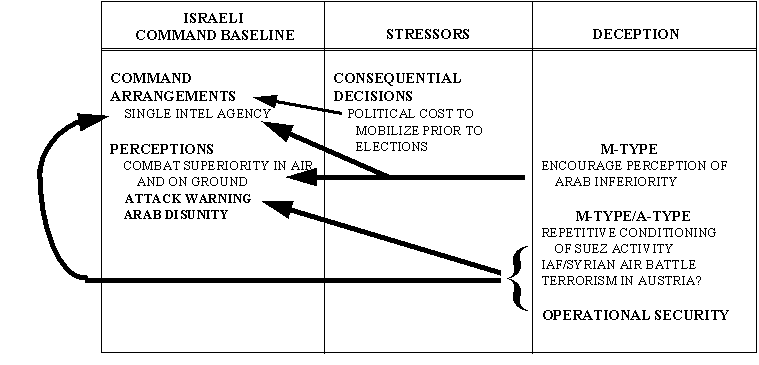
Figure 12: C2W Framework for Arab-Israeli October 1973 War--Prior to 6 October
Figure 13 depicts the C2W framework of the Israeli command upon the start of the attack until its recovery on 9 October. The Egyptians made modest attempts to disrupt Israeli C2 using mobile raids, artillery and electronic radio frequency jamming. The latter two efforts increased the difficulty of Israeli communications at the tactical and operational command levels. While the effect of jamming and C2 targeting would ordinarily increase a commander’s uncertainty about ongoing operations, in this case it denied the evidence that may have given the Southern Command (Gonen) and the General Staff (Elazar) reasons to question their confidence. The seriousness of the Golan threat focused consequential decision stress and time pressure upon the General Staff. The result most likely reduced Elazar’s oversight of the planning and execution of the 8 October counterattack in the Sinai. At the same time, it appeared that the Southern Command was under self-imposed time pressure to rescue the strongholds and to take ground on the west bank of the Suez. This had to occur before superpower intervention precluded the opportunity. As far as Israel’s command dysfunction in the Sinai, these stressors (C2 attack, consequential decisions and time pressure) intensified the major cause of their problems--overconfidence.
As a final thought, one must analyze the Egyptians’ modest C2W plan after 6 October in light of their strategic objectives. If the objective was to establish a foothold on the canal, the elaborate deception scheme was sufficient to attain the surprise to achieve this aim. If they intended to reach the Sinai mountain passes, there may have been an opportunity shortly after the Israelis’ badly executed counterattack on 8 October--while the IDF command was still sorting itself. However, the Egyptians did not have a C2W mechanism to prolong Israeli command dysfunction or induce it again to support their attack on 14 October. In any case, the Israelis had stopped contributing to their own command misfortunes.
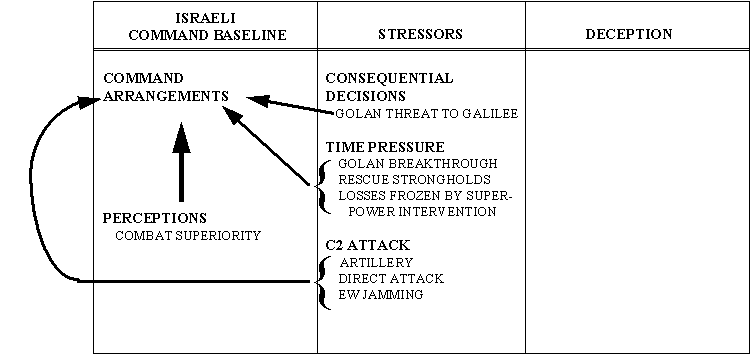
Figure 13: C2W Framework for Arab-Israeli October 1973 War
, 6-8 October
Conclusion
The Egyptians and Syrians successfully planned and executed a deception program that exploited strong Israeli perceptions of force superiority and assured attack warning. This enabled the Arabs to unleash a surprise assault on two fronts.
The same strong perception of superiority that leveraged the Arab surprise also played a major part in the Israeli command’s misappreciation during the first three days of the conflict in the Sinai. Although the Israelis were relatively quick to appreciate the Egyptians’ use of new weapons and tactics, they were slower to correct their hurried and overconfident "shoot from the hip" decisions. This was apparent during the 8 October Sinai counterattack--an endeavor that ran blind to reality and amok in confusion.
After the initial attack, the Egyptians did not have a significant C2W mechanism to prolong or induce further Israeli command dysfunction. The Israeli Southern command began its recovery when the IDF Chief of Staff ordered it on the defensive on 9 October. This enabled the IDF to adjust their appreciation of the enemy and make better decisions.
Chapter 7: Conclusions and Implications
Chapter 2 examined the limitations of rational decision making and concluded by describing the tension between rational and intuitive judgment. Chapter 3 elaborated on this line of thought by adding the notion that both rational and intuitive decision processes are susceptible to stress and deception. Chapter 3 also developed a cognitive warfare framework to model the action of stress and deception upon a command baseline. Chapters 4, 5 and 6 used the framework to analyze three historical cases: the Allied Normandy campaign, the Battle of the Bulge, and the Arab-Israeli October 1973 War. This chapter analyzes the cognitive warfare framework in light of the conclusions of the historical case studies. The aim is to answer the research question: What factors or conditions lead to command dysfunction?
Comparison of the Historical Cases: Deception
In all three cases, the attacker employed deception to exploit the adversary’s expectations. Each deception varied in its objectives, techniques and duration as a result of the specific setting in which it was used. Strong expectations within the targets' baseline greatly assisted all of the deceptions.
The deception that set up the German Ardennes surprise offensive was the simplest of the three. The ploy encouraged the Allied view that German intentions were defensive. The scheme was primarily one of misdirection. Poor weather, forest cover, night movements, and very tight security cloaked the Germans’ real intent. The deception ended on the morning of the attack.
The Egyptian deception was similar to the German scheme in that it achieved surprise for an attack. However, the deception’s design was more complicated. Like the German plan, the Egyptian scheme employed misdirection to encourage the enemy’s perceptions of non-offensive intentions. However, the Egyptians had little natural cover to hide their forces, so they conditioned Israeli perceptions to accept high levels of activity on the Suez front. Furthermore, as the extent of attack preparations peaked at a new high, the deception employed additional routine "exercise" signals to increase the ambiguity of the Israelis’ overall picture. Nevertheless, the Egyptian ploy was similar to the German Ardennes deception in that it also ended once the attack began. Both the German and Egyptian deceptions achieved surprise in the "if" category; they surprised the victim that an attack was even going to occur.
This is one of the main distinguishing differences of the Allied deception in the Normandy campaign. In 1944 the Germans knew the Allies were coming but they did not know exactly when or where. The deception, Fortitude South, subtly multiplied the options against which the Germans had to defend. It encouraged the German perception that the main landing would take place on the Pas de Calais coast. It also conditioned the Germans to expect a diversionary landing. The two misdirection schemes together created an uncertainty in the German command that did not end when the Allies came ashore at Normandy. The ambiguity as to whether Normandy was the main effort or merely a diversion lingered on for some weeks.
Stressors
Table 1 lists the stressors uncovered in the historical cases. The evidence appears to indicate that all but one of the stressors were by-products of other combat related factors. The exception was timing of the Egyptian attack. By conducting their third major force build-up in ten months and timing it just before the Israeli elections, the Egyptians applied a consequential decision stressor against the Israeli political leadership. The Israelis had to calculate the political costs of mobilizing the IDF for another possible false alarm. The following paragraphs review the other indirectly produced stressors.
Table 1: Comparison of the Historical Studies: Stressors
|
CAMPAIGN |
CONSEQUENTIAL DECISIONS |
UNCERTAINTY |
TIME PRESSURE |
|
NORMANDY
PRIOR D-DAY
POST D-DAY |
ALLIED AIRPOWER
GERMAN DEFENSIVE STRATEGY BELORUSSIAN OFFENSIVE
CENTRALIZED CONTROL OVERWHELMED |
MANEUVER WARFARE
ALTERNATIVE OBJs |
AIRPOWER MANEUVER WARFARE
GERMAN "OODA" CYCLE |
| ARDENNES |
MANEUVER WARFARE
ALTERNATIVE OBJs |
MANEUVER WARFARE
ALLIED "OODA" CYCLE |
|
|
OCTOBER 1973
PRIOR D-DAY
POST D-DAY |
IDF MOBILIZATION
POLITICAL COSTS GOLAN THREAT
|
GOLAN THREAT
LOOSER OVERSIGHT ON SINAI |
GOLAN OVERCONFIDENCE THREAT STRONGHOLDS US/USSR ACTION
SELF-INDUCED TIME PRESSURE |
Prior to D-Day, Allied airpower induced consequential decision stress upon the German command by frustrating both of its defensive options, whether to position its armor forward or deep within the theater. After D-Day, allied airpower put time pressure on the German command by slowing the movement of reinforcements and denying the use of aerial reconnaissance. The effect stretched out the German "OODA" cycle relative to the Allies. The Allies capitalized on the slower German "OODA" cycle after the breakout. The added stress of uncertainty caused by the Allied war of maneuver exacerbated the dysfunction of the German command. The Soviet Belorussian offensive added another consequential decision stressor to the Germans’ operational decision making in Normandy. This is discussed further under command baselines.
During the Battle of the Bulge, the German thrust into the Ardennes produced both time pressure and uncertainty stresses within the Allied Command. The Germans’ lack of material resources, their failure to clear the shoulders of the penetration, Allied airpower and the relatively quick Allied command response tempered these effects. In addition to disrupting the momentum of the advance, the relative narrowness of the penetration helped the Allies discern the Germans’ objectives.
During the Arab-Israeli October 1973 War, the immediate Syrian threat on the Golan exerted time pressure, uncertainty and consequential decision stress on the IDF command. Israel’s limited geographic depth offered little opportunity for failure. These stresses may have loosened the oversight of the events that occurred in the Sinai. In the Sinai, the Israelis appeared to put time pressure on themselves to rapidly defeat the Egyptians. The self-induced time pressure stemmed from overconfidence, concern for cut-off Israeli strongholds, and perceptions of imminent superpower intervention. Egyptian radio jamming had the exceptional effect of assisting the rapidity of incorrect Israeli operational decisions by obscuring actual events.
Command Baselines
The earlier discussion of deception revealed that each target command had strong perceptions about its attacker. In each case, the attacker encouraged these perceptions. Also noteworthy is the fact that each command had internal problems. The Germans at Normandy were in the worst shape. OKW, under Hitler’s domination, exercised tight operational control in Normandy from East Prussia. Hitler, who had a propensity to become mired in tactical details, had little comprehension of the theater’s operational problems. The 20 July assassination attempt against Hitler subsequently aggravated existing internal problems within the German command. Even if the Allies had terminated Fortitude South after D-Day, the dysfunctional German command would have been hard pressed to conduct a successful defense in the midst of secret police purges and the problems of the Eastern Front.
The Allied command during the Battle of the Bulge also had internal difficulties, exhibited by strong personal grievances between Montgomery and Bradley. However, in stark contrast to the German Normandy case, the Allies were able to maintain a coherent unified command despite these problems. The Israeli command in the Sinai likewise dealt with personality conflicts among some of its operational and senior tactical leaders, notably Gonen and Sharon. These conflicts contributed to some of miscues during the 8 October counterattack. Afterwards, the IDF adjusted the chain of command to minimize the operational impact of personality friction.
Combination Effects of Stress and Deception
The historical studies appear to confirm the deception-time stress logic. The Egyptian and Allied deceptions capitalized on lengthy pre-invasion periods to condition Israeli and German perceptions. However, there were additional factors that also affected their timing problem. These factors included attack readiness, weather, tides and currents, and moon illumination. In the Egyptian case, the timing also exploited the observance of religious holidays on both sides and upcoming Israeli elections. Thus, while tempo manipulation may be an important factor for the success of a deception, it is only one of several timing issues to consider.
The German Ardennes deception provides another insight to the deception-time stress interaction. The Germans only had to encourage existing Allied perceptions to set up the Ardennes counteroffensive. The deception-time stress logic would have called for a German attack at the first opportunity to deny the Allies time to detect the impending offensive. For the Germans, this first opportunity occurred in late November, the start of a predicted poor weather period for Allied airpower. However, the Germans had to delay the offensive for nearly three weeks because of Allied air and ground pressure in other sectors. This highlights the importance of possessing the initiative to exploit deception and timing. A deceiver with the initiative can blend deception and tempo as needed, as happened in the other cases. However, without the initiative, the ability to manipulate the pace of events is much more difficult. This was the German problem. Allied pressure complicated the German effort to concentrate forces in the attack sector and to react to Allied initiatives elsewhere. Although the later start exposed the German counteroffensive to Allied air attack sooner than originally anticipated, the delay did not undermine the effectiveness of the original deception. The implication is that manipulating time pressure to reinforce deception is not always necessary.
The Arab-Israeli 1973 conflict illustrates one other possible cognitive C2W combination, that of deception and consequential decision stress. The Egyptian deception encouraged Israeli perceptions about the unlikelihood of an attack. At the same time, Israeli leadership was reluctant to incur the political consequences of a costly mobilization if it proved unnecessary. This motivation was especially operative during an election campaign. It is difficult to determine whether or not the absence of election stress would have made it easier for Israel’s leadership to mobilize. In any case, the desire to avoid political costs could only reinforce Israeli perceptions that an attack was unlikely.
The Tension Between Decision Making Speed and Accuracy
Chapter 3 analyzed the tension between decision speed and accuracy as an important starting point for a cognitive approach for C2W. The requirement for speed in a dynamic environment tends to call for intuitive decision processes. Conversely, the need for accuracy generally calls for a more analytical approach. The intuitive process is fast but can lead to poor decisions when a commander’s intuitive skills do not fit the problem. This is usually due to insufficient pattern recognition. On the other hand, the analytical approach generally yields accurate decisions but normally takes more time than may be available. The question is whether or not this decision accuracy-speed approach is useful for cognitive C2W analysis? One way to tell is to use it to examine the historical cases.
The centrally-controlled German command during the Normandy campaign was beset with organizational and personality problems. It is therefore difficult to say with confidence what additional effect Allied actions had in furthering these problems. Nevertheless, there are several insights to consider. First, one would expect the Germans to analyze the Allies’ probable courses of action for the invasion of the continent. The German problem was the vulnerability of their analytical decision processes to deception. The vulnerability stemmed from the lack of reliable intelligence channels. While the Germans had radio intercept capabilities, they had little aerial reconnaissance. They therefore depended heavily on a system of agents that the Allies had compromised. The Allies exploited this analytical weakness by feeding the fiction of Fortitude South to the Germans. The Allies also profited by reading German command appreciations provided by ULTRA. Second, whether intentional or incidental, Allied maneuver warfare and airpower exploited the speed end of the decision accuracy-speed continuum. The German command was vulnerable here as well. When the situation demanded quick, intuitive decisions to save the German 7th and 5th Panzer Armies from encirclement, the German command did not react in time. It appears to have been attempting to analyze a battle whose major features it was no longer able to recognize.
In the Ardennes campaign, the Germans adroitly let the strength of Allied perceptions (and unknown to the Germans, their reliance on ULTRA) impair their analysis of German intentions. However, once the offensive began, the Germans had no means to affect the accuracy and speed of Allied decisions except for the psychological dislocation that could be caused by an armored breakthrough. The Allied command recovered relatively quickly, in part due to Eisenhower’s intuitive judgment, but also because Allied air supremacy, the tenacious resistance of scattered American defenders and the Germans’ lack of resources slowed the advance.
The "accuracy-speed" analysis of the Arab-Israeli October 1973 war also provides useful insights. Like the other cases, the Egyptian deception attacked the accuracy of Israeli appreciations, skillfully conditioning the Israelis’ analysis of Suez-front activity. What is interesting is the failure of the Israeli counterattack in the Sinai on 8 October. Although it appears that the Egyptians knew how the Israelis would respond to the assault, the Israelis themselves are responsible for rushing into the battle with haste and overconfidence. The Israeli Southern command did not take the time to analyze what was actually happening in the battle. Instead, they intuitively acted on patterns remembered from the Six Day war of 1967. The Israeli command in the Sinai recovered when they slowed their own operating tempo--and analyzed what had actually occurred.
Conclusions
The insights gained from the historical analyses demonstrate that the cognitive warfare framework is a useful C2W analytical tool. The framework arranges the cognitive C2W approach as an integrated whole. It compels one to understand the target command prior to applying stress and deception schemes against it. The analysis requires detailed and accurate human intelligence about an adversary’s cognitive and perceptual tendencies. It also requires understanding on how stress and deception generally impact decision making in order to apply them against a specific target command.
The target command is the starting key to C2W. This is not a new revelation, but it is important in light of the next conclusion. In all three historical cases, however skillful the actions of the attacker, it seems that the success of the C2W effort depended greatly on what the adversary was already doing to himself. This was especially apparent in the Normandy and Arab-Israeli examples. The suggestion is that every command baseline probably carries at least some dysfunctional baggage that is vulnerable to deceptive exploitation.
Although we do not fully understand the impact of stress, the extant literature suggests that stress causes decision makers to channelize or curtail their problem-solving efforts. This paper gave particular attention to the stressors of consequential decisions, uncertainty and time pressure. These factors were included in the cognitive warfare framework as deliberate C2W mechanisms. The historical studies revealed the presence of these stressors; however, the evidence also showed that they were not necessarily the result of a planned C2W scheme. It appears that a stressor can also arise as a by-product of other operational actions. Furthermore, some stressors ensue from circumstances that are independent of the attacker’s C2W design. The Arab-Israeli October 1973 War showed such a mix. After gaining initial surprise, the Egyptians deliberately jammed Israeli command nets to increase uncertainty. The Syrian threat on the Golan and the Egyptian threat against the Suez strongholds also indirectly induced consequential decision stress and time pressure upon the Israeli command. Finally, the threat of early American intervention, seemingly independent of Arab objectives, added time pressure to Israeli perceptions.
The theory of deception is connected to the human mind’s perceptual and cognitive biases. Because these biases are difficult to overcome in the presence of contradictory evidence, deception can be a powerful C2W tool. The historical studies confirmed this power, particularly when the deception encouraged the target’s existing biases and perceptions. Additionally, the cases showed the painstaking detail that that is usually necessary for deception planning and execution. Each scheme was custom-fit to the victim’s command baseline.
There also appears to be a relationship between deception and stress, particularly with respect to time pressure. The logic permits the deceiver to quicken or relax tempo to enhance deception effectiveness. The decision to relax or increase the pace depends on whether or not the victim has accepted the "right" solution. If he has, the deceiver may increase the tempo to limit the victim’s opportunity to detect the error. If the victim has not accepted the "right" solution, then more time is needed to condition him to do so. However, there are other factors that affect the equation. One factor is the ability to maintain the initiative. Before the Ardennes offensive, the Germans lacked it. Thus, they were unable to exploit the timing of their deception-cloaked attack.
The Factors and Conditions of Command Dysfunction
The research question asked what factors or conditions lead to command dysfunction. The answer is that there may be many. The fact that every commander perceives and decides with a unique set of cognitive limitations, biases and perceptions implies a number of variations for possible C2W exploitation. The Normandy study hints that significant internal problems within the command can give rise to serious dysfunction with little or no external input. The adept use of stress and deception can intensify that dysfunction. On the other hand, the Ardennes and Arab-Israeli studies suggest that seemingly healthy commands can be deceived, surprised and stressed--and yet still recover given other advantages. Although none of the examples illustrated the successful employment of stressors without deception, this does not necessarily preclude the possibility. It follows from this observation that a command possessing great skill and material resources could stress the opposing command by presenting multiple threats in a short period of time.
The Ardennes and Arab-Israeli studies also bring another consideration to the C2W problem. Both the Allied and Israeli commands recovered from surprise. Both also possessed superior forces, in quality if not in numbers. However, in both cases their attackers did little to prolong the surprise or induce other command problems once the attack started. This suggests that a weaker command’s C2W effort needs to maintain pressure on its target to slow or stop its recovery. The same is probably true for any C2W effort.
Doctrinal Implications
The conclusion that an opposing command may carry its own dysfunctional baggage does not require a change to the current C2W doctrinal definition; however, it may warrant some shifts in our C2W perspective. First, rather than viewing offensive C2W as something we do to the enemy command, we might take the approach of finding the added increment the adversary needs to contribute to his own disaster. In some cases, the best C2W plan may leave the enemy command alone. Second, we might be more cautious in putting too much weight on any particular C2W strategy when we do not fully understand how the enemy thinks. Furthermore, we are not immune to self-induced dysfunction. We may have difficulty discerning internal problems that are readily apparent to the enemy. The ramification is that we might better appreciate our own blindspots and vulnerabilities if we mentally live in the enemy’s camp and learn to think like him. This suggests that every operational level command needs a culturally-attune, knowledgeable and imaginative "red cell" that is constantly attempting to replicate for the commander what is going on in the mind of the adversary. From this perspective, the cognitive warfare framework is multi-sided.
The tension between decision speed and accuracy may warrant another shift in our C2W perspective. One of the propositions of C2W doctrine, as stated in Joint Pub 3-13.1, states that:
Synchronized C2W operations should enable a JFC [Joint Force Commander] to operate ‘inside’ an adversary’s decision cycle by allowing the JFC to process information through the C2 decision cycle faster that an adversary commander.
This statement concentrates on the speed side of the speed-accuracy continuum. Deciding faster (and more accurately) than the enemy is not the issue, it is the inference that we always desire to disrupt the speed of enemy decision cycles. The inference may ignore occasions when we want the enemy command to maintain or accelerate its decision cycle because its information is inaccurate--or give it more time to digest inaccurate information. Joint Pub 3-58, Joint Doctrine for Military Deception, highlights this subtle deception-time requirement:
A deception operation requires careful timing. Sufficient time must be provided for its portrayal; for the adversary’s intelligence system to collect, analyze, and report; for the
adversary decisionmaker to react; and for the friendly intelligence system to detect the action resulting from the adversary decisionmaker’s decision.Although Joint Pub 3-13.1 emphasizes the requirement of integrating all C2W elements, it fails to address the more complicated timing problems of deception in the discussion of decision cycles.
Finally, given that the cognitive warfare framework is a useful analytical tool, how does it fit into overall C2W doctrine? Another way to ask this question is, what portion of C2W resides outside the cognitive warfare framework? At first glance, it seems the ability to destroy C2 targets is the portion that exists outside the framework. However, the answer is much more complicated. Is the capability to kill an operational commander with a long-range, precision-fire outside the cognitive framework, or is it a new "stressor?" It seems to be a stressor while one is vulnerable (and cognitively affected). If successfully employed, direct attack kills the decision cycle, literally. However, killing one commander’s decision cycle could induce stress on surviving C2 systems, such as other similarly threatened portions of the chain of command. Likewise, other operational actions can induce stress and support deception within the cognitive warfare framework, as was illustrated in the historical studies.
The difference does not reside in the physical method of the attack, but in the object of the attack. The cognitive approach focuses on the perceptions and thinking of the commander, seeking to alter the speed and accuracy of his decisions. It considers the enemy commander’s C2 system in terms of accuracy and speed, and deals with it accordingly. The other approach to C2W views the problem as a system flow. This approach focuses on the C2 system that supports the entire command, seeking to slow or shut down its information flow. It views the command echelon as a major flow component, and removes or destroys it as appropriate and feasible. These are complementary approaches that may operate simultaneously.
Further Research
Military professionals and theorists have written most of the insights concerning the art of operational decision making. Until recently, the cognitive and psychological scientific disciplines had not specifically addressed military decision making environments, especially in regard to stress. This trend had changed during the last ten years, with increased interest now focused at the tactical decision making level. This study suggests that additional research be conducted to study cognitive decision processes at the higher operational levels of war. Such research should examine a larger sample of combat operations to explore the underlying tension between decision speed and accuracy, and how decision makers attempt to satisfy both.
Additional research is also needed to investigate the types and effects of stress are not considered in this study. These include sleep deprivation, hunger and fear. Additionally, the investigation needs to uncover the cognitive effect of these stressors when applied in combination. All such research, however, should build on the basic framework presented in this study: command dysfunction is based on the interaction of the command baseline, stressors to that baseline, and deliberate deceptive actions by a thinking opponent.
The most critical battlefield is the one least understood. The first cognitive war is to understand how we decide. The next battlefield is the enemy’s mind--how he sees us and himself. The objective is not to be out-thought.
APPENDIX A
Janis Vigilant Problem Solving Approach
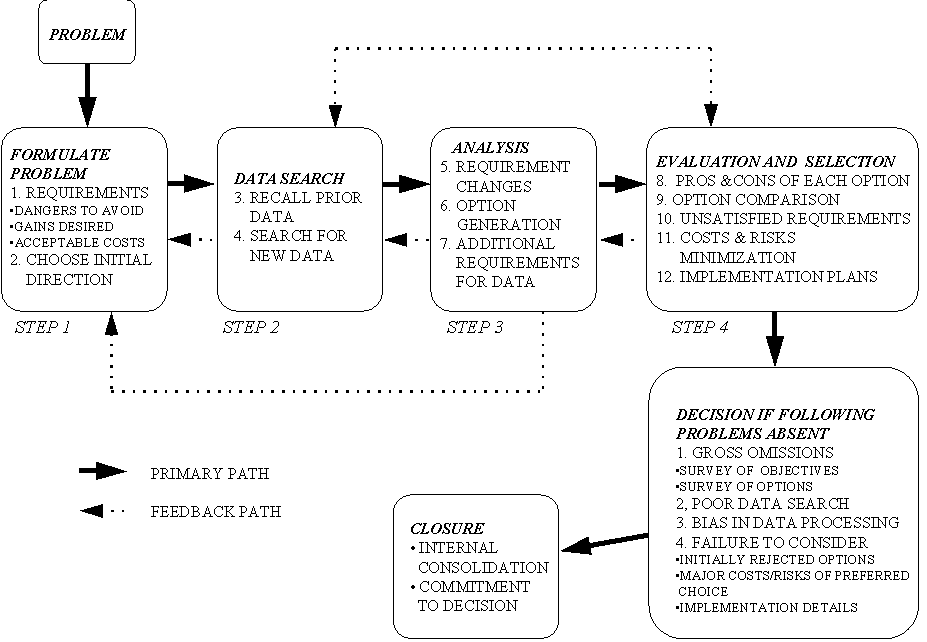
Vigilant Problem Solving Approach to Decision Making
Source: Irving L. Janis, Crucial Decisions, (New York: The Free Press, 1989), 91
The Vigilant Problem Solving Approach flows in four major steps. The first step formulates the problem in terms of acceptable costs and desired gains which, in turn frames the initial direction for the data search of the second step. The third step updates changes in requirements, generates potential solutions and tasks additional data search as required. The last step selects the optimal solution and plans its implementation in the absence of any major decision errors noted in the box below. The process is iterative which is indicated by the dotted feedback path arrows between the steps.
APPENDIX B
BIAS-DECEPTION RELATIONSHIPS
Perceptual Biases
|
Bias |
Deception Implication |
|
Expectations influence perceptions. More unambiguous data is required to recognize an unexpected event than one that is expected. |
It is easier to reinforce existing perceptions than to change them. |
|
Perceptions form quickly but resist change. Once formed, perception of new data is biased toward the initial impression. |
It is easier to reinforce existing perceptions than to change them. |
|
Initial exposure to ambiguous patterns interferes with accurate perception even as more and clearer data becomes available |
The sequence of the information fed into the target impacts the deception ploy. |
Source: Adapted from Richards J. Heuer, "Cognitve Factors in Deception and Counterdeception" in Donald C. Daniel and Katherine L. Herbig, eds., Strategic Military Deception,, (New York: Pergamon Press, 1982), 62.
Cognitive Biases
|
Biases in Estimating Probabilities |
Deception Implication |
|
"Availability" influences estimates. The probability of an event is higher if one can easily imagine it. |
Those charged with watching for certain events overestimate their probability of occurrence. ("Cry Wolf" tendency) |
|
"Anchoring" incrementally adjusts estimates in response to new data. |
It is easier to reinforce existing perceptions than to change them. |
|
Overconfidence of one’s knowledge influences subjective feelings concerning estimates. |
Overconfidence intensifies other bias impacts, leading to self-satisfaction and tendency not to reanalyze judgments |
|
Biases in Evaluating Evidence |
Deception Implication |
|
There is a tendency to hold higher confidence with consistent data from a small sample than with more ambiguous data from a larger set. |
Deception should control as many channels as possible. Deception is possible feeding small amounts of information. |
|
The absence of information is often neglected in forming judgments. |
Deception program errors of commission are more of a danger that errors of omission. |
|
Perceptions persist even when evidence upon which it is based is discredited. |
The target provides some of the security for the deception plan; security leaks are not as compromising as one could expect. |
|
Biases in Perceiving Causality |
Deception Implication |
|
Events are though to arise from ordered patterns. Analysts reject chance, errors, and accidents as explanations for events. Analysts overestimate opponent’s adherence to coherent rational behavior. |
Analysts suspect deception to rationalize randomness, chance, and error. |
|
Others’ behavior attributed to their nature; own behavior attributed to situational context. |
Since nature of enemy is malevolent, they will engage in deception. |
Source: Adapted from Heuer, 62-63.
APPENDIX C
Whaley’s Structure of Deception
|
DISSIMULATION (HIDING THE REAL) |
SIMULATION (SHOWING THE FALSE) |
|
MASKING Eliminate old pattern, blend in with background |
MIMICKING Recreate old pattern, imitation |
|
REPACKAGING Modify old pattern by matching another |
INVENTING Create new pattern |
|
DAZZLING Blur old pattern, reduce certainty |
DECOYING Give additional or alternative pattern, increase certainty |
Source:
Barton Whaley, "Toward a General Theory of Deception" in John Gooch and Amos Perlmutter, eds., Military Deception and Strategic Surprise, (Totowa NJ: Frank Cass and Company Limited, 1982), 182.Dewar’s Principles and Techniques of Deception
Principles:
1. Centralized control and command. Uncoordinated and poorly planned strategies can do more damage by confusing friendly forces than damage to the victim.
2. Detailed Preparation. Requires careful intelligence gathering and wargaming the possible range of victim responses.
3. Logical Deception Ploy. Strategy must fall in line with victim's expectations. This is especially effective when victim deduces findings based on false information using his own intelligence analysis.
4. Corroboration of Sources. False information must be fed to multiple victim intelligence collectors. A balance must be maintained so not to create too good of a picture and arouse suspicion.
5. Timing. Give enough time for the victim to consume false indicators but not enough time to analyze.
6. Appearance and Maintenance of Security. The purposeful release of information can't appear to be too easy and arouse suspicion. At the same time, the real strategy must be protected.
Techniques:
1. Encouraging the Obvious. Confirming the victim's belief that the most likely objective is indeed intended, thus diverting attention from the real plan.
2. The Lure. Present the victim an unexpected and fortuitous opportunity which leads to a trap.
3. The Repetitive Process. Lull the victim into complacency by repeating actions of what is ultimately the intended action.
4. The Double Bluff. Reveal the truth to a victim who expects deception in hopes that it will be rejected.
5. The Unintentional Mistake. Encouraging the victim to believe that he has acquired valuable information by security mistakes on the part of the deceiver.
6. Bad Luck. Encouraging the victim to believe he has acquired vital information through events that are beyond the control of the deceiver (i.e., fog and friction of combat).
7. Substitution. Giving false information to the victim, encourage his continuing belief that is false, and then replace the false with the real. This can work in reverse as well.
8. Impersonation. Age old use of victim's uniforms, systems, and behaviors
9. Physical Forms: Sensory deception based on camouflage, concealment, and decoys.
Bibliography
Allison, Graham T. Essence of Decision: Explaining the Cuban Missile Crisis. Harper Collins Publishers, 1971.
Ambrose, Stephen E. Eisenhower: Soldier, General of the Army, President Elect 1890-1952 Vol 1. New York: Simon and Schuster, 1983.
-----------. The Supreme Commander: The War Years of General Dwight D. Eisenhower. Garden City, NY: Doubleday and Company, Inc., 1970.
American Psychiatric Association. Diagnostic and Statistical Manual for Mental Disorders 4th ` ed. Washington D.C.: American Psychiatric Association, 1994.
Anderson, John R. Cognitive Psychology and Its Implications 2nd ed. New York: W.H. Freeman and Company, 1985.
Adan, Avraham. On the Banks of the Suez: An Israeli General’s Personal Account of the Yom Kippur War. San Rafael, California: Presidio Press, 1980.
Barnett, Correlli et al. Old Battles and New Defenses: Can We Learn From Military History? London: Brassey’s Defence Publishers, 1986.
Bartov, Hannoch. Dado: 48 Years and 20 Days. Ina Friedman, trans. Ma’ariv Book Guild, 1981.
Blumentritt, Guenther. Von Rundstedt: The Soldier and the Man. Trans. by Cuthbert Reavely. London: Odhams Press Limited, 1952.
Bradley, Omar N. A Soldier’s Story. New York: Henry Holt and Company, 1951.
--------------------- and Clay Blair. A General’s Life. New York: Simon and Schuster, 1983.
Chandler, Alfred D., ed. The Papers of Dwight David Eisenhower The War Years: IV. Baltimore: The John Hopkins Press, 1970.
Clausewitz, Carl Von. On War. Michael Howard and Peter Paret, ed. and trans. Princeton NJ: Princeton University Press, 1974.
Cole, Hugh M. The Ardennes: Battle of the Bulge. Washington Dc: Office of the Chief of Military History, 1993.
Cruickshank, Charles Greig. Deception in World War II. New York: Oxford University Press, 1979.
Daniel, Donald C. and Katherine L. Herbig, eds., Strategic Military Deception. New York: Pergamon Press, 1982.
Dayan, Moshe. Moshe Dayan: Story of My Life. New York: William Morrow and Company, Inc, 1976.
Detwiler, Donald S., ed. World War II German Military Studies, Vol 2, Part II. The ETHINT Series. New York: Garland Publishing, Inc., 1979.
------------------------------World War II German Military Studies, Vol 10, Part IV. The OKW Diary Series. New York: Garland Publishing, Inc., 1979.
------------------------------ World War II German Military Studies, Vol 12, Part V. The Western Theater. New York: Garland Publishing, Inc., 1979.
Dewar, Michael. The Art of Deception in Warfare. Newton Abbot Devon UK: David & Charles, 1989.
Dunnigan, James F. and Albert A. Nofi. Victory and Deceit: Dirty Tricks at War. New York: W. Morrow, 1995.
Dupuy, Trevor N. Elusive Victory: The Arab-Israeli Wars, 1947-1974. New York: Harper and Row, Publishers, 1978.
-------------------. Hitler’s Last Gamble: The Battle of the Bulge December 1944-January 1945. New York: Harper Collins Publishers, Inc., 1994.
Eisenhower, Dwight D. Crusade in Europe. Garden City, NY: Doubleday and Company, Inc., 1948.
Eisenhower, John S. D. The Bitter Woods. New York: G. P. Putnam’s Sons, 1969.
El-Gamasy, Mohamed Abdel Ghani. The October War: Memoirs of Field Marshal El-Gamasy of Egypt. Mudhakkarat al-Gamasi, trans. Cairo, Egypt: The American University in Cairo Press, 1993.
Elsedoorn, Ben A. G. and and Herman Bouma, eds. Working Models of Human Perception. London: Academic Press Limited, 1989.
El-Badri, Hassan, Taha El-Magdoub and Mohammed Dia El-Din Zohdy. The Ramadan War, 1973. Dunn Loring, VA: T. N. Dupuy Associates, Inc., 1978.
El-Sadat, Anwar. In Search of Identity. New York: Harper and Row, Publishers, 1977.
El-Shazly, Saad. The Crossing of the Suez. San Francisco, Ca: American Mideast Research, 1980.
Fitzkee, Dariel. Magic by Misdirection. Pomeroy, Ohio: Lee Jacobs Productions, 1987.
Gazzaniga, Michael S., ed. The Cognitive Neurosciences. Cambridge, Massachusetts: The MIT Press, 1995.
Glad, Betty ed. Psychological Dimensions of War. Newbury Park, Ca: SAGE Publications, Inc., 1990.
Goldberger, Leo and Shlomo Breznitz, eds. Handbook of Stress: Theoretical and Clinical Aspects. New York, The Free Press, 1982.
Gooch, John and Amos Perlmutter, eds. Military Deception and Strategic Surprise. Totowa, NJ: Frank Cass and Co., LTD., 1982.
Handel, Michael I. ed. Strategic and Operational Deception in the Second World War. Totowa, NJ: Frank Cass and Co, Ltd., 1987.
Harrison, Gordon A. Cross Channel Attack. Washington DC: Office of the Chief of Military History, 1993.
Heikal, Mohamed. The Road to Ramadan. New York: Times Book Club Co., 1975.
Heller, Frank, ed. Decision-Making and Leadership. Cambridge UK: Cambridge University Press, 1992.
Herzog, Chaim. The Arab-Israeli Wars. New York: Random House, 1982.
Hinsley, F. H. British Intelligence in the Second World War, Abridged Version. New York: Cambridge University Press, 1993.
Hockey, Robert, ed. Stress and Fatigue in Human Performance. New York: John Wiley and Sons,1983.
Horne, Alistair with David Montgomery. Monty: The Lonely Leader, 1944-1945. New York: Harper Collins Publishers, 1994.
Howard, Michael. British Intelligence in the Second World War, Vol. 5, Strategic Deception. New York: Cambridge University Press, 1990.
Janis, Irving L. Crucial Decisions: Leadership in Policymaking and Crisis Management. New York: The Free Press, 1989.
----------------- and Leon Man. Decision Making: A Psychological Analysis of Conflict, Choice, and Commitment. New York: The Free Press, 1977.
Kam, Ephraim. Surprise Attack: The Victim’s Perspective. Cambridge, MA: Harvard University Press, 1988.
Klein, Gary A., Judith Orasanu, Roberta Calderwood and Caroline E. Zsambok, eds. Decision Making in Action: Models and Methods. Norwood NJ: Ablex Publishing Corporation, 1993.
Knorr, Klaus and Patric Morgan, eds. Strategic Military Surprise: Incentives and Opportunities. New Brunswick: National Strategy Information Center, Inc., 1983.
Liddell Hart, B.H. The German Generals Talk. New York: William Morrow and Company, 1948.
---------------, B. H. Strategy. London: Faber and Faber Ltd., 1954; reprint. New York: Penguin Books, 1991.
Masterman, J. C. The Double-Cross System in the War of 1939 to 1945. New Haven: Yale University Press, 1972.
MacDonald, Charles B. A Time for Trumpets: The Untold Story of the Battle of the Bulge. New York: William Morrow and Company, Inc., 1985.
----------------------------. The Mighty Endeavor: The American War in Europe. New York: William Morrow and Company, Inc., 1969.
March, James G. A Primer on Decision Making: How Decisions Happen. New York: The Free Press, 1994.
--------------------- and Roger Weissinger-Baylon, eds. Ambiguity and Command. Marshfield MA: Pitman Publishing Inc., 1986.
Masterman, J. C. The Double Cross System: In the War of 1939 to 1945. New Haven: Yale University Press, 1972.
Meir, Golda. My Life. New York: G.P. Putnam’s Sons, 1975.
Metcalf, Janet and Arthur P. Shimamura, eds. Metacognition, Knowing about Knowing. Cambridge, Massachusetts: The MIT Press, 1994.
Milgram, Norman A. ed. Stress and Coping in Time of War: Generalizations From the Israeli Experience. New York: Brunner/Mazel Publishers, 1986.
Montgomery, Bernard Law. The Memoirs of Field Marshall Montgomery. New York: Da Capo Press, 1958.
Montgomery, Henry and Ola Stevenson, eds. Process and Structure in Human Decision Making. New York: Wiley, 1989.
Morelock, J. D. Generals of the Ardennes: American Leadership in the Battle of the Bulge. Washington DC: National Defense University, 1993.
Pogue, Forrest C. The Supreme Command. Washington DC: Office of the Chief of Military History, 1954.
Posner, Michael I., ed. Foundations of Cognitive Science. Cambridge, Massachusetts: The Massachusetts Institute of Technology Press, 1989.
Price, Frank James. Troy H. Middleton: A Biography. Baton Rouge: Louisiana State University Press, 1974.
Rachlin, Howard. Judgment, Decision, and Choice: A Cognitive/Behavioral Synthesis. New York: W.H. Freeman and Company, 1989.
Sharron, Ariel with David Chanoff. Warrior. New York: Simon and Schuster, 1989.
Simon, Herbert A. Administrative Behavior, 2nd ed. New York: The MacMillan Company, 1957.
Simpkin, Richard E. Race to the Swift: Thoughts on Twenty First Century Warfare. London: Brassey’s. 1988.
Sternberg, Robert J., ed. Handbook of Human Intelligence. New York: Cambridge University Press, 1982.
Sun Tzu. Sun-Tzu: The New Translation. J. H. Huang, trans. New York: William Morrow, 1993.
Sun Tzu. The Art of War. Samuel G. Griffin, trans. London: Oxford University Press, 1971.
Sutherland, Stuart. Irrationality, Why We Don’t Think Straight. New Brunswick, New Jersey: Rutgers University Press, 1992.
Svenson, Ola and A. John Maule, eds. Time Pressure and Stress in Human Judgment and Decision Making. New York: Plenum Press, 1993.
Van Creveld, Martin. Command in War. Cambridge Massachusetts: Harvard University Press, 1985.
Warden, John A. III. The Air Campaign. Washington, DC: National Defense University Press, 1988.
Warlimont, Walter. Inside Hitler’s Headquarters 1939-1945. Trans by R. H. Barry. Novato, CA: Presidio Press, 1962.
Weigley, Russell F. Eisenhower’s Lieutenants: The Campaign of France and Germany 1944- 1945. Bloomington IN: Indiana University Press, 1981.
Winterbotham, F. W. The Ultra Secret. New York: Dell Publishing Co., Inc., 1974.
Journal Articles
Al-Sadat, Anwar. "Al-Sadat Reveals New Information on October War: Interview." Translations on Near East (JPRS) no. 1272 (November 27, 1974): 14-30.
Bar-Siman-Tov, Yaacov. "Contraints and Limitations in Limited Local War: The Case of the Yom Kippur War", The Jerusalem Journal of International Relations 5, no.2 (1981): 46-61.
Barth, Zeev. "Israeli Assessment of October War." Translations on Near East (JPRS) no. 1101 (February 7, 1974): 1-3.
Ben-Zvi, Abraham. Hindsight and Foresight: A Conceptual Framework for the Analysis of Surprise Attacks." World Politics 28, no. 3 (April 1976): 381-395.
-----------------------. "Between Warning and Response: The Case of the Yom Kippur War." International Journal of Intelligence and Counterintelligence 4, no. 2 (1990): 227-242.
Beyerchen, Alan. "Clausewitz, Nonlinearity, and the Unpredictability of War," International Security, 17, no. 3 (Winter 1992-93): 59-90.
Brecher, Michael and Benjamin Geist. "Crisis Behavior: Israel, 1973." The Jerusalem Journal of International Relations 3, no. 2-3 (Winter-Spring 1978): 197-228.
Eshel, David. "Counterattack in the Sinai: 8 October 1973" Military Review 73, no. 11 (November 1993): 54-68.
Gawrych, George W. "The Egyptian High Command in the 1973 War." Armed Forces and Society 13, no. 4 (Summer 1987): 535-560.
Gur, Mordekhai. "Today Our Faces Are Turned to the Future." Translations on Near East (JPRS) no. 1256 (November 1, 1974): 52-63.
Millstein, Uri. "Military Concepts of the October War Reviewed. Translations on Near East (JPRS) no. 1261 (November 8, 1974): 24-34.
"Opinion Poll on October War with Four Israeli Generals." Translations on Near East (JPRS) no. 1266 (November 15, 1974): 1-8.
Peled, Benyamin. "The Three Lessons of the Yom Kippur War." Translations on Near East (JPRS) no. 1238 (October 1, 1974): 46-59.
Safran, Nadav. "Trial by Ordeal: The Yom Kippur War, October 1973. International Security 2 (Fall 77): 133-170.
Shlaim, Avi. "Failures in National Intelligence Estimates: the Case of the Yom Kippur War." World Politics XXVIII, no. 3 (April 1976): 348-390.
"The Agranat Report: The First Partial Report." The Jerusalem Journal of International Relations 4, no.1 (Fall 1979): 69-90.
"The Third and Final Report of the Agranat Commission." The Jerusalem Journal of International Relations 4, no.2 (Winter 1979): 95-128.
Warden, John A. "The Enemy as a System." Airpower Journal 9, no. 2 (Spring 1995): 40- 55.
Winton, Harold R. "The Battle of the Bulge." Military Review, 75, no. 2 (December 1994- January/February 1995): 107-123.
United States Government Publications
Armed Forces Staff College. The Joint Staff Officer’s Guide 1993 (AFSC PUB 1). Washington DC: United States Government Printing Office, 1993.
Department of the Air Force. Gulf War Air Power Survey, Summary Report. Eliot A. Cohen ed. Washington D.C.: Government Printing Office, 1993.
Insitutute for National Strategic Studies. First International Symposium on Command and Control Research and Technology. Washington DC: National Defense University, June 19-22, 1995.
Joint Chiefs of Staff. Memorandum of Policy No. 30 (CJCS MOP 30). Washington D.C.: Department of Defense, 8 March 1993.
Joint Chiefs of Staff. Doctrine for Joint Operations (Joint Pub 3-0). Washington D.C.: Department of Defense, 9 September 1993.
Joint Chiefs of Staff. Joint Doctrine for Command and Control Warfare (C2W) (Joint Pub 3- 13.1). Washington D.C.: Department of Defense, 7 February 1996.
Joint Chiefs of Staff. Doctrine for Joint Psychological Operations (Joint Pub 3-53). Washington D.C.: Department of Defense, 30 July 1993.
Joint Chiefs of Staff. Joint Doctrine for Military Deception (Joint Pub 3-58). Washington D.C.: Department of Defense, 6 June 1994.
Joint Chiefs of Staff. Doctrine for Joint Planning (Joint Pub 5-0). Washington D.C.: Department of Defense, 13 April 1995.
Documents, Papers, and Studies
12th Army Group Situation, 16-31 December 1944, #509-007FF, National Archives (NA) Record Group (RG) No. 331 SHAEF.
Air Land Sea Application Center (ALSA). "Information Warfare/Information Operations Study." Langley AFB, VA, 15 Dec 1995.
Athens, Arthur J. "Unraveling the Mystery of Battlefield Coup d’Oeil." Fort Leavenworth, KA, December 1992. Maxwell AFB, AL: Air University Library. Document No. M-U 42022- 2 A867u.
Awad, Tarek A. "The Ramaden War, 1973." Paper. Maxwell AFB, AL: Air University Library, March 1986. Document No. M-U 43117 A964r.
Barlow, Jason B. "Strategic Paralysis: An Airpower Theory for the Present." Thesis, School of Airpower Studies. Maxwell AFB, Alabama: Air University Press, February 1994.
Blumentritt, Guenther. "OB West (June 6 - July 24, 1944)." 1946. Foreign Military Studies
B-284. Record Group 338. National Archives. Washington D.C.
Boyd, John R. "A Discourse on Winning and Losing." August 1987. A collection of unpublished briefings and essays. Maxwell AFB, AL: Air University Library, Document No. M-U 43947.
Brigman, James L. "Why Israel Slept: An Analysis of Israeli Unpreparedness for the Yom Kippur War." Paper. Maxwell AFB, AL: Air University Library, May 1976. Document No. M-U 35582-7 B856w.
Bundesarchiv Militarchiv. "Kriegstagebuch der Fuhrungsabteilung A.O.K. 7 fur die Zeit vom 1.Jan - 30.Juni 1944." Nr. RH 20-7/129. Partial translation.
DeBlois, Bruce M. "Transient Perspectives Model for Decision Analysis. Unpublished Paper. School of Advanced Airpower Studies, Maxwell AFB, AL.
Deming, Dennis C. "German Deception in the Ardennes: Lessons for the Senior Leader." Air University Library. Document No. M-U 39080-83 D381g.
Deptula, David A. "Firing For Effect: Change in the Nature of Warfare." Aerospace Education Foundation, Arlington, VA, 24 August 1995.
"Die geheimer Tagesberichte der Deutschen wehrmachtfuhrung in Zweiten Weltkrieg 1939- 1945." Kurt Mehmer, ed. Bund 10, Mar 2 1944-31 August 1944. Biblio Bertag, Osnabruck, 1985.
"Die geheimer Tagesberichte der Deutschen wehrmachtfuhrung in Zweiten Weltkrieg 1939- 1945" Kurt Mehmer, ed. Bund 11, 1 Sep 1944-31 Dez 1944. Biblio Bertag, Osnabruck, 1985.
Driskel, James E. , Rhonwyn Carson and Patrick J. Moskal. "Stress and Human Performance Final Report." NAVTRASYSCEN TR86-022. Orlando FL: Naval Training Systems Center, 15 August 1988. Maxwell AFB, AL: Air University Library. Document No. M- U 43821-1 no. 86-022.
Elvashbishy, Ahmed E. "Necessity, Strategy and Preparation of Egypt in the 1973 War." Paper. Maxwell AFB, AL: Air University Library, March 1983. Document No. M-U 43117 E37n.
Fadok, David S. "John Boyd and John Warden, Air Power’s Quest for Strategic Paralysis." Thesis. School of Advanced Air Power Studies. Maxwell AFB, AL: Air University Press, February 1995.
Griffin, Gary B. "The Directed Telescope: A Traditional Element of Effective Command." Fort Leavenworth, KA: US Army Command and General Staff College, July 1991.
Hammond, Kenneth R. "The Effects of Stress on Judgment and Decision Making: An Overview and Argument for a New Approach." US Army Research Institute for the Behavioral Sciences. Alexandria VA, January 1995. Maxwell AFB, AL: Air University Library. Document No. 31716-29 no. 95-14.
Hansen, Chester B. Diary. Bradley Papers, US Army Military History Insititute. Carlisle Barracks, PA.
Harris, William Allen. "Deception." Fort Leavenworth, KA, June 1947. Maxwell AFB, AL: Air University Library. Document No. M- 43706-U.
Handel, Michael I. "Perception, Deception and Surprise: The Case of the Yom Kippur War," Jerusalem, The Hebrew University, 1976. Maxwell AFB, AL: Air University Library. Document No. M-43681-U.
Hausser, Paul. "Seventh Army (June 20 - August 20, 1944)." 1945. Foreign Military Studies
A-907 Record Group 338. National Archives. Washington D.C.
Hayes, John R. "Human Processing Limits in Decision Making." Technical Documentary Report No. ESD-TDR-62-48. Hanscom Field, MA: Air Force Systems Command. Maxwell AFB, AL: Air University Library. Document No. M-41568NC 1962 no 48.
Hicinbotham, James H. "Doing Deception: Attacking the Enemy’s Decision Processes." Research Report. Alexandria, VA: US Army Research Institute for the Behavioral and Social Sciences, February 1990. Maxwell AFB, AL: Air University Library. Document No. M-U 31716-11 no. 1550.
Hutcherson, Norman B. "Command and Control Warfare: Putting Another Tool in the Warfighter’s Data Base." ARI Command-Sponsored Research Fellow Paper. Maxwell AFB, AL: Air University Press, September 1993.
Jodl, Alfred. "Invasion and the Normandy Campaign."1945. Foreign Military Studies A-913. Record Group 338. National Archives. Washington D.C.
--------------. "The Operations after the Breakthrough at Avranches." 1945. Foreign Military Studies A-927. Record Group 338. National Archives. Washington D.C.
Jodl, Alfred and Wilhelm Keitel. "Questionaire on the Ardennes Offensive." July 1945. Foreign Military Studies A-928. Record Group 338. National Archives. Washington D.C.
---------------------------------------. "Answers to Questions on Normandy." 1945. Foreign Military Studies A-915. Record Group 338. National Archives. Washington D.C.
Klein, Gary A. and Beth Crandall. "Recognition-Primed Decision Strategies: First-Year Interim Report." ARI Research Note 90-91. Alexandria VA: U.S. Army Research Institute for Behavioral and Social Sciences. Maxwell AFB, AL: Air University Library, August 1990. Document No. M-U 31716-29 no.90-91.
----------------., Marvin L. Thordsen and Roberta Calderwood. "Descriptive Models of Military Decision Making." ARI Research Note 90-93. Alexandria VA: U.S. Army Research Institute for the Behavioral and Social Sciences. Maxwell AFB, AL: Air University Library, August 1990. Document No. M-U 31716-29 no.90-93.
O’Neill, Richard P. "Toward a Methodology for Perception Management." Maxwell AFB, AL: Air University Library, June 1989. Document No. M-U 41662-6 o58t.
Ronfeldt, David. "Beware the Hubris-Nemesis Complex: A Concept for Leadership Analysis," Report No. MR-461. Santa Monica CA: RAND, 1994.
Schramm, Percy. "The Course of Events of the German Offensive in the Ardennes (December 16- January 14, 1945)." 1946. Foreign Military Studies A-858. Record Group 338. National Archives. Washington D.C.
--------------------. "The Preparations for the German Offensive in the Ardennes (September - December 1944)." 1946. Foreign Military Studies A-862. Record Group 338. National Archives. Washington D.C.
Shlapak, David. "Exploring Paralysis: An Introduction to the Study." RAND Corporation Study, PM-107-AF, December 1992.
Snyder, Frank M. "Command and Control: Literature and Commentaries." Washington DC: National Defense University, September 1993.
Stallings, Patrick A. "What to Do?: Determining a Course of Action at the Operational Level of War." Fort Leavenworth, KA, 18 May 1992. Maxwell AFB, AL: Air University Library. Document No. M-U 4202202 S782w.
Stormer, William P. "The Decision Dilemma--Cognitive Bias." Carlisle Barracks, PA, 5 April 1991. Maxwell AFB, AL: Air University Library. Document No. M-U 39080-83 S885d.
Suchenwirth, Richard. "Historical Turning Points in the German War Effort." USAF Historical Studies: No. 189, USAF Historical Division Research Studies Institute, United States Air Force Systems Command Electronic, Systems Division.
"Human Data Processing Limits in Decision Making." Maxwell AFB, AL: Air University Library, 1962. Document No. M-U 41568 1962 no. 48.
United States Air Force Systems Command Electronic, Systems Division. "Predicting Decision Making Behavior from Personality and Cognitive Variables." Maxwell AFB, AL: Air University Library, 1964. Document No. M-U 41568 1962 no. 619.
United States. Central Intelligence Agency. "Misperception Literature Survey." Maxwell AFB, AL: Air University Library, March 1979. Document No. M-29611-1008-26.
United States. Central Intelligence Agency Office of Research and Development. "Deception Maxims: Fact and Folklore." Washington DC, April 1980. Maxwell AFB, AL: Air University Library. Document No. M-U 29611-1024.
United States. Marine Corps Development and Education Command Development Center. "Analysis of the Lessons Learned in the October 1973 Arab/Israeli War." Quantico, VA, January 1979. Maxwell AFB, AL: Air University Library. Document No. M-U 41886-107.
Von Gersdorf, Rudolf. "Comments on the Seventh Army War Diary." 1945. Foreign Military Studies A-918. Record Group 338. National Archives. Washington D.C.
---------------------------. "The Argetan-Falaise Pocket." 1945. Foreign Military Studies A-919. Record Group 338. National Archives. Washington D.C.
----------------------------. "From Counterattack at Avranches to the Falaise Pocket." 1945. Foreign Military Studies A-920. Record Group 338. National Archives. Washington D.C.
---------------------------. "Results of the Ardennes Offensive." 1946. Foreign Military Studies A- 933. Record Group 338. National Archives. Washington D.C.
Wagener, Carl. "Fifth Panzer Army - Ardennes (Special Questions)." 1945. Foreign Military Studies A-961. Record Group 338. National Archives. Washington D.C.
------------------. "Fifth Panzer Army - Ardennes (General Questions)." 1945. Foreign Military Studies A-962. Record Group 338. National Archives. Washington D.C.
------------------. "Main Reasons for the Failure of the Ardennes Offensive." 1945. Foreign Military Studies A-963. Record Group 338. National Archives. Washington D.C.
Weimer, Michael B. "Preparing to be Deceived: Counterdeception at the Operational Level of War." Fort Leavenworth, KA, 8 May 1988. Maxwell AFB, AL: Air University Library, March 1993. Document No. M-U 42022-2 W422p.
Whaley, Barton. "Strategem: Deception and Surprise in War." Paper. Cambridge MA: Massachusetts Institute of Technology, 1969.
Zimmerman, Bodo. "OB West: Command Relationships (1943-1945)." 1948. Foreign Military Studies B-308. Record Group 338. National Archives. Washington D.C.
Interviews
David R. Jones, Col USAF MC (Ret). Interview by Author, 18 May 96, Maxwell AFB, AL. Air University Library.
Gawrych, George W. Middle East Historian, Combat Studies Institute. US Army Command and General Staff College, Fort Leavenworth, KA. Telephone interview by Author, 14 May 96.