 DoctrineLINK
Section Contents
[ Next | Top of file ]
Published Date: May 1, 1996
This plan, signed by FEMA Director James L. Witt on May 1, 1996, was originally published in
the Federal Register as a Notice, dated May 8, 1996, Part III, pp. 20944-20970. A
subsequent Correction to Notice, dated June 5, 1996, pp. 28583-28584, included the two figures
appearing on Page II-19 that were inadvertently omitted in the original Notice.
[ Prev | Next | Top of file ]
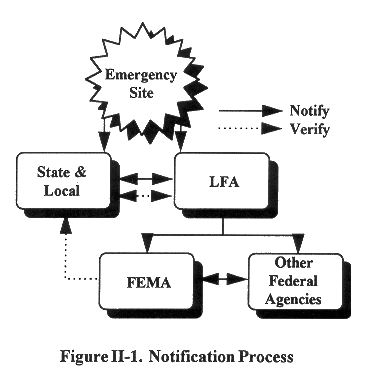
Figure II-1. Notification Process.
Figure II-2. Onscene Response Operations Structure.
[ Prev | Next | Top of file ]
[ Prev | Next | Top of file ]
The objective of the Federal Radiological Emergency Response Plan (FRERP) is to establish an organized and integrated capability for timely, coordinated response by Federal agencies to peacetime radiological emergencies.
The FRERP:
There are two Sections in this Plan. Section I contains background, considerations, and scope. Section II describes the concept of operations for response.
[ Prev | Next | Top of file ]
Each participating agency has responsibilities and/or capabilities that pertain to various types of radiological emergencies. The following Federal agencies participate in the FRERP:
[ Prev | Next | Top of file ]
The FRERP covers any peacetime radiological emergency that has actual, potential, or perceived radiological consequences within the United States, its Territories, possessions, or territorial waters and that could require a response by the Federal Government. The level of the Federal response to a specific emergency will be based on the type and/or amount of radioactive material involved, the location of the emergency, the impact on or the potential for impact on the public and environment, and the size of the affected area. Emergencies occurring at fixed nuclear facilities or during the transportation of radioactive materials, including nuclear weapons, fall within the scope of the Plan regardless of whether the facility or radioactive materials are publicly or privately owned, Federally regulated, regulated by an Agreement State, or not regulated at all. (Under the Atomic Energy Act of 1954 [Subsection 274.b.], the NRC has relinquished to certain States its regulatory authority for licensing the use of source, byproduct, and small quantities of special nuclear material.)
[ Prev | Next | Top of file ]
For an emergency at a fixed nuclear facility or a facility not under the control of a Federal agency, State and local governments have primary responsibility for determining and implementing measures to protect life, property, and the environment in areas outside the facility boundaries. The owner or operator of a nuclear facility has primary responsibility for actions within the boundaries of that facility, for providing notification and advice to offsite officials, and for minimizing the radiological hazard to the public.
For emergencies involving an area under Federal control, the responsibility for onsite actions belongs to a Federal agency, while offsite actions are the responsibility of the State or local government.
For all other emergencies, the State or local government has the responsibility for taking emergency actions both onsite and offsite, with support provided, upon request, by Federal agencies as designated in Section II of this plan.
This Plan describes how the Federal response to a radiological emergency will be organized. It includes guidelines for notification of Federal agencies and States, coordination and leadership of Federal response activities onscene, and coordination of Federal public information activities and Congressional relations by Federal agencies. The Plan suggests ways in which the State, local, and Federal agencies can most effectively integrate their actions. The degree to which the Federal response is merged or to which activities are adjusted will be based upon the requirements and priorities set by the State.
Appropriate independent emergency actions may be taken by the participating Federal agencies within the limits of their own statutory authority to protect the public, minimize immediate hazards, and gather information about the emergency that might be lost by delay.
Some Federal agencies have authority to respond to certain situations affecting public health and safety with or without a State request. Appendix C of this Plan cites relevant legislative and executive authorities. This Plan does not create any new authorities nor change any existing ones.
A response to radiological emergencies on or affecting Federal lands not occupied by a government agency should be coordinated with the agency responsible for managing that land to ensure that response activities are consistent with Federal statutes governing the use and occupancy of these lands. This coordination is necessary in the case of Indian tribal lands because Federally recognized Indian tribes have a special relationship with the U.S. Government, and the State and local governments may have limited or no authority on their reservations.
In the event of an offsite radiological accident involving a nuclear weapon, special nuclear material, classified components, or all three, the owner (either DOD, DOE, or NASA) will declare a National Defense Area (NDA) or National Security Area (NSA), respectively, and this area will become "onsite" for the purposes of this plan. NDAs and NSAs are established to safeguard classified information, and/or restricted data, or equipment and material. Establishment of these areas places non-Federal lands under Federal control and results only from an emergency event. It is possible that radioactive contamination would extend beyond the boundaries of these areas.
In accordance with appropriate national security classification directives, information may be classified concerning nuclear weapons, special nuclear materials at reactors, and certain fuel cycle facilities producing military fuel.
Agencies committing resources under this Plan do so with the understanding that the duration of the commitment will depend on the nature and extent of the emergency and the State and local resources available. Should another emergency occur that is more serious or of higher priority (such as one that may jeopardize national security), Federal agencies will reassess resources committed under this Plan.
State and local government requests for assistance, as well as those from owners and operators of radiological facilities or activities, may be made directly to the Federal agencies listed in Table II-1, FEMA, or to other Federal agencies with whom they have preexisting arrangements or relationships.
The cost of each Federal agency's participation in support of the FRERP is the responsibility of that agency, unless other agreements or reimbursement mechanisms exist. GSA will be reimbursed for supplies and services provided under this Plan in accordance with prior interagency agreements.
[ Prev | Next | Top of file ]
Federal agencies, in conjunction with State and local governments, will periodically exercise the FRERP. Each agency will coordinate its exercises with the Federal Radiological Preparedness Coordinating Committee's (FRPCC's) Subcommittee on Federal Response to avoid duplication and to invite participation by other Federal agencies.
Federal agencies will assist other Federal agencies and State and local governments with planning and training activities designed to improve response capabilities. Each agency should coordinate its training programs with the FRPCC's Subcommittee on Training to avoid duplication and to make its training available to other agencies.
[ Prev | Next | Top of file ]
Federal agencies will respond to radiological emergencies using the FRERP, each agency in accordance with existing statutory authorities and funding resources. The LFA has responsibility for coordination of the overall Federal response to the emergency. FEMA is responsible for coordinating non-radiological support using the structure of the Federal Response Plan (FRP).
When a major disaster or emergency is declared under the Stafford Act and an associated radiological emergency exists, the functions and responsibilities of the FRERP remain the same. The LFA coordinates the management of the radiological response with the Federal Coordinating Officer (FCO). Although the direction of the radiological response remains the same with the LFA, the FCO has the overall responsibility for the coordination of Federal assistance in support of State and local governments using the FRP.
[ Prev | Next | Top of file ]
The following authorities are the basis for the development of this Plan:
1. Nuclear Regulatory Commission Authorization, Public Law 96-295, June 30, 1980, Section 304. This authorization requires the President to prepare and publish a "National Contingency Plan" (subsequently renamed the FRERP) to provide for expeditious, efficient, and coordinated action by appropriate Federal agencies to protect the public health and safety in case of accidents at commercial nuclear power plants.
2. Executive Order (E.O.) 12241, National Contingency Plan, September 29, 1980. This E.O. delegates to the Director of FEMA the responsibility for publishing the National Contingency Plan (i.e., the FRERP) for accidents at nuclear power facilities and requires that it be published from time to time in the Federal Register. Executive Order 12241 has been amended by Executive Order 12657, FEMA Assistance in Emergency Preparedness Planning at Commercial Nuclear Power Plants.
Authorities for the activities of individual Federal agencies appear in Appendix C.
[ Prev | Next | Top of file ]
[ Prev | Next | Top of file ]
The concept of operations for a response provides for the designation of one agency as the Lead Federal Agency (LFA) and for the establishment of onscene, interagency response centers. The FRERP describes both the responsibilities of the LFA and other Federal agencies that may be involved and the functions of each of the onscene centers.
The concept of operations recognizes the preeminent role of State and local governments for determining and implementing any measures to protect life, property, and the environment in areas not under the control of a Federal agency.
[ Prev | Next | Top of file ]
The agency that is responsible for leading and coordinating all aspects of the Federal response is referred to as the LFA and is determined by the type of emergency. In situations where a Federal agency owns, authorizes, regulates, or is otherwise deemed responsible for the facility or radiological activity causing the emergency and has authority to conduct and manage Federal actions onsite, that agency normally will be the LFA.
The following identifies the LFA for each specified type of radiological emergency.
The NRC is the LFA for an emergency that occurs at a fixed facility or regarding an activity licensed by the NRC or an Agreement State. These include, but are not limited to, commercial nuclear power reactors, fuel cycle facilities, DOE-owned gaseous diffusion facilities that are operating under NRC regulatory oversight, and radiopharmaceutical manufacturers.
The LFA is either DOD or DOE, depending on which agency owns or authorizes operation of the facility. These emergencies may involve reactor operations, nuclear material and weapons production, radioactive material from nuclear weapons, or other radiological activities.
The EPA is the LFA for an emergency that occurs at a facility not licensed, owned, or operated by a Federal agency or an Agreement State. These include facilities that possess, handle, store, or process radium or accelerator-produced radioactive materials.
The NRC is the LFA for an emergency that involves radiological material licensed by the NRC or an Agreement State.
The LFA is either DOD or DOE depending on which of these agencies has custody of the material at the time of the accident.
The EPA is the LFA for an emergency that involves radiological material not licensed or owned by a Federal agency or an Agreement State.
NASA is the LFA for NASA spacecraft missions. DOD is the LFA for DOD spacecraft missions. DOE and EPA provide technical assistance to DOD and NASA.
In the event of an emergency involving a joint U.S. Government and foreign government spacecraft venture containing radioactive sources and/or classified components, the LFA will be DOD or NASA, as appropriate. A joint U.S./foreign venture is defined as an activity in which the U.S. Government has an ongoing interest in the successful completion of the mission and is intimately involved in mission operations. A joint venture is not created by simply selling or supplying material to a foreign country for use in their spacecraft. DOE and EPA will provide technical support and assistance to the LFA.
The EPA is the LFA for an emergency that involves radioactive material from a foreign or unknown source that has actual, potential, or perceived radiological consequences in the United States, its Territories, possessions, or territorial waters. The foreign or unknown source may be a reactor (e.g., Chernobyl), a spacecraft containing radioactive material, radioactive fallout from atmospheric testing of nuclear devices, imported radioactively contaminated material, or a shipment of foreign-owned radioactive material. Unknown sources of radioactive material refers to that material whose origin and/or radiological nature is not yet established. These types of sources include contaminated scrap metal or abandoned radioactive material. DOD, DOE, NASA, and NRC provide technical assistance to EPA.
In the event of an unforeseen type of emergency not specifically described in this Plan or a situation where conditions exist involving overlapping responsibility that could cause confusion regarding LFA role and responsibilities, DOD, DOE, EPA, NASA, and NRC will confer upon receipt of notification of the emergency to determine which agency is the LFA.
| Table II-1.-Identification of Lead Federal Agency for Radiological Emergencies | ||
| Type of emergency | Lead Federal agency | |
| 1. Nuclear Facility: | ||
| a. Licensed by NRC or an Agreement State | NRC | |
| b. Owned or Operated by DOD or DOE | DOD or DOE | |
| c. Not Licensed, Owned, or Operated by a Federal Agency or an Agreement State | EPA | |
| 2. Transportation of Radioactive Materials: | ||
| a. Shipment of Materials Licensed by NRC or an NRC. Agreement State | NRC | |
| b. Materials Shipped by or for DOD or DOE | DOD or DOE | |
| c. Shipment of Materials Not Licensed or Owned by a Federal Agency or an Agreement State | EPA | |
| 3. Satellites Containing Radioactive Materials | NASA or DOD | |
| 4. Impact from Foreign or Unknown Source | EPA | |
| 5. Other Types of Emergencies | LFAs confer | |
[ Prev | Next | Top of file ]
For fixed facilities and materials in transit, responses to radiological emergencies generally
do not depend on the initiating event. The coordinated response to contain or mitigate a
threatened or actual release of radioactive material would be essentially the same whether it
resulted from an accidental or deliberate act. For malevolent acts involving improvised
nuclear or radiation dispersal devices, the response is further complicated by the magnitude of
the threat and the need for specialized technical expertise/actions. Therefore, sabotage
and terrorism are not treated as separate types of emergencies rather, they are considered a
complicating dimension of the types listed in Table II-1.
The Atomic Energy Act directs the Federal Bureau of Investigation (FBI) to investigate all
alleged or suspected criminal violations of the Act. Additionally, the FBI is legally
responsible for locating any nuclear weapon, device, or material and for restoring nuclear
facilities to their rightful custodians. In view of its unique responsibilities under the
Atomic Energy Act (amended by the Energy Reorganization Act), the FBI has concluded formal
agreements with the LFAs that provide for interface, coordination, and technical
assistance in support of the FBI's mission.
Generally, for fixed facilities and materials in transit, the designated LFA and supporting agencies will perform the functions delineated in this plan and provide technical support and assistance to the FBI in the performance of its mission. It would be difficult to outline all the possible scenarios arising from criminal or terrorist activity. As a result, the Federal response will be tailored to the specific circumstances of the event at hand. For those emergencies where an LFA is not specifically designated (e.g., improvised nuclear device), the Federal response will be guided by the established interagency agreements and contingency plans. In accordance with these agreements and plans, the signatory agency(ies) supporting the FBI will coordinate and manage the technical portion of the response and activate/request assistance under the FRERP for measures to protect the public health and safety. In all cases, the FBI will manage and direct the law enforcement and intelligence aspects of the response coordinating activities with appropriate Federal, State, and local agencies within the framework of the FRERP and/or as provided for in established interagency agreements or plans.
[ Prev | Next | Top of file ]
The LFA will lead and coordinate all Federal onscene actions and assist State and local governments in determining measures to protect life, property, and the environment. The LFA will ensure that FEMA and other Federal agencies assist the State and local government agencies in implementing protective actions, if requested by the State and local government agencies.
The LFA will coordinate Federal response activities from an onscene location, referred to as the Joint Operations Center (JOC). Until the LFA has established its base of operations in a JOC, the LFA will accomplish that coordination from another LFA facility, usually a Headquarters operations center.
In the absence of existing agreements for radiological emergencies occurring on or with possible consequences to Indian tribal lands, DOI will provide liaison between federally recognized Indian tribal governments and LFA, State, and local agencies for coordination of response and protective action efforts. Additionally, DOI will advise and assist the LFA on economic, social, and political matters in the United States insular areas should a radiological emergency occur.
The LFA will oversee the onsite response monitor and support owner or operator activities (when there is an owner or operator) provide technical support to the owner or operator, if requested and serve as the principal Federal source of information about onsite conditions. The LFA will provide a hazard assessment of onsite conditions that might have significant offsite impact and ensure onsite measures are taken to mitigate offsite consequences.
DOE has the initial responsibility for coordinating the offsite Federal radiological monitoring and assessment assistance during the response to a radiological emergency. In a prolonged response, EPA will assume the responsibility for coordinating the assistance at some mutually agreeable time, usually after the emergency phase.
Some of the participating Federal agencies may have radiological planning and emergency responsibilities as part of their statutory authority, as well as established working relationships with State counterpart agencies. The monitoring and assessment activity, coordinated by DOE, does not alter those responsibilities but complements them by providing for coordination of the initial Federal radiological monitoring and assessment response activity.
Activities will:
Federal offsite monitoring and assessment activities will be coordinated with those of the
State. Federal agency plans and procedures for implementing this monitoring and
assessment activity are designed to be compatible with the radiological emergency planning
requirements for State, local governments, specific facilities, and existing memoranda of
understanding and interagency agreements.
DOE may respond to a State or LFA request for assistance by dispatching a Radiological
Assistance Program (RAP) team. If the situation requires more assistance than a RAP team
can provide, DOE will alert or activate additional resources. These resources may include the
establishment of a Federal Radiological Monitoring and Assessment Center (FRMAC)
to be used as an onscene coordination center for Federal radiological assessment activities.
Federal and State agencies are encouraged to collocate their radiological assessment
activities.
Federal radiological monitoring and assessment activities will be activated as a component of an
FRERP response or pursuant to a direct request from State or local governments,
other Federal agencies, licensees for radiological materials, industries, or the general public after
evaluating the magnitude of the problem and coordinating with the State(s) involved.
DOE and other participating Federal agencies may learn of an emergency when they are alerted
to a possible problem or receive a request for radiological assistance. DOE will
maintain national and regional coordination offices as points of access to Federal radiological
emergency assistance. Requests for Federal radiological monitoring and assessment
assistance will generally be directed to the appropriate DOE radiological assistance Regional
Coordinating Office. Requests also can go directly to DOE's Emergency Operations
Center (EOC) in Washington, DC. When other agencies receive requests for Federal radiological
monitoring and assessment assistance, they will promptly notify the DOE EOC.
Prior to assuming responsibility for the FRMAC, EPA will:
Agencies carrying out responsibilities related to radiological monitoring and assessment during a Federal response also will coordinate their activities with FRMAC. This coordination will not limit the normal working relationship between a Federal agency and its State counterparts nor restrict the flow of information from that agency to the States. The radiological monitoring and assessment responsibilities of the other Federal agencies include:
(1) Department of Agriculture (USDA)
Federal protective action recommendations provide advice to State and local governments on measures that they should take to avoid or reduce exposure of the public to radiation from a release of radioactive material. This includes advice on emergency actions such as sheltering, evacuation, and prophylactic use of stable iodine. It also includes longer term measures to avoid or minimize exposure to residual radiation or exposure through the ingestion pathway such as restriction of food, temporary relocation, and permanent resettlement.
The LFA will assist State and local authorities, if requested, by advising them on protective actions for the public. The development or evaluation of protective action recommendations will be based upon the Protective Action Guides (PAGs) issued by EPA and HHS. In providing such advice, the LFA will use advice from other Federal agencies with technical expertise on those matters whenever possible. The LFA's responsibilities for the development, evaluation, and presentation of protective action recommendations are to:
Advice on environment, food, and health matters will be provided to the LFA through the Advisory Team for Environment, Food, and Health (Advisory Team) consisting of representatives of EPA, HHS, and USDA supported by other Federal agencies, as warranted by the circumstances of the emergency. The Advisory Team provides direct support to the LFA and has no independent authority. The Advisory Team will not release information or make recommendations to the public unless authorized to do so by the LFA. The Advisory Team will select a chair for the Team. The Advisory Team will normally collocate with the FRMAC.
For emergencies with potential for causing widespread radiological contamination where no onscene FRMAC is established, the functions of the Advisory Team may be accomplished in the LFA response facility in Washington, DC.
The primary role of the Advisory Team is to provide a mechanism for timely, interagency coordination of advice to the LFA, States, and other Federal agencies concerning matters related to the following areas:
FEMA will coordinate the provision of non-radiological (i.e., not related to radiological monitoring and assessment) Federal resources and assistance to affected State and local governments. The Federal non-radiological resource and assistance coordination function will be performed at the Disaster Field Office (DFO) (or other appropriate location established by FEMA).
In order to properly coordinate activities, Federal agencies responding to requests for non- radiological support or directly providing such support under statutory authorities will provide liaison personnel to the DFO. The following indicates types of assistance that may be provided by Federal agencies as needed or requested:
Public information coordination is most effective when the owner/operator, Federal, State, local, and other relevant information sources participate jointly. The primary location for linking these sources is the Joint Information Center (JIC).
Prior to the establishment of Federal operations at the JIC, it may be necessary to release Federal information regarding public health and safety. In these instances, Federal agencies will coordinate with the LFA and the State in advance or as soon as possible after the information has been released.
This coordination will accomplish the following: compile information about the status of the emergency, response actions, and instructions for the affected population coordinate all information from various sources with the other Federal, State, local, and non-governmental response organizations allow various sources to work cooperatively, yet maintain their independence in disseminating information disseminate timely, consistent, and accurate information to the public and the news media and establish coordinated arrangements for dealing with citizen inquiries.
The LFA is responsible for information on the status of the overall Federal response, specific LFA response activities, and the status of onsite conditions.
The LFA will:
FEMA will assist the LFA in coordinating non-radiological information among Federal agencies and with the State. When mutually agreeable, FEMA may assume responsibility from the LFA for coordinating Federal public information. Should this occur, it will usually be after the onsite situation has been stabilized and recovery efforts have begun.
All Federal agencies with an operational response role under the FRERP will coordinate public information activities at the JIC. Each Federal agency will provide information on the status of its response and on technical information.
Federal agencies will coordinate their responses to Congressional requests for information with the LFA. Points of contact for this function are the Congressional Liaison Officers. All Federal agency Congressional Liaison Officers and Congressional staffs seeking site-specific information about the emergency should contact the LFA headquarters Congressional Affairs Office. Congress may request information directly from any Federal agency. Any agency responding to such requests should inform the LFA as soon as feasible.
The LFA will report to the President and keep the White House informed on all aspects of the emergency. The White House may request information directly from any Federal agency. Any agency responding to such requests should inform the LFA as soon as feasible. The LFA will submit reports to the White House. The initial report should cover, if possible, the nature of and prognosis for the radiological situation causing the emergency and the actual or potential offsite radiological impact. Subsequent reports by the LFA should cover the status of mitigation, corrective actions, protective measures, and overall Federal response to the emergency. Federal agencies should provide information related to the technical and radiological aspects of the response directly to the LFA. FEMA will compile information related to the non-radiological resource support aspects of the response and submit to the LFA for inclusion in the report(s).
In the event of an environmental impact or potential impact upon the United States, its possessions, Territories, or territorial waters from a radiological emergency originating on foreign soil or, conversely, a domestic incident with an actual or potential foreign impact, the LFA will immediately inform DOS (which has responsibility for official interactions with foreign governments). The LFA will keep DOS informed of all Federal response activities. The DOS will coordinate notification and information gathering activities with foreign governments, except in cases where existing bilateral agreements permit direct communication. Where the LFA has existing bilateral agreements that permit direct exchange of information, those agencies should keep DOS informed of consultations with their foreign counterparts. Agency officials should take care that consultations do not exceed the scope of the relevant agreement(s). The LFA will ensure that any offers of assistance to or requests from foreign governments are coordinated with DOS.
Table II-2 provides an overview of the responsible Federal agencies for major response functions.
| Table II-2.-Response Function Overview | ||
| Response action | Responsible agency | |
| (1) Maintain cognizance of the Federal response conduct and manage Federal onsite actions. | LFA | |
| (2) Coordinate Federal offsite radiological monitoring and assessment: | ||
| -Initial Response | DOE. | |
| -Intermediate and Long-Term Response | EPA | |
| (3) Develop and evaluate recommendations for offsite protective actions for the public. | LFA, in coordination with other agencies. | |
| (4) Present recommendations for offsite protective actions to the appropriate State and/or local officials | LFA, FEMA, in conjunction with other Federal agencies when practical. | |
| (5) Coordinate Federal offsite non-radiological resource support. | FEMA | |
| (6) Coordinate release of Federal information to the LFA after public. mutual agreement. | FEMA | |
| (7) Coordinate release of Federal information to LFA. | Congress | |
| (8) Provide reports to the President and keep the White House informed on all aspects of the emergency. | LFA | |
| (9) Coordinate international aspects and make DOS as required international notifications. appropriate. | LFA | |
| (10) Coordinate the law enforcement aspects of a criminal act involving radioactive material. | DOJ/FBI | |
[ Prev | Next | Top of file ]
The Federal response is divided into five stages: Notification, Activation and Deployment, Response Operations, Response Deactivation, and Recovery.
The owner or operator of the facility or radiological activity is generally the first to become aware of a radiological emergency and is responsible for notifying the State and local authorities and the LFA. The notification should include:
If any Federal agency receives notification from any source other than FEMA or the LFA, the agency will notify the LFA. See Figure II-1 for the notification process.
Once notified, each agency will respond according to its plan. The LFA will assess the technical response requirements and cause the activation and deployment of response components. FEMA, in conjunction with the LFA, will coordinate the non-radiological assistance in support of State and local governments. Initially, the LFA, FEMA, and other Federal agencies will coordinate response actions from their headquarters locations, usually from their respective headquarters EOCs.
The following describes the general operational structure for meeting Federal agency roles and responsibilities in response to a radiological emergency. At the headquarters level, the LFA, FEMA, and other Federal agencies (OFAs) will generally exchange liaison personnel and maintain staffs at their EOCs to support their respective onscene operations. Federal agencies may also activate a regional or field office EOC in support of the emergency. Figure II-2 provides a graphic depiction of the onscene structure.
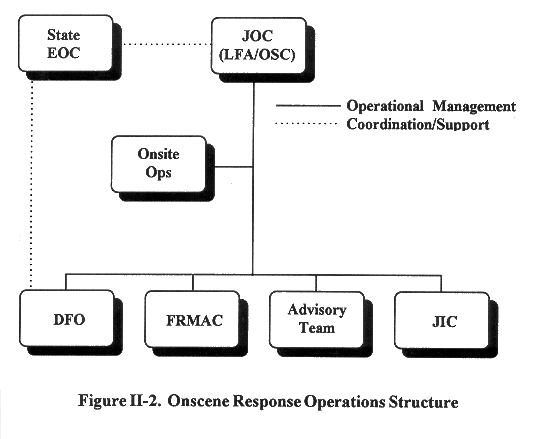
The JOC(1) is established by the LFA under the operational control of the Federal OSC as the focal point for management and direction of onsite activities, establishment of State requirements and priorities, and coordination of the overall Federal response. The JOC may be established in a separate onscene location or collocated with an existing emergency operations facility. The following elements may be represented in the JOC:
The DFO is established by FEMA as the focal point for the coordination and provision of non-radiological resource support based on coordinated State requirements/priorities. The DFO is established at an onscene location in coordination with State and local authorities and other Federal agencies. The following elements may be represented in the DFO:
The FRMAC is established by DOE (with subsequent transfer to EPA for intermediate and long-term actions) for the coordination of Federal radiological monitoring and assessment activities with that of State and local agencies. The FRMAC is established at an onscene location in coordination with State and local authorities and other Federal agencies. The following elements may be represented in the FRMAC:
The Advisory Team is established by representatives from EPA, USDA, HHS, and other Federal agencies as needed for the provision of interagency coordinated advice and recommendations to the State and LFA concerning environmental, food, and health matters. For the ease of transfer of radiological monitoring and assessment data and coordination with Federal, State, and local representatives, the Advisory Team is normally collocated with the FRMAC.
The JIC(2) is established by the LFA, under the operational control of the LFA-designated Public Information Officer, as a focal point for the coordination and provision of information to the public and media concerning the Federal response to the emergency. The JIC is established at an onscene location in coordination with State and local agencies and other Federal agencies. The following elements should be represented at the JIC:
a. Each agency will discontinue emergency response operations when advised that Federal assistance is no longer required from their agency or when its statutory responsibilities have been fulfilled. Prior to discontinuing its response operation, each agency should discuss its intent to do so with the LFA, FEMA, and the State.
b. The LFA will consult with participating Federal agencies and the State and local government to determine when the Federal information coordination operations at the JIC should be terminated. This will occur normally at a time when the rate of information generated and coordinated by the LFA has decreased to the point where it can be handled through the normal day-to-day coordination process. The LFA will inform the other participants of their intention to deactivate Federal information coordination operations at the JIC and advise them of the procedures for continued coordination of information pertinent to recovery from the radiological emergency.
c. FEMA will consult with the LFA, other Federal agencies, and the State(s) as to when the onscene coordination of non- radiological assistance is no longer required. Prior to ending operations at the DFO, FEMA will inform all participating organizations of the schedule for doing so.
d. The LFA will terminate JOC operations and the Federal response after consulting with FEMA, other participating Federal agencies, and State and local officials, and after determining that onscene Federal assistance is no longer required.
e. The agency managing the FRMAC will consult with the LFA, FEMA, other participating Federal agencies, and State and local officials to determine when a formal FRMAC structure and organization is no longer required. Normally, this will occur when operations move into the recovery phase and extensive Federal multi-agency resources are no longer required to augment State and local radiological monitoring and assessment activities.
a. The State or local governments have the primary responsibility for planning the recovery of the affected area. (The term recovery as used here encompasses any action dedicated to the continued protection of the public and resumption of normal activities in the affected area.) Recovery planning will be initiated at the request of the States, but it will generally not take place until after the initiating conditions of the emergency have stabilized and immediate actions to protect public health and safety and property have been accomplished. The Federal Government will, on request, assist the State and local governments in developing offsite recovery plans, prior to the deactivation of the Federal response. The LFA will coordinate the overall activity of Federal agencies involved in the recovery process.
b. The radiological monitoring and assessment activities will be terminated when the EPA, after consultation with the LFA and other participating Federal agencies, and State and local officials, determines that:
[ Prev | Next | Top of file ]
| CFR | Code of Federal Regulations |
| DFO | Disaster Field Office |
| DOC | Department of Commerce |
| DOD | Department of Defense |
| DOE | Department of Energy |
| DOI | Department of the Interior |
| DOJ | Department of Justice |
| DOS | Department of State |
| DOT | Department of Transportation |
| EICC | Emergency Information and Coordination Center |
| EO | Executive Order |
| EOC | Emergency Operations Center |
| EPA | Environmental Protection Agency |
| ERT | Emergency Response Team |
| ERT-A | Emergency Response Team-Advance Element |
| FBI | Federal Bureau of Investigation |
| FCO | Federal Coordinating Officer |
| FECC | Federal Emergency Communications Coordinator |
| FEMA | Federal Emergency Management Agency |
| FRERP | Federal Radiological Emergency Response Plan |
| FRMAC | Federal Radiological Monitoring and Assessment Center |
| FRP | Federal Response Plan |
| FRPCC | Federal Radiological Preparedness Coordinating Committee |
| GIS | Geographical Information Systems |
| GSA | General Services Administration |
| HHS | Department of Health and Human Services |
| HUD | Department of Housing and Urban Development |
| JIC | Joint Information Center |
| JOC | Joint Operations Center |
| LFA | Lead Federal Agency |
| MERRT | Medical Emergency Radiological Response Team |
| NASA | National Aeronautics and Space Administration |
| NCC | National Coordinating Center for Telecommunications |
| NCS | National Communications System |
| NDA | National Defense Area |
| NOAA | National Oceanic and Atmospheric Administration (DOC) |
| NRC | Nuclear Regulatory Commission |
| NSA | National Security Area |
| OSC | Onscene Commander |
| PAG | Protective Action Guide |
| PIO | Public Information Officer |
| RAP | Radiological Assistance Program (DOE) |
| RECP | Regional Emergency Communications Planner |
| SCO | State Coordinating Officer |
| SFO | Senior FEMA Official |
| TLD | Thermoluminescent dosimeter |
| USDA | United States Department of Agriculture |
| VA | Department of Veterans Affairs |
[ Prev | Next | Top of file ]
[ Prev | Next | Top of file ]
Each Federal agency develops and maintains a plan that describes a detailed concept of
operations for implementing this Plan. This section contains summary information about the
following Federal agencies:
Department of Agriculture (USDA)
Department of Commerce (DOC)
Department of Defense (DOD)
Department of Energy (DOE)
Department of Health and Human Services (HHS)
Department of Housing and Urban Development (HUD)
Department of the Interior (DOI)
Department of Justice (DOJ)
Department of State (DOS)
Department of Transportation (DOT)
Department of Veterans Affairs (VA)
Environmental Protection Agency (EPA)
Federal Emergency Management Agency (FEMA)
General Services Administration (GSA)
National Aeronautics and Space Administration (NASA)
National Communications System (NCS)
Nuclear Regulatory Commission (NRC)
Summary information for each agency contains: (1) a response mission statement, (2) a
description of the agency's response capabilities and resources, (3) agency response plan and
procedures references, and (4) sources of agency authority.
[ Prev | Next | Top of file ]
The United States Department of Agriculture (USDA) provides assistance to State and local governments in developing agricultural protective action recommendations and in providing agricultural damage assessments. USDA will actively participate with EPA and HHS on the Advisory Team for Environment, Food, and Health when convened. USDA regulatory responsibilities for the inspection of meat, meat products, poultry, poultry products, and egg products are essential uninterruptible functions that would continue during an emergency.
USDA can provide assistance to State and local governments through emergency response personnel located at its Washington, DC, headquarters and from USDA State and County Emergency Board representatives located throughout the country. USDA Emergency Board representatives have knowledge of local agriculture and can provide specific advice to the local agricultural community. In addition, USDA State and County Emergency Boards can assist in the collection of agricultural samples during a radiological emergency. USDA actively participates with EPA and HHS on the Advisory Team when convened.
The functions and capabilities of the USDA to provide assistance in the event of a radiological emergency include the following:
| a. | Provide assistance through regular USDA programs, if legally adaptable to radiological emergencies | |
| b. | Provide emergency food coupon assistance in officially designated disaster areas, if a need is determined by officials and if the commercial food system is sufficient to accommodate the use of food coupons | |
| c. | Assist in reallocation of USDA-donated food supplies from warehouses, local schools, and other outlets to emergency care centers. These are foods donated to various outlets through USDA food programs | |
| d. | Provide lists that identify locations of alternate sources of food and livestock feed and arrange for transportation of the food and feed if requested | |
| e. | Provide advice to State and local officials regarding the disposition of livestock and poultry contaminated by radiation | |
| f. | Inspect meat and meat products, poultry and poultry products, and egg products identified for interstate and foreign commerce to assure that they are safe for human consumption | |
| g. | Assist State and local officials, in coordination with HHS and EPA, in the recommendation and implementation of protective actions to limit or prevent the ingestion of contaminated food | |
| h. | Assist, in conjunction with HHS, in monitoring the production, processing, storage, and distribution of food through the wholesale level to eliminate contaminated product or to reduce the contamination in the product to a safe level | |
| i. | Assess damage to crops, soil, livestock, poultry, and processing facilities and incorporate findings into a damage assessment report | |
| j. | Provide advice to State and local officials on minimizing losses to agricultural resources from radiation effects | |
| k. | Provide information and assistance to farmers, food processors, and distributors to aid them in returning to normal after a radiological emergency | |
| l. | Provide a liaison to State agricultural agencies if requested | |
| m. | Assist DOE at the FRMAC in collecting agricultural samples within the Ingestion Exposure Pathway Emergency Planning Zone. Assist in the evaluation and assessment of data to determine the impact of the emergency on agriculture | |
| n. | Assist in providing temporary housing for evacuees who have been displaced from their homes due to a radiological emergency and | |
| o. | Provide emergency communications assistance to the agricultural community through the Cooperative Extension System, an electronic mail system. |
USDA Radiological Emergency Response Plan, January 1988.
| a. | Title 7, U.S.C. 241-273. | |
| b. | Title 7, U.S.C. 341-349. | |
| c. | Title 7, U.S.C. 612 C. | |
| d. | Title 7, U.S.C. 612 C Note. | |
| e. | Title 7, U.S.C. 1431. | |
| f. | Title 7, U.S.C. 1622. | |
| g. | Title 7, U.S.C. 2014(h). | |
| h. | Title 7, U.S.C. 2204. | |
| i. | Title 16, U.S.C. 590 a-f. | |
| j. | Title 21, U.S.C. 451 et seq. | |
| k. | Title 21, U.S.C. 601 et seq. | |
| l. | Title 21, U.S.C. 1031-1056. | |
| m. | Title 42, U.S.C. 1480. | |
| n. | Title 42, U.S.C. 3271-3274. | |
| o. | Title 50, U.S.C. Appendix 2251 et seq. | |
| p. | Title 7, CFR 2.51 (a)(30). | |
| q. | E.O. 12656, November 18, 1988. | |
| r. | DR 1800-1, March 5, 1993. |
[ Prev | Next | Top of file ]
The National Oceanic and Atmospheric Administration (NOAA) is the primary agency within the Department of Commerce (DOC) responsible for providing assistance to the Federal, State, and local organizations responding to a radiological emergency. Other assistance may be provided by the National Institute of Standards and Technology. DOC's responsibilities include:
| a. | Acquiring and disseminating weather data and providing weather forecasts in direct support of the emergency response operation | |
| b. | Preparing and disseminating predictions of plume trajectories, dispersion, and deposition of radiological material released into the atmosphere | |
| c. | Providing local meteorological support as needed to assure the quality of these predictions | |
| d. | Organizing and maintaining a special data archive for meteorological information related to the emergency and its assessment | |
| e. | Ensuring that marine fishery products available to the public are not contaminated | |
| f. | Providing assistance and reference material for calibrating radiological instruments and | |
| g. | Providing radiation shielding materials. |
NOAA is the principal DOC participant in the response to a radiation accident. NOAA prepares both routine and special weather forecasts, and makes use of these forecasts to predict atmospheric transport and dispersion. NOAA's forecasts may be the basis for all public announcements on the movement of contamination from accidents occurring outside U.S. territory or during domestic accidents when any released radioactive material is expected to be carried offsite. NOAA has capabilities to do the following:
| a. | Provide current and forecast meteorological information as needed to guide aerial monitoring and sampling, and to predict the transport and dispersion of radioactive materials (gases, liquids, and particles). | |
| b. | Routinely forecast the atmospheric transport, dispersion, and deposition of the radioactive materials, and disseminate the results of these computations via automatic facsimile to all relevant parties, twice per day. | |
| c. | Produce (and archive) special high-resolution meteorological data sets for providing an improved capability to predict atmospheric transport and dispersion of radioactive materials in the atmosphere. | |
| d. | Augment routine and special upper atmosphere and surface meteorological observation systems, as required to improve the quality of these predictions. | |
| e. | Evaluate NOAA's transport and dispersion forecast products in conjunction with those of other nations" weather services responding to the emergency, to provide a more internationally consistent product. |
Additionally, DOC may provide support to HHS at its request, through the National Marine Fisheries Service, in order to avoid human consumption of contaminated commercial fishery products (marine area only). The National Institute of Standards and Technology can assist in calibrating radiological instruments by comparison with national standards or by providing standard reference materials for calibration, as well as making extensive data on the physical properties of materials available. The National Institute of Standards and Technology can also supply temporary radiation shielding materials.
National Plan for Radiological Emergencies at Commercial Nuclear Power Plants. Federal Coordinator for Meteorological Services and Supporting Research, National Oceanic and Atmospheric Administration, November 1982.
Department of Commerce Organization Order 25-5B, as amended, June 18, 1987.
[ Prev | Next | Top of file ]
The Department of Defense (DOD) is charged with the safe handling, storage, maintenance, assembly, and transportation of nuclear weapons and other radioactive materials in DOD custody, and with the safe operation of DOD nuclear facilities. Inherent in this responsibility is the requirement to protect life and property from any health or safety hazards that could ensue from an accident or significant incident associated with these materials or activities.
The DOD role in a Federal response will depend on the circumstances of the emergency. DOD will be the LFA if the emergency involves one of its facilities or a nuclear weapon in its custody. Within DOD, the military service or agency responsible for the facility, ship, or area is responsible for the onsite response. The military service or agency having custody of the material outside an installation boundary is responsible for the onsite response. For emergencies occurring under circumstances for which DOD is not responsible, DOD will not be the LFA, but will support and assist in the Federal response.
Offsite authority and responsibility at a nuclear accident rest with State and local officials. It is important to recognize that for nuclear weapons or weapon component accidents, land may be temporarily placed under effective Federal control by the establishment of a National Defense Area or National Security Area to protect U.S. Government classified materials. These lands will revert to State control upon disestablishment of the National Defense Area or National Security Area.
DOD has a trained and equipped nuclear response organization to deal with accidents at its facilities or involving materials in its custody. Radiological resources include trained response personnel, specialized radiation instruments, and mobile instrument calibration and repair capabilities. DOD also may perform special sampling of airborne contamination on request. Descriptions of the capabilities and assets of DOD response teams can be found in DOD 5100.52M.
DOD may provide assistance in the form of personnel, logistics and telecommunications, assistance and expertise in site restoration, including airlift services, when available, upon the request of the LFA or FEMA. Requests for assistance must be directed to the National Military Command Center or through channels established by prior agreements.
| a. | DOD Directive 5100.52, DOD Response to an Accident or Significant Incident Involving Radiological Materials. | |
| b. | DOD Directive 5230.16, Nuclear Accident and Incident Public Affairs Guidance. | |
| c. | DOD Directive 3025.1, Military Support to Civil Authorities. | |
| d. | DOD Directive 3025.12, Military Assistance for Civil Disturbances. | |
| e. | DOD Directive 3150.5, DOD Response to Improvised Nuclear Device (IND) Incident. | |
| f. | DOD 5100.52M, Nuclear Weapon Accident Response Procedures (NARP) Manual. | |
| g. | Joint Federal Bureau of Investigation, Department of Energy, and Department of Defense Agreement for Response to Improvised Nuclear Device Incidents. |
| a. | The Atomic Energy Act of 1954, as amended, 42 U.S.C. 2011- 2284. | |
| b. | Public Law 97-351, "Convention on the Physical Protection of Nuclear Material Implementation Act of 1982." | |
| c. | Department of Defense, Department of Energy, Federal Emergency Management Agency Memorandum of Agreement on Response to Nuclear Weapon Accidents and Nuclear Weapon Significant Incidents, 1983. |
[ Prev | Next | Top of file ]
The Department of Energy (DOE) owns and operates a variety of radiological activities throughout the United States. These activities include: fixed nuclear sites the use, storage, and shipment of a variety of radioactive materials the shipment of spent reactor fuel the production, assembly, and shipment of nuclear weapons and special nuclear materials the production and shipment of radioactive sources for space ventures and the storage and shipment of radioactive and mixed waste. DOE is responsible for the safe operation of these activities and should an emergency occur at one of its sites or an activity under its control, DOE will be the LFA for the Federal response.
Due to its technical capabilities and resources, the DOE may perform other roles within the Federal response to a radiological emergency. With extensive, field-based radiological resources throughout the United States available for emergency deployment, the DOE responds to requests for offsite radiological monitoring and assessment assistance and serves as the initial coordinator of all such Federal assistance (to include initial management of the FRMAC) to State and local governments. With other specialized, deployable assets, DOE assists other Federal agencies responding to malevolent nuclear emergencies, accidents involving nuclear weapons not under DOE custody, emergencies caused by satellites containing radioactive sources, and other radiological incidents as appropriate.
DOE has trained personnel, radiological instruments, mobile laboratories, and radioanalytical facilities located at its national laboratories, production, and other facilities throughout the country. Through eight Regional Coordinating Offices, these resources form the basis for the Radiological Assistance Program, which can provide technical assistance in any radiological emergency. DOE can provide specialized radiation detection instruments and support for both its response as LFA and as initial coordinator of Federal radiological monitoring and assessment assistance. Some of the specialized resources and capabilities include:
| a. | Aerial monitoring capability for tracking dispersion of radioactive material and mapping ground contamination | |
| b. | A computer-based, emergency preparedness and response predictive capability that provides rapid predictions of the transport, diffusion, and deposition of radionuclides released to the atmosphere and dose projections to people and the environment | |
| c. | Specialized equipment and instruments and response teams for locating radioactive materials and handling damaged nuclear weapons | |
| d. | Medical experts on radiation effects and the treatment of exposed or contaminated patients and | |
| e. | Support facilities for DOE response, including command post supplies, communications systems, generators, and portable video and photographic capabilities. |
| a. | DOE Order 5500.1B, Emergency Management System, April 1991. | |
| b. | DOE Order 5500.2B, Emergency Categories, Classes, and Notification and Reporting Requirements, April 1991. | |
| c. | DOE Order 5500.3A, Planning and Preparedness for Operational Emergencies, April 1991. | |
| d. | DOE Order 5500.4A, Public Affairs Policy and Planning Requirements for Emergencies, June 1992. | |
| e. | DOE Order 5530.1A, Accident Response Group, September 1991. | |
| f. | DOE Order 5530.2, Nuclear Emergency Search Team, September 1991. | |
| g. | DOE Order 5530.3, Radiological Assistance Program, January 1992. | |
| h. | DOE Order 5530.4, Aerial Measuring System, September 1991. | |
| i. | DOE Order 5530.5, Federal Radiological Monitoring and Assessment Center, July 1992. |
| a. | Atomic Energy Act of 1954, as amended, 42 U.S.C. 2011- 2284. | |
| b. | Energy Reorganization Act of 1974, 42 U.S.C. 5801 et seq. | |
| c. | Department of Energy Organization Act of 1977, 42 U.S.C. 7101 et seq. | |
| d. | Nuclear Waste Policy Act of 1982, 42 U.S.C. 10101 et seq. | |
| e. | Title 44, Code of Federal Regulations, Part 351, Radiological Emergency Planning and Preparedness, 351.24, The Department of Energy. |
[ Prev | Next | Top of file ]
In a radiological emergency, the Department of Health and Human Services (HHS) assists with the assessment, preservation, and protection of human health and helps ensure the availability of essential health/medical and human services. Overall, the Office of Public Health and Science, Office of Emergency Preparedness, coordinates the HHS emergency response. HHS provides technical and nontechnical assistance in the form of advice, guidance, and resources to Federal, State, and local governments. The principal HHS response comes from the U.S. Public Health Service. HHS actively participates with EPA and USDA on the Advisory Team for Environment, Food, and Health when convened.
HHS has personnel located at headquarters, regional offices, and at laboratories and other facilities who can provide assistance in radiological emergencies. The agency can provide the following kinds of advice, guidance, and assistance:
| a. | Assist State and local government officials in making evacuation and relocation decisions | |
| b. | Ensure the availability of health and medical care and other human services (especially for the aged, the poor, the infirm, the blind, and others most in need) | |
| c. | Provide advice and guidance in assessing the impact of the effects of radiological incidents on the health of persons in the affected area | |
| d. | Assist in providing crisis counseling to victims in affected geographic areas | |
| e. | Provide guidance on the use of radioprotective substances (e.g., thyroid blocking agents), including dosage, and also projected radiation doses that warrant the use of such drugs | |
| f. | In conjunction with DOE and DOD, advise medical personnel on proper medical treatment of people exposed to or contaminated by radioactive materials | |
| g. | Recommend Protective Action Guides for food and animal feed and assist in developing technical recommendations on protective measures for food and animal feed and | |
| h. | Provide guidance to State and local health officials on disease control measures and epidemiological surveillance and study of exposed populations. |
| a. | 55 FR 2879, January 29, 1990-Delegations of authority to the Assistant Secretary for Health for department-wide emergency preparedness functions. | |
| b. | 55 FR 2885, January 29, 1990-Statement of organization, functions and delegations of authority to the Office of Emergency Preparedness. | |
| c. | Federal Response Plan, Emergency Support Functions #8 (Health and Medical Services), April 1992. | |
| d. | Disaster Response Guides, Operating Divisions, Various Dates. |
| a. | Public Health Service Act, as amended, 42 U.S.C. 201 et seq. | |
| b. | Federal Food, Drug, and Cosmetic Act of 1938, as amended, 21 U.S.C. 301-392. | |
| c. | Snyder Act, 25 U.S.C. 13 (1921). | |
| d. | Transfer Act, 42 U.S.C. 2004b. | |
| e. | Indian Health Care Improvement Act, 25 U.S.C. 1601 et seq. | |
| f. | The Robert T. Stafford Disaster Relief and Emergency Assistance Act, as amended, Title VI, 42 U.S.C. 5195 et seq. | |
| g. | Comprehensive Environmental Response, Compensation, and Liability Act of 1980 (SUPERFUND), 42 U.S.C. 9601 et seq., as amended by the SUPERFUND Amendments and Reauthorization Act of 1986 (Public Law 99-499) (1986). | |
| h. | 42 U.S.C. 3030-Section 310 of the Older Americans Act. | |
| i. | 42 U.S.C. 601 et seq.-Section 401 et seq. of the Social Security Act. | |
| j. | 45 CFR 233.120-Emergency Community Services Homeless Grant Program. | |
| k. | 45 CFR 233.120-AFDC Emergency Assistance Program. | |
| l. | 45 CFR 233.20(a)(2)(v)-AFDC Special Needs Allowance. | |
| m. | Runaway and Homeless Youth Act, as amended, Section 366(0). | |
| n. | Omnibus Budget Reconciliation Act of 1981, Title XXVI (as amended by Public Laws 98-558, 99-425, 101-501, 101-517)- Low Income Home Energy Assistance Program. | |
| o. | E.O. 12656, National Security Emergency Preparedness-Part 8. |
[ Prev | Next | Top of file ]
The Department of Housing and Urban Development (HUD) provides information on available housing for disaster victims or displaced persons. HUD assists in planning for and placing homeless victims by providing emergency housing and technical support staff within available resources.
HUD has capabilities to do the following:
| a. | Review and report on available housing for disaster victims and displaced persons | |
| b. | Assist in planning for and placing homeless victims in available housing | |
| c. | Provide staff to support emergency housing within available resources and | |
| d. | Provide technical housing assistance and advisory personnel. |
HUD Handbook 3200.02, REV-3, "Disaster Response and Assistance."
HUD housing programs provide the Department some discretion, to the extent permissible by law, in granting waivers of eligibility requirements to disaster- displaced families. These programs provide rental housing assistance, HUD/FHA-insured loans to repair and rebuild homes, and HUD/FHA- insured loans to purchase new or existing housing, under the following authorities:
| a. | National Housing Act, as amended, 12 U.S.C. 1701 et seq. | |
| b. | United States Housing Act of 1977, as amended, 42 U.S.C. 1437c et seq. | |
| c. | Housing and Community Development Act of 1974, as amended, 42 U.S.C. 5301 et seq. | |
| d. | National Affordable Housing Act of 1990 (P.L. 101-625), as amended. |
[ Prev | Next | Top of file ]
The Department of the Interior (DOI) manages over 500 million acres of Federal lands and thousands of Federal natural resources facilities and is responsible for these lands and facilities, as well as other natural resources such as endangered and threatened species, migratory birds, anadromous fish, and marine mammals, when they are threatened by a radiological emergency. In addition, DOI coordinates emergency response plans for DOI-managed refuges, parks, recreation areas, monuments, public lands, and Indian trust lands with State and local authorities operates its water resources projects to protect municipal and agricultural water supplies in cases of radiological emergencies and provides advice and assistance concerning hydrologic and natural resources, including fish and wildlife, to Federal, State, and local governments upon request. DOI also administers the Federal Government's trust responsibility for 512 Federally recognized Indian tribes and villages, and about 50 million acres of Indian lands. The Bureau of Indian Affairs of the Department of the Interior is available to assist other agencies in consulting with these tribes about radiological emergency preparedness and responses to emergencies. DOI also has certain responsibilities for the United States insular areas.
DOI has personnel at headquarters and in regional offices with technical expertise to do the following:
| a. | Advise and assist in assessing the nature and extent of radioactive releases to water resources including support of monitoring personnel, equipment, and laboratory analytical capabilities. | |
| b. | Advise and assist in evaluating processes affecting radioisotopes in soils, including personnel, equipment, and laboratory support. | |
| c. | Advise and assist in the development of geographical information systems (GIS) databases to be used in the analysis and assessment of contaminated areas including personnel, equipment, and databases. | |
| d. | Provide hydrologic advice and assistance, including monitoring personnel, equipment, and laboratory support. | |
| e. | Advise and assist in assessing and minimizing offsite consequences on natural resources, including fish and wildlife, subsistence uses, land reclamation, mining, and mineral expertise. | |
| f. | Advise and assist the United States insular areas on economic, social, and political matters. | |
| g. | Coordinate and provide liaison between Federal, State, and local agencies and Federally recognized Indian tribal governments on questions of radiological emergency preparedness and responses to incidents. |
| a. | 910 DM 5 (Draft)-Interior Emergency Operations, Federal Radiological Emergency Response Plan. | |
| b. | 296 DM 3 (Draft)-Interior Emergency Delegations, Radiological Emergencies. |
| a. | Organic Act of 1879 providing for "surveys, investigations, and research covering the topography, geology, hydrology, and the mineral and water resources of the United States," 43 U.S.C. 31 (USGS). | |
| b. | Appropriations Act of 1894 providing for gaging streams and assessment of water supplies of the U.S., 28 Stat. 398 (USGS). | |
| c. | OMB Circular A-67 (1964) giving DOI (USGS) responsibility"* * * for the design and operation of the national network for acquiring data on the quantity and quality of surface ground waters * * *" (USGS). | |
| d. | The Reclamation Act of 1902, as amended, 43 U.S.C. 391, and project authorization acts (BuRec). | |
| e. | National Park Service Act of 1916, 16 U.S.C. 1 et seq., and park enabling acts (NPS). | |
| f. | The Snyder Act of 1921, as amended, 25 U.S.C. 13. DOI shall direct, supervise, and expend such monies appropriated by Congress for the benefit, care, and assistance of Indians throughout the United States for such purposes as the relief of distress, and conservation of health, for improvement of operation and maintenance of existing Indian irrigation and water supply systems * * * etc. (BIA). | |
| g. | National Wildlife Refuge System Administration Act of 1966, as amended, 16 U.S.C. 668dd, and refuge enabling acts (FWS). | |
| h. | Federal Land Policy and Management Act of 1976, 43 U.S.C. 1701 et seq. (BLM). | |
| i. | Endangered Species Act (1973), as amended, 16 U.S.C. 1531 et seq. Federal agencies may not jeopardize the continued existence of endangered or threatened species (FWS). | |
| j. | Migratory Bird Treaty Act (1918), as amended, 16 U.S.C. 703 et seq. Prohibits the taking of migratory birds without permits (FWS). | |
| k. | Anadromous Fish Conservation Act, as amended, 16 U.S.C. 757a et seq. Reestablishes anadromous fish habitat (FWS). | |
| l. | Marine Mammal Protection Act (1972), as amended, 16 U.S.C. 1361 et seq. Conserves marine mammals with management of certain species vested in DOI (FWS). |
[ Prev | Next | Top of file ]
The Department of Justice (DOJ) is the lead agency for coordinating the Federal response to acts of terrorism in the United States and U.S. territories. Within the DOJ, the Federal Bureau of Investigation (FBI) will manage the law enforcement aspect of the Federal response to such incidents. The FBI also is responsible for investigating all alleged or suspected criminal violations of the Atomic Energy Act of 1954, as amended.
The FBI will coordinate all law enforcement operations including intelligence gathering, hostage negotiations, and tactical operations.
| a. | Memorandum of Understanding between DOJ, DOD, and DOE for Responding to Domestic Malevolent Nuclear Weapons Emergencies. | |
| b. | Federal Bureau of Investigation Nuclear Incident Response Plan. | |
| c. | Memorandum of Understanding between DOE and the FBI for Responding to Nuclear Threat Incidents. | |
| d. | Memorandum of Understanding between the FBI and the NRC Regarding Nuclear Threat Incidents Involving NRC-Licensed Facilities, Materials, or Activities. | |
| e. | Memorandum of Understanding between DOE, FBI, White House Military Office, and the U.S. Secret Service Regarding Nuclear Incidents Concerning the Office of the President and Vice President of the United States. | |
| f. | Joint Federal Bureau of Investigation, Department of Energy, and Department of Defense Agreement for Response to Improvised Nuclear Device Incidents. |
| a. | Atomic Energy Act of 1954, 42 U.S.C. 2011-2284. | |
| b. | 18 U.S.C. 831 (Prohibited Transactions Involving Nuclear Materials). |
[ Prev | Next | Top of file ]
The Department of State (DOS) is responsible for the conduct of relations between the U.S. Government and other governments and international organizations and for the protection of U.S. interests and citizens abroad.
In a radiological emergency outside the United States, DOS is responsible for coordinating U.S. Government actions concerning the event in the country where it occurs (including evacuation of U.S. citizens, if necessary) and internationally. Should the FRERP be invoked due to the need for domestic action, DOS will continue to hold this role within the FRPCC structure. Specifically, DOS will coordinate foreign information-gathering activities and, in particular, conduct all contacts with foreign governments except in cases where existing bilateral agreements permit direct agency-to-agency cooperation. In the latter situation, the U.S. agency will keep DOS fully informed of all communications.
In a domestic radiological emergency with potential international trans-boundary consequences, DOS will coordinate all contacts with foreign governments and agencies except where existing bilateral agreements provide for direct exchange of information. DOS is responsible for conveying the U.S. Government response to foreign offers of assistance.
The State Department maintains embassies, missions, interest sections (in countries where the United States does not have diplomatic relations), and consulates throughout the world. The State Department Operations Center is capable of secure, immediate, around-the-clock communications with diplomatic posts. The diplomatic personnel stationed at a post are knowledgeable of local factors important to clear and concise communication, and frequently speak the local language. The Ambassador is the President's personal representative to the host government, and his country team is responsible for coordinating official contacts between the U.S. Government and the host government or international organization.
Task Force Manual for Crisis Management (rev. 11 January 1990).
| a. | Presidential Directive/NSC-27 (PD-27) of January 19, 1978. | |
| b. | 22 U.S.C. 2656. | |
| c. | 22 U.S.C. 2671(a)(92)(A). |
[ Prev | Next | Top of file ]
The Department of Transportation (DOT) Radiological Emergency Response Plan for Non-Defense Emergencies provides assistance to State and local governments when a radiological emergency adversely affects one or more transportation modes and the States or local jurisdictions requesting assistance have inadequate technical and logistical resources to meet the demands created by a radiological emergency.
DOT can assist Federal, State, and local governments with emergency transportation needs and contribute to the response by assisting with the control and protection of transportation near the area of the emergency. DOT has capabilities to do the following:
| a. | Support State and local governments by identifying sources of civil transportation on request and when consistent with statutory responsibilities. | |
| b. | Coordinate the Federal civil transportation response in support of emergency transportation plans and actions with State and local governments. (This may include provision of Federally controlled transportation assets and the controlling of transportation routes to protect commercial transportation and to facilitate the movement of response resources to the scene.) | |
| c. | Provide Regional Emergency Transportation Coordinators and staff to assist State and local authorities in planning and response. | |
| d. | Provide technical advice and assistance on the transportation of radiological materials and the impact of the incident on the transportation system. | |
| e. | Provide exemptions from normal transportation hazardous materials regulations if public interest is best served by allowing shipments to be made in variance with the regulations. Most exemptions are issued following public notice procedures, but if emergency conditions exist, DOT can issue emergency exemptions by telephone. | |
| f. | Control airspace, including the imposition of Temporary Flight Restrictions and issuance of Notices to Airmen (NOTAMS), both to give priority to emergency flights and protect aircraft from contaminated airspace. | |
| DOT is responsible for dealing with the International Atomic Energy Agency and foreign Competent Authorities on issues related to packaging and other standards for the international transport of radioactive materials. If a transport accident involves international shipments of radioactive materials, DOT will be the point of contact for working with the transportation authorities of the foreign country that offered the material for transport in the United States. |
| a. | Department of Transportation Radiological Emergency Response Plan for Non-Defense Emergencies, August 1985. | |
| b. | DOT Order 1900.8, Department of Transportation Civil Emergency Preparedness Policies and Program(s). | |
| c. | DOT Order 1900.7D, Crisis Action Plan. | |
| d. | Transportation Annex (Emergency Support Function #1), Federal Response Plan. |
| a. | 49 U.S.C. 301. | |
| b. | 44 CFR 351, Radiological Emergency Planning and Preparedness, 351.25, The Department of Transportation. |
[ Prev | Next | Top of file ]
The Department of Veterans Affairs (VA) can assist other Federal agencies, State and local governments, and individuals in an emergency by providing immediate and long-term medical care, including management of radiation trauma, as well as first aid, at its facilities or elsewhere. VA can make available repossessed VA mortgaged homes to be used for housing for affected individuals. VA can manage a system of disposing of the deceased. VA can provide medical, biological, radiological, and other technical guidance for response and recovery reactions. Generally, none of these actions will be taken unilaterally but at the request of a responsible senior Federal official and with appropriate external funding.
In addition to the capabilities listed above, VA:
| a. | Operates almost 200 full-facility hospitals and outpatient clinics throughout the United States | |
| b. | Has almost 200,000 employees with broad medical, scientific, engineering and design, fiscal, and logistical capabilities | |
| c. | Manages the National Cemetery System in 38 States | |
| d. | May have a large inventory of repossessed homes (this inventory varies according to economic trends) | |
| e. | Is one of the Federal managers of the National Disaster Medical System | |
| f. | Is a participant in the VA/DOD contingency plan for Medical Backup in times of national emergency | |
| g. | Has the capability to manage the medical effects of radiation trauma using the VA's Medical Emergency Radiological Response Teams (MERRTs) and | |
| h. | Has a fully equipped emergency center with multi-media communications at the Emergency Medical Preparedness Office (EMPO). |
MP-1, Part II, Chapter 13 (Emergency Preparedness Plan), March 20, 1985, as revised.
| a. | The Robert T. Stafford Disaster Relief and Emergency Assistance Act, as amended, Title VI, 42 U.S.C. 5195 et seq. | |
| b. | National Security Decision Directive Number 47 (NSDD-47), July 22, 1982, Emergency Mobilization Preparedness. | |
| c. | National Security Decision Directive Number 97 (NSDD-97), June 13, 1982, National Security Telecommunications Policy. | |
| d. | National Plan of Action for Emergency Mobilization Preparedness. | |
| e. | Veterans Administration and Department of Defense Health Resources Sharing and Emergency Operations Act, 38 U.S.C. 5001 et seq. | |
| f. | E.O. 11490, Assignment of Preparedness Functions to Federal Departments and Agencies, October 28, 1969, as amended, 3 CFR, 1966-1970 Comp., p. 820. | |
| g. | E.O. 12656, Assignment of Emergency Preparedness Responsibilities, November 18, 1988, 3 CFR, 1988 Comp., p. 585. | |
| h. | E.O. 12657, Federal Emergency Management Agency Assistance, Emergency Preparedness Planning at Commercial Nuclear Power Plants, November 23, 1988, 3 CFR, 1988 Comp., p. 611. |
[ Prev | Next | Top of file ]
The Environmental Protection Agency (EPA) assists Federal, State, and local governments during radiological emergencies by providing environmental and water supply monitoring, recommending protective actions, and assessing the consequences of radioactivity releases to the environment. These services may be provided at the request of the Federal or State Government, or EPA may respond to an emergency unilaterally in order to fulfill its statutory responsibility. EPA actively participates with USDA and HHS on the Advisory Team when convened.
EPA can provide personnel, resources, and equipment (including mobile monitoring laboratories) from its facilities in Montgomery, AL, and Las Vegas, NV, and technical support from Headquarters and regional offices. EPA has capability to do the following:
| a. | Direct environmental monitoring activities and assess the environmental consequences of radioactivity releases. | |
| b. | Develop Protective Action Guides. | |
| c. | Recommend protective actions and other radiation protection measures. | |
| d. | Recommend acceptable emergency levels of radioactivity and radiation in the environment. | |
| e. | Prepare health and safety advice and information for the public. | |
| f. | Assist in the preparation of long-term monitoring and area restoration plans and recommend clean-up criteria. | |
| g. | Estimate effects of radioactive releases on human health and environment. | |
| h. | Provide nationwide environmental monitoring data from the Environmental Radiation Ambient Monitoring Systems for assessing the national impact of the emergency. |
| a. | U.S. Environmental Protection Agency Radiological Emergency Response Plan, Office of Radiation Programs, December 1986. | |
| b. | Letter of Agreement between DOE and EPA for Notification of Accidental Radioactivity Releases into the Environment from DOE Facilities, January 8, 1978. | |
| c. | Letter of Agreement between NRC and EPA for Notification of Accidental Radioactivity Releases to the Environment from NRC Licensed Facilities, July 28, 1982. | |
| d. | Manual of Protective Action Guides and Protective Actions for Nuclear Incidents, Office of Radiation Programs, January 1990. | |
| e. | Memorandum of Understanding Between the Federal Emergency Management Agency and the Environmental Protection Agency Concerning the Use of High Frequency Radio for Radiological Emergency Response 1981, Office of Radiation Programs, EPA. |
| a. | Atomic Energy Act of 1954, as amended, 42 U.S.C. 2011 et seq. (1970), and Reorganization Plan #3 of 1970. | |
| b. | Public Health Service Act, as amended, 42 U.S.C. 241 et seq. (1970). | |
| c. | Safe Drinking Water Act, as amended, 42 U.S.C. 300f et seq. (1974). | |
| d. | Clean Air Act, as amended, 42 U.S.C. 7401 et seq. (1977). | |
| e. | Comprehensive Environmental Response, Compensation, and Liability Act of 1980 (SUPERFUND), 42 U.S.C. 9601 et seq., as amended by the Superfund Amendments and Reauthorization Act of 1986 (Public Law 99-499) (1986). | |
| f. | E.O. 12656, Assignment of Emergency Preparedness Responsibilities, November 18, 1988, 3 CFR, 1988 Comp., p. 585. |
[ Prev | Next | Top of file ]
The Federal Emergency Management Agency (FEMA) is responsible for coordinating offsite Federal response activities and Federal assistance to State and local governments for functions other than radiological monitoring and assessment. FEMA's coordination role is to promote an effective and efficient response by Federal agencies at both the national level and at the scene of the emergency. FEMA coordinates the activities of Federal, State, and local agencies at the national level through the use of its Emergency Support Team and at the scene of the emergency with its Emergency Response Team.
FEMA will provide personnel who are experienced in disaster assistance to establish and operate the DFO public information officials to coordinate public information activities personnel to coordinate reporting to the White House and liaison with the Congress and personnel experienced in information support for the Federal response. FEMA personnel are familiar with the capabilities of other Federal agencies and can aid the States and other Federal agencies in obtaining the assistance they need. FEMA will:
| a. | Coordinate assistance to State and local governments among the Federal agencies | |
| b. | Coordinate Federal agency response activities, except those pertaining to the FRMAC, and coordinate these with the activities of the LFA | |
| c. | Work with the LFA to coordinate the dissemination of public information concerning Federal emergency response activities. Promote the coordination of public information releases with State and local governments, appropriate Federal agencies, and appropriate private sector authorities and | |
| d. | Help obtain logistical support for Federal agencies. |
| a. | Federal Response Plan, April, 1992, and subsequent changes. | |
| b. | Emergency Response Team Plans for FEMA Regions I, II, III, IV, V, VI, VII, VIII, IX, and X, various dates. | |
| c. | NRC/FEMA Operational Response Procedures for Response to a Commercial Nuclear Reactor Accident (NUREG-0981/FEMA-51), Rev. 1, February 1985. | |
| d. | Memorandum of Understanding for Incident Response between the Federal Emergency Management Agency and the Nuclear Regulatory Commission, October 22, 1980. | |
| e. | Department of Defense, Department of Energy, Federal Emergency Management Agency Memorandum of Agreement for Response to Nuclear Weapon Accidents and Nuclear Weapon Significant Incidents, 1983. | |
| f. | Memorandum of Understanding, GSA and FEMA, February 1989. |
| a. | The Robert T. Stafford Disaster Relief and Emergency Assistance Act, P.L. 93-288, as amended, 42 U.S.C. 5121 et seq. | |
| b. | E.O. 12148 of July 20, 1979, Federal Emergency Management, 3 CFR, 1979 Comp., p. 412. | |
| c. | E.O. 12241 of September 29, 1980, National Contingency Plan, 3 CFR, 1980 Comp., p. 282. | |
| d. | E.O. 12472 of April 3, 1984, Assignment of National Security and Emergency Preparedness Telecommunications Functions, 3 CFR, 1984 Comp., p. 193. | |
| e. | E.O. 12656 of November 18, 1988, Assignment of Emergency Preparedness Responsibilities, 3 CFR, 1988 Comp., p. 585. | |
| f. | E.O. 12657 of November 18, 1988, Federal Emergency Management Agency Assistance in Emergency Preparedness Planning at Commercial Nuclear Power Plants, 3 CFR, 1988 Comp., p. 611. | |
| g. | 44 CFR 351, Radiological Emergency Planning and Preparedness. | |
| h. | 44 CFR 352, Commercial Nuclear Power Plants: Emergency Preparedness Planning. |
[ Prev | Next | Top of file ]
The General Services Administration (GSA) is responsible to direct, coordinate, and provide logistical support of other Federal agencies. GSA, in accordance with the National Plan for Telecommunications Support During Non-Wartime Emergencies, manages the provision and operations of telecommunications and automated data processing services. A GSA employee, the Federal Emergency Communications Coordinator (FECC), in accordance with appropriate regulations and plans, is appointed to perform communications management functions.
GSA provides acquisition and procurement of floor space, telecommunications and automated data processing services, transportation, supplies, equipment, material it also provides specified logistical services that exceed the capabilities of other Federal agencies. GSA also provides contracted advisory and support services to Federal agencies and provides security services on Federal property leased by or under the control of GSA. GSA will identify a Regional Emergency Communications Planner (RECP) and FECC, when required, for each of the 10 standard Federal regions. GSA will authorize the RECP to provide technical support and to accept guidance from the FEMA Regional Director during the pre-deployment phase of a telecommunications emergency. The GSA Regional Emergency Coordinator will coordinate all the services provided. Upon request of the Senior FEMA Official (SFO) through the Regional Emergency Coordinator, GSA will dispatch the FECC to the disaster site to expedite the provision of the telecommunications services.
GSA is not funded by Congressional appropriations. All requests for support are funded by the requestor in accordance with normal procedures or existing agreements.
| a. | Memorandum of Understanding between GSA and FEMA Pertaining to Disaster Assistance Programs, Superfund Relocation Program, and Federal Radiological Emergency Response Plan Programs, February 2, 1989. | |
| b. | GSA Orders in the 2400 Series (Emergency Management). | |
| c. | National Communications System Plan for Telecommunications Support to Non-Wartime Emergencies, January 1992. | |
| d. | National Telecommunications System Telecommunication Procedures Manuals. |
| a. | The Federal Property and Administrative Services Act of 1947, as amended, 40 U.S.C. 471 et seq. | |
| b. | The Communications Act of 1934, 47 U.S.C. 390 et seq. | |
| c. | The Defense Production Act of 1950, as amended, 50 App. 2061 et seq. | |
| d. | E.O. 12472 of April 3, 1984, Assignment of National Security and Emergency Preparedness Telecommunications Functions, 3 CFR, 1984 Comp., p. 193. | |
| e. | Federal Acquisition Regulations, 48 CFR 1. | |
| f. | The General Services Administration Acquisition Regulations, 41 CFR 5. | |
| g. | Federal Property Management Regulations, 41 CFR 101. | |
| h. | Federal Travel Regulations, 41 CFR 301-304. |
[ Prev | Next | Top of file ]
The role of the National Aeronautics and Space Administration (NASA) in a Federal response will depend on the circumstances of the emergency. NASA will be the LFA and will coordinate the initial response and support of other agencies as agreed to in specific interagency agreements when the launch vehicle or payload carrying the nuclear source is a NASA responsibility.
NASA has launch facilities and the ability to provide launch vehicle and space craft telemetry data through its tracking and data network. NASA also has the capability to provide limited radiological monitoring and emergency response from its field centers in Florida, Alabama, Maryland, Virginia, Ohio, Texas, and California.
| a. | KHB 1860.1B KSC Ionizing Radiation Protection Program. | |
| b. | Memorandum of Understanding between the Department of Energy and the National Aeronautics and Space Administration concerning Radioisotope Power Systems for Space Missions, dated July 26, 1991, as supplemented. |
| a. | National Aeronautics and Space Act of 1958, as amended, 42 U.S.C. 2451 et seq. | |
| b. | NASA Policy Directives (NPDs), as applicable. |
[ Prev | Next | Top of file ]
Under the National Plan for Telecommunications Support in Non-Wartime Emergencies, the Manager, National Communications System (NCS), is responsible for adequate telecommunications support to the Federal response and recovery operations. The Manager, NCS, will identify, upon the request of the Senior FEMA Official, a Communications Resource Manager from the NCS/National Coordinating Center (NCC) staff when any of the following conditions exist: (1) when local telecommunications vendors are unable to satisfy all telecommunications service requirements (2) when conflicts between multiple Federal Emergency Communications Coordinators occur or (3) if the allocation of available resources cannot be fully accomplished at the field level. The Manager, NCC, will monitor all extraordinary situations to determine that adequate national security emergency preparedness telecommunications services are being provided to support the Federal response and recovery operations.
NCS can provide the expertise and authority to coordinate the communications for the Federal response and to assist appropriate State agencies in meeting their communications requirements.
| a. | National Plan for Telecommunications Support in Non-Wartime Emergencies, September 1987. | |
| b. | Memorandum of Understanding, GSA and FEMA, February 1989. | |
| c. | E.O. 12046 (relates to the transfer of telecommunications functions), the White House, March 27, 1978, 3 CFR, 1978 comp., p. 158. |
| a. | E.O. 12472, Assignment of National Security and Emergency Preparedness Telecommunications Functions, April 3, 1984, 3 CFR, 1984 Comp., p. 193. | |
| b. | E.O. 11490, October 30, 1969, 3 CFR, 1966-1970 Comp., p. 820. | |
| c. | E.O. 12046, March 27, 1978, 3 CFR, 1978 Comp., p. 158. | |
| d. | White House Memorandum, National Security and Emergency Preparedness: Telecommunications and Management and Coordination Responsibilities, July 5, 1978. |
[ Prev | Top of file ]
The U.S. Nuclear Regulatory Commission (NRC) regulates the use of byproduct, source, and special nuclear material, including activities at commercial and research nuclear facilities. If an incident involving NRC- regulated activities poses a threat to the public health or safety or environmental quality, the NRC will be the LFA. In such an incident, the NRC is responsible for monitoring the activities of the licensee to ensure that appropriate actions are being taken to mitigate the consequences of the incident and to ensure that appropriate protective action recommendations are being made to offsite authorities in a timely manner. In addition, the NRC will support its licensees and offsite authorities, including confirming the licensee's recommendations to offsite authorities.
Consistent with NRC's agreement to participate in FRMAC, the NRC may also be called upon to assist in Federal radiological monitoring and assessment activities during incidents for which it is not the LFA.
| a. | The NRC has trained personnel who can assess the nature and extent of the radiological emergency and its potential offsite effects on public health and safety and provide advice, when requested, to the State and local agencies with jurisdiction based on this assessment. | |
| b. | The NRC can assess the facility operator's recommendations and, if needed, develop Federal recommendations on protective actions for State and local governments with jurisdiction that consider, as required, all substantive views of other Federal agencies. | |
| c. | The NRC has a system of thermoluminescent dosimeters (TLD) established around every commercial nuclear power reactor in the country. The NRC can retrieve and exchange these TLDs promptly and obtain immediate readings onscene. |
| a. | NRC Incident Response Plan Revision 2 (NUREG-0728), NRC Office for Analysis and Evaluation of Operational Data, June 1987. | |
| b. | Regions I through V Supplements to NUREG-0845, 1990. | |
| c. | NRC/FEMA Operational Response Procedures for Response to a Commercial Nuclear Reactor Accident, (NUREG-0981 FEMA- 51), Rev. 1, February 1985. | |
| d. | Operational Response Procedures Developed between NRC, EPA, HHS, DOE, and USDA, January 1991. | |
| e. | Memorandum of Understanding for Incident Response between the Federal Emergency Management Agency and the Nuclear Regulatory Commission, October 22, 1980. | |
| f. | Memorandum of Understanding Between the FBI and the NRC Regarding Nuclear Threat Incidents Involving NRC-Licensed Facilities, Materials, and Activities, March 13, 1991. | |
| g. | NUREG/BR-0150, "Response Technical Manual," November 1993. | |
| h. | NUREG-1442 (Rev. 1)/FEMA-REP-17 (Rev. 1), "Emergency Response Resources Guide," July 1992. | |
| i. | NUREG-1467, "Federal Guide for a Radiological Response: Supporting the Nuclear Regulatory Commission During the Initial Hours of a Serious Accident," November 1993. | |
| j. | NUREG-1471, "U.S. NRC Concept of Operations," February 1994. | |
| k. | NUREG-1210, "Pilot Program NRC Severe Reactor Accident Incident Response Training Manual," February 1987. |
| a. | Atomic Energy Act of 1954, as amended, 42 U.S.C. 2011- 2284. | |
| b. | Energy Reorganization Act of 1974, 42 U.S.C. 5841 et seq. | |
| c. | 10 CFR Parts 0 to 199. |
[FR Doc. 96-11313 Filed 5-7-96 8:45 am] BILLING CODE 6718-02-P
The Contents entry for this article reads as follows:
Federal radiological emergency response plan, 20944
Notes:
[ Top of file ]
1. For NRC reactor licensees, the JOC is within the Emergency Operations Facility (EOF). The EOF would be staffed in accordance with the owner/operator's site-specific Emergency Plan.
2. For NRC licensees, the Federal JIC is within the JIC
established by the owner/operator.