United States Space Management and
Organization: Evaluating Organizational
Options
Keith Kruse
Charles B. Cushman, Jr.
Darcy M.E. Noricks
DFI International
And
Craig Baker
Space Commission Staff Member
Prepared for the Commission to Assess United States National Security Space Management and Organization
The information presented in this paper is based on research done by the authors. Although it was prepared for the Commission in conjunction with its deliberations, the opinions expressed in this paper are those of the author alone and do not represent those of the Commission or any of the Commissioners.
I. Introduction
A. Organizational Management Functions
B. Methodology
C. Assumptions
D. CriteriaIII. Baseline
1. Executive Office of the President
2. Interagency/Inter-sector Cooperation (DoD-Civil)
3. Interagency/Inter-sector Cooperation (DoD-Commercial)
4. Interagency/Inter-sector Cooperation (DoD-IC)
5. CongressB. Implementation Guidance, Policy and Oversight
1. Intelligence Community
2. Office of the Secretary of Defense
3. Joint Chiefs of Staff
4. Military Services
5. Programming and Budgeting1. Intelligence Community
2. OSD
3. Joint Chiefs of Staff
4. CINCs/ServicesD. Research, Development and Acquisition
1. Intelligence Community
2. Office of the Secretary of Defense
3. Military Services
4. CINCsE. Operations, Use, Training and Education
1. Intelligence Community
2. CINCs
3. Military Services
4. Training and EducationIV. Desired Outcomes and the Limitations of the Baseline
A. High-Level Guidance
B. Implementing Guidance, Policy and Oversight
C. Requirements Determination
D. Research, Development and Acquisition
E. Operations, Use, Training and EducationV. Options for Space Management and Organization
A. Congressionally Mandated Options
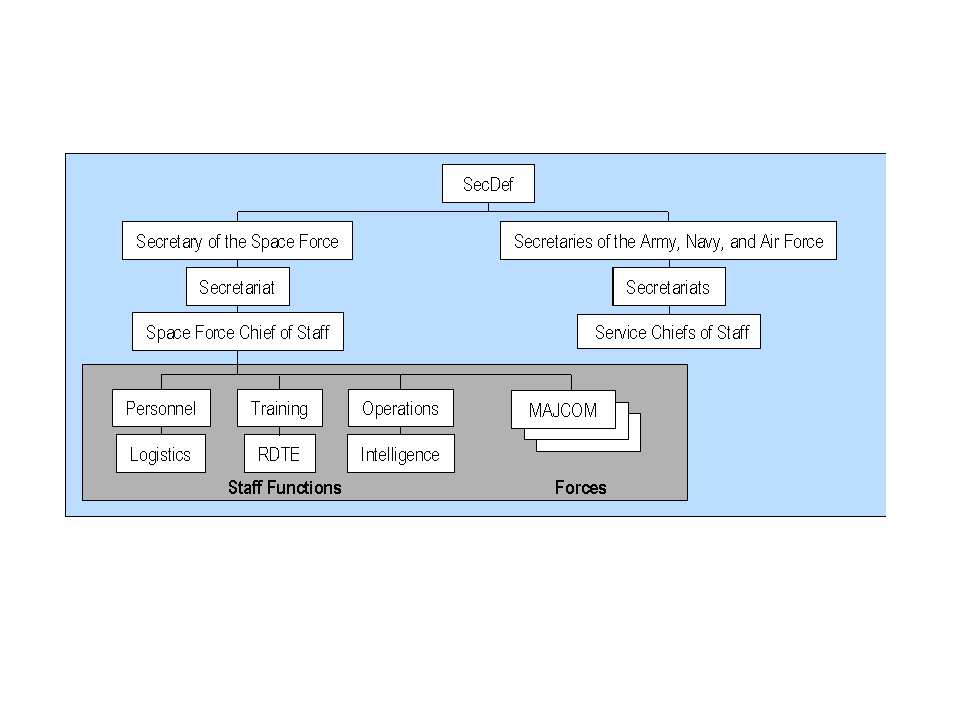
1. An Independent Military Department and Service
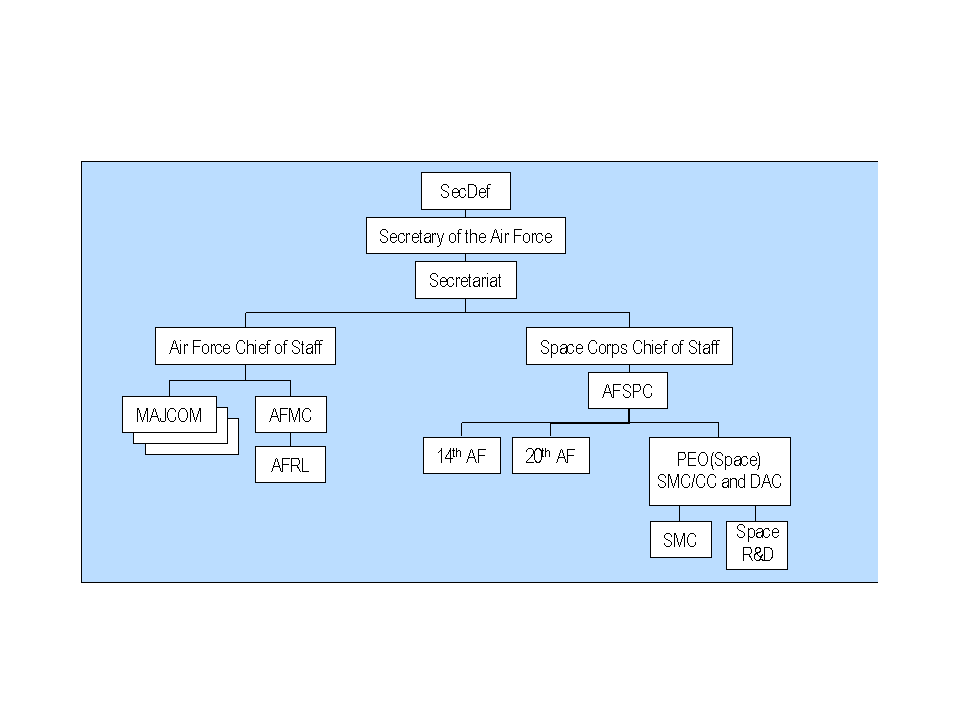
2. A Space Corps within the Air Force
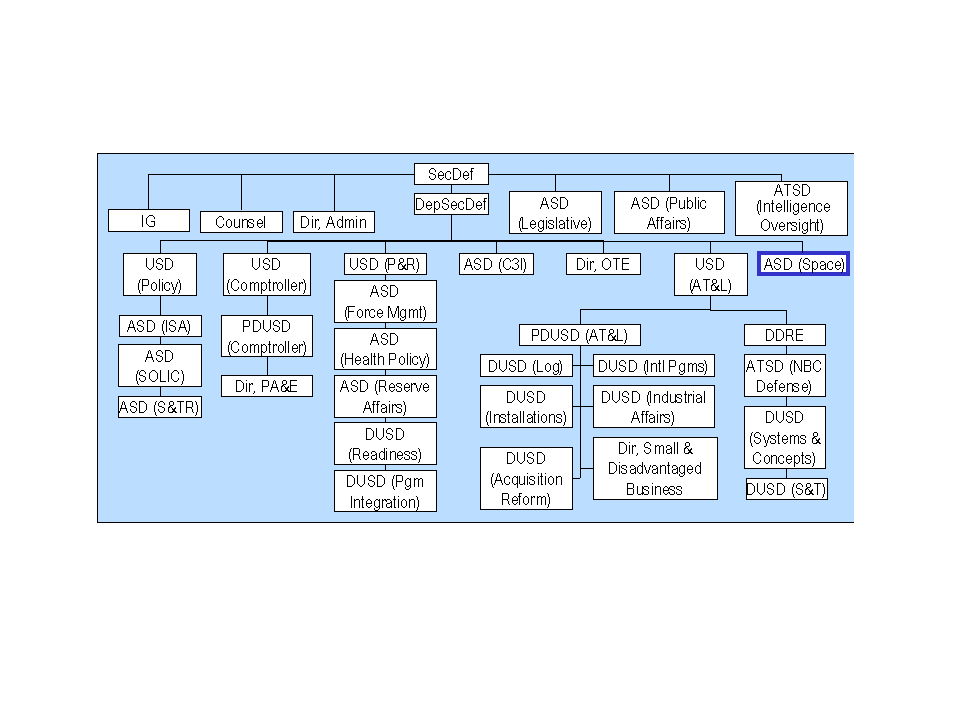
3. An Assistant Secretary of Defense for Space
4. A Space Major Force Program1. Centralized Space Management and Operations Option
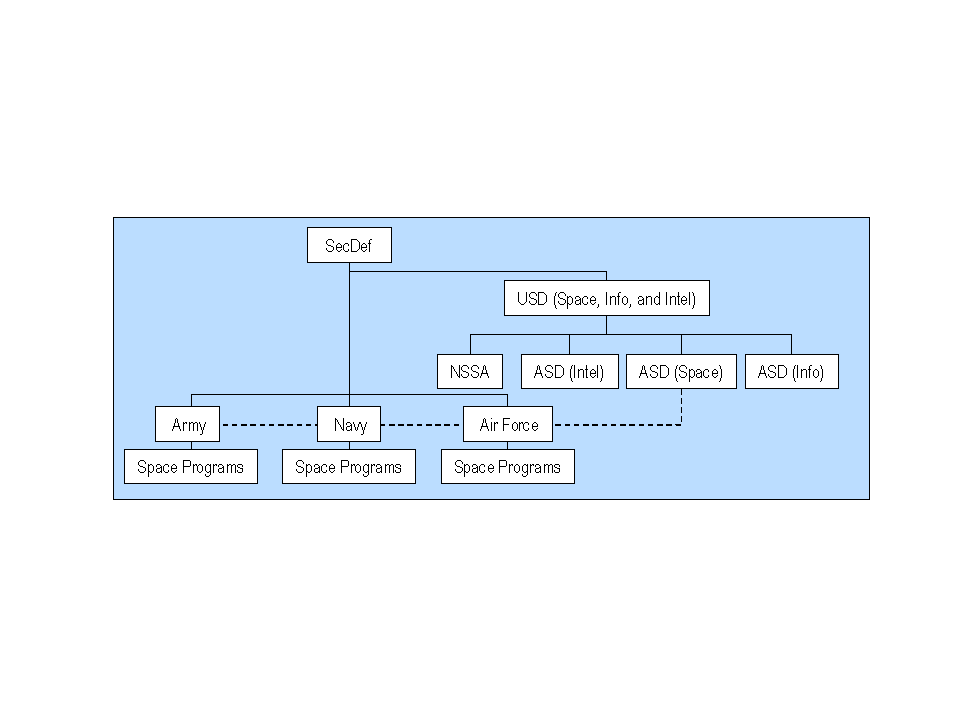
2. Under Secretary of Defense for Space, Information and Intelligence Option
3. Improved DoD/IC Cooperation Option
4. "Nuclear Navy" Option
5. Air Force's Recommended Changes1. Transition/Executive Agent Option
2. National Security Space Organization Option
3. Joint OptionVI. Summary of Organizational Options
A. High-Level Guidance
B. Implementing Guidance, Policy and Oversight1. OSD-DCI cooperation options
2. Policy guidance options
3. Budget-Programming guidance optionsC. Requirements Determination
D. Research, Development & Acquisition
E. Operations, Use, Training and Education
This document is not intended to be exhaustive, although it is intended to be sufficiently comprehensive to support those topics the Commissioners discussed during the course of their deliberations. In several cases, this paper touches on topics but does not completely detail those topics. This occurs where the Commissioners did not delve too deeply into issues not considered vital to the execution of their charge. Readers desiring more information on specific units or agencies not covered here should contact those agencies directly. The information is only as accurate and as current as could be obtained from published sources describing some of the organizations, since the authors did not specifically contact every organization addressed herein to verify the accuracy and currency of the information presented. The materials collected and the analyses provided to the Commissioners are reflected in the background paper that follows.
I. Introduction
Since the initiation of the Root reforms in the War Department in 1903, the defense establishment of the United States has confronted several key turning points when American leaders discovered that defense organization, technology and doctrine were not aligned optimally. At the end of both World War I and World War II, Congress engaged in a series of major discussions aimed at producing legislation that would reorganize the military in a way that more completely meshed technological advances (such as the airplane, the tank, aircraft carriers, and radio communications), improvements in doctrine, and military organization. Specifically, the history of the nearly half-century long evolution of the military's organization to use aircraft from the Wright brothers' first flight in 1903, and the establishment of an independent Air Force in 1947 is a case in point, full of military debates on the use of aircraft and legislative battles to build an effective defense organization. The history of these legislative efforts offers some insight into the organizational options facing the United States today as it confronts the challenges of managing the national security space mission. In particular, the history of military reorganization over the past century indicates both the gradual pace of change and the importance of congressional involvement in advancing defense reorganizations.(1)
The evolution of the Army Air Corps into the United States Air Force presents interesting parallels to the evolution of military space. Following the successes of American aviators in the First World War, military leaders and legislators in Congress began to discuss the appropriate organization for the future of U.S. military aviation. Army aviators, led by the fiery advocate for aviation's independence, Brigadier General William "Billy" Mitchell, argued for the creation of a new, independent Air Force, but the Army's senior leaders convinced Congress that such a move was premature. Instead, Congress reorganized the Army, moving the aviators out of the Signal Corps and into the Air Corps, designated a separate branch of the Army in 1926, equivalent to the other combat branches (infantry, cavalry, and artillery). In these years, Air Corps leaders developed a detailed doctrine for the use of aircraft for close air support, pursuit of enemy aircraft, and bombardment. In 1936, the Army established General HQ, Army Air Forces (GHQ, AAF), to provide field command of air units, and later designated the Chief of the Air Corps as Commander, GHQ, AAF in order to centralize command of Army air assets.
Further evolution of the air arm occurred in World War II. The Chief of the Air Corps was designated the Deputy Chief of Staff for Air, and in 1942, a wartime reorganization made the AAF an independent headquarters within the Army, parallel to the Army Ground Forces and Services of Supply, which provided common items and basic logistics, supply and support services to the field units. The AAF managed their own research and development (R&D) and procurement programs for aircraft, weapons, and aircraft-specific support equipment, with their budget under the final decision authority of the Secretary of War, who submitted the entire Army budget to the Congress.(2) Throughout this period, the AAF operated largely as an independent organization, with its own chain of command and acquisition infrastructure, but the Air Forces personnel were still members of the Army. The head of the AAF, General Henry "Hap" Arnold, also served as a member of the Joint Chiefs of Staff (JCS), which was established as an ad hoc organization to coordinate the U.S. war effort, and also included Army Chief of Staff General George Marshall, and Chief of Naval Operations Admiral Ernest King. The JCS then, unlike today, had no statutory authority to make decisions or advise the President. The Secretaries of War and Navy made decisions and advised the President, and a civilian war resources board managed the industrial war effort.
Following the war, Congress engaged in a series of debates and hearings on the subject of future joint operations, resulting in the passage of the National Security Act of 1947. This act established the Department of Defense and made the U.S. Air Force a separate Service. Following twenty years of debate on whether to establish an independent air service, the experiences of World War II and the demonstrated performance of the Army Air Forces made it clear that aviation technology and U.S. operational doctrine had advanced to the point that an independent organization made sense.
The launch of the Russian satellite Sputnik in 1957 presaged the development of military operations in a new medium, space, much like the Wright brothers flight at Kitty Hawk, North Carolina had done for the medium of air in 1903. Just as aircraft were designed to enable long-range communications and long-range reconnaissance, soon after Sputnik manned and unmanned spacecraft improved military communications and reconnaissance capabilities. Military doctrine, strategy and organizations devoted to space evolved in both the United States(3) and the Soviet Union.(4) As the Congressionally mandated Commission to Assess United States National Security Space Management and Organization began meeting in the summer of 2000, Russia was reorganizing their military space establishment by creating a Russian Space Force.(5)
The management of the U.S. national security space mission is under scrutiny today in order to decide whether it is time for the initiation of a similar evolution on the part of U.S. space capabilities into some form of independent military organization. Congress established The Commission to Assess U.S. National Security Space Management and Organization in order to study potential improvements in U. S. national security space management and organization. This paper supports the Commission's efforts with respect to Section 1622. (a), subparagraph (5). Specifically, the Commission was asked to assess
"the potential costs and benefits of establishing any of the following:
An independent military department and service dedicated to the national security space mission;
A corps within the Air Force dedicated to the national security space mission;
A position of Assistant Secretary of Defense for Space within the Office of the Secretary of Defense;
A new major force program, or other budget mechanism, for managing national security space funding within the Department of Defense; and
Any other changes to the existing organizational structure of the Department of Defense for national security space management and organization."(6)
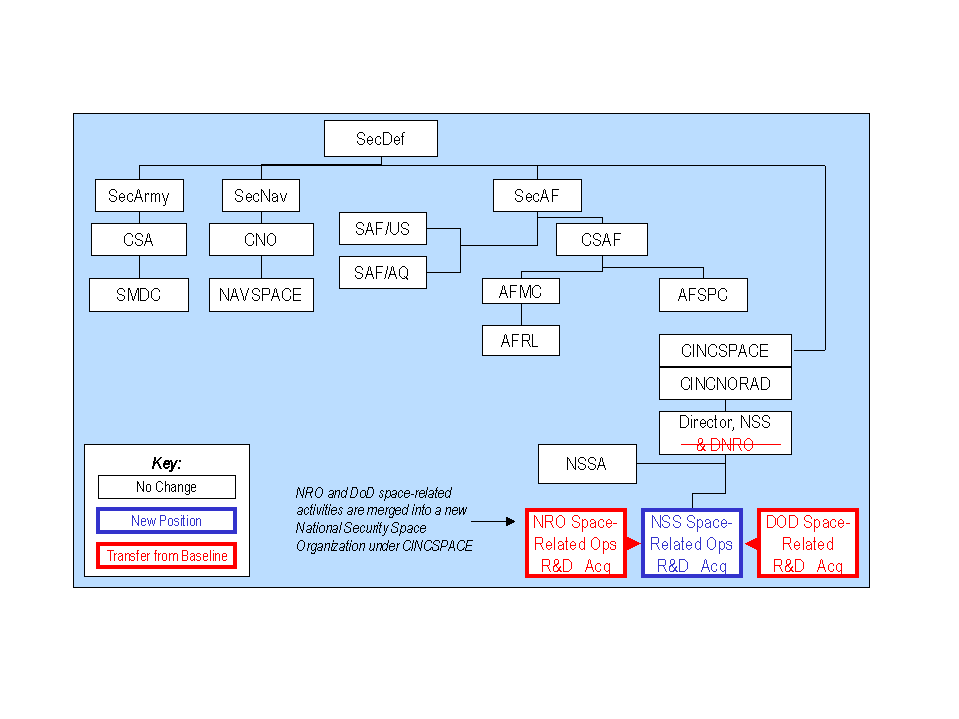
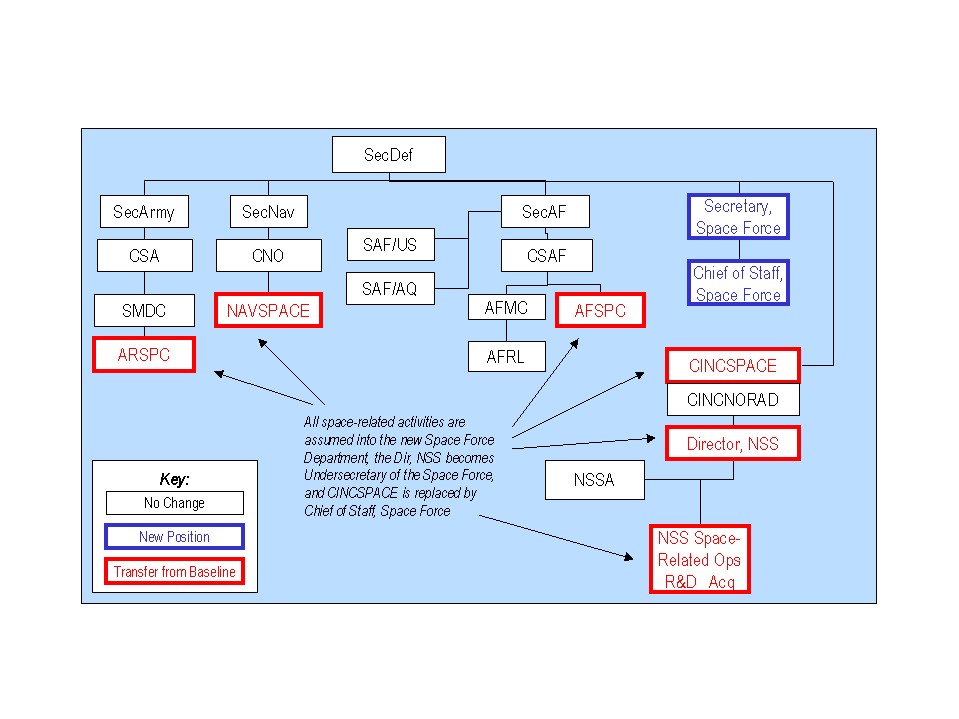
In order to assess alternative recommendations for organization and management reforms, the Commission agreed upon a process to evaluate each of the prescribed organizational models, as well as others that were offered to the Commission, or that the Commission developed over the course of the study. This paper outlines the evaluation process, the current state of national security space management (the baseline), and options for recommended changes to space management and organization that were considered by the Commission.
Chapter 2 details the method used for assessing the baseline, to include the management functions studied, the evaluative methodology, assumptions underlying the baseline and the organizational models considered by the Commission, and criteria for assessing each organizational option. Chapter 3 examines the baseline organizations involved in national security space in detail. This chapter reports the duties of each of the offices, agencies, and officials who have some role in the management of national security space. This paper draws the material in Chapter 3 primarily from information sources of the agencies themselves--their mission statements, directives, regulations, or other official documents that state their role in national security space.
Chapter 4 discusses the desired outcomes for any potential reorganization of the management of national security space; this section also reports the limitations of the baseline. Chapter 5 briefly outlines the range of organizational options considered by the Commission as possible changes to the current space management baseline. The Commission's recommendations do not embrace a single option as the "right answer" to the challenges facing national security space management; the Commissioners focused on those elements within each of the options that seemed most likely to improve space management, and developed a set of recommendations that combined the best features of the options into a single set of recommended changes. Chapter 6 summarizes the analysis of the individual options examined by the Commission.
II. Construct for Evaluation
The Commission developed a means to assess systematically each of the organizational alternatives during the course of their review. The organizational options considered include those specified in the legislation that established the Commission, other models suggested by witnesses in their testimony to the Commission, and other options of interest to the Commission.
A. Organizational Management Functions
The Commission identified a set of management functions that highlight how U.S. space policy is developed and implemented, resources allocated to accomplish the space mission, new capabilities developed and procured, and space operations conducted. To accomplish the future national security space mission, organizations, of whatever form, must collectively accomplish the following management functions: High-Level Guidance; Implementation Guidance; Requirements Determination; Research, Development and Acquisition; and Operations, Use, Training, and Education. How a particular administration chooses to organize to accomplish these functions may vary depending upon the needs and circumstances at the time, but the functions span the major activities needed to perform the national security space mission. The Commission used this set of functions to organize and assess the range of organizational alternatives that it reviewed:
High-Level Guidance--This includes Presidential, Executive Office, other government agency, and congressional-level guidance, to include budget appropriations and authorization. Vision, goals, strategy, regulatory and policy functions, and inter-agency policy and planning coordination are performed at this level.
Implementation Guidance, Policy and Oversight--This includes the Secretary of Defense (SecDef), the Director of Central Intelligence (DCI), the JCS, and Service headquarters level directives, regulations, guidance, oversight, interagency coordination, and architectural development. High-Level Guidance is implemented by the SecDef and DCI at this level through the performance of planning, programming and budget functions delegated to specifically designated agents in the Office of the Secretary of Defense (OSD), the Services, in the Community Management Staff (CMS) and throughout the Intelligence Community (IC).
Requirements Determination--This process focuses on melding the demands of meeting tactical and operational needs with those long-term strategic requirements embodied within the objectives and guidance of the leadership. Requirements are developed and coordinated among the beneficiaries or "users" and operators, vetted through a higher-level authority to manage competing requirements, and significantly influence the planning, programming, and budget functions performed by the SecDef and DCI. Regional and functional Commanders-in-Chief (CINCs) can influence requirements by submitting Integrated Priority Lists (IPLs) through the Chairman, JCS.
Research, Development and Acquisition--The acquisition authority is responsive to those identifying validated requirements, executing all activities necessary to develop and procure new space and space-related capabilities. Research, development, and acquisition activities are performed by those organizations that develop and operate space systems, as well as those organizations that are users of space capabilities. Testing, evaluation and experimentation activities are performed by organizations as an element of this function.
Operations, Use, Training, and Education--These activities relate to the organizations that operate and use space systems and their derived products and capabilities. The "organize, train, and equip" responsibilities of the Military Departments and the operational employment authority for the CINCs under the Unified Command Plan (UCP) define this aspect of space management. The conduct of operations, development of relevant strategy, doctrine, training, and tactics, personnel management, and support functions for military operations are included in this functional area. Operators of ground stations, space component organizations and "space cells" resident in the functional commands are examples of space operators and users.
B. Methodology
As a first step in their evaluation, the Commission examined the agencies and processes that govern U.S. national security space systems and operations today. This Baseline of space organization and management serves as the departure point for identifying potential organizational and management challenges that may inhibit the development of capabilities needed to address future U.S. interests in space. Chapter 3 of this background paper provides a comprehensive overview of current organizations and their responsibilities as they pertain to the management of national security space. Chapter 4 examines the problems with the current practice of national security space management--What's broken?--and explores desired outcomes that would guide any contemplated space reorganization. Finally, this paper walks through the range of organizational options available to the U.S. Government for addressing each of the concerns with the baseline arrangements.
C. Assumptions
The Commission examined various organizational approaches in light of certain shared assumptions, particularly regarding the growing importance of space to our nation in the future. This importance of space holds true across a range of likely future conditions, and therefore warrants more robust organizational structures with respect to national security space. The Commission also assumed that within the next quarter century, activities in space will become so prevalent and important to our peace, livelihood and well being that a military space force may be clearly warranted. That said, the Commission assumed that specific organizational implementations should be left to the Administrations responsible for preparing for, and then carrying out, the national security space mission when the time comes.
In constructing the organizational alternatives under consideration, the Commission used similar, existing organizations where appropriate, as a starting point to help define how such an organization or management process might be applied to national security space. From these initial organizational models, the Commission identified potential limitations of analogous organizations as they might pertain to space and explored organizational and procedural refinements of the models to better address the unique nature of space operations.
D. Criteria
To facilitate comparison of organizational options to each other and to the baseline of national security space management, the Commission debated the use of a set of criteria to assess the viability of the organizational alternatives considered. The following quantitative and qualitative measures of effectiveness were developed to reflect the Commission's sense of desired outcomes in each of the functional areas of space management:
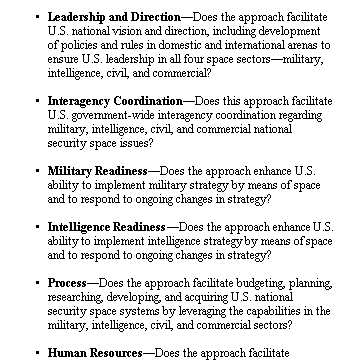
III. Baseline
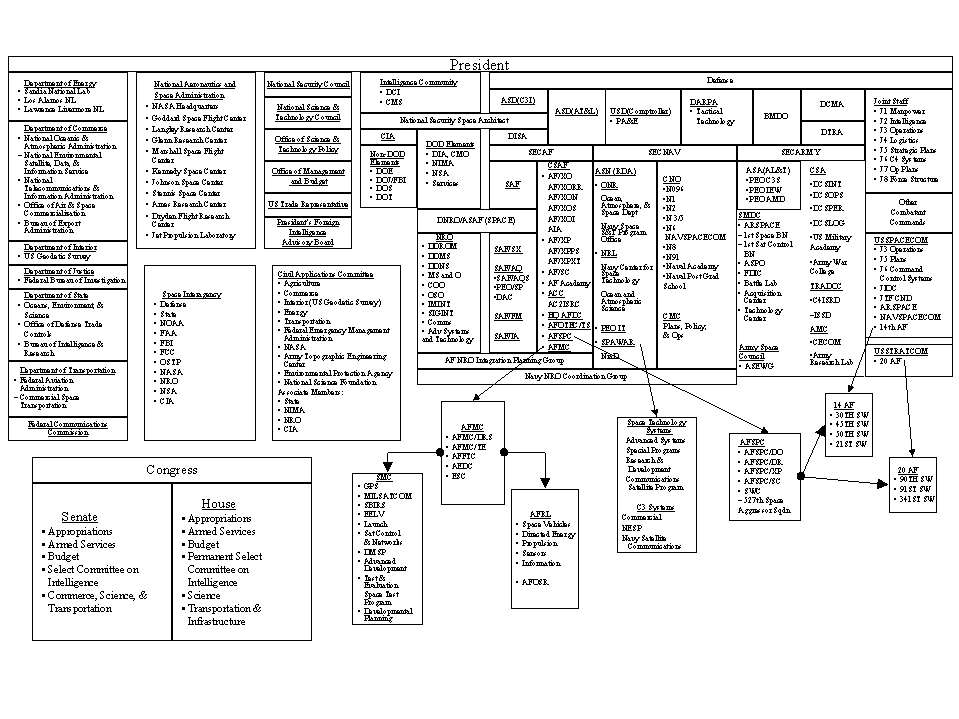
This section outlines the baseline of organizations and management processes as they pertain to national security space today. The roles and responsibilities of relevant White House, congressional, other government agency, Department of Defense (DoD), and IO organizations in the conduct of policy formulation, implementation, planning and resource allocation, requirements determination, development and procurement, and operation of national security space capabilities (as depicted in Figure 1) are described in the following pages. Baseline organizational descriptions have been arranged according to the management functions each agency performs. The organizational descriptions also identify the applicable laws, directives, and regulations that authorize each agency to perform designated tasks and describe the interaction of each agency with the other entities that contribute to that function.
A. High-Level Guidance
The President of the United States provides the highest level of guidance in the form of written policies. For space, this guidance comes from three types of documents: (1) The National Security Strategy; (2) Presidential Decision Directives (PDD); and (3) Presidential Review Directives. The National Security Council (NSC), Office of Science and Technology Policy (OSTP), and the National Science and Technology Council (NSTC) coordinate the production and content of any of these documents that are space-related. The President's Budget, coordinated through the Office of Management and Budget (OMB), is also a policy document of sorts, as it identifies policy priorities by funding levels.At the Interagency level, high-level guidance involves the coordination of space policy and requirements throughout the government for all four space sectors--commercial, civil, intelligence, and military--including coordination of the regulatory regime, science and technology research, and national security issues. In addition, congressional authorization committees also provide high-level guidance through the recommendation of government operations, and funding for new and existing programs.
1. Executive Office of the President
1.1. National Security Council
The NSC was established by the National Security Act of 1947 to advise the President with respect to the integration of domestic, foreign, and military policies relating to the national security. The NSC is the highest Executive Branch entity providing review of, guidance for, and direction to the conduct of all national foreign intelligence and counterintelligence activities. The statutory members of the NSC are the President, the Vice President, the Secretary of State, and the SecDef. The DCI and the Chairman of the Joint Chiefs of Staff (CJCS) participate as advisers.(7)The President ensures that the nation's laws are carried out and enforced, but also sets the strategic course for the nation. The President issues the National Security Strategy through the NSC. The National Security Strategy is the capstone document that directs agencies in the identification of priority policies. The December 1999 National Security Strategy had the following to say about space:
"We are committed to maintaining U.S. leadership in space. Unimpeded access to and use of space is a vital national interest--essential for protecting U.S. national security, promoting our prosperity and ensuring our well-being. Consistent with our international obligations, we will deter threats to our interests in space, counter hostile efforts against U.S. access to and use of space, and maintain the ability to counter space systems and services that could be used for hostile purposes against our military forces, command and control systems, or other critical capabilities. We will maintain our technological superiority in space systems, and sustain a robust U.S. space industry and a strong, forward-looking research base. We also will continue efforts to prevent the spread of weapons of mass destruction to space, and will continue to pursue global partnerships addressing space-related scientific, economic, environmental and security issues."(8)
In addition, the NSC helps the President produce Presidential Decision Directives (PDDs) on space, including PDD8/NSC49, National Space Policy. These directives spell out the national-level goals, priorities, and direction for US space activities, and generally recommend actions by the Interagency on various aspects of space policy, from the most general, to the most specific: space transportation, remote sensing, Landsat, and the National Polar-Orbiting Operational Environmental Satellite System (NPOESS), for example.(9)
1.1.1. Senior Director, Defense Policy and Arms Control. Within the NSC, space issues are addressed by the Director for Space who reports to the Senior Director for Defense Policy and Arms Control.(10)
1.2. National Science and Technology Council
According to PDD-49, the NSTC is the principal forum for resolving issues related to national space policy.(11) Established by President Clinton in 1993, this Cabinet-level Council is the primary means for the President to coordinate science, space, and technology, and to coordinate the diverse parts of the Federal research and development enterprise. All executive departments and agencies are required to coordinate science and technology policy through the Council and share information on R&D budget requests with the Council. The Council also develops recommendations on R&D budgets that reflect national goals and submits them to the Director of OMB.(12) The Council's R&D strategies are coordinated across Federal agencies to form an investment package aimed at accomplishing multiple national goals. Located in the OSTP, the President chairs the NSTC. Membership consists of the Vice President, Assistant to the President for Science and Technology, Cabinet Secretaries and Agency Heads with significant science and technology responsibilities, and other White House officials.(13) The NSTC also prepares space-related PDDs, and Presidential Review Directives (PRDs), the mechanism used by the Clinton Administration to direct that departments and agencies undertake specific reviews and analyses.1.2.1. Office of Science and Technology Policy. OSTP provides the staff for the National Science and Technology Council. The Technology Division of OSTP helps to develop and implement Federal policies for harnessing technology to serve national goals such as global economic competitiveness, environmental quality, and national security. The Division's priorities include the U.S. space and aeronautics program, including the space station. The goal of the National Security and International Affairs (NSIA) Division is to strategically promote the contribution of science and technology to national security, global stability, and economic prosperity. Priorities in the commerce-security nexus include international technology transfer, export controls, information security, and dual-use technology policies. In addition, OSTP, in coordination with the NSC staff, examines the interagency approval process for international cooperation involving space nuclear power systems, including measures to address possible commercial use of space nuclear systems. Such requests for approval take into account public safety, economic considerations, international treaty obligations, and U.S. national security and foreign policy interests.(14) At their request, the OSTP also serves as an advisor to the NSC on science and technology as it relates to national security.(15)
1.3. Office of Management and Budget
OMB's predominant mission is to assist the President in overseeing the preparation of the Federal budget and to supervise its administration in Executive Branch agencies. In helping to formulate the President's spending plans, OMB evaluates the effectiveness of agency programs, policies, and procedures, assesses competing funding demands among agencies, and sets funding priorities.(16)1.4. President's Foreign Intelligence Advisory Board (PFIAB)
The PFIAB provides advice to the President concerning the quality and adequacy of intelligence collection, of analysis and estimates, of counterintelligence, and of other intelligence activities. The PFIAB, through its Intelligence Oversight Board, also advises the President on the legality of foreign intelligence activities. The PFIAB currently has eleven members selected from among distinguished citizens outside the government who are qualified on the basis of achievement, experience and independence.(17)2. Interagency/Inter-sector Cooperation (DoD-Civil)
2.1. National Aeronautics and Space Administration
According to PDD-49, NASA is the lead agency for research and development in civil space activities. This document further directs NASA, in coordination with other departments and agencies as appropriate, to focus its research and development efforts in: space science to enhance knowledge of the solar system, the universe, and fundamental natural and physical sciences; Earth observation to better understand global change and the effect of natural and human influences on the environment; human space flight to conduct scientific, commercial, and exploration activities; and space technologies and applications to develop new technologies in support of U.S. Government needs and our economic competitiveness.(18)NASA is a Federal research and engineering agency that accomplishes most of its space, aeronautics, science, and technology programs through nine Field Centers and the Jet Propulsion Laboratory, which is a Federally Funded Research and Development Center. NASA is responsible for exercising control over aeronautical and space activities sponsored by the United States and is the lead agency for R&D in civil space activities. To avoid unnecessary duplication of effort, facilities, and equipment, NASA collaborates with the DoD on a variety of space launch and operations activities and in developing future human exploration and development of space capabilities. The 1994 National Space Transportation Policy (NSTP) policy directed NASA to pursue technology development and demonstration efforts (to support a decision by the year 2000) on whether to continue to rely on the Space Shuttle for the indefinite future or expect a new "2nd generation" Reusable Launch Vehicle (RLV) in the early 2000's.(19) This led NASA to enter into a government-industry cooperative arrangement called the X-33 Program. The X-33 Program was to have 15 flight tests between March and December 1999 and expire at the end of the year 2000. Due to technical problems with its engines and construction of its composite fuel tanks, NASA has restructured its program into a Space Launch Initiative (SLI) Program and shifted the shuttle or "2nd generation" RLV decision to 2005. In addition, only if the current X-33 team successfully competes funds under the SLI program will there be test flights of the X-33 hardware, now expected to be in the 2003 timeframe.(20)
The Armed Services have been active participants in the U.S. manned spaceflight program since the inception of manned space flight. This program has focused on conducting research experiments and gathering scientific data. Every year the Services have a selection board that considers all qualified applicants, selects a list of candidates and forwards the list to NASA, which in turn makes the final selection of astronaut candidates. Successful military candidates are detailed to NASA for a specified tour of duty and are assigned to the astronaut office at the Johnson Space Center to begin a one to two year training and evaluation program. The Army, Navy, and Air Force all have military officers serving as astronauts with NASA.
In 1997 NASA, the DoD and the NRO formed a Space Technology Alliance, chaired by senior technology leaders in each organization, for continued dialogue, information exchange, and direct cooperation in the development of advanced space technology. NASA and DoD also collaborate on future communications and data systems architectures for space operations through the National Security Space Senior Steering Group.(21) In addition, the DoD Space Test Program, overseen by the Air Force's Space and Missile Systems Center, sometimes uses NASA spacecraft to launch its spacecraft experiments.
NASA's Tracking and Data Relay Satellite System (TDRSS) is a communication signal relay system that provides tracking and data acquisition services between low earth orbiting spacecraft and control and/or data processing facilities. The system is capable of transmitting to and receiving data from spacecraft over at least 85% of a spacecraft's orbit. TDRSS has the ability to provide communications support for appropriately configured national security spacecraft.
Under NSTC-4, NASA will provide for the improvement of the Space Shuttle system, focusing on reliability, safety, and cost-effectiveness. NASA also will be the lead agency for technology development and demonstration for next generation reusable space transportation systems. NASA, the Intelligence Community, and the DoD, in cooperation with the private sector, will develop design guidelines for future government procurements of spacecraft, launch vehicles, and services. The design and operation of space tests, experiments and systems, will minimize or reduce accumulation of space debris consistent with mission requirements and cost effectiveness.(22)
2.2. Department of Energy (DOE)
PDD-49 tasks DOE with maintaining the necessary capability to support civil space missions, including research on space energy technologies and space radiation effects and safety. In addition, DOE, in coordination with DoD, the Arms Control and Disarmament Agency and the DCI, will carry out research on and development of technologies needed to effectively verify international agreements to control special nuclear materials and nuclear weapons. DOE will maintain the necessary capability to support space missions, which may require the use of space nuclear power systems.(23)2.2.1. Los Alamos National Lab. Los Alamos was born as part of the Manhattan Project to create the first atomic weapons during World War II, and is today a U.S. Department of Energy national laboratory operated by the University of California. Their scientific expertise is very broad and ranges from innovative biological research to modeling global climate, and from novel methods for examining material properties to helping explore the outer reaches of the solar system.(24) The Center for Space Science and Exploration promotes interdisciplinary research that develops and enhances synergies between Space Science and Exploration programs and capabilities from across the Lab.(25) Los Alamos is a major contributor to international space research programs. This contribution derives from the research and development performed in support of the DOE nonproliferation mission. The Center for Space Sciences and Exploration's major interface is with NASA. Los Alamos also collaborates with Lawrence Livermore, and the University of Michigan, in the area of astronomical science.(26)
2.2.2. Lawrence Livermore National Lab (LLNL). LLNL is a U.S. Department of Energy national laboratory operated by the University of California. Lawrence Livermore's mission is to apply science and technology in the national interest, with a focus on global security, global ecology, and bioscience. Key research areas include astronomy and astrophysics; atmospheric science; nonproliferation, counter proliferation and arms control; national security; and weapons and defense technologies.(27)
2.3. Department of the Interior
PDD-49 gives the Department of the Interior, through the U.S. Geological Survey (USGS), the responsibility for maintaining a national archive of land remote sensing data and other surface data as appropriate, making such data available to U.S. Government and other users.(28)2.3.1. Civil Applications Committee (CAC). The USGS chairs the CAC, a Federal interagency committee that provides civil Federal agencies with access to classified imagery information needed to support agency missions. Established in 1968 and officially chartered in 1975 by the Office of the President, the CAC includes representatives from the Departments of Agriculture, Commerce, Energy, the Interior, and Transportation, Federal Emergency Management Agency (FEMA), NASA, U.S. Army Corps of Engineers, U.S. Environmental Protection Agency, and National Science Foundation (NSF). The activities of the CAC have expanded beyond traditional mapping to include a broad spectrum of environmental and remote sensing applications. Some examples include monitoring volcanoes; detecting wild fires; responding to emergencies caused by natural disasters, such as hurricanes, earthquakes, and floods; monitoring ecosystems; and mapping wetlands.(29)
2.4. Department of Commerce (DOC)
According to PDD-49, DOC, through the National Oceanic and Atmospheric Administration (NOAA), has the lead responsibility for managing Federal space-based civil operational Earth observations necessary to meet civil requirements. In this role, the DOC, in coordination with other appropriate agencies, will:
- Acquire data, conduct research and analyses, and make required predictions about the Earth's environment;
- Consolidate operational U.S. Government civil requirements for data products, and define and operate Earth observation systems in support of operational monitoring needs;
- Provide for the regulation and licensing of the operation of private sector remote sensing systems.(30)
2.4.1. National Oceanic and Atmospheric Administration Within the DOC, the Office of the Under Secretary of Commerce for Oceans and Atmospheric Research and Administrator of NOAA provides satellite observations of the global environment by operating a national system of satellites to explore, map, and chart the global ocean and its resources and describe, monitor and predict conditions in the atmosphere, ocean and environment.(31)
2.4.1.1. National Weather Service (NWS). NOAA's NWS provides weather, hydrologic, and climate forecasts and warnings for the United States, its territories, adjacent waters and ocean areas, for the protection of life and property and the enhancement of the national economy. NWS data and products form a national information database and infrastructure, which can be used by other governmental agencies, the private sector, the public, and the global community. The NWS is the sole United States official voice for issuing warnings during life threatening weather situations.(32)
2.4.1.2. National Environmental Satellite, Data, and Information Service (NESDIS). NESDIS acquires and manages the Nation's operational environmental satellites, provides data and information services, and conducts related research in order to provide and ensure timely access to global environmental data from satellites and other sources to promote, protect, and enhance the Nation's economy, security, environment, and quality of life. The prime customer for the satellite data is NOAA's National Weather Service.(33)
- Office of Satellite Data Processing and Distribution (OSDPD). An element of NESDIS, OSDPD manages and directs the operation of the central ground facilities, which ingest, process, and distribute environmental satellite data and derived products to domestic and foreign users.(34)
2.4.1.3. CoastWatch Program. The CoastWatch Program makes satellite data products and data from NOAA environmental buoys available to federal, state, and local marine scientists and coastal resource managers with hourly updated images of the Northeast, Southeast Caribbean, Great Lakes, Gulf of Mexico, Gulf Coast, West Coast and Central Pacific.(35)
2.4.1.4. Integrated Program Office. The Integrated Program Office is a tri-agency office reporting through NOAA to an Executive Committee comprised of Under Secretary/Administrator level officials of the DOC, DoD and NASA. This office provides an example of how diverse agencies with similar requirements can work together in the development of NSS programs. It provides for the planning, development, management, acquisition, and operation of the Nation's single (converged) polar-orbiting operational environmental satellite system to satisfy both civil and national security requirements for remotely sensed meteorological, oceanographic, climatic and space environmental data. In 1994, the President directed convergence of the DOC/NOAA's Polar-orbiting Operational Environmental Satellite (POES) program and the Department of Defense's Defense Meteorological Satellite Program (DMSP). These two programs became the National Polar-orbiting Operational Environmental Satellite System (NPOESS). In addition, NASA, through its Earth Observing System efforts, offers new remote sensing and spacecraft technologies that could potentially improve the capabilities of the operational system.(36)
2.5. Department of State (DOS)
The DOS is the primary institution for the conduct of American diplomacy. State leads representation of the United States overseas and advocates U.S. policies for foreign governments and international organizations to include the United Nations; conducts negotiations, concludes agreements, and supports U.S. participation in international negotiations of all types; and manages those international affairs programs and operations for which the Department has statutory responsibility. The DOS is responsible for export licensing of munitions. Satellites were reclassified as munitions by Congress in 1999.(37)2.5.1. Bureau of Oceans and International Environmental and Scientific Affairs (OES) OES is the Department of State's focal point for foreign policy formulation and implementation in global environment, science, and technology issues. The Bureau works closely with the White House, U.S. Government agencies, Congress, U.S. universities, nongovernmental organizations, private citizens, and other bureaus in the Department of State to formulate U.S. foreign policy on these issues. The Space and Advanced Technology (SAT) staff handles international space issues and multilateral science and advanced technology questions. Its objectives are to ensure that U.S. space policies and multilateral science activities support U.S. foreign policy objectives and enhance the competitiveness of the U.S. aerospace industry. The SAT staff has primary responsibility for U.S. representation on the United Nations Committee on the Peaceful Uses of Outer Space, the NATO Science Committee, and the OECD Committee on Scientific and Technological Policy. SAT also maintains the U.S. Registry of Space Objects and reviews export license requests for space technology.(38)
3. Interagency/Inter-sector Cooperation (DoD-Commercial)
3.1. Federal Communications Commission (FCC)
Established by the Communications Act of 1934 as an independent United States government agency directly responsible to Congress, the FCC is charged with establishing policies to govern interstate and international communications by television, radio, wire, satellite and cable.(39) The FCC manages the use of the spectrum by the public, including state and local governments.(40)3.1.1. The International Bureau. The International Bureau was established in October 1994 to handle all FCC international telecommunications and satellite programs and policies. Its functions include international safety and distress, space and earth stations, cable landing licenses, bilateral discussions and interaction with other international organizations. The International Bureau is responsible for FCC activities regarding international matters. The Bureau is also charged with domestic administration of telecommunication provisions of treaties and international agreements to which the United States is a party. Under DOS auspices, the International Bureau of the FCC participates in related international conferences.(41)
- Satellite and Radiocommunication Division. This division develops, recommends and administers policy, rules, standards and procedures for licensing and regulating new and modified satellite Earth and space station facilities and associated services. It also handles space station International Telecommunications Union (ITU) coordination activities to permit the coexistence and coordination of U.S. and foreign-licensed satellite systems, ensuring no unacceptable interference among, from, or to those systems. This division also prepares for, and participates in, international meetings and conferences, ensuring that U.S. satellite and terrestrial interests are represented.(42)
- Planning and Negotiations Division. This division also represents the FCC in international conferences and meetings involving the ITU and other international fora, ensuring that FCC officials are aware of international and bilateral agreements regarding spectrum and other issues. This division oversees rulemakings involving spectrum issues and the reconciliation of domestic and international spectrum policies, in addition to directing and coordinating negotiations with Mexico, Canada, and others regarding spectrum use and interference protection.(43)
3.1.2. Office of Engineering and Technology (OET) OET is responsible for the management and allocation of non-Federal Government spectrum and for coordination of Federal Government spectrum management with other Federal Government agencies. OET is responsible for the performance of expert technical and engineering analysis on all aspects of radio frequency, propagation and electromagnetic compatibility.(44) OET also advises and represents the FCC on frequency allocation and spectrum usage matters, and conducts engineering and technical studies in advanced phases of terrestrial and space communications, and special projects to obtain data on new or improved techniques. OET advises the FCC and other bureaus and offices concerning spectrum management, emerging technologies, technical standards, international considerations and national security matters involved in making or implementing policy or in resolving specific situations involving these matters, and coordinates with other agencies of government, technical experts representing foreign governments, and members of the public and industry concerned with communications and frequency allocation and usage.(45)
3.2. Department of Commerce
With regard to space, the Department of Commerce is responsible for promoting the competitiveness of the U.S. commercial space industry.3.2.1. Office of Space Commercialization. Established in 1998(46), the Office of Space Commercialization, part of the Office of the Under Secretary for Technology, is the principal office within the Department of Commerce for the coordination of space-related issues, programs, and initiatives. The goal of the Office is to foster an economic and policy environment that ensures the international competitiveness of the U.S. commercial space industry. The office conducts activities in three primary areas: policy development, market analysis, and outreach/education. In fulfilling these roles and functions, the Office of Space Commercialization focuses its efforts on a select group of commercial space industry sectors, including satellite navigation and imaging, space transportation, satellite communications, and emerging space business frontiers. The Office of Space Commercialization serves as an advocate for the interests of the U.S. commercial space industry during government discussions concerning national space policy.(47)
3.2.2. National Telecommunications & Information Administration (NTIA). An agency of the Department of Commerce, NTIA is the Executive Branch's principal agency responsible for domestic and international telecommunications and information policy issues, and is the President's principal adviser on telecommunications and information policy issues.(48) NTIA is the manager of Federal Government uses of the spectrum. The Office of International Affairs (OIA) advocates Executive Branch policy perspectives in bilateral and multilateral consultations with foreign governments, in international regulatory conferences, and in other fora dealing with Global Information Infrastructure issues. Specific oversight responsibilities include, in cooperation with the State Department and with the FCC, the COMSAT Corporation's (now doing business as Lockheed Martin Global Telecommunications) activities in the International Telecommunications Satellite Organization (INTELSAT), along with other developments in the satellite industry.(49)
3.2.2.1. Office of Spectrum Management (OSM). OSM is responsible for managing the Federal Government's use of the radio frequency spectrum. To achieve this, OSM receives assistance and advice from the Interdepartmental Radio Advisory Committee. OSM carries out this responsibility by: Establishing and issuing policy regarding allocations and regulations governing the Federal spectrum use; developing plans for the peacetime and wartime use of the spectrum; preparing for, participating in, and implementing the results of international radio conferences; assigning frequencies; maintaining spectrum use databases; reviewing Federal agencies' new telecommunications systems and certifying that spectrum will be available; providing the technical engineering expertise needed to perform specific spectrum resources assessments and automated computer capabilities needed to carry out these investigations; participating in all aspects of the Federal Government's communications related emergency readiness activities; and, participating in Federal Government telecommunications and automated information systems security activities.(50)
3.2.2.2. The Interdepartment Radio Advisory Committee (IRAC). The IRAC provides an interagency forum to develop and execute policies, programs, procedures, and technical criteria pertaining to the allocation, management, and use of the spectrum. Its membership consists of the NTIA, the National Science Foundation, NASA, Interior, Justice, Treasury, the Air Force, Coast Guard, Army and Navy, the FAA, HHS, FCC, Agriculture, Energy, State, GSA, FEMA, Commerce, the U.S. Postal Service, the VA, and the Broadcasting Board of Governors.(51)
3.2.3. Bureau of Export Administration (BXA). BXA seeks to advance U.S. national security, foreign policy, and economic interests by regulating exports of critical goods and technologies, that could be used to damage U.S. interests, by enforcing compliance with those regulations; by cooperating with like-minded nations to obtain global support for this effort; by assisting nations that are key exporters or transit points for sensitive goods and technologies to strengthen their own transit and export controls; and by monitoring the U.S. defense industrial base to ensure it remains strong.(52)
3.3. Department of Transportation (DOT)
According to PDD-49, DOT is the lead agency within the Federal government for regulatory guidance pertaining to commercial space transportation activities.(53) The U.S. Government encourages and will facilitate U.S. private sector and state and local government space launch and recovery activities. All activities related to space transportation undertaken by U.S. agencies and departments will be consistent with PDD/NSTC-4. DOT, in coordination with DoD, also co-chairs the Executive Secretariat of the Interagency GPS Executive Board.3.3.1. Assistant Secretary of Transportation for Transportation Policy. The Assistant Secretary co-chairs the Interagency GPS Executive Board (IGEB) with the Under Secretary of Defense for Acquisition, Technology and Logistics (USD (AT&L)). The DoD, DOT, DOS, and DOC are members of the IGEB by virtue of their specific responsibilities in PDD/NSTC-6. Other U.S. Government agencies that have responsibilities identified in the PDD, make substantial use of GPS, and/or provide GPS-related services are also members of the IGEB. Current additional members include the Departments of Agriculture, and the Interior, the CJCS, and NASA. PDD/NSTC-6 directs that a permanent IGEB manage GPS and U.S. Government augmentations to GPS to support and enhance U.S. economic competitiveness and productivity while protecting national security and foreign policy interests.(54) The IGEB is charged to:
- Review status and plans for continued development, acquisition, and operation that affect dual use;
- Approve management policies that affect dual use;
- Resolve interdepartmental issues;
- Provide periodic status reports to the President through the Assistant to the President for National Security Affairs and the Assistant to the President for Science and Technology; and
- Consult with U.S. Government agencies, U.S. industry, and foreign governments involved in navigation and positioning system research, development, operation, and use.(55)
3.3.2. Federal Aviation Administration (FAA). The FAA's major functions with regard to space include the development and operation of a common system of air traffic control and navigation for both civil and military aircraft; research and development with respect to the National Airspace System and civil aeronautics; and the regulation of U.S. commercial space transportation.
3.3.2.1. The Office of the Associate Administrator for Commercial Space Transportation (AST). AST is the newest and only space-related line of business within the FAA. Established in 1984 as the Office of Commercial Space Transportation (OCST) in DOT, AST was transferred to the FAA in November 1995. AST is divided into three functional components, the Office of the Associate Administrator, the Space Systems Development Division (SSDD), and the Licensing and Safety Division (LASD). AST is given the responsibility to:
In fulfilling its responsibilities under Title 49, AST issues Launch Operator's Licenses for U.S.-based commercial launches of orbital rockets such as the Atlas, Delta, Taurus, and Athena launch vehicles, and the air-launched Pegasus rocket. AST also has issued licenses for commercial launches of sub-orbital sounding rockets such as the Black Brant and Starfire, and has licensed the operation of several non-federal launch sites including the California Spaceport at Vandenberg Air Force Base, Spaceport Florida at Cape Canaveral Air Station, the Virginia Space Flight Center at Wallops Island, and Spaceport Alaska at Kodiak Island, Alaska.(57)
- Regulate the commercial space transportation industry, only to the extent necessary to ensure compliance with international obligations of the U.S. and to protect the public health and safety, safety of property, and national security and foreign policy interest of the United States;
- Encourage, facilitate, and promote commercial space launches by the private sector;
- Recommend appropriate changes in Federal statutes, treaties, regulations, policies, plans, and procedures; and
- Facilitate the strengthening and expansion of the United States space transportation infrastructure.(56)
Space Systems Development Division (SSDD). SSDD provides the space systems engineering, space policy, and economic and launch forecast capabilities for the Associate Administrator. SSDD's systems engineering expertise supports AST's regulatory mission through the development of requirements and criteria for the regulation of advanced launch concepts and launch site technologies. In particular, SSDD is developing regulations to ensure the safety of the many proposed reusable launch vehicles. Systems engineering support also includes the evaluation of environmental impacts of new launch vehicles and launch sites and the integration of space launch activities into a Space and Air Traffic Management System (SATMS) as part of the FAA's National Airspace (NAS) modernization activity. The SATMS represents a conceptual "aerospace" environment in which space and aviation operations are seamless and fully integrated in a "modernized", efficient NAS.(58) SSDD develops long-range commercial launch forecasts based on the markets for established and new satellite services, and identifies both domestic and international future space markets and industry trends. As part of its policy role, AST works with the interagency community to develop space transportation policies and works closely with other Federal agencies on issues relating to the use of U.S. commercial launch services. SSDD also works with other government agencies to monitor trading practices in the worldwide launch market and to develop policy guidelines for free and fair trade in commercial launch services for international launch services providers.(59)
Licensing and Safety Division (LASD). LASD carries out AST's licensing responsibilities and determines insurance or other financial responsibility requirements for commercial launch activities. The components of the licensing process include a pre-licensing consultation period, policy review, payload review, safety evaluation, financial responsibility determination, and an environmental review.(60)
3.4. Department of State
The Department of State's responsibility related to commercial space is to ensure that U.S. space policies support U.S. foreign policy commercial objectives. DOS represents the U.S. on the United Nations, NATO and OECD Science or Space Committees. In addition, bureaus such as the Bureau of Intelligence and Research (INR) are users of national security space assets for intelligence gathering purposes.3.4.1. Office of Defense Trade Controls (DTC). DTC (61) controls the export and temporary import of defense articles and services, including communication satellites, by taking final action on license applications and other requests for approval for defense trade exports and retransfers, and handling matters related to defense trade compliance, enforcement and reporting.(62) Although the DOC is the primary agency that administers and enforces the nation's export laws and licenses, the DOS handles exports relating to munitions. The satellite industry claims that exports of satellite components dropped nearly 40 percent in 1999 partly because licensing control of those exports switched from the DOC to DOS, leading to a lengthier, more complicated approval process. Congress enacted the switch in order to further guard against the transfer of launch technology to China.(63) The satellite industry has been calling for a return of responsibility to the Commerce Department, citing lengthy delays and an exponential increase in paperwork.(64)
3.4.2. Remote Sensing Interagency Working Group (IWG). To streamline review of potential exports of advanced remote sensing systems consistent with established policy, the DOS chairs a standing IWG with relevant interagency expertise in remote sensing from space. The IWG includes the participation of the DoD, DOC, the IC and other agencies as appropriate. Decisions on actual exports of advanced remote sensing systems on the U.S. Munitions List continue to be made in accord with existing laws and regulations. The DOS will provide, upon request by a U.S. company, an advisory opinion, which is coordinated through the IWG on whether the performance characteristics of a proposed system make it potentially exportable consistent with U.S. foreign policy and national security concerns. Authority to negotiate and conclude any such agreements are subject to normal interagency review processes. If members of the IWG disagree with decisions made in accordance with procedures, the issue may be referred to the NSC and OSTP.(65)
4. Interagency/Inter-sector Cooperation (DoD-IC)
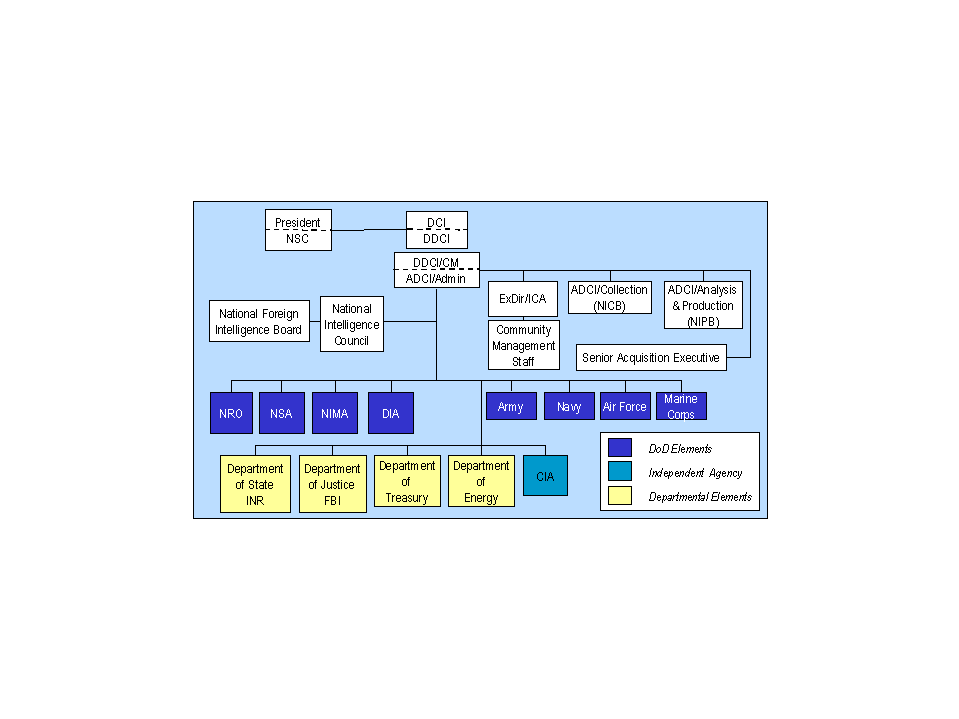
The thirteen organizations that collectively comprise the IC are shown in Figure 2. Subsequent paragraphs address the roles that some of them play with regard to high-level guidance in national security space.
4.1. Director of Central Intelligence/Central Intelligence Agency
According to PDD-49, the SecDef and the DCI oversee those space activities necessary for national security consistent with their respective responsibilities.(66) Other departments and agencies assist as appropriate. Improving the U.S. ability to support military operations worldwide, monitor and respond to strategic military threats, and monitor arms control and non-proliferation agreements and activities are key priorities for national security space activities. The SecDef and DCI ensure that defense and intelligence space activities are closely coordinated; that space architectures are integrated to the maximum extent feasible; and will continue to modernize and improve their respective activities to collect against, and respond to, changing threats, environments and adversaries.(67) The DCI appoints the NRO Director, with the concurrence of the SecDef.4.1.1. National Intelligence Council (NIC). The NIC is comprised of National Intelligence Officers--senior experts drawn from all elements of the Community and from outside the Government. These officers concentrate on the substantive problems of particular geographic regions of the world and of particular functional areas such as economics and weapons proliferation. They serve the DCI in his role as leader of the IC by providing a center for mid-term and long-term strategic thinking and production. Through routine close contact with policymakers, collection, research, and community analysis, the NIC provides the DCI with the information he needs. The NIC also draws on nongovernmental experts in academia and the private sector to bring in fresh perspectives and analytic methods to enhance the intelligence process. Finally, the NIC assists the IC by evaluating the adequacy of intelligence support and works with the Community's functional managers to refine strategies to meet the most crucial needs of the senior consumers.(68)
4.1.2. Deputy Director of Central Intelligence/Community Management (DDCI/CM). The Director of Central Intelligence as head of the Intelligence Community is assisted by the DDCI/CM, a statutory position established by the Intelligence Authorization Act for FY 1997. As directed by the DCI, the DDCI/CM oversees the implementation of a unified Intelligence Community optimized to provide a decisive information advantage to the President, the military, diplomats, the law enforcement community, and Congress. The DDCI/CM is assisted by the Assistant DCI for Administration who serves as deputy, the Assistant DCI for Collection, the Assistant DCI for Analysis and Production, the Senior Acquisition Executive, and the Executive Director for Intelligence Community Affairs. Working together, the ODDCI/CM oversees Community activities by establishing policies and managing processes that promote accountability, leadership, and corporate management of the intelligence enterprise.
Figure 1: Baseline Organization
Source: National Security Space Architect4.1.2.1. Community Management Staff. The Executive Director for Intelligence Community Affairs leads the Community Management Staff (CMS). CMS has four offices and an administrative support group.
- The Requirements, Plans and Policy Office supports the DCI's development and promulgation of policy to guide IC activities. It evaluates the Community's performance in responding to intelligence requirements of policy makers; develops procedures for coordinating policy formulation for security, information operations/warfare, intelligence-related aerospace issues, and human resources.
- The Program Assessment and Evaluation Office (PAEO) performs a comprehensive program review each year evaluating the relative merits of intelligence activities and their appropriate levels of funding in future years. It also performs independent cost analyses of major acquisition programs within the NFIP on behalf of the DCI. PAEO also performs studies and analyses of long term, enduring intelligence challenges by linking national security requirements with an independent evaluation of available resources.
- The Resource Management Office (RMO) is responsible for NFIP budget formulation, justification and technical evaluation. RMO also performs budget liaison with the congressional oversight committees on reprogramming actions.
- The IC Chief Information Officer (IC/CIO) establishes Community-wide information services (IS) policy, goals and objectives; leads the development of the IS strategic plan, architecture, and investment strategy; and fosters a shared commitment to improved interoperability consistent with the Community's mission.(69)
Figure 2: Intelligence Community Membership (70)
4.2. Director, National Reconnaissance Office
The Assistant Secretary of the Air Force for Space also serves as the Director of the NRO. The Director of the NRO is appointed by the DCI and the SecDef after being confirmed by the Senate as the Assistant Secretary of the Air Force for Space. The Director reports to the SecDef who, in concert with the DCI, has ultimate management and operational responsibility for the NRO. The DCI establishes collection requirements and priorities for satellite-gathered intelligence. The NRO develops and operates space systems for collection of imagery intelligence, signals intelligence, measurement and signature intelligence (MASINT), and communications.(71)
5. Congress
As will be shown, many congressional committees have a hand in formulation of national security space legislation, policy, guidance, programs and budgets. This section addresses those committees within the U.S. Congress that entertain matters pertaining to national security space.
5.1. House of Representatives
5.1.1. House Armed Services Committee. The jurisdiction of the committee as it relates to space is as follows:
- Common defense generally;
- The Department of Defense generally, including the Departments of the Army, Navy, and Air Force generally;
- Tactical intelligence and intelligence related activities of the Department of Defense;
- Pay, promotion, retirement, and other benefits and privileges of members of the armed services;
- Scientific research and development in support of the armed services;
- Size and composition of the Army, Navy, Marine Corps, and Air Force; and
- Strategic and critical materials necessary for the common defense.(72)
5.1.2. Committee on Commerce. Jurisdiction includes oversight for the Department of Commerce and the Telecommunications Trade & Consumer Protection Subcommittee.(73)
5.1.3. International Relations Committee. Jurisdiction includes international space-related treaties, as well as the following: relations of the United States with foreign nations generally; export controls, including nonproliferation of nuclear technology and nuclear hardware; international conferences and congresses; and United Nations Organizations (such as the Office for Outer Space Affairs). In addition to its legislative jurisdiction and its general oversight function, the committee also has special oversight functions with respect to intelligence activities relating to foreign policy.(74)
5.1.4. Committee on Science. This Committee's space-related responsibilities include:
- Astronautical research and development, including resources, personnel, equipment, and facilities;
- National Aeronautics and Space Administration;
- National Space Council;
- National Science Foundation;
- National Weather Service;
- Outer space, including exploration and control thereof;
- Science scholarships; and
- Scientific research, development, and demonstration, and projects therefore.(75)
5.1.5. House Permanent Select Committee on Intelligence. The select committee includes at least one Member from: the Committee on Appropriations; the Committee on National Security; the Committee on International Relations; and the Committee on the Judiciary. Proposed legislation, messages, petitions, memorials, and other matters relating to the following are referred to the select committee:
- The Central Intelligence Agency and the Director of Central Intelligence, and the National Foreign Intelligence Program as defined in section 3(6) of the National Security Act of 1947;
- Intelligence and intelligence-related activities of all other departments and agencies of the Government, including, but not limited to the tactical intelligence and intelligence-related activities of the Department of Defense;
- The organization or reorganization of any department or agency of the Government to the extent that the organization or reorganization relates to a function or activity involving intelligence or intelligence-related activities; and
- Authorizations for appropriations, both direct and indirect, for the areas listed above.(76)
5.1.6. House Committee on Appropriations. This committee has broad responsibility over the Federal budget. The Committee appropriates revenue for the support of the Government, or rescinds previous appropriations that are no longer valid.(77)
5.1.6.1. Subcommittee on Defense. This subcommittee has jurisdiction over the following space-related areas: The Armed Services; Office of the Secretary of Defense; Defense Advanced Research Projects Agency; Ballistic Missile Defense Organization; Intelligence Community (Central Intelligence Agency; National Reconnaissance Office; National Security Agency); and the Defense Agencies (Defense Intelligence Agency; Defense Logistics Agency; and Defense Threat Reduction Agency).
5.1.6.2. Subcommittee on VA, HUD, and Independent Agencies. This subcommittee's jurisdiction includes FEMA, NASA, NSF, and OSTP.(78)
5.2. Senate
The U. S. Senate has many areas of jurisdiction over national security space.5.2.1. Senate Committee on Armed Services. Jurisdiction includes aeronautical and space activities peculiar to or primarily associated with the development of weapons systems or military operations; the common defense; the DoD, the Department of the Army, the Department of the Navy, and the Department of the Air Force, generally; military research and development; national security aspects of nuclear energy; pay, promotion, retirement, and other benefits and privileges of members of the Armed Forces, including overseas education of civilian and military dependents; and strategic and critical materials necessary for the common defense. Comprehensive study and review of matters relating to the common defense policy of the United States is also included.
5.2.1.1. Strategic Subcommittee. Jurisdiction includes nuclear forces; national intelligence programs; space policy; Department of Energy nuclear programs including labs, facilities and cleanup; ballistic missile defense; and chemical-biological warfare issues.(79)
5.2.2. Senate Select Committee on Intelligence. This committee was created to oversee and make continuing studies of the intelligence activities and programs of the United States Government, and to submit to the Senate appropriate proposals for legislation and report to the Senate concerning such intelligence activities and programs. In carrying out this purpose, the Select Committee on Intelligence is required to make every effort to assure that the appropriate departments and agencies of the United States provide informed and timely intelligence necessary for the executive and legislative branches to make sound decisions affecting the security and vital interests of the Nation. The Select Committee on Intelligence also provides legislative oversight over the intelligence activities of the United States to assure that such activities are in conformity with the Constitution and laws of the United States.(80)
5.2.3. Senate Committee on Foreign Relations. Jurisdiction includes international space-related treaties, as well as the following: international aspects of nuclear energy; international conferences and congresses; international law as it relates to foreign policy; ocean and international environmental and scientific affairs as they relate to foreign policy; relations of the United States with foreign nations generally; treaties and executive agreements, except reciprocal trade agreements; and the United Nations and its affiliated organizations (Office for Outer Space Affairs). The Committee is also mandated to study and review, on a comprehensive basis, matters relating to national security policy, foreign policy, and international economic policy as it relates to foreign policy of the United States, and report thereon from time to time. The Committee also has a special responsibility to assist the Senate in its constitutional function of providing "advice and consent" to all treaties entered into by the United States and all nominations to the principal executive branch positions in the field of foreign policy and diplomacy.(81)
5.2.4. Senate Committee on Commerce, Science, and Transportation. This committee is responsible for all proposed legislation, messages, petitions, memorials, and other matters relating to the following space-related subjects:
- Communications;
- Nonmilitary aeronautical and space sciences;
- Oceans, weather, and atmospheric activities;
- Science, engineering, and technology research and development and policy; and
- Transportation.
5.2.4.1. Communications Subcommittee. Jurisdiction includes the Federal Communications Commission; the Communications Satellite Corporation; Intelsat; telecommunications industry economics; and telecommunications law.
5.2.4.2. Science, Technology, and Space Subcommittee. Jurisdiction includes NASA, NOA, NSF, NIST, OSTP, federal R&D funding, and international science and technology.(82)
5.2.5. Senate Committee on Appropriations. This committee is referred all proposed legislation, messages, petitions, memorials, and other matters relating to appropriation of the revenue for the support of the Government, and rescission of appropriations contained in appropriation acts, in addition to the amount of new spending authority.
5.2.5.1. Subcommittee on Defense. This subcommittee has jurisdiction over the following space-related areas: The Armed Services; Office of the Secretary of Defense; Defense Advanced Research Projects Agency (DARPA); Ballistic Missile Defense Organization; Intelligence Community (Central Intelligence Agency; National Reconnaissance Office; National Security Agency); and the Defense Agencies (Defense Intelligence Agency; Defense Logistics Agency; and Defense Threat Reduction Agency).
5.2.5.2. Subcommittee on Transportation. This subcommittee has jurisdiction over the Department of Transportation's Office of Commercial Space Transportation.
5.2.5.3. Subcommittee on Veterans, Housing and Urban Development. This subcommittee has jurisdiction over the following space-related areas: NASA; National Science Foundation; and the Office of Science and Technology Policy.(83)
B. Implementation Guidance, Policy and Oversight
This section presents the second major classification of management functions addressed by the Commission. As distinguished from the presidential and congressional level guidance addressed in the above section, this portion will highlight IC, OSD, JCS, and Service headquarters organizations and their roles with respect to issuance and implementation of guidance, policy and oversight functions. These functions are distinguished from research, development and acquisition, requirements determination, education, training, and the operation and use of space systems. For that reason, certain organizations are discussed more than once throughout this chapter.High-Level Guidance is implemented by the SecDef and DCI at this level with input from the Executive Office of the President, the JCS and the Interagency. DoD and the IC provide planning, programming and budgeting guidance for space activities, and coordinate the DoD/IC interface.
1. Intelligence Community
The IC implements the guidance and direction provided by the CMS. The DepSecDef and the DCI issue Joint Intelligence Guidance to provide focused program direction and priorities for all intelligence and related activities. They co-chair the Expanded Defense Resources Board (EDRB), which is the senior advisory body for reviewing all Defense intelligence and related activities, including programmatic, resource, and substantive intelligence issues.(84) Although not specifically involved in the management of national security space, the Bureau of Intelligence and Research (INR) at DoS, the FBI at Justice, and the intelligence components of the Energy and Treasury Departments are all users of space-based intelligence resources such as those provided by the NRO. In addition, the Service Intelligence components: Army, Navy, Air Force, and Marine Corps Intelligence, are all users of space-based intelligence, both strategic and tactical. See Figure 2 on page 36 of printed copy.
1.1 National Reconnaissance Office
The U.S. Intelligence Space Program is managed and conducted by the NRO, a joint activity of the IC and the DoD. (See organization chart, Figure 3.) The NRO develops and operates space systems for collection of imagery intelligence, signals intelligence, measurement and signature intelligence (MASINT), and communications. NRO satellites collect raw data that are processed by the NRO and then provided to one of its mission partners: the National Security Agency (NSA) for signals intelligence (SIGINT), the National Imagery and Mapping Agency (NIMA) for imagery intelligence (IMINT), or to the Central MASINT Office (CMO) for MASINT. These entities are responsible for exploitation, analysis and dissemination of the final intelligence product to the customers that originally requested the information. The internal NRO organization includes four Directorates responsible for building and operating satellite systems, three Offices responsible for key support functions, and a Staff responsible for all the staff support to the organization. (85) Under four agreements dating back to the 1960s, the Director of the NRO reports to both the SecDef and the DCI.The NRO was created in 1960 in order to manage all of DoD's satellite and over-flight reconnaissance projects. The NRO was initially placed under the joint direction of the Under Secretary of the Air Force and the CIA's Deputy Director for Plans. A second agreement, in 1962, determined that the NRO Director would be designated by both the DCI and SecDef and be responsible directly to them for management of the National Reconnaissance Program (NRP). NRO personnel came from DoD and CIA, which both provided funds for NRO projects. A third agreement superseded the 1962 version in 1963 and identified the SecDef as the Executive Agent for the NRP and the NRO as a separate operating agency within DoD. The NRO Director was now to be appointed by the SecDef, with the concurrence of the DCI. A Deputy NRO Director was to be appointed by the DCI, with the concurrence of the SecDef. NRO budget requests were to be presented by the NRO Director to the SecDef and DCI, the Bureau of the Budget and Congressional committees. The NRO Director was to report directly to the SecDef, while keeping the DCI informed. In 1965, the last agreement gave the SecDef "ultimate responsibility" for the management and operation of the NRO and eliminated the requirement for DCI concurrence in the selection of the NRO Director.(86) The DCI retained authority for appointing the Deputy NRO Director, but with the concurrence of the Secretary. This agreement also provided that the SecDef was the final decision-maker for the NRP budget and all NRP issues. An NRP Executive Committee--consisting of the DepSecDef, DCI and the Assistant to the President for Science and Technology--was created to "guide and participate" in NRP budget and operational decisions, but the SecDef was ultimately responsible. According to the NRO's General Counsel, all four agreements are considered by the NRO to be still in effect, although more recent provisions have added structure to the relationship.(87) In practice, the Director, NRO regularly attends staff meetings held by the DCI, but only meets infrequently with the SecDef or DepSecDef.
Specifically, the SecDef, in consultation with the DCI, ensures that budgets of the IC elements within the DoD are adequate to satisfy the overall intelligence needs of the DoD; that policies and resource decisions of the DCI are appropriately implemented by elements of the DoD within the National Foreign Intelligence Program; and that elements of the IC within the DoD are responsive and timely with respect to satisfying the needs of the operational military forces. The SecDef also ensures that the NRO provides an effective unified organization for the research and development, acquisition, and operation of overhead reconnaissance systems necessary to satisfy the requirements of all elements of the IC.(88), (89)
1.3. Defense Intelligence Agency (DIA)
The DIA is a combat support agency of the DoD under the authority, direction, and control of the Assistant Secretary of Defense for Command, Control, Communications, and Intelligence (ASD (C3I)). DIA coordinates all DoD intelligence collection requirements; manages the Defense Attaché system; provides foreign intelligence and counterintelligence staff support to the CJCS; and, manages the General Defense Intelligence Program.(90)1.3.1. Central MASINT Office. The CMO was formed by DIA in 1993, when it became evident an authoritative single source of information was required on high growth technology areas outside the traditional disciplines of SIGINT, IMINT, and Human Intelligence. Thus, the CMO serves as the functional manager and single IC point of contact for MASINT. It consists of four divisions, a MASINT Committee Staff, and a technology coordination office. The CMO has special Directorate status within the Directorate for Intelligence Operations (formerly the National Military Intelligence Collection Center) to maintain its DCI and SecDef-directed role as the National and Defense Functional Manager for MASINT.(91)
1.3.2. Missile and Space Intelligence Center (MSIC). MSIC was operated by the Army for over 40 years, but became part of DIA in January 1992 as part of a continuing effort to consolidate intelligence production and make it more efficient.(92)
1.4. National Imagery and Mapping Agency
NIMA is a statutory DoD combat support agency with significant assigned national intelligence mission responsibilities. The mission of NIMA is to provide timely, relevant, and accurate imagery, imagery intelligence, and geospatial information in support of the national security objectives of the United States. NIMA carries out this responsibility by advising the SecDef and DepSecDef, the ASD (C3I), the CJCS, the Combatant Commanders, and, for national intelligence purposes, the DCI and other Federal Government officials; and by supporting the imagery, imagery intelligence, and geospatial requirements of the departments and agencies of the federal government.(93)NIMA was formed through the consolidation of the following: the Defense Mapping Agency, the CIA's Central Imagery Office, the Defense Dissemination Program Office and the National Photographic Interpretation Center as well as the imagery exploitation and dissemination elements of the DIA, the NRO, the Defense Airborne Reconnaissance Office and the CIA.
The creation of NIMA centralized responsibilities for imagery and mapping, representing a fundamental step toward achieving the DoD vision of "dominant battlespace awareness."(94)
1.5. National Security Agency/Central Security Service (NSA/CSS)
The NSA/CSS is a combat support agency of DoD under the authority, direction, and control of the SecDef, and is responsible for centralized coordination, direction, and performance of highly specialized intelligence functions in support of U.S. Government activities. NSA serves as the Executive Agency for U.S. Government SIGINT, communications security, computer security, and operations security training activities. The CSS provides the Military Services a unified cryptologic organization within DoD designed to assure proper control of the planning, programming, budgeting, and expenditure of resources for cryptologic activities.(95)1.6. National Security Space Architect
On 31 July 1998, the SecDef and the DCI made a commitment to improve the coordination of National Security Space activities by signing a Memorandum of Understanding (MOU) on National Security Space Management that established the Office of the National Security Space Architect (NSSA), combining architecture responsibilities from the IC with those performed previously by the DOD Space Architect. The NSSA's main job is to develop space architectures across the range of space mission areas for DoD and the IC, integrate requirements, and do so cooperatively with the IC. This office develops architectural recommendations to establish the long-range vision for future space capabilities and to enhance the utility and affordability of current and future space systems. Its first major task has been to develop a future Mission Information Management architecture that encompasses core military and intelligence capabilities, as well as allied, civil and commercial functions. The NSSA also has the responsibility to identify and advocate opportunities for integrating space-related R&D, programmatic initiatives, and activities across DoD and the IC, as well as the national security interest of the government and civilian agencies. The NSSA works through the ASD (C3I), and the DDCI to provide leadership and processes to develop, coordinate and integrate DoD and IC space architectures for the mid- and long-term. Additionally, the NSSA supports the development of transition plans to ensure the stakeholder organizations are on the path to achieve these future capabilities. NSSA has no funding authority and can only provide recommendations for action. NSSA was tasked with integrating existing long-range plans, strategic initiatives, and program roadmaps from the NRO, DoD, US Space Command (USSPACECOM), and AFSPC.(96) (See Figure 4 for NSSA Process Relationships Chart).Figure 4: NSSA Process Relationships(97)
1.6.1. National Security Space Senior Steering Group (NSS-SSG). A key feature of the National Security Space Management MOU was the formation of the NSS Senior Steering Group (NSS-SSG). The NSS-SSG is tri-chaired by the DDCI/CM, ASD (C3I), and the Joint Staff/J-8. Its key functions are to:
- Address broad national security space management and integration issues;
- Provide architecture policy and guidance to the NSSA;
- Review NSSA architecture proposals;
- Provide expert advice to the NSSA to reconcile significant differences between stakeholder equities; and
- Approve or identify alternatives to proposed architectural characteristics that affect DoD or IC Agency responsibilities or policy implementation.
The NSS-SSG tri-chairs will ensure that equities are represented and policies satisfied prior to architecture presentation to the EDRB for approval and incorporation in the DPG and DCI Guidance. All interested National Security and Civil Agencies are invited to be involved in NSS-SSG deliberations. NSS-SSG develops high-level space policy initiatives and approves NSSA's key findings, goals, principles and recommendations. Other members include the NRO and USSPACECOM.
Figure 5: OSD Organization Chart.
2. Office of the Secretary of Defense
2.1. Secretary of Defense
According to PDD-49, the SecDef and the DCI oversee those space activities necessary for national security consistent with their respective responsibilities as set forth in the National Security Act of 1947, as amended, other applicable law, and Executive Order 12333. Other departments and agencies assist as appropriate. Improving our ability to support military operations worldwide, monitor and respond to strategic military threats, and monitor arms control and non-proliferation agreements and activities are key priorities for national security space activities. The SecDef and DCI ensure that defense and intelligence space activities are closely coordinated; that space architectures are integrated to the maximum extent feasible; and will continue to modernize and improve their respective activities to collect against, and respond to, changing threats, environments and adversaries. (See Figure 5)
DoD maintains the capability to execute the mission areas of space support, force enhancement, space control, and force application.
In accordance with Executive Orders and applicable directives, DoD protects critical space-related technologies and mission aspects.
DoD, as launch agent for both the defense and intelligence sectors, maintains the capability to evolve and support those space transportation systems, infrastructure, and support activities necessary to meet national security requirements. DoD is the lead agency for improvement and evolution of the current expendable launch vehicle fleet, including appropriate technology development.
DoD pursues integrated satellite control and continues to enhance the robustness of its satellite control capability. DoD coordinates with other departments and agencies, as appropriate, to foster the integration and interoperability of satellite control for all governmental space activities.
The SecDef establishes DoD's specific requirements for military and national-level intelligence information.
- The SecDef, in concert with the DCI, and for the purpose of supporting operational military forces, may propose modifications or augmentations to intelligence space systems as necessary. DoD may develop and operate space systems to support military operations in the event that intelligence space systems cannot provide the necessary intelligence support to the DoD.(98)
Under NSTC-4, DoD is the launch agent for the national security sector and maintains the capability to evolve and operate those space transportation systems, infrastructure, and support activities necessary to meet national security requirements. DoD also is the lead agency for improvement and evolution of the current expendable launch vehicle (ELV) fleet, including appropriate technology development. All significant ELV technology-related development associated with medium and heavy-lift ELVs will be accomplished through the DoD. In coordination with the DoD, NASA will continue to be responsible for implementing changes necessary to meet its mission-unique requirements. Consistent with mission requirements, DoD, in cooperation with the civil and commercial sectors, should evolve satellite, payload, and launch vehicle designs to achieve the most cost-effective and affordable integrated satellite, payload, and launch vehicle combination. ELV improvements and evolution plans will be implemented in cooperation with the IC, NASA, DOT and Commerce, taking into account, as appropriate, the needs of the commercial space launch sector. DoD maintains the Titan IV launch system until a replacement is available.(99)
2.2. Deputy Secretary of Defense (DepSecDef)
The DepSecDef chairs the Defense Resources Planning Board (DRPB), which makes final decisions about the Service program objective memorandums (POMs) in which the Services identify forces and programs proposed for the Future Years Defense Plan (FYDP). The DepSecDef is also the program manager for the Joint Military Intelligence Program budget, assisted by the ASD (C3I), and is a member of the IC Executive Committee and the NRP Executive Committee, which guides and participates in the NRP budget and operational decisions.(100)2.3. Assistant to the Secretary of Defense (Intelligence Oversight) (ATSD (IO)). Under the direction of the Secretary of Defense, the ATSD (IO) is responsible for the independent oversight of all intelligence activities in the Department of Defense. In this capacity, the ATSD (IO) ensures that all activities performed by intelligence units and all intelligence activities performed by non-intelligence units, are conducted in compliance with Federal law and other laws as appropriate, Executive Orders and Presidential Directives, and DoD Directives System issuances. The ATSD (IO) is responsible for various functional areas including developing intelligence oversight policy and, in coordination with the DoD General Counsel issuing intelligence oversight guidance to the DoD intelligence components, including regulatory guidance implementing intelligence oversight aspects of Executive Order 12333.(101)
2.4. Under Secretary of Defense (Policy) (USD (P)). Under the direction of the SecDef, the USD (P) ensures that space policy decisions are closely integrated with overall national security policy considerations, in coordination with the ASD (C3I), and reviews all Combatant Commander operations and contingency plans to ensure proposed employment of space forces are coordinated and consistent with DoD policy and the National Military Strategy.
In addition, the USD (P) exercises authority, direction, and control over the Defense Technology Security Administration, through the Assistant Secretary of Defense (International Security Policy). In the exercise of this responsibility, the USD (P) does the following:
Provides oversight of all DoD activities related to international technology transfer;
Develops, coordinates, and provides policy direction and overall management for the DoD Technology Security Program and policy related to international technology transfer, to include export controls, dual-use and munitions licensing, arms cooperation programs, and support for enforcement and intelligence systems; and
Develops, coordinates and oversees the implementation of strategy and policy for strategic and theater nuclear offensive forces, strategic and defensive forces, and space systems; and reviews and evaluates plans, programs, and systems requirements for such forces and systems to assure consistency with the strategy and policy.(102)
In addition, the USD (P) prepares the Defense Planning Guidance (DPG), which provides the basic rationale for DoD programs and budgets in the FYDP. The DPG is the formal outcome of a process in which threat assessments, national strategies and defense policies, ongoing defense plans and programs, and projected financial resources are integrated into an overall statement of policy.(103) The DPG is discussed further in the "Programming and Budgeting" portion of this management function.
Figure 6: ASD (C3I) Organization Chart(104)
2.5. Assistant Secretary of Defense (Command, Control, Communications, and Intelligence)
ASD (C3I) serves as the principal staff assistant and advisor to the SecDef and DepSecDef and focal point within DoD for space and space-related activities, and also serves as DoD's Chief Information Officer. ASD (C3I) is also responsible for the following:
Develop, coordinate, and oversee the implementation of policies regarding space and space-related activities and, in coordination with the Under Secretary of Defense for Policy, ensure that space policy decisions are closely integrated with overall national security policy considerations.
Oversee the development and execution of space and space-related architectures, acquisition, and technology programs, in coordination, as appropriate, with the Under Secretary of Defense for Acquisition, Technology, and Logistics.
Oversee the Director of the NSA's compliance with DODD 3100.10, "Space Policy".
Oversee the Director of the DIA's compliance with the same Directive.
Oversee the Director of the NRO's management and execution of the National Reconnaissance Program to meet the U.S. Government's needs through the research, development, acquisition, and operation of space borne reconnaissance systems.
Oversee the Director of NIMA's compliance with DODD 3100.10.
Oversee the Director of DISA's compliance with DODD 3100.10.
Oversee the National Security Space Architect's compliance with DODD 3100.10.(105)
ASD (C3I) also is the principal OSD staff assistant for the development, oversight, and integration of DoD policies and programs relating to the strategy of information superiority for DoD. In addition to space systems and space policy, ASD (C3I) functions include information policy and information management, command and control, communications, counterintelligence, security, information assurance, information operations, intelligence, surveillance and reconnaissance, and intelligence-related activities conducted by the Department. In addition, the ASD (C3I) serves as the Chief Information Officer of the Department. He or she also serves as the principal DoD official responsible for preparing and defending the Department's related programs before the Congress; assesses the responsiveness of intelligence products to DoD requirements; and participates, as appropriate, in the DoD planning, programming, and budgeting system for C3I, IM, IT, CI, and SCM activities by reviewing proposed DoD resource programs, formulating budget estimates, recommending resource allocations and priorities, and monitoring the implementation of approved programs.(106) (See Figure 6 for the ASD (C3I) organization chart).
2.5.1. Deputy Assistant Secretary of Defense for Command, Control, Communications, Intelligence, Surveillance, Reconnaissance (C3ISR), and Space (DASD (C3ISR & Space)). The DASD (C3ISR & Space) is responsible for guiding the development and integration of defense capabilities for communications, command and control, intelligence, surveillance, reconnaissance, space control, and space support. He or she also is responsible for space policy and spectrum management.(107)
2.5.1.1. Space Policy Directorate. This directorate is responsible for developing, coordinating, and overseeing the implementation of U.S. Government and DoD policy guidance for space activities. The directorate is the office of primary responsibility and point of contact within OSD for space policy matters. Its purview includes national space policy, defense space policy, space control policy, remote sensing policy, commercial space policy, space arms control, and international space cooperation.(108)
- Defense Remote Sensing Working Group (DRSWG). The DRSWG, chaired by the ASD (C3I) Director of Space Policy, was established as a mechanism to coordinate remote sensing issues among the DoD components. The DRSWG reviews remote sensing issues from a DoD perspective and provides a forum for discussion, information sharing and coordination. DRSWG reviews issues brought before it and advises on remote sensing activities in the following areas: developing and coordinating DoD positions on remote sensing matters for DoD input to interagency fora; DoD involvement in foreign remote sensing space cooperation activities; and streamlining DoD remote sensing processes to fulfill the goals of PDD-23.(109) The Joint Staff provides the Vice Chair. The DRSWG consists of representatives from the following DoD organizations: DoD General Counsel, DASD Intelligence, Joint Staff, Departments of the Army, Navy and Air Force, DIA, NRO, NIMA, NSA, Deputy Under Secretary of Defense Technology Security Policy, CMO, and USSPACECOM. The DRSWG develops and coordinates DoD positions on private remote licensing matters and international cooperation on remote sensing space activities; makes recommendations to the Defense Threat Reduction Agency concerning export of remote sensing systems, components, and technology; provides the DoD focal point for U.S. industry on commercial remote sensing matters; provides the DoD point of contact for other USG departments and agencies on remote sensing space policy.(110)
2.5.1.2. C3 Systems Directorate. The Directorate oversees all DoD Communications and Command and Control Systems from the national level of government to the tactical warfighter. It ensures interoperability between the DoD components, as well as allied and Coalition partners. Responsibilities include: tactical radios and data links, joint/coalition interoperability, military & commercial satellite communications, base and long-haul terrestrial communications, command and control systems, Global Information Grid (GIG) implementation plan, national & nuclear C2, Integrated Broadcast System (IBS), Defense Message System, combat ID, personnel recovery, and Network Centric Support.(111)
2.5.1.3. ISR Systems Directorate. Responsibilities include: ISR strategic planning, airborne systems, manned reconnaissance, Unmanned Aerial Vehicles (UAVs), space borne systems, and ISR interoperability.(112)
2.5.1.4. Space Systems Directorate. Responsibilities include: space launch, space control, satellite control, navigation, FAA, GPS, navigation warfare, environmental sensing, space weather, space technology, and space architectures.(113)
2.5.1.5. Program Analysis and Integration Directorate Responsibilities include: C4ISR system cross-program integration, Decision Support Center, Information Superiority Advanced Technology Plan, C3ISR acquisition staff Overarching Integrated Product Teams (OIPT), and the C4I Support Plan review.(114)
2.5.2. DISA. DISA is the combat support agency responsible for planning, developing, and providing C4I systems that serve the needs of the NCA and the warfighter under all conditions of peace and war. DISA provides mission support to the President and Vice President through the White House Communications Agency. DISA operates under the direction, authority and control of the ASD (C3I), and participates fully in all phases of DoD's comprehensive PPBS process. DISA has both a general fund appropriated budget and Defense Working Capital Fund budget. DISA provides direct support to the Joint Staff and the CINCs operations in concert with Joint Vision 2020 (JV2020). DISA's core programs are critical components of DoD's drive toward information superiority. DISA performs foundation information technology activities for all of DoD, and plans, builds, tests, operates, sustains and secures critical components of the Global Information Grid.(115)
3. Joint Chiefs of Staff
3.1. Chairman of the Joint Chiefs of Staff (CJCS)
The CJCS has organized the Joint Staff as depicted in Figure 7. CJCS is charged to establish a uniform system for evaluating the readiness of each combatant command and combat support agency to carry out assigned missions by employing space forces; develop joint doctrine for the operation and employment of space systems of the Armed Forces and formulate policies for the joint space training of the Armed Forces and for coordinating the space military education and training of the members of the Armed Forces. CJCS must also integrate space forces and their supporting industrial base into the Joint Strategic Capabilities Plan Mobilization Annex; formulate policies for the integration of National Guard and Reserve forces into joint space activities; and provide guidance to Combatant Commanders for planning and employment of space capabilities through the joint planning process.(116)Figure 7: Joint Chiefs of Staff Organization
3.1.2. Vice-Chairman of the Joint Chiefs of Staff (VCJCS). The VCJCS serves as the Chairman of the Joint Requirements Oversight Council (JROC), Vice Chairman of the Defense Acquisition Board (DAB), and as a member of the National Security Council Deputies Committee and the Nuclear Weapons Council. In addition, the VCJCS acts for the Chairman in all aspects of the Planning, Programming and Budgeting System to include participating in meetings of the DRB.(117)
3.1.3. J-2, Directorate for Intelligence. Headed by a two-star, the J-2 provides all-source intelligence to the Joint Chiefs of Staff, Office of the Secretary of Defense, Joint Staff, and Unified Commands. J-2 is unique on the Joint Staff in that it is a subordinate part of the Defense Intelligence Agency, which is headed by a three-star. J-2 draws deeply on the DIA's broad range of capabilities to accomplish its mission and functions.
The J-2 apprises the Chairman of foreign situations and intelligence issues relevant to current operational interests and potential national security policies, objectives and strategy. The J-2 acts as the national level focal point for crisis intelligence support to military operations, indications and warning intelligence in DoD, and Unified Command intelligence requirements. The J-2 coordinates joint intelligence doctrine and architectures and manages intelligence for joint warfighting assessments. J-2 serves as the Intelligence Community Manager for Support to Military Operations, and is the Director of the Joint Warfighting Capabilities Assessments for Intelligence, Surveillance and Reconnaissance under the JROC.
3.1.4. J-3, Directorate of Operations. The J-3 is where all of the Joint Staff's planning, policies, intelligence, manpower, communications and logistics functions are translated into action. This is the directorate that moves military forces, conducts detailed operational briefings for the national leadership and serves as the operational link between the warfighting CINCs and the National Command Authority (NCA). J-3 is responsible for synchronizing and monitoring worldwide military operations and activities in support of the National Military Strategy. J-3 is involved in every aspect of the planning, deployment, execution and redeployment of U.S. strategic and conventional forces in response to worldwide crises.
To that end, J-3 assists the Chairman in carrying out responsibilities as the principal military adviser to the NCA by developing and providing guidance to the Combatant Commands and by relaying communications between the NCA and the Unified Commanders regarding current operations and plans. J-3 provides functional area advice in combating terrorism, information operations, readiness, reconnaissance, special technical operations, special operations, counter proliferation of WMD, nuclear operations, space operations, counter narcotics, and the National Military Command System. In addition, J-35 is dual-hatted as the Deputy Director for Military Support for the NRO.
3.1.5. J-4, Logistics Directorate. J-4 is charged with providing assistance to CJCS by:
Establishing joint logistics doctrine;
Providing logistics parameters for strategic and contingency plans development;
Developing logistics, environmental, mobility and mobilization annexes in support of strategic and contingency plans;
Maximizing the logistics capabilities of the combatant commands, to include developing sustainment polices and procedures to support combat forces;
Maintaining a logistics and mobility asset prioritization capability for contingency operations;
Performing logistic requirements in the Planning, Programming, Budgeting System (PPBS), to include developing alternative budget recommendations;
Planning and providing guidance for the logistics aspects of security, humanitarian and disaster assistance, and support to the civil emergency agencies;
Reviewing the logistics and mobilization plans and programs of the Combatant Commands to determine their adequacy;
Providing guidance to the Military Services and combat support agencies for the preparation of their respective logistics and mobilization plans;
Establishing combined logistics strategy, doctrine, and plans;
Operating a Logistics Readiness Center (LRC) to execute the logistics aspects of current and future operations and short notice emergencies and contingencies for the NCA and CINCs; and
Integrating logistics information systems requirements across joint programs and between logistics and other combat support functional areas.
3.1.6. J-5, Strategic Plans and Policy Directorate. J-5 is charged with the preparation of strategy, planning guidance and policy for operations, organizational issues, politico-military affairs, and international negotiations, in coordination with the Combatant Commands, the Services, OSD, the interagency and international organizations. J-5 is also responsible for development of the UCP that delegates responsibilities to the Unified Commands.
3.1.7. J-6, C4 Systems Directorate. The J-6 mission is to provide the CJCS advice and recommendations on C4 matters; establish joint doctrine and procedures for Defense-wide communications, military satellite and terrestrial networks, joint tactical C4 systems, and communications security, and coordinate crisis and contingency C4 support for US forces worldwide.
3.1.7.1. J-6, Spectrum Division (J-6B). J6B is responsible for advising the CJCS through the Director, C4 Systems on all matters relating to the frequency spectrum and ensuring adequate access to spectrum to support the CINCs. J6B is involved in national and international processes that develop spectrum management policy, and J6B also represents CINC interests in the areas of spectrum training, readiness, and the development of systems that enhance Service and joint spectrum management capabilities.(118)
3.1.7.2. J-6, Space Systems Division (J-6S). J6S is charged with responsibility for programs, policy, and planning for space-based systems used for the command and control of military forces and for surveillance and warning. Systems include surveillance, warning, navigation, and communications satellites and related supporting ground-based systems. J6S is also responsible for ensuring the sustainment, integrity, interoperability, compatibility, evolution, operational effectiveness, and sufficiency of systems in these categories.(119)
3.1.8. J-7, Operational Plans and Interoperability Directorate. J-7 is charged with increasing Combatant Commands' current and future joint operational capability by improving joint interoperability through modeling and simulations, war plans, doctrine, education, training, exercise, and the assessment of each through the observation of CINC and CJCS exercises and real world operations. J-7 is also the CJCS Executive Agent for JV 2020 implementation and system integration, and the focal point for joint doctrine development and dissemination.
3.1.9. J-8, Force Structure, Resources, and Assessment Directorate. J-8 was established in response to the increased responsibilities and authority placed on the chairman by the Goldwater-Nichols Department of Defense Reorganization Act of 1986. Since then, J-8 has provided resource and force structure analysis and advice to the Chairman and the JCS. The Director, J-8, provides support to CJCS for developing force structure requirements; for conducting studies, analyses and assessments; and for evaluating military forces, plans, programs, and strategies. The directorate assesses major acquisition programs and proposed changes to DoD acquisition policy. J-8 also analyzes service budgets and programs and represents the Unified Commands in both the Defense Acquisition Management System and the PPBS. J-8 also conducts joint war games and interagency politico-military seminars and simulations. J-8 develops and supports quantitative analytical models used in warfighting analyses of alternative forces. The Director, J-8, serves as the JROC Secretary, discussed under "Requirements Determination," and as the Chairman of the Joint Requirements Board (JRB). In this capacity, the Director orchestrates Joint Staff support of the requirements development process and oversees the JWCA process.(120) Within J-8, space requirements and acquisition matters fall under Requirements and Acquisition Division, space-related programming and budget matters under Program and Budget analysis Division, and analysis and assessments of space control and general space issues under Full Dimensional Protection Assessment Division.(121)
4. Military Services
The Army, Navy, Air Force and the Marine Corps incorporate space planning, policy, and management within their Service headquarters in different manners, based on the degree of each of their Services involvement with space programs. The Air Force has the largest infrastructure related to space, as the majority of DoD space programs are the responsibility of the Air Force. The Navy is responsible for two satellite programs, the UHF Follow On program and the Multi-User Objective System. The Army predominantly manages ground terminal programs for satellites, and the Marine Corps usually piggybacks on ground terminal programs led by one of the other Services.
4.1. Headquarters, Department of the Air Force
Air Force Service Headquarters space responsibilities are carried out under the supervision of the Chief of Staff, Air Force, and the Secretary of the Air Force.4.1.1. Assistant Secretary of the Air Force for Space. The Assistant Secretary of the Air Force (Space) is responsible for the overall supervision of Air Force space and space-related matters. Additionally the ASAF (Space) serves as the Director of the NRO responsible to the SecDef and the Director of Central Intelligence for the execution of the National Reconnaissance Program (NRP). It is the function of this office to ensure that Air Force space activities are properly integrated with those of the NRO and are otherwise managed and integrated with internal and external agencies in a manner that most effectively supports the warfighter, national users and the Air Force Long Range Plan. ASAF (Space) provides broad guidance and supervision of Air Force space-related activities, develops USAF space policy, is responsible for Air Force positions on US government interagency and international space matters, and supervises the development and execution of plans and agreements pertaining to USAF support of the US commercial space industry and space-related activities of US civil agencies.
4.1.2. Assistant Secretary of the Air Force for Acquisition. The Assistant Secretary of the Air Force for Acquisition directs, supervises, and executes the research, development, production, and support of the Air Force space systems and related defense materials and issues guidance to Air Force system program offices on the use of commercial space services.
4.1.3. Deputy Chief of Staff for Air and Space Operations (AF/XO) develops operational doctrine, requirements, strategy, plans, program guidance, and policies for structuring, operating, and employing space forces. This office also establishes Air Force operational positions on space-related activities and oversees the Air Force Tactical Exploitation of National Capabilities (TENCAP) program. (122)
4.1.3.1. Directorate of Space Operations and Integration (AF/XOS). AF/XOS is a new division under the Deputy Chief of Staff, Air and Space Ops (AF/XO). This directorate will develop policy, guidance, and provide space operational expertise and oversight. It was established on 30 Oct 2000 and will have four divisions. The four divisions are as follows:
XOSO--space operations responsible for Satellite Operations and the Air Force Satellite Control Network (AFSCN), Navigation, DMSP, SATCOM and Missile warning and commercial space;
XOSR--space launch ranges and infrastructure;
XOSP--program integration and space ops policy; and
XOSC--space control.(123)
4.1.3.2. Director of Intelligence, Surveillance and Reconnaissance (XOI) develops and provides intelligence policy, guidance, and plans for tasking, collection, processing, exploiting, and disseminating data derived from intelligence space systems. This office also advocates intelligence requirements for space platforms to the DCI and the national intelligence space community, responsive to the operational needs of the Air Force.
4.1.4. Deputy Chief of Staff for Installations and Logistics (AF/IL) develops space logistics strategies, concepts, plans, policies, and organizational relationships required to sustain Air Force space forces and as required for USAF support of US commercial space sector, to include disposition of surplus Air Force launch-related assets.
4.2. Headquarters, Department of the Army
Army Service Headquarters space responsibilities are carried out under the supervision of the Chief of Staff, Army, and the Secretary of the Army. Policy and planning responsibilities reside within the Deputy Chief of Staff for Operations and Plans (DCSOPS) and Deputy Chief of Staff for Programs (DCSPRO), while the Director for Information Systems, Command, Control, Communications, and Computers oversees satellite communications and spectrum planning. The Assistant Secretary of the Army for Acquisition, Logistics, and Technology (ASA (ALT)) oversees the few space RD&A activities that the Army pursues. The Army's Deputy Chief of Staff for Intelligence oversees space matters pertaining to Intelligence, Surveillance and Reconnaissance, and similarly the Army Engineer oversees space terrain mapping activities.4.2.1. Deputy Chief of Staff for Operations and Plans. DCSOPS is the principal advisor to the CSA on strategy NSC matters, politico-military aspects of international affairs, joint matters, and is the Army Operations Deputy to the JCS. DCSOPS is responsible for force-management Army-wide, and has Army Staff responsibility for mobilization planning, readiness reporting, policy for individual and collective training and institutional and unit training, security planning, resource planning, and prioritization. DCSOPS develops policy for special weapons and Army applications in space.(124)
4.2.1.1. Deputy Chief of Staff for Operations and Plans, Strategy, Plans, and Policy Directorate, National Security Policy Division is the Army Staff focal point for National Security Policy on: Space, Nuclear and Chemical Weapons and Surety, NBC defense matters, NBC and Conventional Arms Control, Chemical Demilitarization, Army Reactor Program, WMD Counter proliferation, ABM Treaty, Gulf War Illness, and Identification and Reporting of emerging non-traditional security issues and the effect they have on the Army's ability to accomplish its operational mission.
4.2.2. Deputy Chief of Staff for Program. Within the Army's DCSPRO, the mission of DAPR-FDE is to serve HQDA for Air and Missile Defense and Space systems for determining requirements, accomplishing fielding and other user-oriented functions related to material acquisition, and reviewing the equipment portion of unit authorizations documents. The Division also develops and coordinates the DA position on proposed material requirements documents and provides recommendations to the approval authority, develops and coordinates the DA position on combat developer proposed Basis of Issue plans and reviews.
4.2.3. Training and Doctrine Command (TRADOC), Information Superiority and Space Division. In October 2000, space functional responsibilities were assigned to the Information Superiority and Space Division (ISSD) under the C4ISR Directorate, Deputy Chief of Staff for Combat Development, HQ TRADOC. Their focus is on the combat development process with emphasis on producing DTLOMS solutions. ISSD is responsible for TRADOC HQ input to the Army's space program. They advocate and support efforts to normalize, operationalize, and institutionalize space capabilities throughout the Army, and integrate and synchronize space-related actions throughout TRADOC. In addition, ISSD promulgates TRADOC policy and guidance concerning issues associated with the use of space systems in support of the Army Transformation Process, development of warfighting concepts, and formulation of DTLOMS solutions.(125)
4.2.4. Army Space Program Office at SMDC. The Army Space Program Office is responsible for the Army's tactical exploitation of national capabilities program (TENCAP). The program focuses on exploiting current and future tactical potential of national systems and integrating the capabilities into the Army's tactical decision-making process. Army TENCAP systems enable the tactical commander to see and hear deep in today's battlefield and then assess the impact of shooting deep. The ASPO has successfully fielded more than 60 systems and is constantly exploring ways to integrate advanced technologies into its inventory. Primary ASPO missions include:
Support appropriate organizations to develop/implement streamlined concepts of operation and requirements.
Design, develop, test, field, and sustain systems that provide national and theater products to tactical commanders.
Provide the responsible Program Executive Officers with the appropriate technologies and acquisition activities.
Provide technical support to the Army staff with respect to TENCAP activities.
Identify technologies to enhance the Army mission.
Coordinate training and exercise support for national systems.
Act as point of contact for all tactical activities between major commands/users and the national community.
Serve as technical advisor and technical expert to TRADOC and battle labs.(126)
4.3 Headquarters, Department of the Navy
Navy Service Headquarters space responsibilities are carried out under the supervision of the Chief of Naval Operations (CNO), and the Secretary of the Navy.4.3.1. Space, Information Warfare, Command and Control Directorate (N6). CNO N6 provides Navy Space and Electronic Warfare Leadership, Vision, Policy Resources and Doctrine support of Naval, Joint and Combined Operating Forces.(127)
4.3.1.1. Navy Space Systems Division (N63). The Navy Space Systems Division develops Navy space systems programs for surveillance, communication, navigation, command and control (C2), environmental sensing, targeting and indications and warning. This division is the principle point of contact within Navy for command, control, communications and intelligence (C3I) space matters, including policy and planning for the exploitation and defense of space. They act as program sponsor for C3I space systems, and are responsible for ensuring that Navy space systems are responsive to the operational commanders (including Joint Commanders).(128)
4.3.1.2. Navy Tactical Exploitation of National Capabilities Branch (N632). The TENCAP Program is a multifaceted initiative that:
Exploits potential operational capabilities of National Space Systems;
Influences National Systems support of tactical commanders;
Evaluates intelligence support provided to meet tactical requirements;
Develops rapid system prototypes and engineering demonstrations to improve tactical exploitation of National Sensor efforts.
Influences the development of new systems to ensure they are aligned with tactical support capabilities; and
Provides training to tactical users.
4.3.2 Naval Space Board. Co-chaired by the Deputy Assistant Secretary of the Navy for C4/EW/Space and CNO (N6B), the Naval Space Board facilitates, coordinates, and directs the development of DON Space Policy. It provides advice and counsel on all matters relating to space systems in support of maritime operations. The Executive Committee of the Board is comprised of the Assistant Secretary of the Navy for Research, Development, and Acquisition (ASN (RD&A)), CNO (N6), and the Deputy Chief of Staff for Plans, Policies, and Operations, Headquarters Marine Corps.
5. Programming and Budgeting
5.1. Process
The programming and budgeting for space activities is broken down across the various responsible agencies, previously identified under "High-Level Guidance" and the first portion of this section, along with the Services and CINCs. The cabinet departments and agencies responsible for commercial and civil space activities prepare their space-related budgets with the help of OMB through the President's budget submission, just as they would any other program. OMB coordinates with all of the federal agencies during the budget preparation process, holding hearings and discussions at the Agency, Department, and Executive Office level. OMB assesses competing funding demands among agencies, and sets funding priorities. Finally, OMB prepares the President's budget request for submission to Congress.(129)
DoD prepares its budgets for submission to OMB through a complex process. All budgets, including space-related budgets, are developed through the PPBS. The Planning portion of the process is based on the DPG, produced by the USD (P), with inputs from OSD, the Services, and the JCS through their Joint Strategic Planning Document (JSPD). The DPG provides official guidance to the Services on the policies that their budget plans should address, and was discussed under the USD (P) section, previously.
Each CINC is required to provide a list of prioritized requirements for consideration by the Secretaries of the Military Departments, the CJCS and the SecDef in development of DoD programs and budgets. The integrated priority list (IPL) identifies operational and resource deficiencies, contains potential programs to correct these deficiencies, and prioritizes these programs across missions and Services. Documents such as threat assessments, architectures, and master plans identify deficiencies and plans to correct them, and are used to develop the IPLs.(130)
The Programming phase of PPBS requires each Service to prepare a Program Objective Memorandum (POM), which details the specific forces and programs that the Service proposes for the FYDP (covering a period of six years) to meet the requirements identified in the DPG. The Service POMs are reviewed by the Defense Resource Planning Board (DRPB), chaired by the DepSecDef, and including representatives from OSD and the JCS. The DRB makes final decisions about the Service proposals in the form of Program Decision Memoranda (PDM) that are officially approved and signed by the SecDef.
The Budgeting phase of PPBS is coordinated through the USD (Comptroller) who works closely with OSD and OMB.(131) Once the OMB has prepared the President's budget request, it is submitted to Congress for action by the various committees.
The intelligence budget is prepared as follows. U.S. expenditures for intelligence are allocated among three distinct programs: the National Foreign Intelligence Program (NFIP), the Joint Military Intelligence Program (JMIP) and the Tactical Intelligence and Related Activities Aggregation (TIARA). The DCI controls the NFIP. The SecDef controls JMIP and TIARA.
5.1.1. National Foreign Intelligence Program (NFIP). The NFIP, an element of the DoD budget, consists of the budgets for the elements of the IC that are responsible for collecting and analyzing intelligence to fulfill national-level requirements. The agencies within the IC that are part of the NFIP are: CIA, NSA, DIA, NRO, CMO, and the intelligence elements of the Military Services, and the Departments of State, Justice, Energy and Treasury. Also funded by the NFIP are the NIC, the CMS, and several DCI centers. The DCI provides guidance for the development of the component parts of the program, reviews and approves budget submissions by these component parts, and ultimately approves the NFIP budget and presents it to the President and the Congress.
5.1.2. Joint Military Intelligence Program (JMIP). Under the authority of the SecDef, the JMIP encompasses military intelligence activities that support Defense-wide objectives, as opposed to the requirements of a single Military Service. Intelligence produced by these activities may also support national requirements. Although intelligence assets funded in the JMIP may belong to a particular Service, they are used to support joint Service operations in each theater. The JMIP consists of four Defense programs: a SIGINT program, an imagery program, a mapping, charting, and geodesy program, and the Defense General Intelligence and Applications program. The DepSecDef serves as program manager for the JMIP, assisted by the ASD (C3I).
5.1.3. Tactical Intelligence And Related Activities (TIARA). Also under the authority of the SecDef, TIARA is an aggregation of intelligence activities funded by each of the Military Services to satisfy their specific tactical requirements. Since TIARA assets serve the individual services, there is no single program manager. The Services annually submit a list of the activities they intend to fund within this aggregation to the ASD (C3I) who attempts to ensure their consistency with intelligence programs being funded in JMIP and NFIP. The amount to be allocated to NFIP activities is decided by the SecDef and the DCI. The amount to be allocated to JMIP is determined by the SecDef, and the amounts to be allocated to TIARA are determined by each of the Military Departments separately, subject to the overall authority of the SecDef.(132)
5.2. Intelligence Community
5.2.1. Director of Central Intelligence. As head of the IC, the DCI is charged with directing and coordinating the national foreign intelligence activities of the U.S. Government, but exercises direct line authority over only the CIA and the staff organizations which support him in his non-CIA functions: the NIC, and the CMS, which assists the DCI in his Community functions. These latter functions include the preparation of the annual budget for the NFIP, evaluation of the Community's performance, the development of long-term plans, and the coordination of Community-wide programs.(133)Once the top line spending level for the NFIP has been determined, the DCI issues guidance to the NFIP program managers to formulate budgets for their intelligence programs that will fulfill the national intelligence needs of the government. The proposals are then developed and forwarded to the CMS and OMB. The CMS ensures that the budgets reflect the DCI's priorities and those of intelligence customers. OMB determines if the total funding is in line with the President's priorities, and if individual programs within the NFIP are being funded at appropriate levels.
Although the DCI is responsible for formulating the NFIP budget, it is, in fact, a cooperative effort with the SecDef. Since most of the NFIP program managers head agencies within DoD, their budgets will also reflect Defense requirements and priorities. The CMS also must assess what Defense intends to fund through JMIP and TIARA in order to arrive at the national program. In recent years, this coordination between national and defense programs has been particularly strong. Once the budget for the NFIP has been approved by the DCI, it is sent to the President and the Congress.
5.2.1.1. Deputy Director of Central Intelligence/Community Management (DDCI/CM). Chaired by the DDCI, the Community Management Staff advises the DCI in preparation of the annual budget for the NFIP, as discussed previously.
5.2.2 NRO. The U.S. Intelligence Space Program is managed and conducted by the NRO, a joint activity of the Intelligence Community and the DoD. The NRO is a single, national organization to meet U.S. Government needs through space borne reconnaissance. The NRO is an agency of the DoD and receives its budget through that portion of the NFIP known as the National Reconnaissance Program (NRP), which is approved by both the SecDef and the DCI. Funds for the NRO are provided in the NRP as an element of the NFIP. The overall funding level of the NFIP is determined by agreement of the SecDef and the DCI. Funding decisions within the NRP are made in a joint IC-DoD process which parallels the DoD programming and budgeting process, but which includes participation of IC members in addition to DoD members. The NRP programming and budgeting occurs within the IC Capabilities Programming and Budgeting System, which closely parallels the DoD PPBS. The NRO develops its Intelligence Program Objective Memorandum (IPOM) submittal, which goes to the DCI/CMS for rationalization into the IPOM. NFIP program decisions involving the DoD are worked jointly between the IC and the DoD in the Intelligence Program Review Group and the EDRB, and are documented in the Intelligence Program Decision Memorandum. The DCI provides guidance to elements of the IC for the preparation of their annual budgets and approves such budgets before their incorporation in the NFIP. The NRO acquires systems in accordance with NRO Directive 7.(134)
5.2.3. DIA. DIA prepares their budget as an element of the NFIP. The DCI provides guidance for the development of the component budgets, reviews and approves budget submissions, and ultimately approves the NFIP budget and presents it to the President and the Congress.
5.2.4. NIMA. NIMA is a DoD combat support agency with significant assigned national intelligence mission responsibilities. The agency is funded through the NFIP budget and the JMIP budget. NIMA funding is reviewed and approved, as appropriate, by DCI and SecDef components prior to submission to the President.
5.2.5. NSA. NSA prepares both a NFIP budget and a DoD budget. The DCI provides DoD with guidance for development of NFIP component budgets, reviews and approves these component budget submissions, and ultimately approves the NFIP budget for presentation to the President and Congress. The Information Systems Security Program, Defense Cryptologic Program, Defense Airborne Reconnaissance Program, and Defense Counter Intelligence Program are forwarded to DoD for approval and submission to the President and Congress.(135)
5.2.6. DISA. DISA falls under the rubric of the JMIP. Budgets are coordinated through the ASD (C3I), and then through the DRB, before submission to the President.
5.3. Office of the Secretary of Defense
5.3.1. Under Secretary of Defense (Comptroller) (USD(C)). Under the direction of the SecDef, the USD(C) is the principal advisor and assistant to the SecDef and the DepSecDef for budgetary and fiscal matters (including financial management, accounting policy and systems, budget formulation and execution, and contract audit administration and organization), DoD program analysis and evaluation, and general management improvement programs. In addition, the USD(C) is the Chief Financial Officer of the Department of Defense. In the exercise of this responsibility, the USD(C) does the following:
Administers the PPBS of the DoD;
Supervises and directs the formulation and presentation of Defense budgets, the interactions with the Congress on budgetary and fiscal matters, and the execution and control of approved budgets; and maintains effective control and accountability over the use of all financial resources of the DoD; and
Establishes and supervises the execution of uniform DoD policies, principles, and procedures for budget formulation and execution.(136)
The above functions are carried out with the support of the Principal Deputy Under Secretary of Defense (Comptroller), and the Director, Program Analysis and Evaluation.
5.3.1.1. Director, Program Analysis and Evaluation (PA&E) The Director, PA&E is the principal staff assistant to the SecDef for program analysis and evaluation. The Director's principal responsibilities include:
Analyze and evaluate plans, programs, and budgets in relation to U.S. defense objectives, projected threats, allied contributions, estimated costs, and resource constraints;
Review, analyze, and evaluate programs, including classified programs, for executing approved policies;
Provide leadership in developing and promoting improved analytical tools and methods for analyzing national security planning and the allocation of resources;
Ensure that the costs of DoD programs, including classified programs, are presented accurately and completely; and
Assess effects of DoD spending on the U.S. economy, and evaluate alternative policies to ensure that DoD programs can be implemented efficiently.(137)
5.3.2. Assistant Secretary of Defense for Command, Control, Communications, and Intelligence. The ASD (C3I) plays the principal support role in packaging JMIP programs, whereas the Military Services build the TIARA program submissions. ASD (C3I) is focal point within DoD for space and space-related activities. ASD (C3I) develops, coordinates, and oversees the implementation of policies regarding space and space-related activities and, in coordination with the USD (P), ensures that space policy decisions are closely integrated with overall national security policy considerations. The ASD (C3I) also oversees the development and execution of all DoD space and space-related architectures, acquisition, and technology programs.(138)
5.4. Joint Chiefs of Staff
5.4.1. Chairman of the Joint Chiefs of Staff. The CJCS prepares and submits the Joint Planning Document to the SecDef. The Joint Planning Document contains the CINC, Service and Defense Agency strategies, advice, and recommendations for consideration in developing the DPG. Prior to the completion of the DPG, the Chairman uses the Chairman's Program Recommendations to provide personal recommendations to the SecDef for consideration in the DPG. The Chairman's Program Assessment (CPA) provides an assessment of the extent to which program recommendations and budget proposals of the Services and DoD components conform to the priorities established in strategic plans and by the requirements of the Combatant Commands.(139)5.4.2. J-8, Directorate for Force Structure Resources and Assessments J-8 is the CJCS POC for PPBS activities, for the CINCs, Services, and OSD. J-8 conducts the annual summer program review and fall budget review for CJCS; analyzes the CINC IPLs and relays important concerns to the CJCS; develops fiscally constrained strategies, military options, net assessments, performs a risk evaluation; and reviews and comments on all PPBS-related documents.(140)
5.4.3. CINCs. The CINCs provide input to the DPG during the Planning stage, and provide input to the Programming stage through the requirements generation process. They also provide an integrated priority list (IPL) to the SecDef, DepSecDef, and CJCS that lists high priority needs, prioritized across Service and functional lines, with consideration of fiscal constraints. For the budgeting stage, the CINCs submit a budget proposal to the component commands, responsible commands and Services, for activities of each of the Combatant Commands, including joint exercises, force training, contingencies, and selected operations.(141)
5.4.3.1. USSPACECOM. The Deputy Commander in Chief (DEPUSCINCSPACE) chairs the Program and Budget Review Board, consisting of the USSPACECOM Directors, and the Director of Plans chairs the Program and Budget Review Committee with membership consisting of deputy directors from the organization. These two committees make up the USSPACECOM Programming System, the vehicle by which the functional staff completes and review programming actions and provides the procedures for making the IPL recommendations to CINCSPACE; for identifying programs and priorities for the POM and the NFIP, and for budget formulation and advocacy.(142)
5.5. Military Services
With the exception of the Air Force's status as DoD's Executive Agent for space launch, the Navy's responsibility for sea-based launch,(143) and the Air Force's responsibility for development, production and deployment of space systems for warning and surveillance of enemy nuclear delivery capabilities(144), no formal delineation of the four functional areas of space exists between the Services.As such, each Service has been free to develop those space capabilities needed to perform its mission, as long as they are approved by the DRPB. Specific direction on development of space programs is provided to the Services through the DPG. Following Service input to the DPG, and a final document issued through USD (P), each Service prepares a POM detailing the specific forces and programs that the Service proposes for the FYDP to meet the requirements for space as identified in the DPG. The Service POMs are reviewed by the DRPB, and final decisions are turned into Program Decision Memoranda (PDM) that are officially approved and signed by the SecDef. For intelligence budgets, proposals are coordinated through the ASD (C3I) who compiles the TIARA budget.
5.5.1. Department of the Air Force. The Air Force's role in national security space is as the provider of launch and space support (excepting sea launch),(145) and as the provider for the development, production and deployment of space systems for warning and surveillance of enemy nuclear delivery capabilities.(146) The Air Force is also authorized to "organize train, equip, and provide forces to...conduct space operations; ...air and missile defense...and space control operations."(147) More specific direction for the development of space programs is provided through the DPG.
Air Force budgeting for S&T is done through a specialized management change. The S&T program includes basic research, exploratory development, and advanced-technology development to produce generic, not system-specific, technologies. Neither a validated requirement nor programmed funding for formal acquisition is necessary to begin an S&T effort. Directors and commanders of Air Force laboratories manage and carry out specific efforts in S&T. They allocate resources between in-house and contracted activities, and maintain in-house centers of excellence in technology areas critical to the Air Force--with special emphasis on areas not adequately addressed by other organizations. The laboratory directors and commanders report to the Technology Executive Officer concerning the plans and management processes of the S&T program.
5.5.1.1. The Secretary of the Air Force, together with the Chief of Staff of the Air Force, determines a yearly funding threshold for the Air Force S&T program.
5.5.1.2. The Assistant Secretary of the Air Force for Acquisition. SAF/AQ annually develops broad policy guidance on S&T and approves the S&T plan for the Technology Executive Officer (TEO) at Headquarters, Air Force Material Command/Research Lab. This individual also represents the Air Force's S&T program in the activities of the Defense S&T Advisory.
Director of Science, Technology and Engineering (SAF/AQR). SAF/AQR establishes broad policy and guidance for the S&T program, directs advanced-technology development, and oversees the Air Force's S&T staff. SAF/AQR allocates the S&T funding threshold within the S&T program elements, prepares and submits the biennial justification for the Congress, adjusts funding as required, and approves reprogramming actions. SAF/AQR also advocates and defends the S&T program within the Secretariat, Headquarters US Air Force, OSD, and the Congress, and provides broad guidance and direction on executing programs.
5.5.1.3. Air Force Materiel Command (AFMC). AFMC provides facilities, equipment, and trained personnel at the AFMC headquarters, Air Force Office of Scientific Research, and the Air Force laboratories.
Technology Executive Officer (TEO), HQ AFRL/CC. The TEO is responsible for the development and implementation of Air Force S&T program plans and management processes, and reports to SAF/AQ. The TEO develops technology area plans that address Air Force technology needs and opportunities and submits these plans through SAF/AQT to SAF/AQ for approval. The TEO advises SAF/AQT on budget allocation.(148)
5.5.1.4. Assistant Secretary of the Air Force Financial Management and Comptroller (SAF/FM). SAF/FM's mission is to obtain and properly apply adequate funds to accomplish the Air Force mission by formulating, justifying, and executing budgets; improving resource allocation decisions through cost and economic analysis; and providing advice, establishing policy, and insuring compliance with laws and regulations.
Deputy Assistant Secretary Budget (SAF/FMB). SAF/FMB manages all USAF budget matters including planning, formulating, reviewing, presenting, and justifying, and Chairs the Air Force Board. He or she has financial oversight and control of all USAF appropriations and USAF business areas within the Air Force Working Capital Fund. SAF/FMB acts as liaison to the Congressional Budget Office (CBO) and appropriations committees on all budgetary matters, and maintains and updates the Air Force's Force and Financial Plan.(149)
Budget Investment Directorate (SAF/FMBI). SAF/FMBI is the Air Force focal point for developing the budgets and tracking financial execution for aircraft, missile, munitions, and other procurement; Research, Development, Test and Evaluation (RDT&E); Military Construction; Base Realignment and Closure (BRAC) appropriations; and Security Assistance Activities accounts.
Missiles, Munitions, Space and Other Procurement Division (SAF/FMBIX). The Missiles and Space Procurement Division develops and defends the Air Force budget for acquisition programs, and ensures that USAF resources for satellites, space launch, tactical missiles and ICBM forces are effectively used in compliance with OSD, OMB, General Accounting Office (GAO) and congressional program guidance and instructions. The Munitions and Other Procurement Division develops and defends the Air Force budget for acquisition programs. The Division also ensures that Air Force resources for munitions, communications and electronics, vehicles and other base support equipment are effectively used in compliance with OSD, OMB, GAO and Congressional program guidance and instructions.
Program Support Division (SAF/FMBIP). The Program Support Division directly supports the Director of Budget Investment and supports the development of the Budget Estimate Submission (BES) and the President's Budget for the Investment Appropriations. FMBIP advises SAF/FMBI on investment budget and financial management issues through the Investment Budget Review process, and integrates procurement; RDT&E; Military Construction; and BRAC into the PPBS process. He or she works with each of the divisions to ensure effective and efficient processes are in place to facilitate decision making by the Director.
Air Force Board. SAF/FMB chairs the Air Force Board for purposes of budget formulation and execution to include the BES, Budget Review Cycle, and President's Budget. The Air Force Board reviews those issues and topics related to developing and defending the Air Force Budget within the DoD PPBS including funding, pricing, and executability. The Air Force Board reviews all PBDs issued by the DoD; determines the PBD impact on Air Force programs; identifies potential Major Budget Issues (MBIs); and recommends any reclama or rebuttal as a result of Air Force Board deliberations. The Board also requests the Directorate of Programs (AF/XPP) to identify offsets as required by final PBDs and in support of MBIs selected by Air Force senior leadership. The Board chairperson presents recommendations to the Air Force Requirements Oversight Council, the CSAF, the SECAF, and OSD. In addition, during the BES and President's Budget exercises, the Air Force Board may review findings and recommendations from the Air National Guard and Air Force Reserve financial communities concerning program pricing, execution, and executability. The Investment Budget Review Committee (IBRC) and the Operating Budget Review Committee (OBRC) support the Air Force Board for purposes of budget formulation and execution with special functions.(150)
Investment Budget Review Committee). The Deputy Assistant Secretary (Budget) selects the IBRC Chair. Core members include: SAF/FMBI, SAF/AQ, SAF/MI, AF/IL, AF/DP, AF/XO, and AF/XP Non-Core Members include: SAF/FMBM, SAF/FMBP, SAF/FMCC, AF/TE, AF/REC, NGB/FMB, and Mission and Mission Support Panel Chairpersons. The IBRC assists the Air Force Board and the Air Force Requirements Oversight Council in evaluating investment appropriations and accounts.(151)
Operating Budget Review Committee). The Deputy Assistant Secretary (Budget) selects the OBRC Chair. Members and alternates are from the Secretariat/Air Staff. Core Members include: SAF/FMBO, SAF/AA, SAF/AQ, SAF/MI, AF/DP, AF/IL, AF/SC, AF/XO, and AF/XP. Non-Core Members include: SAF/FMBP, SAF/FMCC, SAF/FMBM, SAF/IG, SAF/SX, and AF/TE. The OBRC assists the Air Force Board and the Air Force Requirements Oversight Council in evaluating the program budgeting and execution of the Operation and Maintenance (O&M) appropriation.(152)
5.5.2. Department of the Army. Army budgets for space activities are the responsibility of the Assistant Secretary of the Army (Financial Management and Comptroller) (ASA (FM&C)), who funds programs research, development and acquisition endeavors regarding space through the ASA (Research, Development and Acquisition), and other programs and operations through the Deputy Chief of Staff for Programs.
The Army's role in national security space is to provide forces for air and missile defense, as appropriate, and for space control operations. More specific direction for the development of space programs is provided through the DPG. The Army's Science and Technology program provides an action plan for mobilizing government, industry, and academic resources. Army leadership oversight of the Army S&T program is provided by the Army Acquisition Executive, the Vice Chief of Staff, Army, the Army Science and Technology Executive (the Deputy Assistant Secretary for Research and Technology), and the Assistant Deputy Chief of Staff for Operations and Plans (Force Development).(153)
5.5.2.1. Assistant Secretary of the Army (Financial Management and Comptroller). The ASA (FM&C) establishes budget policy and budget preparation instructions, coordinates and consolidates final Army budget submissions, receives and consolidates procurement and RDTE budget forms from Major Commands and Program Executive Officers (PEOs), described later in additional detail. The ASA (FM&C) coordinates the final product before submission to OSD and Congress, analyzes and approves all justification and supplementary Army budget materials, and identifies and coordinates Army budget adjustments in response to changing fiscal guidance. Once submitted, this office manages the presentation, justification and defense of the Army budget request to OSD and the Army portion of the OSD budget review process (Program Budget Decision Cycle); orchestrates Army staff and Secretariat leadership testimony to Congress; and manages the Congressional Appeal process. ASA (FM&C) manages the budget execution process as well, through the receipt, allocation, withdrawal, and redistribution of funds; direct execution planning and administration of the Army reprogramming process; participation in cost-performance trade-off studies and provision of O&S cost projections. Finally, he or she maintains responsibility for the Army Cost Position in support of Milestone Decision Reviews, discussed in additional detail below.(154)
5.5.2.2. Deputy Assistant Secretary of the Army (DASA) for Budget (also known as the Director of the Army Budget [DAB]). DASA is responsible for the Department of the Army's budget formulation, the presentation and defense of the budget through the Congressional appropriation process, budget execution and analysis, reprogramming actions, and appropriation fund control/distribution. The DASA for Budget provides the ASA (FM&C) and the Army Staff budgetary assessments and impacts of implementing future Army plans and programs. The Army Budget Office (ABO) works closely with the functional program/subprogram managers and sponsors who are responsible for program development and management. The ABO is responsible for pricing. To accomplish its missions and functions, the DASA for Budget is organized into four directorates: Management and Control, Operations and Support, Investment, and Business Resources, and the Congressional Budget Liaison Office.(155)
- Management and Control Directorate (SAFM-BUC). The directorate is responsible for issuing Army-wide guidance for the development, execution, and analysis of the budget process. It is organized into four divisions: Budget Formulation, Budget Execution and Policy, Integration and Evaluation, and Funds Control.(156)
5.5.2.3. Army Director of Program Analysis and Evaluation (DPA&E). DPA&E manages the programming phase of the PPBES, and develops the POM, to include resource guidance. He or she reviews and analyzes fiscal programs, requirements, resource planning, and resource allocation for the program years; maintains the Army portion of the FYDP; and administers the PPBES Data Management System, in coordination with OASA (FM&C).(157)
5.5.2.4. Deputy Assistant Secretary for Research and Technology. Reporting to the ASA (ALT), the DAS for Research and Technology is responsible for the Army's entire Research and Technology program, spanning 21 laboratories and research, development and engineering centers. He is also the principal scientific advisor to both the Secretary of the Army and the ASA (ALT).(158)
5.5.3. Department of the Navy(159)
5.5.3.1. Office of the Assistant Secretary of the Navy, Financial Management and Comptroller (ASN (FM&C)). All Department of the Navy (DON) comptroller functions, including budget, are assigned to the ASN (FM&C).5.5.3.2. Director of Office of Budget/Fiscal Management Division (FMB). The Director, FMB is responsible to the Secretary of the Navy (SECNAV) through the ASN (FM&C) for formulation, justification, and execution of the DON budget. They provide substantive guidance and technical direction with respect to the budget submission to FMB by Budget Submitting Office (BSO). They review, justify and prepare the total Navy Budget Estimate Submission for submission to OSD/OMB, the President, and finally to the Congress. They are also responsible for monitoring budget execution and program performance.
Programming Division (N80). N80 is responsible for the Navy programming process for the CNO. With respect to budget formulation, N80 assists FMB in the translation of both the Navy POM and PDM from program terms (i.e., Major Force Program format) to budget terms (i.e., Appropriation format).
5.5.3.3. Resource Sponsors (RS). Navy RS are responsible for an identifiable group of resources constituting certain warfare and supporting warfare tasks, such as air, surface, or subsurface warfare. Unlike appropriation sponsors, RS have a functional or program orientation. The RS is responsible for interrelated programs or parts of programs in several mission areas. One of the RS's responsibilities during the programming process is to ensure an effective and balanced program within assigned fiscal controls. Accordingly, during budget reviews, the RS provides assistance when program changes are required to accommodate fact-of-life pricing and other funding increases in order to maintain a balanced program. RS offices are also responsible for providing program guidance to Budget Submission Offices during the development of budget estimates and subsequent reviews of those estimates. They perform key functions in determining program adjustments needed to accommodate fact-of-life pricing increases. Sponsor representatives attend DON budget review sessions, review the FMB Mark-up, attend OSD budget hearings, review Program Budget Decisions (PBDs) and participate in reclama reviews. They are also responsible for nominating issues to be considered at the Major Budget Issue meetings and for nominating program offsets as necessary during the course of the OSD/OMB review.
5.5.3.4. Budget Submitting Office. Budget Submitting Offices are those administering offices or claimants responsible for preparation, compilation, and submission of budget estimates and supporting material directly to FMB for the DON, OSD/OMB, and President's Budget submissions. These offices are responsible for preparation of budget estimates within the program, fiscal, and policy guidance provided in the POM, the FMB Budget Guidance Manual, and Budget Guidance Memoranda. They are responsible for the submission of these estimates in the appropriate Budget Exhibits and for ensuring that subordinate offices submit material in time to meet prescribed due dates. They are responsible for ensuring submissions are consistent with decisions made during the DON Review for the OSD/OMB submission and with PBDs for the President's Budget Submission. They also arrange for the appropriate personnel to attend FMB budget review sessions and OSD/OMB budget hearings and to provide any follow-up information necessary to justify estimates. They are responsible for reviewing budget adjustments made by FMB, OSD/OMB, and Congressional Committees, and preparing reclamas or appeals as necessary. (160)
C. Requirements Determination
Requirements determination really begins with high-level guidance. The President, through the National Security Strategy, and the SecDef, through the National Military Strategy, set the strategic priorities for the country. The Interagency, the CINCs, the Services, and the IC then interpret those priorities as they pertain specifically to each organization, and derive their organizational requirements. Interagency requirements are developed through the individual agencies--with approval through the department--or developed by the departments, and are accepted or rejected as the agencies and departments work thorough the annual budgeting process with OMB (See "High-Level Guidance" for relevant agencies).The DoD requirements generation process consists of four phases: definition, documentation, validation, and approval. The definition phase defines, analyzes, evaluates, and justifies the development of a requirements document. The documentation phase consists of the formal preparation and initial DoD component review of the required documents in support of a defined mission need. During the validation phase, the requirements document undergoes formal review by an operational authority other than the user to confirm the identified need and operational requirement. During the approval phase, the operational authority's concurrence is documented and the requirements document itself is validated.(161)
For Unified Command requirements, the CINCs and CINCNORAD identify their mission needs to the responsible Service component commander. The component commanders then coordinate the definition and documentation activities through their sponsoring Service's requirements system and keep the CINCs appraised of the status of the mission need statement (MNS). MNS then go to the JROC (for items of "joint interest") or back to the CINC for validation and approval.(162) The JROC then performs the mission need review, validation and approval prior to start of the acquisition process, and ensures that military requirements are linked to the National Military Strategy.(163) This includes a review of military intelligence requirements, which then are relayed to the DCI for aggregation with other intelligence requirements.(164) Once the CINC approves the MNS returned to that office, he or she will forward the MNS to the appropriate Service or agency, and then on to the component Acquisition Executive.(165)
The Services define their mission needs and operational requirements and develop and coordinate the documentation with the appropriate DoD components. The Service is both validation and approval authority for Service-generated MNSs and operational requirements documents (ORDs) for acquisition categories II and below.(166) MNSs, ORDs, and capstone requirements documents (CRDs) are described in more detail under "Military Services" below. (See Figure 8 for Requirements Process chart).
DoD Directive 5000.1 underscores the goal of interoperability within and among the Services, and emphasizes that the requirements community should work together to specify performance parameters. The ultimate objective is shared decision-making and close cooperation between the requirements, test and evaluation, and acquisition communities. In addition, DODD 5000.1 emphasizes the need for the DoD S&T program to enable rapid transition from the S&T base to a useful product, and for the maintenance of a strong technology base investment.(167)
Figure 8: Requirements Process
1. Intelligence Community
The IC requirements process is driven initially by collection requirements submitted by the consumers, and/or prescribed by Presidential Directives, through the Community Management Staff. The community of collectors--CIA, NSA, DIA, NRO, NIMA, and the Military Services--then determine how best to fulfill these requirements.(168) IC requirements are ultimately approved through the Community Management Staff and the DCI.
The IC is implementing a Mission Requirements Board (MRB) modeled after the DoD requirements process. The purpose of the MRB is to provide the DCI with an integrated process to articulate, prioritize and defend the future needs of national intelligence consumers. The Board is chaired by the Assistant Director of Central Intelligence (ADCI) for Administration, and the ADCIs of Analysis & Production, and Collection, act as Vice Chairs. The Board consists of lead agents representing various functional areas, including arms control & treaty monitoring, and counter terrorism, among others areas requiring intelligence collection.(169)
1.1. The Assistant DCI for Collection.
The Assistant Director of Central Intelligence for Collection (ADCI/C) is responsible for working with program managers to ensure the effectiveness of national intelligence collection. The ADCI/C chairs the National Intelligence Collection Board (NICB), which consists of senior collection managers from NFIP agencies, and serves as the Intelligence Community's overarching mechanism for developing and implementing cross-discipline, cross-agency coordination of intelligence collection.1.2. The Assistant DCI for Analysis and Production.
The Assistant Director of Central Intelligence for Analysis and Production (ADCI/AP) is responsible for the managing intelligence community analysis and production. The ADCI/AP chairs the National Intelligence Production Board (NIPB), which consists of the heads of the NFIP analytic organizations. The NIPB works with the ADCI/AP to develop corporate strategies that will improve the quality of analysis, meet customer requirements, effect better production management, address analytic gaps and shortfalls, and establish processes for analytic requirements to drive collection.(170)1.3. NRO
The NRO's mission is to "ensure the U.S. has the technology and space borne assets needed to enable U.S. global information superiority." To this end, the NRO is responsible for conducting research and development and for acquiring and operating overhead systems for the collection of intelligence, the nation's intelligence satellites.(171)1.4. Defense Intelligence Agency
The DIA certifies all MNSs, CRDs, and ORDs for intelligence supportability and impact on joint intelligence strategy, policy, and architecture planning. DIA forwards intelligence certification to the JROC or to the sponsoring DoD component or agency.(172)
2. OSD
2.1. Under Secretary of Defense for Acquisition, Technology, and Logistics
The USD (AT&L) interacts directly with the requirements development community through the JROC, whereby the CJCS advises the SecDef on requirements, programs and budgets.(173) CJCS provides advice on prioritization of Defense Acquisition Programs and provides alternative program recommendations and budget proposals as available. The USD (AT&L) serves as the Acquisition Executive for space programs that are designated Major Defense Acquisition Programs and, in coordination with the ASD (C3I), oversees space and space-related acquisition and technology programs. USD (AT&L) has overall responsibility for managing the total RDT&E budget as well. (174)3. Joint Chiefs of Staff
With respect to requirements determination, certain key elements and organizations on the Joint Staff, and their relation to national security space are addressed in the following paragraphs.
3.1. Vice Chairman of the Joint Chiefs of Staff
The VCJCS, in his role as Chairman of the JROC, is the requirements authority for all potential major defense acquisition programs and is responsible for all requirements policy and procedures, including MNSs, CRDs, and ORDs.(175)3.2. J-5, Strategic Plans and Policy
The Directorate for Strategic Plans and Policy is the focal point for assisting the CJCS in four major areas:
Current and future military strategy, planning guidance, and policy;
Politico-military advice and policies;
Military positions on projected and ongoing international negotiations; and
Interagency coordination within these three areas.
The Deputy Directorate for Strategy and Policy is the focal point for the strategic planning required to prepare our Armed Forces for the 21st century. In part, the directorate satisfies this responsibility through the development of the National Military Strategy. In concert with this strategy, the directorate develops advice for planning and programming guidance and recommends inputs to the Secretary of Defense in preparation of his contingency planning guidance.
3.3. J-6, C-4 Systems Directorate The Director, J-6 certifies MNSs, CRDs, and ORDs for conformance with joint C4 policy and doctrine, technical architectural integrity, and interoperability standards, and then forward certification to the JROC or to the sponsoring DoD component.(176)
3.4. J-7, Operational Plans and Interoperability
The Director, J-7 is the Executive Agent for JV2020 implementation and as such, reviews recommendations resulting from Joint Experimentation that will affect joint doctrine, organizations, training and education, materiel, leadership, or personnel, and forward them to the JROC.(177)3.5. J-8, Force Structure, Resources, and Assessment Directorate
As mentioned previously, J-8 develops the requirements and options for strategic and nonstrategic nuclear and conventional forces and systems; conducts studies, analyses and net assessments and supports the CINCs. The directorate assesses major acquisition programs and proposed changes to DoD acquisition policy. J-8 also analyzes Service budgets and programs and represents the unified commands in both the Defense Acquisition Management System and the PPBS.In his role as JROC Secretary, the Director, J-8, supports the Chairman in the development of the Chairman's Program Recommendation and the Chairman's Program Assessment. The program recommendations, delivered at the beginning of each POM cycle, provide early input into the programming and budget process--before completion of the DPG. Where applicable, the Chairman makes recommendations to the SecDef on specific program adjustments that are intended to enhance joint readiness, promote joint doctrine and training and more adequately reflect strategic and Unified Command priorities.
3.6. Joint Requirements Oversight Council (JROC)
The JROC is chaired by the VCJCS and populated by one four-star from each of the Services. The JROC oversees the Joint Warfighting Capabilities Assessment (JWCA), and oversees the requirements generation process and mission need determination. The JROC also performs mission need review, validation and approval prior to start of the acquisition process and ensures that military requirements are linked to the National Military Strategy. This includes, among other things, the review and validation of military intelligence requirements, (after which they are relayed to the DCI for aggregation with other intelligence requirements.)3.6.1. Joint Warfighter Capability Assessment (JWCA) Process. As the principal military advisor to the NCA and the CINCs' spokesman, the Chairman approaches the assessment of military needs from a joint warfighting perspective. The JWCA process is one of the mechanisms that the Chairman uses for conducting such reviews. JWCAs consist of teams of warfighting and functional area experts from the Joint Staff, Unified Commands, Services, OSD, Defense Agencies, and others. During the assessments, the teams appraise various aspects of joint warfighting within their respective domains. The results are vetted through the Armed Services and the Joint Requirements Board; are approved by the JROC; and are then used to assist the Chairman in developing the Chairman's Program Recommendations and Program Assessment, or to task the Services with direction from the JROC.(178) The eight JWCAs are organized to align with JV2020 operational concepts. Specific military space issues pertinent to a particular JWCA will be addressed by that JWCA, however certain topics naturally fall under the purview of specific JWCAs. For example, satellite communications under Communications/Computer Environment space-related ISR under ISR, and ICBMs under Strategic Deterrence. Space control topics are assigned to the Full Dimensional Protection JWCA.(179)
4. CINCs/Services
The CINCs and Services operate in a symbiotic fashion throughout the requirements generation process. The CINCs coordinate with the Services to identify mission needs and the Services shepherd the MNSs through the process. This process is described in greater detail in the introduction to this section. MNSs are prepared for needs that could result in new defense acquisition programs. They are validated when a non-material solution alone cannot satisfy the identified need. Subsequently, the needs expressed in the MNS are developed into requirements in the form of a CRD or an ORD, described below.
4.1. CINCs
The CINCs are charged with considering space in the analysis of alternatives for satisfying mission needs as well as developing and articulating military requirements for space and space-related capabilities. For military requirements, CJCSI 3170.01A instructs the CINCs and CINCNORAD, to identify their mission needs to the responsible Service component commander. The component commanders then coordinate the definition and documentation activities through their sponsoring Service's requirements system and keep the CINCs appraised of the status of the MNS.(180)4.2 US Space Command
USSPACECOM coordinates and advocates military space requirements for all Unified Commands within the interagency forum.(181)4.3 The Military Services
The Services each have a requirements board that reviews and approves identified warfighting needs. Requirements generation is ultimately a Headquarters Staff function. The Service Chiefs designate a representative to coordinate receipt of requirement inputs from all of the Service's warfighting commands.The Service Chief (or the designated representative) then prioritizes the command inputs for final submission as a MNS to the JROC. The JROC performs the mission need review, validation and approval prior to start of the acquisition process, and ensures that military requirements are linked to the National Military Strategy. In addition, the CINCs, including CINCNORAD identify their mission needs to the responsible Service component commander, who uses the Service's requirements system to validate and satisfy their needs.(182) The following are processes used by all of the Services during the requirements determination process:
Mission Needs Statement. The MNS is a brief statement written by DoD Components in broad operational terms that succinctly defines a mission deficiency or technological opportunity. Along with the mission deficiency, a MNS identifies and describes, based on the results of mission need analysis, why non-materiel changes are not adequate to correct the deficiency. It identifies potential materiel alternatives and describes key boundary conditions and operational environments that may preclude satisfying the need/deficiency. It describes required operational capabilities and constraints to be studied during the Concept Exploration. MNS must be non-system specific to allow for the broadest consideration and selection of the most cost effective solution. However, the operating major command (MAJCOM) may identify potential solutions and indicate a tentative preference.(183) The following processes, or their equivalent DoD component procedures, are used to help define the MNS.(184)
Mission Area Assessment (MAA). The MAA, or its equivalent, identifies capability deficiencies and the time frame that these deficiencies will exist. The MAA should use a "strategy-to-task" methodology (e.g. National Military Strategy to individual mission tasks) to identify the operational and support tasks needed to meet mission objectives.(185)
Mission Need Analysis (MNA). The MNA, or its Service equivalent, helps to evaluate the identified deficiencies using a task-to-need methodology to identify mission needs. This analysis looks across DoD component boundaries for solutions. MNAs identify the time-based nature of the need.(186)
Capstone Requirements Document. Some mission needs are so broad that a single system is not capable of fulfilling them. Instead, the needs may necessitate development of a "family-of-systems" or "system-of-systems." Thus, the CRD is referred to as an "umbrella document" linking the MNS to a series of ORDs that express the requirement for a family-of-systems to be integrated and operated together to effectively accomplish the overall mission. An example of a "system-of-systems" with a CRD is the National Missile Defense (NMD) System CRD that describes the space, air and ground based elements of NMD as components that operate in concert to defeat missile threats to the United States. In such cases, the user may choose, or the JROC directs, the development of a CRD to state the required top-level capabilities that ensure interoperability across the family-of-systems. When a CRD is appropriate, the JROC identifies the lead agency to best represent overarching requirements for a family-of-systems".(187) Once a MNS has been validated it goes either to the JROC or to the component approval authority (the Chief/Director of a DoD component) and then on to the component acquisition authority.(188)
Operational Requirements Document. The ORD is a document that specifies operational performance requirements for a proposed concept or system. The using major command prepares the initial ORD during the Concept Exploration phase. The first ORD is the statement of the user's requirements. The ORD is solution-oriented and will be based on the most promising alternative determined during the concept studies or analysis of alternatives (AoA) accomplished during this phase.(189) The ORD is a bridge that links the needs and capabilities identified in the MNS or CRD to the Acquisition Program Baseline and the contractual specifications for a program. The ORD is updated throughout the further definition of a program between the acquisition milestones. It establishes the requirements of a proposed system so that the acquisition community can use it as a guide in making trade off decisions between the threshold and objective levels of the stated requirements. The JROC or the appropriate Service component validates the ORD.(190)
4.3.1. Department of the Air Force
4.3.1.1. Modernization Planning Process (MPP). Guided by the Air Force Strategic Plan, the MPP is the foundation for requirements generation and the acquisition process. Mission area planners at the MAJCOMs, certain designated Field Operating Agencies (FOA) and Air Staff functional areas conduct the MPP through the MAA, MNA, and Mission Solution Analysis (MSA) to generate the Mission Area Plans (MAP), Mission Support Plan (MSP) and fiscally constrained investment plans. The MAPs and MSPs identify and prioritize operational deficiencies and identify potential non-materiel and materiel solutions to these deficiencies. The MPP provides investment strategies for Air Force POM development.(191)
Mission Area Assessment (MAA). The MAA is the first phase of the MPP. Mission area planners at the MAJCOMs, certain designated FOAs, Air Staff offices and functional areas conduct MAAs to identify mission tasks. These planners review the tasks and assigned missions under broad concepts of operations for the various regional plans that assign specific military objectives. Planners then list the tasks required to accomplish their assigned missions. MAJCOMs and Air Staff functional areas continually evaluate plans and Joint Staff guidance for changes in assigned missions and objectives that affect the tasks. They then evaluate their ability to accomplish these tasks.(192)
Mission Need Analysis (MNA). The MNA is the second phase of the MPP. The MNA begins when tasks are identified during the MAA. The MNA evaluates the Air Force capability to accomplish identified tasks and missions using current and programmed future systems. The Air Force Studies and Analyses Agency (AFSAA), the USAF Office of Aerospace Studies (OAS), and the Directorate of Command and Control (AF/XOC), accomplish applicable analyses. Other participating organizations may include the Technical Planning Integrated Product Teams (TPIPTs) from the various AFMC product centers, wargamers at Service schools, the various USAF Battlelabs, and the command's own in-house analysts. The result of the MNA is a common list of needs/deficiencies that detail the shortfalls in mission capability.(193)
Mission Solution Analysis (MSA). The MSA is the third phase of the MPP. If a shortfall in capability to accomplish a task or mission is identified, a non-materiel solution is considered (tactics, doctrine, training, strategy, etc.) to solve the deficiency. Only after these options are exhausted will organizations consider a materiel solution and develop a MNS. The MSA effort identifies potential materiel solutions to solve the deficiencies identified during MNA, integrates those solutions, develops mixes of solutions and begins to constrain the solutions by applying various constraint factors such as cost, environmental interoperability (to include international interoperability), etc. Using this process, the mission area planners attempt to prioritize the solutions. The TPIPTs, MAJCOMs, Air Staff functional areas, and National Laboratories work together during this phase to identify a relevant set of solutions that address the needs and deficiencies from the MNA.(194)
4.3.1.2. Mission Area Plan (MAP). The MAP is a "modernization roadmap". It provides materiel solutions and technology development efforts and outlines the mission area in terms of all the assigned force elements over the next 25 years, including new acquisitions. This leads to the development of MNS and begins the requirements process. It uses the results of the MAA, MNA, and MSA processes to document the most effective means of correcting task deficiencies from several non-materiel solutions, changes in force structure, systems modifications or upgrades, S&T applications, and new acquisitions.(195)
4.3.1.3. Mission Support Plan (MSP). MSPs are developed when investing in systems or leveraging technologies managed across multiple MAJCOMs, Services or national agencies' needs can more efficiently meet mission area needs. MSPs are developed using the same guidance as the MAPs. The MSP identifies infrastructure needs for its functional area and investments that directly tie to successful implementation of each MSP.(196)
4.3.1.4. Analysis of Alternatives. An AoA is an analysis of the operational effectiveness and estimated life cycle costs of alternative materiel systems to meet a mission need. The AoA documents the analytical and operational rationale for choosing the preferred alternative materiel systems to meet a mission need. The AoA also provides the means to establish Measures of Effectiveness (MOEs) for the materiel system, as well as the operational requirements (thresholds and objectives) that support the MOEs. Additionally, the AoA includes modeling and simulation. The AoA identifies models, simulations, and other analysis tools needed to complete the study.(197)
4.3.1.5. Air Force Requirements Oversight Council (AFROC). The AFROC assists AF/XO, AF/CV and CSAF in their responsibilities to assess Air Force operational requirements. The AFROC reviews MNS, AoA Results, CRDs, and ORDs.(199) The AFROC chairperson is the Director of Operational Requirements (AF/XOR). The AFROC permanent members are the MAJCOM Requirements principal O-7/O-8 or civilian equivalent, representatives from SAF/AQ, SAF/FM (FMB for funding and FMC for cost issues), the Air Force agency whose need or requirement is under AFROC consideration, AFOTEC, AF/XOI, AF/IL, AF/XP, AF/TE and AF/XOC. Ad hoc member participants are based on topics under review. They include: functional expert representatives from AF/SC, AF/SG, and AF/SP. Other service representatives may be present when joint needs or requirements are considered.(200)
AoA Reviews. The Air Force Requirements Oversight Council (AFROC) and the Air Force Council review AoA study plans, midterm status, and draft final results. Either the MAJCOM or the AFROC may request a formal technical assessment by the Technical Review Group (TRG). The AFROC may direct AoA products be presented to the Air Force Group or Board.
Technical Review Group. The TRG assesses Acquisition Category (ACAT) I and selected ACAT II AoAs for technical adequacy and completeness of the analytical approach and results when requested by the study team or the AFROC. The Air Force Operational Test and Evaluation Center (AFOTEC) is responsible for reviewing the linkage between the TEMP and ORD (as outlined in the AoA final report) and for presenting a linkage assessment to the TRG or the OAS, if a TRG is not formed. The TRG is chaired by the Chief Scientist, HQ USAF, Director of Command and Control (AF/XOCS).
AFMC Office of Aerospace Studies (AFMC/OAS). The AFMC/OAS) is the Air Force Center of Expertise (COE) for AoAs. The AoA COE supports the MAJCOM study director in helping administer, plan, execute, and facilitate AoAs and their reviews.(198)
4.3.2. Department of the Army. In general, requirements determination activities during the Determining Mission Needs phase include determining Doctrine, Training, Leadership, Organizations, Material, Soldiers (DTLOMS) solutions to Future Operational Capabilities (FOCs) and, when applicable, preparing, processing, and approving a MNS for materiel solutions. A CRD may be used for a "system of systems" approach, as discussed under the previous section.
The solution determination effort proceeds in the order of D-T-L-O-S-M, reflecting consideration of the quickest, least cost solution (doctrine) to the slowest, most expensive solution (materiel). DTLOS domains must be eliminated as providing a viable solution before proceeding with a materiel solution. Within any one-materiel concept, several technologies may meet or exceed the required operational capability. The Materiel Development (MATDEV) community performs analysis to discriminate among the multitude of potential concepts to avoid dilution of the research dollar. Agencies such as the Army Research Organization (ARO) and the Army Research Lab (ARL) identify new technologies to meet mission needs. Other MATDEV agencies such as the Research, Development and Engineering Centers (RDECs) can identify current technology that can be integrated into a system to meet the FOC.
After Mission Need Determination and a decision to proceed with concept exploration, TRADOC and the Army Materiel Command (AMC) conduct analyses to develop the initial ORD, identify system concept alternatives, and provide advice to the MDA regarding whether a new program is warranted. These analyses are operational analyses, concept studies, and the AoA.
Figure 9: Army Space Requirements Process(201)
The combat developer is that command, organizational element (including base operations and HQDA), and individual responsible for preparing and processing the materiel requirement document (MRD) and representing the user (organization and individual) of the new or modified system throughout the acquisition process. The MATDEV, in coordination with the Combat Developer (CBTDEV) and Training Developer (TNGDEV), performs concept studies on the best technological candidates identified by the technology trade-offs conducted during the Determination of Mission Need phase. These studies develop rough performance estimates and RDA cost estimates to permit trade-offs among system performance, operational capability, requirements, and costs.(202) The space requirements determination process is detailed in Figure 9.
4.3.2.1. Deputy Chief of Staff for Operations and Plans (DCSOPS). DCSOPS is the principal advisor to the CSA on strategy NSC matters, politico-military aspects of international affairs, joint matters, and is the Army Operations Deputy to the JCS. DCSOPS is responsible for force-management Army-wide, and has Army Staff responsibility for mobilization planning, readiness reporting, policy for individual and collective training and institutional and unit training, security planning, resource planning, and prioritization. DCSOPS develops policy for special weapons and Army applications in space.(203) DCSOPS develops Army policy and guidance for materiel requirements and combat development programs and validates and integrates the review and evaluation of materiel requirements for all ACAT programs.(204)
4.3.3. Department of the Navy. The requirements generation process is delineated in SECNAVINST 5000.2B.
4.3.3.1. Chief of Naval Operations /Commandant of the Marine Corps (CMC). The CNO and CMC are responsible for the DON's requirements generation process, operational test and evaluation, readiness, planning and programming to satisfy operational requirements, and providing acquisition logistics support to ASN (RD&A). CNO program sponsors are responsible for identifying naval warfare and IT program requirements. CNO resource sponsors are responsible for specific appropriation categories and may also have dual responsibility as program sponsors.(205)
4.3.3.2. OPNAV Mission Needs Statements Procedures.
Step 1, MNS Preparation. The program sponsor administers and tracks mission need proposal processing and determines whether any non-materiel alternatives exist. The sponsor then prepares a draft MNS and assigns it a priority. This is coordinated with the Assistant Secretary of the Navy (Research, Development and Acquisition) (ASN (RD&A)) staff to determine the potential ACAT, and with the CNO (N810) to ensure that the document meets basic compliance. Fleet CINCs (FLTCINCs) send the proposed MNS to CNO (N83), who forwards it to CNO (N81) for identification of the appropriate OPNAV program sponsor. The program sponsor acts as the FLTCINC's representative to staff the document through both OPNAV and JCS. Draft MNSs for applicable USMC programs are forwarded from Marine Corps Combat Development Command (MCCDC).
Step 2, Initial Review. The program sponsor distributes the draft MNS concurrently to CNO (N1, N2, N3/5, N4, N6, N81, N83 (for CINC/FLTCINC review), N091, and N096). The program sponsor may have to repeat the initial review if the revisions are substantial. The program sponsor then forwards a copy of the draft MNS to ASN (RD&A) and cognizant PEO / Systems Command (SYSCOM) / Direct Reporting Program Manager (DRPM) for information. Then, CNO (N81) enters the draft MNS into the requirements document library database. From there, the MNS is forwarded to the JROC Secretariat, CINCs, and the Joint Staff, for ACAT I programs, for an O-6 level detailed review, to other Services for an O-6 level review and joint potential designation (JPD) assessment, and, in the case of C4I systems, to JCS (J-6I) for interoperability certification. And for all programs, the MNS is forwarded to the other Services for JPD. CNO (N81) initial review is required before the MNS is forwarded to the JROC Secretariat. CNO (N81) also staffs other Services' MNSs for JPD assessment and C4I review by the OPNAV staff.
Step 3, MNS Revision. The program sponsor receives comments from OPNAV codes, other Service JPD comments and Joint Staff review comments, and consolidates them. For USMC programs, OPNAV comments are forwarded to MCCDC, as applicable. For Navy ACAT I programs, the revised MNS is forwarded to CNO (N81) for staffing and to the JROC secretariat for O-7/8 review. Response comments are then incorporated. The consolidated and revised MNS is then coordinated with CNO (N810) for a Resources and Requirements Review Board (R3B), if required. CNO (N810) is designated as the Navy point of contact to the JROC and assists the program sponsor with joint review of the MNS.
Step 4, Flag-level Endorsement. The revised MNS is forwarded to the following OPNAV codes for flag level endorsement: CNO (N091, N096, N1, N2, N3/5, N4, N6 (Space & Electronic Warfare (SEW) and C4I only), and N83 (CINC/FLTCINC endorsement)).
Step 5, Final Review Preparation. The program sponsor collects the final flag-level endorsements, and forwards the final MNS to CNO (N810) for final coordination and processing.
Step 6, Final Coordination. CNO (N810) verifies final document compliance and ensures that all endorsements are received. The document is then forwarded to CNO (N8) (if it is an ACAT II, III, or IV) for validation and approval (endorsement only of applicable USMC programs), or forwarded to, in order, CNO (N8), Vice Chief of Naval Operations (VCNO), CNO for endorsement (and, for USMC programs, MCCDC for Assistant Commandant of the Marine Corps (ACMC) and CMC endorsement), if it is an ACAT I.
Step 7, ACAT II, III, and IV Validation/Approval. CNO (N8) validates and approves the MNS (Navy programs only), which confirms that the need is valid and there are no non-materiel alternatives. He or she also endorses applicable USMC program MNSs (ACMC approves). MNSs are prioritized relative to other warfighting programs.
Steps 8, 9, & 10, Endorsements. CNO (N8) reviews and endorses MNS (Navy and USMC programs), and forwards them to VCNO for review; VCNO reviews and endorses MNS, and forwards them to CNO for review; and the CNO reviews and approves MNS for Navy (endorse for USMC) programs.
Step 11, JROC (Navy ACAT I Programs Only). The program sponsor conducts formal pre-briefs with VCNO. The JROC validates and approves the MNS.(206)
4.3.3.3 Joint Potential Designator (JPD) Interface With Other Services. For weapon system programs, CNO (N81)/CMC (CG, MCCDC) staff MNSs received from the other Services for JPD assessment and, in turn, provide Navy/Marine Corps MNSs to the other Services for their JPD determination. ORDs which have MNSs evaluated as joint or joint interest, or that are not preceded by an MNS, are also staffed among the Services for JPD reassessment or assessment, as appropriate.(207)
4.3.3.4. United States Marine Corps. The following specific procedures apply to USMC programs that have Navy fiscal sponsorship (e.g., aviation programs). The Commanding General, Marine Corps Combat Development Command (CG, MCCDC), submits MNS/ORDs for these programs to the applicable OPNAV program sponsor, via CNO (N810), for concurrence, prioritization, staffing, and endorsement. MCCDC coordinates validation and approval as follows:
ACAT I are endorsed by CNO (N8), reviewed by the Assistant CMC (ACMC), VCNO, CNO, and approved/validated by the CMC or JROC, as appropriate.
ACAT II, III, and IV are endorsed by CNO (N8) and forwarded to CG, MCCDC for final approval and validation processing. CG, MCCDC reviews, approves, and prioritizes MNSs and ORDs for Marine Corps ACAT II, III, and IV programs. The ACMC validates Marine Corps MNSs and ORDs for ACAT II, III, and IV programs.(208)
D. Research, Development and Acquisition
The Intelligence Community and the DoD use similar processes to develop and acquire national security space capabilities, as will be described in the following section. Generally, the DCI overseeing a more technically demanding but smaller enterprise than the SecDef, has somewhat more apparent flexibility to develop and acquire revolutionary national security space capabilities. For space in the IC, the DNRO serves as the acquisition executive.In DoD, the USD (AT&L) serves as the acquisition executive. Prior to submission of the budget requests and priorities to the President, and testimony before Congress, the USD (AT&L), in coordination with the ASD (C3I), oversees space and space-related acquisition and technology programs. USD (AT&L) also manages the total DoD RDT&E budget and is the Acquisition Executive for Major Defense Acquisition Programs with advice from the Defense Science Board. The following three organizations are under the authority of USD (AT&L):
(1) DDR&E reports to the USD (AT&L) and oversees the S&T program to ensure that the combined S&T programs of the Services and Agencies compliment each other;
(2) BMDO is responsible for managing and directing DoD's Ballistic Missile Defense acquisition programs, and for the continuing research and development of follow-on technologies; and
(3) DARPA, as the central research and development organization for DoD, manages and directs selected basic and applied R&D projects for DoD.
As mentioned previously, there is no formal delineation of the four functional areas of space among the services, with the exception of the Air Force's status as DoD's Executive Agent for space launch. As such, each Service has been free to develop those space capabilities needed to perform its mission, subject to JROC approval, Service funding constraints, OSD and congressional budgeting and program approval. Following Service input to the DPG, and a final document issued through USD (P), each Service prepares a POM, detailing the specific forces and programs that the Service proposes for the FYDP to meet the requirements identified in the DPG. The Service POMs are reviewed by the DRPB, chaired by the DepSecDef, and final decisions are turned into Program Decision Memoranda that are officially approved and signed by the SecDef. Defense space program acquisition takes place via each Service in a decentralized structure. Service-unique programs remain with their individual Services.
1. Intelligence Community
The following organizations provide RD&A for the IC. These activities are budgeted through the NFIP and proposals are developed and forwarded to the CMS and the OMB. Refer to the Programming and Budgeting section of this report for additional information.
1.1. CIA, Directorate of Science and Technology (DS&T)
DS&T provides support to the IC for research and development to support new means of improvements in the collection, processing, and exploitation of intelligence. This includes research, development, acquisition, and operation of technical systems.(209)
1.2. CIA, Senior Acquisition Executive
As part of the CMS, the Senior Acquisition Executive provides independent oversight of major systems acquisitions and acquisition management. In addition, the SAE chairs the Intelligence Community Acquisition Council, which is a forum to exchange best practices and improvements in acquisition management as well as to address areas of common concern.(210)1.3. NRO
The NRO is responsible for research and development, acquisition, and operation of space borne collection systems that are used by the intelligence collection agencies for signals intelligence, imagery, and other collection. Additional information on the NRO and IC RDA process can be found in the recently released report of the Commission for the Review of the National Reconnaissance Office, The NRO at the Crossroads.(211)1.4. NIMA
At this time, NIMA has not established an acquisition system capable of conducting major systems engineering and acquisition activities, particularly for the information management systems that are critical to NIMA's core mission. A detailed study of NIMA can be found in the recently released report of the Independent Commission on the National Imagery and Mapping Agency, The Information Edge: Imagery Intelligence and Geospatial Information in an Evolving National Security Environment. Specifically, the report addresses NIMA's emerging acquisition systems saying, "NIMA's forebears, by and large, did not do systems acquisitions: [Defense Mapping Agency] and [National Photographic Interpretation Center] both required (and received) outside help for their major systems procurements. Consequently, NIMA has neither the tradition nor the organic assets to conduct major systems engineering and acquisition activities."(212)
2. Office of the Secretary of Defense
DoD is ultimately responsible for R&D investment and acquisition of required technologies across the Services, Defense Agencies, and the Unified Commands.
2.1. Under Secretary of Defense Acquisition, Technology and Logistics (USD (AT&L))
The USD (AT&L) serves as the Acquisition Executive for space programs that are designated Major Defense Acquisition Programs and, in coordination with the ASD (C3I), oversees space and space-related acquisition and technology programs. USD (AT&L) has overall responsibility for managing the total RDT&E budget as well. In addition, the USD (AT&L) exercises authority, direction, and control over the following:
Ballistic Missile Defense Organization
Defense Advanced Research Projects Agency, through the Director of Defense Research and Engineering
Defense Logistics Agency
Defense Special Weapons Agency, through the Assistant to the Secretary of Defense (Nuclear and Chemical and Biological Defense Programs)
Defense Acquisition University, through the Deputy Under Secretary of Defense (Acquisition Reform)(213)
2.1.1. Director of Defense Research and Engineering (DDR&E). The DDR&E reports to the USD (AT&L) and oversees the S&T program to ensure that the combined S&T programs of the Services and Agencies compliment each other, serve the joint warfighting capabilities identified by the JCS and the area CINCs and address the National Security Science and Technology Strategy generated by the NSTC.
2.1.2. DUSD (S&T). The DUSD (S&T) is responsible for Defense S&T strategic planning, budget allocation, and program execution and evaluation. The DUSD (S&T) ensures that the National Defense objectives are met by the $7 billion per year DoD S&T Program, and is responsible for oversight of all federally funded R&D Centers. This office also coordinates NATO and other international science and technology collaborative efforts.(214)
Defense Science and Technology Reliance Project (Reliance). Reliance coordinates the Services and Defense Agencies, and provides a forum where agreements on joint planning, collocation of in-house R&D, and lead-service/agency assignments are made. Reliance focuses primarily on those areas of common interest to more than one Service (e.g. space). Membership includes the Services, DARPA, BMDO, and the Deputy DDR&E.(215)
2.1.3. Ballistic Missile Defense Organization. BMDO, under the authority, direction, and control of the USD (AT&L), is responsible for managing and directing DoD's Ballistic Missile Defense acquisition programs, which include theater missile defense and a national missile defense for the United States. BMDO also is responsible for the continuing research and development of follow-on technologies that are relevant to long-term ballistic missile defense, some of which include state-of-the-art space sensors and systems. Until recently, for example, BMDO was responsible for the Space Based Laser program. In developing these acquisition and technology programs, BMDO utilizes the services of the Military Departments, the Department of Energy, private industries, and educational and research institutions. See Figure 11 for BMDO organization.
It is also worth noting that BMDO, as a joint acquisition agency organizational model, is similar to elements of two of the "synthesized" options evaluated by the Commission and addressed later in Chapter 5, Section 3.
2.1.4. Defense Advanced Research Projects Agency. DARPA is the central research and development organization for DoD, which manages and directs selected basic and applied R&D projects for DoD, and pursues research and technology where risk and payoff are both very high and where success may provide dramatic advances for traditional military roles and missions and dual-use applications. Projects include technology demonstration projects like the Discoverer II, a joint program with the USAF and the NRO that was recently terminated by Congress. Although scaled back in scope, DARPA continues to evaluate the technical feasibility and affordability of a space-based system offering high-range-resolution ground moving target indication, synthetic aperture radar imaging, and high-resolution digital terrain mapping data directly taskable by theater or joint task force commanders. In addition, DARPA is performing technology demonstration projects to enhance the affordability of space operations. These include concepts to develop new space infrastructure as well as a new, very-low-cost launch vehicle. See Figure 12 for organization chart.
2.2. Assistant Secretary of Defense (Command, Control, Communications, and Intelligence).
ASD (C3I) is responsible for overseeing the development and execution of space and space-related architectures, acquisition, and technology programs, in coordination, as appropriate, with the USD (AT&L).2.3. DoD Space Test Program
The DoD Space Test Program serves the military research and development community by providing space flight opportunities for advanced DoD-sponsored experiments that do not have their own funds for space flight. In addition to providing space flight opportunities, STP manages and funds the spacecraft and launch vehicle integration and one year of data retrieval costs.The objective of the Space Test Program is to implement missions to fly the experiments on the DOD Space Test Program priority list. DOD experiments normally originate in DOD laboratories or in research institutions. To obtain space flight for an experiment, the sponsoring agency submits a request for space flight through channels to SAF/AQS. Each year, SAF/AQS convenes a tri-Service board known as the Space Experiments Review Board to review and prioritize all submissions. The prioritized list of experiments is then forwarded to the Space Test Program Office of the Air Force Materiel Command for planning and execution of the flight program.
Once an experiment makes the priority list, STP pursues one of three methods used to launch the experiment into space. First, STP funds, develops, integrates and launches its own sophisticated free-flying spacecraft for experiments with unique orbital requirements. Second, STP launches experiments as secondary payloads (also known as "piggybacks") onboard the spacecraft of other DOD, NASA and foreign space agencies. Finally, STP gains space flight for many experiments by manifesting them on the Space Shuttle and International Space Station.(216)
3. Military Services
The VCJCS is the individual charged with overall requirements definition and validation, and is the requirements authority for all potential major defense acquisition programs in his role as the Chairman of the JROC. In addition, the VCJCS is responsible for all requirements policy and procedures, including MNSs, CRDs, and ORDs.(217)
3.1. Department of the Air Force
The Air Force Directive on the Acquisition System instructs that all Air Force acquisition programs will be reviewed at a level within the management chain consistent with the cost and complexity of the program and with a frequency to ensure appropriate oversight. The level of management is determined by the program's ACAT which determines who the MDA will be.(218) There are four major categories: ACAT I programs require Joint approval, while the Service can approve the other levels, II-IV.Air Force ACAT I D programs are managed by SAF/AQ, a Program Executive Officer (PEO), and a System Program Director (SPD), with the Defense Acquisition Executive as the MDA. The Air Force Acquisition Executive (AFAE) (SAF/AQ) is the MDA for ACAT I C programs. Occasionally, an ACAT I program may not be assigned to a PEO, and the SPD will report directly to the AFAE. Air Force ACAT I C programs that meet certain conditions(219) may be transferred to a Designated Acquisition Commander (DAC). A PEO is the corporate operating official who supervises a portfolio of mission-related ACAT I and selected programs. A DAC is the individual who performs the same functions as the PEO on programs that are not assigned to a PEO, primarily the commanders of product centers. Logistic centers commanders may be identified as DACs. Both PEOs and DACs are accountable to the AFAE. An SPD is an individual who is responsible for the life-cycle management of a system or commodity, and who is vested with full authority, responsibility, and resources to execute an approved acquisition program on behalf of the Air Force. He or she is accountable to either the PEO or the DAC.(220)
Air Force ACAT II programs are managed by the AFAE, the DAC, and an SPD, unless the program has been selected by the AFAE for special oversight and assigned to a PEO. The AFAE is the MDA for ACAT II programs. Air Force ACAT III and IV programs are managed by the AFAE, the DAC, and an SPD, unless the program has been selected by the AFAE for special oversight and assigned to a PEO. The AFAE will exercise his or her responsibilities on an exception basis when considered necessary as a result of a report from the DAC. The DAC is the MDA for ACAT III and IV programs. DACs may recommend to the AFAE that smaller dollar value, low-risk programs be designated as ACAT IV. The MDA for these ACAT IV programs may then be delegated below the DAC by the AFAE.(221)
3.1.1. Assistant Secretary of the Air Force/Acquisition. SAF/AQ is designated as the AFAE and is accountable to the SECAF for all domestic and international Service acquisition functions, including foreign military sales programs that require USAF acquisition oversight.(222) The Assistant Secretary provides direction, guidance and supervision of all matters pertaining to the formulation, review, approval and execution of acquisition plans, policies and programs, and serves as the chief information officer. Unless otherwise directed by SAF, the AFAE is the MDA for ACAT I C through IV programs and may delegate this authority as appropriate. SAF/AQ is the AFAE, the Senior Procurement Executive, and the Senior Information Resource Management Official.(223)
SAF agencies and Air Staff are responsible for providing guidance and assistance in developing appropriate elements of acquisition policy. The Secretariat acquisition staff provides all acquisition inputs to the biennial PPBS, develops the program budget, and identifies reprogramming sources for "top-down" directed requirements.(224)
The Air Force Systems Acquisition Review Council is the Air Force body that advises the Air Force AE on major system acquisitions. A program will be reviewed before each milestone decision to ensure it is ready to proceed.
Director of Space and Nuclear Deterrence Programs (SAF/AQS). SAF/AQS oversees the acquisition of space and ICBM systems for the Air Force.
3.1.2. Space Program Executive Officer. The Air Force Space PEO supervises the portfolio of Air Force space ACAT I space acquisition and selected programs.
3.1.3. Air Force Materiel Command (AFMC). Headquartered at Wright-Patterson Air Force Base, Ohio, the command conducts RDT&E, and provides acquisition management services and logistics support necessary to keep Air Force weapons systems ready for war.
3.1.3.1. Space and Missile Systems Center (SMC). The SMC, located at Los Angeles AFB in El Segundo, CA, is a subordinate unit of the AFMC, and is the center of technical excellence for researching, developing and purchasing military space systems. A number of major programs are overseen by the center, and each one is managed by a program office responsible for developing, deploying and sustaining the following systems:
NAVSTAR Global Positioning System
MILSATCOM
Airborne Laser
Defense Support Program
Space Based Infrared System
Evolved Expendable Launch Vehicle
Launch Programs (Titan, Atlas, Delta)
Defense Meteorological Satellite Program
Satellite and Launch Control System
Space Based Laser Program(225)
3.1.3.2. Air Force Research Lab (AFRL). AFRL is an element of AFMC. The laboratory is responsible for the Air Force's annual $1.2 billion S&T program, including the full spectrum of Air Force basic research, exploratory development, and advanced development.
The Space Vehicles Directorate, located at Kirtland AFB, NM, develops space technologies that support evolving warfighter requirements. Its focus areas include the battle environment of space; protection of space assets; space vehicle control; space-based sensing; space vehicle technology wargaming; and performance of a variety of integrated space technology demonstrations.
The Directed Energy Directorate, also at Kirtland, develops, integrates, and transitions S&T for directed energy to include high power microwaves, lasers, adaptive optics, imaging, and effects to assure the preeminence of the U.S. in air and space. The directorate's focus areas include pulsed power, nonlinear optics, and target effects and vulnerabilities.
The Propulsion Directorate, located at Wright Patterson AFB (WPAFB), OH, provides "one-stop shopping" for all forms of propulsion science and technology of interest to the air and space forces. The directorate's focus areas include turbine and rocket engines, advanced propulsion systems, and associated fuels and propellants. The directorate is also responsible for most forms of power technology (other than those required for spacecraft), making it one of the nation's leaders in the field of energetics.
The Sensors Directorate, also located at WPAFB, with operating locations at Rome, NY, and Hanscom AFB, MA, conceives, demonstrates, and transitions advanced sensors and sensor technologies for air and space reconnaissance, surveillance, precision engagement, and electronic warfare. The directorate's focus areas include radar, active and passive electro-optical systems, navigation aids and automatic target recognition.
The Information Directorate, located at the AF Research Lab, Rome, NY, develops systems, concepts and technologies to enhance the Air Force's capability to successfully meet the aerospace information technology needs for the 21st century. The directorate develops and integrates programs to acquire data, and find better ways to store, process, and fuse data to make it into meaningful or useful information. The directorate also creates the means to deliver and present tailored information, allowing military decision-makers to manage the total sphere of information needed for successful operations.
The Air Force Office of Scientific Research (AFOSR), located in Arlington, VA, plans, formulates, initiates and manages the entire Air Force's basic research program. Its technical experts sponsor and direct basic research conducted in the nation's universities, industry, and government agencies. To leverage international research, it operates offices in Europe and Asia.(226)
3.1.4. Air Force Space Command. The following two organizations in AFSPC support research and development experimentation and wargaming with respect to space.
3.1.4.1. Space Warfare Center. Located at AFSPC, the Center includes a Space Battlelab and ICBM follow-on test and evaluation. The Battlelab works with hyper-spectral imagery collection, Space Surveillance Network Optical Augmentation, Commercial Application for Combat Effectiveness, Space Environment Network Display, and Satellite Tracking of Re-entry Vehicle Convoys.
527th Space Aggressor Squadron. The space aggressors were created in Oct 2000 to study the potential threat of enemies using commercial space assets against the U.S. military. Their mission is similar to an air aggressor squadron, but without the aircraft--to make the Air Force warrior realize how much they depend upon space assets and to learn how to counteract the enemy's attempts to thwart the use of those assets.(227)
3.1.5. Air Force Scientific Advisory Board (SAB). The SAB is a Federal Advisory Committee organized under the Federal Advisory Committee Act. The SAB provides a link between the Air Force and the nation's scientific community. The SAB promotes the exchange of the latest scientific and technical information that may enhance the accomplishment of the Air Force mission. In addition, it may consider management challenges that affect Air Force use of scientific knowledge and technological advances. The Board's function is solely advisory, and it provides findings and recommendations to the Air Force senior leadership, namely the SECAF or the CSAF. The Board assists, strengthens, and supplements, but does not duplicate the work of the Assistant Secretary of the Air Force (Acquisition), Air Force Materiel Command, the Air Force Office of Scientific Research, and all other Air Force activities that deal with science and technology.
3.2. Department of the Army
The Secretary of the Army has delegated Army acquisition responsibilities to the ASA (ALT) who serves as the AAE, and to the VCSA who chairs the ASARC.3.2.1. Vice Chief of Staff, U.S. Army (VCSA). VCSA serves as a co-chairman of the ASARC.
3.2.2. Assistant Secretary of the Army (Acquisition, Logistics and Technology) (ASA (ALT)). The ASA (ALT) serves as the Army Acquisition Executive (AAE), the senior procurement executive, the senior science advisor to the Secretary of the Army, and the senior R&D official for the Department of the Army. As the senior procurement executive, ASA (ALT) is responsible for managing the procurement and contracting functions. Among the responsibilities of the ASA (ALT) are the following:
Execute the acquisition function and the acquisition management system of the Army, and advise the Secretary on all matters relating to acquisition and logistics management.
Appoint, manage, and evaluate Program Executive Officers (PEOs) and direct-reporting Program Managers (PMs).
Manage the Army Acquisition Corps and the Army Acquisition Workforce, and represent the Army on the DAB.
Co-chair, with the Vice Chief of Staff, Army the Army Systems Acquisition Review Council, and provide the Army representative to the Defense Acquisition Regulatory Council.
Formulate Army-wide technology base strategy, policy, guidance, and planning.
Exercise the authority of agency head for contracting, procurement, and acquisition matters.
Direct the Army Science Board and administer and oversee RDT&E and acquisition programs.
Support the Army's acquisition of space and strategic programs.(228)
3.2.2.1. PEO, PM, Direct Reporting to AAE, and Deputy for Systems Acquisition at Army Materiel Command, Major Subordinate Commands. The PEOs, direct-reporting PMs, and Deputy for Systems Acquisition will do the following for each acquisition program:
Serve as material developer (MATDEV).
Be responsible for the planning, programming, budgeting, and execution necessary to guide assigned programs through each milestone within approved baselines.
Provide the planning guidance, direction, control, oversight, and support necessary to ensure systems are developed in accordance with the Army Enterprise Architecture; minimize life-cycle cost; and fielded within cost, schedule, and performance baselines.(229)
3.2.2.2. Program, Project, Product Managers or Other Materiel Developers. The PMs or other materiel developers:
Plan and manage acquisition programs consistent with the policies and procedures issued by the AAE and appropriate regulations, policies, procedures, and standards.
Provide the planning guidance, direction, control, oversight, and support necessary to ensure systems are developed in accordance with the Army Enterprise Architecture, to include certification of compliance with the Army Enterprise Architecture to the MDA prior to formal release of the draft and final solicitations; minimize life-cycle cost; and are fielded within cost, schedule, and performance baselines.
3.2.3. Deputy Under Secretary of the Army (International Affairs). DUSA (IA) provides management oversight, technical advice, and policy guidance for cooperative research, development, and acquisition related to the Army's international programs. He or she also represents the Army in various R&D standardization groups such as the NATO Army Armaments and Senior National Representative; concludes International Agreements as signature authority on behalf of the U.S. Government for cooperative research, development, and acquisition programs; formulate acquisition policy for international RDA programs; identifies and develops international cooperative opportunities for Army acquisition programs; and develops a broad strategy concerning international cooperative RDA ventures and activities.
3.2.4. Deputy Chief of Staff for Operations and Plans (DCSOPS). DCSOPS is the principal advisor to the CSA on strategy NSC matters, politico-military aspects of international affairs, joint matters, and is the Army Operations Deputy to the JCS. DCSOPS is responsible for force-management Army-wide, and has Army Staff responsibility for mobilization planning, readiness reporting, policy for individual and collective training and institutional and unit training, security planning, resource planning, and prioritization. DCSOPS develops policy for special weapons and Army applications in space.(230)
3.2.5 Deputy Chief for Staff for Programs (DCSPRO). As the officer responsible for developing, integrating, and synchronizing all elements of the Army's program, DCSPRO is responsible for the force development process by which it executes approved material requirements. DCSPRO assists the VCSA as the Army's representative on the JROC, and assists in the integration of Army requirements into the overall DoD planning and programming process.(231)
3.2.6 Commanding General (CG), US Army Space and Missile Defense Command (SMDC). The CG serves as MATDEV for assigned programs, and provides the planning guidance, direction, control, oversight, and support necessary to ensure systems are developed in accordance with the Army Enterprise Architecture; minimize life-cycle cost; and are fielded within cost, schedule, and performance baselines. The CG supervises, and evaluates assigned PMs, for projects assigned to USASMDC and provides matrix support as requested by PEO/PMs. The CG is also the principal assistant and staff advisor to the Secretary of the Army and the Chief of Staff of the Army for all matters pertaining to RDTE, fielding, and logistics support of space and missile defense programs. He or she is responsible for the conduct of R&D for future strategic and defense concepts, and other assigned technologies, and for validating space and missile defense cost estimates for assigned programs. The CG serves as the primary point of contact with the BMDO for assigned technology base activities and other assigned programs. He or she manages the development, acquisition and support of system and non-system training aids, devices, simulators and simulations (TADSS) as requested by PEOs and PMs related to space and missile defense systems, and develops and acquires targets, threat simulators and unique test instrumentation related to space and missile defense systems. Finally, as the Army's specified proponent for space and NMD, the CG leads multidisciplinary integrated concept teams (ICT) to identify desired future warfighting and training capabilities for space and missile defense, and formulates concepts, and identifies requirements for future doctrine, training, leader development, organizations, materiel, and soldier (DTLOMS) for space and missile defense.(232) SMDC oversees a number of Army elements:(233)
3.2.6.1. Space and Missile Defense Acquisition Center. SMDAC centralizes materiel development functions and testing and evaluation activities. The center develops, fields, and sustains low-density space and missile defense systems for the warfighter. The center includes the Army Space Program Office; Joint Land Attack Cruise Missile Defense Elevated Netted Sensor System; Ballistic Missile Targets Joint Project Office U.S. Army Kwajalein Atoll/Kwajalein Missile Range; and the High Energy Laser Systems Test Facility. The Space and Missile Defense Acquisition Center has working relationships with organizations such as the Test and Evaluation Command, the Operational Test and Evaluation Command (OPTEC), and the Communications and Electronics Command (CECOM).(234)
3.2.6.2. Space and Missile Defense Technical Center (SMDTC). SMDTC continues to manage technology base R&D for BMDO and provides significant technical and program support to the Army PEO for Air and Missile Defense. The Center is now expanding its area of expertise to support Army space requirements as well. The Center is organized into four major directorates along with the Space Technology Directorate. (235)
Weapons: This directorate develops and demonstrates technologies required for kinetic energy weapons, directed energy weapons, structures, and materials; conducts lethality and vulnerability analysis and testing of various threat objects; performs survivability testing and analysis; and provides test and evaluation support.
Sensors: This directorate conducts developmental research in the areas of optics, radar and laser radar (ladar) technology, high-performance electronics, sensor phenomenology, analysis, and measurement programs. The directorate also manages the Advanced Measurements Optical Range at Redstone Arsenal, AL, which boasts the world's largest known target cross section laser measurement capability.
Advanced Technology: This directorate pursues innovative, high-risk, high-pay-off research programs that continue to evolve and push the state-of-the-art in space and missile defense technologies forward. The directorate is currently exploring acousto-optical processing, laser satellite communications, radar range Doppler images, and innovative threat destruction mechanisms.
Technology Analysis and Integration: This directorate provides command expertise for program analysis, technology assessment, integration expertise for program analysis and validation operations, operations research studies and analyses, economic analyses, cost analyses, and cost effectiveness support for all planning and programmatic activities related to Space and Missile Defense Technology with primary responsibility for monitoring the research and development program and integration.
Space Technology Directorate (STD): This directorate functions as the command's space technology scout and executes the Army Space Applications Technology Program. The STD identifies space technologies and applications developed by the Army and other agencies and develops a long-range space R&D program. This program will focus Army space technology on space and future warfighting concepts and space operational capabilities.(236)
3.2.7. Space and Missile Defense Battle Lab (SMDBL). Chartered by TRADOC in December of 1997, the SMDBL is charged with developing warfighting concepts; focusing military science and technology research; and conducting warfighting experiments for Army space and missile defense applications.(237)
3.2.8. Commanding General, Army Material Command (CG, USAMC). The CG of the USAMC serves as the material developer for assigned programs, and is responsible for the RDTE, and the acquisition and logistics support of assigned materiel in response to approved requirements. He or she provides the planning guidance, direction, control, oversight, and support necessary to ensure systems are developed in accordance with the Army Enterprise Architecture; minimize life-cycle cost; and are fielded within cost, schedule, and performance baselines. The CG supervises, and evaluates assigned PMs and provides matrix support as requested by PEO/PMs. He or she manages the development, acquisition, and support of system and non-system TADSS as requested by PEOs and PMs; develops and acquires targets, threat simulators, and unique test instrumentation; acts as the Army Executive Agent for physical security equipment; develops international cooperative opportunities for assigned Army acquisition programs; and provides Combat Training Center (CTC) device support throughout all acquisition phases for use at one or more of the CTCs.(238)
3.2.9. U.S. Army Communications Electronics Command (CECOM). CECOM is the Army's agent for developing, acquiring and sustaining information technologies and integrated systems for the Army. CECOM works closely with the NSSA regarding Global Information Grid development, providing the Army's input for that program. CECOM's subordinate elements involved in space-related research and development include the following:
3.2.9.1. Research, Development and Engineering Center (RDEC). RDEC's Space & Terrestrial Communications divisions is responsible for SATCOM on-the-move development; for the development of the Commercial Satellite based Personal Communication System to integrate with Warfare Information Network; and for Global Broadcast System on-the-move development. RDEC's Command & Control division is the Army's center for GPS technical expertise, developing future GPS waveform and architectures. RDEC's Night Vision division manages the Army's contribution to the NSSA's Hyper Spectral Imaging project. RDEC's Army Systems Engineering Office is responsible for the Joint Technical Architecture (Protocols and Standards development), including space-related projects.
3.2.9.2. Information Systems Engineering Command (ISEC). ISEC purchases, operates, and maintains the Army's SATCOM equipment.
3.2.9.3. CECOM Software Engineering Center. The Center provides post-deployment software support on SATCOM systems including the SATCOM Network Control system.
3.2.9.4. Tobyhanna Army Depot. The Depot is responsible for the repair, refurbishment, modernization, and assembly of SATCOM Ground Terminals.
3.2.9.5. CECOM Systems Management Center. The Systems Management Center is home to the Army's program mangers for space-related systems. The four PMs are:
PM GPS, who is the Army's Acquisition Agent for GPS terminals;
PM for Defense Communications and Army Transmissions Systems (DCATS), who is responsible for the deployment, modernization, and upgrade of large DSCS Earth terminals for all of the Services. PM DCATS designed, built and deployed the Defense Satellite Communications System Digital Communications SATCOM System, which is the base band system deployed at large fixed SATCOM stations for all services and classified customers. This office is also the Acquisition Agent for Satellite Configuration Control Element for the DSCS system. The DCATS office contains the Army's ground terminal expertise in concept, design and development for the Wideband Gapfiller Satellite and the Future Advanced Wideband Communications program;
PEO for Command, Control and Communications Systems (C3S), who is responsible for the acquisition of tactical ground SATCOM terminals (PM MILSATCOM is part of the PEO C3S office), and for architecture for overall Command, Control and Communications Systems for the Army. This office is also responsible for Situational Awareness Products and their acquisition, including blue force tracking using space based systems. Working with CECOM, PEO C3S shares the Army representation to the MILSATCOM PEO Council, and CECOM and PM MILSATCOM jointly manage the Commercial Satellite Terminals Program for the acquisition of commercial Ground SATCOM Terminals via formal agreements with DISA, CECOM and PEO C3S; and
PEO for Information, Electronic Warfare and Systems, who is responsible for the Joint Tactical Terminal. This office is the Army's voice for development of the Integrated Broadcast System and for IC discussions about tactical ISR issues.(239)
3.2.10. Commanding General, US Army Intelligence and Security Command (CG, INSCOM). The CG for INSCOM serves as MATDEV for assigned programs, and as the CBTDEV and TNGDEV for strategic SIGINT, information security (INFOSEC) and INSCOM sole user Intelligence, Electronic Warfare (IEW) systems, as well as being responsible for formulating doctrine, concepts, organization, materiel requirements, and objectives; prioritizing materiel needs; and representing the user in the materiel acquisition process. He or she prepares requirements documents and serves as the Army representative during development and fielding of new SIGINT and INFOSEC systems under the purview of the NSA. The CG also coordinates with the PEO or MATDEV on matters pertaining to acquisition of INSCOM sole-user SIGINT and Intelligence, Security, and Electronic Warfare (ISEW) systems, and provides counterintelligence support to HQDA and MATDEVs for Army acquisition programs.(240)
3.2.11 Commanding General, U.S. Army Training and Doctrine Command (TRADOC). The CG serves as the principal Army CBTDEV and TNGDEV, and is responsible for integrating the total combat/training developments efforts of the Army. He or she formulates concepts; identifies requirements for future DTLOMS; recommends priorities for force modernization changes; and represents the soldier in the acquisition process. Army warfighting and training requirements are approved by the TRADOC CG prior to their submission to the Department of the Army for prioritization and resourcing.(241)
3.2.12. Army Science Board. The ASB is an independent, objective advisory group to the Secretary of the Army (SECARMY) and the CSA. It is the Department of the Army senior scientific advisory body chartered in 1977 to replace the Army Scientific Advisory Panel. The ASB advises and makes recommendations to the SECARMY, the CSA, the ASA (ALT), the Army Staff, and major Army commanders on scientific and technological matters of concern to the Army. The Army Science Board has displayed a continuing interest in the Army's use of space, addressing it in major studies in 1993, 1999 and 2000.(242)
3.3. Department of the Navy
In their role as user representatives, the Chief of Naval Operations and the Commandant of the Marine Corps identify, define, validate, and prioritize mission requirements, and program resources through the PPBS. This requires continuous interaction with the ASN (RD&A) throughout the acquisition process in order to evaluate and appropriately respond to changes in requirements or the PPBS.3.3.1. Assistant Secretary of the Navy (Research, Development, and Acquisition (ASN (RD&A)). ASN (RD&A) is the Department of the Navy (DON) AE responsible for DON acquisition. The AE has authority, responsibility and accountability for all acquisition functions, programs, and enforcement of USD (AT&L) procedures. This office acts as the principal advisor to SECNAV for acquisition management including resource allocation decisions.(243) SECNAVINST 5400.15 gives ASN (RD&A) further responsibilities to represent DON to USD (AT&L) and Congress on all matters relating to acquisition policy and programs; establish policies and procedures and manage RDA in accordance with the DoDD 5000 series; serve as MDA on ACAT IC; Supervise PEOs and DRPMs; supervise SYSCOM commanders relative to RDA matters; recommend decisions on ACAT ID programs; nominate PEOs and major PMs to SECNAV after coordination with the CNO or the CMC.(244)
3.3.1.1. Deputy Assistant Secretary of the Navy for C4I, Electronic Warfare, and Space (DASN (C4/EW/Space). The DASN (C4I/EW/Space) is the focal point in the Office of the ASN (RD&A) for all matters pertaining to strategic, tactical and nontactical C4I, EW, space systems, related ancillary and support equipment, Information Resource Management, and other matters as assigned.(245)
3.3.1.2. Acquisition and Business Management Directorate (ABM). ABM's mission is to facilitate the efficient and effective operation of the Navy's acquisition system by providing the Navy AE with the best business advice and by acting on his behalf when empowered to do so.(246)
3.3.2. Office of the Chief of Naval Operations (OPNAV) Program and Resource Sponsor. For Navy programs, the OPNAV program sponsor, in coordination with the OPNAV resource sponsor, where separately assigned, acts as the user representative, prepares the necessary requirements documentation, provides explicit direction with regard to mission and operational requirements generation and changes, programs the funds necessary for proper execution, and defines the thresholds and parameters for operational testing.
3.3.3 Deputy CNO (Resources, Warfare Requirements and Assessments) (CNO (N8)). CNO (N8) reviews, validates, approves, and prioritizes MNSs and ORDs for Navy weapon system ACAT II, III, and IV programs. CNO (N8) convenes, when appropriate, a Resources and Requirements Review Board to perform a review prior to endorsement or validation and approval.(247).
3.3.3.1. Assessments Division, Deputy CNO (Resources, Warfare Requirements and Assessments (N81). CNO (N81) coordinates the requirements generation process for achieving MNS and ORD validation and approval. Prior to JROC validation and approval, CNO (N81) provides potential ACAT I program MNSs to CNO or CMC, as appropriate, for endorsement. The CNO or CMC shall be the ACAT I program ORD validation and approval authority for DON whenever the JROC delegates this authority.
3.3.4. Naval Research Advisory Committee (NRAC). The NRAC is an independent civilian scientific advisory group dedicated to providing objective analyses in the areas of science, research and development. By its recommendations, the NRAC calls attention to important issues and presents Navy management with alternative courses of action. It is the senior scientific advisory group to the SECNAV, the CNO, CMC, and the Chief of Naval Research. As a permanent committee of experts, it acts as a corporate consultant and advisor to top-level Navy officials. The Committee reports to the SECNAV through the ASN (RD&A). Space-related issues previously addressed by the committee include GPS, C3I, and ballistic missile defense.(248)
3.3.5. Space and Naval Warfare Systems Command (SPAWAR). SPAWAR is responsible for the development, acquisition, and life cycle management of C4ISR and space systems for the United States Navy, and select Marine Corps and joint service programs. (249)
SPAWAR serves as the program sponsor for C4I, electronic warfare, space, and integrated information systems in Navy headquarters, providing the key interface between the requirements generation system, the PPBS, and the acquisition management system. Further, SPAWAR provides launch and life cycle management requirements of space systems and establishes the space engineering curriculum for Naval Postgraduate School.
To support and facilitate the goal of making DoD and national space systems interoperable with naval warfare systems, the Director of Space Technology Systems Program Directorate has been designated as the Commander of the SPAWAR Space Field Activity (SSFA)--the single, flag-level focal point for naval space RD&A. The SSFA has also been designated as the focal point for Naval/NRO Coordinating Group that provides the interface between the NRO and US Navy space activities.(250)
3.3.6. Office of Naval Research (ONR). ONR coordinates, executes, and promotes the S&T programs of the United States Navy and Marine Corps through universities, government laboratories, and nonprofit and for-profit organizations. The department of Ocean, Atmosphere, and Space Science and Technology consists of two large divisions, Sensing and Systems and Processes and Prediction, and the Naval Space S&T Program Office, the central point of contact for the DON's space science and technology activities. The department focuses its S&T programs in the areas of:
Battlespace Environments: Observing, modeling, and predicting both small and large-scale processes in the air/ocean/shore environments. It encompasses Environmental Processes, Sensors/Data, Model Development, Data Assimilation and Information Exploitation, and Validation Studies;
Anti-Submarine Warfare;
Mine Warfare;
Maritime Intelligence, Surveillance, and Reconnaissance and Space; and
Exploitation (ISR): Providing maritime situational awareness through development and exploitation of remote sensing and space capabilities that encompasses: Remote/Space Sensing Processes, Space/Airborne Sensor Development, and Sensor Exploitation and Demonstration.
3.3.7. Naval Space Science & Technology Program. The mission of this office is to operate as the central point of contact for the DON's S&T activities in space. The Naval Space S&T Program Office has the charter to enhance the DON's space efforts through inter-department integration and linkage with external commands and agencies. The office's goal is to optimize a plan for S&T coherency, synergy, and relevancy to effect technology transition to the Systems Commands or PEO's. Additionally, the office is responsible for developing an investment strategy that accommodates and leverages the commonality of commercial and consumer thrust areas and products. In addition, the Naval Space S&T Program Office is investing in key space S&T that focuses on furthering the military goals to provide communications, surveillance and reconnaissance, navigation, environmental intelligence, affordability and increased performance of space systems, and low-cost access to space for Navy sensor platforms and other naval applications.
3.3.8. The Naval Research Laboratory (NRL). NRL is the Navy's corporate laboratory under the parent organization of the ONR.(251) NRL conducts a broad-based multidisciplinary program of scientific research and advanced technological development directed toward maritime applications of new and improved materials, techniques, equipment, system, and ocean, atmospheric, and space sciences and related technologies. It is a field command under the Chief of Naval Research. The lab is working on SAR images of Gulf Stream features from space, a Navy Earth Mapping Observer (NEMO) remote sensing program, which will provide unclassified, space-based hyper-spectral passive imagery at moderate resolution with potential for direct use by Naval forces and the civil sector. Other projects include WINDSAT, a space-based radiometric sensing satellite to provide wind velocity and directions worldwide to Navy operational forces; and the Space Sensor Ultraviolet Limb Instrument for the Defense Meteorological Space Program for providing ionospheric data used in predicting the impact of the ionosphere on the communication capabilities of operational forces.(252) NRL is also the liaison office for the Navy on matters dealing with the Space Test Program.(253)
3.3.8.1. Naval Center for Space Technology (NCST). In its role to preserve and enhance a strong space technology base and provide expert assistance in the development and acquisition of space systems that support naval missions, the activities in NCST extend from basic and applied research through advanced development in all areas of interest to the Navy Space program. These activities include developing spacecraft, systems using these spacecraft, and ground command and control stations. Principal functions of the Center include understanding and clarifying requirements; recognizing and prosecuting promising R&D; analyzing and testing systems to quantify their capabilities; developing operational concepts that exploit new technical capabilities; system engineering to allocate design requirements to subsystems; and engineering development and initial operation to test and evaluate selected spacecraft subsystems and systems. The Center is a focal point and integrator for those divisions at NRL whose technologies are used in space systems.(254)
4. CINCs
With the exception of US Special Operations Command (USSOCOM), none of the CINCs have an AE and none of them can send an MNS directly to a component AE. They must work closely with a sponsoring Service or DoD agency by submitting their mission needs to the Services and then coordinating the definition and documentation activity through the Service's requirements system. The CINCs can actually validate their own potential ACAT II and III MNSs, as they are not seen as users by that point in the process.(255)
4.1. US Special Operations Command
Although USSOCOM has no space role, its organizational formation, structure, budgeting and acquisition authorities served as a potential model for reorganizing the national security space mission, and it is included here for the insights it offers for space management. As of 1993, USSOCOM's mission has been to prepare special operations forces to successfully conduct worldwide special operations, civil affairs, and psychological operations (PSYOP) in peace and war in support of the regional Combatant Commanders, American ambassadors and their country teams, and other government agencies; and to exercise command of a selected special operations mission, if directed by the President or SecDef. CINCSOCOM is designated a Component Acquisition Executive (CAE) for special operations, and has budget oversight authority over Service SO programs that comprise MFP-11. USSOCOM develops strategy, doctrine and tactics; trains assigned forces; validates requirements and establishes priorities for requirements; develops and acquires SO-peculiar equipment, material, supplies, and services; formulates and submits requirements for intelligence support; monitors promotions, assignments, retention, training, and professional military education of SOF officers; prepares and submits to SecDef, program recommendations and budget proposals for special ops forces and other forces assigned to USSOCOM; exercises authority, direction, and control over the expenditure of funds for forces assigned to the command, and to a limited extent, for SOF assigned to other Combatant Commanders.(256)4.1.2. Special Operations Acquisition and Logistics Center (SOAL). Within USSOCOM, SOAL is assigned authority, responsibility, and accountability to acquire the equipment, material, and services to support the readiness of the special operations forces in a responsive, responsible manner, at the best value.(257)
E. Operations, Use, Training and Education
The following organizations are operators, trainers/educators, or users of space systems, with USSPACECOM as the lead for spacecraft operations and control. The Combatant Commanders integrate space capabilities into their operations plans. USSPACECOM coordinates use of Army, Navy and Air Force space forces to perform space operations. The Services are responsible for training their personnel that operate space systems, as well as educating their forces generally, and especially their leaders, on military space capabilities.
1. Intelligence Community
Although not specifically involved in the management of national security space functions, the Bureau of Intelligence and Research (INR) at State, the FBI at Justice, and the intelligence components of the Energy and Treasury Departments are all users of space-based intelligence resources such as those provided by the NRO. The CIA, DIA, NIMA, and the NSA all depend upon space reconnaissance systems run by the NRO and the Services. In addition, the Service intelligence components: Army, Navy, Air Force, and Marine Corps Intelligence, are all users of space-based intelligence, both strategic and tactical.
1.1. National Reconnaissance Office
The NRO is the primary data collection agency with respect to space-based systems. NRO's systems collect a range of data in response to collection requirements generated by its end users in the IC. The IC adjudicates these requirements from the individual Community members, sets priorities, and forwards approved requests to the NRO for collection.The collection of intelligence is done through four "disciplines", human intelligence (CIA, DIA), signals intelligence (CIA, NSA, Services), imagery intelligence (CIA, NIMA), and measurement and signature intelligence (CIA, DIA, Services). Budgetary requirements are generally managed according to discipline. The CIA's Deputy Director of Operations is the manager for HUMINT; the Director of NSA is responsible for SIGINT, including coordination with NSA, CIA, and the Services for SIGINT; NIMA is responsible for IMINT; and the DIA's CMO is responsible for managing MASINT.(258)
NRO satellites collect data that are processed by the NRO and then provided to its mission partners: the NSA for SIGINT, NIMA for IMINT, or to the CMO for MASINT. These entities are responsible for processing, exploitation, analysis and dissemination of the final intelligence product to the customers that originally requested the information.(259) The NRO Operational Support Office orchestrates and delivers tailored support to DoD, national, and other approved users of NRO products and services in concert with appropriate agencies and offices.(260)
In order to accomplish its task of providing data for the IC, NRO operates its mainstay satellite reconnaissance systems. These systems serve both strategic and national customers on the one hand, and tactical customers on the other. In order to ensure future capabilities, the NRO must also devote resources to acquiring new satellite collection systems that can provide continuing data support to customers while incorporating new technology, which the NRO achieves by conducting advanced research on future satellite systems to guarantee that the U.S. can achieve global information superiority.(261)
The users of the NRO's data (NSA, NIMA, CMO, and others) all have internal processes for processing, exploiting, and disseminating the data provided by the NRO. Each of the three primary users provides materials to end-users in response to specific intelligence requests from those users. For instance, NIMA provides a range of long-term intelligence reports to the DIA and CIA, as well as shorter-term tactical intelligence products in support of contingency operations to users such as the Joint Staff, DIA, and the regional CINCs.(262) The end-users incorporate the reports from NIMA, CMO, and NSA into their long-term, short-term, or operational planning processes in accordance with their own internal procedures.
1.2. Department of State: Bureau of Intelligence and Research
INR is the State Department's primary source for interpretive analysis of global developments. The INR Assistant Secretary reports directly to the Secretary of State and serves as the Secretary's principal advisor for all intelligence matters. INR's analyses are not subject to approval by other parts of the Department or to formal coordination with other components of the Intelligence Community (IC). INR sits on the National Counterintelligence Policy Board, and works with the Bureau of Diplomatic Security on matters concerning security and security countermeasures. INR also coordinates with the national security community on visa denials, intelligence sharing, and requirements and evaluation for collection in all intelligence disciplines. Finally, INR develops intelligence policy for the Department of State, ensuring that intelligence activities abroad are in harmony with US policy and that collection resources and priorities are in accord with U.S. diplomatic interests and requirements.(263)1.3. Department of Justice: Federal Bureau of Investigation
The FBI is the principal investigative arm of the US Department of Justice. The U.S. Code authorizes the Attorney General to appoint officials to detect crimes against the U.S.; other federal statutes give the FBI authority and responsibility to investigate specific crimes. With respect to counterintelligence, the FBI is responsible for detecting and counteracting foreign intelligence activity that gathers information that adversely affects U.S. national security interests. The FBI also conducts foreign counterintelligence.(264)
2. CINCs
On the battlefield, the CINCs are users of military satellite communications and satellite navigation for command and control, space-based surveillance for threat detection, targeting and damage assessment, earth resource monitoring and missile warning capabilities, which enables them to operate under virtually any condition. They are also charged with considering space in the analysis of alternatives for satisfying mission needs as well as developing and articulating military requirements for space and space-related capabilities; integrating space capabilities and applications into contingency and operations plans as well as planning for the employment of space capabilities within their Area of Responsibility (AOR). In addition, they provide input for evaluations of the preparedness of their Combatant Command to carry out assigned missions by employing space capabilities; coordinate on CINCSPACE campaign plans and provide supporting plans as directed by the CJCS; and plan for and provide force protection, in coordination with the CINCSPACE, for space forces assigned, deployed, and operating in their AOR.(265)
2.1. CINCSPACE
CINCSPACE serves as the single point of contact for military space operational matters and provides military representation to United States national, commercial, and international agencies for matters related to military space operations. CINCSPACE is required to conduct space operations, including support of strategic ballistic missile defense for the United States; coordinate and conduct space campaign planning through the joint planning process in support of the National Military Strategy; and advocate space (including force enhancement, space control, space support, and force application) and missile warning requirements of other Combatant Commanders.(266) CINCSPACE is also the DoD Manager for Manned Space Flight Support through DDMS, which coordinates DoD support to NASA for future manned space programs.(267)Figure 13: USSPACECOM Organization
2.2. U.S. Space Command
USSPACECOM coordinates the use of Army, Naval and Air Force space forces to perform the following missions:
Space Forces Support: launching and operating satellites;
Space Force Enhancement: supporting joint-service military forces worldwide with intelligence, communications, weather, navigation, and ballistic missile attack warning information;
Space Force Application: engaging adversaries from space; and
Space Force Control: assuring U.S. access to, and operation in, space--and denying enemies that same freedom.(268)
USSPACECOM also plans for the operation of a system that someday will defend the nation against ballistic missiles, and advocates the space requirements of all nine Unified Commands. It performs these missions primarily through its Army, Naval and Air Force Space components.(269) When tasked, USSPACECOM leads the US military's interaction with other space organizations, domestic and international. Because USSPACECOM has no funding authority, it can only provide recommendations, and not directives. Although USSPACECOM is a "functional" command and not a regional command (i.e., it was not given Space as an AOR), its missions, as assigned in the UCP, clearly give it the lead in protecting, defending, and shaping the space environment. The 1999 UCP assigned the following missions to USSPACECOM:
- Advocate CINCs' requirements for space;
- Assure freedom of action in space and deny same;
- Launch and operate space systems;
- Engage and defeat the enemy from or through space;
- Provide warfighter's space needs at the right time and place;
- Conduct space operations;
- Coordinate and conduct space campaign planning;
- Act as the single POC for military space operational matters;
- Act as the military representative to agencies related to military space operations;
- Provide warning and assessment of space attack (integrated tactical warning and attack assessment; and
- Conduct counterproliferation of WMD in space.
USSPACECOM's responsibilities also include the integration and synchronization of component space forces, and the execution of assigned missions including space support to all CINCs.(270)
CINCSPACE is also the military lead for computer network defense (CND), and as of 1 October 2000, computer network attack (CNA), to include advocating the CNA and CND requirements of all CINCs, conducting CNA and CND operations, and planning and developing national requirements for CNA and CND, and supporting other CINCs for CNA and CND.
CINCSPACE is the DoD Manager for Manned Space Flight Support. He fulfills this function through his staff at DDMS based at Patrick AFB, FL. In the current Space Shuttle Program, DDMS has the responsibility for astronaut rescue and recovery, contingency landing site support, payload security, medical support, coordination of airlift/sealift for contingency operations, as well as other support services required in the event of a shuttle emergency.(271)
DoD Manned Space Flight Support Office (DDMS). DDMS is the single point of contact for coordination of all DoD contingency support to the nation's manned space flight programs. Chartered in 1959 by the SecDef, DDMS has continued to be the focal point for all DoD contingency support to Projects Mercury, Gemini, Apollo, Apollo/Soyuz Test Project and the Space Shuttle. This support included astronaut and space capsule recovery, worldwide communications, tracking and data relay, public affairs, and medical support.
2.2.1. Air Force Space Command. AFSPC is an Air Force major command. The current Commander of AFSPC is also CINCSPACE and CINCNORAD. The Air Force's component to USSPACECOM, the 14th Air Force, headquartered at Vandenberg Air Force Base, California, prepares forces, assesses their readiness, and exercises operational control of more than 28 weapons systems at 44 locations worldwide. As DoD's Executive Agent for launching and operating DoD satellites, AFSPC launches most of the U.S.'s military satellites, tracks all satellites and other orbiting objects, controls most military satellites, operates ground- and space-based missile warning systems. Headquarters, AFSPC organizes, trains, equips, funds and advocates for future space forces and resources. Its Space Warfare Center integrates space systems into the operational Air Force and explores and tests new ways to use space systems to support warfighters.(272) AFSPC supports the Unified Commands with space-based communications, weather, intelligence information, navigation, and surveillance; enforces space superiority; ensures freedom of access to and operations in space; applies force from or through space; plans for and executes strategic BMD operations; and supports NORAD by providing missile warning and space surveillance information.
Figure 14: 14th Air Force Organization
2.2.1.1. 14th Air Force. The 14th Air Force, Headquartered at Vandenberg AFB, CA, serves as the Air Force Component to USSPACECOM. The 14AF's primary job is to ensure that space enhances the combat capabilities of air, land, sea and Special Forces.
2.2.1.2. Space Warfare Center (SWC). SWC is AFSPC's direct reporting unit responsible for improving military operations through the exploitation of space power. The SWC plays a major role in fully integrating space systems into the operational Air Force by enhancing AFSPC's four core mission areas: space force support, space force enhancement, space force application, and space control. The SWC accomplishes this mission by recommending, designing, demonstrating, and testing improved applications of space power for the warfighter. The SWC executes the following missions:
The 14th AF operates the Navstar GPS system.
Most of the military's communications traffic is routed through space, largely by the DSCS. DSCS satellite tracking, telemetry and commanding are controlled by 14th AF operators.
In geosynchronous orbits 22,000 miles above the earth, Defense Support Program (DSP) satellites use onboard infrared sensors to detect both theater and strategic ballistic missile launches, space launches and above-ground nuclear detonations.
Through radar ground stations and communication links, 14th AF operators pass data and voice warning through NORAD and USSPACECOM early warning centers at Cheyenne Mt, CO, to National Command Authorities.
The 14th AF is responsible for space surveillance, which involves detecting, tracking, cataloging and identifying man-made objects orbiting Earth, including active and inactive satellites and space "debris" from spent rocket bodies and fragmentation.
The 14th Air Force also is the day-to-day manager of AFSPC's space forces and is responsible for their operational planning and employment in wartime and major worldwide exercises. The 14th is composed of the following major space units:
The 21st Space Wing, Peterson AFB, CO, operates a global network of missile warning sensors including tactical monitoring and attack assessment of sea-launched and ICBM attacks against the U.S. and operates the world's only global space surveillance network providing data on man-made objects in space to Cheyenne Mountain and other national agencies. The 76th Space Control Squadron, part of the 21st Space Wing as of 22 January 2001, is Air Force Space Command's first counterspace technology unit. It will explore future space control technologies by testing models and prototypes of counterspace systems for rapid achievement of space superiority.(273)
The 30th Space Wing, Vandenberg AFB, CA, tests DoD space and missile systems, launches a variety of boosters placing satellites into polar orbit and operates the Western Range.
The 45th Space Wing, Patrick AFB, FL, launches a variety of boosters placing satellites into equatorial orbit, and supports NASA Space Shuttle launch operations and operates the Eastern Range.
The 50th Space Wing, Schriever AFB, CO, operates DoD satellites, manages the global satellite network, and controls the Defense Satellite Communications System and NATO III constellations.
Serves as command-lead for space training and education;
Serves as Executive Agent for the Air Force Tactical Exploitation of National Capabilities (TENCAP) programs;
Provides intelligence assessments and threat intelligence support to operational units, including exercises, contingencies, and wartime operations;
Serves as Command Executive Agent for modeling, simulation, and analysis to support the warfighter;
Develops operational tools for the Air Force Space Support Teams for use in exercises and contingencies;
Engages in Information Warfare and command and control protection efforts; and
Identifies, develops, and evaluates new tactics, techniques, and procedures to meet emerging threats.(274)
2.2.1.3. GPS Support Center (GSC). The GSC is DoD's focal point for operational issues and questions concerning military use of GPS. The GSC is responsible for receiving reports and coordinating responses to radio frequency interference in the use of GPS in military operations; providing prompt responses to DoD user problems or questions concerning GPS; providing official USSPACECOM monitoring of GPS performance provided to DoD users on a global basis; and providing tactical support for planning and assessing military missions involving the use of GPS. The GSC serves as US Space Command's interface to the civil community, through the US Coast Guard's Navigation Center and Federal Aviation Administration's National Operations Command Center.(275)
2.2.2. Army Space Command (ARSPACE) and Army Space and Missile Defense Command. ARSPACE is the Army component command for USSPACECOM and operational component of US Army Space and Missile Defense Command. The Commander of ARSPACE also is commander of SMDC, the Army's proponent for space and national missile defense and the Army's integrator for Theater Missile Defense. SMDC identifies, coordinates and forwards space and missile defense requirements for TRADOC approval.(276)
Figure 15: ARSPACE Organization
Members of the Army component of USSPACECOM are experts in identifying and providing space support to soldiers worldwide. Its rapid-response, air-transportable Joint Tactical Ground Stations (JTAGS) provide commanders in Europe and the Pacific with accurate, timely, direct warning of regional ballistic missile launches that might threaten their forces. JTAGS are in-theater information processing systems that receive and process direct down-linked data from the Defense Support Program satellite system to warn of Theater Ballistic Missile launches. It ties directly to the theater communications systems to disseminate warnings of missile launches, predict impact point and time, and estimate threat launch locations. It is manned by an Army/Navy team of 15 personnel(277), and is deployed in-theater as a detachment of two sections. In an MOA signed by the three Service Acquisition Executives on 13 September 1996, they agreed to pursue evolution of the JTAGS system as the common mobile processor. Army Space Support Teams (ARSST) deploy worldwide to provide Army commanders with space-based mapping, mission planning and rehearsal, weather and satellite communications capabilities. Soldiers also command operations centers for communications satellites and manage the use of those satellites by Army ground units.(278)
ARSPACE is responsible for the on-orbit communications payload and network control of ten Defense Satellite Communications System spacecraft via the 1st Satellite Control Battalion. The 1st Satellite Control Battalion executes this mission 24 hours a day from six geographically dispersed satellite control companies (one in Okinawa, four in the continental U.S., and one in Germany), supporting the National Command Authority, JCS, CINCs, Intelligence Agencies, and deployed ground, air, and naval forces.
ARSPACE soldiers provide space capabilities to Army components of warfighting CINCs through the 1st Space Battalion by deploying ARSSTs and organic equipment upon request of Army units and/or as approved by DCSOPS HQDA. ARSPACE also provides flight crews for manned space programs, engineering expertise for human interface and an Army focus for space operations and requirements, all of which enhance the Army's ability to execute operational doctrine using manned space capabilities.(279)
2.2.3. Naval Space Command. NAVSPACE serves as the Navy component command of USSPACECOM. Its component responsibilities include operation of assigned space systems for surveillance and warning; provision of spacecraft telemetry and on-orbit engineering; development of space plans, programs, concepts, and doctrine; and advocacy of naval warfighting requirements in the joint arena. In addition, NAVSPACE serves as the Alternate Space Control Center (ASCC) for USSPACECOM's primary center located at Cheyenne Mountain. ASCC missions include operational direction of the entire Global Space Surveillance Network for CINCSPACE. The ASCC also detects, tracks, identifies, and catalogs all man-made objects in space and provides position information on these objects to about 1,000 customers. In addition, ASCC is charged with monitoring the space environment and informing owners and operators of U.S. and allied space systems of potential threats to their assets by continuous liaison with the systems' operations centers. The primary Navy mission of NAVSPACE revolves around providing direct space support to Fleet and Fleet Marine Force operational units around the world for routine deployments, exercises, or actions in response to a crisis situation.
- Joint Tactical Ground Station (JTAGS). Naval Space Command detachments deploy to operate JTAGS. This joint Army/Navy program provides enhanced capability to detect tactically significant targets using the DSP satellites. JTAGS detachments are located in-theater with direct connectivity to the theater CINC and various weapon systems such as AEGIS and Patriot. JTAGS is one element of a comprehensive joint-service Tactical Event System (TES) architecture built by U.S. Space Command.(280)
Figure 16: NAVSPACE Organization
2.3. U.S. Strategic Command (USSTRATCOM)
USSTRATCOM's mission is to deter military attack on the United States and its allies, and should deterrence fail, employ forces so as to achieve national objectives. As of 1992, the planning, targeting and wartime employment of strategic forces came under the control of a single commander while the day-to-day training, equipping and maintenance responsibilities for its forces remained with the Services--the Air Force and Navy. USSTRATCOM's responsibilities include providing intelligence on countries and other entities possessing or seeking weapons of mass destruction; providing support to other Combatant Commanders; developing a Single Integrated Operational Plan (SIOP) that fully satisfies national guidance; monitoring the readiness of SIOP committed forces; and commanding, controlling and employing assigned forces. Of the six directorates J1-J6, it is the J-6, Chief Information Officer (CIO) which designs, operates and supports innovative, highly secure computer, information retrieval and global communication systems used in war planning, intelligence gathering, and command and control of strategic forces.(281)
- 20th Air Force. The 20th AF, an operational commander of AFSPC, and the Air Force component to USSTRATCOM, is assigned three AFSPC wings controlling missile complexes located in five states. The 20th Air Force maintains 500 Minuteman and 50 Peacekeeper intercontinental ballistic missiles (ICBMs) to help maintain America's strategic nuclear deterrence.(282)
2.4. U.S. Special Operations Command
Although USSOCOM has no space role, its organizational formation, structure, budgeting and acquisition authorities served as a potential model for reorganizing the national security space mission, and it is included here for the insights it offers for space management. As of 1993, USSOCOM's mission has been to prepare SOF to conduct worldwide SO, civil affairs, and PSYOP in peace and war in support of the regional combatant commanders, American ambassadors and their country teams, and other government agencies; and to exercise command of a selected SO mission, if directed by the President or SecDef. USSOCOM trains assigned forces; monitors promotions, assignments, retention, training, and professional military education of SOF officers; exercises authority, direction, and control over the expenditure of funds for forces assigned to the command, and to a limited extent, for SOF assigned to other Combatant Commanders.
3. Military Services
The Services provide space capabilities to support operations (see USSPACECOM components above), as well as employ space capabilities to operate in times of war and peace. Army Space Support Teams provide space-based mapping, mission planning, weather and satellite communications capabilities, while Navy Space Support Teams work with a battle group to integrate space capabilities as a viable part of the warfighter's toolkit(283). The Services use military satellite communications and satellite navigation for command and control, space-based surveillance for threat detection, targeting and damage assessment, earth resource monitoring and missile warning capabilities. Theater Space Liaison Officers are provided to the Unified Commands to provide enhanced space support, and are the primary liaison between the supported CINC's staff and USSPACECOM. The Liaison Officer ensures space-based capabilities are integrated into the CINC's daily planning, operations, training and execution, and conduct education, coordination and staffing as necessary. A Joint Space Support Team supports each Space LNO in this mission. Joint Space Support Teams provide expertise, recommendations and liaison regarding the application of space systems capabilities to Unified and Joint Task Force Commanders.(284)
3.1. Department of the Air Force
In support of national and Air Force goals, Air Force space forces conduct space related combat, combat support operations, and peacetime activities. In the event of missile, air, and space attack against the US and its allies, Air Force space forces provide tactical warning and attack assessment. Space forces also provide warning of attack to U.S. Combatant Commands and U.S. allies. The Air Force ensures control of the aerospace environment, while precluding the use of space systems and products hostile to U.S. national security. The Air Force bases, operates, and maintains space systems ready to support the operational requirements of U.S. Combatant Commands. Combat support includes launch, surveillance, early warning, intelligence, navigation, environmental data, and rapid, secure communications.As the DoD Executive Agent for space launch, the Air Force launches satellites for DoD and other government agencies for required orbital operations. As directed by the SecDef and the SECAF, the Air Force supports national intelligence space activities. The Air Force is also the primary DoD agent for development, procurement, and integration of new satellites.(285) Title 10 designates the SECAF with the responsibility of "carrying out the functions of the Department of the Air Force so as to fulfill (to the maximum extent practicable) the current and future operational requirements of the unified and specified combatant commands."(286)
3.2. Department of the Army
The Army has taken an active role in developing those capabilities needed to ensure control of space (mid infrared advanced chemical laser, MIRACL and kinetic energy-anti-satellite (KE-ASAT) weapons). The Army has pursued missile defense capabilities that rely on space cueing NMD, theater high-altitude air defense (THAAD) and Patriot Advanced Capability-3 (PAC-3)). Title 10 designates the Secretary of the Army with the responsibility of "carrying out the functions of the Department of the Army so as to fulfill (to the maximum extent practicable) the current and future operational requirements of the unified and specified combatant commands."(287)The ARSPACE Joint Tactical Ground Station, which provides Theater Missile Warning (TMW) and the Army Space Support Teams are involved in virtually every exercise in EUCOM, CENTCOM, and PACOM. The Regional Space Support Center (RSSC) and DSCS Operations Center all support the warfighter in the entire European and Southwest Asian theaters of operation from their permanent locations daily.(288)
The Army's Space Operations Officers are selected from among officer candidates and distributed throughout the Army in nearly every Army organization. They provide commanders expertise and guidance on conducting space operations, which enhance a command's ability to monitor, assess, plan, and execute space operations in support of their mission. Space Operations Officers assist commanders to fully integrate and synchronize space-based information and capabilities into their operations across the full-spectrum of conflict. They provide technical and operational knowledge about space environment, space system composition and capabilities, space related technologies and civilian-military space operations. Their assigned functions are to formulate Army space policy and doctrine, develop space-related operational concepts, and conduct research in and development of technologies applied to the space environment; and, to plan, evaluate and implement the tactics and techniques, and procedures for the operation and use of space systems in support of the warfighter. Space Operations Officers provide experience, advice and capability to commanders and their staffs during the military decision making process. They also coordinate the use of Army, Joint, and National space systems in order to provide warfighters superior military capability.(289)
3.3. Department of the Navy
The Navy is the largest consumer of space (satellite communications and navigation), and, along with the Army, has taken the lead in missile defense. Title 10 designates the SECNAV with the responsibility for "carrying out the functions of the Department of the Navy so as to fulfill (to the maximum extent practicable) the current and future operational requirements of the unified and specified combatant commands."(290) It further states that "[s]ubject to the authority, direction, and control of the Secretary of Defense..., the Secretary of the Navy is responsible for, and has the authority necessary to conduct, all affairs of the Department of the Navy, including the following functions: ...(3) Supplying; (4) Equipping (including research and development)."(291) Naval Space Support Teams provide space awareness, education and training to Fleet, Fleet Marine Forces, and Theater and Joint Task Force Naval Component Commanders. They also provide operational space support during joint and naval exercises and during Fleet/FMF pre-deployment workups and during actual deployments. In addition, they provide operational assessments and/or demonstrations of TENCAP projects, and coordinate with Joint Space Support Teams and other component Space Support Teams.(292)
3.3.1. Space, Information Warfare, Command and Control Directorate, Office of the Chief of Naval Operations (N6).(293) Component commands include the Naval Computers and Telecommunications Command, the Navy Center for Tactical Systems Interoperability, Naval Space Command, and Space and Naval Warfare Systems Command.
3.3.2. Naval Satellite Operations Center (NAVSOC). Located at Point Mugu, CA, NAVSOC is a component organization of Naval Space Command. Its mission is to maintain the health and welfare of satellites that are critical to naval operations. NAVSOC is the system operational manager for Navy space-based communications systems, including the Fleet Satellite (FLTSAT) Communications System and the UHF Follow-On (UFO). It also operates the GEOSAT Follow-on (GFO) Satellite. Other missions include maintaining telemetry, tracking and control on operational and scientific satellites and providing on-orbit technical and engineering support in conjunction with spacecraft operations.(294)
3.3.3. Navy Space-Based Navigation Programs (N633). N633 is the Navy focal point for all radio navigation matters related to overall policy, performance standards and the integration of ship, submarine and air requirements that can be satisfied by common systems. The primary mission of N633's Navigation program is to provide supported, affordable, integrated, and interoperable navigation solutions to the naval warfighter. Navigation program funding priorities are as follows: 1) Fielding of initial Global Positioning System (GPS) capability; 2) Provide enhanced navigation and targeting capability through the Navigation Sensor System Interface (NAVSSI); and 3) Mitigate threats to GPS performance.(295)
4. Training and Education
The Services are responsible under Title X for the education, training, and professional development of their personnel. Each of the Services manages an extensive training and education system, which is designed to prepare military and civilian personnel for their duties by providing them formal training courses at intervals throughout their careers. The following sections outline the Service's training establishments.
Culture and personnel issues are also important to the management of national security space. Services shape their cultures through their doctrine, education and training programs, as well as through the tactics, techniques, and procedures employed in unit operations. Although this section focuses on education and training, further discussion of culture and personnel issues can be found in Lieutenant Colonel McLaughlin's paper.(296)
4.1. Department Air Force
The Air Force is responsible for training and equipping of forces for appropriate air and space operations. This includes individual and unit training of Air Force space operations forces and participation in joint space operations training and exercises. The Air Force also provides launch and space support for DoD, except sea-based launch.(297)4.1.1. Air Education and Training Command (AETC). Commander, AETC is responsible for the professional education of Air Force personnel. The AETC recruits, accesses, commissions, trains and educates Air Force enlisted, officer, and civilian personnel, and provides basic military training, initial and advanced technical training, flying training, and professional military and degree-granting professional education.(298)
4.1.2. U.S. Air Force Academy (USAFA). Established in April 1954, the USAFA mission is to "Inspire and develop outstanding young men and women to become Air Force officers with knowledge, character and discipline; motivated to lead the world's greatest aerospace force in service to the nation."(299) Increasingly, space operations programs will introduce cadets to the broader aerospace realm.(300)
4.1.3. Air University. Air University's mission is to educate Air Force people to develop and lead the world's best aerospace force; inspiring commitment to a war-winning profession of arms." Air University conducts professional military education, graduate education and professional continuing education for officers, enlisted personnel and civilians to prepare them for command, staff, leadership and management responsibilities. Air University contributes to the development and testing of Air Force doctrine, concepts and strategy.(301)
4.1.3.1. Air Command and Staff College. Air Command and Staff College (ACSC) uses computer-based education and world-class hyper-information systems to annually educate almost 600 resident and more than 7,000 nonresident mid-career officers and DoD civilians. ACSC's 40-week curriculum focuses on educating students on the profession of arms, the requisites of command, the nature of war, and the application of air and space power at the theater warfare level. The college prepares officers to apply air and space power during peace and war and challenges faculty and students to think critically and creatively. The curriculum emphasizes warfare at the operational and strategic levels through nine major courses of study woven around a problem-solving methodology for a theater-joint campaign.(302)
4.1.3.2. Air War College. The mission of the Air War College is to educate senior officers and civilians to lead at the strategic level in the employment of aerospace forces, including joint operations, in support of national security. Air War College, the senior school in the Air Force professional military education system, prepares selected senior officers for key staff and command assignments, where they will manage and employ aerospace power as a component of national security. The curriculum focuses on warfighting and national security issues, with emphasis on the effective employment of aerospace forces in joint and combined combat operations. Each class lasts 44 weeks. Its enrollment of more than 250 consists of officers from all branches of the armed forces, international officers and civilians of equivalent rank from U.S government agencies.(303)
4.1.3.3. Air Force Institute of Technology. AFIT is the Air Force's graduate school and its premier professional continuing education institution. A component of Air University, the Institute provides graduate and professional continuing education, research and consulting programs to keep the Air Force and DoD on the leading edge of technology and management. The Institute accomplishes this mission through three resident schools (the Graduate School of Engineering and Management, the School of Systems and Logistics, and the Civil Engineer and Services School). Through its Civilian Institution Programs, AFIT manages the educational programs of Air Force officers enrolled in civilian universities, research centers, hospitals and industrial organizations.(304)
4.2. Department of the Army
The Army is responsible for the training and education of its forces for appropriate space operations. This includes individual and unit training of Army space operations forces and participation in joint space operations training and exercises.(305) In addition, Army Space Support Teams provide space awareness, education and training to Army Forces, and Theater and Joint Task Force Army Component Commanders. TRADOC is the Army major command assigned overall responsibility for the Army's training and education programs.4.2.1. Training and Doctrine Command. TRADOC is the Army's schoolhouse, responsible for conducting training for initial entry of enlisted and officer personnel into the Army, and for follow-on training such as the Officer's Advanced Course, which prepares mid-level officers for company-level command, and Advanced Non-Commissioned Officer's Course, which prepare mid-level enlisted soldiers for positions of authority in the Army. The CG, TRADOC serves as the Army executive agent for civilian leader development. The CG reports status of civilian leader training and education to ASA (M&RA) and develops recommendations regarding program development, improvement, and sustainment.
4.2.1.1. Deputy Chief of Staff for Training (DCST). The DCST manages officer (to include precommission), warrant officer (to include preappointment), noncommissioned officer, and civilian leader training and education. The DCST develops and publishes policy guidance for analyzing, designing, developing, standardizing, implementing, and evaluating leader training and education to meet the Army's current and future needs. He is also responsible for developing and fielding selected civilian leader development training and education, and for assessing effectiveness and efficiency of military and civilian leader training and education and providing recommendations to HQDA.(306)
4.2.2. Force Development and Integration Center (FDIC). FDIC provides U.S. Army Space and Missile Defense Command a capability to coordinate and execute its specified proponent responsibilities for space and national missile defense and to serve as the Army's overall integrator for theater missile defense. Collocated with the headquarters in Arlington, Va., the center also serves--in coordination with the Army Staff--as the single integrator for articulating the Army's space and missile defense operational concepts and requirements. Its ultimate mission is to ensure these concepts and requirements are translated into doctrine, training, leader development, organizations, materiel, and/or soldier solutions to support the warfighter. To execute this mission, the FDIC is organized into five divisions, four of which are focused on the Training and Doctrine Command domains of doctrine, training, leader development, organizations, materiel, and soldiers. The fifth division serves as the focal point for developing and articulating the Command's position on space and missile defense issues and for ensuring continuous liaison with external organizations/agencies.(307)
4.2.3. Army Command and General Staff College. The mission of the Command and General Staff College (CGSC) is to educate leaders in the values and practice of the profession of arms, to act as the executive agent for the Army's Leader Development Program, to develop doctrine that guides the Army, and to promote and support the advancement of military art and science.(308) CGSC offers Army officers the opportunity to take a space elective course, which earns them an additional skill identifier for space, 3Y.
4.2.4. Army War College. The Army War College prepares senior Army leaders for command positions in the Army and senior joint positions. The War College conducts a range of educational programs, research efforts, and distance-learning and other outreach programs designed to advance the purposes of the War College.(309)
4.2.5. U.S. Military Academy. The Academy provides a four-year academic, military, and physical training program designed to produce graduate ready to face the myriad challenges of Army leadership today. The academic program at West Point is designed to produce graduates who are technically competent and comfortable with advanced technologies.(310)
4.3. Department of the Navy
The Navy is responsible for the training and equipping of Navy and Marine Corps forces for appropriate space operations. This includes participation in joint space operations training and exercises. In addition, Naval Space Support Teams provide space awareness, education and training to Naval Fleet and Fleet Marine Forces, and Theater and Joint Task Force Navy Component Commanders.4.3.1. Chief of Naval Education and Training (CNET) (N7). The Chief of Naval Education and Training is responsible for the education and training of Navy and Marine Corps personnel, both officer and enlisted. CNET oversees a network of training and education programs throughout the United States and on ships at sea. CNET supervises 57 Naval Reserve Officers Training Corps units at colleges and universities throughout the United States, and 433 Naval Junior ROTC units at civilian high schools in 43 states, Washington D.C., Guam, Italy and Japan. As an essential part of Naval readiness, CNET's training responsibility includes recruit training, specialized skills training, pre-commissioning training for officers, warfare specialty training, and fleet individual and team training. CNET is also involved in the education and training of students of many foreign nations, ranging from enlisted skills training to officer flight training.(311)
4.3.2. Naval War College. The Naval War College (NWC) prepares its students for the remainder of their careers by providing them with a professional military education second to none--one that is based on intellectual flexibility and flows from a clear understanding of the fundamental principles that have governed national security affairs in peace and in war throughout history. NWC does not have a curriculum dedicated to space issues, however, the college does offer an elective course in Space Policy and Operations. That course examines the importance of space and how the U.S. can use space assets to influence operational theaters both now and in the future.(312)
4.3.3. Naval Postgraduate School. The Naval Postgraduate School (NPGS) is an academic institution whose emphasis is on study and research programs relevant to the Navy's interests, as well as to the interests of other arms of the Department of Defense. Graduate programs are designed to accommodate the unique requirements of the military, and students enrolled in the school's Space Systems Engineering curriculum can obtain a Master of Science degree in Astronautical Engineering.
The Department of Aeronautics and Astronautics provides advanced education in Astronautical Engineering to develop technical sub-specialists in the field. Upper division undergraduate and graduate courses are offered in aerodynamics, structures, guidance and control, propulsion and design, with applications to missiles and spacecraft. Naval Space Command currently funds a Space Chair at NPGS to provide space systems students with insight into real-world engineering applications and provides space related topics for their theses. NAVSPACECOM also provides funding for operational experience tours after students complete their course of instruction at NPGS.(313)
4.3.4. U.S. Naval Academy. The United States Naval Academy (USNA) is the undergraduate college for the Navy that prepares young men and women to become professional officers in the U.S. Navy and Marine Corps. Midshipmen at the Academy have the opportunity to take the astronautics track in the Aerospace Engineering major to study astro-dynamics, satellite attitude dynamics and control, and the space environment. The astronautics track concludes with a design course, where Midshipmen apply their engineering knowledge to the design of space flight vehicles. Naval Space Command currently funds a Space Chair at USNA to provide astronautics students with insight into real-world space systems engineering applications. Additionally, NAVSPACECOM is developing curricula on the tactical utilization of space for all Midshipmen as part of their professional development as officers. The USNA has produced more NASA Astronauts than any other college or university in the country.(314)
4.4. Joint Training and Education
The National Defense University offers courses for officers in space as part of the curriculum of the National War College and the Industrial College of the Armed Forces.4.4.1. National War College. NWC's mission is to prepare future leaders of the Armed Forces, State Department, and other civilian agencies for high-level policy, command, and staff responsibilities by conducting a senior-level course of study in national security strategy and national security policy process. The National War College conducts a senior-level course of study in national security policy and strategy to prepare selected military officers and federal officials for high-level policy, command and staff responsibilities. The National War College focuses on national security policy and strategy, and emphasizes the joint and interagency perspective.(315)
4.4.2. Industrial College of the Armed Forces. Their mission is to prepare selected military officers and civilians for senior leadership and staff positions by conducting postgraduate, executive-level courses of study and associated research dealing with national security strategy and the resource component of national power, with special emphasis on acquisition and joint logistics, and their integration into national security strategy for peace and war.(316)
IV. Desired Outcomes and the Limitations of the Baseline
Before considering options for improving national security space management, the Commission first needed to identify the limitations of the current management of the military space mission. In order to propose changes to the national security space organization and management structure, the Commission sought to arrive at a common understanding of the problems with the current system. In doing so, the Commission realized that identified problems can be symptoms that something is broken, or that something is lacking in the current system; where a process or a management practice is broken, a new process must be recommended, and where missing program or processes can be identified, an addition may correct the problem. This in turn led the Commission to consider what organizational outcomes were desirable.
The Commission was directed by its enabling legislation to consider four specific organizational alternatives, or models, as potential candidates for solving identified problems with national security space management. By identifying existing problems and desired characteristics for a future space organization, the Commission was able to evaluate whether these candidates would correct the problems and meet future needs. The following sections evaluate the current management and organization of U.S. national security space in each of the five management functional areas, with the criteria discussed earlier in this paper in mind. After assessing current practices in each management arena, a short discussion follows that outlines the desired outcomes and organizational goals for any potential reforms to current national security space management practices.
A. High-Level Guidance
The fundamental challenge to continued U.S. dominance in space is the lack of sustained focus on space issues by the national leadership. Three key issues serve as indicators of how this lack of leadership impacts on U.S. space capabilities. First, there are no national goals for science and technology education designed to assure U.S. future technological leadership. The Soviets' successful launch of Sputnik in 1957 sparked such a program in the U.S., but no similar effort is underway today. Lack of strong USG support for a vibrant training and education program makes it more likely that other nations could improve their space capabilities at the expense of the U.S.Second, the space interagency process is ineffective--there is no formalized effort to institutionalize multi-agency cooperation and coordination on space, with the result that there is no clear declaration of policy and little encouragement of cross-sector space cooperation within the government. No lead agency has been identified to manage USG actions in space across the four space sectors, so little progress can be made towards an integrated U.S. approach to space. Without a functioning interagency to provide guidance for USG activities in the four space sectors, critical decisions and trade-offs are not being made and there is little consideration of or accountability for national security space.
Third, specifically within the defense and intelligence sectors, the lack of leadership on space has significantly reduced readiness to accomplish national security space missions, for both military and intelligence purposes. Because of a lack of Executive Branch leadership, at several levels, the case for space is not being made persuasively; as a result, necessary resources are not being provided, especially for future systems. There is no senior advocate for space on the NSC, so there is no sustained interest in space, or support for space-related activities, at the NSC level. Furthermore, with no dedicated space evaluation cell within OMB, no consistent budget support for major space programs can be guaranteed. This lack of focus has had two organizational impacts that make clear guidance for space very difficult: there has been no sustained effort to make the interagency process for space work, and the DoD- IC link has not been institutionalized.
In addition to coordination problems, the lack of close DoD-IC cooperation has a significant impact on policy direction with respect to specific space-related programs. In resource discussions within DoD, no single office is authorized to take the lead in making the necessary trade-offs between air, land, sea, and space systems and/or among space systems. The lack of national focus on space and space-related activities has degraded the ability of both entities to assess threats in space in a realistic manner. Even when space threats can be identified, coordinated national response to those perceived threats is not possible since the interagency and the DoD-IC links do not function well. Thus, threats to space assets have not been well understood or sufficiently woven into national requirements.
As a direct result of the lack of national focus on U.S. space capabilities, while the USG has made a clear declaration of national space policy, the USG has taken few policy or programmatic steps to foster further advances in space. Similarly, there have been few successful USG efforts at cross-sector cooperation to capitalize on the advances in commercial space applications in the past decade. The lack of national leadership on space has inhibited DoD and the IC from institutionalizing cooperation on space, so the two organizations pursue largely independent agendas in space. Consequently, DoD has been poorly equipped to apply recent commercial advances for military purposes and unable to coordinate effectively with the IC to ensure that both military and intelligence requirements are met.
An additional concern with the current system for providing high-level guidance for military space activities is that Congressional oversight of space programs is complicated by extensive overlaps among authorizing committees. Especially for DoD-IC activities, as many as ten committees could be involved in approving needed legislation: in the Senate, the Armed Services Committee, Foreign Relations Committee, Select Committee on Intelligence and the Commerce, Science, and Technology Committee could all have some legislative oversight, with the Appropriations Committee involved to fund any programs. In the House, the Armed Services, Intelligence, International Relations, Commerce, and Science Committees could all speak on a single program, along with Appropriations to provide funds for the program.
With these limitations in mind, what might the executive branch and DoD do to ensure continued U.S. leadership in space? The USG must create some form of centralized focus on space, including better advocacy for space at the national, DoD, and Service levels. DoD must consider ways to adapt more rapidly to the changing nature of space operations across the four space sectors. Specifically, what might future DoD-IC coordination resemble? There will continue to be overlapping DoD and IC space requirements in the future, DoD must seek to establish a flexible organization that is able to satisfy the operational requirements of IC and Joint service user requirements. In addition, Operation ALLIED FORCE points to the need for U.S. forces to be capable of interoperability among the Services, at the joint level, and allied platforms and C3I systems. Also, it is likely that there will be a continued requirement for black programs within IC and DoD, so a future space organization must be capable of meeting black and white space needs.
In summary, future military space organizational needs will demand comprehensive coordination between military space operators and the IC, and in order to meet established national goals, DoD and the IC will have to provide coordinated top-level oversight to ensure that operational requirements are met.
B. Implementing Guidance, Policy and Oversight
The Department of Defense has no central office responsible for space strategy, leadership, for providing guidance on space-related military activities, or for programming and budgeting decisions concerning space-related activities. On the policy side, there is no office dedicated solely to the full range of space-related activities. Although ASD (C3I) has the space portfolio, the office's primary responsibility has been the communications, command and control and intelligence functions. Their perspective with respect to space has primarily focused on the exploitation of space to enhance the effectiveness of U.S. forces, with the result that the office's inclination is to pursue established C4ISR programs rather than expand more forcefully into offensive and defensive capabilities in space.The lack of policy guidance within DoD is mirrored on the Joint Staff and among the CINCs, with direct impacts on military space readiness. The Army, Navy and the Air Force have been incorporating space into its wargaming, but DoD does not effectively integrate realistic space activities or potential space threats into wargames and military exercises. Without extensive experimentation of space capabilities in such exercises and in training, planners, operators and military leaders cannot determine the full range of potential applications. New uses and vulnerabilities of commercial and national security space systems can't be discerned, and forces cannot train and prepare adequately to meet space needs, or to incorporate space capabilities into joint operations.
On the budget side, DoD does not consistently support space-related activities. Recently DoD has tended to invest its limited R&D resources in a risk-averse manner. DoD guidance and programming decisions favor legacy systems over advanced or leap-ahead systems, in space as in other categories. This risk aversion has impacts on DoD-IC programs as well as purely military space programs, making DoD-IC cooperation more difficult. Examples of the challenge include the Future Imagery Architecture and Integrated Overhead SIGINT (Signals Intelligence) Architecture; both of these agreements are fragile and beginning to unravel.
The budgetary impact of unfocused DoD space management is two-fold: within DoD, the Air Force is left as steward of space programs for DoD, but does not always act in a manner that adequately represents the needs of the other Services for those space programs it manages for the Department. On the DoD-IC front, NRO has been great autonomy to manage the IC's space budget. Insufficient top-level guidance has been given and solid arrangements with the Air Force have not developed.
From the preceding discussion, it is clear that in the future, military space programs will place two sets of demands on DoD. First, there will be a continuing need for funding stability for legacy systems, ongoing space operations, research, development and acquisition of legacy system upgrades and user applications. Second, if the U. S. is to remain the leading space faring nation, DoD must commit to increased and sustained investment for research, development, and acquisition in new space capabilities. DoD's steady and continuing space investments are needed to encourage the adoption and full use of commercial and civil advances, and it must reflect careful consideration of tradeoffs among air, ground, sea, and space alternatives.
C. Requirements Determination
In setting requirements for space today, DoD has consistently concentrated on using space-based systems to improve or enhance U.S. forces, while doing little toward finding new missions for space. With requirements being set by the Service chiefs of staff and vetted by the JROC, space continues to be seen as a supporting function rather than a potential sphere for separate operations. Concentrating on providing supporting capabilities from space to operating forces, the Service chiefs and the JROC have not addressed the potential for space operations, nor have they addressed the potential threats facing U.S. military forces or U. S. space systems by our adversary's employment of space capabilities.Furthermore, the current requirements process fails to give priority to space-based systems, given that space systems play a supporting role on most of the operational concepts advanced by the Services. With low priority and no OSD-level office to champion them, space programs do not gain support when priorities are set. Coupled with the lack of DoD-IC coordination, this bleeds over into DoD-IC programs, as well. The end result is that future military and intelligence readiness in space is in question--because of limitations in the requirements process, DoD and the IC do not coordinate well and they are not open to innovation in space systems.
In the end, DoD should seek to establish within its requirements process equality among systems and capabilities in all mediums, so that future decisions will take air, ground, sea, and space systems into account. The requirements process should also recognize the need for all such systems to be interoperable, and for U.S. forces to be able to work seamlessly with U.S. allies. Finally, the requirements process must be open to advances in the other space sectors, so that potential civil or commercial space capabilities are assessed for determination of whether they meet any DoD-identified operational requirements, or if they generate any new vulnerabilities were they to be employed by our adversaries.
D. Research, Development and Acquisition
DoD space research development and acquisition (RD&A) has relied on routine DoD practices for identifying technologies and programs for implementation. Routine DoD practices do not make timely use of advancements in the commercial or civil sectors, so military space RD&A lags behind the state of the art in these two space sectors. Coupled with the lack of coordination between DoD and the IC, and the differing processes used in the two communities for space programs, DoD also has not been able to fully leverage advances in the IC, either. The end result is that DoD has been slow to capitalize on innovative new technologies in the other three space sectors.
DoD's approach to space as mainly a supporting medium has limited the ability of the military R&D sector to take up long-term projects or to consider leading edge technologies for many space missions. The lack of national and OSD leadership on space has made it difficult to sustain space research in military laboratories, and meager government funding for military space research projects threatens our domestic space research base.
With the rapid advances in technology and applications in the commercial space sector, DoD RD&A must seek to increase its flexibility and focus, so that DoD can keep abreast of ongoing advances in the commercial space sector and leverage any advances that that can meet military objectives. Where possible, DoD should seek to focus its RD&A activities in a manner that helps to promote and sustain the U.S. space industrial base and assure its continued international competitiveness.
E. Operations, Use, Training and Education
Current practice emphasizes support operations over independent space operations, with the unified command structure and Service operational approaches focusing on space as a supporting rather than operational medium. Because of this focus on space's support capabilities, the Services and USSPACECOM have not effectively pursued new capabilities. The Joint Staff and the regional CINCs have been largely willing to treat space as supportive of their other operations, with the result that space operations have been only partially incorporated into wargaming and exercises.The cadre of space professionals is also small and the Services have not made significant progress towards providing space professionals with appropriate career paths, education, and training. Several space cadres have developed in the Air Force over time. One began in the NRO's Program A, and continues in the Air Force personnel assigned to the NRO today. Another evolved from the inception of the Air Force's space research and development efforts in Los Angeles, and is focused on the research, development and acquisition aspects of space. Since AFSPC was established in 1982, the Air Force has worked to develop an "operationally oriented" space cadre, but these personnel are only now beginning to reach senior leadership positions within Air Force Space Command, and the Air Force generally. A challenge came to these personnel when the Air Force combined the Space career field with the Missile career field in 1992, which radically affected the nature of the space culture within the Air Force.(317)
Looking to the future of space operations, two goals stand out clearly. First, DoD must develop space organizations that can pursue space-related missions to enhance the effectiveness of U.S. space capabilities across the spectrum of conflict.
Second, DoD must develop space organizations that will create an environment conducive to the full development of a professional space cadre. This would include recruitment, training, promotion, retention, and leadership opportunities for space professionals in both space operations and acquisition.
V. Options for Space Management and Organization
The previous section identified the management and organizational challenges facing national security space today. In addition, the section outlined organizational goals and objectives for the future, which are unlikely to be accomplished if DoD continues with its current approach to the military space mission. For each of the management functions examined by the Commission, several procedural and organizational options were considered for their potential to correct identified deficiencies and accomplish desired outcomes. Several models were suggested by the enabling legislation, by witnesses in their testimony before the Commission, and by the Commissioners themselves.
This section describes the organizational options considered by the Commission. The following sections describe the key elements that comprised each of the options. Each descriptive paragraph is supported by a summary listing of key features and a figure that portrays the organizational changes recommended by the option. The section is organized into three broad categories of options--Section A, the Congressionally mandated options, Section B, other options suggested to or developed by the Commission in the course of its deliberations, and Section C, "synthesized" options that the Commission focused its attention on after evaluating the options presented in Sections A and B.
A. Congressionally Mandated Options
The Commission began its deliberations by examining the organizational options mandated by the enabling legislation. While these models offered the Commission a good starting point for detailed discussions about the future organization of the national security space sector, the four Congressional options did not fully address the challenges facing DoD and the IC today. But these four options provided an excellent starting point for deliberations.
1. An Independent Military Department and Service
The first option under discussion was the creation of an independent Space Force, a military service like the existing Services. This would entail the creation of a new Military Department within DoD, consisting of a Space Force Secretariat, and a Space Force Headquarters. The personnel, units and forces initially assigned to the Space Force would be transferred from the existing Services, primarily the Air Force. This option would create a strong DoD space advocate with a singular focus on space; the Space Force would have the capacity to perform the full range of space missions and would develop a strong space cadre in DoD; in fact, the Space Force would be the best option for creating an independent space identity within DoD. But the Space Force would also tend to separate space professionals from other warfighters, and its leaders would face a difficult challenge in integrating personnel from the other Services into a single organization. The Space Force would also be able to better pursue space systems development, although it would possibly face serious budget choices, since it would be smaller and less influential than the other Services, and it would have to make trade-offs only among its own programs. Finally, creation of the Space Force would entail substantial overhead costs, since the Headquarters and a new Secretariat would have to be established. Figure 16 depicts the key features and organizational relationships of the Space Force option.
2. A Space Corps within the Air Force
The second option envisioned the creation of a space corps within the existing Department of the Air Force, and while models like the Army Corps of Engineers, the Army Acquisition Corps, and the Marine Corps within the Navy Department(318) were considered, the Commission considered this option to be more like the evolution of the Army Air Corps into the Air Force.(319) Establishing a Space Corps would entail creating a Space Corps Headquarters reporting to the Secretary of the Air Force. Space assets currently in the other Services (particularly the Air Force) would be transferred to the Space Corps. Like the Army did with the Army Air Corps during the 1930's, the Air Force would act as the parent Service and would provide many of the Space Corps' support needs. The Space Corps option would establish a strong DoD space advocate, with a strong organizational focus on space. Reliance on USAF support would reduce overhead costs compared to the Space Force option, while still enabling the full range of space missions and developing a strong cadre of space professionals. On the negative side, the Space Corps would separate the space professionals from other warfighters. The Space Corps would still face USAF-managed trade-offs among space and air programs, and the Corps would likely have less influence than the other Services in budget battles. Finally, the Corps HQ would place a significant overhead burden on the Space Corps, although not as significant a burden as the Space Force would entail. Figure 17 depicts the features of the Space Corps option.
3. An Assistant Secretary of Defense for Space
Under this option, there would be in OSD a new Assistant Secretary position created to manage the national security space mission and to provide guidance for that mission area. Under this option, the Services would continue to exercise their Title X responsibilities to organize, train, and equip their own space forces and personnel. This option would create an advocate for space within DoD and would ensure that space policy guidance had a joint, rather than Service-centric, focus. However, ASD (Space) would likely have limited influence compared to the Service Secretaries, and would probably face strong resistance from the Services, which have traditionally opposed direct DoD oversight of their activities.(320) Without the creation of an MFP for space, and assignment of oversight responsibilities for the MFP to the ASD (Space), the ASD (Space) would have limited effectiveness. And with no role in the Services force management, ASD (Space) would have limited ability to improve the lot of space professionals, whose retention, training, promotion, and assignments would remain with the Services.
4. A Space Major Force Program
The final Congressionally mandated option asked the Commission to examine a new budgetary mechanism to improve the management of space programs. Like the creation of MFP-11 for the Special Operations Forces in 1986, MFP-12 would bundle all space program funds (in an administrative sense) to one budgetary account for management. Creating an MFP for space similar to that established for USSOCOM would also necessitate a primary authority within DoD to develop plans and programs and manage the separate space budget. One possibility for this oversight would be to establish a new Assistant Secretary of Defense for Space (ASD (Space)) to provide the required civilian oversight of the MFP-12 budget, which would then be executed by a designated official, such as CINCSPACE. There are several other possibilities for how MFP-12 authority might be managed. A second option would be to grant the MFP authority to CINCSPACE along the lines of CINCSOC's MFP-11 role. This would require the creation of a new requirements and budgeting section within USSPACECOM's headquarters, as well. Finally, the Undersecretary of the Air Force could become the MFP-12 manager for DoD. The advantages of creating a space budget program, as a stand-alone MFP would be to centralize the management of DoD's space budget and create a DoD space advocate. The MFP management office's overhead would be quite low in comparison to the Space Force or Space Corps options, and this option would give space management a joint focus. MFP-12 would suffer from a few challenges, though. Depending on how the MFP is defined by DoD and the Congress, the MFP manager might be forced to make space-only tradeoffs if the resulting space budget were "fenced" from the rest of the DoD budget, and his budget role might dilute his capacity to concentrate on operations. The MFP manager would likely have less influence than the Services, and would have limited oversight over the professional development of a space cadre.
B. Other Suggested Options
The Commission recognized that there were many other viable and possibly necessary changes that could improve space organization and management within DoD, beyond those options that Congress mandated for the Commission to review. During their deliberations, the Commission solicited other inputs on the issue. The Commissioners received several suggestions for elements that might be improved or changed. While most of the alternatives presented in the models below were not endorsed by the Commission, as can be determined by comparing them with the Commission's report, they are presented herein to capture the range of options that the Commission considered. The following section details five such options.
1. Centralized Space Management and Operations Option
The first additional option examined by the Commission was intended to centralize management and operation of military space activities within USSPACECOM, while also bringing together all of the Air Force's space programs within a single organization (AFSPC). This option combined features from the MFP-12 and ASD (Space) options with a program of changes within the Air Force that would centralize Air Force space operations, RDT&E, and budgeting within a single Air Force organization. In this option, CINCSPACE would manage MFP-12 in a manner similar to CINCSOC's MFP-11 authority. Air Force space programs would be executed within AFSPC, an Commander of SMC would become a Vice Commander of AFSPC for Acquisition (the current Vice Commander of AFSPC would become the Vice Commander for Operations and Requirements) and would also be designated the USAF PEO and DAC for space, further centralizing control over Air Force space activities. This option would create a DoD space advocate and would establish a "cradle to grave" management approach to DoD space programs. The Air Force would be able to develop a professional space cadre, and USSPACECOM's involvement would continue to maintain a joint focus on DoD space operations. As with earlier MFP options, however, the scoping of the MFP authority would be challenging.
Figure 20: Centralized Space Management and Operations Option
CINCSPACE would not be as influential as the Service chiefs in budget battles, and a larger role in space budgeting and RDT&E might dilute his capacity to concentrate on space operations. Within the Air Force, the establishment of a separate space budgeting system might divide the USAF acquisition community and make acquisition management more difficult. Finally, the MFP-12 program would require civilian oversight, so some official would have to be designated to oversee CINCSPACE's MFP-12 role
2. Under Secretary of Defense for Space, Information and Intelligence Option
Another option suggested to the Commissioners was the establishment of a new Under Secretary of Defense for Space, Intelligence and Information (USD (SII)) to manage the military and IC space mission area. This official would provide policy guidance and oversight, and would have three ASDs (one for each area in the USD's portfolio), with ASD (Space) also having MFP-12 authority for military space programs. This option would create a strong DoD space advocate, with clear policy direction and a joint perspective on the space mission. An Under Secretary would have influence in budget discussions, as well. But the MFP-12's scope would have to be carefully defined, and USD (SII) would face Service resistance to direct OSD oversight of Service activities. ASD (Space) would likely have to make space-only budget tradeoffs. The USD organization would likely make it difficult to transition to an independent space service in the future, and the USD (SII) option would not address the development of space professionals. Figure 21 depicts the USD (SII) option.
3. Improved DoD/IC Cooperation Option
Under this option, efforts would be made to more closely integrate the IC and DoD by combining the space activities of the two organizations. First, the Executive Committee would be re-invigorated to provide clear national guidance for space policy. Second, ASD (C3I) would be redesignated USD (Information Superiority), and the office would focus DoD's space policy and programs. Finally, the Undersecretary of the Air Force would be dual-hatted as Director, NRO and Air Force space activities would be centralized under AFSPC for better management. This option would create strong space advocates at the national, DoD, and Service levels, and would improve DoD/IC space coordination. The option would also allow the Air Force to take up a "cradle to grave" approach for managing space programs, and would enable the development of the strong space cadre within the Air Force. But the creation of a separate Air Force space acquisition community would divide the Air Force acquisition responsibilities between two independent commands. The Executive Committee's budget role might also complicate DoD budget decision-making. And the additional responsibilities within AFSPC and USSPACECOM would likely make it more difficult for CINCSPACE to concentrate on space operations. Figure 21 depicts this option in detail.
Figure 22: DoD/IC Cooperation Option
4. "Nuclear Navy" Option
Another option considered was to manage space programs like the Navy manages its nuclear propulsion programs. The program has special status, and its Director has control over nuclear programs, training standards and recruiting. The Director has complete authority for establishing and implementing personnel practices for the Navy Nuclear Program, including career progression, promotions, positions and assignments. The Director provides input into the Navy budget process, with budget decisions being made by the CNO and the SECNAV. The long tenure of Director gives him influence in bureaucratic battles (the Director is appointed to serve a term of eight years with mutual concurrence by both the Secretaries of the Navy and Energy).
Under this option, the Air Force would create a Director, Space Programs with similar responsibilities and authority. The Director would also serve as Director, NRO, and all space programs in the Air Force would transfer to AFSPC. This option would create a strong DoD space advocate and would enable the Director to develop a strong space cadre. Combining all Air Force space programs under one Director would also allow for the introduction of a 'cradle to grave' approach to program management. But the multiple responsibilities of the Director in this option might prove hard to manage, and the creation of a separate Air Force space acquisition system would divide the larger Air Force acquisition community, making it more difficult to manage. The Director would still face air and space tradeoffs, with such decisions in the hands of the Secretary of the Air Force, and the Director's influence in budget and resource discussions would be limited, even though the Director would likely have more influence than other Air Force MAJCOM leaders. Figure 22 depicts the Director, Space Programs option.
Figure 23: Nuclear Navy Option
5. Air Force's Recommended Changes
During the course of the Commission's deliberations, the Air Force presented a range of recommendations that it hoped would improve the problems it perceived in the organization and management of military space programs. The Air Force called for the establishment of a National Space Council to provide high-level guidance. The Air Force would also have a new Undersecretary for Space, who would also serve as Director, NRO, in order to further integrate DoD and the IC. The Air Force called for the granting of Title X responsibility for the space mission to the Air Force, to fix the role officially on the Air Force, which provides the bulk of the forces for the mission already. The Air Force also called on DoD to establish a means of reimbursing the Air Force for operating space systems used by all DoD customers. Finally, the Air Force recommended separating CINCSPACE and CINC, AFSPC, so the Air Force Space Command leadership could concentrate on improving the development of aerospace personnel. This option would create a strong space advocate, and would allow the Air Force to focus more clearly on developing a professional cadre capable of air and space missions. But air and space tradeoffs would still occur, and the Air Force Secretary would still make those decisions. A fee-for-service reimbursement scheme would likely be difficult to implement, and this option might increase the other Service's concerns over joint space requirements. Figure 23 portrays the Air Force's recommendations to the Commission.
Figure 24: Air Force Recommendations
C. Synthesized Options
After evaluating the range of options in detail, the Commission identified key elements and features of several options that seemed to meet the challenges facing the national security space community today. It was suggested that the staff prepare two to three models that would capture the range of views still under consideration by the Commission, to elicit their discussion and determinations as to what to recommend. The Commission staff generated three options that provided the basis for discussions that would focus on development of consensus conclusions by the Commissioners. As with the models presented in Section B above, the Commission did not endorse these models, rather they are being presented here to highlight the range of options the Commission considered. The organizational changes that the Commission did endorse will be found in the Commission's report.The Commission's views with respect to high-level guidance options could be debated generally without reference to a particular model, and thus, the synthesized models did not offer much detail with respect to recommendations within the Executive Office of the President. Also, the high-level guidance recommendations could stand-alone; that is, they could be somewhat independent of the other recommendations. This was not generally the case with the recommendations regarding OSD, the Services, and the relationship between DOD and the IC. Those relationships were more inter-related, and needed to be presented in a more synthesized fashion.
The Commission was charged by Congress to assess "changes to be implemented over the near-term, medium-term and long-term that would strengthen United States national security".(321) The meaning of near-term, medium-term and long-term can be debated, but the Commission interpreted the Congressional language to correspond roughly to the PPBS cycle. Near-term was considered to imply a timeframe for implementation actions from the present to the end of the FYDP, medium-term to extend through the Extended Planning Period, and the long-term was considered to be after that until about 2025. These interpretations were not strict, for the Commission recognized that world events, as well as more informed decisions made in the future would carry more weight than any recommendations that could be made now concerning implementation actions to be made in the medium-term or long-term. That said, there was considerable discussion regarding the inevitability of the eventual existence of a Space Force within the United States. Whether that force was a part of the U.S. Air Force, or not, or whether the four separate Services as we know them today would exist at the time of the creation of a Space Force were options left unresolved, yet not precluded. External events, such as the detonation of a nuclear warhead in low earth orbit, or the weaponization of space by a nation or nations hostile to U. S. interests could accelerate U. S. decision-making regarding when to establish a Space Force. Therefore, the models below focus primarily on near-term implementation, although each was created so as to allow an evolution or a transition to a potential future Space Corps or Space Force.
1. Transition/Executive Agent Option
The Transition/Executive Agent option was constructed in order to address many of problems identified within the national security space community.(322) The term "Transition" in its title is intended to imply that this option would allow for the evolution of space organizations, over time, that could become a Space Corps within the Air Force (possibly by the medium-term), or possibly a Space Service (medium-term to long-term). A key motivating principle with respect to this model was the thought that an organizational entity needed to be put in place that would aggregate and holistically address national security space matters. This option placed that entity within the Air Force. The National Security Space Organization option presented next would have placed that core space entity within a BMDO-like agency, while the final model, the Joint Option, would have DoD evolving to an eventual Space Force from an entity centered within CINCSPACE.
At the national level, this option proposed a National Security Space Council to advise the President on space matters, and a Special Assistant for Space that would also be added to the National Security Council to provide an individual to focus on space for the President on the NSC.
To improve DoD-IC coordination and cooperation on space matters, the EXCOM that enabled direct interaction between the SecDef and the DCI until its abolition in the 1970's would be revived. And to improve space oversight, the Under Secretary of Air Force (SAF/US) would be dual-hatted as Director, NRO.
Figure 25: Transition/Executive Agent Option
In order to ensure adequate policy guidance and oversight within DoD, this option proposed creating an USD (SII). The current practice of triple-hatting CINCSPACE as CINCNORAD and as Commander, AFSPC would be ended, so that CINCSPACE would be dual-hatted as CINCNORAD, while Commander, AFSPACE would become a separate 4-star position, in order to allow the Air Force to concentrate on the development of Air Force space capabilities. This separate Commander, AFSPC position would become important as the Air Force would be formally designated as DoD's Executive Agent for space programs. In keeping with this responsibility, the NSSA would report to the SAF/US (dual-hatted as the DNRO), and joint program offices (JPO) would be established to provide an institutionalized, cooperative space acquisition effort among the Services. These JPO's would be responsible for fielding space systems and satellite control equipment, although terminals and user equipment would continue to be acquired by the Services. Figure 24 depicts the key features of the Transition/Executive Agent option.
In addition to creating the range of new offices and arrangements described above, the Transition/Executive Agent option also incorporated the Commission's thinking on how to evolve the current organization and management practices to a new organizational structure. The option envisioned a combination of the NRO and the Air Force's space acquisition practices and organizations over time, enabling the Air Force to embrace the NRO's "cradle to grave" approach to managing space systems acquisition. Within the Air Force, the Space and Missile Systems Center Commander (SMC/CC) would become PEO for Space and Designated Acquisition Commander, and to facilitate improved space research; Air Force Research Lab space directorates would be reassigned to SMC/CC.
This option would create a single focus for DoD space. With the Air Force being given authority for military space, space would gain the advantages of Service stewardship, advocacy, and the capability to build a strong cadre of space professionals. However, the other Services might not support the granting of this authority to the Air Force, on the grounds that they also have significant space responsibilities and requirements that they might prefer to manage on their own. Rather than relying on the Air Force, which had not always been a good steward for DoD space programs, the Army and Navy would prefer more Service autonomy regarding space, at the expense of greater interoperability, cost-effectiveness and a unified DoD-IC national security space program. Space would likely continue to face competing priorities within the Air Force, to include the potential for air-space budget tradeoffs. This approach would also potentially face the criticism that the Air Force has not yet demonstrated that it values space systems as highly as it does its airplanes. Finally, the option's efforts to consolidate space for improved management might make functional and operational trades more difficult by isolating space from the other Services.
2. National Security Space Organization Option
The National Security Space Organization (NSSO) option in some sense resembled a BMDO-like organization. It was devised to examine the centralization of space within the OSD and a new defense agency, the NSSO. This option was designed to create stronger policy guidance at the national and DoD levels. A Space Advisor would be created as a staff assistant on the National Security Council, as well as a new Undersecretary of Defense for C3ISR or Information Superiority, with an ASD (Space) under the USD with a dual role as Director, NRO. The Commander, AFSPC would be separated from CINCSPACE and all Air Force space programs would be centralized under AFSPC, with Commander SMC dual-hatted in the AFSPC chain of command, while retaining an AFMC mission. This option would generate better policy guidance and would create a strong DoD space advocate. DoD would have a joint focus on space, and the Air Force would be able to introduce a "cradle to grave" management approach for space, as well as build a strong space cadre. But the Services might resist the USD's direct oversight of their activities, and the USD's indirect role in the budget process might limit the USD's effectiveness and influence. Figure 25 depicts this option.
Figure 26: National Security Space Organization Option
The Vice Commander of AFSPC for Acquisition would be designated the USAF PEO for space, further centralizing control over Air Force space activities. This option would create a DoD space advocate and would establish a "cradle to grave" management approach to DoD space programs. The Air Force would be able to develop a professional space cadre, and USSPACECOM's involvement would continue to maintain a joint focus on DoD space operations. As with earlier MFP options, however, the scoping of the MFP authority would be challenging. CINCSPACE would not be as influential as the Service chiefs in budget battles, and a larger role in space budgeting and RDTE might dilute his capacity to concentrate on space operations. Within the Air Force, the establishment of a separate space budgeting system might pose challenges to building and executing a coherent departmental budget.
3. Joint Option
Like the Transition/Executive Agent option, the Joint option considered phased steps that could ultimately lead to the creation of an independent space force. However, the Transition/Executive Agent option differed from the Joint option with respect to where the "cadre" of space experts would be developed and expanded. The Transition/Executive Agent option aggregates that cadre within the Air Force, primarily Air Force Space Command. The Joint option proposed that this cadre be identified in
Joint organizations, USSPACECOM and the National Security Space Organization, a joint DoD-IC organization combining space research, development, and acquisition functions for the DoD and IC. This option proposed that a joint cadre be developed to perform DoD/IC space activities over time. It borrowed from the philosophy used in the creation of SOCOM, in that each of the Services should provide forces to perform the joint function of space-related operations. Combined with the notion that NRO activities could be merged over time with DoD space activities, this option allowed for a gradual transition towards an integrated DoD/IC space operation. In recognition of this transition, the Director, NRO, would evolve into the Director of National Security Space (and Acquisition Executive for DoD and IC space programs), and ultimately into Undersecretary, Space Force. Figure 26 depicts the first stage of this transition.
In Phase 1, DNRO would be assigned as Civilian Deputy to CINCSPACE, and would carry IC acquisition authority through the DCI, to whom the DNRO would continue to report. DoD would create a Space Acquisition Executive and assign this function to the Director, NSS. Finally, Army, Navy, Air Force Space Research, Development and Acquisition would be transferred to Director, NSS and Joint Program Offices formed to acquire DoD Space systems. Unlike the Transition/Executive Agent option, these JPOs would be responsible for all elements of the space systems, to include user terminals, so that systems could be optimized in their development and acquisition by a single responsible organization.
Figure 27 depicts phase two of the transition. In this phase, NRO operations are transferred to the 14th AF and Services and IC space research, development and acquisition are combined into one organization. The former DNRO now becomes solely the Director, NSS.
Figure 27: Joint Option, Phase 1
Figure 28 portrays the Phase 3, an independent Space Force, in which an organization responsible for NSS Education, Training and Doctrine is created; an organization responsible for NSS organizational design, and standards for NSS personnel is created. The need for an ASD Space, which might have been envisaged in Phase one, may no longer be necessary if a Space Force were to be established. The position of the Director, NSS could transition into the Space Force Acquisition Executive and the Undersecretary of the Space Force.
Figure 28: Joint Option, Phase 2
Along with these changes, several changes of responsibility or transitions in CINCs could occur. For instance, CINCSPACE could evolve into the Chief Of Staff, Space Force. A new CINC, CINC Information, could be created to handle the Information and IO missions. CINCNORAD could be given responsibility for the BMD mission; and CINCSTRAT could be made responsible for the Space Control and other Space Defense and Deterrence missions. Finally, the Service components of USSPACECOM could become part of the newly established Space Force. As necessary to support the regional CINCs, the Space Force would likely provide Space Force Service components for assignment to CENTCOM, JFCOM, SOUTHCOM, PACOM, EUCOM, and NORAD.
Figure 29: Joint Option, Phase 3
VI. Summary of Organizational Options
Each of the models examined by the Commission addressed several of the concerns with the baseline, but no model addressed all of the concerns in a comprehensive way. Because of this, the following discussion of organizational options is not oriented on the particular models themselves; rather, the section presents alternatives within each of the management functions, using elements of the aforementioned models that possessed desirable features. Each of the options is described briefly below, followed by the benefits and potential disadvantages of implementing the option.(323)
A. High-Level Guidance
The view that the United States has a vital national interest in space and that space deserves the attention of the national leadership, from the President down, helped to frame the Commission's consideration of the following alternatives. A wide range of possible options were discussed and evaluated by the Commission in this area:
The President could establish a National Space Council to assist with measures to monitor the progress of the national space program toward defined goals. The Commission felt strongly that every effort must be made to enable the President to speak forcefully and clearly on the national space policy; without such presidential focus on space, it would be difficult for the SecDef or the DCI to advance the space program significantly. A National Space Council might prove invaluable in assisting the President to set the right tone.
The President could also appoint a Presidential Space Advisory Group to provide independent advice on developing and employing new space capabilities. The group might consist of a small number of distinguished experts to advise the President on means and methods for achieving national space goals. Such a group would be able to provide independent advice on new concepts for employing space capabilities for intelligence collection and operations, military operations or commercial advantage
A standing Senior Interagency Group for Space (SIG (Space)) might improve the interagency coordination process. This Group might help to assure implementation of U.S. space policy in a coherent and deliberate manner. The President could direct that a Senior Interagency Group for Space be established and staffed within the National Security Council structure, with the goal of ensuring that senior-level attention is directed to space issues. The Group's membership could also be expanded to include officials from other relevant departments and agencies as issues warrant.
The Commissioners also considered that a fourth option for improving national-level attention to space matters might be the appointment of a Senior Director, National Security Space on the NSC. This official might serve as the chair of the SIG (Space) Working Group discussed above, and would be responsible for coordinating with OSTP on any space issues that were uniquely civil or commercial. This official would be supported by a small staff with experience across all space sectors. Ultimately, the Commissioners did not decide to go forward with any recommendations on this possibility.
The Commissioners also evaluated the potential for the establishment of a Committee on Space Technology, which might be charged with the formal coordination of space technology enterprises within the USG. This Committee might also be called upon to act as a leading advocate for national science and technology funding.
B. Implementing Guidance, Policy and Oversight
DoD could pursue a number of organizational options to provide strong guidance and oversight to military space activities. In addition, a new OSD-level space office would be able to serve as OSD's focal point for space issues, giving space a strong advocate within OSD and providing DoD an institutional mechanism for better coordination on space issues with the IC. Any such organizational option would have to contend with three main tasks:
Providing policy oversight for DoD space activities;
Building an institutionalized relationship with the IC to enable combined DoD-IC programming and policy decisions for space systems, and a more cooperative approach for operating those systems in a manner that meets both IC and DoD needs;
Providing clear, prioritized budget and programming guidance to the Services for their individual space programs.
1. OSD-DCI cooperation options
The Defense Department could explore several organizational options specifically designed to improve the capacity of DoD to cooperate with the IC on space planning, budgeting, and operating space assets. First among these options would be to dual-hat the Under Secretary of the Air Force as the Director of the NRO, as recommended in both the Improved DoD-IC Coordination option and by the US Air Force. The Air Force recommended establishing a second Undersecretary for Space, who would also serve as Director, NRO. While this would improve the DoD-IC interface, the dual-hatting would not create a sufficiently robust institutional link between the IC and DoD in and of itself, and might not improve cooperation significantly. Another approach would be to redesignate the ASD (C3I) as an USD (Information Superiority) to focus DoD space policy and programs; while this would allow for a more established IC-DoD interface, the USD (IS) would face the same challenges as the USD (SII) or the ASD (Space) described above.
Another option for improving IC-DoD cooperation would be to establish within the Air Force Staff a Director of Space Programs (analogous to the Director of Nuclear Propulsion in the Navy Staff), who would be double-hatted as Director of NRO. While concentrating the Air Force's space programs, the dual-hatting would likely not significantly improve DoD-IC cooperation, especially since the Director would be less influential than an Air Force Under Secretary.
With either a Space Corps or a new Space Department, the new Service would take up the responsibility of interfacing with the IC. This would have the advantage of DoD-IC liaison being done by the dedicated space organization within DoD, which would be likely to improve coordination. In the case of the Space Department, a senior official (the Under Secretary, like the currently proposed Department of the Air Force arrangement) could be double-hatted as the Director, NRO, which would be especially helpful if the Space Department and the NRO used similar budgeting, programming and acquisition processes. Under the Space Corps option, the Air Force Under Secretary would likely continue as Director, NRO, but the Space Corps Staff would take on the responsibility of institutionalizing the DoD-IC relationship.
2. Policy guidance options
The primary goal to be achieved by any potential organizational reform within OSD would be to ensure that DoD provided clear guidance to the Services on space activities. Two primary possibilities exist for the creation of a central OSD space office. First, OSD could establish an USD (SII) who would be supported by three Assistant Secretaries of Defense (one each for space, intelligence, and information). This option would create a strong DoD space advocate and clear space policy, and would infuse space activities with a Joint perspective, since space policy would not be generated by the Services. But the USD (SII) option would face some drawbacks. Specifically, the Services have been resistant to direct OSD oversight of their activities, so USD (SII)-Service relations might not be cooperative. Also, a new USD would not be able to develop a professional cadre of space warfighters since the USD would have limited input into Service management of personnel, which is a part of the Services' Title X responsibilities. With no operational role, the USD staff would also not be fully prepared for a future transition to an independent space entity.
A second option to improve DoD space policy would be to establish an Assistant Secretary of Defense (Space), either as an independent office or as a subordinate office of the USD (Policy). Like the USD (SII), this option would provide clear direction for all DoD space activities and would offer DoD a chance to build a better, institutionalized relationship with the IC through the ASD (Space) office. But this option would also face significant challenges that might limit the ASD's effectiveness. Compared to the Service Secretaries and chiefs of staff, an ASD would have limited influence, which would make it even more difficult for an OSD office to provide direct oversight over Service space programs. And with no operational or Title X role, the ASD (Space) would have limited capacity to improve personnel training, retention, and promotion, and would have no impact on CINCSPACE's employment of space forces.
Policy could also be improved by Service-level organizational changes, particularly the establishment of a Space Corps within the Department of the Air Force, or an independent military Space Department. Organized within the Department of the Air Force as a separate military Service (like the Marine Corps within the Department of the Navy), the Space Corps would consist of all existing space forces, facilities, units and personnel transferred from the Services, and would have a Headquarters, US Space Corps organized along the lines of the other Service Headquarters. Civilian oversight and policy guidance would come from the Secretary of the Air Force. Like the other Services, the Space Corps would have Title X responsibility to organize, train, and equip space forces, and would train and maintain a professional cadre of space warfighters. The Space Corps option has several benefits for the military space mission. First, the Corps would provide DoD with a strong space advocate, with a strong organizational focus on space that would enable the Space Corps to support the full range of space missions. Space policy guidance would be centralized in the Air Force secretariat and the Space Corps Staff, and the Space Corps would be able to leverage USAF support to keep overhead costs lower than would be required for a new Space Department. But the Space Corps would further complicate joint cooperation with the separation of space personnel from other warfighters. This option would have no impact on air and space tradeoffs, since they would continue to be made within the Department of the Air Force. A Space Corps would incur significant overhead costs to establish a headquarters. Being smaller than the other Services, the Space Corps would likely have less influence than the existing Services, as well.
A military Space Department would consist of all existing space forces, facilities, units and personnel transferred from the Services. The Department would have Title X authority to organize, train, and equip space forces, in line with the responsibilities of the current Services. The Secretary and the Chief of Staff of the new department would oversee the development of space doctrine, and all management functions relevant to space would be grouped in the space secretariat and Service staff. The Space Department would create a strong DoD space advocate and would establish an independent organization dedicated to the full range of space missions. This would improve space guidance, budget management, and personnel development, but it would suffer from several drawbacks as well. Establishing a new Service would require significant overhead expenditures to create a new secretariat and Service headquarters. A space department would be smaller than the other Services, making it difficult to compete for resources with the established Services, and the space department would have to make tradeoffs among space programs only. Finally, a space department would separate the space professionals from other warfighters, making joint integration more complicated.
3. Budget-Programming guidance options
Many organizational and procedural reforms could be introduced to improve the programming and budgeting process for space. Given the frequency and importance of criticisms of recent DoD space management, budgeting reforms take on special significance.
One option for improving budgeting guidance and management for military space programs would be to raise the issue to the national level by reestablishing an Executive Committee (EXCOM) to provide broad national guidance on space policy and independently evaluate space funding requirements. Under this option, space budgeting decisions would be made by the EXCOM and executed by the Air Force under the direction of the Undersecretary of the Air Force, who would also serve as Director, NRO. This option would have the benefit of providing clear national directions for space, but it would cause two key problems that might make it difficult to implement. First, EXCOM management of space budgeting would likely complicate routine DoD budgeting processes, making it difficult to coordinate all DoD budgeting in a coherent fashion. Second, this option could lead the Air Force to establish a separate space budgeting organization within its acquisition and budgeting community, in order to manage the unique demands of the EXCOM-driven space-only budget. This would complicate the management, training, and assignment of the Air Force's budget and acquisition personnel.
A second option for improving national guidance on space programming and budgeting would be to establish a separate space budget in Congress. To do this, there would be established a new Space Subcommittee on the Appropriations Committees of the House and the Senate, and the Armed Services and Intelligence Committees of the two chambers would have to consider reorganizing to provide focused space oversight, as well. Under this option, space programs of the Department of Defense and the intelligence community would be authorized and appropriated in stand-alone legislation, much as military construction spending is treated today. This would fence space programs from other defense-related programs and would give Congress the opportunity to speak more clearly on its preferences for particular space programs. While this would protect space programs, it would have the disadvantage of making it more difficult to move other monies into space programs, and it would further complicate the already-difficult appropriations process for both chambers of the Congress. And if done without any reorganization within DoD, this reform of congressional procedure might not significantly improve DoD's space budgeting processes.
Chief among the possibilities for improving space budgeting at the OSD level would be the establishment of a new Major Force Program (MFP-12) for space forces, analogous to the 1986 creation of MFP-11 for special operations forces. Two options might be explored for the management of MFP-12. First, the MFP-12 authority could be granted to CINCSPACE, who would combine his operational responsibilities with programming for new space systems. This would centralize DoD space management and would create a space advocate within DoD with a strong Joint focus. On the negative side, CINCSPACE might lose focus on his operational responsibilities, given the challenges likely to face the USSPACECOM staff in generating requirements and apportioning acquisitions programs among the Services. CINCSPACE would only be able to make trades among space programs, so this option might not increase DoD spending on space capabilities. CINCSPACE would also have limited influence in the budget process compared to the Service leaders, and it would be difficult to define the scope of his MFP authorities relative to the Services. Finally, a civilian official would have to be made responsible for overseeing CINCSPACE's budgeting duties, much as ASD (SOLIC) oversees CINSOC's MFP-11 efforts.
The MFP-12 could also be granted to the ASD (Space), which would centralize budgeting and policy guidance within the same OSD office. But ASD (Space) would also face the challenge of making trade-offs only within space programs, and his influence in budget fights might be less than that of the Service Secretaries. If the USD (SII) option were followed, and ASD (Space) were granted MFP-12 authority, this might improve the ASD's influence in budget battles, but the Services would still likely oppose such a direct OSD role in managing specific programs, which would still be executed by the Services.
Space programming-budgeting decisions would change under the Director, Space Programs option. Like the nuclear propulsion program in the Navy, the Director would have input into the existing budgeting process. This would protect the space budget somewhat, but it would not establish a separate space budget along the lines of an MFP-12 option. The Air Force secretariat would still make air-space tradeoffs, however limited by space-specific policies. This option could also lead to the creation of a separate space acquisition community within the Air Force, which could complicate management, training, and assignment of USAF acquisition personnel.
Were a Space Corps to be created within the Department of the Air Force, budget authority for space would reside within the Space Corps Headquarters and ultimate decision-making authority would reside in the Air Force Secretariat. While the space budget would exist as a separate component of the Department of the Air Force's budget, all air-space tradeoffs would continue to be made by the Secretary of the Air Force, so while the Space Corps would likely be able to generate more comprehensive budgeting data and advice on space programs, the final decisions would reside in the same offices as today.
Space budgeting decisions would reside entirely within the Military Space Department if that option were followed. Budget authority would belong to the Space Secretary and the Chief of Staff. While this would centralize oversight and management for space budgeting decisions, the Space Secretary could only make space-only tradeoffs, and the Secretary is likely to have less influence in DoD budget battles than the other Service leaders, given the relatively small size of the Space Service compared to the existing Services.
C. Requirements Determination
Ultimately, the Commission recommended no changes be made to the processes in place for Space requirements determination by the Services and JCS. However, several options were considered for improving the requirements process for space in a manner that would address joint and intelligence needs, as well as the needs of the individual Services. Two options would raise requirements to OSD-level offices: the establishment of ASD (Space) with MFP-12 authority, or granting of the MFP-12 role to CINCSPACE. Under both these options, a civilian official would have to be involved to ensure proper oversight of procurement programs under MFP-12. In either case, this option would bring a joint perspective into the requirements process from the start. An ASD (Space) would set priorities and direct funds for space programs to the Services, which would manage individual programs. The Space Architect would move to the ASD's office to participate in the budgeting, RD&A, and requirements decision-making. Under the Centralized Space Management and Operations option, CINCSPACE (under ASD (Space) oversight) would oversee space procurement by setting priorities and directing funds to the Services for program execution. Both of these options would bring joint perspectives to the requirements process, but several issues might arise to complicate space requirements. First, defining the scope of MFP-12 authority is likely to be difficult. ASD (Space) and CINCSPACE both would have less influence than the Service secretaries and chiefs of staff, and the Services have opposed previous efforts by OSD that involved direct OSD supervision over specific Service programs.
Two Service-level approaches might also be considered for enhancing the space requirements process. First, a Director of Space Programs within the Air Force could have special authority to offer input on space requirements to the Air Force Chief of Staff. While this would ensure that the Air Force's chief advocate for space had the opportunity to advise the Chief of Staff, the Director of Space Programs would likely have only limited influence over resource decisions; the Chief of Staff and the Secretary of the Air Force would continue to make air and space tradeoffs, as they do today. Second, space requirements could be transferred to the Chief of Staff (Commandant) of the Space Corps or the Chief of Staff of the Space Department. In both of those cases, the space organization would take up the responsibility of setting space requirements for DoD and managing programs to acquire systems designed to meet those requirements. Joint concerns would be incorporated in the JROC, much as they are today. Both options would focus DoD's space requirements process, but the Space Corps' resource decisions would be made in the Air Force secretariat, allowing air and space tradeoffs as occurs today. In the Space Service option, the other Services would lose some control over their ability to meet their space requirements, as they would be satisfied by the Space Force, a situation akin to the way the Army and the Navy depend upon the Air Force today.
D. Research, Development & Acquisition
Within the current RD&A system, several changes could be made to centralize USAF space efforts, with the intent of improving management of the programs and enhancing the Air Force's ability to provide capabilities for support, offense, and defense in space. One option would be to dual hat the Commander, Space and Missile Center as also the Air Force's PEO for Space, as suggested above as part of the option to centralize all space operations within the Air Force under the Commander, AFSPC. Under this option, acquisition personnel would be transferred to AFSPC along with all other USAF space activities. The Space PEO would oversee the space RD&A process. While this would focus USAF space efforts, it would divide the USAF acquisition community between air acquisition and space acquisition, complicating management, training, and assignment of acquisition personnel. Furthermore, this option would add procurement and requirements duties to the role of Commander, AFSPC, possibly diluting that officer's attention to space operations. Another option would be to establish within the Air Force headquarters a Director of Space Programs, with the responsibility to oversee the RD&A process. Like the SMC option, though, this might dilute the operational focus of AFSPC. The Director, Space Programs would also have limited influence over resource decisions, which would continue to reside in the Air Force secretariat in both of these options.
Especially for those options that considered merging of DoD and IC space acquisition programs, but even for the situation where those entities remain separate but become more robust, it may be prudent to consider having multiple PEOs for space, since the space acquisition budgets for both DOD and the IC are several billion dollars. One possibility might be designation of PEOs for Space Force Application, Space Control, Space Force Enhancement and Space Support.
Rather than relying on the Air Force to pursue joint space needs, the ASD (Space) could be established, with oversight over the NSSO or USAF space RD&A process. In this approach, the NSSO or the Air Force would still execute joint space procurement programs, but the ASD (Space) would set the priorities and direct resources to the appropriate programs through the Air Force acquisition system. While this option would likely include joint needs from the start of programs, the Services would still be responsible for their participation in individual programs.
Under the Space Corps option, the Chief of Staff (Commandant) would have staff sections (organized like the headquarters of the other Services) to manage the RD&A process within the Space Corps for space--specific systems. The Space Corps could obtain support from the Air Force for any dual air-space research, and all acquisition efforts generated within the Space Corps headquarters would go through the Air Force secretariat for final adjudication. In keeping with the purpose of the Space Corps, this would give DoD an organization primarily focused on the full range of military space missions. But as discussed previously, major resource decisions about space would still be the responsibility of the Air Force secretariat, who would still be able to make air and space tradeoffs, as they do today.
By establishing a Space Service, DoD would transfer RD&A responsibilities from the other Services to the Secretary of the Space Department. The Space Service headquarters and secretariat would be organized for this function like the other Services, and the Space Service Secretary would make any tradeoff decisions among the space programs managed by the Department. While this would have the advantage of centralizing space decision-making in one headquarters, the limited influence and likely smaller budget of the Space Service could limit the resources available to the Space Service for reallocation among space programs.
E. Operations, Use, Training and Education
Clearly, space will continue to grow in importance with respect to its role in national security. As with the other mediums in which military forces operate, space is not now and will never be devoid of a military presence. As the American west was settled, and commerce developed, and as our opportunities for maritime trade grew, the United States Army and Navy followed our flag to protect United States interests and our citizens. Such were the motivations of Generals Billy Mitchell and Hap Arnold, in the domain of the air. For space, it will be no different. United States interests: civil, commercial, scientific, intelligence and national security-related lie in space. Protection of those interests is a national security responsibility to be carried out primarily by military forces of the DoD. How best to organize our military forces to afford that protection is the basis of the discussion below. Motivating the discussion is the sense that a cadre and culture of skilled military space personnel must emerge. Space leaders to command and guide the forces, strategists, doctrine writers, researchers, acquirers, educators, trainers and operators that will be needed to perform all the activities that defending our nations interests in space will require.
Options for improving space operations and use fall into three categories. Command arrangements for the US Space Command and its subordinate component commands could improve the operation of space forces. Second, several options could be pursued to change the way the Services manage space forces. Finally, several options could be considered to enhance the development of a cadre of trained space professionals within DoD.
Two possible modifications to current practice regarding CINCs could improve the command and control of space forces. First, as discussed above under "Implementing Guidance, Policy, and Oversight", CINCSPACE could be granted MFP-12 authority over space systems acquisition, much as CINCSOC manages special operations procurement. While this would create a warfighter-focused DoD advocate for space, it would require the appointment of a civilian to oversee USSPACECOM's acquisition efforts, and it would require USSPACECOM to conclude memoranda of agreement with the Services, a process that has proved difficult for the much smaller MFP-11 efforts of SOCOM. Finally, the addition of procurement responsibilities to CINCSPACE's already difficult job might reduce CINCSPACE's ability to concentrate on space operations.
Another option would be to separate the duties of CINCSPACE from command of AFSPC. Recognizing the necessity to provide clear leadership within the Air Force space community, the Air Force has recommended that Commander, AFSPC become a separate billet, allowing the commander to concentrate on building a trained space cadre, while CINCSPACE retains responsibility for building and leading the joint space team. This option would improve the capacity of AFSPC to focus on space operations and on the development of the USAF space community. This option would have to be combined with budget mechanisms to ensure that space programs receive adequate resources, since Commander, AFSPC would be unable to do so alone.
The Services provide the forces and personnel for space operations, so several options could be contemplated to improve Service management and preparation of space forces. The Centralized Space Management and Operations model, the Improved DoD/IC Cooperation model, and the Nuclear Navy model all recommend centralizing all of the Air Force's space activities within AFSPC, to include research and development conducted by AFMC. This option, especially when combined with separating CINCSPACE and Commander, AFSPC into two billets, would focus the Air Force's space efforts and would contribute to the development of a robust cadre of space professionals. Such an option might complicate USAF operations, though, if management of space procurement also shifted to AFSPC. If that were to occur, Air Force acquisitions would be split into two entities, making assignment, training, and management of acquisitions personnel more difficult. If a Director of Space Programs were established to supervise Air Force space efforts, the duties of that position might be too onerous to be successfully executed: the Director could simultaneously serve as CINCSPACE, Commander, AFSPC, CINCNORAD, and Director, NRO, in addition to serving as Director, Space Programs.
Two other Service options exist for changing the manner in which space forces and personnel are managed. First, Congress could establish a Space Corps within the Air Force, and transfer all space forces and personnel to the Corps. The Space Corps would have Title X responsibilities for organizing, training, and equipping all space forces, and would raise, train, and support a cadre of space professionals. This option would build a strong space community and give it a voice within DoD, since its Chief of Staff (or Commandant) would join the JCS and Space Corps officers would serve in Joint Staff and unified command staff billets. Even so, the Corps' influence would likely be limited, given the small size of the Space Corps compared to the other Services. Also, resource tradeoffs between the Air Force and the Space Corps would be made by the Secretary of the Air Force, mush as air-space tradeoffs are made today. The Space Corps option would also entail overhead and management costs, as a new headquarters would have to be established. Staffing the Space Corps might also prove difficult, as space professionals in the existing Services might prefer to remain in their parent Services rather than transfer to a new organization.
The second Service option for improving operation and management of space forces would be to establish a military Space Department, transferring all space units and personnel to the new Service from their parent Services. The Space Service would have Title X authority for organizing, training, and equipping all space forces, and would be responsible for the development of DoD's space cadre. This option would build a strong space community within DoD focused entirely on space. The Space Service would be DoD's primary space advocate, with the Chief of Staff serving on the JCS and Space Service officers assigned to Joint Staff and unified command staff billets. Like the Space Corps option, though, the Space Service would wield less influence than the other Services, given its small size in comparison to the other Services. A significant drawback to this option would be the overhead costs of establishing a new Military Service Headquarters and Secretariat. Also, the Space Secretary would be constrained when making policy decisions to space-only tradeoffs.
Both the Space Corps and the Space Department options might complicate the operational employment of space capabilities since the establishment of a separate space organization would add to the complexity of joint operations. Such an organization would also split space operators from the other joint warfighters, making the operation of USSPACECOM more difficult. Finally, under either option, assignment policies for command of USSPACECOM and the regional CINCs might be complicated by questions of whether to assign Air Force, Army, Navy, Marine, or Space Corps/Service officers to leadership billets within each of the regional commands.
As presented in the NSSO option and the Joint option, two paths to more coherent national space capabilities could be formed outside a Service. However, these would both be fraught with difficulties given the Service-centric nature of all military matters today. An agency devoted to NSS would be considered much like BMDO, to be outside the National Security mainstream. Likewise, growing a Space Force by starting with a joint entity (USSPACECOM) would encounter stiff resistance from each Service, rightfully concerned that it would lose its own prerogatives in the transition.
As a final consideration, two types of options could be pursued to create a culture of professionalism within DoD space personnel. Within the Air Force, pursuit of the Director of Space Programs option would include provisions for specialized management policies for space personnel. This option would give the Director management responsibility over the training programs for USAF space professionals, including initial entry and professional military education programs. With centralized control over space professional training, this option would likely improve the focus and professionalism of USAF space personnel. But the establishment of a separate educational program for space warfighters might also lead to professional and doctrinal separation of space personnel from other USAF personnel.
Under both the Space Corps and Space Department options, such confusion would not exist. The Chief of Staff (Commandant) of either the Corps or the Space Service would be charged with responsibility to train space personnel. Under either option, the new organization would establish schools, training, and doctrine for space operations. Both of these options would lead to the development of a professional staff of trained space warfighters.
Footnotes
(1) This historical example is drawn from several sources: I.B. Holley, Ideas and Weapons (1953, USAF reprint, 1997); Warren Trest, Air Force Roles and Missions: A History (US Air Force History and Museum Program, 1998); John Shiner, Faulois and the US Army Air Corps 1931-35 (US Air Force History and Museum Program, 1983), and "The Coming of GHQ Air Forces," in Winged Shield, Winged Sword: A History of the United States Air Force, Volume I (1907-1950) (US Air Force History and Museum Program, 1997); Maurer Maurer, Ph.D., Aviation in the US Army, 1919-1939 (US Air Force History and Museum Program, 1987); R. Earl McClendon, Autonomy of the Air Arm (US Air Force History and Museum Program, 1996); Thomas H. Greer, The Development of Air Doctrine in the Army Air Arm 1917-1941 (US Air Force History and Museum Program, 1985); and Richard G. Davis, HAP: Henry H. Arnold, Military Aviator (US Air Force 50th Anniversary Commemorative Pamphlet, 1997).
(2) Lawrence Benson, Acquisition Management in the Unites States Air Force and its Predecessors (Air Force History and Museums Program, 1997), 4-19.
(3) Joshua Boehm (et al) A History of U.S. National Security Space Management and Organization, Commission to Assess United States National Security Space Management and Organization, February 2001.
(4) Maxim Tarasenko, Russian Military Space Activity (TBP), see http://altrs.narod.ru/En_AFile1.htm,
(5) Simon Saradzhyan, "Russia Makes Space Force Independent Arm of Military," Space News. 25 September 2000.
(6) "Commission To Assess United States National Security Space Management and Organization." (P. L. 106-65), United States Statutes at Large. 113 Stat. 813.
(7) CIA, Factbook on Intelligence, 2000. Retrieved from the World Wide Web 27 January 2001:
http://www.odci.gov/cia/download.html.(8) The White House, A National Security Strategy for a New Century (December 1999).
(9) NSC website located at http://www.whitehouse.gov/WH/EOP/NSC/html/nschome.html.
(10) NSC website located at http://www.whitehouse.gov/WH/EOP/NSC/html/NSC_Staff.htm
(11) The White House, Presidential Decision Directive (PDD) 49: National Space Policy, 19 September 1996.
(12) Executive Order (E.O.) 12881, "Establishment of the National Science and Technology Council," 23 November 1993.
(13) NSTC website located at http://www.ostp.gov/NSTC/html/NSTC_Home.html.
(14) OSTP website located at http://www.ostp.gov/.
(15) "National Science and Technology Policy Organization and Priorities Act." (P. L. 94-282), United States Statues at Large, 5 November 1976.
(16) OMB website located at http://www.whitehouse.gov/OMB/index.html.
(17) PFIAB website located at http://www.whitehouse.gov/WH/EOP/pfiab/index.html. See also E.O. 12863 President's Foreign Intelligence Advisory Board, 13 September 1993.
(18) PDD-49.
(19) National Science and Technology Council NSTC-4: National Space Transportation Policy (5 August 1994). See also, "Space Launch Vehicles: Government Activities, Commercial Competition, and Satellite Exports", Congressional Research Service, The library of Congress, Marcia S. Smith, p 4.
(20) Ibid, p 5
(21) Statement of Mr. Keith Hall, Assistant Secretary of the Air Force (Space) and Director, NRO, "Presentation to the Senate Committee on Armed Services, Subcommittee on Strategic Forces," 8 March 2000.
(22) National Science and Technology Council, NSTC-4: National Space Transportation Policy, 5 August 1994.
(23) PDD-49.
(24) Los Alamos website located at http://www.lanl.gov/worldview/.
(25) Center for Space Science and Exploration website located at http://w10.lanl.gov:80/csse/.
(26) Los Alamos National Laboratory, Institutional Plan FY2000-FY2005. Retrieved 10 December 2000 from the World Wide Web: http://lib-www.lanl.gov/la-pubs/00460118.pdf.
(27) Lawrence Livermore website located at http://www.llnl.gov/.
(28) PDD-49.
(29) U.S. Geological Survey, Strategic Plan for the National Mapping Division of the U.S. Geological Survey, (February 1999). Retrieved 20 November 2000 from the World Wide Web: http://mapping.usgs.gov/misc/strategic.html#toc.
(30) PDD-49. See also "Land Remote Sensing Policy Act of 1992." (P.L. 102-555), United States Statutes at Large,. 28 October 1992.
(31) NOAA website located at http://www.noaa.gov/.
(32) NWS website located at http://www.nws.noaa.gov/.
(33) NESDIS website located at http://www.nesdis.noaa.gov/.
(34) OSDPD website located at http://psbsgi1.nesdis.noaa.gov:8080/OSDPD/osdpd.html.
(35) CoastWatch website located at http://sgiot2.wwb.noaa.gov/COASTWATCH/index.htm.
(36) Integrated Program Office website located at http://www.ipo.noaa.gov/.
(37) Authority is under sections 38-40 of the Arms Export Control Act. Title 22 U.S. Code, Ch. 2778-80, and the International Traffic in Arms Regulations. 22 CFR, Parts 120-130.
(38) OES website located at http://www.state.gov/www/global/oes/.
(39) FCC website located at http://www.fcc.gov/.
(40) NTIA, "Spectrum Tutorial," retrieved 29 January 2001: http://www.ntia.doc.gov/osmhome/.
(41) International Bureau website located at http://www.fcc.gov/ib/.
(42) Provided directly to the Commission staff by the Satellite and Radiocommunication Division.
(43) Provided directly to the Commission staff by the Planning and Negotiation Division.
(44) Mission statement provided directly to the Commission Staff by the FCC, via email, 26 January 2001.
(45) Office of Engineering and Technology website located at http://www.fcc.gov/oet/.
(46) "National Institute of Standards and Technology Authorization Act of 1997." (P.L. 105-309), United States Statutes at Large, 30 October 1998.
(47) Office of Space Commercialization website located at http://www.ta.doc.gov/space/.
(48) NTIA website located at http://www.ntia.doc.gov/.
(49) OIA website located at http://www.ntia.doc.gov/oiahome/oiahome.html. Also received information directly from NTIA Office of Public Affairs, via fax, 25 January 2001.
(50) Office of Spectrum Management website located at http://www.ntia.doc.gov/osmhome/mission.html.
(51) IRAC Functions and Responsibilities: http://www.ntia.doc.gov/osmhome/iracdefn.html.
(52) BXA website located at http://www.bxa.doc.gov/.
(53) PDD-49. Also see: Commercial Space Launch Activities (1999). Title 49 U.S. Code, Ch. 701, et seq. ONLINE. Available at http://uscode.house.gov/usc.htm, and E.O. 12465, "Statement on National Space Transportation Policy," 5 August 1994.
(54) National Science and Technology Council, PDD/NSTC-6: U.S. Global Positioning System Policy, 28 March 1995.
(55) "Charter, Interagency GPS Executive Board," retrieved 10 January 2001 from the World Wide Web: http://www.igeb.gov/charter.shtml.
(56) Commercial Space Launch Activities (1999). Title 49 U.S. Code, Ch. 701 ONLINE. Available at http://uscode.house.gov/usc.htm.
(57) AST website located at http://ast.faa.gov/.
(58) Ibid.
(59) SSDD information located on AST site.
(60) Ibid.
(61) Authority is granted to DTC under sections 38-40 of the Arms Export Control Act. Title 22 U.S. Code, Ch. 2778-80, and the International Traffic in Arms Regulations. 22 CFR, Parts 120-130.
(62) Office of Defense Trade Controls website located at http://www.pmdtc.org/.
(63) Associated Press, "Export-control regime ensnares big, small, well-known companies," Telegraph Herald (Dubuque, IA), 1 October 2000, p. D3.
(64) "Satellite Industry Association's Executive Director Calls For U.S. Government to Speed Up Export Licensing," Satellite News, vol. 23, no. 39, 25 September 2000.
(65) Unclassified OSTP-NSC Memo Forming Remote Sensing IWG from Dr. Gibbons and Mr. Berger to the Secretaries of State, Defense, Commerce and the Director of the CIA, 18 March 1998.
(66) As set forth in the National Security Act of 1947, as amended, Title 50, U.S. Code, and E.O. 12333, "United States Intelligence Activities," 4 December 1981.
(67) PDD-49.
(68) See CIA website, "National Intelligence Council" at http://www.odci.gov/ic/nic.html.
(69) Provided directly to the Commission Staff by the ODCI, via email, 1 February 2001.
(70) Ibid.
(71) "Who We Are," NRO website, available at http://www.nro.gov/index1.html.
(72) House Armed Services Committee website located at http://www.house.gov/hasc/.
(73) House Committee on Commerce website located at http://www.house.gov/commerce/.
(74) International Relations website located at http://www.house.gov/international_relations/.
(75) Committee on Science website located at http://www.house.gov/science/welcome.htm.
(76) See 106th Congress, Rules of the House of Representatives, http://www.house.gov/rules/AllRules.htm.
(77) House Committee on Appropriations website located at http://www.house.gov/appropriations/.
(78) Space-related subcommittee jurisdiction information taken from the Congressional Yellow Book, vol. 25, no. 4 (Leadership Directories, Inc.: New York, Winter 2000) 757-762.
(79) Senate Committee on Armed Services website located at http://www.senate.gov/~armed_services/
(80) Senate Select Committee on Intelligence website located at http://intelligence.senate.gov/.
(81) Committee on Foreign Relations website located at http://www.senate.gov/~foreign/.
(82) Committee on Science, Commerce, and Transportation website located at http://www.senate.gov/~commerce/.
(83) Senate Committee on Appropriations website located at http://www.senate.gov/~appropriations/.
(84) William S. Cohen, SecDef, "Chapter 8: C3ISR," Annual Report to the President and the Congress, 1998.
(85) Paragraph 2, 1961, Agreement on Management of National Reconnaissance Program, and Paragraph I, 1964 DoD Directive (DoDD) Top Secret 5101.23 and Paragraph B, 1965 Agreement on the Reorganization of the NRO.
(86) However, the Intelligence Authorization Act for Fiscal Year 1993 (October 1, 1992) states that, "The Director of the NRO reports to the SecDef, and the Secretary has ultimate responsibility, which is exercised in concert with the DCI, for management and operation of the NRO."
(87) Report of the National Commission for the Review of the National Reconnaissance Office, "Appendix D: Historical Development of the SecDef-DCI Relationship with the NRO," The NRO at the Crossroads. 1 November 2000. See also E.O. 12333.
(88) Title 50, U.S. Code. Sec 403-5.
(89) "NRO Mission," Report of the National Commission for the Review of the National Reconnaissance Office.
(90) DODD 5105.21, "Defense Intelligence Agency," 18 February 1997, and in accordance with DODD 5137.1, "Assistant Secretary of Defense for Command, Control, Communications, and Intelligence," 12 February 1992.
(91) Office of the Inspector General, DoD, "Evaluation Report on Measurement and Signature Intelligence" (Report No. PO 97-031) 30 June 1997.
(92) Defense Intelligence Agency 35 Years: A Brief History. Retrieved 10 January 2001 from the World Wide Web: http://www.dia.mil/.
(93) DODD 5105.60, "National Imagery and Mapping Agency," 11 October 1996.
(94) NIMA website located at http://www.nima.mil/.
(95) NSA website located at http://www.nsa.gov/.
(96) NSSA website located at http://www.acq.osd.mil/nssa/.
(97) Taken from NSSA website located at http://www.acq.osd.mil/nssa/org/orgrelat/orgrelat.htm.
(98) PDD-49.
(99) NSTC-4.
(100) Keith Berner and Stephen Daggett, CRS Report for Congress, "A Defense Budget Primer," 9 March 1993, pp. 25-26.
(101) ATSD (IO) website located at http://www.dtic.mil/atsdio/, and E.O. 12333.
(102) DODD 3100.10, "Space Policy," 9 July 1999, p. 18.
(103) Keith Berner and Stephen Daggett, pp. 25-26.
(104) Adapted from the ASD (C3I) website located at http://www.c3i.osd.mil/org/.
(105) DoDD3100.10, pp. 16-17. See also Department of Defense Reform Initiative Directive (DRID) 11, "Reorganization of DoD Space Management Responsibilities," on the World Wide Web: http://www.defenselink.mil/dodreform/drids/drid11.htm, and DRID 42, "Transfer of the Space Policy Function from the Under Secretary of Defense for Acquisition and Technology to the Office of the Assistant Secretary for Command, Control, Communication, and Intelligence," on the World Wide Web: (http://www.defenselink.mil/dodreform/drids/drid42.html).
(106) ASD (C3I) website located at http://www.c3i.osd.mil/.
(107) "RADM Robert Nutwell Biography," ASD (C3I) website: http://www.c3i.osd.mil/bio/bio_nutwell.html.
(108) Space Policy Directorate information located at http://www.c3i.osd.mil/org/c3is/spacepol/index.html.
(109) See the Land Remote Sensing Policy Act of 1992, Title 15 U.S. Code 5601 et seq.; PDD-23, Foreign Access To Remote Sensing Space Capabilities, 10 March 1994; and PDD-49.
(110) Memo on Defense Remote Sensing Working Group (DRSWG) Charter from Assistant Secretary of Defense (C3I) Arthur L. Money, 20 June 2000.
(111) C3 Systems Directorate website located at http://www.c3i.osd.mil/org/c3is/ccbm/index.html.
(112) ISR Systems Directorate website located at http://www.c3i.osd.mil/org/c3is/isr/index.html.
(113) See Organization of the DASD for C3ISR and Space website located at http://www.c3i.osd.mil/org/c3is/index.html.
(114) See Organization of the DASD for C3ISR and Space website located at http://www.c3i.osd.mil/org/c3is/index.html.
(115) Provided directly by DISA to the Commission Staff by fax, 21 January 2001.
(116) DODD 3100.10.
(117) Joint Staff website, "VCJCS Biography," located at http://www.dtic.mil/jcs/.
(118) Information provided directly to the Commission by J6B, 17 Jan 2001.
(119) J-6 Space Systems Division, "Missions and Functions Briefing," provided by J-6S Staff to DFI International, 16 January 2001.
(120) Joint Staff website located at http://www.dtic.mil/jcs/.
(121) Provide J-8 Manual, J8M5100.1, Organization and Functions of the Force Structure, Resources, and Assessment Directorate (J-8), Washington DC: Department of Defense, 23 November 2000.
(122) Taken from the biography of Lt. Gen. Marvin R. Esmond, the current AF/XO, available at http://www.af.mil/news/biographies/esmond_mr.html.
(123) Taken from an Air Force Press Release, General Officer Announcement, 20 September, 2000.
(124) Provided directly to the Commission Staff by DCSPRO, Air, Missile and Space Division, by fax, 19 January 2001.
(125) Provided directly to the Commission Staff by ISSD, by email, 2 February 2001.
(126) SMDC website, "Army Space Program Office," http://www.smdc.army.mil/aspo.html.
(127) N6 website: http://cno-n6.hq.navy.mil/divisions.htm.
(128) N63 website located at N63 website: http://cno-n6.hq.navy.mil/n63/.
(129) OMB website located at http://www.whitehouse.gov/OMB/index.html.
(130) USSPACECOM Regulation 27-1, "United States Space Command Programming System," 28 February 1991.
(131) Keith Berner and Stephen Daggett, pp. 25-27.
(132) "An Overview of the Intelligence Community," available at http://www.access.gpo.gov/int/int023.html.
(133) Ibid.
(134) OMB Circular 109, "Major Systems Acquisitions," 5 January 1976. Retrieved 18 January 2001 from the World Wide Web: http://www.whitehouse.gov/OMB/circulars/index.html#numerical.
(135) Provided by NSA staff, by fax, 19 January 2001.
(136) DoD Comptroller website located at http://www.dtic.mil/comptroller/.
(137) PA&E website located at http://www.pae.osd.mil/.
(138) DoDD 3100.10, p. 17.
(139) Keith Berner and Stephen Daggett, pp. A-1-A-2.
(140) Ibid, pp. A-4-A-5.
(141) Ibid, pp. A-2-A-4.
(142) USSPACECOM Regulation 27-1, "United States Space Command Programming System," 28 February 1991.
(143) DoD Directive 5100.1, "Functions of the Department of Defense and Its Major Components," 23 November 2001.
(144) DoD Directive 5160.32, "Development of Space Systems," 8 September 1970, p. 1.
(145) DoDD 5100.1.
(146) DoD Directive 5160.32, "Development of Space Systems," 8 September 1970, p. 1.
(147) DoDD 5100.1.
(148) S&T Program information taken from Air Force Policy Directive 61-1, Management of Science and Technology, 31 August 1993.
(149) Air Force budget information taken from "Turning Programs Into Budgets: A Look at the Budget Review Process," located at http://www.safaq.hq.af.mil/training/pemao/budget/sld001.htm.
(150) Air Force Instruction (AFI) 65-601, Vol 3: The Air Force Budget Corporate Process, 1 May 1998, pp.1-2.
(151) Ibid, pp.2-3.
(152) AF Instruction 65-601, pp.3-4.
(153) Army Science and Technology Master Plan, retrieved 1 February 2001: http://www.sarda.army.mil/sard-zt/ASTMP98/astmp98.htm.
(154) Army Regulation (AR) 70-1, "Chapter 2: Responsibilities," Research, Development, and Acquisition: Army Acquisition Policy, 15 December 1997.
(155) Army Budget Office website located at http://www.asafm.army.mil/orc/o&f/ABO/ABO_o&f.htm.
(156) Ibid.
(157) AR 70-1.
(158) DAS for Research and Technology website: http://www.sarda.army.mil/aboutUs/about/sardzt.htm.
(159) All DON budget information taken from the N6 Online PPBS Tutorial, available at http://cno-n6.hq.navy.mil/N6E/PPBS/ppbs_process.htm.
(160) All DON budget information taken from the N6 Online PPBS Tutorial, available at http://cno-n6.hq.navy.mil/N6E/PPBS/ppbs_process.htm.
(161) CJCS Instruction (CJCSI) 3170.01A, "Requirements Generation System," 10 August 1999, pp. B-1-B-2.
(162) Ibid, pp. B-5-B-6.
(163) Ibid, pp. B-2-B-3.
(164) CJCSI 8501.01, "CINC of the Combatant Commands, and Joint Staff Participation in the PPBS," 1 April 1999.
(165) CJCSI 3170.01A, p. B-6.
(166) CJCSI 3170.01A, p. B-5.
(167) DoDD 5000.1, Nov 2000.
(168) Commission on the Roles and Capabilities of the United States Intelligence Community, Preparing for the 21st Century: An Appraisal of U.S. Intelligence, 1 March 1996. Retrieved 30 January 2001: http://www.access.gpo.gov/int/int023.html. Appropriate changes were made to the sections on NIMA to accommodate recent reorganization.
(169) Information provided directly to the Commission in a briefing by the ADCI for Administration and the Executive Director for IC Administration. For additional discussion of the IC requirements generation process, see Bill Savage, Defense/Intelligence Space Integration, 25 January 2001, pp. 3-7.
(170) Provided directly to the Commission Staff by ODCI, via email, 1 February 2001.
(171) "NRO," United States Intelligence Community website located at http://www.odci.gov/ic/icagen2.htm.
(172) CJCSI 3170.01A, p. B-3.
(173) See the Defense Reorganization Act of 1986.
(174) DODD 5134.1, "Under Secretary of Defense for Acquisition, Technology, and Logistics," 21 April 2000.
(175) DODD 5000.1.
(176) CJCSI 3170.01A, p. B-4.
(177) Ibid, p. B-5.
(178) CJCSI 3137.01A, The Joint Warfighting Capabilities Assessment Process," (Department of Defense: Washington DC, 22 January 1999).
(179) Provided directly to the Commission by J-8 via fax, 26 January 2001.
(180) CJCSI 8501.01.
(181) Unified Command Plan, 29 September 1999, p.13.
(182) CJCSI 3170.1A.
(183) Ibid, pp. C-1-C-4.
(184) Ibid., pp. C-1-C-2.
(185) Ibid, p. C-2.
(186) Ibid.
(187) Ibid, pp. D-1-D-7.
(188) Ibid., p. C-4.
(189) Ibid., p. E-1.
(190) Ibid., pp. E-3-E-4.
(191) AFI 10-601, p. 4.
(192) Ibid.
(193) Ibid., pp. 4-5.
(194) Ibid., p. 5.
(195) Ibid.
(196) AFI 10-601, pp. 4-5.
(197) Ibid, p. 27.
(198) Ibid., p. 29.
(199) Ibid., p. 33.
(200) Ibid., p. 34.
(201) Army Space Master Plan, August 1999.
(202) Department of the Army Pamphlet 70-3, Research, Development, and Acquisition--Army Acquisition Procedures, 15 July 1999, pp. 6-8.
(203) Provided directly to the Commission Staff by DCSPRO, Air, Missile and Space Division, by fax, 19 January 2001.
(204) AR 70-1.
(205) Secretary of the Navy Instruction (SECNAVINST) 5000.2B, Implementation of Mandatory Procedures for Major and Non-Major Defense Acquisition Programs and Major and Non-Major Information Technology Acquisition Programs, 6 December 1996.
(206) Ibid.
(207) Ibid.
(208) Ibid.
(209) Commission on the Roles & Capabilities of the U.S. Intelligence Community, "Preparing for the 21st Century: An Appraisal of U.S. Intelligence," 1 March 1996, Retrieved 30 January 2001 from http://www.access.gpo.gov/int/int023.html.
(210) Provided directly to the Commission staff by ODCI, via email, 1 February 2001.
(211) The NRO at the Crossroads, available online at http://www.nrocommission.com, 1 November 2000.
(212) Independent Commission on the National Imagery and Mapping Agency, "The Information Edge: Imagery Intelligence and Geospatial Information in an Evolving National Security Environment," December 2000, available online at http://www.nimacommission.com/toc.htm, p. 19.
(213) DODD 5134.1, "Under Secretary of Defense for Acquisition, Technology, and Logistics," 21 April 2000.
(214) DUSD (S&T) website located at http://www.dtic.mil/dusdst/.
(215) Congressional Research Service, Defense Research: A Primer on the Department of Defense's Research, Development, Test and Evaluation (RDT&E) Program, 5 May 1998, p. 5. Also see the Reliance website at http://www.scitechweb.com/reliance/.
(216) Space and Missile Systems Center "DoD Space Test Program Fact Sheet," retrieved 31 January 2001: http://www.laafb.af.mil/SMC/PA/Fact_Sheets/STPfs.htm.
(217) DODD 5000.1, p. 13.
(218) AFPD 63-1, Acquisition System, 31 August, p. 2.
(219) Department of Defense Instruction (DODI) 5000.2, "Defense Acquisition Management Policies and Procedures," 23 February 1991.
(220) AFPD 63-1, pp. 8-9.
(221) Ibid, p. 2.
(222) Designated by Secretary of the Air Force Order 100.1, "Functions of the Secretary, Under Secretary, and the Assistant Secretaries of the Air Force," 1 May 1990.
(223) Ibid, pp. 2-3.
(224) Ibid, p. 3.
(225) Links to all Program Office websites are available at http://www.losangeles.af.mil/SMC/organizations.shtml.
(226) Air Force Research Lab website located at http://www.afrlhorizons.com/About/.
(227) Tech. Sgt. Austin Carter, AFSPC Public Affairs, "New squadron trains space-based aggression," retrieved 20 November 2000 from the World Wide Web: http://www.af.mil.
(228) ASA (ALT) website located at http://www.sarda.army.mil/AboutUs/MissionStatement.htm.
(229) Ibid.
(230) Provided directly to the Commission Staff by DCSPRO, Air, Missile and Space Division, by fax, 19 January 2001.
(231) Ibid.
(232) AR 70-1, "Chapter 2: Responsibilities". Also see the SMDC website located at http://www.smdc.army.mil/.
(233) USASMDC website located at http:www/smdc.army.mil.
(234) SMDAC website: http://www.smdc.army.mil/AcqCtr.html.
(235) SMDTC website located at http://www.smdc.army.mil/smdtc.html/.
(236) All SMDTC Directorates discussed at http://www.smdc.army.mil/factsheets/FactsIndx.html/.
(237) "Space and Missile Defense Battle Lab," SMDC Factsheets. Retrieved 25 January 2001 from the World Wide Web: http://www.smdc.army.mil/factsheets/FactsIndx.html.
(238) AR 70-1, "Chapter 2: Responsibilities".
(239) Communication to Space Commission by Jeffrey Ozimek, Principal Assistant for Space Systems and Technology, CECOM RDEC, 31 Jan 2001. CECOM website: http://www.monmouth.army.mil/newpages/vCcecom.html. CECOM Systems Management Center website: http://www.monmouth.army.mil/newpages/vCcecom.html. CECOM RDEC website (http://www.monmouth.army.mil/cecom/rdec/rdecDA.html).
(240) Ibid.
(241) Ibid.
(242) [Gen. Otis participated in 1993 Study; I have references for the 1999 and 2000 studies]
(243) According to DoDD 5000.1.
(244) SECNAVINST 5400.15, "Department of the Navy RD&A, and Associated Life Cycle Management Responsibilities," 26 May 1995.
(245) Direct input from DASN (C4I/EW/Space), received by fax 19 January 2001.
(246) ABM website located at http://www.abm.rda.hq.navy.mil/org.cfm.
(247) Ibid.
(248) NRAC website located at http://nrac.onr.navy.mil/webspace/.
(249) SECNAVINST 5000.2B.
(250) Navy Department Input to the Space Commission, 14 Nov 00
(251) NRL website located at http://www.nrl.navy.mil/.
(252) Direct input from DASN (C4I/EW/Space), received by fax 19 January 2001.
(253) Chief of Naval Operations (OPNAV) Instruction 3913.3, "Procedures for Navy Participation in the DoD Space Test Program," 11 January 1995. For more information on the STP, see the applicable section on page 83.
(254) NCST website located at http://www.ncst.nrl.navy.mil/.
(255) CJCSI 3170.01A, pp. A-4-A-5.
(256) Statement of General Downing, CINC, USSOCOM, in Department of Defense Authorization for Appropriations for1996, Part 1. Hearings before the Committee, Senate Committee on Armed Services, 104th Congress, 1st Session, pp.320-21.
(257) SOAL website located at http://www.SOAL.SOCOM.mil/aboutSOAL01.htm/.
(258) Commission on the Roles and Capabilities of the United States Intelligence Community, Preparing for the 21st Century: An Appraisal of U.S. Intelligence, 1 March 1996. Retrieved 30 January 2001: http://www.access.gpo.gov/int/int023.html. Appropriate changes were made to the sections on NIMA to accommodate recent reorganization.
(259) "NRO Mission," Report of the National Commission for the Review of the National Reconnaissance Office, available at the Space.Gov website (http://www.nrocommission.com/evolving.htm#evolv).
(260) NRO website located at http://www.nro.gov/.
(261) Report of the National Commission for the Review of the National Reconnaissance Office (available at the Space.Gov website (http://www.nrocommission.com/evolving.htm#evolv). The NRO Commission also addressed significant concerns within the IC that the NRO's "cradle to grave" acquisition approach might no longer be fully effective in providing the data needed by its customers, many of whom are new agencies or agencies that share functions with other IC members, making it possible that NRO tasking, processing, exploitation, and dissemination (TPED) functions might be duplicating efforts by other agencies. See the Report of the Commission for a full discussion of the operational and organizational implications of TPED duplication of effort.
(262) For a more extended discussion of end-user interface with NIMA, refer to the Report of the Independent Commission on the National Imagery and Mapping Agency (available at the Space.gov website at http://www.nimacommission.com/article09.htm#7.7).
(263) United States Intelligence Community website located at http://www.odci.gov/ic/icagen2.htm.
(264) Ibid.
(265) DODD 3100.10, p. 19.
(266) Ibid, pp. 19-20.
(267) "DDMS Fact Sheet," available at USSPACECOM website located at http://www.spacecom.af.mil/usspace/ddms.htm.
(268) See http://www.vafb.af.mil/organizations/14AF/ for more details on these missions.
(269) USSPACECOM Brochure available at http://www.spacecom.af.mil/usspace/missions.htm.
(270) Unified Command Plan, pp. 13-15.
(271) "DDMS Fact Sheet," available at USSPACECOM website located at http://www.spacecom.af.mil/usspace/ddms.htm.
(272) USSPACECOM Brochure, "Organizations and Facilities," available at http://www.spacecom.af.mil/usspace/orgnfacs.htm.
(273) Air Force Space Command News Service, "Counterspace Technology Unit Activated at Peterson," 22 January 2001. Retrieved 22 January 2001: http://spacecom.af.mil/hqafspc/news/news_asp/nws_tmp.asp?storyid=01-08.
(274) "Space Warfare Center," Air Force Space Command Fact Sheets. Retrieved 29 January 2001 from the World Wide Web: http://www.peterson.af.mil/hqafspc/library/default.htm.
(275) GPS Support Center "FAQs" available at USSPACECOM website located at http://www.spacecom.af.mil/usspace/gps_support/frequently_asked_questions.htm.
(276) Army Space Master Plan, August 1999.
(277) Only 12 are operators.
(278) USSPACECOM Brochure, "Organizations and Facilities," available at http://www.spacecom.af.mil/usspace/orgnfacs.htm.
(279) Army Space Command website located at http://www.spacecom.af.mil/usspace/.
(280) Navy TENCAP website: http://cno-n6.hq.navy.mil/n63/tencap.htm.
(281) STRATCOM website located at http://www.stratcom.mil/.
(282) Neary, Tom Maj. Gen., "20th Air Force today: A proud past...A bright future," Air Force News, 10 March 2000. Retrieved 10 January 2001 from the World Wide Web: http://www.af.mil/news/Mar2000/n20000310_000383.html.
(283) "Naval Space Support Teams," NAVSPACE Factsheets. Retrieved 24 January 2001 from the World Wide Web: http://www.navspace.navy.mil/PRODUCTS/nsst.htm. For Army Space Support Teams see USSPACECOM Brochure, "Organizations and Facilities," available at http://www.spacecom.af.mil/usspace/orgnfacs.htm.
(284) USCINCSPACE, UMD 38-2, "Space Support Operations," 8 July 1999.
(285) NSTC-4.
(286) Title 10, U.S. Code. Section 8013
(287) USC Title 10, Section 3013(b) also states that "[s]ubject to the authority, direction, and control of the Secretary of Defense..., the Secretary of the Army is responsible for, and has the authority necessary to conduct, all affairs of the Department of the Army, including the following functions: ...(3) Supplying; (4) Equipping (including research and development)."
(288) Army Space Command website: http://www.armyspace.army.mil/OpSupport.htm.
(289) Functional Area 40 (Space Operations Officer) website: http://www.smdc.army.mil/FA40/FA40.html.
(290) USC Title 10, Section 5013.
(291) USC Title 10, Section 5013(b).
(292) Space Support Team information provided by Naval Space Command via fax, 30 January 2001.
(293) N6 website located at http://cno-n6.hq.navy.mil/.
(294) N635 Website, NAVSPACE Information: http://cno-n6.hq.navy.mil/n63/programs.htm.
(295) N633 website: http://cno-n6.hq.navy.mil/n63/surveillance.htm.
(296) Lieutenant Colonel Kevin McLaughlin, "Military Space Culture," Commission to Asses United States National Security Space Management and Organization, February 2001.
(297) DODD 5100.1, pp. 24-25.
(298) AETC website located at http://www.zianet.com/jpage/airforce/majcoms/aetc.html.
(299) AFA website located at http://www.usafa.af.mil/.
(300) United States Air Force Academy, Strategic Plan: Into the Millennium. Retrieved 19 January 2001 from the World Wide Web: http://www.usafa.af.mil/xp/stratplan/index.htm.
(301) Air University website located at http://www.usaf.com/orgs/19.htm.
(302) Air Command and Staff College website located at http://wwwacsc.maxwell.af.mil/default.htm.
(303) Air War College website located at http://www.maxwell.af.mil/au/awc/awchome.htm. Also see http://www.defensedaily.com/progprof/usaf/Air_University.html.
(304) Air Force Institute of Technology website located at http://www.afit.af.mil/.
(305) DODD 5100.1, pp. 18-19.
(306) TRADOC Regulation 351-10, "Institutional Leader Training and Education," 1 May 1997. Also available electronically from: http://www-tradoc.army.mil/tpubs/regs/r351-10.htm.
(307) FDIC website located at http://www.smdc.army.mil/FDIC/FDIC.html.
(308) Army Command and General Staff College website located at http://www-cgsc.army.mil/.
(309) AWC website located at http://carlisle-www.army.mil/.
(310) U.S. Military Academy website located at http://www.usma.edu/.
(311) CNET website: http://www.cnet.navy.mil/.
(312) NWC website located at http://www.nwc.navy.mil/default.asp.
(313) Naval Postgraduate School website located at http://www.nps.navy.mil/.
(314) Space Commission staff, and U.S. Naval Academy website located at http://www.nadn.navy.mil/
(315) NWC website located at http://www.ndu.edu/ndu/nwc/nwchp.html.
(316) Industrial College of the Armed Forces website located at http://www.ndu.edu/ndu/icaf/index.html.
(317) Lt. Col. Kevin McLaughlin, Military Space Culture Staff Paper, Commission to Assess United States National Security Space Management and Organization, February 2001.
(318) The role of the Marine Corps evolved over many years, to include the position of the Commandant as a member of the JCS. Originally not a JCS member, in 1953 the Commandant was allowed to vote with the other JCS members when matters of direct concern to the Marine Corps are considered. Later, he became a full member (Public Law 95-485, 20 October 1978) Congress amended ¤ 141 of Title X to provide full JCS membership for the Commandant, USMC. On management issues, the USMC manages all USMC ground combat items and programs and supporting equipment, and Naval Air Systems Command manages all aviation programs for the Department of the Navy. Title X grants authority over requirements determination to the Commandant, USMC, but budget authority rests with Secretary of the Navy. Final authority for sea-amphibious tradeoffs rests with Secretary of the Navy
(319) See the Introduction to this paper
(320) Congress mandated the creation of the position of Deputy Undersecretary of Defense for Space in 1995. For a variety of reasons, not the least of which was entrenched Service bureaucracies resentful of DUSD (Space) oversight, the office of DUSD (Space) was abolished by DoD in 1998 and its functions assigned to the ASD (C3I), USD (P), and USD (AT&L) by DRID 11.
(321) "Commission To Assess United States National Security Space Management and Organization." (P. L. 106-65), United States Statutes at Large. 113 Stat. 813.
(322) The term Executive Agent, as defined by DoD and used explicitly in the creation of this organizational option is as follows: A term used in DoD and Service regulations to indicate a delegation of authority by a superior to a subordinate to act on behalf of the superior. An agreement between equals does not create an executive agent. For example, a Service cannot become a DoD executive agent for a particular matter with simply the agreement of the other Services; the Secretary of Defense must delegate such authority. Designation of executive agent, in and of itself, confers no authority. The exact nature and scope of the authority must be stated in the document designating the executive agent. An executive agent may be limited to providing only administration and support or coordinating common functions, or it may be delegated authority, direction and control over specified resources for specified purposes.
(323) As will be clear from a thorough reading of the Space Commission's report, the Commission did not support many of the options presented in this and the previous chapter. They have been included in this paper nevertheless, to provide a more complete look at what was presented, even those options not considered very seriously.